INTRODUCTION
In general, little is known about the effects of widespread catastrophic disturbance events on plant reproductive success. Pollinator limitation has been reported immediately following some hurricanes in Caribbean communities (Gardner et al. Reference GARDNER, MICHENER, WILLIAMS, BLOOD, KJERVE, SMOCK, LIPSCOMB and GRESHAM1992, Rathcke Reference RATHCKE2000, Reference RATHCKE2001), but the frequency of pollination was unchanged following others (Bronstein & Hossaert-McKey Reference BRONSTEIN and HOSSAERT-MCKEY1995, Cane Reference CANE1997). In contrast, bee diversity and plant reproductive success were higher in fire-driven Mediterranean landscapes 1–5 y after fires compared with areas 6–20 y after fires (Potts et al. Reference POTTS, PETANIDOU, ROBERTS, O'TOOLE, HULBERT and WILLMER2004); in this case, the difference was correlated with the disappearance of early-successional species.
Hurricanes are major disturbance events in mangrove communities, with high winds and storm surge that cause significant structural damage (Imbert et al. Reference IMBERT, LABBE and ROUSTEAU1996, Sherman et al. Reference SHERMAN, FAHEY and MARTINEZ2001, Smith et al. Reference SMITH, ANDERSON, BALENTINE, TILING, WARD and WHELAN2009). Hurricanes can also have positive effects, if the plants take advantage of increased precipitation and nutrient availability (Attiwill Reference ATTIWILL1994), or if damage results in an increase in habitat for seedling recruitment (Pascarella Reference PASCARELLA1998, Rathcke & Landry Reference RATHCKE, LANDRY, Smith and Smith2003, Landry unpubl. data). Although hurricane frequency varies over time, hurricanes are regular events in the Caribbean region (Shaklee Reference SHAKLEE1996), and long-lived woody mangrove species are likely to experience multiple hurricanes during their lifetimes (Tomlinson Reference TOMLINSON1994).
Hurricane disturbance is also an important factor responsible for fluctuating insect populations in tropical coastal communities (Gandhi et al. Reference GANDHI, Gilmore, KATOVICH, MATTSON, SPENCE and SEYBOLD2007), but previous work is limited and the results are mixed. Flying insects were among the first organisms to recolonize one area following hurricane-associated surge (Gardner et al. Reference GARDNER, MICHENER, WILLIAMS, BLOOD, KJERVE, SMOCK, LIPSCOMB and GRESHAM1992), and in another community, populations of generalist pollinators persisted following hurricanes despite the loss of some plant species previously used for floral resources (Roubik & Villanueva-Gutierrez Reference ROUBIK and VILLANUEVA-GUTIERREZ2009). In contrast, Landry (Reference LANDRY, Cole and Baxter2011) reported the loss of native pollinator species from one community following hurricanes, although floral visitation rates rebounded due to an increase in non-native Apis mellifera individuals.
The purpose of this study was two-fold: to investigate the effects of hurricanes on pollinator species assemblages; and to document changes in pollination interactions with Laguncularia racemosa (L.) C.F. Gaertn. (Combretaceae) that could affect the mating system. Pollination interactions documented in three populations of L. racemosa following two hurricanes that made landfall in September 2004 were compared with previously published data (Landry & Rathcke Reference LANDRY and RATHCKE2012). Two factors influence floral visitation rate, the frequency of animal visitors and the number of flowers visited during each within-plant foraging bout. A decrease in the number of animal visitors decreases the number of vectors carrying pollen from another plant, which can decrease outcrossing frequency (Ashman et al. Reference ASHMAN, KNIGHT, STEETS, AMARASEKARE, BURD, CAMPBELL, DUDASH, JOHNSTON, MAZER, MITCHELL, MORGAN and WILSON2004). In this study, the frequency of floral visitors was expected to decline in 2005 and to return to pre-hurricane numbers over time. Further, the mating system of L. racemosa could be affected if the relative abundance of pollinators with different foraging behaviours is altered (Landry & Rathcke Reference LANDRY and RATHCKE2012, Whelan et al. Reference WHELAN, AYRE and BEYNON2009). For example, as proportionately fewer insects visit a large number of flowers per foraging bout, the frequency of geitonogamous self-pollination decreases (Karron et al. Reference KARRON, HOLMQUIST, FLANAGAN and MITCHELL2009, Snow et al. Reference SNOW, SPIRA, SIMPSON, KLIPS, Lloyd and Barrett1996). Some insect species were expected to have greater survivorship or faster rates of recovery following the hurricanes due to differences in their life-history traits, as has been found in other studies of ecological disturbance (Williams et al. Reference WILLIAMS, CRONE, ROULSTON, MINCKLEY, PACKER and POTTS2010).
STUDY SPECIES
Laguncularia racemosa is an insect-pollinated shrub or tree found in mangrove forests throughout the Neotropics and north-western Africa (Tomlinson Reference TOMLINSON1994). The species has a variable breeding system (Landry et al. Reference LANDRY, RATHCKE and KASS2009); some populations are androdioecious (Landry & Rathcke Reference LANDRY and RATHCKE2007), with male and hermaphroditic plants, while other populations are hermaphrodite-only. Laguncularia racemosa also has a mixed mating system; hermaphroditic flowers can only be outcrossed if visited by an animal pollinator, but they are also self-fertile (Landry & Rathcke Reference LANDRY and RATHCKE2007) and in the absence of floral visitors, they autogamously self-pollinate (Landry Reference LANDRY2005). Landry & Rathcke (Reference LANDRY and RATHCKE2007) found an inbreeding coefficient of −0.03 in one population included in this study. Laguncularia racemosa flowers are most commonly visited by bees, wasps and flies, with occasional visits by butterflies and beetles (Landry & Rathcke Reference LANDRY and RATHCKE2012). Pollen carryover has not been estimated for L. racemosa, and is likely to be different for insect visitors with different anatomical features.
METHODS
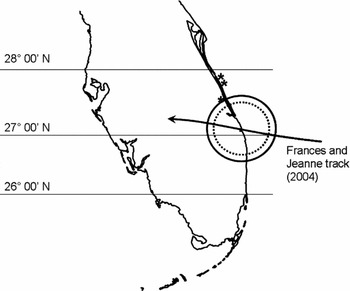
Insect visitors and their foraging behaviours were recorded in three hermaphrodite-only L. racemosa populations located on the eastern coast of Florida, USA (Figure 1; listed in geographic order from north to south, with abbreviations in parentheses): Sebastian Inlet State Recreation Area, Brevard County (SEB); Environmental Learning Center, Wabasso Island, Indian River County (WAB); Florida Atlantic University–Harbor Branch Oceanographic Institute, Ft. Pierce, St. Lucie County (HBR). Hurricanes Frances (Category 2) and Jeanne (Category 3) made landfall on the east Florida coast on 5 September and 26 September 2004, respectively (Bevin Reference BEVIN2004, Lawrence & Cobb Reference LAWRENCE and COBB2005). The two hurricanes followed similar tracks, and each was centred over the southern end of Hutchinson Island when it made landfall, 32 km south of HBR (Figure 1).
Map of Florida, USA, showing locations of communities, approximate hurricane tracks and approximate sizes of the hurricane eyes as they passed over the east coast of Florida. Communities (*), listed in geographic order from north to south: Sebastian Inlet State Recreation Area, Brevard County; Environmental Learning Center, Wabasso Island, Indian River County; Florida Atlantic University-Harbor Branch Oceanographic Institute, Ft. Pierce, St. Lucie County. Tracks of Hurricanes Frances and Jeanne are represented with a single solid line. Circles indicate the furthest extent of the eye-wall of each hurricane as it made landfall: Frances, solid-line circle; Jeanne, dotted-line circle. Hurricane data from NOAA National Hurricane Center Archives (Bevin Reference BEVIN2004, Lawrence & Cobb Reference LAWRENCE and COBB2005).

Insect assemblages
Insects were observed on 4–18 d during the time period 30 June–16 July in 2001–2003, 2005 and 2009, during the peak of the L. racemosa flowering season, when the species provided most of the floral resources available in the mangrove community. Observations were made on days when weather conditions were typical, with partly sunny to partly cloudy skies, light winds, and high temperatures 32–35 °C. Landry & Rathcke (Reference LANDRY and RATHCKE2012) reported pollinator assemblages and foraging behaviours in these L. racemosa populations in 2001–2003; in this paper, the published results were compared with data collected in the same manner after the hurricanes. During each time period, insect visitors were observed on 15–30 plants located along a single 1.0-km transect or two 0.5-km transects, depending on the population; each plant was at least 5 m from all other plants included in the study. A watch zone was established for each tree every day, and the number of open flowers in the watch zone was estimated so direct comparisons could be made between plants with different floral densities. Only insects that made physical contact with anthers and/or stigmas when probing flowers were considered potential pollinators and included in this analysis.
Species richness of the pollinator assemblages and the relative abundances of pollinator species visiting L. racemosa flowers in each community were compared to determine whether the pollinator assemblages were different following the hurricanes. The Shannon Diversity Index was used to compare pre- and post-hurricane pollinator diversity in each community. The relative abundances of pollinator species were used to estimate their importance to L. racemosa pollination. Insect vouchers were collected in 2001–2003 and identified by Mark O'Brien, Collections Manager, University of Michigan Museum of Zoology (UMMZ), Insect Division; voucher specimens are housed at the UMMZ. Foraging insects observed in 2005 and 2009 were identified in the field, based on specimens collected in 2001–2003 and photographs of voucher specimens.
Insect visitation rates
Insect visitors were observed during 10-min intervals between 9h00 and 17h00; the number of 10-min intervals varied from 27–36 in each population and year. Insect visitation rates were estimated for each interval, and average insect visitation rates were calculated for each year in each population. Two-way analysis of variance (ANOVA) was performed using Systat 12 to test for differences in insect visitation rates between populations and years.
Insect foraging bouts
An insect's within-plant foraging bout was defined as the total number of flowers that were probed by the insect on a single plant before the insect left that plant. The numbers of flowers probed by 1445 foraging insects were recorded. Using the method employed by Landry & Rathcke (Reference LANDRY and RATHCKE2012), the foraging-bout distributions were divided into four quartiles in order to isolate the smallest and largest foraging bouts, which are included in the first and fourth quartiles, respectively. Two-way ANOVA was used to test for differences in foraging-bout distributions between populations and years. One-way ANOVA was used to test for differences in the number of first and fourth quartile foraging bouts made to plants before and after the hurricanes.
RESULTS
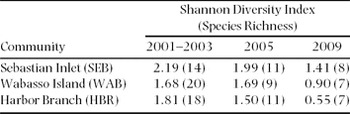
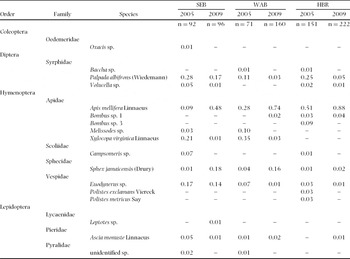
In all communities, the diversity of insect visitors to L. racemosa declined 36–70% in the 5 y after the hurricanes, and species richness was reduced 43–65% over the same time period (Table 1). Changes in the relative abundances of five species were important to L. racemosa in at least two communities following the hurricanes (Appendix 1), four hymenopterans (Apis mellifera Linnaeus and Xylocopa virginica Linnaeus (Apidae), Sphex jamaicensis (Drury) (Sphecidae), and a Euodynerus species (Vespidae)) and one dipteran (Palpada albifrons (Wiedemann) (Syrphidae)). The disappearances of a Melissodes species and a Bombus species (Apidae) also contributed to changes in relative abundance (Appendix 1). Diversity and species richness increased with distance from the storm centres (Table 1).
Laguncularia racemosa pollinator diversity estimates and the number of pollinator species observed (species richness) for all communities before and after Hurricanes Frances and Jeanne (2004). Data from Landry & Rathcke (Reference LANDRY and RATHCKE2012) used for 2001–2003 index values.

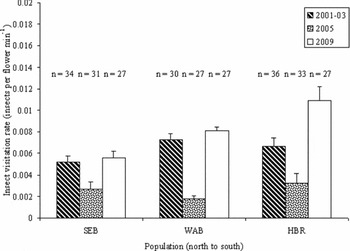
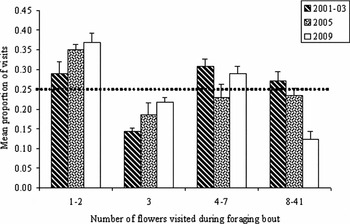
The rate of insect visitation to L. racemosa flowers declined significantly in 2005, but returned to pre-hurricane levels by 2009 (Figure 2; F-ratio = 50.6, df = 2, P < 0.001). Over time, the fraction of foraging bouts in the fourth quartile was reduced significantly (Figure 3; F-ratio = 11.7, df = 2, P = 0.008), but the reduction was greatest between 2005 and 2009. There was also a non-significant increase in the fraction of foraging bouts in the first quartile over time (Figure 3; F-ratio = 2.97, df = 2, P = 0.125).
Insect visitation rates in three Laguncularia racemosa populations affected by Hurricanes Frances and Jeanne (2004): Sebastian Inlet (SEB), Wabasso Island (WAB) and Harbor Branch (HBR). Overall, visitation rates declined significantly between 2001–2003 and 2005, and increased significantly between 2005 and 2009 (P < 0.001). 2001–2003 data from Landry & Rathcke (Reference LANDRY and RATHCKE2012). n = number of 10-min time intervals.

Mean proportion of floral visits made to plants in three Laguncularia racemosa populations during three time periods in each of four categories, representing four quartiles: insects that visited 1–2 flowers per foraging bout, 1st quartile; insects that visited 3 flowers, 2nd quartile; insects that visited 4–7 flowers, 3rd quartile; and insects that visited 8–41 flowers, 4th quartile. There was a significant decline in the frequency of 4th quartile foraging bouts (P = 0.008) and a non-significant increase in the frequency of 1st quartile foraging bouts (P = 0.125) following the hurricanes, which increased outcrossing frequencies. The dotted line represents the expected frequency of foraging bouts in each quartile if the distribution is even. 2001–2003 data from Landry & Rathcke (Reference LANDRY and RATHCKE2012). For each category and year, n = three populations.

DISCUSSION
Reductions in the diversity of pollinators visiting L. racemosa flowers and insect visitation rates observed in 2005 are likely a direct result of the hurricanes. Mature insects, in addition to eggs, larvae and pupae, could have been killed or carried away by high winds, rain or storm surge. The hurricanes would have stripped flowers as well as foliage from the plants (Smith et al. Reference SMITH, ANDERSON, BALENTINE, TILING, WARD and WHELAN2009), reducing floral resources and forcing survivors to leave the area. While HBR was closest to the storm centres, storm intensity does not explain why HBR suffered the greatest reduction in diversity. Maximum wind speeds experienced by these communities during Hurricane Frances declined with distance from the centre of the hurricane (Bevin Reference BEVIN2004). However, maximum wind speeds during Hurricane Jeanne were greater in the communities further away from the hurricane centre (Lawrence & Cobb Reference LAWRENCE and COBB2005). Diversity increased with distance from the mainland; despite fewer insect visitors to L. racemosa, the SEB assemblage remained the most diverse following the hurricanes. The SEB and WAB communities are located on islands surrounded by plant communities that could provide additional resources for recovering insect populations. The HBR community is smaller than the other communities, and is located on the mainland at Harbor Branch Oceanographic Institute, Florida Atlantic University campus. Human activity at HBR following the hurricanes, including clean-up of the grounds and repair work on buildings, may also be responsible for the decline in pollinator diversity at this location.
The mixed mating strategy observed in these populations allowed L. racemosa to maximize reproductive success in a stochastic environment with inconsistent pollination services between years. Floral production was typical in 2005, the year following the hurricanes, but significant reductions in floral visitation rates reduced outcrossing. Previous work demonstrated that there were no differences in fruit set or early survivorship of selfed and outcrossed progeny at WAB (Landry & Rathcke Reference LANDRY and RATHCKE2007), so autogamous self-pollination (Landry Reference LANDRY2005) provided reproductive assurance for L. racemosa when pollination services were limited. Insect visitation rates increased by 2009, but the foraging behaviours of the dominant species were different from those made before the hurricanes. In 2009, more pollinators made short foraging bouts, which increased the frequency of outcrossing, and fewer pollinators made long foraging bouts, which reduced the frequency of geitonogamous self-pollination (Snow et al. Reference SNOW, SPIRA, SIMPSON, KLIPS, Lloyd and Barrett1996).
The continued decline in species richness of pollinator assemblages in 2009 was not expected, and could be due to a number of factors. Since most of the 24 insect species observed before the hurricanes were infrequent visitors to L. racemosa flowers, it is possible that some of these species were present following the hurricanes, but not seen during observation times due to very low abundance. However, species-specific characteristics related to pollinator survivorship and recolonization rates could also be important in explaining changes in the pollinator assemblages visiting L. racemosa following the hurricanes.
Apis mellifera were the most common visitors in all communities before the hurricanes. By 2009 A. mellifera was clearly the dominant species, although their numbers declined in 2005, as was true for most species. The rapid recovery and increase in the number of A. mellifera individuals observed in these communities could be due to feral colonies escaping into natural areas from nearby citrus groves, which are pollinated by large numbers of commercial bees brought into the area (Bureau of Plant and Apiary Inspection 2008). The closer proximity of HBR to agricultural lands could be responsible for the larger increase in A. mellifera in this community. Apis mellifera is known to outcompete native pollinators for nectar and pollen resources and to reduce native bee fecundity (Goulson Reference GOULSON2003, Goulson & Sparrow Reference GOULSON and SPARROW2009, Paini & Roberts Reference PAINI and ROBERTS2005, Rivera-Marchand & Ackerman 2006, Thomson Reference THOMSON2004), so rapid growth of the A. mellifera population may have resulted in reduced resource availability for other pollinator species, slowing the recovery of their populations. In 2007, feral colonies of Africanized A. mellifera were documented in the region (http://www.ars.usda.gov/Research/docs.htm?docid=11059&page=6). Africanized colonies grow faster and swarm more frequently than European colonies because they are more focused on resource acquisition (Schneider et al. Reference SCHNEIDER, DEGRANDI-HOFFMAN and SMITH2004), which could have intensified the effect of competition on native pollinators.
Native species that increased in frequency following the hurricanes were able to take advantage of the disturbance. Xylocopa species are considered important pollinators in areas prone to disturbance because of their resourcefulness and flexibility in nesting and foraging behaviours (Rivera-Marchand & Ackerman Reference RIVERA-MARCHAND and ACKERMAN2006); they frequently use cavities in wood as nest chambers (Gerling & Hermann Reference GERLING and HERMANN1978), which are created when hurricanes damage mature trees and wooden structures. Increases in nesting habitat caused by flooding and damage to trees may also have resulted in the increased frequency of Palpada albifrons, since many species in the subfamily Eristalinae lay eggs in water associated with decaying wood (Maier Reference MAIER1982, Reference MAIER1987). Human activities such as clearing dead trees and repairing buildings during the years following the hurricanes could have reduced nesting sites for Xylocopa and Palpada by 2009, when they were less frequent. In addition, increased availability of prey species could have been responsible for the rapid recovery of Sphex jamaicensis and the Euodynerus species. These wasp species have flexible nesting requirements and prey on herbivorous orthopterans (Genaro Reference GENARO1998) and lepidopteran larvae (Krombein et al. Reference KROMBEIN, HURD, SMITH and BURKE1979), respectively. Herbivore populations can increase in years following hurricanes if the species can take advantage of the flush of new leaves (Schowalter Reference SCHOWALTER1994, Torres Reference TORRES1992), although herbivore populations can also decline immediately following disturbance (Koptur et al. Reference KOPTUR, RODRIGUEZ, OBERBAURER, WEEKLEY and HERNDON2002).
Native species that have not been observed since the hurricanes could have had low survivorship or may have limited dispersal ability. For example, apid Melissodes and Bombus species are groundnesters that use wax in the construction of their nest cells (Cameron et al. Reference CAMERON, WHITFIELD, HULSLANDER, CRESKO, ISENBERG and KING1996, Michener Reference MICHENER1974). Waxes may provide protection from saturated soils under normal conditions (Cane Reference CANE1997), but may not have been sufficient protection from the hurricane-associated storm surge and subsequent flooding. Native species might recover given enough time, as long as they are able to obtain the resources they need in a community dominated by A. mellifera.
ACKNOWLEDGEMENTS
This work was performed with permission from: Harbor Branch Oceanographic Institute – Florida Atlantic University, Ft. Pierce, Florida; Environmental Learning Center, Vero Beach, Florida; and Florida Department of Environmental Protection, Division of Recreation and Parks, District 3 (Permit No. 06-03-02-2, Sebastian Inlet State Park). Special thanks to Nancy B. Elliott, Siena College (retired), and Beverly J. Rathcke, University of Michigan (deceased), for discussions concerning insect behaviours and comments that improved this manuscript; Mark O'Brien, Collections Manager for the University of Michigan Museum of Zoology – Insect Division, for insect identifications; and Mark Kaufmann for assistance with field observations.
Frequency of insects visiting Laguncularia racemosa flowers in three populations following Hurricanes Frances and Jeanne: Sebastian Inlet (SEB), Wabasso Island (WAB) and Harbor Branch (HBR). n = number of insect visitors.