On 21 September 1768, two Algerian cruisers returned to port with a Genoese prize carrying a company of 150 Spanish soldiers in transit to Barcelona. This vessel, the St. Antonio, sailed under British colors and under the command of a Gibraltarian named Nicholas Traverso, who possessed a British Mediterranean pass.Footnote 1 Britain's treaties with Algiers specified that corsairs were not to molest or capture vessels carrying British passes, but North Africans were well aware that Genoese merchants and shipowners frequently sailed under the cover of these instruments. Algerian officials turned to the resident British consul, James Fraser, to determine whether the vessel had a valid claim to British protection. On inspecting the pass, Fraser found that it was clearly fraudulent: the name of the captain to whom the pass had originally been issued had been erased and replaced with that of a Genoese inhabitant of Gibraltar, Francis Dodero, who, in turn, had given the pass to Traverso.Footnote 2 Although Fraser felt “[w]hat a Christian ought to Feel at a Scene of Distress,” he refused to “[c]ountenance a sort of Villany which descredited His Majesty's Passes & Robbs the Subject of their Bread.” After securing Traverso and the other British subjects who had been on board the St. Antonio, he allowed the vessel to be condemned and its foreign passengers enslaved “as an Example to others” and a demonstration to the Algerians of his credibility in distinguishing legitimately British vessels from those that sought to pass as such.
From the end of the seventeenth century to the beginning of the nineteenth, the security of British ships in the corsair-infested waters of the Mediterranean and eastern Atlantic rested on Mediterranean passes.Footnote 3 Corsairs were seafarers commissioned by North African and Southern European rulers to seize enemies’ ships, subjects, and property and who were engaged in a perennial naval war, the corso, that had its ideological roots in the contest between Christianity and Islam and was an essential part of early modern Mediterranean commercial and maritime life. Although frequently derided then and now as indiscriminate pirates, corsairs were expected to observe the distinction between the polities with which their sponsoring governments were at war and those with which they were in a state of peace.Footnote 4 Mediterranean passes were printed sheets of indented parchment certifying that a vessel was owned and manned by British subjects and thus fell under the protection of Britain's treaties with the regencies of Algiers, Tunis, Tripoli, and the empire of Morocco.Footnote 5 They formed the basis for an interstate legal and regulatory regime that arose from a process of negotiation and treaty making.Footnote 6 By providing a mechanism to identify British vessels at sea and to limit the protection of Britain's treaties to them, the Mediterranean pass served to balance the free navigation of British vessels with the right of corsairs to seek out the ships of their enemies. In this respect, the pass regime took on a legally pluralistic quality. Instances like that of the St. Antonio turned on the relationship between the jurisdiction of North African officials over prize cases and the protective quality of the pass. As a result, the operation of the regime depended on the respective authority of the North African and British governments. The North Africans expected the British to regulate the use of passes carefully while the British relied on the general threat of corsairs to enhance the competitiveness of British navigation.
Yet, by establishing the pass as the key means for determining whether a vessel was to enjoy security from corsairs, Britain's treaties with the North African powers also made possible a transformation of the pass system. In the case of the St. Antonio, the condemnation of the vessel depended on Fraser's willingness to acknowledge the fraudulent nature of the vessel's pass. Indeed, British officials particularly hoped that the condemnation of the ship would discourage Genoese merchants from attempting to use British passes in the future since their own efforts to make a “severe example” of Traverso and Dodero failed.Footnote 7 Yet, even as Fraser sought to teach foreigners using British passes a lesson, he allowed the St. Antonio and its passengers to be condemned only after he first rendered a judgment on Traverso's right to his pass “as a Free Man Subject to his Jurisdiction only, till Convicted by … the King's Officer on the Spot.”Footnote 8 In theory, the pass was intended only to prove that the vessel carrying it was genuinely British. In practice, treaty terms that required corsairs to respect British passes gradually extended the protection of those articles to any vessel with a pass.
During the eighteenth century, the Mediterranean pass evolved from a document of identification into an instrument of protection. Within the insecure world of the early modern Mediterranean, “the search for protection” was at the center of the practice and organization of trade.Footnote 9 The abuse of British passes was widespread as foreigners engaged in fraudulent practices to obtain them. More importantly, from the early eighteenth century onwards, merchants and mariners from around the Mediterranean, but especially from Genoa, moved to Britain's new colonies at Gibraltar and Minorca in order to gain access to British passes. These outposts formed an embryonic British Mediterranean Empire and confronted British governors and officials with garrisons in need of supply and with populations of non-British subjects.Footnote 10 In order to encourage the provisioning of Gibraltar and Minorca and their commercial development, the governors of those colonies provided passes freely to short-term residents and vessels that were foreign owned. Meanwhile, the growth of British naval power in the latter half of the eighteenth century allowed British consuls to establish the protective quality of passes even for vessels that were not legitimately British. The liberal distribution of passes and the security they provided for their bearers established a regime of protection that incorporated a diverse range of Mediterranean subjects and protégés under the umbrella of the pass system.
This article examines how the interactions of British consuls and imperial officials with mariners and merchants from around the Mediterranean transformed the pass system from an interstate regime of identification into one of imperial protection that sustained Britain's fledgling Mediterranean outposts in the eighteenth century and helped to make possible the dramatic expansion of the British Empire into the Mediterranean at the beginning of the nineteenth century. By securing British ships from attacks by North African corsairs, passes promoted the expansion of British navigation and trade well into the eighteenth century. The conception of the pass system as a means to organize British navigation along “national” lines endured, manifesting in regular complaints from consuls and merchants about the abuse of passes. Yet the development of a British Mediterranean empire, first with the acquisition of Gibraltar and Minorca and then, during the French Revolutionary and Napoleonic Wars, the short-lived occupations of Corsica and Sicily, and the conquest of Malta and the Ionian Islands overrode the original purpose of the pass system. The transformation of the Mediterranean pass into an instrument of protection both reflected the growth of British imperial power and underscored Britain's reliance on Mediterranean merchants and mariners to sustain that imperial presence.
The history of the pass system demonstrates the wider importance of treaties and interstate legal and regulatory regimes in the development of the British and European empires.Footnote 11 By the mid-nineteenth century, it had become unimaginable that treaties with the North African regencies should have compelled British vessels to carry passes.Footnote 12 Indeed, for Victorian scholars, Mediterranean passes were indicative of a shameful complicity with the “Barbary pirates,” as Britain and other European powers condoned the activity of corsairs in order to hamper the navigation of their rivals.Footnote 13 Conversely, for some contemporary scholars, England's mid- seventeenth-century treaties with the regencies marked the beginning of European dominance over North Africa.Footnote 14 These views exaggerate, however, European military superiority in the seventeenth century. In creating a system of passes to promote the identification of ships at sea, treaties with the regencies created a legal and regulatory regime that promoted British navigation but revealed the ability of the North African powers to shape the terms under which British vessels sailed in Mediterranean and Southern European waters. Around the early modern world, such agreements and understandings with extra-European peoples and polities proved central to the construction of European state and imperial authority overseas.Footnote 15 As the balance of power between Britain and North Africa shifted across the eighteenth century, treaties and passes provided a legal foundation for the extension of British protection and facilitated the emergence of Britain's Mediterranean empire.
This article traces the history of the British Mediterranean pass system from its seventeenth-century origins to its role in the expansion of Britain's Mediterranean empire in the early nineteenth century. It begins by exploring the emergence of the pass as a means to identify English vessels out of mid-seventeenth-century treaty-making with the North African regencies. The second section moves into the eighteenth century and addresses the difficulties that surrounded efforts to confine passes to legitimate British vessels. As foreign merchants and shipowners found myriad ways to obtain the protection of British passes, instruments originally intended to identify British vessels increasingly complicated the “national” organization of British navigation. This discussion of the misuse of passes leads into the third section, which examines the incorporative impact of the pass system by revealing how the distribution of passes to foreign mariners and merchants at Britain's colonies of Gibraltar and Minorca brought ostensibly foreign ships under the protection of the pass. The final section describes how the provision of passes to Mediterranean merchants and mariners, together with the expansion of British naval power in the latter half of the eighteenth century, transformed the pass from a tool of identification into an instrument of protection as consuls and ministers insisted on and, to a large degree, successfully enforced the inviolability of the Mediterranean pass, even when carried by vessels that were not legally entitled to them.
I. NORTH AFRICAN TREATIES AND THE BIRTH OF THE MEDITERRANEAN PASS
The British Mediterranean pass system evolved out of treaties the English Crown entered into with the North African powers during the third quarter of the seventeenth century in order to secure its subjects’ shipping and commerce from the effects of the corso. These treaties were the product of the development of English naval and maritime power as the threat of increasingly powerful and capable English fleets induced the North African governments to agree to refrain from interfering with English navigation. Yet they also revealed the ability of the North Africans to shape the organization of English navigation around the sea. Much as trade was increasingly vital to English state- and empire-building, the corso was ideologically and fiscally central to the seventeenth-century North African regencies. Treaties accordingly at once secured English ships from the threat of corsairs and defined the specific conditions under which a ship was to be deemed English and thus eligible for treaty protection. North African pressure was, moreover, instrumental in establishing the pass as the primary means to identify English vessels in Mediterranean and Southern European waters. As a means to prevent foreign vessels from enjoying the benefits of England's treaties with the regencies, the pass initially mediated between the practices of North African corsairs and the growth of English navigation and thus also between North African and English naval power.
As a document of identification and an instrument of maritime politics, the Mediterranean pass rested on well-established foundations. Although studies of the passport as a tool of state building and imperial regulation overwhelmingly focus on the nineteenth century, various forms of pass and passport had long been in use both to identify ships and travelers and to regulate their movements.Footnote 16 Medieval rulers granted safe-conducts to merchants and travelers both in Europe and Asia; the practice of granting written licenses and identifying documents to vessels dates at least to the fourteenth century.Footnote 17 Seventeenth-century marine treaties among European states subsequently established passports as a primary tool for identifying ships at sea; European overseas expansion further encouraged the proliferation of maritime passports. Around the Indian Ocean, the Estado da India and European trading companies issued cartazes or shipping passes, which specified that the vessels carrying them belonged to their settlements or sailed under their protection or license.Footnote 18 Meanwhile, from the early seventeenth century, Dutch agreements with the North African powers called for corsairs to identify Dutch vessels on the basis of the passports customarily given them by their provincial governments.Footnote 19
The growth of English and Northern European naval power from the middle of the seventeenth century made the pass an essential feature of Mediterranean maritime organization and a tool of commercial competition. Fernand Braudel famously described the entry of English and Dutch vessels into the Mediterranean at the end of the sixteenth century as a “Northern Invasion,” yet these vessels relied on firepower and obfuscation for their security rather than on state protection.Footnote 20 Even when England was at peace with the North African powers in the first half of the seventeenth century, English vessels were liable to be searched by corsairs for enemy passengers and goods. It was only in the wake of the British Civil Wars that the English state developed the fiscal resources and military strength to confront North African corsairs successfully, when first Cromwell and then Charles II marshaled England's newfound naval power to secure the safety of English vessels and their immunity from interference by corsairs.Footnote 21 Unsurprisingly, North African rulers initially resisted such demands: if Italian, Spanish, and Portuguese merchants could protect their property and persons by freighting English vessels, English navigation would thrive and corsairs would be left without prey.Footnote 22 Yet, through the threat and use of military force, English admirals in 1662 negotiated treaties with the North African regencies that exempted English vessels from search and secured the safety of the passengers and cargo they carried. These treaties established that vessels were to be considered English either if the majority of the crew was English or if they carried a pass issued by the Lord High Admiral. They also gave rise to the first passes specially designed to identify vessels to North African corsairs and thus provided for the development of a distinct Mediterranean pass system.Footnote 23 French admirals entered into treaties with the North African regencies that established a French pass regime soon after the English.Footnote 24
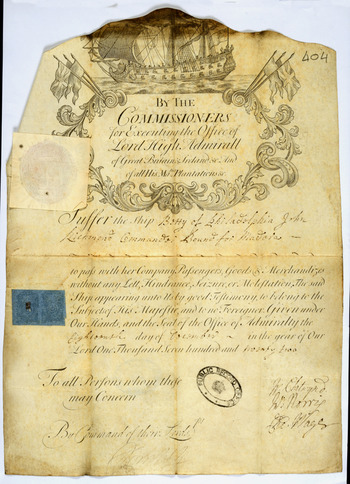
The introduction of Mediterranean passes was part of a wider seventeenth-century process of negotiation and treaty making whereby naval powers established interstate legal regimes for the regulation of maritime violence during a period of growing oceanic commerce and competition.Footnote 25 In the years immediately prior to England's treaties of 1662, the Treaty of the Pyrenees of 1659 between France and Spain and the Treaty of Whitehall of 1661 between England and Denmark called on their parties to issue passports to their subjects’ ships in order to facilitate identification at sea. Even within the early modern proliferation of maritime passports, though, Mediterranean passes were a “peculiar description of protection.”Footnote 26 In the summer of 1662, William Coventry, secretary to the Admiralty, asked the members of Trinity House, the corporate body responsible for overseeing English navigation, to devise a means to ensure that only English vessels would be able to enjoy the protection of England's new treaties with the North African powers. In response, they proposed the introduction of passes modeled on the indenture contract, whereby the pass would be cut in two by means of a uniform, scalloped incision (see Figure 1).Footnote 27 Examples of the top portion of the pass, or “countertop,” were issued to the captains of North African cruisers by the resident British consuls, allowing corsairs who could not necessarily understand European languages to verify whether the pass a ship carried was valid by simply confirming whether the two parts matched. In drawing on the physical model of the ubiquitous indenture, this approach married an English legal form intended to ensure a document's authenticity to the maritime practices of North African corsairs to create a regulatory order through which the English Crown identified and secured the navigation of its subjects at the expense of commercial rivals.Footnote 28
Mediterranean pass for the Betty of Philadelphia from December 1722. Notice the scalloped incision at the top of the pass. The inscription on the pass requests the reader to “Suffer the ship Betty of Philadelphia John Richmond Commander Bound for Madera to pass with her company, Passengers, Goods and merchandizes, without any loss, hindrance, seizure or molestation; The said ship appearing unto me by good testimony to belong to the Subjects of our Soveraign Lord the King and to no Foreigner.” TNA, ADM 1/3825. © The National Archives, London.

The growth of Northern European naval power in the latter half of the seventeenth century fundamentally transformed the Mediterranean maritime world and the political context in which corsairs operated. When England and France secured their subjects’ vessels from interference by corsairs, these maritime powers overturned the well-established Mediterranean maritime custom of allowing corsairs and privateers to search neutral vessels for enemy goods and passengers and established a privileged position for their subjects’ navigation.Footnote 29 Yet, although observers praised the admirals dispatched against the North Africans who “rather brought them to submission than capitulation,” the relationship between England and the North African powers was never as one-sided as such exultations would suggest.Footnote 30 Naval wars against the regencies were expensive and often counterproductive, as they left English ships vulnerable to attack while inflicting relatively little damage on North African fleets or cities. Meanwhile, the North African governments continued to try to set the terms of their relationship with England. In 1663, the government of Algiers informed the English government that it intended to seize foreign cargo from English vessels that sailed without passes.Footnote 31 Further naval expeditions led the Algerian government to agree again to the terms of the 1662 treaty that established crew composition, as well as possession of a pass, as evidence that a ship was to be considered English. Yet rival interpretations of treaty articles and difficulties determining the actual provenance of particular vessels led to regular outbreaks of violence between England and the regencies, culminating in a long and costly war with Algiers two decades later.Footnote 32 Although England enjoyed notable military successes, especially against Tripoli, these conflicts illustrated its inability to impose lasting terms on either Morocco or Algiers.Footnote 33
The conclusion to the Anglo-Algerian war of 1677–82 underscores the drawn-out process of both conflict and negotiation that established the conditions under which English vessels would enjoy protection from North African corsairs. This conflict stemmed largely from Algerian frustration at the ease with which foreign vessels passed as English by hiring English captains and crewmembers and ultimately cost the English hundreds of captured ships and thousands of enslaved mariners, weighing heavily both on English trade and on a straitened royal treasury.Footnote 34 The treaty that finally ended the conflict affirmed the right of English vessels to carry foreign goods and passengers unmolested. It also, however, conceded the Algerians’ long-standing insistence that only vessels bearing passes enjoy treaty protection and eliminated the provision that vessels with a majority English crew were to sail freely, which had tended to lead to fraud and confusion.Footnote 35 It thus established the Admiralty pass as the key instrument for identifying English ships at sea by obliging corsairs to allow merchant vessels belonging to subjects of the English monarch to sail upon their “producing a passe under the hand and seal” of the king or Lord High Admiral of England and Ireland or of Scotland.Footnote 36 This condition, moreover, complemented the position of English ministers and officials who sought greater Crown supervision over English trade and navigation. Admiral Arthur Herbert responded to long-standing merchant criticism of passes as an undue burden on trade by emphasizing that the requirement that English vessels carry passes was “an honour to the office of Lord High Admiral,” which would allow the Crown to foster English navigation by restricting the protection of its treaties to legitimately English ships.Footnote 37
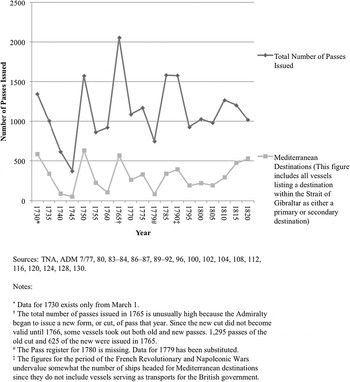
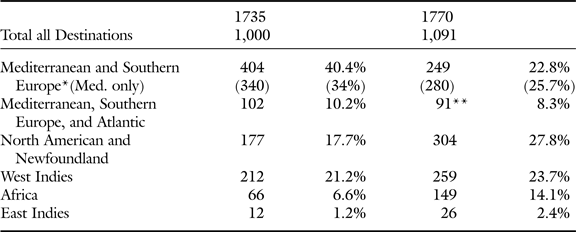
By making the Mediterranean pass the basis for securing English vessels from the threat of Algerian corsairs, the treaty of 1682 established those instruments as an essential and central feature of British navigation. The Admiralty issued 789 Mediterranean passes in 1683, more than it had for the entire 1660s, and 1,002 the year following.Footnote 38 Although the distribution of passes fluctuated sharply between years of peace and years of war in the eighteenth century, an average of 1,200 passes were issued annually from 1730 until 1819 (see Graph 1).Footnote 39 The limited growth of the pass system during a century when the British merchant fleet quadrupled in size reflected the relatively stagnant nature of British Mediterranean trade across the century. Nevertheless, the pass system expanded geographically even if it remained bounded numerically.Footnote 40 As consuls observed, the terms “Mediterranean pass” or “Straits pass” were both misleading labels, since corsairs sailed far out into the Atlantic in search of prizes.Footnote 41 Mediterranean passes consequently became a ubiquitous feature of eighteenth-century British navigation. Ships sailing from Britain to Africa, to the American colonies, and to the East Indies voyaged through waters cruised by corsairs and regularly took out Mediterranean passes. Indeed, with the growth of the Atlantic economy, vessels destined for the Caribbean or North America constituted an increasingly large percentage of the vessels carrying them (see Table 1). Southern Europe, meanwhile, constituted a primary market for the American fisheries.Footnote 42 From the mid-1690s, the Admiralty also dispatched passes to colonial governors in the American plantations. By the mid-eighteenth century, about two hundred additional passes were granted annually to vessels sailing out of Britain's North American and Mediterranean colonies.Footnote 43
Mediterranean Passes Issued in Britain, 1730–1820

Destinations Given for Mediterranean Passes Issued in 1735 and 1770
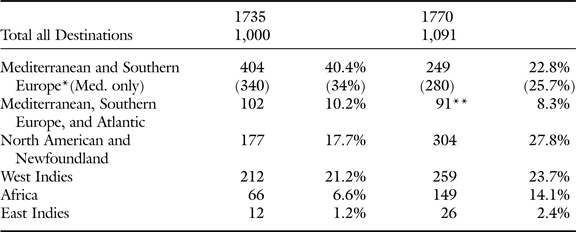
Sources: TNA, ADM 7/80, 96.
Notes:
* Mediterranean here refers to all destinations within the Strait of Gibraltar, while Southern Europe applies to Iberian destinations outside the Strait.
** This figure understates the number of ships whose voyages took them both into the Western Atlantic and Mediterranean, as fifty-seven vessels were listed as bound for “Newfoundland” or “Newfoundland & Trading Voyage.” It is probable that many, if not most, of these vessels ultimately sailed to Southern European or Mediterranean ports, the principal destinations for cargoes of fish from Newfoundland.
The Mediterranean pass regime constituted an expansive regulatory sphere that centered on the Western Mediterranean but extended into the Atlantic; it demonstrates the interlocking and overlapping nature of the Atlantic and Mediterranean maritime spheres.Footnote 44 The significance of this system lay primarily in the advantages it provided to British trade in Southern Europe. The late seventeenth century and the first half of the eighteenth was a period of relative decline for the once flourishing British Levantine trade as French competition grew and British attention and capital shifted towards the Atlantic and Indian Oceans.Footnote 45 Conversely, during this same period, British navigation thrived in the competitive carrying trades of the western Mediterranean; the number of British vessels entering the Tuscan entrepôt of Livorno more than tripled, while the members of the British factory at Lisbon would later recall that British ships had been “the Carriers of all the Merchandize of the Mediterranean to this Port [Lisbon].”Footnote 46 This expansion of British trade and navigation in the western Mediterranean rested largely on the wider development of Britain's Atlantic economy, but contemporary observers had no doubt that the protection of passes gave British vessels in the western Mediterranean a decided advantage over Southern European and Baltic competitors.Footnote 47
II. BRITISH PASSES AND FOREIGN SHIPS
The pass system was integral to the broader “nationalization of oceanic space” that characterized British maritime expansion from the end of the seventeenth century.Footnote 48 Yet pass regulations reflected an official desire to restrict the protection of Britain's treaties to its subjects that did not correspond to the nebulous and multinational environment of the early modern Mediterranean.Footnote 49 Lauren Benton's description of the Indian Ocean cartaz system is equally appropriate for the system of Mediterranean passes, insofar as both “provided only a loose set of rules for much more complex and layered arrangements.”Footnote 50 For example, foreigners regularly found protection within the British pass system by taking up residence in the British colonies of Gibraltar or Minorca, or by enlisting the aid of British merchants and captains. As a result, passes undermined and complicated the national organization of British navigation even as they served to define and demarcate what officially constituted it.
Through the eighteenth century, the pass system provided an institutional and legal framework for the regulation of British navigation. In response to widespread consular reports of passes falling into the hand of foreigners, and at the behest of the Board of Admiralty, the Privy Council in June 1722 prescribed measures to strengthen existing rules for the distribution and supervision of passes.Footnote 51 Like earlier regulations for the provision of passes, this order specified that passes were to be limited to ships built in Britain or in British dominions and whose owners and masters were natural-born subjects or naturalized foreign Protestants and had posted a bond for the return of the pass within twelve months or upon completing their voyage.Footnote 52 More importantly, the Privy Council expanded the role of consuls and colonial officials in the administration of the pass system by ordering them to endorse the passes of vessels that entered port by recording the date of the ship's arrival on the back of the pass. It also directed consuls and other officials to seize passes from vessels that did not appear to have a valid claim to them.
The national organization of navigation in the Mediterranean proved, however, an elusive goal. Around the Mediterranean, multinational crews, itinerant merchants, and cross-national partnerships complicated efforts to organize trade along national lines; merchants and ship-owners went to great lengths to shelter their property under the protection of neutral flags and passes.Footnote 53 Although the corso declined in the eighteenth century from its earlier heights in the face of growing European naval power and the increasing profits of peaceful trade, North African cruisers still captured dozens of vessels a year.Footnote 54 Since the “[e]nmities subsisting between the opposite Inhabitants of those Seas make it dangerous for Either to coast even their own Shores,” it was, according to Nathaniel Ware, a British consul at Malaga, “[n]o wonder … that so many, even Strangers to our very Language, affect to shelter themselves under that Protection, by which they are enabled to share with us the navigation of those Seas, which otherwise must necessarily be all in our own Hands.”Footnote 55 Consuls in Southern European and Mediterranean ports regularly reported to the Admiralty secretaries responsible for overseeing the pass system on the number of foreign captains and merchants who obtained British passes, “by false oaths, and Clandestine means.”Footnote 56 The system of bonds put in place for the return of passes proved, moreover, only partially effective as passes could be sold in Mediterranean ports for more than the value of the bond.Footnote 57
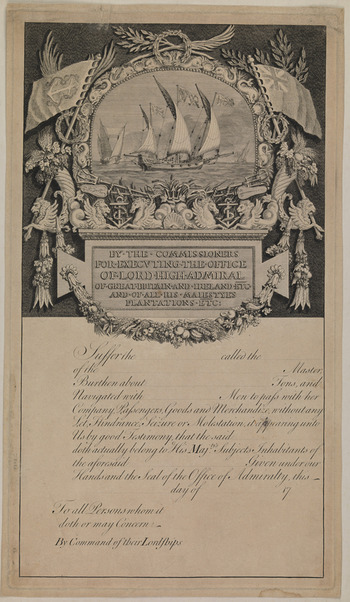
The extension of the British Empire into the Mediterranean created further opportunities for foreign captains and merchants to gain access to British passes. Following the acquisition of Gibraltar and Minorca during the War of the Spanish Succession, Britain negotiated provisions in its treaties with the North African powers confirming that the inhabitants of those Mediterranean colonies would be “looked upon as his Majesty's natural subjects” and thus receive the protection of those treaties. In recognition of the largely Catholic civilian populations of the outposts and the small number of sailors available in them, the Crown exempted them both from the general requirements that passes be granted only to “natural born subjects or naturalized Protestants” and that three-fourths of the crew be composed of British subjects. As a result of the modified regulations for passes granted at Gibraltar and Minorca, these instruments, renewable annually, were distinguished by a unique design that led to them being called “settee passes,” after the type of lateen sailing vessel featured on them (see Figure 2).Footnote 58
A blank “settee pass,” ca. 1750. In contrast with the square-rigged ship depicted on the regular Mediterranean pass, this pass shows a lateen-rigged vessel characteristic of the small merchant vessels used by merchants at Gibraltar and Minorca. This design distinguished the passes granted at those colonies from regular passes since a different set of regulations governed the conditions of their use. National Maritime Museum, AML/V/15. © National Maritime Museum, Greenwich, London.

The acquisition of Gibraltar and Minorca substantially complicated the regulation of passes by expanding the definition of what constituted a “British” vessel. Although the English occupation of Tangier between 1661 and 1684 had brought Spanish and Italian sailors and traders living in that city under the protection of England's treaties, that colony was too short-lived and its civilian population too small to significantly impact the emergence of the pass regime.Footnote 59 Conversely, foreign merchants and mariners flocked to Gibraltar where they played a vital role in supplying and maintaining the British garrison and contributed to the tripling of Gibraltar's civilian population from 1,113 to 3,201 in the half-century between 1725 and 1777.Footnote 60 With regards to the pass system, the most important of these new arrivals were the Genoese, who were notorious for the ease with which they moved between flags.Footnote 61 Although the Genoese government made some halfhearted efforts to rein in the practice, the republic's ministers admitted that their subjects’ trade and navigation depended on the protection of the passes of the great powers at peace with the North African regencies.Footnote 62 Genoese officials reported how merchants and shipowners regularly made false sales of their vessels to British and French subjects either in consular chanceries or at Marseilles or Gibraltar, allowing the feigned proprietor to obtain a pass even as real ownership of the vessel remained in Genoese hands.Footnote 63 Foreign shipowners further hired British subjects and inhabitants of the Mediterranean garrisons as “captains of the colors” (capitani di bandiera), who used their subject status to obtain passes to cover foreign vessels.Footnote 64 It was often nearly impossible to determine the actual provenance of vessels sailing out of Gibraltar or Minorca behind layers of such commercial obfuscation, leading consul George Jackson at Genoa to lament in early 1739, “how difficult it is to come at a thorough proof of such underhand transactions, those who are guilty of them using all possible methods to cover the fraud.”Footnote 65 Jackson learned that one vessel bearing a pass issued at Gibraltar was foreign owned only when a dispute over ownership of the ship broke out among Genoese merchants who then turned to him to resolve the case.
Meanwhile, the regulation of passes in foreign ports rested on uncertain foundations. Although their responsibilities in the supervision of passes underscored the gradual transformation of consuls into agents of the state, eighteenth-century British consuls were not public ministers but rather the representatives of British merchant communities in foreign ports.Footnote 66 They were generally well-established merchants whose main responsibility lay in serving as an intermediary between British merchants, mariners, and other subjects and local state and legal officials. They lacked the authority, moreover, to compel merchants or captains to adhere to pass regulations. Consuls in Southern European ports possessed no legal jurisdiction over their fellow subjects through which to force captains to turn over their passes for inspection and they had no power to compel the captains of foreign ships to relinquish British passes they carried.Footnote 67 Instead, the Order in Council of 1722 directed them to turn to local officials for assistance in recovering passes and to local courts to bring suits against vessels that carried them illicitly.Footnote 68 Although officials helped consuls to reclaim passes in some ports, captains seeking to avoid consular inspection found assistance and protection from governors in others.Footnote 69
Vessels could, moreover, avoid British consular oversight altogether by simply entering port under a different flag. One British consul at Cartagena complained of how vessels that sailed with British passes often entered port under other colors in order to avoid inspection: “The Mediterranean Sea swarms with Vessells under English Collours and with Passes to Protect them from the Barbary Cruizers, but few of those Passes taken at Minorca and Gibraltar ever appears in Port where there is a Consul except they want him, as will appear by the Endorsements on those Passes after they have had them several years.”Footnote 70 Confiscated passes returned to the Admiralty confirm the ability of foreign vessels to sail with them for years unmolested by either corsairs or British officials. In 1765, the British consul at Livorno, John Dick, seized a pass issued ten years earlier to the Success of Dublin from a Genoese vessel. The pass carried only a single endorsement from after 1755 and that in the name of yet another vessel.Footnote 71
Mediterranean merchants, mariners, and shipowners frequently enjoyed British assistance as they subverted the regulatory features of the pass system. Consular agents collected consulage, a fee for consular services, from vessels sailing under the British flag and thus had good reason to overlook the misuse of passes; the locally hired vice-consuls who handled day-to-day matters for consuls and substituted for them in less important ports were often happy to countenance the use of passes by their countrymen and by vessels that were not technically entitled to them.Footnote 72 Meanwhile, whether because they feared undermining North African confidence in the pass system by acknowledging fraudulent use of these instruments or because they were reluctant to allow fellow Christians to be enslaved, British consuls in North African ports defended vessels and crews whose claim to the protection of British passes was tenuous at best.Footnote 73 After an Algerian cruiser sank a vessel sailing with a Gibraltar pass, consul Charles Black sought in vain for the release of the surviving crew members while acknowledging that the corsairs were probably correct in their belief that the vessel and crew were actually Genoese.Footnote 74 Such tacit complicity in the abuse of passes at once undermined the advantages of British navigation with respect to foreign competitors and encouraged the development of Britain's outposts at Gibraltar and Minorca by drawing foreign merchants, mariners, and captains to them. Although the abuse of French and, later, Austrian Mediterranean passes was equally common, it was the importance of foreigners to Britain's Mediterranean colonies that endowed the foreign use of British passes with particular significance.
III. GIBRALTAR, MINORCA, AND THE PASS SYSTEM
Through the first half of the eighteenth century, the abuse of Mediterranean passes was pervasive and partially institutionalized. The result was a more complex relationship between the regulation and use of passes than that suggested by the term “fraud.”Footnote 75 Although consular agents and officials in Gibraltar and Minorca both enforced and circumvented pass regulations, different contexts encouraged divergent approaches to the supervision of passes. In Gibraltar and Minorca, governors, garrison commanders, and their secretaries confronted a growing range of Mediterranean merchants and shipowners who sought passes on the basis of their residence in those outposts.Footnote 76 These officials were well aware that the commercial development of the colonies and, more importantly, the supply of the garrisons and civilian populations depended on such inhabitants, yet, these same individuals were deemed “foreign” by consuls who represented British merchant communities facing competition from Mediterranean merchants sailing under British passes.
Among observers around the Mediterranean and ministers in London, concern over the abuse of passes grew as British navigation in the Mediterranean underwent a notable decline in the second half of the eighteenth century. Although the total quantity of passes granted remained constant, the number of ships that listed Mediterranean destinations in their requests for passes dropped from an annual peacetime average of nearly 440 in the 1730s to about 330 in the 1760s (see Table 1).Footnote 77 Two decades of nearly constant warfare during the mid-eighteenth century undermined the security and stability of British navigation in the Mediterranean at the same time that British merchants found new opportunities around the Atlantic and Indian Oceans. Moreover, new competition arose as Scandinavian and Southern European states began to enter into peace treaties with the North African powers.Footnote 78 Many contemporary explanations for the decline of British Mediterranean navigation focused, however, on the ability of foreign vessels carrying British passes to engross Britain's share of intra-Mediterranean trade. In 1769, Admiral Richard Spry compiled a list of more than forty captains who navigated foreign vessels with British passes, while Genoese observers a year later noted a similar number of Genoese vessels sailing under the British flag at a single Ligurian port.Footnote 79 Although it is impossible to ascertain the precise number of British passes covering foreign vessels, one navy captain estimated that as much as a third of the trade conducted under British colors in the Mediterranean was actually carried out by Italians and other foreigners.Footnote 80
Over the course of the eighteenth century, foreign captains and merchants found ready access to protection in Britain's Mediterranean outposts. Observers blamed the distribution of passes to foreigners at Gibraltar and Minorca for the wider decline of British Mediterranean trade. Members of the British factory at Livorno complained of “the number of Vessells and small Craft with English Colours and Mediterranean Passes, which have been procured by Indirect means, from Mahone, and Gibraltar, when at the same time they are the property of Genoese, and Spaniards, who under the Protection of the British Flag, hurt our Navigation.”Footnote 81 The impact of the distribution of passes at Gibraltar and Minorca was, however, less than the complaints of merchants and officials would suggest. Although the combined number of passes granted annually at Gibraltar and Minorca increased from about sixty to over eighty between the 1730s and 1770s, the latter figure could account for only part of the wider decline in British Mediterranean navigation.
More importantly, the distribution of passes at Gibraltar and Minorca rested on and complicated the reciprocal relationship between subject status and sovereign protection. Although case law restricted subject status to natural-born subjects and to those who obtained formal naturalization, Admiralty and imperial practice regularly deviated from this legal standard. Instead, Admiralty courts focused on place of residency rather than place of birth to determine the subject status of merchants and shipowners with respect to the validity of prizes, and imperial administrators recognized the inhabitants of conquered territories as subjects.Footnote 82 According to Admiralty secretaries, individuals were eligible for passes at Gibraltar so long as they were “bona fide, Inhabitants of that Garrison, who by their being so, are deemed his Majestys Subjects.”Footnote 83 By taking up residence in Britain's Mediterranean colonies, foreign captains and merchants established a claim to be regarded as British subjects eligible for the protection of passes.Footnote 84
Liberal interpretations on the part of governors and officials at Gibraltar and Minorca of what constituted a “bona fide” inhabitant, one who might be considered a British subject, reflected the diverse populations of those colonies and their reliance on foreign merchants and mariners for provisions. They were also, however, a source of frequent and widespread protest. Consul John Udny at Venice was incredulous when he saw that a shipping list advertised the arrival from Naples of the ship “Nostra Signora del Rosario, Capitano Giuseppe Rixat, Inglese,” while other consuls and merchants complained that “even menial servants of the Garrison of Gibraltar have obtained Pass's” with which they covered foreign vessels.Footnote 85 Consuls who represented and worked as merchants balked at the notion that individuals with Spanish and Italian names who did not speak English should be granted passes, which, in their view, enabled foreign competition with native-born British merchants.Footnote 86 Similarly, the North African governments objected to passes that protected “foreigners and Enemys,” rather than legitimate British subjects.Footnote 87 For corsairs who watched potential prizes escape thanks to the passes they carried, the extension of British protection to Southern European ships and mariners that seemed to have only a tenuous connection to Gibraltar or Minorca constituted an abuse of the pass system.
Officials in Britain's Mediterranean colonies, on the other hand, adopted a more inclusive approach to the distribution and regulation of passes. Colonel William Herbert, a commander of the garrison at Gibraltar, thus responded in 1752 to Moroccan complaints about foreigners sailing under British passes by pointing out that although those sailing out of the colony were mostly Genoese and others who did not “have the Appearance of the Native English,” as inhabitants of the colony, they were nevertheless “deem'd English Subjects & by the King's order I cannot refuse them Passes.”Footnote 88 Subsequently, in response to reports of foreign vessels carrying passes from Gibraltar, one secretary to that garrison, John Braithwaite, admitted in 1766, “every Pass granted here, is made a cover and protection for foreign property.” Yet, as Braithwaite explained to Admiralty secretary Philip Stephens:
The greatest part of the inhabitants of this Garrison, consists of Genoese comers and goers, that is, persons who come here very poor, and, when they have made a little money, retire again to Genoa, and are succeeded by others of their family; during the late War, numbers of them came down, and either resided here, or were employed on board the Privateers fitted out here; these having served in this manner, and, some having taken the Oaths of Fidelity; look upon themselves as Denizens of Gibraltar … and, say that they have forfeited all claim to any other colours, but the English; that is, they find them the best and safest to navigate with.Footnote 89
The commerce and supply of Gibraltar depended on a mobile community of itinerant merchants, captains, and mariners who moved in and out of British protection and service as proved convenient. Braithwaite granted passes to these individuals on the basis that they were British subjects as long as they lived in and served the colony.Footnote 90 “I find,” lieutenant-governor General Robert Boyd later observed regarding the issuance of passes at Gibraltar, “all Inhabitants have been hitherto deemed subjects whether Natives or Foreigners.”Footnote 91
The willingness of Britain's colonial governors to confer protection on Mediterranean merchants and mariners confounded the efforts of consuls and other officials to confine passes to those they considered legitimate British subjects. With the encouragement of the Admiralty, governors of Gibraltar after the Seven Years’ War indeed began to regulate the distribution and use of passes more carefully.Footnote 92 Yet, as Minorca's governors welcomed the arrival of merchants who brought supplies for the garrison and the growing population of the island, consul James Fraser at Algiers disparaged the ease with which “Genoese, French, and Greek Merchants Pretenders to the Protection of His Majesty's Colours” gained access to the protection of English passes at Minorca: “I don't know how every Body that comes to Mahon, bawl out & Claim British Protection for them & theirs tho they are Perhaps only Renters of a Garret” in the port.Footnote 93 Minorcan officials protested, however, when Fraser seized a pass from Abraham Hay Busnach, a Tunisian Jewish merchant who had recently moved to Minorca with his father, David Busnach, who was himself a native of Livorno. Although the secretary of state praised Fraser's diligence in enforcing pass regulations, the commander of the Minorcan garrison and the colony's leading merchants attacked Fraser for his mistreatment of a British subject.Footnote 94
Efforts to stop the profusion of passes revealed Britain's increasingly complicated Mediterranean presence as foreign merchants and mariners were at once integrated into Britain's Mediterranean empire and incorporated into the protective framework of the pass system. Much as South Asian merchants and bankers moved to the East India Company's settlements and sought the protection of its shipping passes, Mediterranean merchants sought protection and opportunity at Gibraltar and Minorca.Footnote 95 The incorporation of Mediterranean merchants and mariners made possible the survival and development of those outposts and reshaped and expanded conceptions of subjecthood within those garrison communities. At the same time, this extension of protection to vessels that were sailed and owned by foreigners also changed the nature of the pass regime itself.
IV. THE PROTECTION OF THE PASS
As foreigners sought out the protection of British passes and British officials insisted evermore strongly on their inviolability, the pass regime developed from a legal and regulatory basis for the identification and growth of British navigation in the Mediterranean to a system of protection and imperial incorporation. Unlike the cartazes of the Estado da India and shipping passes of the East India trading companies, which manifested a jurisdictional claim over sea lanes and the movement of ships and goods, Mediterranean passes purportedly only identified the nationality of the ship carrying them; the protection they conferred rested not directly in the power of a political body but rather in the terms of the specific treaty that bound the subjects of its parties to allow each others’ vessels to pass freely.Footnote 96 From about the middle of the eighteenth century onwards, however, British consuls and agents in North African ports responded to the proliferation of passes and to the growth of British naval power by emphasizing that the treaties forbade the North Africans from interfering with any vessel bearing a pass.
The changing character of negotiations and diplomatic exchanges that followed the capture of vessels carrying British passes illustrates this transition across the eighteenth century. From its inception through the first half of the eighteenth century, North African corsairs and governments approached the pass system in accordance with the established practices of the corso and their understanding of their treaties with Britain. The Algerian government responded to instances of corsairs encountering demonstrably British vessels sailing without passes by allowing the ship and crew to go free, while condemning the whole of their cargoes, in spite of strenuous objections from British consuls and ministers that full treaty protection should extend to such vessels.Footnote 97 Meanwhile, although North African corsairs rarely interfered with clearly British vessels that were provided with valid passes, they periodically seized pass-carrying vessels that sailed out of Gibraltar or Minorca, or that were manned by predominately foreign crews on suspicion that they were foreign property. The negotiations that followed such seizures centered primarily on determining the actual provenance of the vessel in question.Footnote 98 Although consuls often secured the release of suspect vessels, especially those belonging to Gibraltar and Minorca, North African governments occasionally refused to reverse the condemnation of vessels and crews.Footnote 99 Consul Charles Hudson at Algiers, for example, spent much of the 1720s unsuccessfully seeking redress for the seizure of the King George, which carried a Mediterranean pass but, because its British owners had sold it to a Portuguese subject, sailed under the Portuguese flag with a largely Portuguese crew.Footnote 100 Such contests between the North African governments and British consuls over the validity of prizes were comparable to disputes between European powers over the decisions of prize courts.Footnote 101
During this period and in reaction to the seizure of vessels bearing British passes, official British attitudes towards the protective quality of passes gradually hardened. In 1733, for example, Consul Richard Lawrence at Tunis secured the release of the sailors from a ship sailing out of Gibraltar, which had been seized and initially condemned on the basis of a Catalonian bill of health found on board, by insisting that it was the pass that “Protected the Vessel, goods, & Passengers.”Footnote 102 By the mid-eighteenth century, consuls frequently argued explicitly that Britain's treaties forbade North African authorities from interfering with any vessel that carried a British Mediterranean pass. In late 1764, James Bruce, the British consul at Algiers, reported the arrival of a ship from Genoa under British colors, with only two British subjects in a crew of eleven and a Minorcan captain who carried a pass issued for a different vessel. Bruce admitted that he was uncertain as to how to proceed. If he endorsed the pass, he condoned the abuse of those instruments and threatened Britain's relations with Algiers. Yet if he refused to endorse the pass, he condemned the sailors to slavery by demonstrating that the vessel did not sail under British protection. Moreover, if the Algerians then proceeded to seize the vessel, it “would be Illegall and Irregular on the Part of the Algerines,” as the fourth article of the Anglo-Algerian treaty:
Confines their Examination to the Scallop only, without suffering them at all to enter into consideration of its Contents and as this Scallop does agree with the Scallop delivered to them the Pass is to all Intents and purposes good against them according to that Treaty. Thus my Lord it would become my Duty to defend this Passport against the Algerines ‘tho the Seizure was made in Consequence of my declaration that the Pass was a false one.Footnote 103
The dilemma that consul Bruce confronted was fundamental to the working of the treaty regime and pass system: did the pass merely testify that a ship was owned and manned by subjects or did it itself confer protection on the ship carrying it? As Bruce noted, the basis for the latter position lay in Britain's treaties with the North African powers, which stipulated that a vessel carrying a valid pass was to be allowed to sail unmolested. It was, however, custom and negotiation that determined the mechanics of the pass system, since the treaties did not specifically refer to the use of scalloped passes and were silent with regard to fraudulent passes. In demanding that corsairs and foreign officials refrain from interfering with vessels carrying passes, Bruce and other consuls stretched the terms of Britain's treaties to reshape the character of the pass regime. This insistence on the protective quality of British passes with regard to North African corsairs diverged from Admiralty court practice towards European vessels, since Admiralty jurists held that passes found on foreign vessels constituted only “evidence” towards determining the ship's national affiliation.Footnote 104 It also challenged the linkage of identification, regulation, and protection that had provided a basis for the introduction of indented passes in the seventeenth century.
By denying the right of foreign officials to enquire into the validity of passes, consuls redefined an interstate regime for the identification of ships into a unilateral system of imperial protection. Ironically, this transformation stemmed largely from the widespread abuse of passes. The wars of the mid-eighteenth century and the French conquest of Minorca severely disrupted the distribution and regulation of passes, as illustrated by the use of passavants, informal written passes from consuls or military commanders that were viewed with great suspicion by North African corsairs and authorities, as they did not conform to the pattern of the printed scalloped passes.Footnote 105 As foreign mariners and merchants took up residence at Gibraltar and Minorca and as suspect passes proliferated around the Mediterranean, British officials sought to uphold the pass system by refusing to countenance North African interference.Footnote 106 Meanwhile, in the wake of these European and imperial conflicts, the balance of power between Britain and the North African regencies so shifted in favor of the former that corsairs had little incentive to bring in vessels that might fall under British protection. Britain emerged as Europe's preeminent maritime power even as North African fleets shrank and the regencies became increasingly dependent on the profits of peaceful trade, including the provision of grain and supplies to Britain's Mediterranean colonies.Footnote 107 In a letter to the British king seeking the suppression of the passavants, the Dey of Algiers noted that he had instructed the commanders of Algerian cruisers to avoid meddling with ships that “even pretended to be English.”Footnote 108
The growth of British power thus reshaped the operation of the pass system. In 1765, it was the threat of force that allowed James Fraser, while serving as British consul at Tripoli, to obtain restitution for the seizure of a Minorcan vessel, the St. Vincenzio Ferrario. The predominately Genoese crew of this ship sailed “with the King of Great Britain's Passport, Colours, and under his Protection,” but Tripolitan corsairs seized the vessel on suspicion that it was foreign owned.Footnote 109 Only after the captain of a British man-of-war arrived and warned that failure to pay compensation would lead to war did the government of Tripoli release the crew and promise restitution.Footnote 110 Despite this successful display of force, the relationship between the North African powers and the British was still not wholly one-sided. Algiers and, especially, Morocco remained formidable military powers and British ministers were acutely aware of the potential costs of open conflict.Footnote 111 Thus, after the Dey of Algiers condemned a Minorcan vessel that carried only a passavant in 1764 and complained repeatedly over the use of these unofficial documents, the Privy Council commanded the governors of Gibraltar and Minorca to discontinue their use in order to maintain good relations with the regency.Footnote 112 Yet, if the suppression of passavants illustrated the continuing ability of the North Africans to shape the pass regime, it also gave British ministers an opportunity to insist on the protective quality of regular Mediterranean passes. When secretary of state Henry Conway wrote Fraser to approve his handling of the affair of the St. Vincenzio Ferrario, he informed the consul that in light of the suppression of written passes, the North Africans had no further excuse “for not paying the proper Respect to the British Colours.” Instead, the British Crown expected that for the future, “unremitted Regard and Respect” be paid to “every Vessel furnished with the proper Passes.”Footnote 113
Such insistence on the inviolability of passes underscored the newfound determination on the part of British officials to define the operation of the pass system. In early 1768 and a year after becoming the British consul at Algiers, Fraser reported that of the ten passes that had come before him since arriving at that port, four had “laboured under strong Suspicion of being in Improper hands.”Footnote 114 Two of these vessels were Minorcan fishing vessels that were seized on supposition that the passes they carried did not legitimately belong to them. He nevertheless defended them and staunchly opposed the suggestion that the Algerians might examine the vessels and their passes beyond confirming whether the passes and countertops matched. Fraser thus advised the Algerians that their corsairs
[h]ave nothing to do but with the Cut of the Pass to see whether it fits or does not fit with the top delivered out to them—all enquiries about what is in the Body of the pass and upon the Back of it Lays with me whose Business is to Check what is amiss and to order such Punishment as the King may think Proper to bestow but which His Majesty allows no other Power to dictate what that may be.Footnote 115
Although Fraser and other officials noted that the abuse of passes would soon stop if the perpetrators were made to suffer the consequences of their actions, consuls almost invariably insisted on the protection of the pass.Footnote 116 Following the release of the two suspect vessels, Fraser warned the Algerians that if Minorcan vessels were similarly stopped in the future, it would be an “[a]ffront to the Authority of the Passes His Majesty had Condescended upon for the Security & free Trade of His Subjects,” of which he could not “answer where the Consequence might End.”Footnote 117 On another occasion, when Algerians detained a Gibraltarian vessel after learning that the whole of the crew was Genoese, Fraser obtained the ship's release after demonstrating that its pass matched the North African countertop, despite his own suspicions that the vessel was foreign-owned.Footnote 118 Such assertions of the security of passes undermined efforts to restrict those instruments to properly British vessels by allowing foreign ships with passes to sail safely so long as their passes matched the countertops carried by corsairs.Footnote 119 They underscored and reinforced, however, the transformation of the pass regime into a system of protection.
V. CONCLUSION
By the late eighteenth century, the British pass system had brought a range of Mediterranean merchants and mariners under British protection. A system originally conceived as a means to define and promote British navigation increasingly served to protect the Mediterranean merchants upon whom Britain's Mediterranean colonies and military presence depended. The root of this transformation lay in the terms of Britain's treaties with the North African powers. Those treaties had always favored the interests of the British, but they also underlay a pluralistic regulatory order. Yet, as with the subsequent extension of European consular jurisdiction in North Africa, where it was “the malleability of the customary law of North African diplomacy that allowed it to be incorporated into the imperialist onslaught,” the force and effect of treaty terms and the operation of the pass regime evolved with the growth of British power.Footnote 120 The ambiguous quality of passes as both certificates of subject identity and as documents that secured their carrier from attack allowed British consuls and colonial officials to reshape the pass regime during the eighteenth century.
Conceptions of the pass as a primary means to identify British vessels nevertheless continued to exist alongside this general transformation of the pass regime. Fraser's successor at Algiers, Henry Davison, initially refused to defend the Genoese mariner John Podestà, who had been given a pass by the governor of Gibraltar in 1779 in order to bring provisions to the besieged colony, when he was captured by Algerian corsairs.Footnote 121 Since Podestà was Genoese and carried multiple passes, Davison assumed his British pass to be fraudulent and decided to make an example of him.Footnote 122 Only after many pleas from Podestà and upon receiving confirmation from the governor of Gibraltar as to his status, did Davison unsuccessfully seek the release of him and his crew.Footnote 123 Yet, perhaps as a result of his experience of the case, Davison subsequently revised his approach to passes. When Admiral Roger Curtis, then-ambassador to Morocco and Algiers, advised in 1783, “we have no sort of Right to claim Podesta's Vessel, himself, his Crew, or his Cargo, as the property, or the Subjects of his Majesty,” Davison worried of the consequences if the British did not demand the release of individuals captured while under “the Protection of a British Pass.”Footnote 124 Since British navigation in the Mediterranean generally departed from regulations for the use of passes, Davison warned that “[w]ere the Turks permitted to look farther than the Cut of a Pass, and take Cognizance of every Irregularity in the Navigation of our Ships, it would be vain to expect that Pretexts would ever be wanting to commit Acts of Violence and Vexation.”Footnote 125
As the number of foreign vessels sailing under British passes grew in the second half of the eighteenth century (and in spite of the legally sound reasoning of Admiral Curtis and others), the pass increasingly served not to identify a ship as British as defined by treaty and legislation, but to extend to it the protection of the British state and its treaties with the North African powers. The case of John Podestà foreshadowed the subsequent escalation of this development during the early nineteenth century. The Revolutionary and Napoleonic Wars disrupted British navigation in the Mediterranean and left the British substantially dependent on foreign merchants and their vessels to supply the ever-larger numbers of British soldiers and warships active around the Mediterranean basin.Footnote 126 War and the expansion of Britain's Mediterranean empire dramatically increased the number of Mediterranean vessels sailing under the protection of British passes as Corsica, Malta, Sicily and the Ionian Islands fell into British hands. The number of Mediterranean passes issued annually at Gibraltar skyrocketed to 267 by 1812 and, a decade after the island's occupation, over eight hundred ships, almost all foreign-owned and navigated, were registered for passes at Malta.Footnote 127 By the start of the second decade of the nineteenth century, nearly as many vessels were registered for passes at Gibraltar and Malta as in Britain. Although the seizure of Mediterranean vessels bearing passes by corsairs sometimes still led North African authorities to dispute the terms under which manifestly foreign vessels enjoyed the protection of British passports, most ships carrying Mediterranean passes sailed securely.Footnote 128
This extension of protection to foreign merchants both underlay and manifested the growth of British power in the Mediterranean. By the early nineteenth century, British policy towards the Mediterranean revolved less on the development of national trade than it did on sustaining a military and naval position in the Mediterranean, building a burgeoning empire of island garrisons and strategic ports, and managing a growing array of Mediterranean subjects and dependents.Footnote 129 Moreover, in the wake of the Napoleonic Wars, British ministers increasingly saw the corso less as a legitimate custom and aid to British navigation than as an anachronism incompatible with “the modern system of Europe.”Footnote 130 Although the Anglo–Dutch bombardment of Algiers in 1816 did not bring the corso to a definitive close and the British government continued to issue Mediterranean passes through the first half of the nineteenth century, these instruments gradually fell into disuse as European dominance over North Africa grew and gave way to colonial conquest.Footnote 131
The nineteenth-century ascendancy of Britain and Europe obscured the centrality of an interstate regime for the development of Britain's Mediterranean Empire. The mariner and traveler James Silk Buckingham thus wondered why Britain had so-long tolerated the activities of North African corsairs: “That such a state of things should be tamely submitted to by the weaker Governments of Spain, Sardinia, Italy, and Sicily might not excite much surprise; but that so powerful a maritime nation as Great Britain should allow such a practice to exist for a single day, is really as much a matter of reproach as it is of wonder; but so it was.”Footnote 132 The history and evolution of the pass system echoes the wider relationship between global processes of empire building and the development of early modern maritime legal regimes. Treaty law, crown regulations, and the interactions of British and North African officials with a range of merchants and mariners created an interstate regulatory order that defined the organization of British navigation in Mediterranean and Southern European waters. The transformation of this regime into a system of imperial incorporation and protection was as much a part of the development of the British Empire in the Mediterranean as the more familiar stories of Nelson's Battle of the Nile and the conquest of Malta.