Recently, work at the Canadian League Against Epilepsy (CLAE) has begun in creating a national consensus on postgraduate epilepsy education. To better understand the existing training framework, a survey of epilepsy training programs was conducted. This survey attempts to characterize existing epilepsy fellowship programs in Canada and was completed as part of the CLAE’s education mandate. 1
Our primary aim was to provide comprehensive and accessible information to neurologists, neurophysiologists and educators across Canada regarding the availability and resources within Canadian epilepsy training programs. We also sought to identify areas for development and collaboration within and between programs. In the era of competency-based medical education, this survey may provide insight into attaining competency in electroencephalography (EEG) and epileptology. Reference DOnofrio, Reid and Ramachandrannair2
Canadian epilepsy fellowship program directors and educators in the CLAE were contacted to participate in developing a consensus statement on epilepsy fellowship training in Canada in 2022. As part of this process, detailed information was obtained about each institution offering epilepsy fellowship training. Representatives from both adult and pediatric epilepsy programs across the country contributed to the study. Participants were asked to provide specific information on program resources, education plans and trainee volumes through a GoogleTM Forms questionnaire. Program directors were contacted directly to clarify answers when necessary. Average, range and median values were calculated for each answer. The median was included due to outliers in some responses. This project was approved by the University of Toronto Ethics Review Board.
All 16 known Canadian epilepsy fellowship programs (eight adult and eight pediatric) at the time of the survey participated in this study. Despite multiple attempts to contact program directors, complete information was not obtained for all programs.
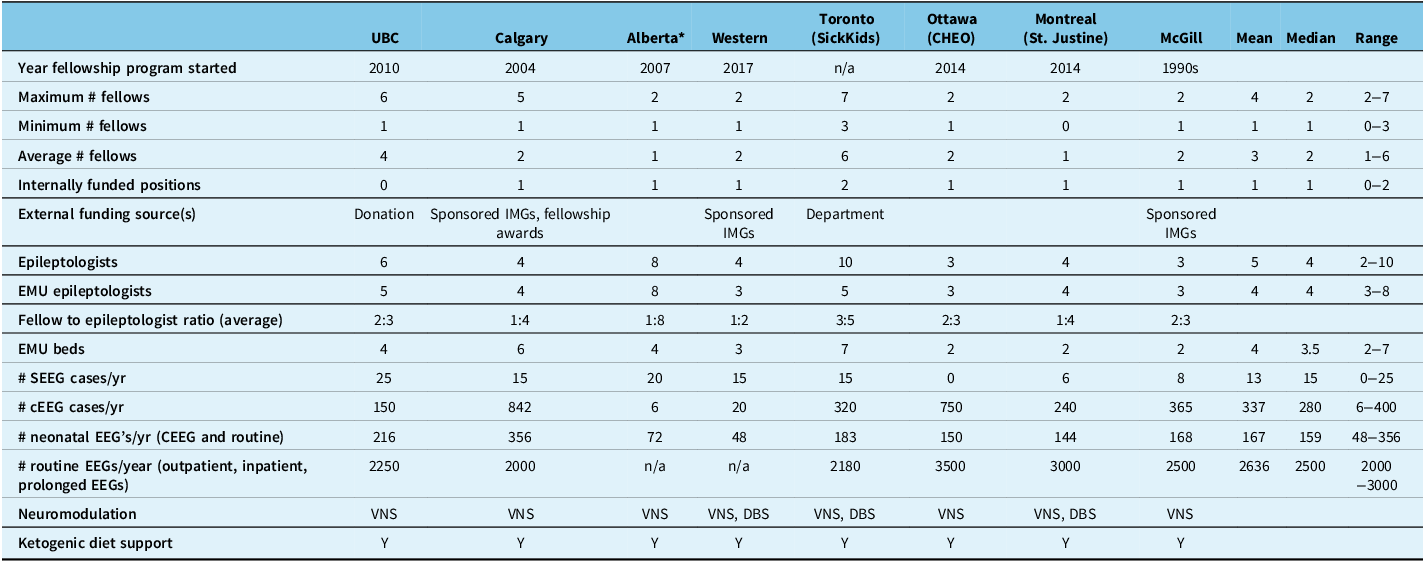
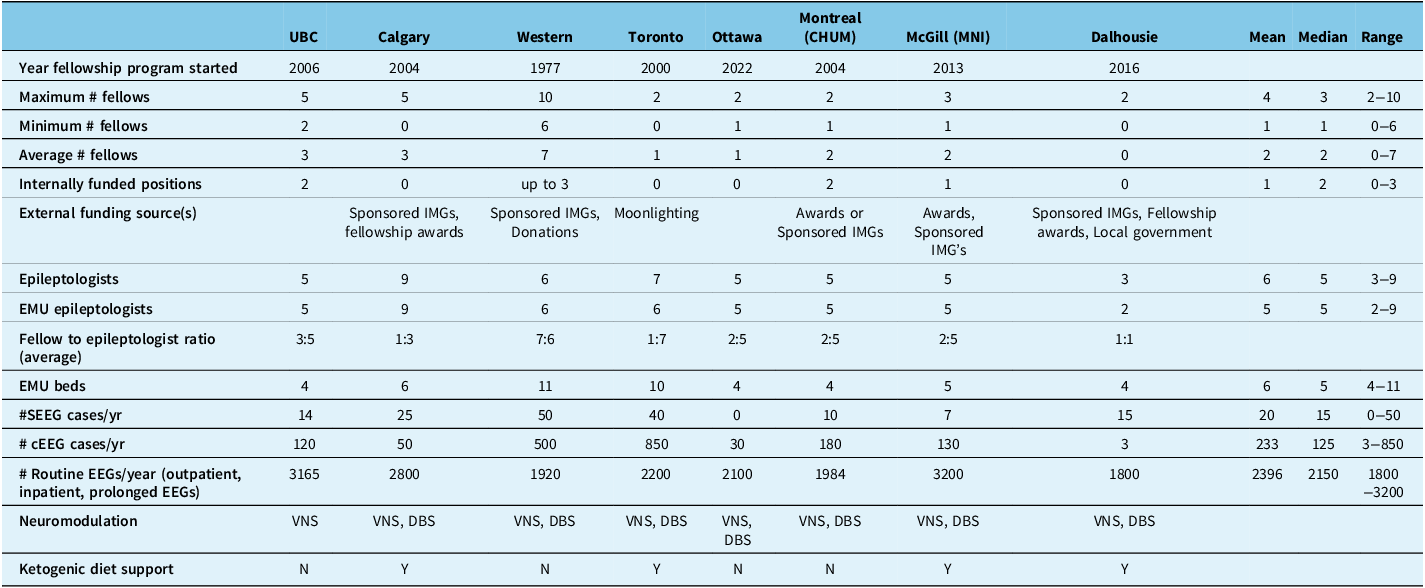
Most fellowship programs (10/18) trained one or two fellows concurrently, while two programs regularly trained five or more fellows (Tables 1 and 2). One program did not have consistent access to funding and only occasionally trained fellows. The epileptologist-to-fellow ratios for individual programs varied between 1:0.6 and 8:1.
Program information for pediatric epilepsy fellowships offered across Canada

*Comprehensive epilepsy program provides training in both adult and pediatric epileptology.
Note: universities not listed in this table did not have an epilepsy fellowship program at the time of the surveys.
Abbreviations: EMU = epilepsy monitoring unit; sEEG = stereo EEG; cEEG = continuous EEG; VNS = vagus nerve stimulation; DBS = deep brain stimulation; IMG = international medical graduate.
Program information for adult epilepsy fellowships offered across Canada

Note: universities not listed in this table did not have an epilepsy fellowship program at the time of the surveys.
Abbreviations: EMU = epilepsy monitoring unit; sEEG = stereo EEG; cEEG = continuous EEG; VNS = vagus nerve stimulation; DBS = deep brain stimulation; IMG = international medical graduate.
Fellowship duration was 1–2 years, but many programs also offered 6-month EEG training for neurologists interested in writing the Canadian Society of Clinical Neurophysiologists (CSCN) EEG examination, a national examination designed to establish competency in reading routine EEG. Internal funding for fellows was available in 62.5% fellowship programs (nine pediatric, nine adult) while the remainder relied solely on external funding (Tables 1 and 2). The most common source of external funding was from international medical graduate funding from their home government. Fellowship awards were another common source of external funding.
The number of routine EEG recordings completed at each center varied (Tables 1 and 2). In most centers, routine EEGs Reference Dash, Dash and Primrose3 included EEGs completed on inpatients, outpatients and ICU patients (non-continuous), as well as sleep-deprived and other special studies. Further breakdown of these numbers was not possible in many cases due to recording practices at each center.
All fellowship programs provided epilepsy monitoring unit experience, with each center reporting at least two beds (Tables 1 and 2). Stereo-EEG (sEEG) was performed at 87.5% of institutions, with a range of 5–65 cases per year. sEEG case volume was dependent on the number of EMU beds, with programs having 4–6 beds reporting 7–25 cases/year and those with 10 or more beds reporting 40–50 cases/year. All programs provided continuous EEG (cEEG), albeit with heterogeneous volumes of delivered care and training. All pediatric and half of the adult programs had support for ketogenic diet. All programs provided neuromodulation: 10 provided both deep brain stimulation and vagus nerve stimulation (three pediatric, seven adult), while the remainder provided only vagus nerve stimulation.
Planning and reading sEEG recordings are often considered a pillar of advanced epilepsy training and an essential skill set specific to an epileptologist, especially at an epilepsy surgical program. Participants agreed sEEG competency is generally achieved in the second year of an epilepsy fellowship and is considered an advanced proficiency in the International League Against Epilepsy’s Fellowship Roadmap. Reference Blumcke, Arzimanoglou and Beniczkey4 Only two programs (one adult, one pediatric) did not have sEEG capabilities, and one of these only provided a one-year fellowship option.
All programs report access to pediatric/adult epilepsy clinical experience for trainees in adult/pediatric fellowships, respectively; however, not all institutions have both pediatric and adult epilepsy fellowship programs. One program without a pediatric fellowship counterpart had access to a significantly lower number of all types of pediatric cases, including EMU, sEEG and neonatal EEGs.
As there were wide variations in volumes of specific EEG subtypes (routine EEG, cEEG, neonatal EEG and sEEG) and in fellowship training capacity between sites, we also calculated a fellow-to-EEG ratio. We assumed one fellow is assigned one record and determined the number of records assigned to a single fellow each year based on the yearly averages provided by each center. This demonstrated a range of 17–216 neonatal EEGs per fellow per year, 274–3000 routine EEGs per fellow per year, 1.5–750 cEEGs per fellow per year and 0–40 sEEGs per fellow per year. These numbers provide a rough estimate of volumes but are highly dependent on factors such as the number of fellows and fellowship goals. The widest range of volumes occurred within centers rather than between centers.
Access to high volumes of EEGs in multiple formats (cEEG in ICU, routine EEG, neonatal EEG and sEEG) is essential in developing competence in EEG. Although the ideal number of EEG record interpretations required to obtain competency in this skill for each format is unknown, Reference DOnofrio, Reid and Ramachandrannair2 data from our study can guide future research in this area.
There is a notable geographic disparity in fellowship program distribution, with no epilepsy fellowship program between Calgary, AB, and London, ON, a span of 3200 km. Major regions between these two epilepsy training programs include Saskatchewan, Manitoba and Northern Ontario, each reflecting unique and underserviced health populations. In Atlantic Canada, there is no pediatric epilepsy fellowship program. No correlation was associated with size of the population served and the size of the epilepsy fellowship program, except for the largest pediatric epilepsy fellowship program, located in Toronto, Canada’s largest city.
Differences in training programs could be related to differences in resources available to these programs. As healthcare is primarily funded at the provincial level, there are often differences in available resources among provinces, possibly explaining the geographic variations across Canada. This resource variability across training sites may also affect access to advanced epilepsy training and EEG numbers required to challenge the CSCN EEG Examination based on the competency-based requirements. 5 Our study identified the lack of designated funding for fellowship programs in Canada, raising concerns of sustainability for many epilepsy fellowship programs.
Additionally, local clinical practices may also play a role in variations of training within provinces, as previously demonstrated in the care of Canadian women with epilepsy. Reference Thornton, Fantaneanu and Zhang6 In addition to the services provided, the availability of funding for trainees also affects each institution’s ability to provide fellowship opportunities.
Our study identified significant barriers in access to epilepsy care across the country. These data show significant regional differences in 16 large academic centers that are best resourced to provide epilepsy care, as indicated by their ability to train fellows, and suggest that there may be even greater limitations in accessing these resources in smaller centers. Again, resource availability could contribute to these barriers; however, training availability may also be a factor. Multiple studies demonstrate that trainees often practice in locations similar to those in which they trained. Reference Ryan and Stewart7,Reference Jarman, Cogbill and Mathiason8 The current availability of fellowship programs perpetuates barriers to accessing epilepsy care by training fellows who often stay or migrate to more urban centers, which perpetuates regional access inequities.
This study’s main limitations are its reliance on “word of mouth” knowledge of Canadian epilepsy fellowships and participant estimates for survey responses. It is possible that we could have missed fellowship programs; however, this is unlikely given the small Canadian epileptology community. Since completion of the survey, at least one other fellowship program has started. Although this study was primarily completed through surveys of fellowship program directors, further correspondence through email for clarification of answers provided additional data making most of the data complete. Despite these efforts, the lack of institutional data for cross reference may result in inaccuracies with participant recall bias. Apart from cEEG, all fellowship training programs provide trainees with similar educational experiences. Higher volume centers provide more exposure to a greater variety of cases, but as these centers generally also have more fellows, the number of cases any one fellow is primarily responsible for is similar between large and average-sized programs. This suggests that currently available epilepsy fellowship training programs provide similar proportionate exposure to advanced clinical epilepsy and EEG training.
The programs surveyed in this study are widely recognized nationally and internationally for producing competent epileptologists and electroencephalographers. This suggests that obtaining competency in various forms of EEG studies lies within the numbers obtained in this survey. However, there is significant variation in these numbers, with up to 500-fold differences between sites. Further advocacy for equitable access to EEG and epilepsy care across the country is needed. In the interim, collaboration between centers could improve training-level access concerns.
Acknowledgements
The authors would like to acknowledge the work of Sharon Ng and Sabrina Chan for their contribution in facilitating and transcribing the consensus data used for this manuscript.
Author contributions
KMI was responsible for study conception, data collection and analysis and drafting the manuscript. AND was responsible for study conception, data collection and analysis and reviewed the manuscript critically for intellectual content. AH, JPA and JJ contributed to data collection and reviewed the manuscript critically for intellectual content. GD, EK and RR reviewed the manuscript critically for intellectual content. EB was responsible for study conception, data analysis, critical review and major revisions related to the manuscript.
Funding statement
This research received no specific grant from any funding agency in the public, commercial or not-for-profit sectors.
Competing interests
KMI received honoraria from Jazz Pharmaceuticals and Knight Therapeutics and participated in an advisory board for Jazz Pharmaceuticals. AND received honoraria from Jazz Pharmaceuticals and Biomarin and participated in advisory boards for Jazz Pharmaceuticals, Knight Therapeutics and Pendopharm. GD received fellowship support from the Savoy Foundation and travel support from Paladin (now Knight Therapeutics). EK received consulting fees from Knight Therapeutics, Creative Research Designs, travel support from Paladin (now Knight Therapeutics) and participated in advisory boards for Paladin (now Knight Therapeutics) and Jazz Pharmaceuticals. AH, JPA, JJ, RR and EB have no disclosures.
Ethical standards
Approved by University of Toronto Ethics Board 42597.