Pericarditis is the most common disease of the pericardium and accounts for 5% of all children who present with chest pain, with a risk of recurrence of about 30% within 18 months from presentation. Reference Imazio, Bobbio and Cecchi1,Reference Imazio, Brucato and Cemin2
The 2015 European Society of Cardiology Guidelines for the diagnosis and management of pericardial diseases recommends the following medications for treatment of pericarditis in children:
High-dose non-steroidal anti-inflammatory drugs, given until complete symptoms resolution, are the first-line therapy, while colchicine or anti-interleukins-1 drugs are to be given as an adjunct therapy for recurrent pericarditis. Systemic corticosteroids were not recommended due to the severity of side effects, but if given, then the minimal effective dose should be used. Reference Adler, Charron and Imazio3
Data review
There are currently no randomised controlled trials in children with pericardial diseases, with all medical therapies being off-label. Most of our experience in managing these patients is adopted from adult studies. While the use of non-steroidal anti-inflammatory treatment or colchicine was proven to be effective, Reference Adler, Finkelstein and Guindo4 some patients still suffer from persistent prolonged effusion despite the long course of medication.
In our current case, we were faced with this dilemma after exhausting all conventional management options.
Reviewing the literature, we found a growing evidence of the efficacy of intrapericardial steroids administration.
The first case of cardiac tamponade successfully treated by pericardiocentesis and intrapericardial injection of methylprednisolone was described by Sharf et al in 1976. Reference Scharf, Levy, Benderly and Nahir5
Maisch B and college found that in this type of patient, the use of intrapericardial steroids could be an effective treatment with minimal systemic side effects and long-term efficacy with no recurrence. The direct intrapericardial application of drugs has the advantage of giving a high local dose with little systemic side effects. Reference Maisch, Ristić, Seferović and Tsang6
Another study by the same group evaluated the efficacy and safety of intrapericardial treatment with the crystalloid corticosteroid triamcinolone in autoreactive pericardial effusion; it found that it resulted in symptomatic improvement and prevented recurrence in 92.6% of patients after 3 months and in 86.0% after 1 year. Reference Maisch, Ristić and Pankuweit7
Case description
A 43-month-old girl who had previously been healthy, presented with a history of poor activity, mild chest discomfort, face puffiness, and bilateral foot swelling of 2 months duration. The symptoms were preceded by mild upper respiratory tract infection, but there was no history of fever. Her mother is a known case of systemic lupus erythmatosis.
The first echo performed at presentation showed a large pericardial effusion with impending tamponade and normal intracardiac anatomy. Emergency pericardiocenthesis was done and 280 ml (19/ml/kg) of pericardial fluid was removed.
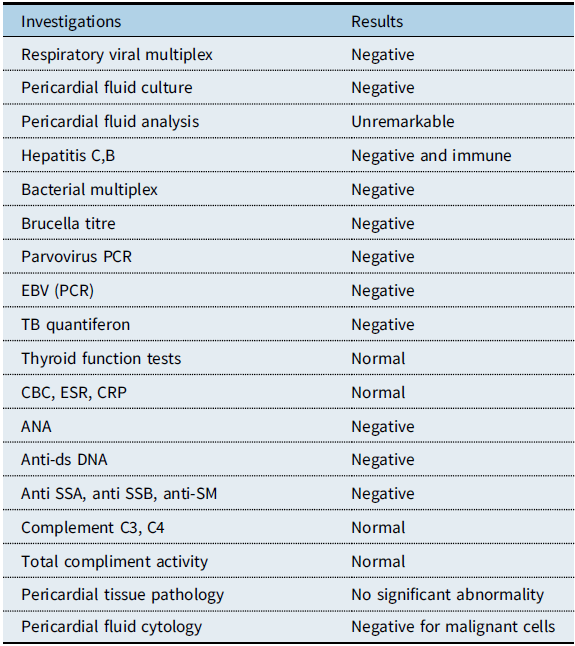
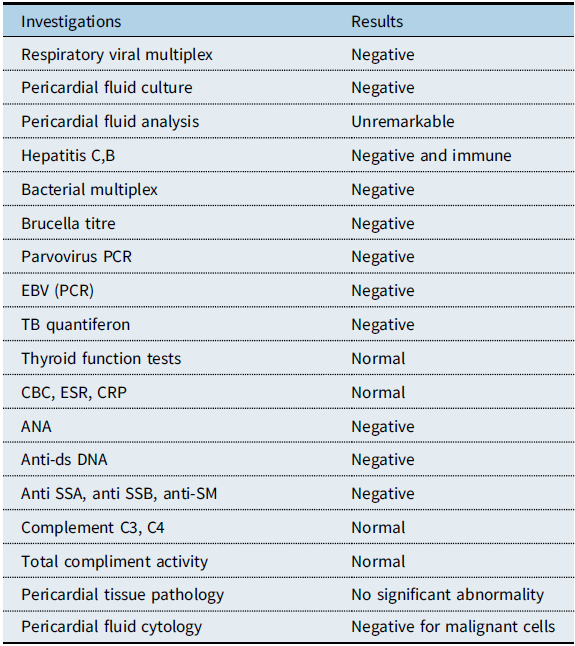
Fluid analysis was unremarkable. Serum albumin was normal, and urine was negative for protein so nephrotic syndrome spectrum was excluded. Rheumatology, immunology, and infectious disease teams requested a full work up which was all unremarkable (Table 1).
List of lab work up done which was all unremarkable supporting the diagnosis of idiopathic pericardial effusion.
Our impression was that her presentation was most likely explained by post infectious inflammatory pericarditis or idiopathic pericardial effusion.
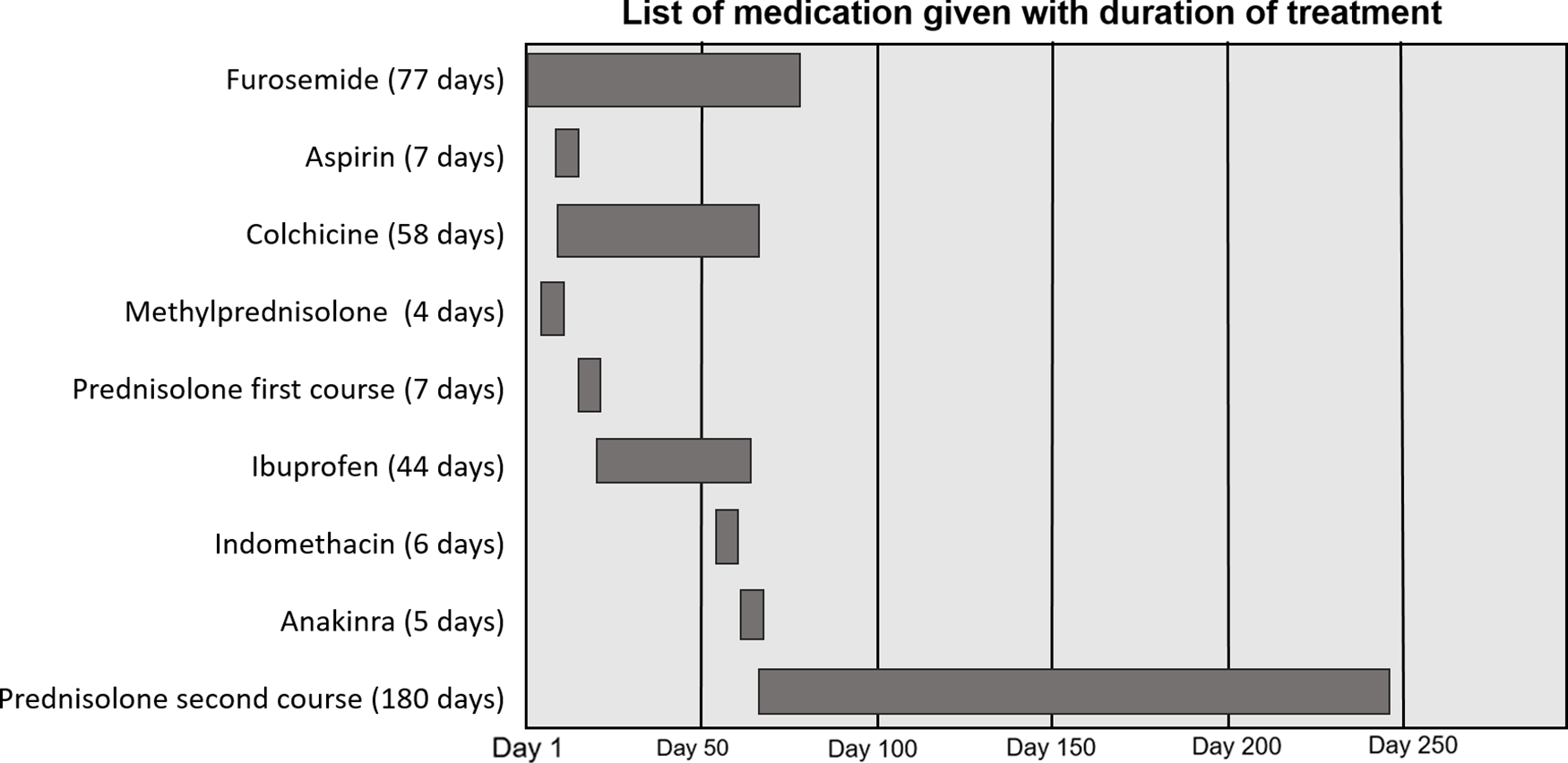
She was started on furosemide, methylprednisolone for 5 days, and then aspirin with Colchicine (Fig 1).
Bar chart showing the time line and total duration of medication given during admission and after discharge (discharged on day 78).

However, despite all medical management, she continued to drain from pericardial tube with fluctuating amounts of 2–10 ml/kg/day. Serial echoes showed moderate to minimal pericardial effusion depending on the drain amount with no significant improvement
After multiple failed attempts to clamp the drain with significant re-accumulation of fluid within 24 hours from clamping, she was resumed back on prednisolone and aspirin was stopped.
Following 20 days in hospital with no progress, the creation pericardio-pleural window was carried out after careful multidisciplinary discussion. A sample of the pericardium was taken for pathology assessment and showed no abnormality.
However, the drain persisted in having a high output (around 10 ml/kg/day) and so another set of rheumatology work up tests was requested which later came back normal. A trial of Indomethacin for 6 days was attempted with no improvement, so it was discontinued. Finally, a therapeutic trial of Anakinra was given for 5 days without improvement. The final impression was that it was unlikely the patient’s condition was related to a rheumatological cause.
At this point, the patient had been in hospital for 2 months with no response to all medical management; the case was re-discussed and after reviewing the published data mentioned above the team agreed to a trial of insertion of local steroids through tubing directly into the pericardial space.
All medications were stopped, and drains were clamped a day before the procedure. The procedure was performed in the cath lab under transthoracic echocardiography guidance with conscious sedation. An injection of 30 mg (2 mg/kg) of Methylprednisolone through the pleural and pericardial tubes each was given and pericardial and pleural drains kept clamped for 24 hours then unclamped. She was started on oral prednisolone with a dose of 2 mg/kg/day.
The fluid amount in the drains was observed closely in the following days, and it became less than 3 ml/kg/day within 5 days. The drains were clamped on day 5 after the procedure. Echos 24 hours and 48 hours post clamping showed minimal pericardial effusion. They were removed on day 7, and Echo follow-up on day 10 showed no pericardial effusion. The girl was finally discharged on oral prednisolone with OPD follow-up in 1 week which also showed no pericardial effusion.
Follow-up at the 1 and 3 months marks was also normal, and prednisolone was weaned off gradually over 3 months. She remained medically free after 2 years with no more effusion.
As described above, the use of intrapericardial steroids was in this case a very effective treatment with no recurrence or major complications. As far as we know, this is the first published case to study this method in paediatric idiopathic pericardial effusion which showed a similar outcome to adult studies. However, more studies with larger number of patients are needed to confirm our experience.
Acknowledgements
We would like to acknowledge Dr Omer Altamimi for his kind effort and input in managing this patient.
Financial support
This case report received no specific grant from any funding agency, commercial, or not-for-profit sectors.
Conflicts of interest
None.
Ethical standards
Patient confidentiality was maintained at all level, and this case report was approved by institutional review board in national guard hospital with approval no RC 20\602\R.