Introduction
This article reviews the state of evidence on the comparative impact of remittances and cash transfers on a broad range of household-level indicators of wellbeing in low and middle-income countries. Cash transfers in this review are defined as solely public transfers. Cash transfers may be universal (covering an entire population group) or targeted (for example, at poor households or specific demographic groups, such as households with children). They can be contributory, requiring past contributions of the recipient, as in the case of pensions, or non-contributory. Remittances are informal cash or in-kind private transfers sent by migrants to family and friends. This review only considers cash remittances.
In the past decade, we have seen growth of both remittance flows and cash transfer coverage in low-income countries. The total amount of cross-country remittances received by low-income countries increased fivefold from US $81.3 billion in 2000 (World Bank, 2010) to an estimated US $401 billion in 2012 (World Bank, 2013). Remittances represent 2 per cent of global GDP. For low-income countries, remittances represent almost 6 per cent of GDP (Sirkeci et al., Reference Sirkeci, Cohen and Ratha2012) and can be up to 48 per cent, as seen in Tajikistan (World Bank, 2013). Cash transfers have become an increasingly popular instrument in low-income countries. In 2011, cash transfer programmes were estimated to cover between 750 million and one billion people in low-income countries (DFID, 2011).
Cash transfers and remittances are both monetary transfers received by individuals or households. It is often assumed that receiving a public cash transfer is the same thing as receiving a private transfer, that is remittances (Maitra and Ray, Reference Maitra and Ray2003). The existing literature, with remittances and cash transfers treated separately, shows that both have positive effects on poverty reduction. Money is money, so can we safely conclude that a dollar of cash transfer received by the household has the same poverty reducing impact as a dollar of remittances? There are a number of a-priori reasons why one might expect that this is not the case.
First of all, remittances and cash transfers may reach different socio-economic groups in the population. While cash transfers tend to be targeted at the most vulnerable, the migration literature shows that migrants (and hence remittance recipients) often do not belong to the poorest population groups owing to the substantial costs of migration (Stark and Taylor, Reference Stark and Taylor1991; Nyberg-Sørensen et al., Reference Nyberg-Sørensen, Hear and Engberg–Pedersen2002; De Haas, Reference De Haas2005; Skeldon, Reference Skeldon2008). Second, transfers may be received by different family members, with cash transfers often targeted at women, whereas remittances are received by both men and women, and the literature shows that which household member receives a transfer potentially has strong impacts on household outcomes (Duflo and Udry, Reference Duflo and Udry2004). Third, transfers may have explicit or implicit conditions attached. For example, some of the cash transfers reviewed here are conditional on school attendance and making visits to preventive health care providers. Conditional cash transfers may have different outcomes from unconditional ones, although the literature is still divided on this (Fiszbein et al., Reference Fiszbein, Schady and Ferreira2009). Fourth, public transfers and remittances may be spent differently. For instance, cash transfers tend to be spent on consumption (DFID, 2011) and to a lesser degree on investment. Remittances, on the other hand, tend to be associated more with investment, for example, on human capital, assets or housing (for example, Adams, Reference Adams2005; Yang, Reference Yang2008).
While two separate strands of literature have looked at how either public transfers or remittances have been spent, generating the theories in the previous paragraph, few studies have compared them directly. Using a rigorous, evidence-focused literature review approach put forward by Hagen-Zanker and Mallett (Reference Hagen-Zanker and Mallett2013), this article reviews all studies that consider the question: ‘Do remittances and cash transfers have different impacts on poverty and vulnerability of households?’. In doing so, the review will also shed light on the question of whether public transfers crowd out private transfers (and vice versa), and generate insight into how monetary transfers are spent.
Notwithstanding the evidence suggesting different intra-household distributions for different types of transfers (for example, Slater and Mphale, Reference Slater and Mphale2008), we focus on the household as the unit of analysis, rather than on individuals within households. In doing so, we follow the approach of the studies covered in this review. This review covers studies addressing the above question in all low- and middle-income countries.
This article starts by describing the methodology of the review and then presents a classification of the studies found. The review of the studies highlights a number of methodological concerns and these are discussed in more detail in the forth section. The next section presents and synthesizes the findings. We then conclude and propose future research questions.
Methodology of the review
This literature review focuses on empirical studies looking at the comparative impact of remittances and cash transfers on household-level indicators of poverty or vulnerability in low- and middle-income countries. The review was conducted in November–December 2011 and updated in June 2013 to include newly published studies.
The review process drew on the systematic review methodology to ensure breadth in the included literature and rigour in the search process (see Hagen-Zanker and Mallett, Reference Hagen-Zanker and Mallett2013, for a detailed discussion of the research methodology). The process is designed to produce a review strategy that adheres to the core principles of systematic reviews, rigour, transparency and a commitment to taking questions of evidence seriously, while allowing for a more flexible and user-friendly handling of retrieval and analysis methods. The search question was ‘Do remittances and cash transfers have different impacts on poverty and vulnerability of households?’ We used a multi-dimensional definition of poverty going beyond monetary measures – for instance we also included studies on health outcomes. We included all publicly provided cash transfers, contributory and non-contributory.
A search protocol was set up and a formal literature search was conducted using predefined search strings to explore six academic databases, ten academic journals and ten websites and Google Scholar. In addition, six experts in the field suggested relevant studies. We only searched for studies based on primary empirical research and included academic articles, reports and dissertations. We only included studies written in English, which is a limitation of this review.
While full-blown systematic reviews often exclude studies on the basis of ‘low quality’ or ‘inappropriate methodology’, we included all studies that fitted the search criteria without making judgments on quality. Likewise, rather than carrying out a full assessment of research quality, we have instead focused on a comprehensive and informative classification of studies that includes an assessment of the size and consistency of the body of evidence, as well as a general discussion on issues of internal validity in the studies found. Assessment of the research quality of individual studies would have been extremely difficult and inherently subjective as methodologies and datasets used vary considerably and information provided in most articles was not sufficient to objectively assess design, implementation and interpretation of the methodology (see Hagen-Zanker and Mallett, Reference Hagen-Zanker and Mallett2013, for a further discussion on this). We included both qualitative and quantitative studies in our search protocol, but we found only quantitative studies with varying methodological approaches.
The classification of studies found is presented in the next section.
Classification of studies found
In this section, we seek to describe the studies found by comparing the geographical coverage, type of social protection programmes included, methodology and poverty indicators measured. This review found eleven studies that assessed both the impact of cash transfers and remittances on poverty and vulnerability of households.
Figure 1 below shows that geographical coverage of the studies varies considerably. There are comparatively more studies on countries in the Asian and Latin-American regions, but these cover a limited number of countries (for example, two of four studies on Latin-America look at Nicaragua and three of four studies on Asia consider Vietnam).
Number of studies by region

The studies found are highly diverse in all aspects:
• There are four studies on Latin-American countries (two of which are on Nicaragua, one on Peru and one on Guatemala), three on Vietnam, one on Pakistan, one on South Africa, one on Armenia and one study comparing Slovenia, Poland, the Czech Republic and Hungary.
• The two Nicaraguan studies look at conditional cash transfers; all other studies in the review consider unconditional transfers.
• The outcome variables used in the studies are quite diverse, ranging from health care utilisation to loan requests, with seven studies looking at monetary poverty incidence.
• Analytical methods range from straightforward ex-post assessment of income less the transfer (with clear limitations, see below) to difference-in-difference or regression analysis.
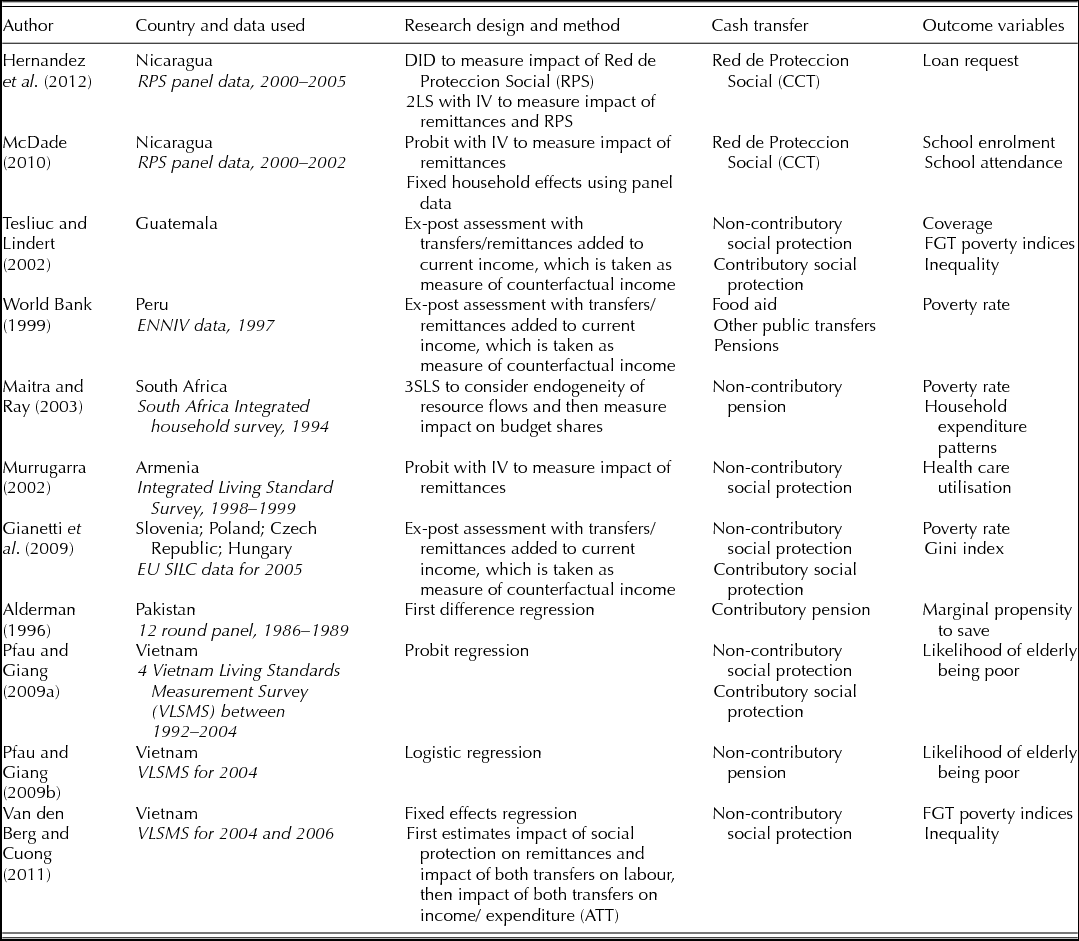
Table 1 below presents key information on the studies: country focus, research method and design, social protection programme evaluated and outcome indicator considered.
Summary of studies found
Note: DID stands for Difference-in-Difference; 2LS stands for Two Stage Least Square simultaneous equation model; IV stands for Instrumental Variable technique; 3SLS stands for Three Stage Least Square simultaneous equation model; FGT stands for Foster–Greer–Thorbecke poverty measures; ATT stands for Average Effect on the Treated.
The great variation in methodological approaches, social protection programmes and outcome indicators, means that it is impossible to compare the studies and directly assess their relative research quality. Instead, we discuss the general methodological challenges found across all of the studies.
Following DFID (2013), we regard the size of the body of evidence (eleven studies) as small. Further, we find the evidence to be highly context specific. With the exception of one cross-country study, the studies focus on one country only and on different time-periods. As already emphasised, the programmes studied range considerably in terms of objectives, target group, implementation and basic design. Hence, it is highly doubtful that any of the studies can claim to have external validity, that is the extent to which the findings of a study can be legitimately transferred from one context to another. As Pritchett and Sandefur (Reference Pritchett and Sandefur2013) have recently argued:
When non-experimental estimates vary across contexts, any claim for external validity of an experimental result must make the assumption that (a) treatment effects are constant across contexts, while (b) selection processes vary across contexts.
In this case, such assumptions would be misplaced and the evidence presented below must be regarded as highly context specific.
The review of the studies has also thrown up issues of internal validity. These are discussed in the next section.
Issues of internal validity
Internal validity concerns itself with the extent to which causal relationships have been convincingly demonstrated. The review of the studies highlighted a number of methodological concerns rendering threats to internal validity.
The first concern involves a possible endogeneity bias. Cash transfers (and perhaps remittances) are often targeted at low-income households. This implies that the allocation of the transfer is non-random: households with a lower income are more likely to receive transfers. At the same time, when a transfer is received by the household (ceteris paribus), the household's income goes up. This means there is reverse causality between transfers and income, implying that direct comparisons of those households receiving a transfer and those not receiving one may be biased.
Due to their very nature, remittances are also not randomly assigned. As with cash transfers, there may also be an endogeneity bias when looking at the impact of remittances. However, this is probably less of a concern because remittances are often more uniformly distributed throughout the population.
There are a number of methodological solutions to assessing impact when there is an endogeneity bias. In one of the social protection programmes discussed, the Red de Proteccion Social in Nicaragua, a randomised control trial (RCT) was conducted, with access to the transfer being randomly assigned amongst the target group. Utilising pre- and post-transfer panel data, the authors (McDade, Reference McDade2010; Hernandez et al., Reference Hernandez, Sam, Gonzalez-Vega and Chen2012) were able to assess the unbiased impact of the transfer.
A common solution to addressing endogeneity of public/private transfers is to employ an instrumental variable approach. An instrumental variable is a variable that is correlated with the endogenous explanatory variable (i.e. measures the likelihood of receiving a transfer), but not the outcome variable. This approach is used by three authors (Murrugarra, Reference Murrugarra2002; McDade, Reference McDade2010; Hernandez et al., Reference Hernandez, Sam, Gonzalez-Vega and Chen2012).
Maitra and Ray (Reference Maitra and Ray2003) use another approach entirely. Acknowledging the endogeneity of different resource flows, they estimate an endogenous equation system between public transfers, private transfers and other income, before assessing their respective impacts on household expenditure patterns. In doing so, they also address the second of the methodological issues, fungibility.
The second concern is potential fungibility. Fungibility means that when a household receives cash it can be extremely difficult to assess the impacts on expenditure patterns, as money is fungible, i.e. a unit of cash is equivalent to another unit of money of the same amount. This means that when households tell us they are spending a transfer on education, we do not know if they would have spent the money on education anyway and just free up the money otherwise ‘reserved’ for education to be spent on something else. Maitra and Ray (Reference Maitra and Ray2003) resolve this problem by first measuring the impacts of different resource flows on each other, before assessing impacts on expenditure shares.
Third, related to the issue of fungibility is the question of income pooling in the household. Transfers are often received by different household members. Other studies focusing on cash transfers only have shown that it matters who receives a transfer in the household and that household members do not always pool their income (for example, Duflo and Udry, Reference Duflo and Udry2004; Slater and Mphale, Reference Slater and Mphale2008). Apart from Maitra and Ray (Reference Maitra and Ray2003), who reject income pooling on the basis of their findings, none of the other studies test for this.
Finally, we need to consider that the impact of the transfer on poverty at the household level may not be identical to the value of the transfer, as a number of studies implicitly assume (for example, Gianetti et al., Reference Giannetti, Federici and Raitano2009). Apart from the monetary transfer, a transfer may affect household income by changing a household's behaviour (for example, changing their work efforts). As discussed in more detail in Hagen-Zanker et al. (Reference Hagen-Zanker, McCord and Holmes2011), when impact on income is calculated on the basis of ex-post assessment, taking current income less the transfer as the counterfactual income, the result may be an over-estimation of the impact, as this approach disregards income foregone (income the households would have earned if they had not received the transfer). Households may be changing their behaviour both after receipt of a transfer and in anticipation of a transfer. This is especially the case where cash transfers have conditions attached or public work requirements (see McCord, Reference McCord2012).
Another relevant example of these behavioural impacts is the question of whether cash transfers crowd out remittances. In other words, keeping in mind the fungibility assumption, households that receive a transfer may consequently receive lower or no remittances. Maitra and Ray (Reference Maitra and Ray2003) find that this is only the case for households below the poverty line in South Africa,Footnote 1 and Muzzurunga (Reference Murrugarra2002) finds that social assistance crowds out remittances in Armenia. On the other hand, social transfers may also ‘crowd in’ remittances by facilitating migration (see Hagen-Zanker and Leon Himmelstine, Reference Hagen-Zanker and Leon Himmelstine2013, for a review of studies on the impact of social protection on migration flows). Panel data are useful here, as it allows one to measure ex-ante household income, without having to rely on assumptions (as used for example, in Hernandez et al., Reference Hernandez, Sam, Gonzalez-Vega and Chen2012).
In conclusion, measuring the impact of cash transfers and remittances on poverty is a highly complex undertaking, and reliant on high quality data and careful methodological design and implementation of econometric methods. While we did not undertake a full assessment of research quality and internal validity of individual studies, our review suggests that some of the studies lack internal validity. This means that the findings presented in the next section must be interpreted with caution.
Discussion and synthesis of findings
In this section, we discuss the findings of the evidence found and draw some tentative conclusions on general trends found in the studies, followed by a discussion of the factors that mediate impact.
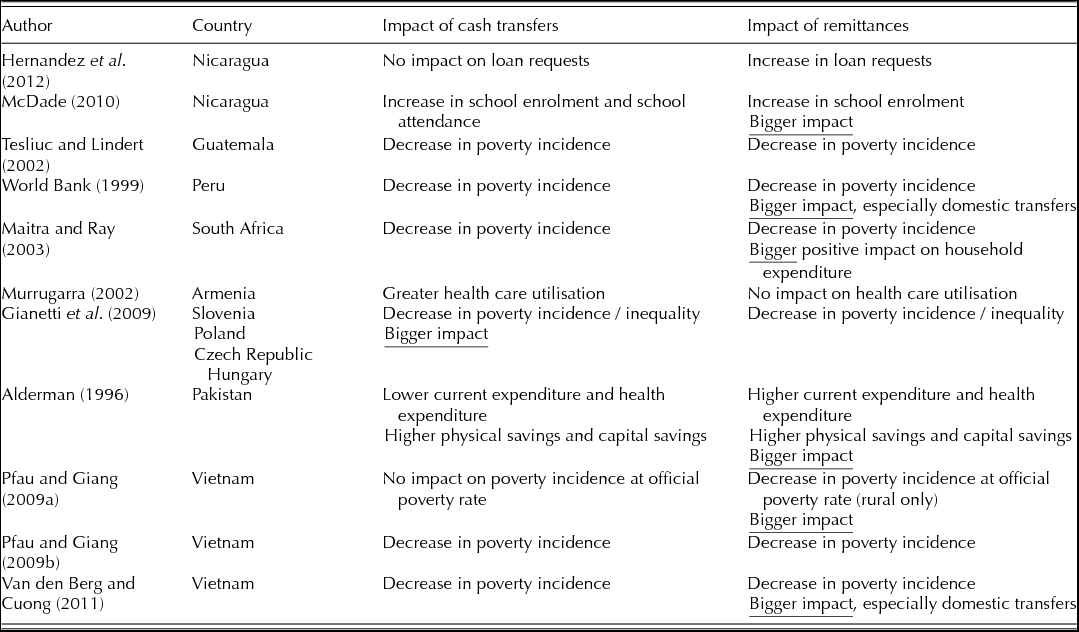
Table 2 shows the comparative impacts of remittances and cash transfers on poverty and vulnerability, organised by study. Figure 2 gives an overview of the general patterns found. We have used a traffic light design to indicate if the transfer has had a positive or negative impact on household wellbeing, with white indicating no significant impact, yellow indicating a mixed impact and green indicating a positive impact.
Findings from the studies
Overview of impacts by type of transfer
As can be clearly seen in Figure 2 and Table 2 below, in the majority of studies both cash transfers and remittances are shown to have positive impacts on a range of indicators of wellbeing. Three studies find no significant impactFootnote 2 for either cash transfers or remittances, and the study by Alderman (Reference Alderman1996) shows a negative impact of pensions on current health expenditure.
However, when we look at the magnitude of the impacts we start seeing some differences: in more than half of the studies, remittances are shown to have a bigger impact on poverty reduction than cash transfers (Maitra and Ray, Reference Maitra and Ray2003; McDade, Reference McDade2010; Van den Berg and Cuong, Reference Van den Berg and Cuong2011; Hernandez et al., Reference Hernandez, Sam, Gonzalez-Vega and Chen2012). Only one study finds that cash transfers have a greater impact on poverty and inequality reduction than remittances (Gianetti et al., Reference Giannetti, Federici and Raitano2009). However, this study refers to four countries, Slovenia, Poland, the Czech Republic and Hungary, which have well-established social protection systems.Footnote 3
Digging deeper into the details of the design and implementation of the cash transfers and the country-specific remittances trends, some factors that explain impacts are beginning to emerge. These are:
• Targeting of the transfer: It is obvious that those transfers that are targeted to the poorest will have the greatest impacts on poverty reduction. Counter-intuitively, and contradicting much of the migration literature, a number of studies in this review suggest that the extremely poor or vulnerable are more likely to receive remittances than social protection (World Bank, 1999; Tesliuc and Lindert, Reference Tesliuc and Lindert2002; Van den Berg and Cuong, Reference Van den Berg and Cuong2011). Further, as Tesliuc and Lindert (Reference Tesliuc and Lindert2002) highlight, some social protection transfers may be regressive, for instance contributory transfers. Likewise programmes targeted at specific social-categorical groups, for example older people, often do not target the poorest or most vulnerable within a population, intentionally or unintentionally (see Slater and Farrington, Reference Slater and Farrington2009). This should not be seen as evidence that social transfers are ineffective: cash transfers may not always have an income poverty-reduction objective.
• Coverage: The greater the share of poor and vulnerable households covered, the bigger the impact on poverty reduction. Coverage of social protection in low-income countries is notoriously low, and this is also the case in the reviewed studies: many of the cash transfers have extremely low coverage (for example, World Bank, 1999 on Peru; Tesliuc and Lindert, Reference Tesliuc and Lindert2002 on Guatemala; Pfau and Giang, Reference Pfau and Giang2009a, Reference Pfau and Giangb and Van den Berg and Cuong, Reference Van den Berg and Cuong2011 on Vietnam). In the South Africa data analysed by Maitra and Ray (Reference Maitra and Ray2003), a greater share of poor households receive remittances than those receiving social protection transfers, thus explaining why remittances have an overall stronger impact on poverty reduction. On the other hand, in the four Eastern and Central European countries studied by Gianetti et al. (Reference Giannetti, Federici and Raitano2009), social protection coverage is generally high and social protection has a greater effect on overall poverty reduction.
• Amount of the transfer: Although other evidence on cash transfers outside this review shows that even small transfers can have an impact (Samuels and Jones, Reference Samuels and Jones2013), generally one can assume that the bigger the transfer the greater the impact on poverty reduction. In four of the case studies included in this review, remittances are significantly larger than cash transfers (i.e. World Bank, 1999; Tesliuc and Lindert, Reference Tesliuc and Lindert2002; Van den Berg and Cuong, Reference Van den Berg and Cuong2011; Hernandez et al., Reference Hernandez, Sam, Gonzalez-Vega and Chen2012), hence explaining their stronger impact on poverty reduction. The exception is again Gianetti et al. (Reference Giannetti, Federici and Raitano2009), where social transfer levels are generally quite high (especially since most households receive multiple transfers), though not always higher than remittances, and the impact of social protection transfers is stronger. Also, for Nicaragua, McDade (Reference McDade2010) shows that average remittances are similar in magnitude to the cash transfer, but that the median of remittances is much lower.
• Timing of the transfer: While the wider literature suggests that transfers should be regular and predictable to reduce poverty and vulnerability (Farrington and Slater, Reference Farrington and Slater2006; DFID, 2011; Samuels and Jones, Reference Samuels and Jones2013), a small number of studies reviewed here highlight the responsiveness of remittances to shocks. For example Hernandez et al. (Reference Hernandez, Sam, Gonzalez-Vega and Chen2012) claim that the ability to access remittances in case of future shocks is what made them more successful in increasing the financial confidence of remittance recipient households.
• Use of the transfer: It is difficult to measure use of transfers owing to fungibility. However, transfers may be put toward different uses (for example due to explicit or implied conditions). There is some emerging evidence that remittances and cash transfers are not spent in the same way. Maitra and Ray (Reference Maitra and Ray2003) show that remittances lead to a greater expenditure on food and clothing, compared to cash transfers. Finally, Murrugara (Reference Murrugarra2002) shows for Armenia that remittances are used for health shocks, while social protection transfers lead to a general increase in health utilisation.
Conclusion
This systematic literature review addressed the research question: ‘Do remittances and cash transfers have different impacts on poverty and vulnerability of households?’. Using a rigorous, evidence-focused literature review method we found eleven relevant studies that directly compared the impacts of cash transfers and remittances.
The studies are highly diverse in terms of geographical coverage, type of cash transfer, outcome variables considered and data sources and analytical methods used. Hence, the evidence base is small and highly context specific.
While we did not assess the quality of individual studies or the overall strength of evidence, the discussion of issues of internal validity revealed that this question is extremely challenging methodologically, with many previous studies not yet having fully engaged with these challenges. With these caveats in mind, we can only draw some tentative conclusions.
In the majority of studies, both cash transfers and remittances are shown to have positive impacts on households’ wellbeing (with outcome indicators ranging from financial poverty to school enrolment). Overall, remittances seem to have stronger poverty reducing impacts. However, as discussed above, many of the studies are likely to have limited internal validity, and further research needs to be done on the comparative impact of remittances and cash transfers.
There are a number of factors that seem to mediate impact, and which explain why impact is limited in some cases. These factors are closely linked to the specific case studies reviewed here, and the findings may be entirely different for other contexts. The factors are:
• Targeting of the transfer: A number of studies in this review suggest that the extremely poor or vulnerable are more likely to receive remittances than cash transfers.
• Coverage: Many of the cash transfer programmes analysed in the studies in this review have low coverage, and hence show lower impacts on poverty reduction.
• Amount of the transfer: In three of the case studies included in this review, remittances received are significantly higher in value than cash transfers, thus explaining their stronger impact on poverty reduction.
• Timing of the transfer: While transfers should be regular and predictable to reduce poverty and vulnerability, a number of studies reviewed here highlight the responsiveness of remittances to shocks.
• Use of the transfer: There is some emerging evidence that remittances and cash transfers are not spent in the same way.
The evidence on these factors is quite limited at present. For example, the question of regularity of transfers in general, and possible seasonality or the counter-cyclical nature of remittances and how this affects poverty impact, needs to be researched further. Targeting of the transfers is considered in a handful of studies, and in many of those only implicitly. It is likely that remittances and cash transfers are targeted at different groups in the population. It is likely that the type of income source matters (for example, due to implicit or explicit conditions attached), and who receives the transfer influences how the transfer is spent. This also needs to be studied further.
The question of how different transfers are used is methodologically challenging, due to, for example, fungibility and possible crowding out of transfers, and this has only been adequately tackled in two of the studies reviewed here (Maitra and Ray, Reference Maitra and Ray2003; Van den Berg and Cong, Reference Van den Berg and Cuong2011). Further research needs to be done in two respects. First, in which circumstances does crowding out of remittances exist. In doing so, further research should build on some of the existing crowding out literature (for example, Jensen, Reference Jensen2004). Second, the question to what extent remittances and cash transfers are fungible.
Given the number of methodological challenges that have been identified in the existing literature, in addition to further high-quality quantitative analysis, there is also a strong role for in-depth qualitative research. We did not find any qualitative research as part of this review. This would help to better understand some of the issues at hand, such as intra-household decisions on spending and the issue of implicit conditions or restrictions on how remittances or transfers are spent.
Acknowledgments
Many thanks to Fiona Samuels, Rachel Slater, Nicholas Mathers, Franziska Gassmann, Jonas Zanker and two anonymous referees who provided helpful comments on an earlier version of this paper. All remaining errors are our own