INTRODUCTION
Increasing sea surface temperatures are predicted to drive distributions of organisms away from the equator (Munday et al., Reference Munday, Jones, Sheaves, Williams, Goby, Johnson and Marshall2007; Feary et al., Reference Feary, Pratchett, Emslie, Fowler, Figueira, Luiz, Nakamura and Booth2013). However, it is increasingly apparent that alongside warming, global climate change is causing greater instability and more frequent extreme climate events (e.g. Dale et al., Reference Dale, Joyce, McNulty, Neilson, Ayres, Flannigan, Hanson, Irland, Lugo, Peterson, Simberloff, Swanson, Stocks and Wotton2001; Knutson et al., Reference Knutson, McBride, Chan, Emanuel, Holland, Landsea, Held, Kossin, Srivastava and Sugi2010). These factors can include low temperature events, which can, at least temporarily, alter species' distributions. Following two unusually cool winters (water 17–18°C, H. Burgess, personal communication; cf. AIMS, 2013) we report populations of two reef fish species, which were traditionally restricted to central and southern sectors of the Great Barrier Reef (GBR; Munday et al., Reference Munday, Jones, Sheaves, Williams, Goby, Johnson and Marshall2007) occurring in the northern sector of the GBR.
MATERIALS AND METHODS
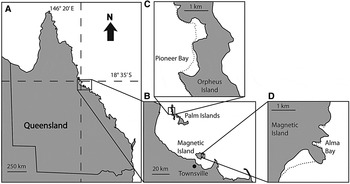
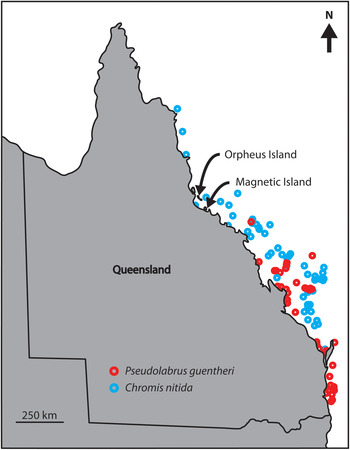
Visual observations were made using snorkel and SCUBA in Pioneer Bay, Orpheus Island in the Palm Island Group, on the northern GBR (Figure 1) and in Alma Bay, Magnetic Island, Townsville (Figure 1). Both have been surveyed since 1981; Magnetic Island only periodically, while Orpheus Island has been regularly surveyed on annual visits to Pioneer Bay since 1981 (by the second author D.R.B.). The observations reported herein represent the first known records for Pseudolabrus guentheri from the Palm Island Group and Townsville region of the GBR (Figure 2).
Site maps showing locations of Pioneer Bay and Alma Bay. Map adapted from Kramer et al. (Reference Kramer, Bellwood and Bellwood2012).


RESULTS AND DISCUSSION
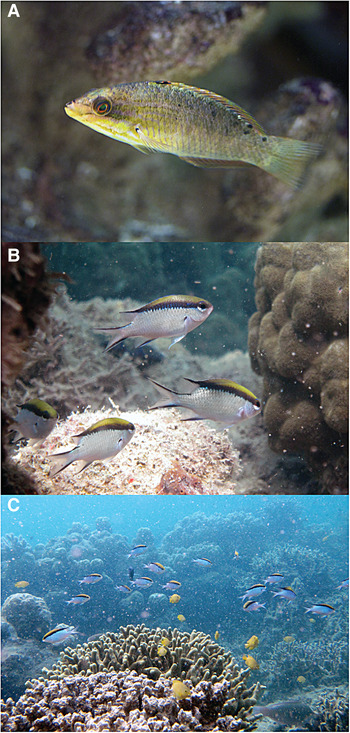
Günther's wrasse, Pseudolabrus guentheri (Labridae, Bleeker, 1862; Figure 3A) were first observed in Pioneer Bay, Orpheus Island and Alma Bay, Magnetic Island in November 2012. The species was common, with over ten individuals observed per hour of observation. Orpheus Island individuals were all recorded from the reef slope, crest and outer flat, 0–8 m deep (cf. Fox & Bellwood, Reference Fox and Bellwood2007). While the reef on Magnetic Island lacks the zonation seen at Orpheus Island, P. guentheri were observed in similar depths. All individuals observed were juveniles, less than 50 mm in length, suggesting that they had recruited within the last few months.
(A) Pseudolabrus guentheri (Labridae); (B & C) Chromis nitida (Pomacentridae), from Orpheus Island, northern Great Barrier Reef.

By April 2013 the population in both locations had declined, with only two individuals observed in over 12 hours of observations in Pioneer Bay, and none observed in Alma Bay. Summer temperatures above this species' tolerances may have led to population declines, either through direct physiological effects, or indirectly by affecting prey availability and/or resource requirements (Munday et al., Reference Munday, Leis, Lough, Paris, Kingsford, Berumen and Lambrechts2009; Feary et al., Reference Feary, Pratchett, Emslie, Fowler, Figueira, Luiz, Nakamura and Booth2013). However, the latter seems unlikely as this species is a generalist invertivore (Russell, Reference Russell1988) with ample prey available (Kramer et al., Reference Kramer, Bellwood and Bellwood2012).
The second species, the barrier reef chromis, Chromis nitida (Pomacentridae, Whitley, 1928; Figure 3B) has rarely been observed on the northern GBR (<10 observations; Figure 2; ALA, 2013; GBIF, 2013; OBIS, 2013). This species was first observed in Pioneer Bay in April 2011 yet unlike P. guentheri has not suffered population decline. In 2011 the population consisted of a few small colonies above branching corals. Since then it has become abundant throughout the bay (Figure 3C), and may play an important ecological role consuming tissue from coral disease lesions across Pioneer Bay (Nicolet et al., Reference Nicolet, Hoogenboom, Gardiner, Pratchett and Willis2013).
Why these two species moved to Pioneer Bay is unclear. Prevailing southwards currents on the GBR are important in driving poleward range extensions (Feary et al., Reference Feary, Pratchett, Emslie, Fowler, Figueira, Luiz, Nakamura and Booth2013), however, these currents can switch to run northwards in winter (Williams et al., Reference Williams, Wolanski and Andrews1984), perhaps driving reverse range expansions. In addition, the cool water temperatures in the winters of 2011 and 2012 may have facilitated settlement of larvae. However, the temperatures were not extraordinary. In the last decade, similarly cold winters occurred in 2007 and 2000 (AIMS, 2013), yet no movement of these species into Pioneer Bay was observed following these events. Cold water, it appears, is not the only factor involved in the range expansions reported herein. The ‘destination’ reefs must be suitable for the fish to both settle and survive and life history strategies that increase their chance of invading new habitats are important. Ultimately, the factors driving range expansions or marine vagrants, are likely to be manyfold, and largely stochastic. Only consistent monitoring can detect these events and observe the outcomes.
Increasing climate instability associated with global climate change may increase such incidences of marine vagrants, and in some cases, as with C. nitida, lead to the establishment of new populations of species in unexpected locations. However, as both cases highlight, movement due to climate change may not be the inexorable polar migration of tropical species. This may be the net result, but considerable short-term variability may also be expected (Feary et al., Reference Feary, Pratchett, Emslie, Fowler, Figueira, Luiz, Nakamura and Booth2013).
ACKNOWLEDGEMENTS
We thank the staff of Orpheus Island Research Station for field assistance. Funding from the Australian Research Council (to D.R.B.).