

Introduction
National identity, as some contend, has overshadowed all other identities and has become the key framework through which individuals identify themselves in their society (Longva Reference Longva1995). As a result, fraudulent practices against nationality are considered “severe moral misconduct”, the criminalization of which protects the integrity of the citizenship institution itself (Birkvad Reference Birkvad2023). In general, fraud is a generic term “that embraces all the multifarious means which human ingenuity can devise, which are resorted to by one individual, to get an advantage over another by false representations” (Albrecht et al. Reference Albrecht, Albrecht, Albrecht and Zimbelman2018:4). Citizenship fraud is a form of misrepresentation that involves acts exploiting a nation-state’s naturalization processes when the required prerequisites are unavailable or unmet (Lenard Reference Lenard2022). In this sense, citizenship fraud can be seen as a form of white-collar crime. Moreover, despite the complexities in defining white-collar crime, this article aligns with the Wheeler, Weisburd, and Bode (Reference Wheeler, Weisburd and Bode1982:642) definition, which describes it as “economic offenses committed through the use of some combination of fraud, deception, or collusion”.
Kuwait, an oil-rich Middle Eastern country located north of the Arabian Gulf, has historically faced issues of citizenship fraud stemming from various causes, not least the extensive benefits provided to its citizens. This situation has prompted longstanding concerns over national identity and the threats posed by citizenship fraud. Given the nature of this discourse, it is unsurprising that in March 2024 the Kuwaiti government launched a highly publicized campaign to decisively tackle this longstanding issue – one that poses a serious threat to national security and various aspects of Kuwaiti society. The paper’s current relevance lies in the need to develop a clear understanding of this issue.
Citizenship fraud has persisted in Kuwait since the establishment of formal nationality laws in 1959. Initial cases of fraud, some dating back to the early 1960s, have evolved into a pattern of chronic offending over time, spreading across generations. However, past efforts to identify illegitimate citizens have proven extremely difficult, particularly in the absence of biological evidence, such as deoxyribonucleic acid (DNA), with efforts at establishing kinship historically relying on testimony and unreliable genealogy. Lately, however, Kuwait has initiated what may be the most consequential reforms since the introduction of the Kuwaiti Nationality Act of 1959 (KN Act), which originally established the prerequisites for citizenship. These reforms have enabled the use of modern scientific methods, which are crucial to combatting this issue, resulting in significant breakthroughs in detection and enforcement. Led by the High Council for Investigations of Nationality (HCIN), extensive efforts have been made to investigate and verify the legitimacy of individuals suspected of not being legitimate citizens or descendants of Kuwaiti citizens. Consequently, thousands of individuals previously recognized as Kuwaitis have been discovered to be illegitimate nationals, with reports suggesting that many more cases are yet to be uncovered.
Beyond this analytical foundation, the study adopts a broader criminological lens to examine the mechanisms that enable citizenship fraud and its far-reaching implications for governance, national identity and policymaking in Kuwait. By demonstrating the Kuwaiti legal framework relevant to citizenship fraud and adopting a criminological approach to this type of fraud, the paper concludes by outlining potential future directions and the broader implications of this form of crime. As the first research article to thoroughly explore this issue, it fills critical gaps in the literature regarding fraudulent citizenship claims, as well as their underlying causes and consequences. Ultimately, this research offers a novel perspective on the intersection of fraud and the sociopolitical dynamics that drive it in the Middle East, highlighting both the challenges and opportunities for reform.
To achieve the paper’s objectives, the paper is organized as follows. The first section provides a brief review of the existing literature on citizenship fraud. The second section examines the historical context of citizenship fraud in Kuwait, the relevant legal framework governing nationality and common patterns of fraudulent claims. The third section analyses citizenship fraud through a criminological perspective, applying Cressey’s (Reference Cressey1953) Fraud Triangle to explain its occurrence.
Methodology: Limitations and Caveats
Given the sensitivity of the subject of citizenship fraud and the scarcity of references and reliable data, research in this area should be approached with caution and a clear awareness of its limitations. In Kuwait, where the issue is closely linked to national security in public discourse, the absence of official data presents a significant constraint. Available information is fragmented, primarily found in official statements, press releases, and a limited number of court rulings that address cases of citizenship fraud and the mechanisms that enable it. Therefore, from a reliability standpoint, it is essential to both clarify the methodology used to gather data in this study and to justify the rationale behind this approach.
This article primarily relies on statements from government officials and press releases. It also combines doctrinal legal analysis with the application of criminological theory to provide novel insights into this unique form of fraud, one rarely seen in other nations. To that end, a systematic document analysis was employed to gather and select relevant news articles and government statements on the issue. This was exclusively conducted in the context of Kuwait.
Source selection criteria encompassed materials published only in nationally recognized Kuwaiti news outlets (e.g. Al-Qabas, Al-Rai and Al-Anba), as well as official government statements issued by agencies responsible for investigating occurrences of citizenship fraud (e.g. the Ministry of Interior and the HCIN). Moreover, articles and statements published between 2015 and 2025 were prioritized, providing both recent and semi-recent coverage leading up to the campaign by the HCIN. Digital archives of the selected newspapers, as well as government press releases, were compiled and synthesized to provide a comprehensive account of cases of citizenship fraud.
It should also be noted that this paper adopted an exclusion criterion: it excluded articles that were (1) purely editorial or opinion-based, (2) redundant information covered by other primary sources and (3) lacked identifiable dates or sources for the claims made. The selected materials were ultimately organized chronologically and thematically analysed, categorizing the information into legislative context, case examples, enforcement methods and government actions. Furthermore, instances of citizenship fraud included in the data collection only encompass cases that have been officially established either through (1) investigative work conducted by official government agencies – proving the occurrence of citizenship fraud beyond a reasonable doubt using biological evidence (e.g. DNA) or through investigations concluding with the perpetrators’ admission of the crime – or (2) cases substantiated by court judgments.
Citizenship Fraud: A Global Issue
Citizenship fraud is a significant issue faced by many countries worldwide, often prompting stringent immigration policies and legal reforms aimed at deterring the exploitation of nation-states (Lenard Reference Lenard2022). Countries like Canada, the United Kingdom and the United States (US) have recurringly encountered challenges like those currently facing Kuwait. More recently, the US addressed citizenship fraud through a 2018 initiative known as Operation Janus (see US Department of Justice 2018). This operation, one of the most comprehensive reviews of citizenship records undertaken by the Department of Justice, utilized fingerprint digitization to examine 315,000 cases (see Nicas and Benner Reference Nicas and Benner2020). The review uncovered over 2,500 instances of citizenship fraud. Another recent instance occurred in 2020, when the US began focusing on denaturalizing individuals who had acquired citizenship through fraudulent means, such as by submitting false information.
Similarly, in Ireland, individuals with Irish-born parents or grandparents can claim citizenship through ancestry, as established by the 1998 Good Friday Agreement. While this provision grants access to one of the world’s most highly valued passports, it has also created opportunities for fraudulent claims by individuals with little or no genuine connection to Ireland. This fraud was facilitated by Ireland’s historical reliance on parish records, such as marriage certificates, which are easier to forge than centralized civil records (An Garda Síochána 2015). Similarly, research presented to the British House of Commons revealed 550 cases of fraud between 2010 and 2021, leading to deprivation orders revoking citizenship (McKinney, Gower, and McGuinness Reference McKinney, Gower and McGuinness2024), while in Norway, the government exerted efforts to expose “citizenship cheaters” under the guise of the 2015–2016 refugee crisis (see Birkvad Reference Birkvad2023).
Instances of post-colonial identity fraud have also been well-documented, particularly in Africa, where disputes over national identity and citizenship are a recurring issue. The disorganized nature of post-colonial states has often left citizenship contested, providing fertile ground for fraud and corruption. Individuals frequently manipulate national identities to navigate bureaucratic systems or claim rights to which they are not entitled (Fadakinte and Amolegbe Reference Fadakinte and Amolegbe2017). This underscores the critical role that disorganization plays in propelling occurrences of citizenship fraud. Similarities can be drawn to Kuwait’s struggles after the 1990 Gulf War, where critical government institutions were rendered practically dysfunctional (Cordesman Reference Cordesman1997), providing fertile ground for criminal acts, such as citizenship fraud.
Also relevant to this study is the intersection of citizenship fraud and the subsequent welfare fraud it often enables, a topic that has been extensively explored in the literature. DeVoretz and Irastorza (Reference DeVoretz, Irastorza, Shachar, Bauböck, Bloemraad and Vink2017), for example, examined the broader economic implications of citizenship fraud, arguing that while naturalization offers economic benefits to individuals and host countries, these benefits are undermined by fraudulent acquisitions. They highlighted how such cases increase enforcement costs, reduce legitimate tax revenue and fuel public resentment toward immigrants, ultimately destabilizing social cohesion and economic stability. Similarly, Todorović, Tomaš, and Todorović (Reference Todorović, Tomaš and Todorović2020) investigated the relationship between fraud, the rule of law and national integrity, emphasizing the significant loss of public resources as a consequence. They argued that the economic implications of fraud extend beyond immediate financial losses, making a severe impact on the long-term economic health of nations and eroding public trust in governance and institutions. While indirectly related, Kedia and Philippon (Reference Kedia and Philippon2009) examined how fraudulent activities distort the allocation of economic resources, resulting in significant disruptions in economic markets. When citizenship is exploited, it not only compromises the integrity of the economic resources provided by nations but also undermines the stability of economic systems as a whole (Johnston Reference Johnston2013).
Social justice has also been closely tied to a state’s ability to establish control and enforce laws against crimes such as citizenship fraud. While the study of Aryee, Budhwar, and Chen (Reference Aryee, Budhwar and Chen2002) primarily addresses organizational aspects of crime prevention, its principles are relevant to understanding the broader societal impacts of citizenship fraud. When such fraud becomes widespread, it can lead to a breakdown of trust in governmental and social institutions, as citizens perceive themselves to be exploited by white-collar criminals. This erosion of trust undermines social stability and diminishes public confidence in the institutions responsible for their protection (Martin Reference Martin2021). The sociological implications of citizenship fraud extend to societal perceptions of morality and ethics. Orosz and Roland-Lévy (Reference Orosz and Roland-Lévy2013) argue that such fraud hurts societal representations of competition and fairness, suggesting that the moral fabric of society is compromised. This erosion of morality can, in turn, lead to a normalization or justification of fraudulent behaviours as individuals perceive others engaging in similar acts. Such shifts in moral standards have far-reaching effects, influencing societal values and norms over time.
Citizenship Fraud: The Case of Kuwait
A Gulf Cooperation Council (GCC) country bordering both Saudi Arabia and Iraq, Kuwait’s history traces back to the early eighteenth century. Once a small fishing and trading settlement, its strategic location established it as a pivotal centre for maritime trade, connecting the Arabian Peninsula to prominent trading regions such as India, Africa and the Levant. Prior to the discovery of oil, Kuwait was characterized by a tribal society composed of local Kuwaitis and a significant number of immigrants from the broader Arabian Peninsula, including Iraq, Hejaz and other Gulf regions (Al-Nakib Reference Al-Nakib2016). Citizenship at the time was informally determined based on tribal affiliations, area of residence and customs rather than a formal legal framework.
The discovery of oil in 1938 drastically transformed Kuwait into one of the world’s wealthiest nations, gaining full independence from British protection in 1961 (Crystal Reference Crystal2016). This discovery led to Kuwait’s growing economic power, which in turn increased its demographic complexity and highlighted the need for a clear and defined national identity. In response, the KN Act was enacted in 1959, establishing the legal foundation for distinguishing between nationals and migrants in Kuwait (for a more detailed historical account of citizenship in Kuwait, see Longva Reference Longva1995). Today, Kuwait plays a significant role in regional and international affairs, occasionally serving as an intermediary in regional affairs. Highly prosperous yet sparsely populated, Kuwait’s governance is based on a welfare-oriented social contract with its citizens, predominantly funded by its abundant oil reserves (Al-Nakib Reference Al-Nakib2013). As a result, Kuwait boasts one of the highest standards of living currently found in the world, providing numerous benefits to its nationals.
To contextualize citizenship fraud in Kuwait, this section addresses two key aspects of the issue. First, it briefly outlines the legal framework governing nationality as set out in the KN Act of 1959. In line with the scope of this paper, the analysis is confined to fraud-related citizenship deprivation, deliberately excluding other legal bases, such as dual nationality or contraventions of statutory provisions. Second, it examines the prevalent and unique patterns of fraud in Kuwait, particularly cases of fraudulent registration of non-Kuwaitis as citizens. Also, it explains the institutional measures adopted by the Kuwaiti government to address such fraud. Together, these aspects provide a comprehensive understanding of citizenship fraud in Kuwait, which is essential for any criminological analysis of the issue.
The Legal Framework of Nationality
The KN Act of 1959 is the primary law governing nationality in Kuwait, replacing the 1948 Act due to its limitations. The KN Act has undergone several amendments, the latest in December 2024, and reflects both domestic considerations and international principles. Under Kuwaiti law, matters of nationality are classified as acts of government, rendering them high-level political decisions that are beyond judicial review. The KN Act grants the government the authority to revoke citizenship in cases such as dual nationality, espionage and fraud. The focus, however, will be on fraud-based revocation. As fraud-based revocation may take different forms, this paper – as will be demonstrated later – focuses specifically on a unique type of fraud in Kuwait: fraudulent registration as a Kuwaiti by the establishment (“original Kuwaiti”). Unlike denaturalization, this fraud results in the withdrawal of the certificate, a legal measure restoring the status quo rather than imposing punishment.
The KN Act defines “original Kuwaitis” as those whose ancestors resided in Kuwait before 1920. The law primarily follows the principle of jus sanguinis (citizenship by descent), granting automatic citizenship to those born to a Kuwaiti father. Jus soli applies only to foundlings and those born in Kuwait to unknown parents. Limited naturalization pathways exist, including long-term residence or exceptional service to the country. The 116/2024 amendment removed naturalization eligibility for Kuwaiti citizens’ wives and children of Kuwaiti mothers, citing national security and demographic concerns. While the KN Act distinguishes between denationalization, denaturalization and withdrawal of a certificate, this paper focuses on the latter, which applies when fraudulent registration as an “original Kuwaiti” is proven.
According to Article 21bis A, the Council of Ministers, upon the recommendation of the Interior Minister, withdraws the citizenship certificate if it was obtained fraudulently. Unlike denaturalization, this measure does not require an explicit decision to revoke nationality; it nullifies the fraudulent status retroactively. From a criminal law perspective, providing false information during naturalization or registration is a criminal offence under Article 21bis B of the KN Act. Fraudulent representation is also classified as forgery under Article 275 of the Kuwaiti Criminal Law Act 16/1960. This framework reflects Kuwait’s broader efforts to protect its national identity, uphold security and regulate matters of nationality.
Patterns of Citizenship Fraud and the Institutional Arrangements
Citizenship fraud frequently involves two key components: (1) the participation of at least two or more individuals – one being a current Kuwaiti citizen at the time of the fraud and the other(s) non-citizen(s); and (2) the intent to engage in fraudulent activities aimed at falsely registering non-citizens without the knowledge of the Kuwaiti state. Citizenship fraud can take various forms. As mentioned earlier, the focus will be on specific methods of citizenship fraud that have emerged and been revealed by real-world events. In Kuwait, the predominant modus operandi of citizenship fraud has been forgery, primarily through the exploitation of infant registration by falsely registering foreign newborns as Kuwaiti infants born overseas or as alleged home births.
As preventive interventions often proved to be unreliable (e.g. confirmatory questioning), previous governmental procedures did not effectively verify the legitimacy of these claims, hence their widespread use among those seeking to engage in this type of fraud. In 2015, following a terrorist attack, the DNA Act 87/2015 was enacted to assist domestic authorities, including the courts, in identifying suspects. Although the scope of the Act was broad enough to include other purposes, such as establishing paternity in matters of nationality, the Ministry of Interior stated that it would not be used for paternity-related matters (Al-Khalifa Reference Al-Khalifa2019). However, the Act was ultimately unsuccessful, as it was constitutionally challenged and subsequently declared unconstitutional in 2017 (Constitutional Court, Case Number 6-9/2017, dated 29 October 2017).
High-profile court cases have shed light on the details surrounding these fraudulent methods and those participating in them (e.g. Supreme Court, Case Number 669/2007, Criminal Division, dated 4 August 2008; Supreme Court, Case Number 167/2012, Criminal Division, dated 17 February 2023). Al-Watan (2020), a reputable Kuwaiti news outlet, reported on several peculiar cases of citizenship fraud predating the current campaign. In one instance, a man falsely registered a “son” who was just 11 years younger than him, implying he had fathered the child at the age of 11 years old. It was later revealed that he had falsely registered the individual and others as his own, paying little heed to the diligence required for the enactment of his crimes.
In another case, a Kuwaiti gentleman claimed to have fathered 21 children, all of whom had distinct and varying physical appearances, raising suspicions (Al-Watan 2020). Upon further investigation, it was revealed that he had accepted 40,000 Kuwaiti dinars (KWD) (approximately US$130,000) in payments for his role in this scheme, as well as demanding lifelong payments of KWD 200 (approximately US$650) from government salaries that he had unrightfully collected. He was sentenced to 10 years in prison and fined an exorbitant sum, while the fraudulent citizenships were revoked.
In a separate incident, eight individuals fraudulently registered as children of a Kuwaiti man attempted to exclude their alleged mother from her late husband’s inheritance while knowing they were not his biological children. After her appeals with them failed, she provided undeniable evidence to members of law enforcement proving their illegitimate citizenship: documents proving her late husband to have been infertile. All eight “children” were sentenced to 10 years in prison and had their citizenships revoked. A recent forgery case was uncovered involving a Kuwaiti citizen born in 1957 who had fraudulently registered 74 individuals (including children and grandchildren) as citizens after Kuwait’s invasion in 1990, taking advantage of the disorganization caused by the war’s aftermath (see Lexis Middle East 2025).
Cases of citizenship fraud have also involved Kuwait’s Homeland Security Agency directly. In 2016, a tip was provided to authorities regarding two Kuwaiti citizens who were fraudulently added to a Kuwaiti national’s file in exchange for large sums of money at the time. After questioning, they admitted to this truth; however, it was later revealed that the son of one of these illegitimate citizens was an active agent in Kuwait’s Homeland Security Agency, raising concerns about the national security implications of undiscovered illegitimate citizens on Kuwait’s national security (Al-Qabas 2022).
The destructive nature of citizenship fraud has affected individuals who are often unaware of the historical acts of fraud committed by their ancestors. In 2018, 250 individuals had their citizenship withdrawn after authorities uncovered cases of citizenship fraud dating back to the early 1960s (Burgan News Reference News2018). Seven non-citizens were fraudulently listed as newborns by Kuwaiti citizens. These non-citizens continued their lives as Kuwaiti members of the public, siring up to three generations of individuals, many of whom had no idea that they were illegitimate citizens until authorities discovered them.
The previous examples of citizenship fraud cases preceded Kuwait’s recent campaign to combat citizenship fraud, one which seeks to remedy the problem in a broader and more direct method. In response to the escalating nature of the problem and its debilitating effects on various aspects of Kuwaiti society, efforts were made to address the citizenship crisis decisively, culminating in the re-establishment of the HCIN by Amiri Decree No. 75 of 2024 (Kuwait News Agency 2024). Extensively backed and funded, the HCIN swiftly intensified investigations of citizenship fraud in Kuwait. These investigations primarily involved revisiting previously resolved cases with suspicious circumstances and examining previously uninvestigated claims of citizenship fraud, utilizing modern methods of identification, including biometric analysis and advanced DNA analysis (Al-Mohaisin and Al-Magamis Reference Al-Mohaisin and Al-Magamis2024). Recent statements from the Director of Investigations at Kuwait’s High Directorate of Nationality revealed the discovery of cases dating back 40 to 50 years, highlighting the longstanding nature of this issue (Al-Mohaisin and Al-Magamis Reference Al-Mohaisin and Al-Magamis2024).
One of its first acts included the establishment of a dedicated hotline for reporting potential cases of citizenship fraud (Ministry of Interior 2024). Many reports stem from the fraudulent use of family names belonging to legitimate Kuwaiti citizens who have historically resided in Kuwait, with newly unaccounted members and lineages appearing suspiciously. In a recent interview with the Kuwait News Agency, the Deputy Director of Nationality at the Ministry of Interior expressed surprise at the volume of reports received, noting that 1,011 calls had been made to the hotline since its installation in May 2024 (Al-Salamah Reference Al-Salamah2024). Considered to be one of their first prominent findings, 310 individuals were investigated and deemed to be of Syrian origin rather than Kuwaiti in 2024 (Arab Times Reference Times2024). This fraud involved the forging of birth certificates abroad, where illegitimate children were falsely registered as twins to legitimate Kuwaiti newborns, a commonly recurring method of fraud confirmed by government officials during a televised “60 Minutes” segment (Al-Anba 2024).
Another significant case involved the revocation of 132 fraudulent citizenships following extensive forensic investigation. DNA testing confirmed that these individuals shared no ancestral lineage with any Kuwaiti citizens, particularly with the family members they had informed investigators they shared ancestry with (Al-Mohaisin and Al-Magamis Reference Al-Mohaisin and Al-Magamis2024). Similarly, 15 individuals, previously considered to be legitimately sired by a single father, were all deemed to be illegitimate. Upon investigating this case, the father admitted to engaging in fraud due to familial obligations. Biological testing linked them to individuals from other Arab countries and non-citizens (Al-Rai 2025). These cases serve to highlight the effective use and reliance on forensic science and advanced investigative techniques to address citizenship fraud that was previously considered inconclusive.
Criminology of Citizenship Fraud
Citizenship fraud is rightfully considered a form of fraud since the latter encompasses all behaviours whose commission depends on deception (Button and Gee Reference Button and Gee2013). In particular, citizenship fraud involves all the elements of fraud: the representation of a material point that is false, and intentionally or recklessly so, which is believed and acted upon by the victim to the detriment of the victim (Albrecht et al. Reference Albrecht, Albrecht, Albrecht and Zimbelman2018). However, what distinguishes citizenship fraud from other forms of fraud (e.g. corporate fraud) is that the victim, in this case, is the state – or, more dramatically, the entire citizenry of the nation-state. In this sense, citizen fraud closely resembles “benefit fraud”, not least that both forms of fraud cheat the government and target public resources. While benefit fraud involves individuals defrauding social security systems to obtain benefits that they are not entitled to, citizenship fraud (in Kuwait specifically) also involves, among others, illicitly obtaining the financial privileges given to Kuwaiti citizens. Despite the variation in scope between these types of fraud, this comparison suggests that criminological studies on benefit fraud (e.g. Tunley Reference Tunley2011) or welfare fraud can be applied to the context of citizenship fraud. This approach might also serve as a jumping-off point for future research.
Understanding citizenship fraud as a crime should be rooted in relevant criminological theories. Literature on fraud often incorporates criminological theories to explain its causes and the environments that facilitate its occurrence (e.g. Saluja, Aggarwal, and Mittal Reference Saluja, Aggarwal and Mittal2021). Wells (Reference Wells2017), the founder of the Association of Certified Fraud Examiners, states that much of the existing literature on fraud relies on the work of Edwin Sutherland (Reference Sutherland1947). Fraud has also been studied within the broader subject of “white-collar crime” and its associated derivations, such as “corporate crime” and “crimes of the powerful” (Button and Tunley Reference Button and Tunley2015:49). Furthermore, environmental criminological theories, such as rational choice and routine activity (e.g. Wortley and Townsley Reference Wortley and Townsley2017) and situational crime prevention (e.g. Clarke Reference Clarke1983), are also helpful in providing a framework to understand how different types of crime can take place and be prevented, including fraud (e.g. Benson, Madensen, and Eck Reference Benson, Madensen, Eck, Simpson and Weisburd2009).
Other theories have also developed frameworks to specifically understand fraud, each providing unique perspectives that help differentiate fraud from other financially motivated offences, such as theft and robbery. Among these theories or frameworks, Cressey’s (Reference Cressey1953) Fraud Triangle is one of the most prominent in addressing fraudulent acts of deviance. As Tickner and Button (Reference Tickner and Button2021:722) found, the Fraud Triangle represents a “stalwart” of training courses for fraud investigators and, until 2021, the Triangle has been cited in 8,584 studies and papers (see also Button and Gee Reference Button and Gee2013). However, the Triangle has since undergone revisions. For example, Dorminey et al. (Reference Dorminey, Fleming, Kranacher and Riley2012) traced the evolution of subsequent relevant models, such as the Triangle of Fraud Action, the Fraud Scale, M.I.C.E., the Fraud Diamond, the A-B-C analysis and the predator versus accidental fraudster models, and discussed the enhancements to the Triangle as suggested by each of these models.
Despite the criticism directed at the Triangle and its limitations as identified in the literature, this paper argues that Cressey’s (Reference Cressey1953) Triangle still provides a plausible explanation for citizenship fraud in Kuwait. This is so despite two facts: the first is that citizenship fraud is not an occupational crime; and the second is that citizenship fraud does not confer trust on the part of the fraudster. The latter fact is important to consider, as Tickner and Button (2021:729) argue that the current application of Cressey’s Triangle is “an extension and distortion of the original intentions of Cressey’s work”. The following subsections discuss only the key elements of Cressey’s Triangle before proceeding to examine its applicability to the Kuwaiti case of citizenship fraud.
Cressey’s Fraud Triangle
Influenced by prominent criminologists, such as Merton (Reference Merton1938) and Sutherland (Reference Sutherland1947), Cressey (Reference Cressey1953) argued that crime is a complex phenomenon shaped by various psychological and situational factors. He believed these concepts were particularly relevant to understanding acts of fraud. Building on these ideas, Cressey (Reference Cressey1953), in Other People’s Money, developed a theory that remains the classic model for the occupational offender (Wells Reference Wells2017:7). He posited that fraud occurs when three key components converge: (1) motivations/pressure; (2) opportunity; and (3) rationalization. Over time, his hypothesis has come to be known as the “Fraud Triangle” Albrecht Reference Albrecht1991).
The first component, pressure, refers to the motivations or incentives driving individuals to commit fraud: in Cressey’s (1953:34) words, “when they conceive of themselves as having a financial problem which is non-sharable … [which] can be secretly resolved” (for more on the non-sharable problem, see Wells Reference Wells2017:8). These pressures can arise from various sources, such as financial difficulties, unrealistic expectations or personal challenges (Machado and Gartner Reference Machado and Gartner2017). For instance, employees may engage in fraud to cover financial obligations or maintain lifestyles they otherwise cannot afford. Research has shown that this element effectively explains potential victimization by fraud (Saluja et al. Reference Saluja, Aggarwal and Mittal2021). It should be noted that some might question whether the offender faces genuine financial pressure. However, what matters in determining pressure is the potential offender’s perception of it, which could motivate them to commit fraud (Albrecht et al. Reference Albrecht, Albrecht, Albrecht and Zimbelman2018).
The second component, opportunity, pertains to circumstances that enable individuals to commit fraud. Weaknesses in internal controls, inadequate security measures or insufficient oversight often create environments conducive to fraudulent activities (Finnerty, Hegde, and Malone Reference Finnerty, Hegde and Malone2016). For example, Ireland’s challenges with verifying legitimate citizenship applications due to outdated and easily forged documents illustrate how such vulnerabilities facilitate fraud. Studies underscore the importance of robust internal controls as significant deterrents, emphasizing the need for preventive measures to counter potential threats (Nugraha and Susanto Reference Nugraha and Susanto2018).
The final component, rationalization, involves the cognitive processes that allow individuals to justify their fraudulent actions. This involves reconciling unethical behaviour with personal values, leading perpetrators to believe their actions are warranted under certain circumstances (Muhsin, Kardoyo, and Nurkhin Reference Muhsin and Nurkhin2018). The process of rationalization is consistent with the assumption, according to Cressey (Reference Cressey1953), that most people who engage in occupational fraud are first-time offenders and are not considered lawbreakers (Wells Reference Wells2017). For example, cases of benefits fraud in Sweden have shown how individuals dissatisfied with reduced welfare benefits – due to an influx of migrants – rationalize their actions by assuming fake identities to collect double benefits. Understanding these rationalizations is critical for designing effective deterrents to fraud (Skousen, Smith, and Wright Reference Skousen, Smith, Wright, Hirschey, John and Makhija2009).
By examining these three components, Cressey’s (Reference Cressey1953) framework provides a powerful tool for analysing the conditions that enable citizenship fraud in Kuwait. It offers a structured platform to identify the underlying motivations, exploiting opportunities and rationalizations that drive such fraud, enabling policymakers and organizations to design targeted interventions that actively deter these activities.
The Fraud Triangle and Citizenship Fraud in Kuwait
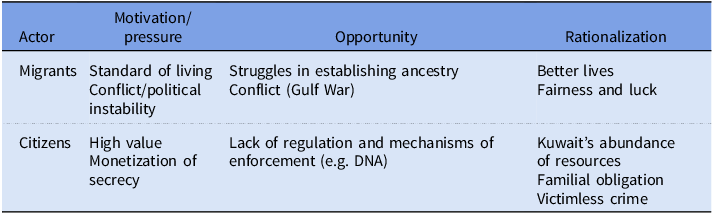
This subsection examines the insights that criminological theories of fraud can provide regarding citizenship fraud in Kuwait, with a particular focus on the applicability of the Fraud Triangle. It explores how the existing literature can be leveraged to both understand and prevent the fraudulent acquisition of citizenship in Kuwait. The three elements of the Fraud Triangle – motivation, opportunity and rationalization – will be analysed regarding both migrants and citizens (see Table 1). Fraud committed by migrants typically involves non-Kuwaitis falsely registering themselves or their children as Kuwaiti citizens. Conversely, fraud committed by citizens often entails a Kuwaiti unlawfully registering non-relatives as family members to secure citizenship benefits.
Application of the Fraud Triangle to citizenship fraud in Kuwait

By applying the Fraud Triangle framework, this discussion aims to elucidate the underlying drivers of citizenship fraud and propose strategies for mitigating such practices. As the Triangle’s elements “can be thought of as value- and culture-driven” (Homer Reference Homer2020:179), the discussion not only addresses these key elements from an individualistic perspective, but is also reinforced by, and takes into account, broader structural factors unique to the Kuwaiti context. Incorporating a structural-level analysis ensures a comprehensive understanding of the citizenship fraud phenomenon in Kuwait. Cieslewicz’s (Reference Cieslewicz2012:214) study on fraud in China, for example, argued that, in order to understand fraud in an international context, it is important to consider “societal-level influences – including philosophical and religious tradition, culture, social norms, and societal conditions such as the rule of law, political climate, and socioeconomic factors”. Structural factors, as outlined in Table 1, will form part of the analysis.
Motivations/Pressure
Motivations differ significantly between migrant and citizen actors in this component of the Triangle, as each group has unique incentives for engaging in this “distinct” form of fraud. “Distinct” is used intentionally here to refer to citizenship fraud as a form of fraud that does not occur in an occupational context. The motivations range from the status and extensive benefits associated with Kuwaiti citizenship to the pursuit of financial gain. In Kuwait, as in other GCC countries, the establishment of a welfare state system is closely tied to being a “national” entity, offering considerable material benefits (Beaugrand Reference Beaugrand2006). To fully explore these aspects, we will discuss each group separately.
Throughout this paper, the motives associated with citizenship benefits are highlighted as a central source of benefit for both migrants and citizens alike. These benefits can be economic, such as higher wages and state-provided services, or socio-political, such as increased security and stability. While these motivations can be analysed separately, they often intersect, especially in the Middle East, where socio-political upheavals have historically shaped standards of living. The region has experienced over 50 conflicts since 1945, many of which have had lasting impacts on its economic and social conditions (Milton-Edwards and Hinchcliffe Reference Milton-Edwards and Hinchcliffe2001). Over the past three decades, this turbulence has led to below-average living standards in many countries, further exacerbated by limited opportunities for legal immigration. This is particularly true in the prosperous GCC countries, including Kuwait, where immigration pathways are notably restrictive. This creates a stark contrast between nations that are geographically close yet significantly different in terms of socio-economic conditions, political stability and overall quality of life (Alvarado, Assouad, and Piketty Reference Alvarado, Assouad and Piketty2019).
Despite sharing cultural, linguistic and historical ties, countries in the Middle East exhibit significant disparities in wealth distribution, governance structures and access to essential services. The oil-rich GCC states, for instance, have leveraged their vast natural resources to build high-income economies, offering citizens extensive social benefits, robust infrastructure and a relatively high degree of security. In contrast, many of their neighbouring countries struggle with economic instability, political volatility and, in some cases, ongoing conflicts that hinder development and exacerbate poverty (Khouri Reference Khouri2019). The uneven distribution of economic and political advantages underscores a broader regional divide where opportunity, security and prosperity remain unequally distributed despite shared cultural dynamics. This division reinforces structural inequalities and highlights the complexities of migration, identity and statehood within the Middle East.
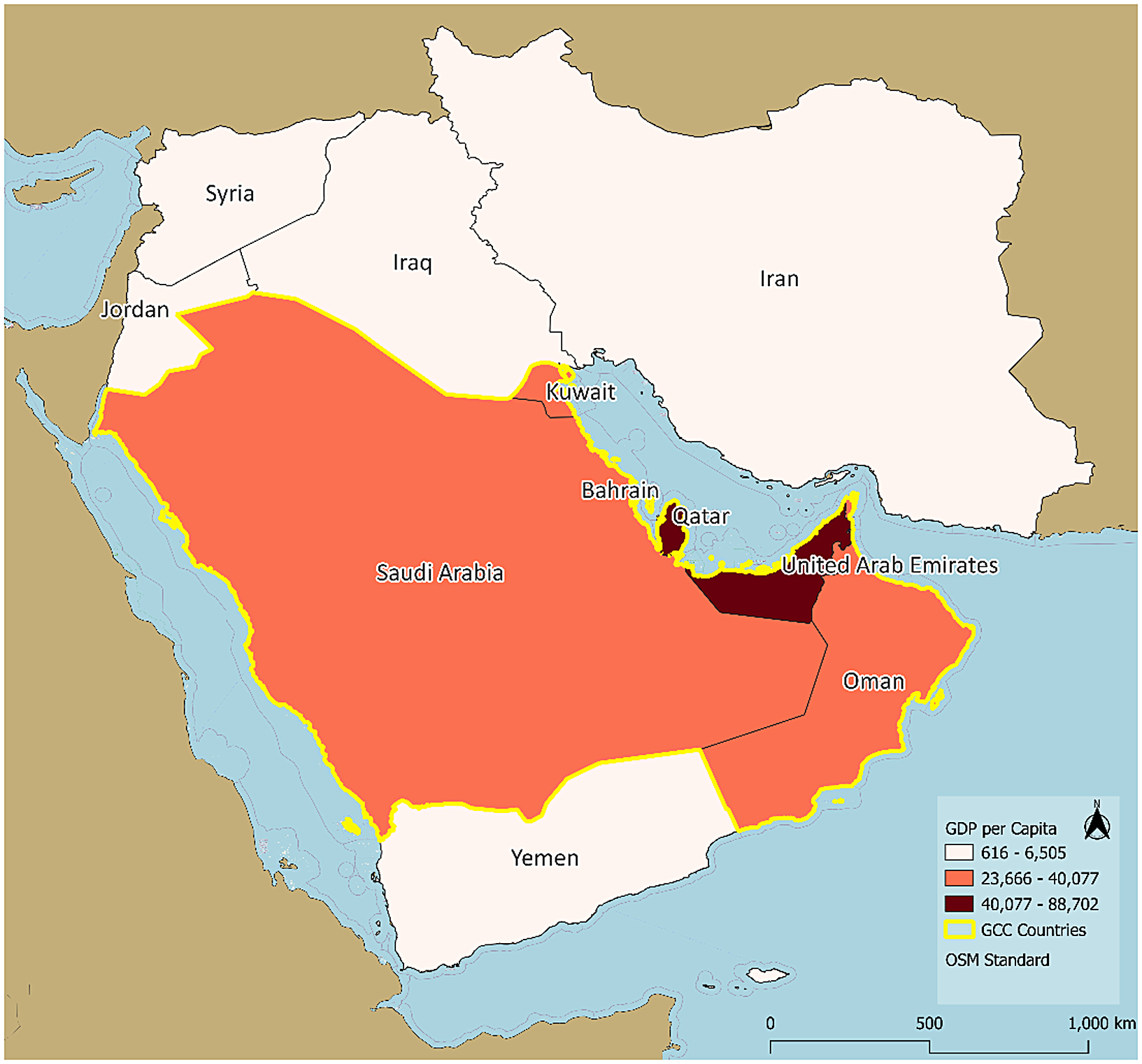
In Kuwait, the financial appeal of citizenship is substantial, as seen by the significant discrepancies in gross domestic product (GDP) per capita between neighbouring Gulf countries and other countries within the region (see Figure 1). According to the World Bank Group (2025), Kuwait’s GDP per capita ranks as the third highest among GCC nations and 44th worldwide. The average public sector wage for citizens is KWD 1,583 (US$5,151) per month (Kuwait Times Reference Times2024), and the total annual value of state-provided services and salaries for a single individual reaches approximately US$79,112 (KWD 24,283), one of the highest globally (Al-Seyassah 2024). These benefits are a significant motivator for migrants seeking to engage in fraudulent schemes to gain citizenship.
Gross domestic product (GDP) per capita of Gulf Cooperation Council (GCC) countries (bordered in yellow) and neighbouring non-GCC countries in 2022 (World Bank Group 2025). OSM, OpenStreetMap.

For Kuwaiti citizens involved in these schemes, the primary motivation is substantial financial gain. Documented cases indicate payments of up to KWD 12,000 (US$40,000) per individual for facilitating such fraud (detailed in the “Patterns of Citizenship Fraud and the Institutional Arrangements” subsection). Additionally, these schemes create opportunities for further financial exploitation through blackmail. Citizens involved may threaten to expose the fraudulent status of migrants unless they pay recurring sums, perpetuating a cycle of extortion. This dynamic is further reinforced by the precarious position of fraudulent citizens themselves, as they risk severe consequences if the blackmail they are subjected to is revealed. As a result, an endless mechanism of exploitation remains in place.
Opportunity
Opportunity stands out as the only consistent component among our groups, as its explanations apply equally to both citizens and migrants. Benson et al. (Reference Benson, Madensen, Eck, Simpson and Weisburd2009) argue that all forms of white-collar crime have their own “opportunity structure”: conditions and situations that should exist in order for a crime to be committed. While citizenship fraud might not necessarily align with Sutherland’s (Reference Sutherland1947) definition of white-collar crime or be classified as an occupational crime, the logic of opportunity structure remains applicable. This type of fraud involves the use of deception and collusion to exploit available opportunities. In the context of Kuwait, the opportunity structure for citizenship fraud often revolves around legal loopholes and challenges (discussed above), weak law enforcement and the historical context of regional conflicts, which collectively contribute to the availability of opportunities for engaging in citizenship fraud.
Many attribute some of the older cases of citizenship fraud to the early state of Kuwait’s modernization efforts, particularly after the issuance of the KN Act. This early endeavour to establish citizenship proved to be incredibly difficult, with many exploiting Kuwait’s recently established riches at the time as an opportunity to feign ancestry. As the explanatory memorandum of the KN Act refers, this was further exacerbated by the nature of Kuwaiti society at the time, with many of its inhabitants coming from nomadic backgrounds and having spent most of their lives in Kuwait’s deserts. As such, establishing residency proved to be very difficult, allowing non-inhabitants to feign Kuwaiti residency in order to attain citizenship.
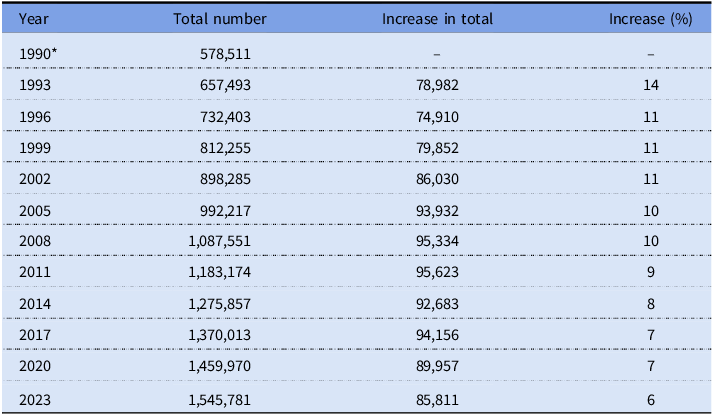
The most prominent evidence stems from the aftermath of Kuwait’s liberation following the Gulf War of 1990. The upheaval and disorganization during this period are often cited as pivotal factors in the prevalence of citizenship fraud. Notably, suspicions have been raised about the disproportionate increases in Kuwait’s citizen population during the 1990s, as growth rates consistently exceeded 10% (per three years) before the turn of the millennium, peaking at 14% in 1993 – a year closely following the Gulf War (see Table 2). By comparison, the current global average population growth rate over three years is approximately 4% (World Bank Group 2025), whereas Kuwait’s stands at 6%, half of its post-war peak growth rate of 14% per three years (Central Statistical Bureau 2024; Public Authority for Civil Information 2024). This starkly contrasts findings in the literature examining the impacts of war on population dynamics. Studies consistently conclude that war and its aftermath typically result in significant declines in population size and growth rates rather than the opposite (Kulu et al. Reference Kulu, Christison, Liu and Mikolai2023; Park Reference Park2014; Zhang et al. Reference Zhang, Lin, Nonaka and Beom2005).
Total number of Kuwaiti nationals from 1990 to 2023

Note: Included in the table is a detailed breakdown of the total number of Kuwaiti nationals, the numerical increase in their population and the percentage growth for every three-year interval (Public Authority for Civil Information 2024; Central Statistical Bureau 2024).
* The year in which the Gulf War occurred, starting August 1990 and ending February 1991.
A significant factor contributing to the persistent issue of citizenship fraud in Kuwait lies in the state’s ineffective administrative mechanisms. The delayed adoption of digitization compounds this inefficiency, as the state continues to rely on physical folders and files to maintain citizenship records. Such physical records are inherently vulnerable to manipulation, compromising the authenticity of documentation. Furthermore, past procedures aimed at investigating and enforcing possible cases of citizenship fraud exhibited many weaknesses. An example is the method by which fraudulent migrants, mainly newborns, were established as legitimate and genuine. Citizens bringing their newborns who had been born outside of Kuwait were required to refer to the Office of Citizenship Investigations to prove the validity of their newborns. However, due to issues with legislation (as mentioned above), requesting biological proof of fatherhood was disallowed, forcing investigators to proceed without it.
Moreover, past investigations into instances of citizenship fraud have proven challenging to both conduct and resolve. This difficulty stems primarily from the evidentiary standards required by courts. Judges often demand incontrovertible proof, such as individuals admitting to fraudulent activities or official records being undeniably shown as tampered with. However, such evidence is rarely attainable. Attempts to employ logical methods, such as DNA testing to verify ancestry and citizenship, have been rendered ineffective – either because such methods are sometimes deemed inadmissible in court or because they have faced challenges on religious (Sharia) grounds, such as the existence of contradictory Islamic legal opinions (fatwas) regarding the admissibility of DNA evidence (Al-Khalifa Reference Al-Khalifa2019). For example, in 2008, the Kuwaiti Family Court decided that DNA “does not constitute valid Sharia evidence for establishing or denying paternity. Moreover, it contradicts the established Islamic legal principle that paternity is confirmed through marriage (al-firāsh), acknowledgment (iqrār), or legal testimony (shuhūd)” (Supreme Court, Case Number 38/2008, Family Division, dated 23 October 2008). This limitation has probably hindered efforts to identify and address cases of fraudulent citizenship.
It should, however, be noted that recent changes to the legislation have increased the admissibility of DNA evidence during court proceedings related to citizenship fraud. Article 20 of the KN Act, as amended in Act 116/2024, stipulates that “scientific evidence may be used to grant, withdraw, or revoke citizenship, in accordance with the regulations issued by the Minister of Interior”. Following the amendment, the Minister of Interior issued Resolution 678/2025, which stipulated the principles and regulations governing the use of modern scientific methods in the granting, withdrawal, loss or revocation of Kuwaiti nationality.
Rationalization
Lastly, rationalization in the Triangle is about self-serving rationalizations, whereby individuals seek justifications for their actions – such as fraud. In this section, the rationalization for committing citizenship fraud in Kuwait is examined, with detailed explanations provided. Like motivations, rationalizations will be analysed for each group, highlighting how various factors justify engagement in this form of fraud.
For migrants, the rationale often stems from the stark contrast in living standards between GCC countries and other nations in the region. The significantly higher quality of life in the GCC motivates individuals to pursue better futures for themselves and their families, even if it involves fraudulent means – a consistent theme found among individuals committing fraud (Ahmad, Ciupac-Ulici, and Beju Reference Ahmad, Ciupac-Ulici and Beju2021). This rationale is further amplified by the extreme socio-economic disparities within the Middle East, as discussed in our motivations section, which have proven to be a catalyst for negative sentiment among populations in neighbouring countries (Ramadan et al. Reference Ramadan, Tappis, Uribe and Brieger2021). Compounding these challenges are the limited legal pathways to citizenship in GCC countries and their stringent visa requirements. These barriers foster a sense of justification for fraudulent acts targeting wealthier states in the region, with citizenship fraud emerging as a prevalent manifestation of these sentiments.
Nationals often offer recurring rationalizations, reflecting common patterns of justification. Some rationalize their actions as assisting those less fortunate, believing Kuwait’s prosperity can accommodate even those fraudulently naturalized. Additionally, they align with common assertions made by committers of white-collar crimes – specifically notions that such crimes are “victimless”, which makes participation psychologically easier. Tunley (Reference Tunley2011:309) applied differential association and social disorganization theories to benefit fraud. Although that study applied different theories, it found justifications for offending that are relevant to citizenship fraud: “everybody does it”; and “perception or construct that benefit fraud is a ‘victimless offence’ or ‘no crime at all’”.
Furthermore, rationalization is related to cultural attitudes toward fraud (Button and Gee Reference Button and Gee2013). Rationalizing citizenship fraud resonates within the very social structure of Kuwaiti society. Kuwaiti society is heavily kinship-based, which arguably influences how local people may have ambivalent attitudes toward the occurrence of crime, particularly among those with familial relations. In studying the Kuwaiti social structure, Al-Rashidi (Reference Al-Rashidi2021) noted that this structure resulted in an indifferent attitude towards corruption. As shown earlier, one common pattern of fraud involves a Kuwaiti father fraudulently registering relatives, such as nephews, as his children. As that father might judge his conduct by his intention, helping relatives is not considered bad, making fraud an acceptable practice – if not a courageous or admired one.
Discussion and Conclusion
Citizenship fraud poses a significant threat to Kuwait’s social fabric, economic stability and governance. It is a unique threat to nation-states, complicating efforts to reinforce national identity while protecting the legitimacy of citizens. This challenge is amplified by Kuwait’s welfare-state model, which allocates significant resources to its citizens. Unlike other forms of fraud, citizenship fraud has a generational impact, creating a snowball effect where its consequences grow over time. Recent initiatives led by the HCIN have aimed to address this issue by closing legislative and enforcement gaps and establishing specialized task forces. However, addressing citizenship fraud carries significant consequences, necessitating a careful approach that balances the deterrence of offenders with consideration of the broader societal impact. A key concern is the cumulative effect on individuals and families affected by citizenship revocation, an unintended but critical byproduct of enforcement efforts. Policies should prioritize mitigating long-term socio-economic hardships and preventing grievances that could destabilize social harmony. While identifying and addressing fraud is essential, the process raises three critical challenges that demand proactive solutions: national security concerns; complex societal implications; and criminological lessons.
The first and most pressing national security issue arising from the detection of citizen fraud and the ensuing revocation is its contribution to an already significant problem in Kuwait: the large population of stateless individuals residing in the country. This number, which is expected to grow due to the state’s recent campaign against fraudulent citizenship, exacerbates an existing challenge. Unofficial estimates place Kuwait’s stateless population at over 100,000 (Mansoor Reference Mansoor2021), a substantial figure given the country’s relatively small citizen population (see Table 2). Existing research has extensively explored Kuwait’s stateless population and the potential national security risks associated with them, with scholars linking rises in these numbers to increased crime and political violence (Abu Sulaib Reference Abu Sulaib2020).
Beyond security concerns, the social implications are also significantly profound. Intergenerational stigmatization stemming from citizenship revocation and statelessness could perpetuate cycles of marginalization, marking a pivotal moment in the struggles of future generations. This phenomenon symbolizes collective shame and guilt (Pereira and van Prooijen Reference Pereira and van Prooijen2018), emotions that could foster resentment and animosity toward the state. Research has demonstrated the profound toll that inequality takes on individuals, suggesting it serves as a pathway to potential radicalization (Lawrence Reference Lawrence2021). This is compounded by social isolation and mistrust, which are significant predictors of poor mental health outcomes (Kahn et al. Reference Kahn, Wise, Kennedy and Kawachi2000). Such sentiments may, in turn, lead to harmful attitudes or actions directed against both the state and/or its citizens (Pélabay and Sénac Reference Pélabay and Sénac2019). Thus, policies addressing these multifaceted challenges must undergo careful and compassionate consideration to mitigate long-term societal and security repercussions.
The second issue pertains to the socio-economic and psychological impacts faced by individuals who have their citizenship revoked. This is particularly relevant to descendants of those who initially committed the act of citizenship fraud, many of whom have, across decades, integrated into Kuwaiti society believing they were legitimate citizens, unaware of their true origins or the crimes committed by their ancestors – crimes for which they are now expected to bear the consequences of (see Morrison Reference Morrison2016). Legally, the revocation of citizenship renders these individuals stateless, exposing them to significant challenges, including restricted access to education, healthcare and employment opportunities, as well as a standard of living previously foreign to them (Mansoor Reference Mansoor2021). Previous instances of citizenship fraud in Kuwait have resulted in courts ordering descendants of perpetrators to reimburse the state for funds and benefits they received as citizens, including government salaries, housing, land and other welfare provisions (e.g. Ministry of Justice 2018). The cumulative value of these benefits, over a lifetime, is exorbitant and typically impossible to repay. These compounded difficulties introduce substantial levels of strain, replacing formerly positive life stimuli with negative ones – a potential segue to deviance (Agnew Reference Agnew1992).
Scholarly work has extensively documented the potential consequences of similar strain, with the literature suggesting that exposure to significant and cumulative strain can drive individuals – or even groups – toward criminal behaviour (Agnew Reference Agnew and Piquero2015). Detotto and Otranto (Reference Detotto and Otranto2012) elaborated on economic exigencies and their correlation with deviance. They found that crime exhibited counter-cyclical patterns, increasing significantly during sudden economic struggles or downturns, a finding confirmed by Balas and Kaya (Reference Balas and Kaya2019) and their observations of crime during economic crises. Similarly, sudden unemployment – such as that experienced by government employees facing revocation of citizenship – can act as a catalyst for deviant behaviour, resulting from the loss of stable and legitimate income sources (Edmark Reference Edmark2005). Future directions should focus on assessing the outcomes spurred by recent or longstanding campaigns that successfully uncover instances of citizenship fraud. This extends to strain in the form of psychological and economic changes encountered by former citizens (or newly stateless individuals), as well as potential ways to mitigate negative outcomes manifesting through strain (Agnew Reference Agnew1992).
The third issue is criminological. Citizenship fraud has been a criminological phenomenon since the introduction of the KN Act in 1959. While criminologists have offered theories and approaches to understand fraud as a form of criminality, citizenship fraud – as a specific form – remains under-researched in the literature. To bridge this gap, the Fraud Triangle has been applied to citizenship fraud in Kuwait, and it has been found to offer a plausible explanation for the current problem. However, more interestingly, the objective of this paper extends beyond simply applying a criminological approach to citizenship fraud. Indeed, the criminological analysis in this paper suggests relevant preventive and theoretical insights. The Triangle is promising in terms of the preventive insights that can be drawn for the future. Some points can be observed from the presence of the Triangle’s three elements in the citizenship fraud problem in Kuwait.
First, the financial privileges associated with Kuwaiti citizenship and the resulting pursuit of status gain will always be a persistent attraction for potential fraudsters, as financial pressures (as previously understood). From a practical perspective, it is not feasible for policymakers to dedicate their efforts solely to addressing this element as long as the advantages and benefits persist. However, adopting better and clearer governance of migrants’ rights and duties, such as facilitating the requirements of permanent or long-term residency, might alleviate the perceived pressure in some cases. Second, given the moral ambiguity associated with it, citizenship fraud in Kuwait is likely to be rationalized. Many social, economic and political factors seem to generate rationalizations for future frauds. Unlike pressure, there is still room for Kuwaiti authorities to address the underlying societal and political drivers that have long threatened to render citizenship fraud a justifiable criminal act. One may suggest that Kuwait’s longstanding reluctance to adopt a path to naturalization serves to enable rationalizations for fraud, given that the state provides no other viable options for these individuals. Third, opportunity is, in our view, the most important element. Not only is it important because the commission of fraud largely depends on opportunity, but also because opportunity is arguably the most controllable element. There are practical approaches that deserve special attention, not least the situational techniques suggested by situational crime prevention (Clarke Reference Clarke1983), which have been used to “uncover the specific characteristics of any particular crime opportunity and to suggest how these structures may be modified to prevent criminal activity” (Benson et al. Reference Benson, Madensen, Eck, Simpson and Weisburd2009:184). However, the successes of the latest campaign against citizenship fraud in Kuwait should not distract us from an important fact: the adaptability of criminals. While we may have successfully identified the weaknesses and loopholes (i.e. opportunities) in the existing nationality mechanisms that fraudsters have exploited, these improvements in fraud detection mechanisms may lead to sophisticated adaptations by potential criminals. Ongoing efforts are always needed to identify potential criminal opportunities, which raises a question: What is the role of criminology in addressing criminal phenomena in Kuwait?
Criminology in Kuwait and the Arab world faces significant challenges (Al-Rashidi Reference Al-Rashidi2023), but embracing public criminology can enhance its relevance to criminal justice institutions (Loader and Sparks Reference Loader and Sparks2011). The discipline’s public role lies in making criminological findings accessible to the public and policymakers (Uggen and Inderbitzin Reference Uggen and Inderbitzin2010). In this region, engaging with public concerns strengthens criminology’s credibility and impact, as seen in this study of citizenship fraud. The Kuwaiti authorities’ response to citizenship fraud as a “criminological phenomenon” highlights their reliance on practical problem-solving, an approach that can be enhanced by research-driven methods explored in this study. While criminology’s role in Kuwait remains constrained, practical-based approaches remain the status quo. A more research-driven approach is needed to strengthen criminology’s contribution to policymaking to combat similar issues discussed in this paper.
In conclusion, examining citizenship fraud in Kuwait through a criminological lens, this study highlights the multifaceted nature of the issue, its historical roots, and the structural and procedural vulnerabilities that previously allowed it to persist. By applying Cressey’s (Reference Cressey1953) theory, this paper demonstrated how financial motivations, systemic opportunities and rationalizations associated with them fuelled the problem, highlighting the necessity for targeted policy interventions. While recent government efforts, such as the HCIN-led campaign, have made significant breakthroughs in detecting fraud, broader implications – ranging from national security concerns to socio-economic and psychological impacts – must be carefully considered. The revocation of fraudulent citizenship, while legally justified, carries long-term consequences that extend beyond the individuals directly involved, potentially contributing to societal tensions and exacerbating longstanding issues (e.g. the stateless population). From a criminological perspective, this study emphasizes the need for a more dynamic and proactive approach to fraud prevention, one that anticipates the evolving methods of offenders and enhances institutional safeguards within Kuwait (Al-Rashidi Reference Al-Rashidi2024). Ultimately, combatting citizenship fraud requires a balanced approach – one that upholds national security and legal integrity while ensuring responses remain just, sustainable and informed. Hence, we call for continued study and research into the intersections of fraud and national identity while also advocating for research into the possible after-effects that citizenship fraud might have on societies and groups of individuals facing enforcement.
Competing interests
The authors declare they have no financial and competing interests.
Nasser AlSabah, M.S. is a police officer in Kuwait’s National Police Force. Nasser’s primary research interests are policing, police culture and criminal justice in the Middle East. His work aims to expand empirical research in the Arab world and promote pedagogy in criminal justice institutions there. He is currently a doctoral candidate at John Jay College of Criminal Justice in New York. His recent publications include “Leadership Styles and Perceptions in Policing: Evidence from Kuwait’s Police Stations” in the Asian Journal of Criminology (2025).
Khaled S. Al-Rashidi is an Assistant Professor of Criminal Law at the College of Law, Kuwait University. He holds an LLB from Kuwait University (2010), an LLM in Criminal Law and Criminal Justice from the University of Leeds (2016) and a PhD in Counter-Corruption Laws from the same institution (2020). Previously, he served as a State Lawyer at the Department of Legal Advice and Legislation, representing government bodies before administrative courts. He is also a board member of the Kuwait Transparency Society, the national chapter of Transparency International. Dr Al-Rashidi’s research focuses on financial crime, anti-corruption laws and criminology, with a particular interest in crime science. His recent publications include: Combating Corruption in the Middle East: A Socio-Legal Study of Kuwait (Routledge 2021); with C. Walker, “Extradition between Kuwait and the UK: New Dispositions, Old Doubts” in the International Journal of Law, Crime and Justice (2021); “Criminology and Crime Science in the Arab World” in the Asian Journal of Criminology (2023); and “Controlling Embezzlement in Kuwait through Situational Crime Prevention” in the Journal of Economic Criminology (2024).