Introduction
Fusarium head blight (FHB), mainly caused by Fusarium graminearum Schwabe [teleomorph: Gibberella zeae (Schwein.) Petch], is a serious threat to wheat production worldwide (Stack, Reference Stack, Leonard and Bushnell2003; McMullen et al., Reference McMullen, Bergstrom, De Wolf, Dill-Macky, Hershman, Shaner and Van Sanford2012; Petronaitis et al., Reference Petronaitis, Simpfendorfer, Hüberli, Scott, Strange, Korsten and Gullino2021). FHB can reduce yield and affect grain quality and safety, particularly due to contamination with mycotoxins such as deoxynivalenol (DON, Desjardins, Reference Desjardins2006). After severe epidemics, the harvested grains may not be marketable due to toxin limits imposed for commercialization. The control of FHB presents great challenges, requiring the adoption of disease management strategies that integrate appropriate cultural practices, fungicide applications and most importantly the use of cultivars with acceptable levels of genetic resistance.
The genetics of FHB resistance is complex and associated with the presence of quantitative trait loci (QTLs; van Eeuwijk et al., Reference van Eeuwijk, Mesterházy, Kling, Ruckenbauer, Saur, Buerstmayr, Lemmens, Keizer, Maurin and Snijders1995; Mesterházy et al., Reference Mesterházy, Bartók, Mirocha and Komoroczy1999; Buerstmayr et al., Reference Buerstmayr, Ban and Anderson2009). More than 100 QTLs for resistance to FHB have been identified. Buerstmayr et al. (Reference Buerstmayr, Ban and Anderson2009) summarized 22 regions present on 16 chromosomes containing QTLs with high stability and an effect on FHB resistance. The most important source of FHB resistance worldwide is the Chinese cultivar ‘Sumai 3’. Many studies of the FHB resistance of ‘Sumai 3’ and its derivatives have been published (Anderson et al., Reference Anderson, Stack, Liu, Waldron, Fjeld, Coyne, Moreno-Sevilla, Mitchell Fetch, Song, Cregan and Frohberg2001; Liu et al., Reference Liu, Pumphrey, Gill, Trick, Zhang, Dolezel, Chalhoub and Anderson2008; Niwa et al., Reference Niwa, Kubo, Lewis, Kikuchi, Alagu and Ban2014; Brar et al., Reference Brar, Pozniak, Kutcher and Hucl2019). The most important QTL in ‘Sumai 3’, Fhb1, is located on chromosome 3BS and confers a high level of type II FHB resistance (i.e. resistance to the spread of infection within the spike; Liu et al., Reference Liu, Zhang, Pumphrey, Stack, Gill and Anderson2006). Rawat et al. (Reference Rawat, Pumphrey, Liu, Zhang, Tiwari, Ando, Trick, Bockus, Akhunov, Anderson and Gill2016) reported a gene encoding a pore-forming toxin-like protein as responsible for the FHB resistance conferred by Fhb1. Conversely, two subsequent independent studies (Li et al., Reference Li, Zhou, Jia, Gao, Fan, Luo, Zhao, Xue, Li, Yuan, Ma, Kong, Jia, An, Jiang, Liu, Cao, Zhang, Fan, Xu, Liu, Kong, Zheng, Wang, Qin, Cao, Ding, Shi, Yan, Wang, Ran and Ma2019; Su et al., Reference Su, Bernardo, Tian, Chen, Wang, Ma, Cai, Liu, Zhang, Li, Trick, Amand, Yu, Zhang and Bai2019) reported on the cloning of Fhb1 and postulated a histidine-rich calcium-binding (TaHRC or His) gene as the Fhb1 candidate. The current knowledge of the underlying genetic basis of Fhb1 may boost the use of technologies for accelerating genetic improvement such as gene editing (Hao et al., Reference Hao, Rasheed, Zhu, Wulff and He2020). In two mapping populations, Anderson et al. (Reference Anderson, Stack, Liu, Waldron, Fjeld, Coyne, Moreno-Sevilla, Mitchell Fetch, Song, Cregan and Frohberg2001) found that simple-sequence repeat (SSR) markers linked with Fhb1 accounted for 24.8 and 41.6% of the variation in FHB resistance. Subsequently, other researchers further confirmed the effect of Fhb1 on other wheat populations (Buerstmayr et al., Reference Buerstmayr, Lemmens, Hartl, Doldi, Steiner, Stierschneider and Ruckenbauer2002; Zhou et al., Reference Zhou, Kolb, Bai, Shaner and Domier2002; Pumphrey et al., Reference Pumphrey, Bernardo and Anderson2007). Liu et al. (Reference Liu, Pumphrey, Gill, Trick, Zhang, Dolezel, Chalhoub and Anderson2008) and Bernardo et al. (Reference Bernardo, Ma, Zhang and Bai2012) developed the diagnostic Fhb1 molecular markers UMN10 and SNP3BS-8, respectively, which are useful for marker-assisted selection (MAS).
Stem rust (SR), caused by Puccinia graminis f. sp. tritici (Pgt), was historically considered the most destructive disease of wheat (Singh et al., Reference Singh, Ma and Rajaram1995). SR was successfully controlled in most of the wheat cropping regions for over 30 years using resistant cultivars (Singh et al., Reference Singh, Hodson, Huerta-Espino, Jin, Njau, Wanyera, Herrera-Foessel and Ward2008). However, since 1998, new virulent races of the pathogen, named the Ug99 race group were detected in Eastern Africa (Pretorius et al., Reference Pretorius, Singh, Wagoire and Payne2000; Wanyera et al., Reference Wanyera, Kinyua, Jin and Singh2006). Ug99 and derived races are virulent to most of the known Sr resistance genes. About 90% of the current wheat varieties worldwide exhibited partial to complete susceptibility to these races when tested in the annual SR assessments conducted in Kenya and Ethiopia from 2005 to 2014 (Singh et al., Reference Singh, Hodson, Jin, Lagudah, Ayliffe, Bhavani and Basnet2015). Ug99 and/or derived races have already migrated to other countries in Eastern Africa and Asia (Sharma et al., Reference Sharma, Singh, Joshi, Bhardwaj, Bains and Singh2013) and their possible migration to other regions poses a major threat to wheat production worldwide.
SR can be successfully controlled by genetic resistance. More than 60 genes associated with SR resistance have been identified (McIntosh et al., Reference McIntosh, Dubcovsky, Rogers, Morris, Appels and Xia2017). Most of these genes are major genes conferring qualitative race-specific and all-stage resistance and have been extensively used in wheat breeding programmes. However, qualitative SR resistance has most frequently been effective for short periods due to the rapid adaptation of the pathogen to the major resistance genes through mutations, that turn avirulent into virulent phenotypes (Dawkins and Krebs, Reference Dawkins and Krebs1979). Five minor resistance genes to SR have been catalogued: Sr2/Lr27/Yr30/Pbc1 (Mago et al., Reference Mago, Brown-Guedira, Dreisigacker, Breen, Jin, Singh, Appels, Lagudah, Ellis and Spielmeyer2011), Sr55/Lr67/Yr46/Pm46/Ltn3 (Herrera-Foessel et al., Reference Herrera-Foessel, Singh, Lillemo, Huerta-Espino, Bhavani, Singh, Lan, Calvo-Salazar and Lagudah2014), Sr56 (Bansal et al., Reference Bansal, Bariana, Wong, Randhawa, Wicker, Hayden and Keller2014), Sr57/Lr34/Yr18/Pm38/Sb1 (Singh, Reference Singh2012) and Sr58/Lr46/Yr29/Pm39 (Singh et al., Reference Singh, Singh, Bhavani, Huerta-Espino and Eugenio2013). These genes confer quantitative non-race specific resistance at the adult plant stage. They also most often confer or are tightly linked to genes that confer resistance to other diseases such as leaf rust (Lr genes), yellow rust (Yr genes) and powdery mildew (Pm genes). Sr2 has been the most widely used minor gene, usually in combination with major or other minor genes, since Sr2 provides insufficient protection by itself (Singh et al., Reference Singh, Hodson, Jin, Huerta-Espino, Kinyua, Wanyera, Njau and Ward2006). Molecular markers for Sr2 have been developed; csSr2, Sr2-ger9 (Mago et al., Reference Mago, Brown-Guedira, Dreisigacker, Breen, Jin, Singh, Appels, Lagudah, Ellis and Spielmeyer2011) and Wms533 (Röder et al., Reference Röder, Korzun, Wendehake, Plaschke, Tixier, Leroy and Ganal1998) are the most commonly used.
The introduction of Fhb1 and Sr2 in commercial wheat cultivars has been a high priority in wheat breeding programmes in North America, Europe and in the International Maize and Wheat Improvement Center (CIMMYT, Anderson et al., Reference Anderson, Stack, Liu, Waldron, Fjeld, Coyne, Moreno-Sevilla, Mitchell Fetch, Song, Cregan and Frohberg2001; Yang et al., Reference Yang, Gilbert, Somers, Fedak, Procunier and McKenzie2003; Miedaner et al., Reference Miedaner, Wilde, Steiner, Buerstmayr, Korzun and Ebmeyer2006; Ellis et al., Reference Ellis, Bonnett and Rebetzke2007; He et al., Reference He, Bonnett, Singh, Hyles, Spielmeyer and Dreisigacker2015). However, a major constraint for their combined introduction in advanced germplasm was that these two genes were linked in repulsion phase and in close proximity, approximately 3 cM apart (Anderson et al., Reference Anderson, Stack, Liu, Waldron, Fjeld, Coyne, Moreno-Sevilla, Mitchell Fetch, Song, Cregan and Frohberg2001). Recently, Zhang et al. (Reference Zhang, Rouse, Nava, Jin and Anderson2016) overcame this restriction by developing lines that contain both genes in coupling phase which represents a major breakthrough for breeding for resistance to SR and FHB.
Both, FHB and SR are important diseases in wheat growing areas in South America. In Uruguay and neighbouring countries, an increased occurrence of FHB epidemics was observed in the last few decades (Pereyra and Lori, Reference Pereyra, Lori, Alconada and Chulze2013). A considerable expansion in the use of wheat cultivars susceptible to SR after 2000 may have contributed to generalized SR epidemics in 2014 and 2015 in Argentina and Uruguay (Campos et al., Reference Campos, Castro, Pereyra, Quincke, Milisich, Gieco, López, Germán and McIntosh2015). Fhb1 is present at a very low frequency in INIA-Uruguay Wheat Breeding Program's germplasm, while Sr2 has been previously introduced to the program from germplasm which carried Fhb1 and Sr2 in repulsion phase.
The present study had two objectives: (1) to introduce Fhb1 and Sr2 in coupling phase in elite wheat germplasm from INIA-Uruguay and (2) to quantify the effect of Fhb1 and Sr2 in enhancing the resistance to FHB and SR, respectively, in the developed lines. A donor line with coupled Fhb1-Sr2 was used in a backcrossing scheme with four INIA wheat cultivars lacking both genes and expressing different levels of resistance to FHB and SR. For each cross, wheat lines carrying the Fhb1-Sr2 introgression were selected during the backcross process using the molecular marker UMN10. The presence of the Fhb1-Sr2 introgression in the BC3F2 lines was verified with additional markers. The effect of the introduced genes on the level of resistance to both diseases was quantified in the different genetic backgrounds comparing the level of resistance of BC3F3 homozygous lines for resistant or susceptible alleles under greenhouse conditions for Fhb1, and under field conditions for Sr2.
Materials and methods
Plant materials and development of populations
‘Sf26’ (CO03W269/Bigg Red), the donor line of the coupled Fhb1-Sr2, was developed by the University of Minnesota Wheat Breeding Program (Zhang et al., Reference Zhang, Rouse, Nava, Jin and Anderson2016) and kindly provided by Dr Jim Anderson. ‘Sf26’ was crossed and backcrossed with four Uruguayan elite wheat cultivars ‘LE 2375 – Génesis 2375’ (LE2302/3/PF90099/OR1//GRANITO), ‘LE 2387 – Génesis 6.87’ (PF90099/OR1//GRANITO/3/BAG10), ‘LE 2332 – INIA Madrugador’ (E.FED//CHUANMAI/BAU) and ‘LE 2331 – INIA Don Alberto’ (I.TIJ/LE2229), which have different levels of resistance to FHB and SR and carry the susceptible alleles of the molecular markers UMN10 for Fhb1 and csSr2 for Sr2. According to the Uruguayan National Cultivar Evaluation Program (INIA/INASE; Castro et al., Reference Castro, Germán and Pereyra2015, Reference Castro, Germán and Pereyra2019) the resistance level to FHB type II resistance and FHB field resistance for the four cultivars were: (i) ‘Génesis 2375’: moderately susceptible (MS) and moderately resistant (MR), (ii) ‘Génesis 6.87’: MRMS and MR, (iii) ‘INIA Madrugador’: MS and MRMS and (iv) ‘INIA Don Alberto’: susceptible (S) to MS and S, respectively. The characterization of field resistance for SR were: (i) ‘Génesis 2375’: MRMS, (ii) ‘Génesis 6.87’: MS, (iii) ‘INIA Madrugador’: MRMS and (iv) ‘INIA Don Alberto’: MSMR. This characterization of resistance was based on at least 3 years of disease data from trials and specific nurseries.
‘Sf26’ and the four INIA elite cultivars were planted and crossed in the field in 2016 at INIA La Estanzuela (LE: latitude 34.3°S, longitude 57.7°W, elevation 70 masl). Generations F1 to BC3F1 were grown in greenhouse facilities at INIA La Estanzuela at 20–30°C and light supplementation with 400 W high sodium pressure lamps between 8:00 P.M. and 6:00 A.M. Plants were grown in pots filled with 1 kg of a mixture of 1/3 of soil, 1/3 substrate (organic compost, VITATERRA) and 1/3 vermiculite (expanded vermiculite, Agrinobre). The water-soluble fertilizer Milagro (18:18:18 N–P–K plus microelements) from DM Agro Company was applied once a week, at a rate of 0.2 g/pot, starting at 15 days after planting until anthesis. The BC3F2 generation was grown in a growth chamber at 22°C temperature, 75–85% relative humidity and 470 W LED lightning (GCLB-8 2nd Generation, Grow Candy) in an 18 h light:6 h dark cycle, for accelerated plant development.
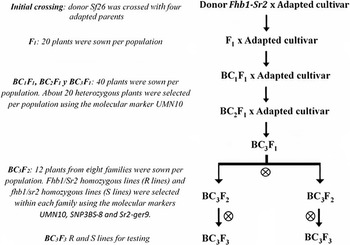
‘Sf26’ was used as the female parent in the initial crosses (Fig. 1). Twenty F1 plants per population, each population derived from one of the four different crosses, were used as the female parent in the backcross with each INIA cultivar to obtain the BC1F1 generation. Subsequently, heterozygous Fhb1-Sr2/fhb1-sr2 plants were selected with marker UMN10 from 40 BC1F1 and BC2F1 plants per population, which were used as the female parents in the following crosses with the INIA cultivars. Heterozygous BC3F1 plants were selected among 40 plants for selfing. Twelve plants from each of eight BC3F2 families per population were sown, each family coming from the same heterozygous BC3F1 plant. The BC3F2 homozygous Fhb1-Sr2 lines (R lines) and homozygous fhb1-sr2 lines (S lines) were selfed for seed increase. Five-to-seven pairs of R and S lines were selected from each of the eight BC3F2 families sown per population for FHB and SR phenotyping.
Marker-assisted backcrossing protocol used for the introduction of Fhb1-Sr2 locus in each of four INIA elite cultivars (‘Génesis 2375’, ‘Génesis 6.87’, ‘INIA Madrugador’ and ‘INIA Don Alberto’) as recurrent parents, and development of resistant (R) and susceptible (S) lines. ⊗: Selfing.

Marker-assisted selection
The presence of Fhb1-Sr2 was determined using the closely diagnostic sequence-tagged site marker UMN10 developed for Fhb1 (Liu et al., Reference Liu, Pumphrey, Gill, Trick, Zhang, Dolezel, Chalhoub and Anderson2008). DNA extractions from the plant material were performed at the Biotechnology Laboratory of INIA La Estanzuela using the CTAB 2% method (Doyle, Reference Doyle1987). Polymerase chain reaction (PCR) was carried out with a volume of 10 μl per reaction, consisting of 3.0 μl of DNA (30 ng/μl), 1 μl of 10× PCR buffer, 0.6 μl of MgCl2 (25 mM), 1 μl of dNTPs (2.0 mM), 0.1 μl of primer F (10 μM), 0.1 μl of primer R (10 μM), 0.05 μl of Taq enzyme (5 U/μl) and 4.15 μl of Milli-Q water. The amplification protocol of the UMN10 marker was performed as indicated by Liu and Anderson (Reference Liu and Anderson2003). The detection of the UMN10 marker on the DNA samples was performed with the 3730xl 96-Capillary Genetic Analyzer (Applied Biosystems) at Yale University. DNA from cultivar ‘Sumai 3’ and the donor line ‘Sf26’ were used as positive controls for the Fhb1 resistance allele. As described in Liu et al. (Reference Liu, Pumphrey, Gill, Trick, Zhang, Dolezel, Chalhoub and Anderson2008), the Fhb1 allele had a band size of 240 bp, while the susceptibility allele fhb1 had a band size of 237 bp.
In BC3F2, the presence of Fhb1 and Sr2 was further confirmed by assessing with the Kompetitive Allele-Specific PCR Genotyping System (KASP™) of UMN10 and SNP3BS-8 markers for Fhb1 (Bernardo et al., Reference Bernardo, Ma, Zhang and Bai2012) and the Sr2-ger9 marker for Sr2 (Mago et al., Reference Mago, Brown-Guedira, Dreisigacker, Breen, Jin, Singh, Appels, Lagudah, Ellis and Spielmeyer2011) at the Wheat Molecular Breeding Laboratory of CIMMYT, El Batán. Polymorphic marker primer sequences, type of marker and annealing temperatures used, are listed in Table 1. The PCR protocol and the visualization of the genotypic data for KASP were performed as indicated in Dreisigacker et al. (Reference Dreisigacker, Sehgal, Reyes Jaimez, Luna Garrido, Muñoz Zavala, Núñez Ríos, Mollins and Mall2016).
Characteristics of the molecular markers used to detect the presence/absence of Fhb1-Sr2

T A, annealing temperature.
a KASP marker.
b Touchdown over 63–55°C for 60 s 10 cycles (dropping 0.8°C per cycle).
c SSR marker.
Evaluation of FHB resistance
Type II FHB resistance was determined under greenhouse and growth chamber conditions at INIA La Estanzuela between October 2018 and February 2019. Plants were grown in a greenhouse until anthesis as previously described for the backcrossing protocol. Two experiments were carried out with a month's-interval (sowing dates 24 October and 20 November). Each experiment had a complete block design with 10 blocks. Each experimental unit consisted of one pot with two plants. A total of 46 treatments included: five BC3F3 homozygous Fhb1-Sr2 R lines, five BC3F3 homozygous fhb1-sr2 S lines per population, each pair of lines derived from the same BC3F1 family and six checks (‘Sumai 3’, ‘Sf26’ and the INIA adapted parents).
Plants were inoculated at anthesis (Z6.5, Zadoks et al., Reference Zadoks, Chang and Konzak1974) with a mix of 14 F. graminearum (sensu stricto) monosporic isolates collected from different cultivars, locations and years, representing the F. graminearum, 15ADON chemotype of the current population diversity in Uruguay. Inoculum concentration was adjusted to 2 × 10⁵ conidia/ml and 0.025 ml of Tween 20 was added per ml of the suspension. Ten microlitres of the inoculum suspension was placed into each of the two central, alternate spikelets of the main spike of each plant with an Eppendorf pipette. Plants were maintained at room temperature for 1 h and then placed in a dew chamber for 72 h (20–22°C, 100% relative humidity). Plants were then transferred to a growth chamber (24°C, 75–85% relative humidity and 12 h photoperiod).
Disease severity (DS) (percentage of symptomatic spikelets per spike) was evaluated at 7, 14 and 21 days after inoculation (dpi). Area under the disease progress curve (AUDPC) was calculated and used to estimate type II FHB resistance:

where n is the total number of observations, yi is the severity of observation ith and ti is the time for observation ith. A Box–Cox transformation was used to correct for normal distribution of the residuals of FHB AUDPC (FHB N_AUDPC). The effect of the Fhb1 introduction in reducing FHB disease was estimated as:

were Fhb1 effect is the percentage of FHB N_AUDPC reduction caused by Fhb1 on R lines compared to S lines.
Evaluation of SR resistance
SR resistance was evaluated at La Estanzuela Experimental Station in a field experiment with an incomplete block design with three replications sown on 15 July 2019. Each experimental unit consisted of a single 1 m row. Treatments included five to seven pairs of BC3F3 R and S lines from each population (each pair of lines derived from the same BC3F1 family), and six checks (‘Baguette 11’, ‘Baguette 601’ and the four INIA parents). A spreader row of SR susceptible cultivars (‘Onix’, ‘Baguette 11’, ‘Baguette 13’ and ‘Baguette 601’) was planted perpendicular to the plots to promote a homogeneous infection. Fertilization and weed control were performed as required. The trial was artificially inoculated four times, starting on stage Z2.2 (Zadoks et al., Reference Zadoks, Chang and Konzak1974). The first and the last inoculations (August 28 and October 28) were performed spraying a suspension of urediniospores on distilled water with two drops of Tween 20 on the plots and the spreader row. The second and third inoculations (September 11 and October 7) were performed injecting the same spore suspension into three tillers per plot and on random tillers of the spreader row. The inoculum was a mix of spores collected in the field during winter 2018 plus four Pgt isolates representing four different races of SR collected in previous years: isolates 2048, 2372, 2749 and 2931 corresponding to races SPLKC, RHKTF, RRTTF and QFCSC (Jin et al., Reference Jin, Szabo, Pretorius, Singh, Ward and Fetch2008), respectively. The Pgt races were increased on the susceptible cultivar ‘Little Club’ under greenhouse conditions and maintained at INIA Rust Laboratory.
SR DS and infection response (IR) were recorded on stems and leaf sheaths on November 19 and November 28 (approximately Z.7 and Z.8, Zadoks et al., Reference Zadoks, Chang and Konzak1974). DS was evaluated using the modified Cobb Scale (Peterson et al., Reference Peterson, Campbell and Hannah1948) and IR was assessed as resistant (R), moderately resistant (MR), moderately susceptible (MS) and susceptible (S) as described by Roelfs et al. (Reference Roelfs, Singh and Saari1992). The coefficient of infection (CI) was calculated as the DS multiplied by a coefficient corresponding to IR (R: 0.2, MR: 0.4, I = MRMS: 0.6, MS: 0.8, S: 1.0) as described by Stubbs et al. (Reference Stubbs, Prescott, Saari and Dubin1986). The SR AUDPC was calculated using the CI according to Campbell and Madden (Reference Campbell and Madden1990). The effect of the Sr2 introduction in reducing SR disease was estimated as:

were Sr2 effect is the percentage of SR AUDPC reduction caused by Sr2 on R lines compared to S lines.
Statistical analysis
FHB AUDPC residuals did not follow a normal distribution according to a Shapiro–Wilk test for normality (Shapiro and Wilk, Reference Shapiro and MB1965, P-value <0.01). After Box–Cox transformation (Box and Cox, Reference Box and Cox1964), the result from the normality test indicated that there was no evidence against the assumption of normality for the normalized FHB AUDPC (N_AUDPC, P-value of 0.12) and this variable was used for the statistical analysis.
The model used to analyse FHB N_AUDPC data was:

where y: FHB N_AUDPC, μ: general mean, T: trial main effect l = {1–2}, R: repetition or block effect m = {1–10} nested in T l = {1–2}, M: Fhb1 marker main effect i = {1: presence, 2: absence}, TM: Fhb1 marker effect by trial effect interaction, P: population main effect k = {1–4}, MP: Fhb1 marker effect by population effect interaction, F: family main effect j = {1–5} nested in P k = {1–4} and ɛ: experimental error with normal distribution N(0, σ 2ɛ).
The model used to analyse the SR AUDPC was:

where y: SR AUDPC, μ: general mean, R: repetition m = {1–3}, B: incomplete block effect as random l = {1–8} nested in R m = {1–3}, M: Sr2 marker main effect i = {1: presence, 2: absence}, P: population main effect k = {1–3}, MP: Sr2 marker effect by population effect interaction, F: family main effect j = {1–7} nested in P k = {1–3} and ɛ: experimental error. Random terms, B and ɛ, follow a normal distribution with N(0, σ 2b) and N(0, σ 2ɛ), respectively.
First, the proposed analysis of variance (ANOVA) models were used to estimate the effect of Fhb1-Sr2 presence/absence on the level of resistance to FHB and SR of BC3F3 homozygous lines and to estimate if there was an interaction between the Fhb1-Sr2 introgression and the genetic backgrounds of the different populations. Second, multiple comparisons of means were performed (Tukey–Kramer range test; Tukey, Reference Tukey1949) to compare the level of resistance in the different introgressed lines, the parental INIA cultivars, the Fhb1-Sr2 donor line and the checks. The ANOVA and Tukey–Kramer range test assumptions were tested and there were no violations of these. The significance threshold level was set as α ≤ 0.05 for all the analyses performed. Statistical analyses were performed using R statistical software with the stats package (R Core Team, 2016).
Results
Development of Fhb1-Sr2 lines
Seven generations were required to obtain homozygous BC3F3 R lines with Fhb1-Sr2 and S lines with fhb1-sr2. The overall protocol took 26 months with an average duration of each generation of 3.7 months (3.2 generations per year).
Sixty-nine BC3F1 heterozygous individuals were obtained: 18, 19, 16 and 16 for the populations derived from ‘Génesis 2375’, ‘Génesis 6.87’, ‘INIA Madrugador’ and ‘INIA Don Alberto’, respectively. After selfing, eight BC3F2 families were selected from population ‘Sf26’/‘Génesis 2375’ and seven from each of the other populations (Table 2), each family coming from the same heterozygous BC3F1 plant. The segregation ratio estimated in the BC3F2 progeny with the marker UMN10 approximated 1:2:1 for homozygote resistance, heterozygotes and homozygote susceptible plants as expected for the segregation of one gene. Five-to-seven pairs of R (Fhb1-Sr2) and S (fhb1-sr2) BC3F3 lines per population were selected for FHB and SR phenotyping.
Number of selected BC3F2 families and homozygous and heterozygous plants per population

G.2375, ‘Génesis 2375’; G.6.87, ‘Génesis 6.87’; I.Mad, ‘INIA Madrugador’; I.DAl, ‘INIA Don Alberto’.
FHB type II resistance
FHB severity is described here to illustrate the level of infection obtained in the experiments. Average FHB severity of all BC3F3 lines and checks at 7, 14 and 21 dpi were 18.3, 38.8 and 45.9%, respectively. The FHB resistant check ‘Sumai 3’ and the ‘Sf26’ donor line had a mean severity of 16.6 and 46.2% at 21 dpi, respectively, while the average severity of the recurrent parents ranged from 38.9 to 70.6% at the same time of evaluation.
The Fhb1 marker and population effects were highly significant (P-value <0.001, online Supplementary Table S1), while other sources of variation had no significant effect on FHB N_AUDPC.
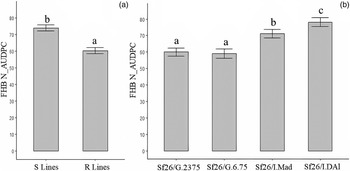
The mean FHB N_AUDPC of R lines was 60.3, significantly lower than the FHB N_AUDPC of the S lines of 73.9 (Fig. 2a); therefore, Fhb1 determined an overall average reduction of the FHB N_AUDPC of 18.4%. The corresponding FHB severity at 21 dpi was 35.6% for the R lines and 51.1% for the S lines.
Comparison of FHB normalized area under the disease progress curve (FHB N_AUDPC) means between R (Fhb1-Sr2) and S (fhb1-sr2) lines (a) considering all populations, and (b) between the four populations. N_AUDPC values with different letters are significantly different based on a Tukey–Kramer Range test (P-value ≤0.05). The error bars represent the 95% confidence interval around the estimate.

Mean FHB N_AUDPC values of the populations derived from ‘Génesis 2375’ and ‘Génesis 6.87’ were significantly lower than the ones of the populations derived from ‘INIA Madrugador’ and ‘INIA Don Alberto’ (Fig. 2b). The population derived from ‘INIA Don Alberto’ had significantly higher N_AUDPC values than the population derived from ‘INIA Madrugador’ (Fig. 2b).
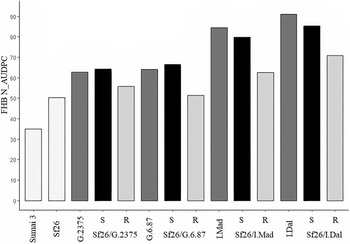
Although the Fhb1 × Population interaction effect on FHB N_AUDPC was not significant at the threshold level of significance fixed in this study, the P-value of this interaction was low (0.09203). A trend was observed of higher FHB N_AUDPC reductions on R lines vs S lines in populations derived from ‘Génesis 6.87’ (22.7%) and ‘INIA Madrugador’ (21.7%), compared to the population derived from ‘Génesis 2375’ (13.4%, Fig. 3). R lines derived from ‘INIA Don Alberto’ had intermediate reduction of FHB N_AUDPC (17.0%) than S lines. In all cases, the FHB N_AUDPC of the S lines was similar to that of the recurrent parents.
Mean FHB normalized area under the disease progress curve (FHB N_AUDPC) of the resistant check (‘Sumai 3’), the donor parent (‘Sf26’), the recurrent parents (G.2375: ‘Génesis 2375’, G.6.87: ‘Génesis 6.87’, I.Mad: ‘INIA Madrugador’, I.DAl: ‘INIA Don Alberto’) and the R (Fhb1-Sr2) and S lines (fhb1-sr2) from each population. The percentage of FHB N_AUDPC reduction of R lines compared to S lines is shown above the R lines bars.

SR resistance
SR CI on the second date of evaluation is described here to illustrate the level of infection obtained in the experiments. The susceptible check ‘Baguette 601’ had the highest SR DS with an average CI of 77.3 (range from 72 to 80), while the check ‘Baguette 11’ had a mean SR disease CI of 56,0. Due to very low infection (SR disease CI average of 0.7 and maximum CI 3 and 7, respectively), ‘INIA Don Alberto’ and its derived lines were removed from the statistical analysis.
The effects of Sr2 marker, population, family and Sr2 marker × Population interaction on SR AUDPC were highly significant (P-value <0.001, online Supplementary Table S2).
The effect of family nested in population (F) was significant. Multiple comparisons of means (Tukey–Kramer range test) showed significant differences in mean SR AUDPC between families 8 and 6 derived from ‘Génesis 2375’ (17.0 and 50.4 respectively) and families 3 and 4 derived from ‘Génesis 6.87’ (4.4 and 40.6, respectively). The interaction between Sr2 marker and population (MP) on SR AUDPC was highly significant.
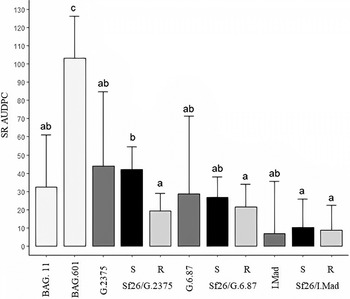
The susceptible check ‘Baguette 601’ had significantly higher SR AUDPC than the rest of the treatments (Fig. 4). The R lines (Fhb1-Sr2) derived from ‘Génesis 2375’ had significantly lower SR AUDPC than the S lines (fhb1-sr2) (54.5% reduction). The reduction of SR AUDPC caused by the presence of Sr2 of 18.9 and 17.2% observed in R lines compared to S lines from ‘Sf26’/‘Génesis 6.87’, and ‘Sf26’/‘INIA Madrugador’, respectively, was not significant. The average SR AUDPC of the S lines did not differ significantly from the AUDPC of their respective recurrent parents.
Mean SR AUDPC of checks (BAG.11: ‘Baguette 11’, BAG.601: ‘Baguette 601’), recurrent parents (G.2375: ‘Génesis 2375’, G.6.87: ‘Génesis 6.87’ and I.Mad: ‘INIA Madrugador’), and R and S lines from each population. AUDPC values with different letters are significantly different (Tukey–Kramer Range, P-value ≤0.05). The black lines represent the 95% upper confidence interval around the estimate.

Discussion
The coupled resistance genes Fhb1 and Sr2 were successfully backcrossed into four Uruguayan wheat cultivars and their effects in enhancing the resistance to FHB and SR were quantified. Fhb1 increased the FHB resistance in all genetic backgrounds, but Sr2 had a statistically significant effect on SR only in the genetic background of the most susceptible recurrent parent.
The marker-assisted backcrossing (MABC) protocol developed in this work was efficient, allowing the rapid selection of lines homozygous for Fhb1 at the seedling stage in 26 months, while in the case of INIA's wheat breeding traditional protocol with one generation per year it would have taken 7 years. MABC can be performed in the seedling stage while under the traditional schemes of phenotypic selection, screening must be done in adult plants. MAS also allowed the selection of the minor gene Sr2, which is often challenging because its partial resistance phenotype may be masked by the presence of major effective resistance genes. This protocol is a relevant technological contribution for Uruguay, since it was the first MAS used to enhance resistance to FHB in this country. Our results confirm that the use of the single marker UMN10 during the backcrossing process was sufficient for the selection of plants with the Fhb1-Sr2 introgression, as expected due to the strong linkage between these two genes. Subsequently, the presence of Sr2 in the developed lines was further confirmed using the csSr2 marker at the end of the MABC protocol. Based on these results, we could confirm that the functional marker UMN10 is a reliable marker for the selection of the coupled Fhb1-Sr2 genes.
A significant effect of Fhb1 in reducing FHB was found in the lines derived from all crosses. The lines with Fhb1 had an average reduction of the disease of 18.4% compared to lines carrying fhb1. He et al. (Reference He, Brar, Bonnett, Dreisigacker, Hyles, Speilmeyer, Bhavani, Singh and Singh2020) introgressed the coupled Fhb1-Sr2 genes in elite CIMMYT wheat lines. Twenty-five derived lines were tested in 32 countries and 10 showed good FHB resistance with less than 30% FHB field severity. The donor lines carrying the coupled genes used in their study came from a different origin than our donor line. Other authors estimated reductions of 24.8 and 41.6% in two different populations (Anderson et al., Reference Anderson, Stack, Liu, Waldron, Fjeld, Coyne, Moreno-Sevilla, Mitchell Fetch, Song, Cregan and Frohberg2001), and 15.4% (Waldron et al., Reference Waldron, Moreno-Sevilla, Anderson, Stack and Frohberg1999) in the FHB infection attributed to Fhb1 under greenhouse conditions. Pumphrey et al. (Reference Pumphrey, Bernardo and Anderson2007) studied the effect of Fhb1 in 19 pairs of near isogenic lines developed from breeding lines of the University of Minnesota and reported that Fhb1 increased 31% type II FHB resistance under greenhouse conditions. While the average FHB reduction attributed to Fhb1 in our study was in the same range of values obtained in other studies, several factors should be taken into account to compare these results. Most of the reports estimated Fhb1 QTL effect in mapping populations, i.e. Zhang et al. (Reference Zhang, Van der Lee, Waalwijk, Chen, Xu, Xu, Zhang and Feng2012), derived in general from parents with highly distant genetic background, which might affect the Fhb1 QTL effect. Also, the QTL effects can be influenced by experimental conditions, growth environment and inoculation method being the most relevant (Pumphrey et al., Reference Pumphrey, Bernardo and Anderson2007). Jin et al. (Reference Jin, Zhang, Bockus, Baenziger P, Carver and Bai2013) and Salameh et al. (Reference Salameh, Buerstmayr, Steiner, Neumayer, Lemmens and Buerstmayr2011) estimated an Fhb1 effect of 25.1 and 35%, respectively, in breeding materials under field conditions comparing genotypes with and without Fhb1.
R lines derived from ‘Génesis 2375’ and ‘Génesis 6.87’ were more resistant than lines derived from ‘INIA Don Alberto’ and those derived from ‘INIA Madrugador’ had intermediate resistance. The resistant lines from the different crosses followed the same pattern as the resistance of their respective recurrent parents, indicating that at least part of the background resistance was recovered, as expected for three backcrosses.
Even when only type II resistance was evaluated in our study, the FHB infection of the parental cultivars under greenhouse conditions (Fig. 2b) followed the same trend of the resistance characterized in field studies: ‘Génesis 2375’ and ‘Génesis 6.87’ were the most resistant, followed by ‘INIA Madrugador’, and ‘INIA Don Alberto’ was the most susceptible cultivar. This confirms the high contribution of type II resistance to FHB field resistance.
Sr2 interacted with the genetic components associated to SR resistance in the genetic background of the cultivars used since the Sr2 marker × Population interaction was significant (online Supplementary Table S2). A significant difference in SR AUDPC among R and S lines was only found in the population derived from the most susceptible cultivar to SR tested, ‘Génesis 2375’ (Fig. 4). The introduction of Sr2 into the ‘Génesis 2375’ genetic background resulted in a high reduction of disease under field conditions, of 54.5% on R lines (Sr2) related to S (sr2) lines. The relatively low infection on ‘INIA Don Alberto’ and ‘INIA Madrugador’ populations indicates that the races used were avirulent on these recurrent parents. This may explain the lack of significance of the effect of Sr2 in those populations. The relevance of the incorporation of Sr2 in resistant backgrounds will be its capacity to reduce the SR infection in the case that virulent races to the recurrent parents become prevalent in the pathogen population.
The disagreement between the low field infection of ‘INIA Madrugador’ and ‘INIA Don Alberto’ with the expected field performance was most probably due to the avirulence/virulence patterns of the races present in the field experiment. The information of the resistance provided by the National Cultivar Evaluation Program (see Plant materials and development of populations section) was most probably obtained under epidemics caused by different races. The characterization of field resistance is based on at least 3 years of disease data. However, the maximum susceptibility is kept even when in a certain period the level of infection is lower, since the potential for disease development on the cultivar is intended to be expressed by the characterization.
Few studies estimate the contribution of Sr2 to SR resistance. He et al. (Reference He, Brar, Bonnett, Dreisigacker, Hyles, Speilmeyer, Bhavani, Singh and Singh2020) reported an SR field severity range of 20–80% and moderately susceptible-susceptible (MSS) to mixed (M) SR responses for lines with the coupled Fhb1-Sr2, while the susceptible (S) check showed 100% severity and susceptible response. Zhang et al. (Reference Zhang, Rouse, Nava, Jin and Anderson2016) developed 59 lines carrying Sr2 derived from two different crosses, which had a reduction of SR field severity ranging from 26 to 53% in relation to their susceptible parent. The effect of Sr2 determined in the ‘Sf26/Génesis 2375’ population was consistent with the effect measured by Zhang et al. (Reference Zhang, Rouse, Nava, Jin and Anderson2016).
The four cultivars introgressed with the coupled genes have been commercially competitive. Particularly, ‘Génesis 2375’ and ‘Génesis 6.87’ combined desirable agronomic characteristics (high and stable grain yield, acceptable bread-baking quality) with adequate multiple disease resistance when released. Having introduced the coupled genes into these elite INIA cultivars is promising due to the derived lines with higher resistance to FHB and partial resistance to SR. Particularly, three lines derived from the ‘Sf26’/‘Génesis 2375’, ‘Sf26’/‘Génesis 6.87’, and ‘Sf26’/‘INIA Madrugador’ crosses (RC3F2-7.11, RC3F2-12.1 and RC3F2-22.10, respectively) are good candidates to be used for the development of commercial varieties in Uruguay.
This work is an important contribution to the knowledge about the effectiveness of the genetic resistance conferred by Fhb1 and Sr2 into commercial germplasm. Both genes have made important contributions to wheat breeding programmes worldwide. Breeding lines with both genes in coupling are a relevant contribution to our and other breeding programmes, allowing increased levels and durability of the genetic resistance to FHB and SR.
Conclusions
A marker assisted backcross protocol for the introduction of the coupled Fhb1-Sr2 using the molecular marker UMN10 was validated. In addition, we confirmed the positive effect of the coupled Fhb1-Sr2 on type II resistance to FHB (greenhouse) and in the field resistance to SR. Adapted, homozygous lines carrying Fhb1-Sr2 developed in this work will contribute to increase the resistance to FHB and SR in the wheat breeding program in Uruguay and elsewhere. Promising results for FHB resistance from greenhouse trials require further confirmation in field experiments, where levels of FHB disease and mycotoxin accumulation should be recorded in replicated trials.
Supplementary material
The supplementary material for this article can be found at https://doi.org/10.1017/S1479262122000107
Data
Terms of availability of the developed germplasm to the scientific and plant breeding community: the lines described in this paper are stored at the Seeds and Plant Genetic Resources Unit of INIA-Germplasm Bank located in INIA La Estanzuela, Uruguay and can be provided upon request.
Acknowledgements
We thank Professor James Anderson from the University of Minnesota for providing the donor lines with Fhb1-Sr2 in coupling. We also thank Noelia Pérez (National Institute of Agricultural Research-INIA Uruguay) for technical assistance with field and greenhouse activities and Victoria Bonnecarrere, Wanda Iriarte (INIA Uruguay) and Adriana Reyes (CIMMYT) for their assistance with KASP genotyping. This research was funded by the National Research and Innovation Agency (POS_NAC_2016_1_129877).
Conflict of interest
The authors declare no conflicts of interest.