Child abuse is commonly defined as any act of commission by a parent or any other caregiver that results in harm, potential for harm, or threat of harm to a child (Leeb, Paulozzi, Melanson, Simon, & Arias, Reference Leeb, Paulozzi, Melanson, Simon and Arias2008). Child abuse may result in emotional and behavioral problems that begin in childhood and can persist throughout adolescence and adulthood (Carr, Martins, Stingel, Lemgruber, & Juruena, Reference Carr, Martins, Stingel, Lemgruber and Juruena2013). For example, child abuse increases the risk of developing depression, anxiety disorders, posttraumatic stress disorder (PTSD), substance abuse, reduced self-esteem, suicidal behavior, conduct disorder, and aggressive or delinquent behavior (Catani, Jacob, Schauer, Kohila, & Neuner, Reference Catani, Jacob, Schauer, Kohila and Neuner2008; Dube et al., Reference Dube, Felitti, Dong, Chapman, Giles and Anda2003; Hermenau, Hecker, Elbert, & Ruf-Leuschner, Reference Hermenau, Hecker, Elbert and Ruf-Leuschner2014; Sugaya et al., Reference Sugaya, Hasin, Olfson, Lin, Grant and Blanco2012), as confirmed by numerous longitudinal studies (Kaplan et al., Reference Kaplan, Pelcovitz, Salzinger, Weiner, Mandel and Lesser1998; Widom, DuMont, & Czaja, Reference Widom, DuMont and Czaja2007). Most abused children have been exposed to multiple forms of abuse, and the greater the number of different forms of abuse, the higher the likelihood of subsequent psychopathologies (Teicher, Samson, Polcari, & Mcgreenery, Reference Teicher, Samson, Polcari and McGreenery2006). Furthermore, abused individuals with a psychiatric disorder are characterized by earlier onset of disease, increased symptom severity, increased comorbidity, increased risk of suicide, poorer treatment response, and shorter interval before recurrence than are individuals with the same diagnoses who were not abused (Harkness, Bagby, & Kennedy, Reference Harkness, Bagby and Kennedy2012; Nanni, Uher, & Danese, Reference Nanni, Uher and Danese2012; Teicher & Samson, Reference Teicher and Samson2013). Finally, child abuse is a major burden not only upon the affected individual but also upon the society at large due to the high costs associated with the utilization of healthcare, educational, welfare, and law enforcement services (Fang, Brown, Florence, & Mercy, Reference Fang, Brown, Florence and Mercy2012).
It has been argued that the aforementioned adverse consequences may not hold for societies or communities in which many of the specific acts of child abuse are culturally normed and highly prevalent. In other words, abused individuals in communities that deem such practices to be socially acceptable and legal would find the effects to be less harmful than would those living in societies in which such practices are unacceptable or illegal. Lansford et al. (Reference Lansford, Dodge, Malone, Oburu, Palme and Bacchini2005) empirically tested this idea in six countries. They found that more frequent corporal punishment is related to more aggression and more anxiety in all six countries. However, the strength of the relation did vary by the perceived normativeness across countries. Many other studies demonstrated detrimental consequences for the psychological well-being and development of abused children, regardless of whether the surrounding society deems such practices acceptable (Ani & Grantham-McGregor, Reference Ani and Grantham-McGregor1998; Hecker, Hermenau, Isele, & Elbert, Reference Hecker, Hermenau, Isele and Elbert2014; Hermenau et al., Reference Hermenau, Hecker, Ruf, Schauer, Elbert and Schauer2011).
There are many countries in which many of the acts constituting child abuse are legal and socially accepted. In Tanzania, for example, a national survey with a representative sample of more than 3,700 youths revealed that the great majority (almost 75%) of both girls and boys had experienced physical abuse and more than one-quarter faced emotional abuse prior to the age of 18 (UNICEF, 2011). In concordance, we and others reported the use of harmful physical acts and psychological tactics on behalf of caregivers toward children to be highly prevalent in Tanzanian families and schools (Feinstein & Mwahombela, Reference Feinstein and Mwahombela2010; Hecker et al., Reference Hecker, Hermenau, Isele and Elbert2014). In April 2013, the Tanzanian government reportedly confirmed that the use of corporal punishment in public schools persists (Tanzania Daily News, 2013). Given such high prevalence of child abuse, it is vital for both individuals and societies to have a better understanding of the potential effects of abuse. In particular, we must study whether the negative consequences of physical and emotional abuse of children are diminished in societies where such acts are legal and socially accepted.
Most studies on mental health problems have been conducted in Western samples. However, findings from the Democratic Republic of the Congo, Ethiopia, and Nigeria have shown that various mental health problems such as anxiety disorders, affective disorders, and hyperactivity are also common phenomena in sub-Saharan Africa (Adelekan, Ndom, Ekpo, & Oluboka, Reference Adelekan, Ndom, Ekpo and Oluboka1999; Kashala, Elgen, Sommerfelt, & Tylleskar, Reference Kashala, Elgen, Sommerfelt and Tylleskar2005). Adelekan et al. (Reference Adelekan, Ndom, Ekpo and Oluboka1999) indicated a prevalence rate of internalizing problems of 7.3% and of externalizing problems of 8% in a representative sample from Nigeria. Kashala et al. (Reference Kashala, Elgen, Sommerfelt and Tylleskar2005) compared their findings in a study with a representative sample in the Congo (Goodman, Meltzer, & Bailey, Reference Goodman, Meltzer and Bailey1998) with prior findings from Great Britain. They found that the mean scores on all subscales of the Strength and Difficulties Questionnaire (SDQ) were significantly higher than the British mean scores of a comparable sample. Hence, Cortina, Sodha, Fazel, and Ramchandani (Reference Cortina, Sodha, Fazel and Ramchandani2012) concluded that child and adolescent mental health problems are also common in sub-Saharan Africa.
Child Abuse and the Hypothalamus–Pituitary–Adrenal (HPA) Axis
The HPA axis, when functioning properly, helps us to deal with crises. It describes a set of interactions between the hypothalamus, the pituitary gland, and the adrenal gland, which results in the release of its effector cortisol (Chrousos & Gold, Reference Chrousos and Gold1992; de Kloet, Joëls, & Holsboer, Reference de Kloet, Joëls and Holsboer2005). Upon stress perception, cortiocotropin-releasing hormone (CRH) and arginine vasopressin (AVP) are released from the hypothalamic paraventricular nucleus to activate the synthesis of proopiomelanocortin (POMC) in the anterior pituitary. POMC is processed into several peptides including adrenocorticotropin hormone (ACTH). Finally, ACTH is released into the blood stream and triggers the secretion of cortisol from the adrenal cortex. At each organizational level, the HPA axis is tightly regulated by negative feedback loops meditated by glucocorticoid receptors (GRs). After binding their ligand, cortisol, GRs dampen HPA axis activity.
Child abuse is translated into negative long-term mental health outcomes via the HPA axis. It plays a central role, because it is tuned to experiences occurring early in life, making it highly susceptible to early childhood adversities (Heim & Nemeroff, Reference Heim and Nemeroff2001). For example, adults with a history of childhood maltreatment displayed altered ACTH and cortisol responses following exposure to an acute stressor (Carpenter et al., Reference Carpenter, Carvalho, Tyrka, Wier, Mello and Mello2007; Heim et al., Reference Heim, Newport, Heit, Graham, Wilcox and Bonsall2000). HPA axis dysregulation is a key feature of a range of psychopathological symptoms (Chrousos & Gold, Reference Chrousos and Gold1992; de Kloet et al., Reference de Kloet, Joëls and Holsboer2005). Both human and animal studies show that unremitting threat or stress weakens the immune response and increases abdominal fat, mental ill health, and depression via alterations of HPA functioning (McEwen & Lasley, Reference McEwen and Lasley2002). HPA axis function, and with it behavioral changes, may be stably altered through aberrant epigenetic modifications, established as the result of child abuse.
Epigenetic Modifications of HPA Axis Genes
Of the various and complex mechanisms leading to epigenetic modification, DNA methylation is currently being studied most extensively. In humans, the relationship between early life adversities and the methylation of the GR has been extensively studied. GR promoter methylation is associated with both child abuse and psychopathology (Dammann et al., Reference Dammann, Teschler, Haag, Altmüller, Tuczek and Dammann2011; Hompes et al., Reference Hompes, Izzi, Gellens, Morreels, Fieuws and Pexsters2013; Labonte, Azoulay, Yerko, Turecki, & Brunet, Reference Labonte, Azoulay, Yerko, Turecki and Brunet2014; McGowan et al., Reference McGowan, Sasaki, D'Alessio, Dymov, Labonté and Szyf2009). Suicide victims with a history of childhood abuse displayed increased GR methylation in brain tissue (Labonte et al., Reference Labonte, Yerko, Gross, Mechawar, Meaney and Szyf2012; McGowan et al., Reference McGowan, Sasaki, D'Alessio, Dymov, Labonté and Szyf2009). Higher GR methylation in peripheral blood mononuclear cells has been observed in patients suffering from borderline personality disorder (i.e., in individuals who have usually been exposed to severe forms of abuse during development). Disruption or lack of adequate nurturing, as measured by child maltreatment and inadequate parental care, was also associated with increased GR promoter methylation (Perroud et al., Reference Perroud, Paoloni-Giacobino, Prada, Olié, Salzmann and Nicastro2011; Tyrka, Price, Marsit, Walters, & Carpenter, Reference Tyrka, Price, Marsit, Walters and Carpenter2012). In addition, epigenetic changes in the POMC gene may promote HPA axis dysfunction. Recent studies suggest epigenetic programming of POMC operates through nutritional cues, such as being underweight (Ehrlich et al., Reference Ehrlich, Weiss, Burghardt, Infante-Duarte, Brockhaus and Muschler2010), while other research suggests an association with alcohol abuse and dependence via increased craving (Muschler et al., Reference Muschler, Hillemacher, Kraus, Kornhuber, Bleich and Frieling2010). Animal models demonstrate epigenetic programming of additional HPA axis genes such as CRH (Mueller & Bale, Reference Mueller and Bale2008) and AVP (Murgatroyd et al., Reference Murgatroyd, Patchev, Wu, Micale, Bockmühl and Fischer2009). Thus, current research has highlighted epigenetic modifications in genes associated with the HPA axis as being a possible driving force producing child abuse-induced disorders.
In the present study we investigated associations of child abuse with both the phenotype and the methylation status of genes related to the HPA axis in Tanzanian children. We limited our analyses of DNA methylation to the genes coding for the main components of the HPA axis, that is, the genes coding for AVP, CRH, and POMC, from which ACTH is cleaved. In addition, we included the gene encoding GR, nuclear receptor subfamily 3, group C, member 1 (NR3C1), because several studies demonstrated its methylation status as being predictive for childhood abuse (Labonte et al., Reference Labonte, Yerko, Gross, Mechawar, Meaney and Szyf2012; McGowan et al., Reference McGowan, Sasaki, D'Alessio, Dymov, Labonté and Szyf2009; Perroud et al., Reference Perroud, Paoloni-Giacobino, Prada, Olié, Salzmann and Nicastro2011; Tyrka et al., Reference Tyrka, Price, Marsit, Walters and Carpenter2012). We hypothesized that exposed children (a) report more emotional and behavioral problems and (b) display altered epigenetic modifications in the genes related to HPA axis functioning.
Methods
Procedure
In the context of a larger research project, a team of Tanzanian and German psychologists conducted structured interviews with a sample of Tanzanian school children (N = 409). Interviewers were taught in interview skills during a 2-week training session. Furthermore, the Tanzanian interviewers were trained to translate from English to Swahili and back in order to assist the German researchers. All instruments were translated in written form to Swahili. A valid and accurate translation into English was ensured through the use of a written, blind backtranslation. In the total sample, 33 interviews were rated by two independent assessors to determine high interrater reliability. Prior to the interviews, we sent a written informed consent form to all parents or caregivers of the children from Class 2 to 7 (age 6–15) explaining the purpose of the study.
Based on these structured interviews, we selected children who had been exposed to high levels of physical and emotional abuse in their homes and those who had been exposed to only low levels of physical and emotional abuse. An a priori power analysis (α = 0.05, power = 0.80, d = 0.80) using G*Power software (Faul, Erdfelder, Lang, & Buchner, Reference Faul, Erdfelder, Lang and Buchner2007) indicated a required sample size of n = 26 per group to detect significant group differences. Therefore, we aimed for two groups from the extreme ends of the abuse continuum (no abuse vs. high levels of abuse) of 30 children each. Because many children, particularly younger children, reported a strong fear of drawing blood, due to harmful experiences in the Tanzanian health system, we decided not to include children of 8 years or younger. We sent an invitation and informed consent form to 96 parents and caregivers of the selected children clarifying that donating blood and saliva samples would be entirely voluntary and no monetary compensation would be offered. In total, 64% (n = 61 of 96) of the parents and caregivers signed the informed consent. We were unable to recruit enough children who had never been exposed to any type of abuse. This is not too surprising, given that several acts of child abuse are culturally normed and highly prevalent in Tanzania. Almost 75% reported exposure to physical abuse in a nationally representative sample (UNICEF, 2011). Nevertheless, our sampling approach resulted in two extreme groups: one group (n = 35) reporting high levels of child abuse (i.e., six or more different types) and one group (n = 25) reporting low levels of child abuse (i.e., four or fewer different types). In the total sample, 173 (42%) children reported low levels of child abuse with only 8 (2%) reporting no exposure to any form of child abuse. In contrast, 175 (43%) children of the total sample reported high levels of child abuse. Only children with an informed consent signed by their caregivers and who also assented themselves orally were included in the study (only 1 child refused to participate despite parents’ informed consent). A trained nurse from the University of Konstanz with extensive work experience in East Africa collected the blood and saliva samples. The Ethical Review Board of the University of Konstanz approved the study. Other, nonepigenomic parts of the data gathered for the total sample are presented in reports by Hecker et al. (Reference Hecker, Hermenau, Isele and Elbert2014); Hermenau, Eggert, Landolt, and Hecker (Reference Hermenau, Eggert, Landolt and Hecker2015); and Hermenau et al. (Reference Hermenau, Hecker, Elbert and Ruf-Leuschner2014).
Participants
The children participating in this study were enrolled at a primary school in a city of approximately 150,000 inhabitants in southern Tanzania. The high-exposure group consisted of n = 35 children (60% girls) who were on average 11.31 years old (SD = 1.47, range = 9–15). The low-exposure group consisted of n = 25 children (56% girls) who were on average 11.76 years old (SD = 1.20, range = 10–14).
Measures
All instruments were applied as a structured interview in Swahili. The first part of the interview consisted of sociodemographic information, including age, grade, and gender.
Child abuse
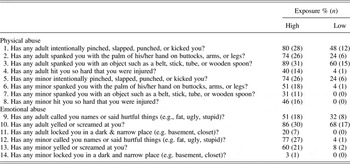
We assessed exposure to abuse at home using the Maltreatment and Abuse Chronology of Exposure—Pediatric Version (Isele et al., Reference Isele, Hecker, Hermenau, Elbert, Ruf-Leuschner and Moran2015; Teicher & Parigger, Reference Teicher and Parigger2015). The Maltreatment and Abuse Chronology of Exposure is a structured interview for children consisting of 45 dichotomous (yes/no) questions, measuring witnessed or self-experienced forms of child maltreatment throughout the lifetime. In this study, we only used the 14 items covering possible forms of physical and emotional abuse (see Table 1) by an adult person living in the same household (e.g., parent, relative, or caregiver) or by a minor living in the same household (e.g., housemaid or sibling). In Tanzania many children grow up not only with their parents in one household but also with other members of their extended families. We also focused on minors in the household because in urban Tanzania many children are raised by an underaged housemaid (12–17) as primary caregiver, while both parents have to work. Using an event checklist, we assessed the presence of different types of abuse but not the frequency. We calculated an abuse score by totaling up all of the question responses. The possible score ranges from 0 to 14. The Cohen κ coefficient measuring the interrater reliability was >0.99 (0.99–1).
Occurrence of physical and emotional abuse during the children's lifetime

Note: Adult, Person living in the same household (e.g., parent, relative, or caregiver); minor, person under the age of 18 living in the same household (e.g., housemaid or sibling).
Mental health
The self-evaluation of internalizing and externalizing problems was assessed with the SDQ (Goodman, Ford, Simmons, Gatward, & Meltzer, Reference Goodman, Ford, Simmons, Gatward and Meltzer2000; Goodman et al., Reference Goodman, Meltzer and Bailey1998). We used the self-report version for children in interview form, which consists of 25 statements. The total difficulties score is generated by summing the scores of all items, except the items for prosocial behavior, and ranges from 0 to 40. A score over 16 indicates an enhanced level of internalizing and externalizing problems. In the present sample, the Cronbach α coefficient was 0.71 and the Cohen κ coefficient was 0.99 (0.94–1).
The University of California at Los Angeles PTSD Reaction Index for Children DSM-IV (Steinberg, Brymer, Decker, & Pynoos, Reference Steinberg, Brymer, Decker and Pynoos2004) was used to screen for symptoms of PTSD, again in interview form. For each DSM-IV symptom, the frequency of occurrence within the last month is scored. The PTSD severity score ranges from 0 to 68. In the present sample, the Cronbach α was 0.92 and the Cohen κ was 0.98 (0.82–1).
The severity of depressive symptoms was assessed by means of the Children's Depression Inventory (Kovacs, Reference Kovacs2001; Sitarenios & Kovacs, Reference Sitarenios, Kovacs and Maruish1999), which has already been successfully implemented and validated in Tanzanian settings (Traube, Dukay, Kaaya, Reyes, & Mellins, Reference Traube, Dukay, Kaaya, Reyes and Mellins2010; Wallis & Dukay, Reference Wallis and Dukay2009). For each of its 27 items, the children were offered three statements and asked to choose the one which best describes their situation. The maximum score possible is 54. A threshold of 12 has been established as being ideal for identifying children at risk of depression (Kovacs, Reference Kovacs2001; Kovacs, Goldstein, & Gastonis, Reference Kovacs, Goldstein and Gastonis1993; Traube et al., Reference Traube, Dukay, Kaaya, Reyes and Mellins2010). In the present sample, the Cronbach α was 0.81 and the Cohen κ was 0.99 (0.92–1).
DNA methylation
Lymphocytes from blood were isolated via a Ficoll gradient and stored in a preservation solution (DNAgard® Tissues & Cells, Biomatrica, San Diego, CA) in order to ensure recovery of high-quality DNA. In addition, saliva samples were collected and stored using the Oragene •DISCOVER (OGR-500) saliva collection kit (DNA Genotek Inc., Ontario, Canada). The tissue samples were subjected to DNA-extraction (DNeasy® Blood & Tissue Kit, Qiagen, Hilden, Germany). Genome-wide analysis of DNA methylation was then conducted at the Barts and the London Genome Centre (Queen Mary University of London). One microgram (1 μg) of genomic DNA was bisulfite converted (EZ DNA Methylation Kit, Zymo) and applied to the Human Methylation 450K array (Illumina). The raw data were preprocessed using both the R package lumi (Du, Kibbe, & Lin, Reference Du, Kibbe and Lin2008) and beta mixture quantile dilation as suggested elsewhere (Marabita et al., Reference Marabita, Almgren, Lindholm, Ruhrmann, Fagerström-Billai and Jagodic2013). After preprocessing, DNA methylation was assessed for all of the 41, 26, 14, and 14 cytosine nucleotide–phosphate–guanine nucleotide (CpG) sites associated with the GR gene (NR3C1), the POMC gene, the CRH gene, or the AVP gene, respectively.
Transcription factor binding site (TFBS)
To reveal potential functional properties associated with the CpG sites included in our study, the respective sequences were submitted to the Jaspar database (Mathelier et al., Reference Mathelier, Zhao, Zhang, Parcy, Worsley-Hunt and Arenillas2014) in order to predict known TFBSs. A conservative threshold of 90% sequence identity was applied.
Data analysis
For the analyses regarding either mental health or exposure to abuse, parametric Welch t tests were performed. For DNA methylation, individual 2 (Abuse) × 2 (Gender) analyses of variance (ANOVAs) for each CpG site were performed using exposure to abuse and gender as between-group factors. We included gender in these analyses in order to account for potential effects arising from gender on DNA methylation. For three CpGs in blood (cg27107893, cg02079741, cg09916783) and one in saliva (cg23035419), the models did not fulfill the requirement of homogeneity of variances, as indicated by a significant Levene test (Fox & Weisberg, Reference Fox and Weisberg2011) and are thus not reported. Nonparametric tests could not be performed because these would not control for the potential influence of gender. In addition, we computed individual 2 (tissue) × 2 (gender) ANOVAs for each CpG site using tissue and gender as between-group factors. Because of the heterogeneity of variances, 25 probes were excluded from the analyses (NR3C1: cg06613263, cg08818984, cg08845721, cg10847032, cg18998365, cg19457823, cg26720913, cg27107893; POMC: cg02079741, cg03560973, cg08030082, cg09527270, cg09672383, cg09916783, cg13025668, cg16302441, cg20387815, cg20807790; CRH: cg00603617 cg23027580; and AVP: cg03279206, cg04360210, cg14065127, cg23035419, cg24257309). Nonparametric tests could not be performed because these would not control for the potential influence of gender.
All analyses used a two-tailed α = 0.05. Our metric for a small effect size was d ≥ 0.20 or η2 ≥ 0.01, for a medium effect d ≥ 0.50 or η2 ≥ 0.06, and for a large effect d ≥ 0.80 or η2 ≥ 0.13. To adjust for multiple testing (for three mental health variables and across the CpG sites for each gene), p values were computed according to Benjamin–Hochberg (Benjamini & Hochberg, Reference Benjamini and Hochberg1995) applying a false discovery rate of 0.05. In an exploratory approach, we also considered the unadjusted p values. All statistical analyses were performed using IBM SPSS Statistics version 21 for Mac or R for Mac version 3.0.3.
Results
Mental health
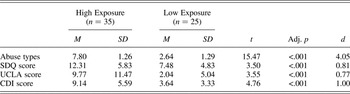
Table 2 displays the descriptive statistics for both groups. In concordance with the sample selection, the high-exposure group reported a substantially higher number of different abuse types than the low-exposure group. The differences between the two groups are especially notable for the items indicating that a minor in the household was the perpetrator of the abuse (see Table 1). All mental health variables (SDQ, UCLA PTSD Reaction Index, and Children's Depression Inventory) differed significantly between groups with medium to large effects (see Table 2). In total, n = 11 (31%) children in the high-exposure group showed an enhanced level of internalizing and externalizing problems compared to n = 1 (4%) in the low-exposure group. Accordingly, n = 9 (26%) children in the high-exposure group fulfilled the clinical diagnosis for PTSD compared to n = 2 (8%) in the low-exposure group. In addition, n = 10 (29%) children in the high-exposure group were at risk of suffering from depression compared to n = 1 (4%) in the low-exposure group.
Demographic characteristics of children with high and low exposure to child abuse
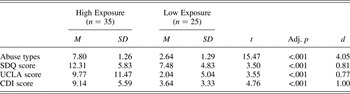
Note: t, Test statistics based on Welch t test; Adj. p, adjusted p value based on Welch t test corrected for alpha inflation due to multiple testing; d, Cohen effect size; SDQ, Strengths and Difficulties Questionnaire; UCLA, University of California at Los Angeles PTSD Reaction Index for Children DSM-IV; CDI, Children's Depression Inventory.
DNA methylation of genes associated with the HPA axis
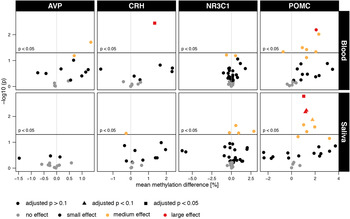
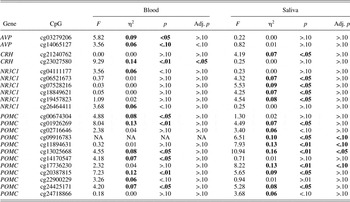
We found a group difference between the high-exposure and low-exposure groups in POMC with higher DNA methylation in children with high exposure. This effect was particularly evident in saliva. In the saliva of the high-exposure group, one CpG site was significantly hypermethylated in one-tailed tests at an adjusted significance level of .05, and three additional CpG sites would be significantly hypermethylated an adjusted significance level of .10 (Figure 1, Figure 2, and Table 3). Considering unadjusted p values as well, three additional CpG sites belonging to POMC were differentially methylated in the saliva of the high-exposure group. All of the aforementioned CpG sites displayed medium to large effect sizes. In saliva, two more CpG sites in POMC displayed moderate effect sizes, although unadjusted p values exceeded the significance level of .05. In blood, six CpG sites in POMC were differentially methylated if unadjusted p values are considered. These six CpG sites displayed medium to large effect sizes. In blood, one additional CpG site in POMC displayed a moderate effect size, although unadjusted p values exceeded the significance level of .05.
(Color online) Mean methylation differences in high- and low-exposure groups. The effect size and the level of significance are color coded (online only) or depicted by the shape, respectively. AVP, Arginine-vasopressin gene; CRH, corticotropin-releasing hormone gene; NR3C1, nuclear receptor subfamily 3, group C, member 1 glucocorticoid receptor gene; POMC, proopiomelanocortin gene.

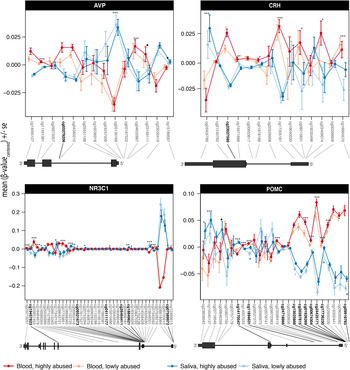
(Color online) DNA methylation of hypothalamic–pituitary–adrenal axis genes. Mean methylation of all analyzed cytosine nucleotide–phosphate–guanine nucleotide (CpG) sites. CpG sites are ordered according to their genomic location (not drawn to scale). For visual purposes, the data were mean centered. Beneath the scatterplots, the respective CpG sites and their positions in the gene model are displayed. CpG sites, which revealed at least moderate effect sizes comparing the high- and low-exposure groups are highlighted in black and bold font. AVP, Arginine-vasopressin gene; CRH, corticotropin-releasing hormone gene; NR3C1, nuclear receptor subfamily 3, group C, member 1 glucocorticoid receptor gene; POMC, proopiomelanocortin gene. •Adjusted p < .1, *adjusted p < .05; **adjusted p < .01; ***adjusted p < .001. Black asterisks/dots depict tissue comparisons, red asterisks/dots (online only) depict comparisons in relation to child abuse in blood, and blue asterisks/dots (online only) depict comparisons in relation to child abuse in saliva.

Analyses of variance analyzing the effect of childhood abuse on DNA methylation in CpGs associated with the AVP, POMC, NR3C1, and CRH genes

Note: F, F statistic for abuse; Adj. p, adjusted p value; η2, eta square effect size. The p values below .05, Adj. p values below .10, and effect sizes above .06 are highlighted in bold. AVP, Arginine-vasopressin gene; CRH, corticotropin-releasing hormone gene; NR3C1, glucocorticoid receptor gene; POMC, proopiomelanocortin gene. Only CpGs, which are differentially either in blood or saliva, are displayed.
For the remaining HPA axis genes investigated, we did not find a clear group difference in DNA methylation. In saliva, four CpG sites were differently methylated in GR and one in CRH, displaying moderate effect sizes and unadjusted p values below .05. In the blood of the high-exposure group, one CpG was hypermethylated in CRH at an adjusted significance level of .05, displaying a large effect. If uncorrected p values were considered, one additional differentially methylated CpG could be found in AVP, displaying a medium effect. If only effect sizes were considered, two additional CpG sites associated with GR and one associated with AVP differed between the groups in blood, displaying moderate effect sizes, but no significant p values were obtained.
Because we found the most pronounced effects in POMC, we inspected the 7 and 9 CpGs, which differed between the groups with at least moderate effect size in blood and saliva, respectively, in more detail. A comparison with the Jaspar database (Fox & Weisberg, Reference Fox and Weisberg2011) revealed that 5 and 6 of these CpGs are either located in or directly flanking a potential TFBS. The potential TFBSs included TFAP2A, ZEB1, THAP1, YY1, BRCA1, E2F, ZNF354C, MZF1, and SPIB. It is interesting that all of these CpGs are located in the 5′ promoter, whose methylation status has been shown to modulate transcriptional activity of the POMC gene (Newell-Price, King, & Clark, Reference Newell-Price, King and Clark2001). Our analyses covered 11 and 12 CpGs in this region in blood and saliva, respectively. In blood, 1 CpG site in this region was excluded from the analyses due heterogeneity of variances. Thus, about one-half of the CpGs in this region differed in their methylation by means of child abuse, and are associated with TFBSs.
DNA methylation of the POMC gene strengthens children's self-reports
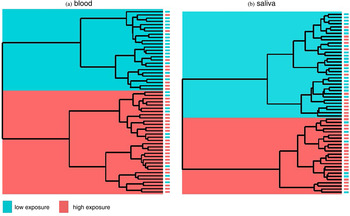
Post hoc we hypothesized that we could replicate, on the molecular level, the group allocation that was originally based on children's self-reports. We performed unsupervised hierarchical clustering on methylation of the 26 CpG sites representing the POMC gene using the Euclidean distance metric and the ward clustering method in the hclust package in R. To account for the dispersion differences across the methylation of the CpG sites, data were z-standardized prior to cluster analysis. Both in blood and in saliva, two distinct clusters reflecting the high-exposure and low-exposure groups could be detected (Figure 3). In blood, the analysis allocated n = 39 (68%) children into their respective group, and in saliva n = 35 (60%). A chi-square test confirmed the significant concordance between the group allocation based on children's self-report and based on methylation value in blood (χ2 = 5.95, df = 1, p = .015) and showed a trend in saliva (χ2 = 3.49, df = 1, p = .062).
(Color online) Hierarchical clustering dendrogram. Based on the methylation of 26 cytosine nucleotide–phosphate–guanine nucleotide sites present in the proopiomelanocortin gene a hierarchical cluster analysis has been performed. Two distinct clusters were formed in both blood (a) and saliva (b) significantly replicating the two groups that are based on children's self-reports regarding exposure to child abuse. The parts of the dendrograms highlighted in red (online only) represent the clusters containing mainly children exposed to high levels of child abuse while the turquoise highlighted segments denote the clusters containing mainly children with low exposure. The colored boxes (online only) next to the final branches denote the exposure to childhood abuse based on the self-reports (red, high exposure; turquoise, low exposure).

DNA methylation of HPA axis genes
We also compared DNA methylation in the four HPA axis genes between the two tissues. Generally, blood tended to show stronger signals of DNA methylated than saliva (Figure 2). The only exception was seen in AVP, in which the pattern was reversed and saliva was characterized by elevated DNA methylation levels compared to blood. This tendency was also revealed in the ANOVAs, as we found 3, 8, 18, and 11 CpG sites in AVP, CRH, POMC, and NR3C1, respectively, which displayed differential methylation between the tissues (online-only supplementary Table S.1).
Discussion
Child abuse is known to impair mental health across the entire life span (Carr et al., Reference Carr, Martins, Stingel, Lemgruber and Juruena2013). However, it has been claimed that the effects of specific forms of child abuse are not as harmful when they take place in societies or cultural groups in which such practices are common, socially accepted, and legal. Lansford et al. (Reference Lansford, Dodge, Malone, Oburu, Palme and Bacchini2005), for example, demonstrated that the relation between corporal punishment and mental health problems varied with the perceived normativeness of corporal punishment in the respective country. However, we and others have already demonstrated the detrimental effects of child abuse in such societies (Ani & Grantham-McGregor, Reference Ani and Grantham-McGregor1998; Hecker et al., Reference Hecker, Hermenau, Isele and Elbert2014). In concordance, in the present study children with high exposure to child abuse showed decreased psychological well-being. Furthermore, we demonstrated that this link manifests itself on a molecular level that cannot be manipulated by the subject: child abuse was strongly associated with the methylation of the POMC gene in both blood and saliva. To date, research incorporating child abuse and the methylation of HPA axis genes has focused mainly on the GR gene (de Kloet et al., Reference de Kloet, Joëls and Holsboer2005; Labonte et al., Reference Labonte, Azoulay, Yerko, Turecki and Brunet2014; McGowan et al., Reference McGowan, Sasaki, D'Alessio, Dymov, Labonté and Szyf2009; Perroud et al., Reference Perroud, Paoloni-Giacobino, Prada, Olié, Salzmann and Nicastro2011). Little is known about the physiological and phenotypic consequences of POMC methylation. The POMC gene is characterized by a 5′ CpG islands, located at exon 1 and the promoter region, and a 3′ CpG island more downstream around the intron 2 and exon 3 boundary (Gardiner-Garden & Frommer, Reference Gardiner-Garden and Frommer1994). Research investigating various disease traits or stress exposure has mainly reported differential methylation at the 5′ CpG island (Mizoguchi et al., Reference Mizoguchi, Kajiume, Miyagawa, Okada, Nishi and Kobayashi2007; Muschler et al., Reference Muschler, Hillemacher, Kraus, Kornhuber, Bleich and Frieling2010; Newell-Price et al., Reference Newell-Price, King and Clark2001; Stevens et al., Reference Stevens, Begum, Cook, Connor, Rumball and Oliver2010), but effects on the 3′ CpG island (Kuehnen et al., Reference Kuehnen, Mischke, Wiegand, Sers, Horsthemke and Lau2012) have also been reported. In cancer tissue that did not belong to the pituitary gland that caused Cushing syndrome (hypercortisolism), differential POMC methylation at the 5′ CpG island and increased ACTH levels were reported, suggesting HPA axis dysregulation, a key feature of many mental diseases (Mizoguchi et al., Reference Mizoguchi, Kajiume, Miyagawa, Okada, Nishi and Kobayashi2007; Newell-Price et al., Reference Newell-Price, King and Clark2001). Our research supports these previous findings, because the majority of differentially methylated CpGs in our study were located in the 5′ CpG island. Moreover, the respective CpGs colocate with TFBSs, suggesting transcriptional regulation. These TFBSs include an E2F response element, methylation of which has been shown to suppress POMC promoter activity in vitro (Newell-Price et al., Reference Newell-Price, King and Clark2001).
In addition to ACTH, the functionally relevant peptides β-endorphin and α-melanocyte stimulating hormone (αMSH) are cleaved from the prohormone POMC. Thus, the possible impairment of other systems than the HPA axis through POMC methylation has to be considered. β-Endorphin has antinociceptive effects that are essential for stress, in particular, the fight–flight situations. It also was reported to have rewarding properties and is considered as a factor in stress-related psychiatric disorders (Merenlender-Wagner, Dikshtein, & Yadid, Reference Merenlender-Wagner, Dikshtein and Yadid2009) and drug abuse (Roth-Deri, Green-Sadan, & Yadid, Reference Roth-Deri, Green-Sadan and Yadid2008). POMC methylation was associated with alcohol craving in patients suffering from alcohol dependence (Muschler et al., Reference Muschler, Hillemacher, Kraus, Kornhuber, Bleich and Frieling2010). Thus, differential POMC methylation by means of child abuse, as found in our study, may heighten the risk of the development of abuse-related mental illness (Carr et al., Reference Carr, Martins, Stingel, Lemgruber and Juruena2013), including drug abuse (Dube et al., Reference Dube, Felitti, Dong, Chapman, Giles and Anda2003). Abuse seems to affect the methylation of the POMC gene and may lead to increased emotional and behavioral problems in the children, which then increase the likelihood for further abuse. In short, settings of frequent abuse would generate a vicious cycle of further abuse and behavioral problems. Because of the nature of our study, it was not possible to test this idea statistically. Future studies using larger samples and longitudinal designs should test this hypothesis empirically. Nevertheless, our findings are congruent with prior findings that child abuse is related to worse child mental health, even in a society in which specific acts of child abuse are common practice.
DNA methylation profiles appear to be tissue specific (Ollikainen et al., Reference Ollikainen, Smith, Joo, Ng, Andronikos and Novakovic2010), and several studies indicated a clear separation of samples derived from saliva and blood (Smith et al., Reference Smith, Kilaru, Klengel, Mercer, Bradley and Conneely2014; Thompson et al., Reference Thompson, Sharfi, Lee, Yrigollen, Naumova and Grigorenko2013; Wu et al., Reference Wu, Wang, Chung, Andrulis, Daly and John2014). Accordingly, we found significantly different methylation profiles between saliva and blood. Moreover, there was a general trend of hypermethylation in saliva, which has previously been demonstrated. However, despite tissue-specific methylation, we demonstrate that childhood abuse is associated with DNA methylation in both saliva and blood. Thus, methylation evoked by adverse experiences seems to be preserved across tissues.
Moreover, parents and caregivers often argue that children tend to overreport the exposure to abuse and the resulting harm. Thus the children's perception of their experiences is often ignored, because children are not regarded as being mature enough to accurately gauge their situation (Qvortrup, Bardy, Sgritta, & Wintersberger, Reference Qvortrup, Bardy, Sgritta and Wintersberger1994). Hierarchical clustering based on the methylation of POMC, however, allocated two-thirds of children into their respective group and a subsequent chi-square test confirmed the significant concordance between the group allocations based on children's self-report and based on methylation value. Therefore, our results strengthen the credibility of children's self-reports on a molecular level and support the conclusion that children are capable of accurately reporting their exposure to abuse. In the school context of our data assessment, we were unable to include parents’ reports for logistical reasons. Furthermore, we deliberately focused on the credibility of children's reports, because their view has been often neglected in research thus far. While it is possible that the inclusion of parents’ reports could have further strengthened our findings, previous studies in resource-poor countries cast doubt on the validity of parents’ knowledge about their children's suffering (Elbert et al., Reference Elbert, Schauer, Schauer, Huschka, Hirth and Neuner2009).
The methodologies employed by our study present some limitations. Our data are correlational in nature and thus cannot prove a causal relationship between child abuse and methylation patterns or decreased psychological well-being. Nevertheless, even if certain methylation patterns might increase the likelihood of child abuse, the data still confirm the credibility of children's subjective reports and with it a wealth of data showing that abused children are more likely to suffer. However, the sample size and our study design using extreme group comparisons limit the generalizability of our findings. In the school context of our data assessment, we were unable to include parents’ reports for logistical reasons. Therefore, we could not gather information regarding the socioeconomic status of our sample. It remains to be tested whether socioeconomic status can impact DNA methylation through other pathways than abuse. Furthermore, it has been suggested that probes containing single nucleotide polymorphisms (SNPs) might result in a biased signal (Price et al., Reference Price, Cotton, Lam, Farré, Emberly and Brown2013). Based on the 1000 Genomes Project's database (1000 Genomes Project Consortium, 2012) eight SNPs colocalize with the target sequence of probes associated with POMC. However, the majority of those are very rare in African populations with minor allele frequencies below 0.2% and are thus considered not relevant to our sample. Excluding one CpG, whose respective probe contained a SNP in their target sequence at higher minor allele frequency (i.e., 1.0%), did not markedly change the results (data not shown). Furthermore, this SNP was located more than 10 base pairs away from its target CpG, which does not seem to evoke biased signals (Price et al., Reference Price, Cotton, Lam, Farré, Emberly and Brown2013). Therefore, we consider our findings to reflect the epigenome of the participants and not as artifacts of their genotype.
In summary, we provide further evidence that in societies or cultural groups in which many specific acts of child abuse are common, legal, and socially accepted, child abuse is nevertheless detrimental for the psychological well-being of affected children. Our evidence for such a link is strengthened by the inclusion of epigenetic information from both blood and saliva. This is the first study reporting the link between child abuse and modifications of DNA methylation of POMC. Epigenetic modifications provide a promising mechanism through which child abuse could act to influence psychological well-being. In addition, on a molecular level, our study strengthens the credibility of children's self-reports evaluating their exposure to abuse. All in all, our findings underscore the need to inform the population at large about the adverse consequences associated with various forms of child abuse, both those societally accepted and those not. This holds especially true in societies in which such practices are commonly employed and generally regarded as effective.
Supplementary Material
To view the supplementary material for this article, please visit http://dx.doi.org/10.1017/S0954579415001248.