A fairly unreflective historical consensus surrounds the assassination of Spencer Perceval, the prime minister, in the lobby of the House of Commons in May 1812.Footnote 1 It was the act of a deranged bankrupt acting on the basis of private grievances. While the event might have given rise to some slight flutters in the breasts of the governing elite, it was a sideshow to the main concerns of that busy year: turbulent Westminster politics, a fragile wartime economy, Luddite disturbances, and, of course, the winning of the war. Assassins themselves and their motivations for acting are apt to be marginalized by historians, and the assessment of Simon Maccoby in his synoptic history of radicalism can stand proxy for the consensus on John Bellingham’s murder of Perceval: “Nobody pretended, or desired to pretend, that there was the slightest political significance in the assassination, which was the work of one who had long brooded over imagined private grievances.”Footnote 2 In addition to a reasonably detailed account of the assassination in Perceval’s modern biography, there have been two useful narratives of the event itself, but these were less interested in the wider contexts for the murder and its reception than in the drama of the assassination and Bellingham’s trial.Footnote 3 More specialized work has examined what the affair can reveal about legal definitions of “insanity,” but it does not raise any questions about the political significance of the event.Footnote 4
The purpose of this article is to question this apparent consensus and to examine some of the responses to the assassination of Perceval. Such a goal is inspired by recent work that has begun to take seriously that least studied period of the British past (by all but military historians), the years between 1800 and 1815.Footnote 5 More particularly, this article is encouraged by some very recent work that has rehabilitated and refurbished an interpretation of 1812 as a year of profound crisis in the British state as it was beset by recession, the challenges of a revived radical platform, the controversy surrounding the Orders in Council, and the threat of Luddism. In recent work by Katrina Navickas and Adrian Randall, the year has been transformed from a footnote into a headline.Footnote 6 Finally, it is encouraged by some of the excellent scholarly work that has examined the assassination of the duke of Buckingham by John Felton (another man whose private grievances ostensibly led to his decision to murder a public man and whose example leapt quickly to people’s minds in 1812) and its reception.Footnote 7 If historians of the seventeenth century have begun to take their assassins seriously, this is perhaps a lesson for those of the nineteenth.
This article focuses not on Bellingham himself but on the reception of his act and the political meanings ascribed to it. It does not aim to pick over the year 1812 and arrive at some measure of its “revolutionary potential” or, conversely, to demonstrate the massive stability of British politics and society during the war. Instead, it seeks more modestly to show how the assassination of the king’s principal minister—a traumatic and at least potentially transformative event—was used by various groups with political interests and featured in political discussion and rhetoric to illustrate a number of different issues: the nature of assassination and the relationship between private and public, the role of the commercial middle classes in the affairs of the nation, the cultures of Luddism and extraparliamentary radicalism, and the role of petitioning within British political life. While political elites were keen to ensure that the assassination was not seen as political and could not be politicized, their very attempts to achieve this undermined their efforts as Perceval’s murder became politicized in a number of different ways. This article aims to explore these different responses. It does this by offering, first, a brief narrative of the affair of John Bellingham and the assassination of Spencer Perceval itself; second, an examination of the debate in Parliament and among political elites about the murder’s significance and the appropriate public response; finally, an analysis of how the assassination was received, discussed, and used outside of Parliament, particularly among the commercial middle classes and those members of the working classes who were engaged in radical and reform politics.
There is no doubt that John Bellingham, a shipbroker from Liverpool, acted on the basis of private grievances. Born in St. Neots in 1770, Bellingham had experienced his fair share of commercial ups and downs before his fateful voyage to Archangel, where he arrived in the summer of 1804. He was prevented from either returning on or loading his goods onto the vessel he had chartered and was detained for a debt of 4,890 roubles, allegedly owed to a Mr. Conrad Dorbecker. Bellingham’s lengthy imprisonment in Russia—from which he repeatedly refused liability for the debt and made frequent representations to Granville Leveson-Gower, then British ambassador in St. Petersburg—was to last until October of 1809. Bellingham remained consistent in his story throughout his life and always claimed to have been wrongfully imprisoned on the fraudulent oath of the bankrupt assignees of Dorbecker. This he linked to a wider accusation, that the real cause of his imprisonment was a conspiracy hatched by two wealthy Russian merchants, Solomon Van Brienen and Vassily Popoff. In 1803 these men had lost a ship, the Sojus, and Lloyd’s of London had refused compensation on the basis of an anonymous letter claiming that the ship had been fraudulently sabotaged by its owners. Although Bellingham protested his innocence and encouraged the authorities in Russia to investigate these merchants, Popoff and Van Brienen were apparently convinced that he had sent the letter.
To these alleged commercial injustices Bellingham added a strong conviction that he had been let down by the representatives of the British government in Russia. Early in his tour around different Russian penal establishments, while under the impression that his health was failing, Bellingham made a declaration to the minister of the English Church at St. Petersburg. This highlighted his strong sense of personal oppression, his conviction that he had been refused the protection that should attend British subjects, and his argument that Russian actions were an affront to British commerce: “I solemnly declare that I have been made the victim of oppression in this extraordinary and unprecedented manner … whereby justice and the laws have been trampled underfoot in the most pernicious manner to the great prejudice of His Most Imperial Majesty, as well as to the utter contempt and dishonor of Great Britain.”Footnote 8
It was an overpowering concern to secure a public discussion of his wrongs and some redress for the injustice he had suffered that formed a constant refrain when Bellingham was released and arrived back in England in December 1809. To his sense of being a victim of commercial fraud and of the inability or unwillingness of the British government to protect its subjects abroad was added the conviction that the government at home also refused to discuss his case or consider his petitions. The substantial paper trail he left over the following years demonstrates that his attempts to have his wrongs redressed became nearly a full-time occupation for Bellingham. He petitioned and was rebuffed by Lord Wellesley at the Foreign Office, the Home Office, Spencer Perceval, the prince regent, the lords of the treasury, and the Privy Council. During this process, he consistently represented his grievances not only as a private matter but also as an “Affair of National Import” and deserving of public discussion.Footnote 9 Having failed to secure a public discussion of his cause in the press and with all official avenues apparently exhausted by the beginning of May 1812, Bellingham began to visit the gallery of the House of Commons. He also purchased a pair of steel pistols from a gunsmith and visited a London tailor to have a side pocket of very specific dimensions made to accommodate these weapons.Footnote 10
On the early evening of Monday 11 May, as he walked through the lobby of the House to attend a session of evidence on the Orders in Council, Spencer Perceval was shot through the heart by Bellingham, a moment captured by several sensationalist contemporary prints.Footnote 11 He was dead within a few minutes. Bellingham offered no resistance—“a mouse might have secured him with a bit of Thread,” according to one eyewitness—and was easily apprehended.Footnote 12 He admitted the charge without compunction and was transferred to Newgate in the middle of a considerable crowd. His trial was speedily arranged. On that day, he wrote to his recent business partner, John Parton, explaining his action as a response to repeated denials of justice, in particular the refusal of every man’s “birth right” of bringing his cause before Parliament. He made it clear, as he did at his trial, that assassination was his last desperate attempt to secure a public hearing of his cause: “I could stand it no longer and resolved to finish the affair by an appeal to a criminal court wether [sic] government can refuse justice or no.”Footnote 13
Bellingham was tried at the Old Bailey on 15 May, with troops strategically positioned in case of attempted rescue. He ostentatiously refused any notion of pleading insanity and framed his actions—as he had throughout—as part of his dogged pursuit of justice. He explained his conduct as a reasoned response to the position in which he had found himself. He had even apparently interpreted one government rebuff as a sanction for assassination: “I had even a carte blanche from the British Government to right myself in any way I might be able to discover. I have done so.”Footnote 14 He was convicted and sentenced to death, and the sentence was carried out on Monday 18 May. It had been one week since his murder of Perceval.
The initial response among political elites in the Houses of Parliament is well captured in the Parliamentary Debates and contemporary eyewitness and newspaper accounts. The murder made its impact on a parliamentary scene that had been more than usually unsettled since the resignation of William Pitt in 1801 and more particularly since his death in 1806. Indeed, the formation of a ministry under Perceval in 1809, leaving out such “big beasts” as the feuding George Canning and Viscount Castlereagh (who later joined the ministry as foreign secretary), had been something of a compromise intended to address the ministerial instability of the first decade of the nineteenth century. Perceval’s death was to pave the way for a more lasting ministry under Lord Liverpool.Footnote 15
There was little evidence of the powerful political clashes of the era in the united front presented by parliamentarians. The immediate reaction was simply a clamor to determine what had happened and, crucially, to ascertain whether Bellingham had acted alone or was part of some wider conspiracy.Footnote 16 Having satisfied themselves on this point by searching others for arms, both Houses moved very promptly on the following day to confirm that the murder had apparently been an “insulated act” unconnected with any wider conspiracy and to deliver a unanimous condemnation of the assassination. This was represented as a crime against both British and universal human values. In the Commons, Castlereagh became “so much affected” that he had to sit down, but not before he had condemned the assassination as a crime that might stain the character of the country and was “inconsistent with the first emotions of human nature.” George Canning, a former (and future) foreign secretary, was the first of many to condemn assassination as fundamentally un-English, as “foreign to the character and abhorrent to the feelings of Englishmen.”Footnote 17
A unanimous condemnation of Perceval’s murder in particular and of assassination in general was easy to achieve. But it did not take long for this consensus to be challenged. On the following day, when debate took up the issue of addressing the prince regent to make an ample provision for Perceval’s family, political and interpretative divisions began to appear in Parliament. They emerged in connection with two issues: the appropriate relationship between private virtues and public distinctions and the precise place of assassination within British political culture. Such divisions were apparent because both issues were live ones that had been the subjects of politically charged debates within recent memory.
As Stuart Semmel has demonstrated, the 1790s and the first decade of the nineteenth century provided numerous opportunities for Britons to discuss the ethics and nature of political assassination, to the extent that “assassination figured prominently in the public imagination of early nineteenth-century Britain.”Footnote 18 Most notably, such discussions revolved around the actions of Napoleon—the kidnapping and summary execution of the duc D’Enghien was a crucial plank in the “black legend” that had developed since 1799—and, increasingly, on the availability or advisability of assassination as a means of defeating the Corsican tyrant.Footnote 19 The immediate context for Bellingham’s actions, however, was a two-year period during which assassination had been extensively discussed. In May of 1810, the duke of Cumberland had been attacked in the early hours of the morning by his Italian valet, Joseph Sellis, who subsequently took his own life. There was considerable public interest in the coroner’s inquest, which mixed suspicion of the verdict of suicide with criticism of the duke for employing foreigners.Footnote 20
More significantly, from the spring of 1811, the renegade journalist Lewis Goldsmith, who had switched an initial allegiance to Bonaparte for a kind of ultra-loyalist defense of legitimacy, was openly canvassing the establishment of secret societies devoted to the assassination of Napoleon and urging the wisdom of this policy on ministers.Footnote 21 Existing ministerial support for Goldsmith’s Anti-Gallican Monitor—not least from Perceval himself—placed the government in an awkward position, which Whig opposition MPs sought to exploit.Footnote 22 As an oppositional language coalesced around a patriotic critique of the conduct of the war after 1809—in which corruption was highlighted as the root cause of military failures in Spain and the Netherlands—Earl Grey in the House of Lords and Samuel Whitbread in the Commons leapt on apparent ministerial complicity in assassination as a patriotic stick with which to belabor ministers. Both Whig questioners and uncomfortable ministerial respondents agreed on a range of denunciations of the crime: assassination was un-Christian, unmanly, un-British, and counterproductive. Perceval himself, in distancing the government from Goldsmith’s schemes, provided a useful précis: “He disavowed most heartily, and from the bottom of his soul, any doctrines which led to practices so unchristian-like and so foreign to a wise and manly policy.”Footnote 23
These sentiments provide one immediate context for the response to the assassination of Perceval. MPs could not but be reminded that public discussion of the propriety of assassination had been extensively canvassed over the previous year. It was certainly picked up in discussion outside of Parliament, as will be demonstrated below. Running beneath this prolonged concern with assassination—and in particular the Whig assault on the Anti-Gallican Monitor—was the suspicion that the private actions of ministers, in subsidizing and encouraging an ultra-loyalist press, were incompatible with their public protestations about the war. The debate in Parliament in the aftermath of Perceval’s assassination served to foreground this other major recent source of political tension: the relationship between public and private life. Assassination, like scandal, forces us to question and discuss the division between the public and the private.Footnote 24
This was another issue with a venerable pedigree that had been taken up with a new urgency during the period immediately preceding Perceval’s assassination. Two powerful discourses had lent the issue a prominent place within public discussion during the French wars: first, the evangelical critique of private moral corruption and, in particular, of those vices “formerly confined to the higher classes of society” percolating from the higher to the middle orders and poisoning the streams of public life; second, a reoriented reform critique, which had been rebuilt around a criticism of scandals—most notably the duke of York affair (1809)—to criticize the deleterious effects of private corruption on both public life and the conduct of the war against Napoleon.Footnote 25
In this latter critique, the relationship between public and private life had become the fulcrum of political debate in a way that had been foreshadowed by radicals such as Mary Wollstonecraft, who had identified private morality as the wellspring of public virtue.Footnote 26 Peter Spence has traced the emergence of this “romantic radicalism” and highlighted its centrality to political discourse in the first decade of the nineteenth century. As the war effort was beset by problems from 1807, including the moral issues raised by the bombardment of Copenhagen and the humiliation of the Convention of Cintra, a patriotic critique of private corruption and its public and military consequences became more and more plausible and more and more powerful.Footnote 27 It reached its apogee with the assault on the duke of York and his mistress, Mary Anne Clarke, in 1808–9. Perhaps the clearest exposition of this obsession with the public consequences of private corruption could be found in the pages of the Examiner, which remorselessly pressed this diagnosis during the duke of York affair, helped to establish its central premises, and circulated political aphorisms based on these ideas: “The union of public and private virtue is as necessary to the sound politics, as it is to the real glory, of a statesman.”Footnote 28 As the Examiner was well aware, Spencer Perceval’s reputation as both a prominent evangelical statesman—“the model of a Christian gentleman … Christianity personified” in the estimation of one contemporary—and a persuasive debater made him the natural choice to defend the duke in the Commons but presented him with some intellectual problems.Footnote 29
Perceval’s response, in a speech that stretched over two days, was to demand that the duke’s detractors cease confounding the issues of public and private wrongdoing. His speech insisted that the House come to a decision on the charge of public corruption and, in effect, this entailed his establishing a boundary between public and private duties. The House might, as he did, reprobate “the moral guilt into which, in an evil hour, h.r.h. suffered himself to be plunged, by his infatuated attachment to this most profligate woman,” but as a public man the duke should be judged only on his public conduct. The House must form an opinion, argued Perceval, as to how far the duke was guilty of “a departure from the duties of his public station,” a desertion of the “importance of character” and “the importance of public opinion.”Footnote 30 Such an apparently rigid distinction between public and private duties seemed to rub up against Perceval’s evangelical convictions and the Examiner was not alone in responding with incredulity: “Mr Perceval, a man who has always professed to consider morality and patriotism inseparable, and who once brought in a bill to punish adultery as a crime, has separated the public and private character of high individuals, and has discovered that the profane and profligate debauchee is as fit a man as any in existence to guard the most dignified virtues of society, the virtues of a patriot soldier.”Footnote 31
The parliamentary response to Perceval’s assassination further exposed these tensions between different understandings of the relationship between public and private. The immediate response was that unanimity on both the unreserved condemnation of the assassin and the propriety of making provision to Perceval’s family was essential. Francis Burdett, the leading parliamentary radical, was fairly typical in underlining the importance of a single and univocal public response: “There was no room for any feeling but one on such an occasion; and that feeling all must wish should be conveyed to the sovereign, unalloyed by any other. It was impossible that this feeling, on a subject which concerned the safety of every man in the nation, should not be carried with unanimity to the throne.”Footnote 32
Such exhortations were necessary because, beyond the immediate condemnation of assassination, there was such rich potential for divergent opinions on how best to mark Perceval’s murder. Indeed, consensus soon began to erode along political lines, when the initial shock of the event had subsided and ministers began to canvas more ambitious projects of indemnification and commemoration. For ministerial colleagues and supporters, these schemes presented fewer problems than for others: for them Perceval’s private virtues were matched by his public ones. Castlereagh outlined these virtues and emphasized Perceval’s high sense of public duty and his eschewal of all pensions and emoluments.Footnote 33 Such arguments, of course, tacitly accepted a relationship between Perceval’s private and public virtues, but they did not need to delve any deeper than expressing an approbation of both. Ministers encouraged opposition members to support motions for a public monument and for more extensive compensation for Perceval’s family on the basis that even party-political opponents could pay their respects to private and public character without implying a wholesale acceptance of Perceval’s policies.
These arguments were increasingly rejected by opposition members as the sums to be granted to Perceval’s family and the honors proposed to his memory escalated. Especially vociferous were those parliamentary radicals who had faced the chancellor of the exchequer over the duke of York affair. In one sense they found themselves on the opposite side of the argument: they agreed to separate the private from the public man and pay testament to the first while reserving judgment on the second. In reality it was, for many, a very difficult division to maintain. Once parliamentary business moved beyond a modest recompense to Perceval’s widow and family, Samuel Whitbread was most vociferous in the rejection of measures that must, he argued, imply endorsement of Perceval’s public virtues.Footnote 34 Another political maverick on the opposition benches, Samuel Romilly, offered perhaps the clearest expression of this discomfort in his diary reflections on the fallen minister. Acknowledging his great respect for Perceval as a father and a private man, Romilly explained why he had shrunk from Perceval’s invitations to friendship: “I could not endure the idea of living privately in intimacy with a man whose public conduct I in the highest degree disapproved, and whom, as a member, I was constantly opposing. I cannot indeed reconcile to my way of thinking, that distinction between private and public virtues which it is so much the fashion to adopt. … It is not suited to anyone who is really in earnest and sincere in his politics.”Footnote 35
Initially, such strong statements were confined to men who operated on the fringes of the Whig establishment (Whitbread, indeed, was in the process of his final alienation from Whiggism) and whose proximity to and involvement in the radical critique of private corruption helped to shape their political convictions. That such a critique had wider purchase became abundantly clear when the debate moved on from the issue of a modest provision for Perceval’s family to that of a public commemorative monument to Perceval himself.Footnote 36 While the minority against the motion for a monument was small, the debate saw powerful speeches from the Grenvillite Charles Williams Wynn, who argued that “there was no instance on the Journals in which a monument had been voted to the public or private ‘virtues’ of any individual” and from the Whig Viscount Milton, who “could not, in his own mind, separate the vote of a public monument from the idea of public services.”Footnote 37 Both men had been critics of the duke of York’s conduct, and their attack on the idea that supposed private virtues could ever be a justification for public monuments was matched by similar criticisms in the radical press.Footnote 38
The reception of Perceval’s death in Parliament thus underlined issues that had been mounting throughout Britain’s experience of revolution and war. The increasing presence from the 1790s of assassination as a topic of public discussion and its recent endorsement as a political strategy by sections of the ultra-loyalist press provided a crucial context for Perceval’s murder. More importantly, the increasing tension between public and private virtue that was being stoked by the language of the wartime state, its patriotic opponents, and an increasingly dominant religious discourse of evangelicalism provided a fulcrum for the debate on the assassination.
One factor that had been apparent in the parliamentary responses to the assassination was concern about the wider public reception of the event. In part, the purpose of swiftly demonstrating it to be the work of an individual actuated by private grievances was to inform and convince the wider public on this point. Indeed, Canning congratulated Castlereagh on his prompt statement, which he hoped had forestalled any attempt by radicals or by loyalists to use the event as the basis for action: “On the one hand it might have been held up as an example and encouragement of practices foreign to the character, and abhorrent to the feelings of Englishmen; while on the other, it might have been regarded as the symptom of a general and prevailing spirit of bloodshed and anarchy, forerunner of the evils which had desolated the rest of Europe.”Footnote 39 Such attempts to depoliticize the assassination were echoed by the bookseller Joseph Butterworth’s later efforts to secure a public statement from Bellingham to the effect that “he was engaged in no sort of confederacy, and that it was not from any kind of political motive whatever that he was induced to commit the horrid deed, but from a Full infatuation of imaginary personal wrongs.”Footnote 40 Butterworth succeeded in obtaining such a statement from Bellingham, which was assiduously and widely reported in accounts of his execution.Footnote 41
A similar sensitivity to how both the assassination and the measures taken by Parliament in its aftermath might be received in the country ran through the subsequent debates. William Wilberforce reminded the House that in aiming for unanimity it should be remembered that “in the country his [Perceval’s] political opinions had many strenuous opponents, who might think too large a sum wholly misapplied.”Footnote 42 Opposition to the monument from Williams Wynn and Milton was partly premised on the idea that the meaning of any public monument would prove impossible to control and that it might become a “column of infamy” that would “commemorate the vices of the person by whom he was destroyed” rather than any supposed virtues of Perceval himself.Footnote 43 During a period when the didactic power of public monuments was being widely canvassed, such disquiet about the possible meanings of monuments was neither flippant nor irrelevant.Footnote 44
Concerns about public reception were shaped by the widespread reports of celebrations, which threatened to lend their own political meanings to Bellingham’s actions. Reports of the impact of the assassination on the “public Mind” reached parliamentarians quickly and linked the murder to the prevailing distress, as did a correspondent from Wolverhampton:
Every serious well-disposed person is struck with horror; but I am sorry to say that numbers of a quite different description have been shewing marks of rejoicing, by firing Guns till near midnight, & the greater part of this Day! Boys in the streets are taught to exclaim—now the great Man in the Parliament House is dead, we shall have a big Loaf! My Ears are assail’d as I pass along the streets with declarations of distress, & almost threats; and I have too much reason to dread that it cannot be long before some serious Event must take place, as the lower classes seem quite ripe for it.Footnote 45
These reports had an impact on parliamentary interpretations and, indeed, one of the contexts for Williams Wynn’s objections to a monument was the evidence of rejoicing at the assassination in such an unlikely place as the Shropshire market town of Oswestry.Footnote 46 Such celebrations had begun almost immediately with the transfer of Bellingham from Parliament to Newgate: “When the prisoner was attempted to be put into the coach, a great bustle was set up, and an attempt to rescue him. In the most detestable spirit they huzzaed and cheered him, calling out ‘Burdett for ever,’ and execrating the soldiery as murderers, and hissed and hooted the carriages of the members and other gentlemen.”Footnote 47 Abhorrence at the “savage joy manifested by the populace” was thus a common trope in elite responses to the assassination.Footnote 48 Romilly was not alone in tying the assassination and the “savage expressions of joy and exultation” in London to the increasingly violent nature of Luddite protest and positing a fundamental shift in the national character: “Sentiments so horrible as these, together with the recent assassinations and attempts at assassination which have taken place at Nottingham and in the North of England, are well calculated to excite the most lively alarms in the minds of all thinking men. The English character seems to have undergone some unaccountable and portentous change.”Footnote 49
Such celebrations, as Canning feared, were met with a loyalist inability to interpret the assassination as an apolitical act. In the context of celebrations by “the mob” in Bolton, where the news had filled “all good Loyalists with grief,” Ralph Fletcher, a prominent and virulently anti-radical magistrate, could report: “The Loyalists here cannot accede to what is stated in the Public Prints—viz that Bellingham had no political motive for committing the foul deed. We here, from the general language of the disaffected and from some secret Information, of a Revolution … expected to have taken place early in May, cannot refrain from entertaining an opinion that Bellingham’s motives were revolutionary.”Footnote 50
Loyalist sermons, pamphlets, and newspapers that speculated on the assassination similarly lent political significance to the event and to the motivations of the assassin. Bellingham’s action was taken as evidence of the deterioration in political culture effected by the American war and, in particular, by the political violence of Jacobins and Paineite principles.Footnote 51 Perhaps the most commonly referenced trope was the un-Englishness of assassination and the nature of the murder as a clear indicator of the foreign dangers to British political life. This formed a constant refrain in printed responses and was, for example, central to one specimen of the truly awful verse sent into loyal newspapers. Written by “An Englishwoman,” these “Lines on a Late Disgraceful and Melancholy Degradation of the British Character” saw the assassination as an importation to Britain of Napoleonic crimes (the poet had in mind Napoleon’s alleged poisoning of French troops in Jaffa) to Britain:
The assassination was also used, however, to make more sophisticated arguments about the duties of the social and political “middle” that had been such a fertile cause of political debate since the 1790s.Footnote 53 The theme was taken up most trenchantly in a pamphlet containing Cursory Remarks on the assassination, which used Bellingham’s social position to argue for the political importance of this middle class standing firmly with “the higher orders.” The appeal was premised on identifying the self-interest of “the middling classes” with that of “the Throne itself,” and readers were reminded that “the same principles which led one wretch to murder a Minister whom he considered as the cause of his ruin, will lead a discarded shopman to murder his former master.” The tract was, however, far from a paean to the middle classes. It identified speculation and borrowing as one of the “principles that disorganize society,” an explanation that provided a neat moral explanation for Perceval’s murder: “The misery and guilt of Bellingham may all be traced up to the fatal error of trading without capital.”Footnote 54
Such moral exhortations highlight the final way in which loyalists discussed Bellingham’s actions: through the lens of religion. The discussion was complex. For the author of the Cursory Remarks, for example, the assassination and Bellingham’s impenitence were an invitation to examine the political morality espoused by different sects with a view to restricting those “whose morality differs from the established law.”Footnote 55 More representative were the lessons drawn by the prominent Anglican evangelical minister of St. John’s in Bloomsbury (and future bishop of Calcutta) Daniel Wilson. His widely circulated Substance of a Conversation with John Bellingham was based on an interview held on the eve of Bellingham’s execution. The pamphlet alluded to the political dangers of an accelerating infidelism, but it dwelt on what Bellingham as a case study of wretched humanity could reveal about the fundamental tenets of evangelical religion: the importance of early religious instruction, the hazards of “hasty and unmeasured schemes of aggrandisement,” the necessity of constant vigilance against the temptations of the devil, and, above all, the need to reject “perfunctory and unmeaning generalities in religion” in favor of Wilberforce’s “real and vital Christianity.”Footnote 56
The ministerial insistence on the apolitical nature of the assassination was thus contested on its reception within public discussion, by loyalists as much as by radicals and reformers. Attempts to brand Bellingham as a Jacobin, or a Catholic, or an infidel, or a speculator, were part of a process through which loyalists derived their own meanings from the assassination of Perceval. That such responses were complex and multivocal provides further support for Mark Philp’s influential approach to popular conservatism as a nuanced and evolving range of political positions rather than as the expression of a simple and instinctive conformity.Footnote 57
The remainder of this article will trace the complex role that Bellingham’s assassination of Perceval came to play within reformist and radical argument and action. If ministers could not avert loyalist politicization of the assassination, they could hardly have expected to be successful in containing radical interpretations. This was even more the case because Perceval’s political conduct across his career made him liable to the hostility of a wide range of reform and radical groups and leaders. He had been involved in the prosecution of members of the London Corresponding Society in the 1790s, of Colonel Despard in 1803, and of William Cobbett in 1804; as prime minister, he strongly supported the imprisonment of Francis Burdett in the Tower of London; and alongside his consistent anti-radicalism, Perceval was associated with a range of other contentious positions, including a virulent anti-Catholicism.Footnote 58
Radical interpretations of the assassination had been apparent in the incongruous cheers for Burdett as Bellingham was moved to Newgate, and numerous accounts attested to the spread of these celebrations and the political meaning they lent to the murder. William Cobbett, who watched Bellingham’s execution from his own berth at Newgate, gave an account of the joy with which the news of Perceval’s death was greeted: “It is very notorious, that the news of the death of Mr Perceval excited demonstrations of joy, the most unequivocal, amongst the people in several of the most populous parts of England; that at Nottingham the church bells were rung, at Leicester there was a supper and songs; at Sheffield there were sheep roasted whole; that, in short, the shouts in Palace-Yard were but a signal for popular rejoicing through the country.”Footnote 59
If Cobbett’s picture of a saturnalian reception of the news of Perceval’s death was drawn rather too luridly, there was plentiful evidence (and criticism) of celebrations occurring in the provinces.Footnote 60 As Cobbett’s commentary demonstrates, the radical press was quick off the mark in ascribing political meaning to the assassination. According to a hostile source, for example, the broadly Burdettite Statesman newspaper used its second edition on 11 May to peddle an idealized version of events: “Bellingham being seized and called upon to account for his motive in shooting Mr. Perceval, had said that ‘he had saved his country and was content’: thereby intimating, that the act was praiseworthy, and a second Brutus had risen to snatch poor Old England from the claws of a tyrant.”Footnote 61
Tracing the political meanings given to the assassination beyond these generalized reports of public rejoicing is more challenging. The most obvious relevant context was that of Luddism, something well recognized by contemporaries. The most frequent appearance of Bellingham’s name and actions came in threatening letters—Luddite and otherwise—after May 1812. A few examples will serve to illustrate the genre. An anonymous letter to the prince regent on 17 May urged “bread or blood” and told the Regent to adopt Burdett as his adviser: “If you do not you shall share the same fate that Pervical [sic] has done.”Footnote 62 Other targets included Granville Leveson-Gower, who had been the British ambassador in St. Petersburg during Bellingham’s detention. Bellingham had suggested at his trial that Leveson-Gower had been his preferred victim, and Leveson-Gower’s explanation of his conduct in a public letter to Castlereagh meant that he continued to attract considerable public hostility:
Dreadfully are you deceiv’d in thinking Bellingham had no accomplice, neither shall your pretended Justification in your ignorant letter to the villain Castlereah [sic] protect you from the just indignation which is felt at your conduct towards the much injur’d man in Russia, there is many yet must fall, and tho’ you think yourself secure, yet before many days are pass’d you’ll meet the fate poor Bellingham design’d you, he was my friend from earliest youth and has left a glorious example to the world that a glorious death, after revenge has nothing frightful in it when compar’d with a life of poverty distress and oppression. Beware the fate which waited [sic] Caesar on the ides of march your fate is decreed therefore prepare for death.One of the fifty BrutusFootnote 63
The assassination of course encouraged a number of loyalist denunciations from the pulpit, and in Liverpool, Bellingham’s hometown, the Reverend Richard Blacow received a letter from “Iulius—Lt. de Luddites” denouncing his “impious falsehood on the subject of the hellborn Percivall [sic]” and defending “the brave and patriotic Bellingham.”Footnote 64
This deployment of what Kevin Binfield has described as a “Bellingham trope,” with Bellingham standing proxy for all sorts of public anger with government, was understandably commonplace during 1812.Footnote 65 The claims of various writers that they would “become” another Bellingham or that their target would “become” another Perceval focused on the outcome of the assassin’s actions rather than on any extended interpretation of his motives. What is clear is that the use of Bellingham within a popular discourse of physical threats had an afterlife. Lord Ellenborough’s sentencing of Lord Cochrane to a fine, imprisonment, and pillory in the summer of 1814 saw him receive a number of threatening letters that made reference to Perceval’s assassination: “Take care when you go the Guildhall that you do not meet a true relation of Bellingham.”Footnote 66 When James Watson Sr. was put on trial for treason in the summer of 1817 for his part in the attempted insurrection at Spa Fields in December 1816, the attorney general urged special caution on the sheriff. Manuscript papers had been circulated in the court and the attorney general produced several with the message: “Britons be alive, a few Bellingham’s [sic] is wanted.”Footnote 67 Similarly, one of the witnesses at the trials of Henry Hunt and others after Peterloo recalled a conversation in his public house, during which Joseph Johnson, one of the organizers of the Manchester meeting, had advocated men going armed to London and had used Bellingham as a model: “Recollect when Bellingham shot Mr Percival [sic] what confusion there was … if one could frighten them so, he was sure it might be done.”Footnote 68
If Bellingham could thus stand proxy for public anger and summary justice, there were more complex receptions of his actions that attempted to contest ministerial interpretations as well as to explain why Bellingham had been forced to act the way he did. One of the most obvious ways in which the government actions over Perceval’s murder were contested was through public expressions of support for Bellingham’s widow and family. A number of pamphlet and press contributions encouraged a public discussion of the Perceval murder and its aftermath: “The Cause of the Assassin and the Assassinated are both before the Public, and deeply is the public interest involved in their fate.”Footnote 69 Such appeals invariably involved political arguments about Bellingham’s actions and set up his widow and family as an alternative focus for compassion, their paterfamilias having been hounded to the point of madness by an insensitive government. One of these appeals took the opportunity to consider the nature of assassination by portraying Bellingham as a man driven by oppression to a desperate act and thus contrasting him with the kind of assassin advocated by newspaper editors, who had been “countenanced by the confidential servants of the crown”: “Mr. Bellingham, therefore, is not of that description of assassins whom Mr. Goldsmith, and other ruffians of his stamp, would range under the drapery of England, to assassinate the man whom we can neither out-wit in the cabinet nor subdue on the field.”Footnote 70
The idea of an appeal to the nation for a public subscription for Mrs. Bellingham and her family, in conscious imitation of the provision being made by the nation’s representatives for Perceval’s family, attracted considerable public attention and emerged very quickly. In Wigan, an examination of a man involved in an open discussion in a public house about Perceval’s murder confirmed that the discussion had revolved around the oppressive nature of wartime taxes and that there had been general approval of Bellingham’s actions. One Mr. Atkinson “approved of the murder of Mr Percivall [sic] and said that a subscription for Bellingham’s wife and family would be a good thing.”Footnote 71 In areas of conspicuous Luddite activity, anxious correspondents noted that liberal newspapers, such as the Leicester Chronicle, advertised the subscription to Bellingham’s widow and attempted to tie this to a critique of assassination principles.Footnote 72
The issue of provision for Bellingham’s widow brought up similar tensions between private and public measures as had the assassination itself. John Drinkwater, the son of the recent mayor of Liverpool, corresponded with Canning over private donations made to Mrs. Bellingham from, among others, Lord Leveson-Gower. Drinkwater was incensed when news of Leveson-Gower’s private £50 donation made it into the Liverpool Mercury, a reformist newspaper. He argued that either Mrs. Bellingham herself or the assassin’s acquaintances—“like many others of Bellinghams [sic] companions, violent unruly Reformists”—were attempting to make political hay by appealing to the nation and publicizing Leveson-Gower’s gift to the detriment of the donor: “It is truly lamentable to see Party Spirit carried to so great an extent.”Footnote 73 In the aftermath of this private donation, Mary Bellingham herself felt compelled to make a public appeal through the London and Dublin newspapers, in the context of the subscriptions being raised for her (including an intended Dublin play, St. Patrick’s Night, to be published for her benefit): “I have never solicited any public subscription, nor given my consent to any such that may have been publicly advertised.” Her claims to want to avoid an appeal to the public, however, ring hollow when compared to her letter of the following week that thanked Leveson-Gower for his donation and explained her conduct: “To a generous public, I am compelled to look for assistance.”Footnote 74
More explicit political connections had to be made when it was Bellingham’s actions themselves that were being discussed rather than provision for his family. Positive presentations, other than those that supported assassination as a political strategy in general, revolved around two themes: first, that Bellingham had acted the part of the patriot; second, that his actions demonstrated some of the fundamental problems within British politics. These interpretations highlight the more complex role that Bellingham’s actions played within political discussion, not least in having an impact on discussions of the nature of the British constitution and associated rights such as petitioning.
In contrast to the representations of assassination as foreign to British political culture, some positive comment sought to rescue Bellingham’s patriotic credentials. This was very apparent, for example, in a placard posted up in Hull: “Civil and Religious Liberty. It is hoped that the friends of Civil & Religious Liberty will enter into a subscription to support Mr Bellingham in his Trial for shooting Mr Percival, the Enemy of England. An Englishman.”Footnote 75 In some accounts, Bellingham could emerge as a patriotic victim and hero for the commercial classes, beset on all side by taxes and the hostility of an aristocratic government. Such appropriations posited a different political view of the role of the middle class than did loyalist attempts to denounce speculation and tie the social middle to the “higher orders.” One dreadful poem, that made it into Gower’s hands, presented Bellingham as the very epitome of the virtues of British commerce:
The poem went on to examine “how an Englishman in Russia far’d,” when his just claims were ignored by the “sycophant” and “courtier” Gower. The poem did not defend Bellingham’s actions (he had shot the wrong man by the poet’s account), but he stood at the center of a critique of how British commerce had suffered during wartime, with merchants imprisoned at will:
As with the poem, most broadly positive interpretations of Bellingham’s actions stopped short of public support for assassination. Instead, such accounts urged readers to consider the extraordinary provocations and oppressions that had driven Bellingham to seek his own justice. Bellingham found ready sympathy, for example, with other members of the middle classes, who were convinced that they had been swindled by a corrupt system but could achieve no redress for their losses. Augustus Cove, a Quaker whose business had occupied a wharf at Paddington before he was forcibly driven from it by the Grand Junction Company in favor of the carriers, Pickfords, took his claims to court. Like Bellingham, he spoke in his own cause and sought “redress before a jury of his countrymen.”Footnote 78 In pamphlet expositions of his case, Cove drew explicit analogies between himself and Bellingham and drew more general lessons from Bellingham’s experience:
Thus “Bellinghams” became shorthand for “men of worthy character, groaning under oppression, and unavailingly, (by peaceable and reasonable means) seeking redress.”Footnote 79 For Cove, it was quite clear how small businessmen who suffered such vexatious treatment might resort to “Deeds of Blood,” and even how, in having secured the repeal of the Orders in Council, Perceval’s assassination could be regarded as “‘A Deed of Public Good.’”Footnote 80 Other publications aimed at the commercial classes made similar points, albeit in less colorful and accusatory language. The Tradesman, for example, highlighted the vexatious manner in which government dealt with claims for redress, sending no answer when the cause was deemed to have no merit. Bellingham’s action was clear evidence of “the dreadful consequences which may follow from resentment thus kindled.”Footnote 81
Such commercial concerns tapped into the wider political question with which much of the public discussion of Perceval’s murder was framed and to which it would be longest applied: the relationship between the people and its governors. To the disgust of the loyalist press, this was the line taken by the chief radical paper, the Independent Whig, which lamented that “a British subject, despairing to get relief even from that assembly expressly instituted for the redress of all grievances, should think himself entitled to do himself justice by an act of violence.” In fact, the Independent Whig lamented that by the assassin’s hand Perceval the “traitor” had escaped proper judgement for his crimes.Footnote 82
Perhaps the clearest exposition of this widely canvassed explanation for Bellingham’s actions was found in a pamphlet addressed to the Examiner to castigate its editor for various attacks on radical politicians. The author reprobated all cases of murder except those in self-defense. He went on to extend this concept of self-defense and argued that denial of the means of life would justify murder: “You starve me by holding me back from obtaining my right, and my only source of support. Bellingham’s, with his family’s not being starved, depended on having his claims allowed by government. Mr. Perceval unjustly and unconstitutionally opposed himself to having those claims even heard, and there was no other mode of getting over his opposition than the hard and certainly terrible one to which Bellingham resorted.”Footnote 83
As such, the assassination of Perceval could be, and was, interpreted within a discourse of petitioning that Steve Poole has recently argued was central to British political culture.Footnote 84 The sense that the relationship between petitioner and both Parliament and the crown was breaking down in the early nineteenth century was palpable. For radicals, Perceval’s assassination provided a convenient shorthand in which to describe and criticize the failure of this culture of petitioning. There was, in fact, something of this critique in Bellingham’s concluding remarks at his trial, during which he had argued in familiar language that in petitioning for redress “I demanded only my right, and not a favour; I demanded what is the birthright and privilege of every Englishman.”Footnote 85
Such issues had been raised tangentially by MPs during the initial debates after the assassination. George Ponsonby, the Whig leader in the Commons, used the occasion to advert to petitioning as one of the hallmarks of British freedom and to contrast this with the political violence characteristic of despotic regimes: “One of the great blessings of a free government was that it allowed men to express their sentiments freely on all occasions, but if acts of revenge and assassination, like the present, were to prevail, the people would be in a condition no better than in those countries subject to the most rigid despotism.”Footnote 86 For Ponsonby, Bellingham’s actions clearly lay outside the parameters of British political culture. It was left to radicals to argue that Bellingham’s experience in fact demonstrated that this “great blessing of a free government” was either defective or altogether broken.
Petitioning lay at the center of radical activities for the opening decades of the nineteenth century. It had, in fact, been a cause of debate as recently as March 1812, when Whitbread had questioned why petitions against the Orders in Council had failed to reach the prince regent.Footnote 87 Perhaps the chief theorist and defender of petitioning was the veteran radical John Cartwright. He innovated extensively with his campaign of printed petitions for parliamentary reform across 1812 and 1813. If this was in part a strategic effort to build a national movement, Cartwright also sought to ensure that the right of petitioning received extensive discussion in Parliament.Footnote 88 In his writings, Cartwright drew links between assassination and despotism similar to those made by Ponsonby and argued for the centrality of constitutionalism to radical aims in Britain: “The English People, who so well know their rights, must of necessity do their work in a different way from the people of Muscovy or Turkey. In those countries, when tyrants are become too brutal to be longer endured even by abject slaves, they are removed by volcanic insurrection, or by assassination.”Footnote 89 Unlike Ponsonby, however, Cartwright did not characterize Bellingham’s case as an aberration from the fundamentally sound contractual relationship between governors and governed but instead used it to issue a warning about the dangerous weaknesses in this relationship and as an illustration of what must inevitably happen when the people’s petitions were met with contempt or negligence: “For the removing of error, information is necessary, and by its friendly communication, men may be pacified into Petitioners, who might otherwise become Bellinghams; and Statesmen may be saved from Pistols, by a timely attention to Petitions.”Footnote 90
William Cobbett, in his response to the assassination and its aftermath from Newgate, took this analysis one step further. He too had evinced considerable interest in petitioning, and part of his lifelong concern with the teaching of English grammar and with redefining popular journalism was to empower both rural and urban workers to take part in a political world of print on their own terms.Footnote 91 Like Cartwright, he assigned Bellingham’s actions to the failure of a culture of petitioning, the operation of which acted as a safety valve within a free constitution: “He seems to have explored ‘the Right of Petition’ to its utmost bounds! He, however, failed at last; he could not obtain Mr. Perceval’s permission to get a member to present his petition; and, not ten minutes before he expired, he declared, that, ‘had my petition been brought into parliament, this catastrophe would not have happened.’”Footnote 92 For Cobbett—with his own incarceration for seditious libel clearly in mind—Bellingham’s actions were also explicable in terms of the failure of another boasted British liberty, the freedom of the press. Bellingham’s petition had been only one part of his attempt to secure a public discussion of his grievances. Had he had access to a free press through which to pursue this end, the tragic events may have been averted: “But, unfortunately, he had no channel through which to make known his case to the country.”Footnote 93
This was to be the most lasting manner in which Bellingham’s case was used within radical argument. His was an object lesson in how a corrupt and fundamentally flawed political system—representatives who did not represent, a forum for the redress of grievances that offered no redress, and a shackled press—by denuding the people of their constitutional rights drove them to the contemplation of desperate violence. It was a dynamic well described by the most prominent practitioner of popular constitutionalist protest, Henry Hunt.Footnote 94 In his Memoirs, Hunt, in common with Cobbett and Cartwright, distanced himself from any ideological defense of assassination, but he did use the case of Bellingham to explain the causes of political violence: “Bellingham had been grievously oppressed, he could not obtain justice from the Government; he could not even make his case known in any way except by means of a petition to Parliament. … At the end of eighteen months of hope and fear and agony, Mr. Bellingham found that the consent of Mr. Perceval was positively refused; he was driven to despair, and he shot him.”Footnote 95
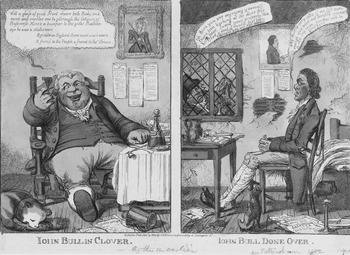
Hunt’s memoirs, written from jail, were composed in the aftermath of an intense period of political agitation between 1816 and 1819, during which the exact boundaries of the constitutional rights of petitioning, meeting, speaking, and the press had been extensively canvassed. As has been demonstrated above, Bellingham’s name, as a rallying call for popular vengeance, was mobilized in different contexts during this period of agitation. A print from January 1819 (see fig. 1), “John Bull in Clover/John Bull Done Over,” neatly summed up some of the key ways in which Bellingham’s legacy had been negotiated.Footnote 96 On the left, a portly John Bull, with full order books for the Russian and other markets, sits with his pipe and port praising the commercially sound nature of government policy. The sense of a departed golden age is communicated by the image of “Good Queen Bess” on the wall and the patriotic ballads beneath it. In contrast, the commercial John Bull of early 1819 sits in a decrepit room in shabby clothes. His order book is empty, his bills are oppressive, a list of bankrupts lies on the floor, and the tax collector knocks at the window. The patriot of 1819 is apparently faced with two options. On the table in front of him lies Toughts on Suicide [sic]. Behind him, on the wall, is a copy of Dennis Dighton’s print representing Bellingham at the Old Bailey during his trial. Like Bellingham, John Bull has been driven to the precipice: in the complete absence of constitutional weapons his only options are violence against his own person or against the nation’s governors.Footnote 97
Apart from its conventional contrast between a glorious age of plenty and a dire and oppressive present, the print is studiedly ambiguous in its meaning. Bellingham’s inclusion is part of this ambivalence and reflects the way in which the political significance of his actions was debated and discussed in the immediate aftermath of the assassination and in the years that followed. Political elites had been very quick in their attempt to constrain opportunities for the event to become politicized. By a focus on the nature of the crime and a stress on the public presentation of Bellingham’s motives as those of a man actuated by private grievances, theirs was an attempt to define and contain the political significance of the event. Even within Parliament itself, however, the debate over the nature of assassination and, more prominently, over the relationship between private and public virtue demonstrated how political meaning was derived from the assassination.
Political meanings were far harder to contain outside of Parliament, and the claims of historians that the event was “politically insignificant” take at face value the statements of political elites who wished to render the assassination politically meaningless. They failed, and within the country more generally, a number of different groups invested Perceval’s murder with their own meanings. In many ways the numerous reports of apparently spontaneous public rejoicing at the news
Charles Williams, “John Bull in Clover/John Bull Done Over,” 9 January 1819. Courtesy of the Lewis Walpole Library, Yale University.

of the murder, both in London and elsewhere, provide the most surprising evidence of this search for meaning. The celebrations to which these reports refer, however, remain the least recoverable of the reactions to Perceval’s death, though they clearly provided a crucial context for radical and loyalist responses. Loyalism remained a complex and protean phenomenon capable both of reading Bellingham’s actions in a number of different ways and of rejecting ministerial claims that it was apolitical. The event had similar significance for Luddites, insurrectionaries, small businessmen, and radical constitutionalists, all of whom found Bellingham’s actions to be politically usable, albeit in a range of different ways. Of these uses, the appropriation of Bellingham as a symbol of popular vengeance against governors is perhaps the most obvious and explicable. More significant, however, was Bellingham’s continued role within a radicalized constitutionalism, where he became a cautionary tale in radical attempts both to contest and to expand the rights of meeting, speaking, and, in particular, petitioning.