Notions that Erich Korngold found his métier in films have long saddled post-war interpretation of the composer's earlier operatic output with ideas that the works are, in some sense, pre-filmic. Although the comparison between these two genres is not in itself problematic – and is capable of revealing much of interest to discourses of both opera and film – the view of film music which many of these interpretations espouse (particularly those encountered in newspaper criticism) is arguably an uncritical one that implies a strict division between art and entertainment: in appealing to the latter, Korngold's operas seem to lose most of their claims to the former. The comparison, though ostensibly useful, is thus all too often used as a convenient way to dismiss any serious discussion of the operas’ role in their contemporary cultural contexts. Moreover, it also threatens to underplay the important cultural role played by those Hollywood films to which Korngold contributed scores in the 1930s and '40s.Footnote 2
There are signs, however, that this attitude is beginning to change, as musicology turns its attention towards the composer, with several notable contributions to Korngold scholarship in recent years resituating discussion of the operas within a post-fin-de-siècle Viennese world of psychoanalysis, gender theory, and emerging notions of mass culture.Footnote 3 Korngold reception is thankfully no longer characterised predominantly by his reputation amongst newspaper critics, or readings of his most famous opera, Die tote Stadt (1920), solely by the evidence of opera stagings – even if the idea of Korngold's operas as pre-filmic is still largely entrenched in the popular imagination.
I want to continue this process, then, of enriching our understanding of Korngold's operatic output, not by nuancing the pre-filmic label (though that is one possible approach), but by revealing the debt of Die tote Stadt to contemporaneous concerns with gender. These intellectual currents, notably voiced in the work of Otto Weininger (1880–1903), themselves engage provocatively with older nineteenth-century conceptions of Woman on which the opera's characters Marie and Marietta also draw. My aim is to demonstrate how the opera can be read in the light of its contemporaneous historical position as firstly, and from a biographical perspective, reflecting the growing influence of the composer's future wife; and secondly, and more widely, as embodying a modernist critique of Weininger's concept of Woman. The latter is supported by Korngold's treatment of one of the key themes of his symbolist source texts, namely the imagery associated with a tress of strangulating blonde hair – a particularly potent symbol in nineteenth-century art and literature. In its role in drawing together the opera's two main female characters, Marie and Marietta – who can be read as two overdrawn images of Weiningerian femininity, the strangulating blonde hair of Die tote Stadt reveals the opera to be not merely an anticipation of future Hollywood fare but an important cultural document among other modernist works of the early twentieth century.
Korngold operas and the pre-filmic label
The notion of seeing all Korngold's works, whether they be pre- or post-Hollywood, through the lens of his film music career is well entrenched in the composer's reception history. Although this can be a useful interpretative device (particularly with regard to the post-Hollywood works, nearly all of which use material first expounded in the films),Footnote 4 all too often it becomes an excuse to avoid engaging with the composer on all but the most superficial levels, or for justifying one-dimensional critiques often passed off as wit or journalistic élan. Thus Ernst Toch used to claim that Korngold had always written for Warner Bros., he was just unaware of the fact at first,Footnote 5 while Olin Downes labelled the 1945 Violin Concerto – famously dismissed as ‘more corn than gold’Footnote 6 – a ‘Hollywood concerto … the facility of the writing is matched by the mediocrity of the ideas’.Footnote 7 Similarly, Paul Hume, reviewing the first commercially available recording of the Symphony in F-sharp (completed in 1952), noted: ‘The Symphony is generally turgid in movement and texture, frequently overblown in the least attractive post-Bruckner style, and as frequently reminiscent of Korngold in his flamboyant Hollywood vein … [it] is largely banal, often tediously empty.’Footnote 8 Evidently, this is part of a complicated post-war reception, the full story of which has yet to be told. Certainly, the composer's Hollywood career appears to have shaped responses to new works, as when Hans Rutz in an otherwise positive review of the 1950 première of the Symphonic Serenade for the Neue Zeitschrift für Musik opens his article by drawing attention to Korngold's activity as a film composer.Footnote 9 Similarly, Andreas Liess in a 1950 article on ‘The Austrian Modernists’ mentions Korngold in the most perfunctory way as having found a place in Hollywood after travelling round the world.Footnote 10 And at Korngold's death, obituaries such as Karl Robert Brachtel's for Musica noted that one would ‘Most frequently encounter his name today as an arranger of classic Viennese operetta, which he provided for Max Reinhardt, or in the introductory credits of some American films.’Footnote 11
Beyond these general associations of Korngold's output with Hollywood, though, specific connections between the operas and film have also recently been bemoaned by Jens Malte Fischer who, in tracing the lack of scholarly attention paid to Korngold's fourth opera, Das Wunder der Heliane, draws attention to Ulrich Schreiber's monumental five-volume study of opera, Opernführer für Fortgeschrittene, which discusses Heliane under the title of ‘Opera as Film Music’.Footnote 12 We might also point an accusing finger at Richard Taruskin, whose only mention of Korngold is as a composer of ‘sacroporn’, a master hypnotist who writes for opera audiences that later became movie audiences, and who accomplishes ‘the transmutation of opera into film’.Footnote 13 Taruskin ends his discussion by suggesting that the ‘Night’ sequence from Another Dawn (William Dieterle, 1937) and the violin concerto that borrows its material as the first movement's opening subject are ‘sublimated operatic scene[s]’. He likewise simplifies with one stroke of the pen the distinctions between opera and film music by suggesting: ‘But of course he was writing opera all along … The style of Viennese opera that Korngold inherited and extended became the Hollywood style of the 1930s and 1940s.’Footnote 14 This is to essentialise film music's own distinct character, and to conflate two genres that, although closely linked, are not equivalent.
Aside from this general linking of Korngold's operatic output with his Hollywood oeuvre, specific connections with Die tote Stadt are also prominent in the opera's reception history. Again, the sources are often journalistic. Thus, in the review I invoked in my opening sentence, Harold Schonberg noted in response to the 1975 New York City Opera production of the opera: ‘Since his own creative imagination was not as strong as his technique, all he could do was repeat what previous composers had done … [Korngold] found his métier in films.’Footnote 15 Likewise, in a 1974 article that looked ahead to New York City Opera's revival of the work the following season, Peter G. Davis notes in gushing terms that ‘the same moon that luridly illuminates the graphic love-making of Paul and Marietta [in Die tote Stadt] also leers down on Salome … the woman who stumbled on the corpse of her beloved in Schoenberg's “Erwartung” and Wozzeck’, yet he still interprets the plot of the opera in Hollywood terms, calling it a 1940s movie twenty years ahead of its time.Footnote 16 When reviewing the RCA complete recording under Erich Leinsdorf the following year, his position had hardened: ‘few people would probably care to advance [the opera] as a masterpiece, even a flawed one … [it] has plenty of juicy tunes as well as the same brand of richly atmospheric mood-painting that Korngold later brought to his movie soundtrack-scoring in Hollywood’.Footnote 17 Even as recently as 2009, with the opera's première at Covent Garden, Ivan Hewett stated boldly: ‘Far from being an unfortunate distraction from his “true” nature, Korngold's Hollywood sojourn suited him perfectly.’Footnote 18 It is a beguiling notion, and all too easy to follow uncritically: in an article commissioned by the Royal Opera House in 2009 for the accompanying programme book, I also encouraged this kind of attitude by revealing the ways in which Die tote Stadt's musical language anticipated Korngold's later Hollywood output.Footnote 19
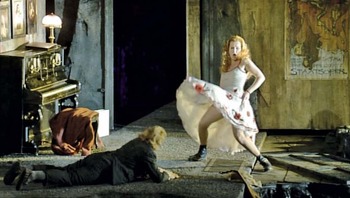
These connections between the opera and Hollywood have also been pursued within its staging traditions which, for all Die tote Stadt's phenomenal success in the 1920s,Footnote 20 are only just beginning to form again (as a result of the opera's virtual absence from the repertory between the late 1930s and mid 1950s).Footnote 21 One of the most popular approaches amongst revivals of the later twentieth and twenty-first centuries (though now seemingly on the wane) is to make specific connections between Die tote Stadt and Alfred Hitchcock's 1958 film Vertigo.Footnote 22 Thus, the productions mounted in Düsseldorf (1977), Spoleto (dir. Günter Krämer, 1997) and Hagen (dir. Paul Esterházy, 2007) all referenced Vertigo directly, with Esterházy, for instance, dressing Dagmar Hesse's Marietta in virtually identical clothes to those worn by Kim Novak in Hitchcock's film.Footnote 23 Hesse's hair was also styled in the same way. For anyone familiar with Hitchcock's Vertigo and its sources, the narrative parallels that motivate the linking of Marietta with the character of Madeleine are admittedly obvious. As with Die tote Stadt's source text, Bruges-la-Morte, the 1954 novel by Pierre Boileau and Thomas Narcejac on which Vertigo is based, D'Entre les Morts, is concerned with a lovelorn protagonist who attempts to resurrect the past, with similarly fatal consequences.Footnote 24 It is perhaps unsurprising that the Düsseldorf, Spoleto and Hagen productions of Die tote Stadt should have sought to make direct references to Vertigo in costuming and design, given the narrative parallels between the two texts and the obsessions of Alfred Hitchcock with his blonde leading ladies.Footnote 25 The 2001 Opéra National du Rhin production on DVD (dir. Inga Levant), on the other hand, made more oblique references to the film as part of a staging that invoked Hollywood cinema in general. As Volkmar Fischer noted in his introductory booklet, the production
brings to mind cinematic associations which alternate between the broad canvas epics à la Cecil B. De Mille and the spiritual fashion show of Federico Fellini's ‘Roma’. Marietta performs her famous aria as Marilyn Monroe, her dress billowing in the updraught of a subway vent – eat your heart out, Billy Wilder!Footnote 26
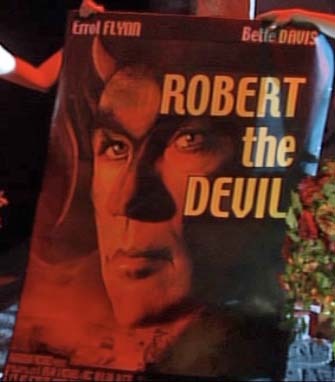
Thus, Marietta sings her Act I aria ‘O Tanz, O Rausch’ (rather than her more ‘famous’ aria, ‘Glück, das mir verblieb’) as Marilyn Monroe in The Seven Year Itch (Billy Wilder, 1955) (see Fig. 1). We are treated to more cinematic imagery in Act II, which takes place with a Los Angeles cityscape as its backdrop and features a giant movie poster for Robert the Devil, a Hollywood version of Meyerbeer's opera Robert le Diable, the resurrection scene from which Marietta and her troupe rehearse. This fictional Hollywood film stars Errol Flynn and Bette Davis, two of the actors for whose films Korngold wrote some of his most famous scores (see Fig. 2). Vertigo references are confined to a kaleidoscopic stage device that references the film's Saul Bass-designed opening titles, and the character of Brigitta (Paul's housekeeper), who is a bespectacled blonde like the character of Midge (Barbara Bel Geddes) in Hitchcock's film. Both Midge and Brigitta are portrayed as loners: Midge is a woman apparently smitten with Jimmy Stewart's character, Scottie (‘there's only one man in the world for me, Johnny-O’), but who can only relate to him in a maternal way (‘Mother's here’); Brigitta, too, admits to Frank ‘Was das Leben ist, weiss ich nicht, Herr Frank, / denn ich bin allein’ (As for what life is – I wouldn't know, Mr. Frank, / for I am alone) and, as David MacKee claims, she appears to be passionately in love with Paul.Footnote 27
(Colour online) Marietta (Angela Denoke) as Marilyn Monroe in the 2001 Opéra National du Rhin production of Die tote Stadt (dir. Inga Levant) © Arthaus Musik

(Colour online) The movie poster in Act II of the 2001 Opéra National du Rhin production © Arthaus Musik

The emphasis on cinematic imagery in this production even seemed to encourage a change to the staging of the climactic ‘murder’ of Marietta: instead of Paul strangling her melodramatically with a braid of hair taken from his dead wife Marie, as is detailed in the libretto and its sources, her throat is cut.Footnote 28 Although ostensibly a minor change, it threatens to disguise what, as we shall later see, is actually an important symbolic act – in which contrasting representations of women expressed in the characters of Marie and Marietta are brought together, with significant repercussions for our understanding of the opera's positioning within its contemporary Viennese milieu. While early productions of Die tote Stadt – such as Georg Hartmann's Dresden production of 1921 – used film as part of its modernist staging practice,Footnote 29 and might appear to provide some historical legitimacy for the staging decisions made by present-day directors, the Korngold of 1920 was not the same composer we find in Hollywood in the late 1930s and early 1940s. Though already seemingly interested in exploiting a mass-culture audience in Die tote Stadt (through two arias – ‘Glück, das mir verblieb’ and ‘Mein Sehnen, mein Wähnen’ – that were recorded extensively in the 1920s),Footnote 30 Korngold saw himself as both continuing and renewing a European operatic tradition. In that sense, Hartmann's use of film in his production arguably emphasised the modernist qualities of the opera, rather than its links with an emerging mass culture.
Film, then, is bound up with the post-war reception of Die tote Stadt, despite the anachronism of such an interpretative strategy, and its potential for reinforcing a reductive view of the opera. We must be careful, then, that scepticism of an uncritical linking of opera and film found in journalistic criticism or operatic productions does not lead to suspicion of all scholarly discussions of connections between the genres (my concerns about Taruskin's comments notwithstanding). As Peter Franklin warns in response to Scott Paulin's critique of the links commonly made between Wagner and film music, opera's status was never as uncomplicatedly ‘high art’ as Paulin seems to suggest. Far from representing the zenith of high art, Wagner was also subject to scepticism about his claims to art-authenticity. Franklin shows persuasively how Wagner's music dramas can be read as theorising and producing a technique of underscoring as ‘tending toward and preparing the techniques, technology, and aesthetics of mass-entertainment film’.Footnote 31 To attempt to divorce Korngold's operas from Hollywood entirely is to risk investing them (in Franklin's terms) with an ‘art-authenticity’ that their position and engagement with nascent mass-culture (noted above with reference to the two arias, ‘Glück, das mir verblieb’ and ‘Mein Sehnen, mein Wähnen’) should cause us to question. In addition, as Franklin's work has revealed, Hollywood film music of Korngold's era had much to contribute to the discourses of modernism and gender in which opera was already engaged:
Yet as a dramatically modernist project which not infrequently figured women as the redeeming sacrificial victims of powerful male heroes, [opera's] mobilization of the tropes of both gender and modernism with an ideologically colored popularizing agenda prefigures the critical history of film in a striking manner.Footnote 32
The corrective to a clichéd view of Korngold as a ‘mere’ film composer that follows is therefore to be thought of not as an alternative to the critically informed and carefully nuanced discourse that sees opera and film as historically and culturally linked; my target is rather the uncritical, polarised view of opera as art-authentic and film music as art-inauthentic, a view that, in linking Die tote Stadt with film, threatens to ignore the opera's rich engagement with the issues of its time – particularly those surrounding gender politics. In order to underscore Die tote Stadt's grounding in Korngold's contemporary world and help explain the connection between that world and some of the opera's music, I want first to explore some biographical resonances with the subject matter of the opera, which suggest that, rather than looking far into Korngold's Hollywood future, we might look first of all at the blond woman who had just entered Korngold's life, Luise (Luzi) von Sonnenthal.
Luzi – the modern woman?
Although Korngold began work on Die tote Stadt in 1916, while still in his teens, the composer's service in the First World War delayed the first performance of the opera until 1920. It received a double première in Hamburg and Cologne – from where it went on to virtually worldwide success, if only for a relatively short period – and firmly established Korngold's then-growing reputation.Footnote 33 Indirectly based on the 1892 novella Bruges-la-Morte by the Belgian symbolist writer, Georges Rodenbach (1855–98), the opera is adapted from Rodenbach's own four-act play version, Le Mirage (1901), and its German translation by Siegfried Trebitsch, Die stille Stadt (1902).Footnote 34 Rodenbach's story tells of Hugues Viane and his attempts to transform the dancer Jane Scott into the living image of his dead wife, having noticed the outward resemblance to his lost love in her hair:
And while he walked behind her, that hair which appeared over the nape of her neck under her black bonnet and veil was clearly the same golden colour, really a silky amber, a fluid textured yellow. The same contrast between nocturnal eyes and blazing noon hair.Footnote 35
Jane, however, is a vulgar brunette, and though Hugues insists she continue to alter her appearance to preserve the veracity of the illusion, he eventually sees her dyed golden locks to be ‘false like her heart and her love’,Footnote 36 a symbol of her avaricious and shallow nature. As Philip Mosley explains, ‘[Hugues] desires Jane as an idealized wife-surrogate, but she refuses this role, preferring to express her own natural womanliness’.Footnote 37 When she desecrates a tress of his dead wife's amber hair, which Hugues has kept as a religious relic under the ‘transparent cover of a crystal case, so that he could gaze devotedly at [it] every single day’,Footnote 38 he becomes enraged, and strangles her with it:
he had grabbed the tress of hair which was still wound around Jane's neck, he wanted to recapture it! And wild, savage-looking, he pulled the tress until, taut, it was tight as a rope around her neck … She had laid a hand on the revengeful hair, that hair which, as emblem – for those whose soul is pure and in communion with the mystery – implied that the minute it was profaned, it would itself become the instrument of death.Footnote 39
The opera renames the principal characters Paul and Marietta (with the dead wife known as Marie) and resituates the murder within a dream narrative, of which more later; but it preserves largely the plot of the novella, and in particular its hair-strangling climax.
Die tote Stadt, then, is largely concerned with two dominant images of woman, the names themselves suggestive of the virgin–whore dichotomy traceable back to the biblical Marys (mother of God and Magdalene),Footnote 40 and it would not be unreasonable therefore to ask about the young composer's experiences with the opposite sex during its period of composition. Luise von Sonnenthal, or Luzi as she was known, was introduced to Erich Korngold in early 1917 at the house of a music enthusiast, by which time of course the composer had already started work on the opera. Though she and Korngold did not see each other again for several months after this initial meeting, Luzi nevertheless indicates a certain ‘affinity’ had already developed between them.Footnote 41 The sixteen-year-old Luzi would seem to have little in common with the bold Marietta currently occupying the composer's thoughts (according to her own account, she took her place at the table after dinner ‘timidly’).Footnote 42 Yet, we should wonder whether his decision to play Marietta's entrance on the piano after coffee for the entertainment of his fellow guests could conceivably have been prompted by her presence.Footnote 43 Might he even have seen something of his operatic heroine in the ‘timid’ Luzi? She was, after all, the granddaughter of an actor (Adolf Ritter von Sonnenthal), and alongside her musical abilities as a pianist and singer was apparently something of a performer. By the early 1920s, she had worked as a film actress, and was evidently far bolder than she reported appearing at their first meeting. For Erich's twenty-fifth birthday in 1922, for example, she arranged a surprise:
Officially he had already been honoured with a repeat of the [String] Sextet by [Arnold] Rosé. I arranged, however, a private celebration with a performance of the ‘Much Ado About Nothing’ suite – under my direction. It was a successful evening to which not only Erich, but also relatives, friends, even Erich's parents were invited. The astonishment was complete when the little orchestra took their places and the conductor (myself in tails) appeared. At this time I got to know my future father-in-law Dr Korngold's amiable side. Perhaps at this time he still hoped that ‘Luzi’ was merely an episode in Erich's life, as with Mitzi, Manzi or Rosi. Within a year, these hopes would be dashed.Footnote 44
Their romance, beginning at their second meeting in late summer 1917, also progressed at the same time as Korngold's work on the opera, and Die tote Stadt's Viennese première coincided with Luzi's first invitation to the Korngolds’ house.Footnote 45 Whatever similarity she might have had to the female characters in the opera, Luzi was in any case evidently enough of a modern woman to be threatening to Korngold's parents, and Julius in particular. In her memoirs, she relates an incident that occurred not long after her marriage, which suggests a certain affinity with the dancer, Marietta. She reports that, although (or perhaps because) Julius claimed to Erich that he was now ‘virtually smitten’ with her (geradezu verliebt), she seemed to have awoken in her father-in-law the feelings of a jealous husband:
Not only was he suspicious of my ‘dark provenance’ – a Viennese girl from an actor's family, who was also a film actress – but he also saw with growing dismay that I let myself go, unselfconsciously, in carefree company. The first break occurred when I was so wicked at the house of Friedrich Buxbaum, the cellist in the Rosé Quartet, where we were all invited. I danced several times with some young people, including Hans Duhan, the baritone from the Vienna Opera. Father Korngold left the house immediately, alone, in the pitch-black night, sulking the whole way home to our [holiday] farm cottage [in Alt-Aussee].Footnote 46
Luzi's growing importance to Korngold at a time in which he was composing the opera could suggest that he was contemplating the nature of twentieth-century femininity at precisely the time these two overdrawn images of woman were present in his libretto. It is a point to which I will return. Yet, as Sherry Lee argues when discussing the autobiographical elements of Zemlinsky's opera Der Zwerg: ‘When viewed merely as a personal document, the work shrinks, its significance pales.’Footnote 47 Just as Lee situates Zemlinsky's opera within wider contexts of portraiture and fin-de-siècle gender concerns, so should we do with Korngold's opera. Some have already begun this process, making connections between Die tote Stadt and Freudian psychoanalysis, and noting parallels with the writings of Otto Weininger.Footnote 48 I want to take the latter on a step further to suggest that Korngold's opera not only engages with Weininger's gender theories, but also critiques his misogynist view of women by (paradoxically) drawing on nineteenth-century imagery.
Le Mirage, Sigmund Freud and Otto Weininger
While Rodenbach's novella and play tell essentially the same story (albeit with a slight renaming: ‘Hugues’ becomes ‘Hughes’), Arne Stollberg notes that Le Mirage and Die stille Stadt placed far more emphasis on Hugues/Hughes's apparent psychic trauma than was evident in Bruges-la-Morte, thus opening up space for a Freudian interpretation of the resulting opera. Hughes is depicted as someone susceptible to hallucination, and is haunted by the appearance his dead wife (Genèvieve), whose presence seems to indicate the character's feelings of guilt in forging a new relationship with the sensual Jane.Footnote 49 The play's climax sees Hughes strangling the ‘body’ of Jane with the ‘soul’ of Genèvieve (as enshrined in the braid of her hair), in order to destroy his sin: ‘Je vais vous tuer … je vais tuer mon péché’ (I'm going to kill you … I'm going to kill my sin).Footnote 50 After the murder, however, his hallucinations continue, and he witnesses the simultaneous presence of fire and ice. Thus, Stollberg argues, Rodenbach reveals the nature of Hughes's psychological illness: just as fire and ice cannot exist together, neither can the past and the present, the dead and the living, the sensuous and the spiritual.Footnote 51 Hughes, it seems, is suffering from a case of refused mourning, sharing much in common with the symptoms described in Sigmund Freud's 1917 essay ‘Mourning and Melancholia’: his mind conjures up phantoms in an example of hallucinatory wishful psychosis, and the play ends with the character still in a state of denial, claiming that his dead wife has returned to him, and will stay with him forever.
Korngold and his father expanded these psychological elements of Le Mirage so that Act II and most of Act III of their opera libretto takes place within a dream narrative.Footnote 52 More significantly, however, Stollberg argues that, whereas Le Mirage ends with the triumph of death over life, the dream in Die tote Stadt functions as psychological catharsis for Paul (the renamed Hughes), in which his psychic trauma can be worked out and the process of mourning can begin. The ‘happy’ ending in which Marietta (the renamed Jane) is revealed to be very much alive, is for Stollberg no mere concession to public taste, then, but an essential part of the opera's psychological drama: it represents, in fact, the triumph of life (the opera's working title).Footnote 53 Clearly, Freud's theories on mourning provide an important interpretative lens through which to view the opera, and Stollberg also identifies the Act II scene between Paul and his friend, Frank, as an inner dialogue emanating from Paul's psychic conflicts.Footnote 54 He argues that it is ‘barely conceivable’ that this scene was written without some awareness of Freudian theory, which Julius Korngold, as chief music critics for the Neue Freie Presse, might well have encountered when Freud was writing for the newspaper in 1903/4. Similarly, Freud's 1927 essay ‘Fetishism’ could be said to illuminate Paul's hair obsessions. As Freud argues, the fetish is a substitution for the mother's absent penis in the boy's mind, and thus both a token of triumph over the threat of castration and a protection against it. Coupled with the extraordinary increase in interest in the fetish object is an aversion to the real female genitals, a ‘stigma indelebile of the repression that has taken place’.Footnote 55 In this context, Paul can be seen as a hair fetishist, and his seeming aversion to Marietta's physical charms might be ascribed to the same repression.
Yet, although contemporaneous psychoanalytical thinking may cast light upon Paul's motivations, and even provide a reason to justify labelling the opera as modernist,Footnote 56 another important intellectual current in which Die tote Stadt swims is found in the gender theory of Otto Weininger. In Geschlecht und Charakter: Eine prinzipielle Untersuchung (Sex and Character: An Investigation of Principles) of 1903, Weininger clearly taps into contemporary gender concerns surrounding the modern woman, and draws in part on a dichotomy that also seems to interest Rodenbach and Korngold: the femme fatale (Marietta) and femme fragile (Marie). As Chandak Sengoopta has argued, these tropes were well entrenched within Germanic cultures by the end of the nineteenth century, and the femme fragile was even a specific ‘cult-object’ for Hugo von Hofmannsthal, Rainer Maria Rilke and Peter Altenberg.Footnote 57 Korngold himself was certainly familiar with the femme fatale as depicted in Balzac's short story ‘The Succubus’, which tells of a woman suspected of being a demon and who kept men ‘in her clutches by her long hair, the which was furnished with certain warm properties by means of which are communicated to Christians the flames of hell in the form of love’.Footnote 58 Luzi Korngold reports that after their wedding night in 1924, Erich ‘drew out from underneath his pillow a book, Balzac's “Contes drolatiques” [a racy collection that contains “The Succubus”] and explained with a sigh his relief: “thank God – now that you're married, you are finally allowed to read this”.’Footnote 59 The virtuous blonde with golden hair (ostensibly exemplified in the character of Marie in Die tote Stadt) was also undoubtedly familiar to Viennese society through Germanic fairy tales such as Rapunzel, but was likely to be encountered in the early twentieth century most obviously through the English figure of Lady Godiva – the legendary medieval noble woman who rode naked through the streets of Coventry, clothed only by her hair, in order to lift the burden of her husband's oppressive tax regime. As Daniel Donoghue points out, no other part of mainland Europe could match German-speaking lands in their artistic and literary fascination with Godiva at the turn of the century.Footnote 60 A number of plays and novels on the subject appeared by Josef Lauff, Emil Lucka, Hans Franck, Arthur Schnitzler, Victor Hardung, Jakob Baxa and Hans Fritz von Zwehl, and a Godiva statue by Arthur Winder was exhibited in Vienna at the Jubiläumsausstellung des Albrecht-Dürer-Bundes (Jubilee Exhibition of the Albrecht Dürer Association) in 1911–12.Footnote 61
Jacques Le Rider suggests the identity crisis of Viennese modernism was bound up with challenges to the traditional polarisation of male and female roles (in addition to crises of Jewish identity), so it is perhaps unsurprising that the femme fatale/femme fragile dichotomy was of such interest to fin-de-siècle writers.Footnote 62 Thus, we can find parallels with the gender concerns of Die tote Stadt in the literature and drama of Hugo von Hofmannsthal and Richard Beer-Hofmann.Footnote 63 These range from the sexual identity crisis of the hero in Hofmannsthal's 1895 Das Märchen der 672. Nacht (The Tale of the 672nd Night),Footnote 64 to the dreams encountered in Richard Beer-Hofmann's Der Tod Georgs (1900)Footnote 65 and Hofmannsthal's unfinished novel, Andreas (begun 1907, worked on 1912–13). In the latter, as Le Rider sketches, the eponymous hero on the grand tour is a sexually anxious man, ‘now a pure and inhibited virgin, now a rogue capable of the basest tyranny’, who ‘corresponds to a double image of woman, sometimes a love object beyond the reach of sexuality, sometimes a wanton, easily seduced and treated with sadistic scorn’.Footnote 66 In Venice, he encounters two women who turn out to be two sides of the same person: as Maria, this woman is devout and afraid of sensuality; as Mariquita, she is irreligious and hot-blooded. Although the character of Maria-Mariquita was suggested by reading Morton Prince's The Disassociation of a Personality (1905), Ritchie Robertson suggests that Hofmannsthal, had he completed the novel, may have ‘used Morton Prince's case history, not to present a case of female split personality, but rather to objectify Andreas's own divided attitude to women which makes him envisage them as either spiritual or sensual … In uniting Maria with Mariquita, he would have resolved his own divided attitude to women.’Footnote 67 The parallels with the characters of Korngold's opera are striking, and though no direct influence between the texts can be suggested (Hofmannsthal's unfinished novel was not published until 1932), they attest to common Viennese gender concerns of interest to both artists.
These gender concerns are articulated most provocatively (and controversially) in Weininger's 1903 book Sex and Character. This is a book that for all its problematic misogyny and anti-Semitism (which, however, never goes as far as condoning Jewish persecution),Footnote 68 was remarkably influential in the Vienna in which Korngold grew up. It appealed to such eminent Viennese personages as Karl Kraus, Ludwig Wittgenstein, Robert Musil and Arnold Schoenberg, and although the Weininger cult was at its height in the first decade of the century, Sex and Character was still the talk of intellectuals in Vienna in the 1920s, as Elias Canetti recalled.Footnote 69 Certainly, as Sengoopta has pointed out, Sex and Character ‘was … rooted in its times and molded … fundamentally by the currents of Viennese intellectual life and cultural politics’.Footnote 70
The book was designed to reveal the true nature of what Weininger identified as the ideal types of Man and Woman, which he considered models of masculinity and femininity. Whereas Man was associated with genius, rationality and morality, and possessed a hyper-empirical self, Woman was pure undifferentiated sexuality. His thesis argued that, as they existed in nature, all men and women were essentially bisexual mixtures of both these ideal types, but that humanity ought to progress towards greater sexual differentiation where men would become more fully Man, with all its attendant attributes. While men had the capacity to overpower their feminine qualities, which were an inevitable part of their makeup, women could never hope to be more than slightly over 50 per cent Man. As a result, they could not approach the intellectual, moral or spiritual level of even an average man, let alone a genius: the influence of ‘Woman’ was too strong. Weininger, then, in his rejection of the thinking of Ernst Mach and espousal of Kantian metaphysics, tried to prove that Woman did not have a rational and moral side – that unlike Man she possessed no noumenal self.Footnote 71 This profoundly misogynist view of women also extended to Jews, who were seen by Weininger as pervasively feminine, and was designed to critique what he saw as the growing feminisation and Semiticisation of masculine culture. According to Sengoopta, his book functioned as ‘a serious, comprehensive, and emotionally charged ideological critique of modernity in general and of women's emancipation in particular’.Footnote 72
As part of this critique, Weininger outlined a distinction between love (or erotics) and desire. The former was confined to Man, and was strongest in the absence of the beloved, whereas desire increased with physical proximity and was traced to Woman. As Sengoopta outlines: ‘Sexual desire was symbolized by the Whore of Babylon, whereas true love was the worship of the Madonna, symbolized by Dante's love for Beatrice.’Footnote 73 Love itself, however, was narcissistic and cruel in that it ignored Woman's true nature (her boundless craving for sexual intercourse), and was responsible for creating feminine beauty (in addition to women's moral qualities). Thus, Weininger stated:
Love of a woman is possible only when it does not consider her real qualities, and so is able to replace the actual physical reality by a different and quite imaginary reality … And so the attempt is cruel to the woman; it is the egotism of love that disregards the woman, and cares nothing for her real inner life … Love is murder.Footnote 74
Moreover, since Woman possessed no ontological self, a similar response to Man's love was impossible. As Sengoopta puts it: ‘The absolute female was incapable of love; she experienced sexual attraction alone.’Footnote 75 Her outward, demure self was therefore a false image, constructed unconsciously to attract the esteem of male admirers and allow her to fulfil her sexual desires. Weininger's ultimate recommendation for society was the chastity of Parsifal, leading ultimately to the end of the human race – though he anticipated the process and committed suicide shortly after the book's publication.
While there is much more to Weininger's treatise than this rather perfunctory summary, there are clearly issues here that can illuminate an interpretation of Die tote Stadt's gender politics.Footnote 76 Furthermore, Weininger's posthumously published essay Über die letzten Dinge (On the Last Things) also expands on his ideas in a way that impinges upon Die tote Stadt's characters, the opera's preoccupation with dancing and its profusion of waltzes. For Weininger, morality was expressed through the unidirectionality of time, as opposed to circular, elliptical or retrograde conceptions, exemplified in particular in the Viennese waltz. He states:
To go around in circles is senseless, aimless; anyone who pirouettes has a self-satisfied, ridiculously vain, vulgar nature. The dance is female motion, and indeed is above all the movement of prostitution. One will find that the more a woman likes to dance, and the better she dances, the more of the prostitute she has in her.Footnote 77
The connection with the character or Marietta, who loves to dance, is striking – though we may recall that Luzi Korngold also liked a twirl, and that it was her dancing that later aroused the jealousy of her father-in-law. Although we cannot say for certain that Korngold read either book, it seems at least plausible if not likely: Slavoj Žižek, for example, suggests that Sex and Character headed the reading lists of troubled adolescents in the first decades of the twentieth century,Footnote 78 and Korngold was, of course, not long out of adolescence when he began writing the opera. Jens Malte Fischer also argues that Korngold was so well read that it is unlikely that he could have escaped it.Footnote 79Sex and Character was, in any case, very probably read by Korngold's mentor Alexander von Zemlinsky, and certainly by the older composer's librettist, George Klaren, who encouraged Zemlinsky to set Der Zwerg around the time that Korngold was working on Die tote Stadt.Footnote 80
Nor is the idea of reading Korngold's operas in the context of Weininger's writings on gender without precedent. Fischer, for instance, argues that the title character in Das Wunder der Heliane is portrayed as fulfilling Weininger's vision of the future of humanity. She achieves a kind of redemption in allowing herself to be killed and by conquering her sexual nature: Heliane renounces her inner sexuality of her own free will. In that sense, Fischer argues, the lust that the Stranger already feels in Heliane is not reprehensible in a Weiningerian sense, since she can be understood as functioning as a transitional stage to a higher state of being.Footnote 81 Both Heliane and the resurrected Stranger enter into a heavenly realm where there are no progeny, no reproduction and no sexual activity.Footnote 82Die tote Stadt has likewise had the Weininger treatment. In her study of the importance of portraiture and mirrors to the nature of subjective identity in fin-de-siècle Viennese opera, Sherry Lee traces the way in which the characters of Marie and Marietta are conflated, in effect tarnishing Marie with the brush of the sexual Marietta. The consequence of this, she argues,
is that viewing the female characters via stereotypically dichotomous gender roles becomes complicated, in a manner particularly characteristic of Viennese perceptions of women that were shaped by the widely influential misogynist theories of Otto Weininger, wherein all women are viewed as essentially and completely sexual.Footnote 83
Like so many other studies of Weininger's influence on stage portrayals of women, then, Lee and Fischer both argue that Korngold's Heliane and Marie/Marietta constitute an implicit acceptance of Weininger's theories.Footnote 84 However, Weininger's insistence on the dichotomous distinction between love and desire, outlined above, and his avowal of chastity as a means of ridding society of the feminine can be seen to be directly challenged by Die tote Stadt. Paul's resolve to leave behind his purely spiritual love of the dead Marie and to re-embrace life at the end of the opera – ‘Ich wills versuchen’ (I will try) he tells FrankFootnote 85 – not only reveals his Freudian catharsis therapy, but can also be said to critique Weininger's vision of the future: Paul, it seems, will be able to love (and desire) again. Moreover, far from conflating the sexual desires of Marietta and the false sanctity of Marie, the opera can be read as revealing them to be overdrawn stereotypes, encountered primarily in the central dream narrative. At the opera's climactic moment – the apparent murder of Marietta with a tress of Marie's blond hair – these two images of woman are brought together in a way that shatters the dream narrative and leads to Paul's epiphany. The sanctity of Marie and the sexuality of Marietta are fused, challenging Weininger's view that the former is merely artifice and the latter woman's true nature, and restoring Paul's healthy view of the opposite sex. In so doing, Korngold's opera draws upon much older polarised imagery of strangling blondes from the nineteenth century.
As Elisabeth G. Gitter points out, ‘While women's hair, particularly when it is golden, has always been a Western preoccupation, for the Victorians it became an obsession.’Footnote 86 This obsession can be seen throughout nineteenth-century European art and literature, particularly since the codes via which hair signified sexual availability speak of a complex body politic, with unkempt or dishevelled hair regarded as the sign of uncontrollable libidinal desires.Footnote 87 Beyond these general markers of sexual availability, however, the strangling blond hair that is so central to Die tote Stadt is encountered specifically in two quite opposing nineteenth-century figures: in the demon, Lilith; and the subject of Robert Browning's poem Porphyria's Lover (1836). Lilith (Adam's first wife) – as presented in the Walpurgisnacht scene of Goethe's Faust (1808) and Dante Gabriel Rossetti's sonnet Lady Lilith (1870) – is a femme fatale with a propensity to strangle the unsuspecting man with her golden locks. She is the precursor of the dangerous, seductive and above all sexual woman seemingly embodied in the character of Marietta. Porphyria, on the other hand, is a ‘perfectly pure and good’ woman – rather like the saintly Marie – strangled with her own yellow hair by a violent and deluded lover. It is in the way that Korngold treats this strangling blonde imagery – collapsing the distinction between the woman who strangles and the one who is strangled – that he offers a critique of Weininger's gender theory. We shall deal with the ‘perfectly pure and good woman’ first.
Nimm dich in Acht! Nineteenth-century femininity and hair
Evidently, the enormous cultural significance of women's hair in the nineteenth century was, in part, due to its links with older myths and legends. Yet, although the association of blonde hair with goodness and virtue, and dark hair (often implicitly in contrast) with wantonness and sin, is a cultural trope with a long history, it came to the fore in the 1800s. Thus, Galia Ofek points to the Greek Medusa myth and the fairy tale of Rapunzel as mirror images upon which Victorian literature drew repeatedly: where Rapunzel is beautiful and alluring, Medusa is disgusting and threatening.Footnote 88 The Rapunzel figure in Charles Dickens's A Tale of Two Cities (1859), for instance, is the idealised, golden-haired Lucie; her opposite is the dark-haired Medusa figure, Mme Defarge.Footnote 89 In Sir Walter Scott's Ivanhoe (1819), it is the beautiful blonde Rowena who marries the hero, while the noble, dark-eyed but socially and morally unacceptable (Jewish) Rebecca is forced to leave England – perhaps suggesting a racial element to this distinction in hair colour. In Edgar Allan Poe's short story Ligeia (1838), too, it is the narrator's second wife – the fair-haired and blue-eyed Lady Rowena – who is possessed in death by the raven-haired Lady Ligeia. Furthermore, it is her hair that signals the act of resurrection/transformation at the story's climax:
Shrinking from my touch, she let fall from her head, unloosened, the ghastly cerements which had confined it, and there streamed forth into the rushing atmosphere of the chamber huge masses of long and dishevelled hair; it was blacker than the raven wings of midnight! Footnote 90
These cultural stereotypes even informed the pronouncements of nineteenth-century scientists and physiognomists. As Ofek recognises, women ‘with fair hair were intuitively “read” by male scientists as more infantile, helpless, asexual and passive, and were favoured as a “safe” type’.Footnote 91
One of the most evocative images of the pure blonde, and one that draws in particular on strangulation motifs, is found in Robert Browning's poem, Porphyria's Lover, the female protagonist of which might be seen to reflect the virtuous ideal woman of the nineteenth century, an updated version of Dante's Beatrice. She is the ‘perfectly pure and good’ woman who is strangled with her own blonde hair:
The speaker in Browning's poem appears to be a hair fetishist, and is often taken to be a madman – particularly as Browning changed the title of the poem from Porphyria (1836) to Porphyria's Lover (1863) only after it had been called Madhouse Cells, No. II and Madhouse Cells, No. II: Porphyria's Lover. Footnote 93 Strangling his lover (whose name has also labelled the madness with which George III was afflicted),Footnote 94 the speaker attempts to preserve her in a state of perfect love. As Barry L. Popovich contends, ‘because [Browning] had seen the delusions experienced by porphyria sufferers, he wrote the poem to be read in a most unstable way as the raving memory of an inmate in an asylum’.Footnote 95 Significantly, the disease porphyria is also associated with sun-sensitivity and, in the case of George III, a mind ‘actively employed upon past impressions’.Footnote 96 Thus Roderick Usher in Poe's The Fall of the House of Usher (1839) is tormented by a similar malady of the mind that also assaults the senses, so that ‘his eyes were tortured by even a faint light’.Footnote 97 He ends up entombing his sister Madeline still alive, and is haunted by the sounds of her struggling in her tomb.
For Paul in Die tote Stadt, his temple of memories is to be kept shrouded in darkness, until Marietta's arrival encourages him to throw open the doors, and let light in:
His visions, then, might be interpreted as delusions brought on by porphyria; indeed, Marietta at the moment of her ‘death’ claims: ‘Du bist verrückt’ (you are mad), and Paul might imagine strangling her because her overt sexuality threatens the saintly image of Marie he has constructed. Yet, if we accept Marie as the saint that Paul claims she is (he refers to her as ‘eine Heilige’) we can perhaps even read Paul's strangling of Marietta in the context of Browning's poem to be his imagined strangulation of Marie with her own hair – an attempt to restore this resurrected woman to death, where her ‘perfectly pure and good’ image remains sacred and untarnished by his conflicted desires for the body of Marietta. The hair-strangling act, after all, seems to unite the characters of Marie and Marietta symbolically, and Paul recognises that ‘Jetzt gleicht sie ihr ganz – Marie!’ (Now she is exactly like her – Marie!). But who is exactly like whom? Does Paul mean that Marietta is now dead like Marie, or has Paul in fact turned his vision of Marie into the sensuous Marietta, and thus destroyed his saintly wife? In either case, he appears to have conflated the two women in his mind.Footnote 98 This is a point to which I will return, placing a rather different emphasis on their conflation than Sherry Lee does when she suggests that they reflect Weininger's type W (Weib, or Woman). As we shall see, Korngold provides a musical hair motif to connect these two characters in Paul's dream and further blur their identities.
While this cultural association of blondeness with purity was sufficiently established in the nineteenth century to allow writers like William Thackeray to work against it,Footnote 99 Ofek argues that a significant change took place in literature at the beginning of the 1860s. At this point, there appeared a number of stories in English ‘sensational’ literature that used the trope of a golden-haired domestic goddess to critique the values of Victorian society. Thus, in The Woman with the Yellow Hair (1861) by Percy Fitzgerald, the title character, Miss Janet Faithfull, is a cunning murderer who uses the hypnotic beauty of her hair to entice. As Ofek describes it, ‘Janet's yellow hair is the embodiment of scheming evil and dangerous sexuality. Indeed, throughout the story, hair is intertwined with the dense imagery of ensnarement, entanglement, and suffocation.’Footnote 100 Alongside this profusion of dangerous blondes, the previously sinful dark-haired woman is redeemed: in Mary Elizabeth Braddon's Aurora Floyd (1863), for instance, the heroine is dark haired. Thus, by 1865, Ofek notes that a critic writing for The Athenæum could recognise the power of yellow hair to ‘signify new things, including female sensuality, sexual lust and criminality, as opposed to the angelic and babyish passive femininity it signified before the sensational decade’.Footnote 101 Other examples of dangerous or revengeful blondes in the late nineteenth century include Bram Stoker's story The Secret of the Growing Gold (1892), in which the golden hair of a murdered woman bricked up behind a wall grows through a crack to kill her former lover and murderer, and his pregnant wife. When they are found, the man's feet ‘were twined with tresses of golden hair, streaked with grey, which came through the broken hearth-stone’.Footnote 102 The connection of blonde hair with the dangers of ensnarement seen in The Secret of the Growing Gold or The Woman with the Yellow Hair is a trope that also connects Die tote Stadt's Marie/Marietta with a more commonly encountered figure in the later nineteenth century: Lilith.Footnote 103
Lilith – the precursor of Eve, and Adam's first wife in Jewish legend – was often portrayed as a blonde in the late nineteenth century: see, for example, the eponymous paintings of John Collier (1887) and Kenyon Cox (1892). Created the equal of Adam, she refused to be subordinate to him, and is thus often seen as a symbol of female independence.Footnote 104 In Dante Gabriel Rossetti's painting Lady Lilith (finally completed in 1868/9), Lilith is portrayed with red-golden hair. It is sometimes considered the inverse of Rossetti's painting Sibylla Palmifera (‘Soul's Beauty’), both paintings having made use of the same model. Rossetti supposedly claimed to Ponsonby Lyons, though, that Lilith represented the modern emancipated woman,Footnote 105 a figure he certainly feared.Footnote 106 This is made particularly clear in the painting's accompanying sonnet (also titled Lady Lilith, but later changed to Body's Beauty in 1881), which stresses the eroticised danger her hair represents:
It is perhaps unsurprising that the figure of Lilith should appeal to Rossetti (1828–82) given his obsessions with hair;Footnote 108 as Gitter points out, Rossetti's other Lilith poem, Eden Bower, also describes Lilith's joys with Adam ‘in terms of entanglement, envelopment, and strangulation’.Footnote 109 Furthermore, Rossetti's earlier drawing of La Belle Dame sans Merci (1855) portrays Keats's Belle Dame as a strangulating femme fatale who wraps her hair erotically around the knight's neck, an image that is also followed by John William Waterhouse's later painting of the same name (1893). Allen notes, however, that Rossetti's original sketch of La Belle Dame had her hair flowing straight down, but that he altered it around the time of his visit to Robert and Elizabeth Barrett Browning in London. Certainly, she claims, Robert Browning's poetry contributed to Rossetti's fascination with strangling hair.Footnote 110
Despite the historical shift in treatment of the blonde from virtuous woman to dangerous sex object identified by Ofek in 1860s England, though, the dangerous blonde is evidently far from simply a late nineteenth-century English phenomenon. Similar imagery in connection with Lilith's hair is to be found, for instance, in the Walpurgisnacht scene in the first part of Goethe's Faust (1808), where Mephistopheles warns Faust of the golden-haired Lilith:
Act III of Korngold's opera even echoes this very injunction. As Marietta discovers the braid of hair, Paul's response is to warn her in similar tones of its power: ‘Nimm’ dich in Acht! Mein Heiligtum – entweih es nicht!’ (Be careful! My relic – don't desecrate it!). Aside from Goethe's portrayal of Lilith in Faust, however, there is a long history of blondes who ensnare and entrap – from Petrarch, to Spenser and ShakespeareFootnote 112 – and a number of prominent European nineteenth-century examples of dangerous (often blonde) hair that play on strangulation motifs. Clearly the danger of entrapment adds to hair's erotic change, something that Katherine Bergeron calls ‘pleasurable containment’,Footnote 113 and was an aspect explored in Pierre Louÿs erotic faux-Greek collection of poetry Les Chansons de Bilitis (1894):
He told me: ‘To-night I dreamed. I had your hair around my neck. I had your locks, like a black necklace, round my neck and over my breast. I caressed them, and they were mine, and we were tied for ever thus by the same hair with mouth upon mouth, like two laurels, which have often but a single root. And little by little it seemed to me that our limbs were so melted together that I became you and you entered, like my dream, into me.’ When he had finished, he laid his hands softly on my shoulders and looked at me with a look so tender that I lowered my eyes, trembling.Footnote 114
This erotic charge may even be increased when the hair is detached from the head of its former owner, with Wendy Cooper recognising that ‘the aura of magic and power already surrounding the living hair was extended in superstition and folklore to hair separated from the head, making it the most highly prized and highly feared fetish object of all’.Footnote 115 The practice of exchanging token gifts of hair (lovelocks), for instance, allowed nineteenth-century lovers to tap into a powerful erotic discourse that could see loose hair both as the symbol of virginity and a sensual licentiousness. While a young girl's hair could be worn loose, the married woman was required to pin or braid her hair; only in the bedroom could it be undone.Footnote 116 Lovelocks hinted at the promise of this future sexual activity while simultaneously providing proof of chastity and fidelity.Footnote 117
Guy de Maupassant's short story La Chevelure (1884), which takes the form of a journal written by a man in an insane asylum, draws on this power of the lovelock to a signify an absent beloved. The man is driven mad by ‘an enormous twist of blond hair, almost red … I took it gently, almost religiously, and lifted it from its resting-place. Immediately it unwound, spreading out its golden billows upon the floor, where it fell, thick and light, supple and brilliant.’Footnote 118 He takes the hair to bed with him, in an attempt to resurrect its owner: ‘The dead returned! She came! Yes, I saw her, touched her, possessed her as she was when alive in former times.’Footnote 119 The quasi-supernatural power of the hair ensures that as the story's narrator is handed the lock at the end, he feels a thrill of both ‘disgust and desire’.Footnote 120 Rodenbach's story evidently draws upon similar resurrection imagery and the idea of a quasi-supernatural tress of hair – Le Mirage even ends with Hughes blaming the hair for the murder, as if it were possessed: ‘Ce n'est pas moi … c'est la chevelure!’ (I didn't do it … it was the hair!).Footnote 121 Given Rodenbach's familiarity with Rossetti's pre-Raphaelite circle it is hardly surprising, either, that Bruges-la-Morte and Le Mirage should be so infused with strangulating hair symbolism.Footnote 122 Korngold and his father, too, were careful to preserve this supernatural importance of hair in their libretto for Die tote Stadt. Paul keeps his wife Marie's hair in a ‘crystal shrine’ that is endowed with magical properties, as we are told by Marie herself when she appears at the end of Act I: ‘Mein Haar stirbt nicht, / Es wacht in deinem Haus’ (My hair never dies, / it will guard you in your house). As in the novella and the play, the hair is also specifically blonde: Paul, when telling Frank of encountering Marie's double (Marietta), talks of ‘den Schimmer ihres goldnen Haars’ (the shimmer of her golden hair). More than this, though, Korngold assigns the hair a remarkably pervasive musical motif that, as I will now demonstrate, is central to his setting and its critique of Weininger's gender stereotypes. In representing both Marie and Marietta, and thus helping to conflate Weininger's dichotomous ideas of love and desire into a single expression of woman's true sexual nature, the hair motif becomes emblematic of Paul's warped view of the two female characters. At the moment of his epiphany, the motif is subtly transformed and then dropped, as Paul is released from a life-draining Weiningerian perspective and perhaps also from a clichéd, nineteenth-century view of femininity.
Hearing hair in Die tote Stadt
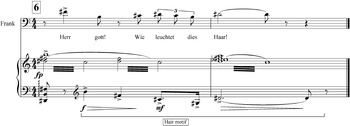
The hair motif is first introduced in the orchestra in Act I scene 1, when Frank comments on the hair depicted in Marie's portrait (rehearsal number 6 – see Ex. 1). Although it shares the interval of the fourth with other motifs in the opera, including one of several motifs for Bruges, its chain of descending fourths followed by a rising fifth is distinct enough to be instantly recognisable.Footnote 123 After its initial introduction in trumpets, glockenspiel and viola pizzicato, it continues to be heard (rhythmically altered in piccolo and flute semiquavers) as Brigitta directs Frank's attention towards the ‘crystal chest’ in which the actual hair is kept.Footnote 124 In the next scene, with Paul lost in contemplation of the portrait in an excited state at the imminent arrival of Marietta, we hear the motif, once again in trumpet (rehearsal number 15, ‘Wie sagst du? Sie war schön?’). Similarly, in Paul's long narration, which is sometimes subject to heavy cuts in recordings, he speaks of his longing for Marie's image, the shimmer of her golden hair (rehearsal 20 minus 1 in flute), and later of the hair of Marie's double (the mystery woman, Marietta), again invoking a rhythmically altered version of the motif in bass trumpet and glockenspiel (rehearsal 25 plus 3).Footnote 125 Concluding his narration with the account of the double's voice ‘Mariens Stimme klang aus ihrem Mund!’ (Marie's voice sounded from her mouth!), the hair motif rings out in augmented rhythmic triumph (rehearsal number 29 in trumpet) signalling its importance to Marie's identity and the power of Marietta's likeness. Even when faced with the physical presence of Marietta in scene 5, it is the same motif that sounds as he notices the effect of the sun on her hair (rehearsal 50 plus 4 in trumpet). In other words, the hair motif does not distinguish between the original object (Marie's hair as remembered, or lying in the crystal shrine), pictorial representation (the portrait) or simulacrum (Marietta), and in that sense the motif may help to indicate both the conflation of Marie and Marietta in Paul's mind, and the equivalence of their characters in a Weiningerian sense. Where the presentation of the motif does differ, however, is with respect to its orchestration: the original object is connected with softer sonorities of flute, in contrast with the trumpet-coloured version associated with the portrait and, in particular, with Marietta.Footnote 126
The hair motif in Act I of Die tote Stadt

Aside from its use in the prelude, the motif is missing from large parts of Paul's Act II dream narrative, perhaps since Paul himself is absent from much of the action. Rejected by Paul, though, and having learned of the existence of Marie, Marietta uses the hair motif as part of her attempt to seduce him, noting ‘Gehöre ich nicht dir?’ (Do I not belong to you?) (rehearsal 208 in trumpet, followed by oboe and clarinet), before making the connection more obvious: ‘mein Haar, das deine Hand durchwühlt’ (my hair, through which your hand rifled) (rehearsal 208 plus six, B-flat clarinet). Taking control of the orchestra and its colouring – rather in the manner that Wagnerian characters do, according to Matt BaileysheaFootnote 127 – Marietta willingly uses her physical similarity to Marie to win back Paul's affections, noticeably dropping the trumpet sonority and adopting woodwind colourations to emphasise her connection with the original hair's flute associations. That it is the hair motif that is the primary acoustic signal of the resemblance, though, sets up the ironic climax of Act III, when Marietta desecrates the hair and is strangled with it.
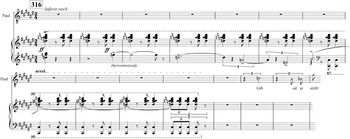
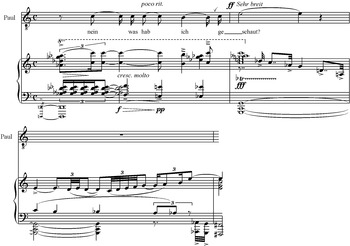
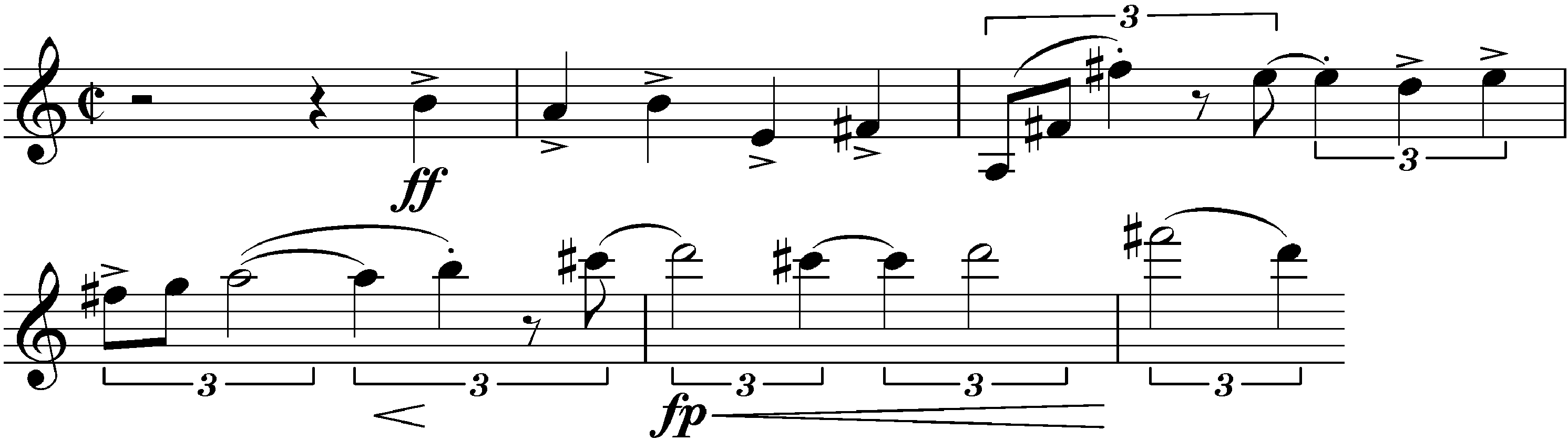
In scene 2 of Act III, the hair motif begins to dominate the musical texture (rehearsal 298 plus 7 in horns, then fragmented and passed between horns and trumpets as Marietta informs Paul she is finished with him). After spying the crystal shrine (rehearsal 299 plus 5 in glockenspiel, xylophone, piccolo and flutes – again, the original object is associated with woodwind), Marietta taunts Paul with the tress of hair (rehearsal 304 to 307: piccolo, glockenspiel, piano and violin pizzicato overlapping with xylophone, trumpet and horn, and viola pizzicato). This canonic treatment of the motif suggests something of the dual personalities of Marie (piccolo, glockenspiel, piano and violin) and Marietta (trumpet, horn, xylophone and viola) struggling for possession of Paul, and indicates a building crisis in the vision. Unable to cope with Marietta dancing provocatively with the tress, Paul grabs her and throws her to the ground with the hair motif standing out just before the murder (rehearsal 315 in trumpets and horns, and then prominently in trumpets at rehearsal 316 plus 2 – see Ex. 2). In the last scene, with Paul having awoken from his dream, the hair motif is heard numerous times (rehearsal 320–2) before its climactic last presentation (rehearsal 322 plus 4 – see Ex. 3) marked fff in trumpets as Paul asks ‘was hab’ ich geschaut?’ (What did I see?). This last epiphanic sounding of the motif is subtly altered, with semitonal upper-note anacruses, and suggests the fundamental transformation of Paul's view of the hair (and Marie/Marietta) in line with the cathartic experience of the dream. That it invokes the semitones of the ‘vision’ motif (as Nicholas Derny labels it – see Ex. 4)Footnote 128 suggests that Paul's attachment to the hair has been broken and he now ‘hears’ it as a part of his disturbing dream – indeed, the altered hair motif is immediately followed by the vision motif in bass trumpet, 1st trombone, viola and cello.
The hair motif as heard before Marietta's ‘murder’ in Act III scene 2

The last, altered, presentation of the hair motif in Act III scene 3 (rehearsal 322 plus 4)

The vision motif

The association of the hair motif with both Marie and Marietta (including Marietta's use of it to seduce Paul), its prominence in the murder scene, and its eventual disappearance once Paul gains understanding of his dream, appears to underwrite the fundamental importance of its symbolism to the opera, and thus its fidelity to the spirit of Rodenbach's source texts. More specifically, it helps connect the characters of Marie and Marietta, and as a result presents us with three possible ways to interpret their portrayal in the context of the nineteenth-century representations of gender upon which the opera draws. Firstly, we might see both as murderous Lilith-like femme fatales, one of whom (Marietta) proves to be dangerously seductive, using her hair (figuratively) to ensnare Paul, while the other (Marie) kills her rival from beyond the grave with the (literal) strangling power of her hair – with Paul as her willing accomplice. Lilith, after all, is a demon who appears to men in dreams, and Marie is clearly a powerful presence who seems to create Paul's vision, her ghost entreating him to ‘Schau, schau, und erkenne’ (Look, look, and understand).Footnote 129 The second scenario, on the other hand, might paint both Marie and Marietta as victims of Paul's obsessions, each symbolically united as the perfectly good Porphyria, strangled by a madman with a lock of her own (or her double's) hair. Perhaps, though, what Paul's dream-experiences reveal to the audience, and what the opera's leitmotifs underwrite, is a third possibility: that the characters of Marie and Marietta are not to be seen as either Lilith-like femmes fatales or as perfectly pure and good Porphyrias; that neither stereotype adequately describes the modern woman of the 1920s. In this way, the hair and its motif, in uniting symbolically the characters of Marie and Marietta in the strangulation scene, play an important role in allowing Paul to work through his psychological trauma.
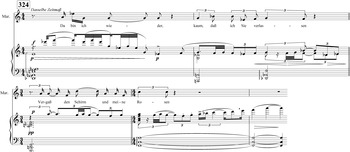
What though, does the symbolic unification of Marie and Marietta through the hair and its motif have to say about the Weiningerian conception of gender then in vogue? How might it affect not only Paul, but also the watching audience? By revealing both Marie and Marietta (the Madonna and the whore) to be two false images through their symbolic unification in the ‘strangling blonde’ trope (‘Jetzt gleicht sie ihr ganz’), Die tote Stadt critiques the notion that Woman's real nature is undifferentiated sexuality. Although Korngold's motifs for both women, in containing the same melodic material, suggest that Marie and Marietta are two sides of the same person (see Ex. 5 and 6), there is little indication that the Marietta of Act I and the last scene of Act III is to be thought of as the sexualised type ‘W’ in the Weiningerian sense. And this is the crucial point: only within the falseness of the dream narrative, where Marietta is certainly sexually voracious and characterised by a seduction motif (see Ex. 7), does she reveal what Weininger would identify as her true identity. As pointed out above, this dream-Marietta also willingly adopts the outer countenance of the saintly Marie (her hair) in order to get what she wants. Yet if the dream presents us with Weininger's conception of Woman in the form of Marietta the seductress, and we see Paul's utter undoing as a result, his waking from the dream and his epiphanic question ‘what did I see?’ is also a waking from Weininger's misogynist vision. It is significant that at this point the hair motif (one of the ways in which Marie and Marietta are conflated) is dropped altogether. Instead, though Marietta's appearance after the dream narrative references briefly the seduction motif, her music continues on with the rest of the material she shares with Paul's idea of Marie (see Ex. 8). Upon release from his dream's climactic fusion of Marie and Marietta, then, Paul is able to see Marietta's true nature, not as a Weiningerian ideal type, but as a real woman, with elements both of sexuality (the seduction motif) and of the virtuous attributes he associates with Marie. Though both women are conflated, as Lee argues, the conflation involves a mixture of their characteristics, not the replacing of Marie's artificial sanctity with Marietta's ‘real’ sexuality. Rather than being represented through the obsessive hair motif, which is perhaps the clearest indication of the Weiningerian themes dominating the majority of the opera, Marietta is now heard as both virtuous and sensuous. Once he awakes from his vision, then, Paul's mourning can now begin, free of a life-draining Weiningerian perspective.
Marie's motifs


Marietta's motif
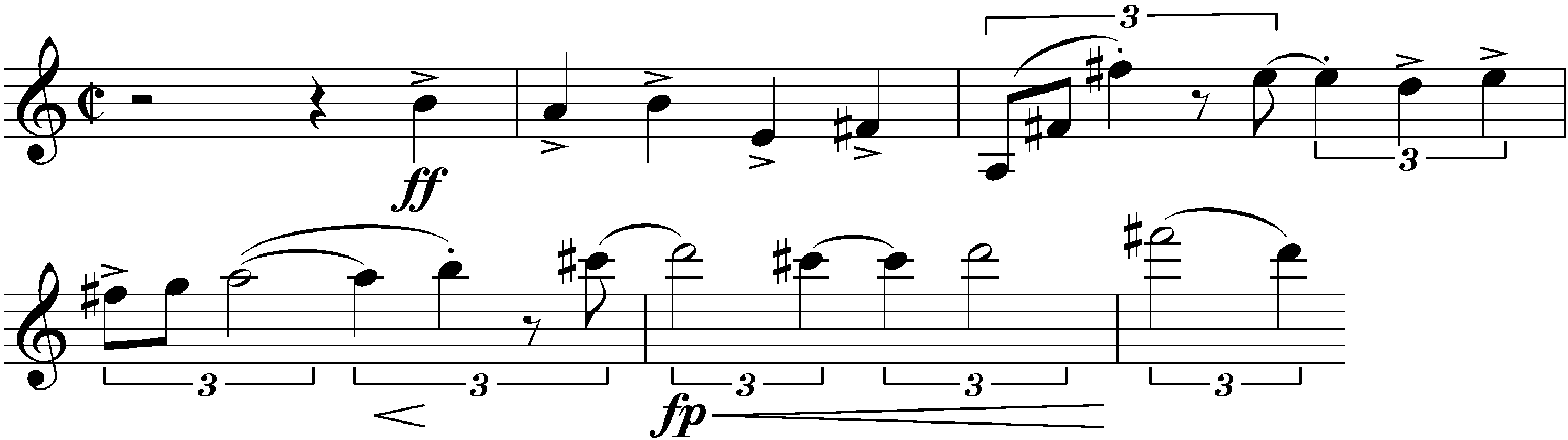
Marietta's seduction motif from Act II

Marietta's appearance in Act III scene 3

In that sense, Die tote Stadt might be interpreted in the same way as Robertson's reading of Hofmannsthal's Andreas referred to above, or in the manner of Hermann Broch's trilogy of novels, Die Schlafwandler (The Sleepwalkers) (1928–32) in which, as Sengoopta points out, Broch attempted to resolve Weininger's dualities while playing with his themes.Footnote 130 Korngold might be said to be exploring Weininger's difference between love and desire in the same way, overturning his judgements and revealing the murderous nature of their implications. Thus, although Jessica Duchen implies that the hair strangling moment symbolises the victory of the nineteenth century in its artistic war with the twentieth – ‘the strictured, superstitious, hypocritical 19th, transfixed by an idealised and unrealistic past, when faced with the glamour, free spirit and sexual liberation of the 20th, is so threatened that it can only strangle it’Footnote 131 – the picture may be more complicated, in that a feature of the opera's modernity (bringing together the woman who strangles and the one who is strangled) is also to be found in this very moment. Michael Steinberg has recently argued that a defining feature of operatic modernism might involve the ability of the female voice to subversively challenge patriarchal power.Footnote 132 While he tentatively makes the case for Die tote Stadt's inclusion in this category, our understanding of the opera's Weininger-themed gender politics, shaped by Korngold's musical treatment of the hair motif and the motifs associated with Marie and Marietta, might add weight to his argument. Korngold admittedly explores similar conceptions of femininity in his earlier one-act opera Violanta (1916), a portrayal of a woman who grapples with her desires in ways that share much in common with Zemlinsky's Eine florentische Tragödie (besides its Renaissance Italy setting).Footnote 133 Yet, while Violanta is essentially tragic, Die tote Stadt's optimistic ending and its cathartic exorcising of these damaging, overdrawn caricatures of Woman might also be seen to reflect the influence of the modern woman who had just entered Korngold's life, Luzi von Sonnenthal.
The use of the braid of hair as the murder weapon, in linking two images of femininity together, is not merely an important part of the opera's nineteenth-century heritage, then. It also reveals the composer's distinctly twentieth-century vision of modern womanhood, a vision that – perhaps inspired in part by Luzi von Sonnenthal – transcends the overdrawn binary of nineteenth-century art and literature that had been perpetuated (in altered form) in Weininger's Sex and Character. In that sense, the opera relies on the presence of that old text of ‘the nineteenth century’ (which is also present musically through the quotations of Meyerbeer's 1831 opera Robert le diable in Act II) and the simultaneous rejection of its binaries through the cathartic dream sequence. Examining Korngold's Die tote Stadt, then, is not just of value for what it might tell us of the composer's later career in Hollywood; nor is its relevance to contemporary Vienna restricted to the thinking of Sigmund Freud. Rather, it played a role in an ongoing gender discourse that had its roots in the past and was still of considerable interest to an entire generation of Viennese writers and thinkers. The later adoption of its melodic language by the classical Hollywood film score need not prevent us from interrogating its complex positioning within European cultural history.