

In this chapter, we present the four contrasting scenarios produced by the study, offering four possible images of the horse industry's future between now and 2030. Each scenario combines the microscenarios for each component: ‘public expectations of horses and of equestrian and horseracing activities’, ‘public policy and regulation’, ‘equestrianism and horseracing’ and ‘horse producer structure and strategy’.
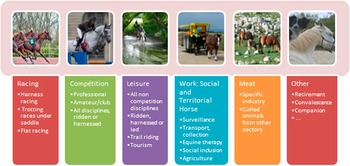
The report incorporates the various segments that make up the horse industry as listed in the Figure 1 below.Footnote 1
Segments of the horse industry.

In order to address local realities, the study is completed by an account of each scenario's impacts on three regions with very different profiles:
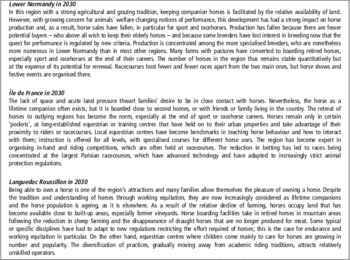
Lower Normandy, which is home to France's largest horse population and a centre for breeding, racehorse training and riding. Cattle and horse breeding farms compete for access to agricultural land in this region.
Île-de-France, the main equestrian region in terms of the number of licensed riders, and main horseracing region in terms of the number of races organised every year. Land here is in great demand for urbanisation.
Languedoc Roussillon, a tourist region with strong cultural ties to horses and a strong link between horses and the land. The decline in ruminant breeding and viticulture is freeing up agricultural land.
The possible impacts of each scenario on the type of users, the horse population, employment, the distribution of horses and equestrian activities, and the environment and biodiversity are put forward at the end of each scenario.
Each scenario is presented as follows:
-
1. a summary;
-
2. a detailed history of the horse industry in 2030;
-
3. a regional account;
-
4. a table indicating socio-economic and environmental impacts.
The first two scenarios, ‘Everyone on Horseback’ and ‘The High-Society Horse’ are based on contrasting economic trends. In the first scenario, revived spending power encourages access to recreational activities, whereas in the second the ongoing economic crisis limits their access to certain populations. The two subsequent scenarios, ‘The Civic Horse’ and ‘The Companion Horse’, are based on social evolutions marked, in ‘The Civic Horse’, by priority to quality of life and solidarity, and in ‘The Companion Horse’ by a sharp increase in concerns for animal welfare.
Scenario 1 – Everyone on Horseback. Horses in the leisure market, buoyed by a wide variety of businesses
Summary of the scenario
After a period of gradual economic recovery, the middle classes’ spending power has increased, finally enabling them to fulfil their desire to ride horses at any age and regardless of their level. The government no longer provides support directly to the industry, which has the economic autonomy to meet the diverse expectations of increasingly numerous users. Expansion of the equestrian recreation market has stimulated competition and encouraged diversity in equestrian activities to satisfy all riders, from the occasional tourist to the regular competitor. Furthermore, thanks to the success of marketing operations targeting young bettors, racing is flourishing and the PMU (Pari Mutuel Urbain) is Europe's leading horseracing betting operator. The boom in equestrian activity benefits the industry as a whole, but requires widespread professionalisation and significant efforts to reduce costs while still improving supply. In order to compete with the growing import of horses from abroad, new breeders have turned their production towards lower-cost horses bred for recreation rather than competition. In reaction, producers of top-quality horses are spurred into making better use of horses not selected for competition by orienting each animal at an early age towards a type of career. This new segmentation is based on the industry's organisation linking breeding to users’ expectations. The production of the French horse breeding industry is once again favoured by riders and sought after on the international market.
In 2030
The economic revival has increased the middle classes’ spending power, enabling them to make the most of their free time. Leisure pursuits feature largely in French people's lives, and outdoor activities in particular are on the increase. As a result, the strong attraction for horses revealed in surveys at the end of the 2000s continues to grow and is satisfied for part of the population, generating a wide variety of available activities sustained by a wide variety of businesses. In 2030, horseriding is practised at all ages and all levels, once again attracting a male public. Leisure activities are developing considerably in urban, peri-urban and rural areas, without, however, being accessible to people from all income brackets.
In a totally liberalised market, the government no longer provides the industry with direct support, although it remains involved in monitoring health and hygiene. Nevertheless, the popularity of betting on horses and the fiscal revenues it generates encourage the government to retain control over racing through the long-established mutualist system, adopted at European Union (EU) level, and to return betting revenues to the industry, although at a reduced rate of 5% of the total bets placed.
To respond to the enthusiasm for riding, two types of specialised equestrian organisation coexist to meet the demand for recreation, games and diversity. Riding schools focus on teaching varied disciplines, giving lessons adapted to each type of client, and equestrian leisure centres are dedicated to teaching basic riding skills to enjoy activities on horseback. These businesses offer attractive rates and guarantee profitability by controlling production and operating costs, and expanding their client base. In addition to these businesses, independent riders gather in highly active organisations, especially with regard to developing riding trails. This benefits equestrian tourism, which has increased considerably since the late 2000s, particularly in rural areas. The market for amateur competitions and clubs is continually expanding with an ever-growing number of disciplines and all levels catered for. Harness racing and flat racing are also practised at amateur level, which enables high-level horses to prolong their careers. In contrast, very high-level competition becomes the remit of federations and remains focused on World Equestrian Games’ disciplines. Innovations in competitions’ staging and format have facilitated media coverage of major equestrian events to the extent that regional and national sporting competition finals are now paid admission events.
Over the last 20 years, the racing public has also grown, thanks to marketing targeting young bettors and a multiplication of the products on offer. The PMU is now the largest betting operator in Europe, and racing is flourishing. The new interest in horserace betting leads to a rise in prize-money sums and boosts investment in racehorses. It also allows racecourse networks to be consolidated by organising a wide variety of races adapted to different types of participants.
In this context, cities with a significant horseracing history invest in horses to enhance their tourist appeal. However, they are almost alone in encouraging the use of horses in town and funding the organisation of horse shows because of the high costs of such events. The consumption of horsemeat is so low that slaughtering in France, revived because of the need to control costs, is sufficient to cover demand.
Given the boom in equestrianism, new riders initially prefer to buy foreign horses better suited to their level and use than French horses. The discrepancy between supply and demand eventually spurs new breeders to enter the market for leisure horses. To do this, they turn towards a breeding model that minimises expenses, where the type of horse prevails over the notion of breed, except when it is possible to promote the specific advantages of a local breed in its natural environment. This dynamic encourages sport horse breeders to specialise in the production of very high-end horses and make better use of the horses not selected for high-level competition by determining their aptitudes early, building on an analysis of animals’ genetic profiles and rearing them appropriately. They purchase semen on the international market that focuses on producing general sport horses in which brand prevails over breed. However, racehorse breeding generally remains the preserve of enthusiasts, for whom breeding may be a secondary activity.
In each breeding system, scientific and technical knowledge has become essential to optimise production according to individual obligations and choices concerning the types of animal produced, and adapting techniques to the system is therefore a key element in segmentation. As a result of the diverse demand, major players in the industry have created businesses offering services at every stage of buying a horse. This contributes significantly to making the French breeding industry competitive on the domestic as well as the international market.

‘Everyone on Horseback’ – impacts in France in 2030

Scenario 2 – The High-Society Horse. Limited number of users in a socially divided society where natural resources are under pressure
Summary of the scenario
The lasting economic crisis has profoundly affected the middle classes, whose spending power has declined. In parallel, tensions over access to land and agricultural raw materials are driving up the cost of equestrian activities. The middle and working classes therefore choose more affordable recreational pursuits and riding is once again a social distinction, attracting a wealthy and exacting clientele. The most renowned and innovative equestrian centres have adapted to these customers who seek the atmosphere of an elite club. In contrast, economic difficulties encourage gambling, including betting on horses. The racing sector remains financially stable through levies on horserace bets, the use of modern technology and growth in international betting. Facing rising and already very high structural costs, racehorse trainers become owners and even breeders themselves, with harness racing nevertheless remaining more robust than flat racing. The meat sector disappears without finding an alternative use for draught horses. Breeding becomes more focused. In order to remain viable, riding horse breeders have been obliged to specialise and become more professional by producing elite sport horses selected at an earlier age on the basis of their potential; the others have abandoned the activity. As a result, better mastering of techniques and economics combined with an early career orientation for animals enables French horse breeders to establish themselves on international markets.
In 2030
In a climate of continuing economic crisis and tension over natural resources that affects agricultural land use and the cost of keeping animals, equestrian activities and, to an even greater extent, horse ownership, have become inaccessible for the middle classes. The economic crisis has, however, increased the popularity of gambling and betting. In this context, the French Government is primarily concerned with social and energy issues, refocusing its role in the horse industry to health and hygiene monitoring and no longer providing direct support for the industry's development. Nonetheless, to ensure the survival of an industry that earns it tax revenues, the government continues to supervise and regulate racetrack betting, returning 5% of bets taken by the PMU to the industry.
Equestrian activities, limited to an affluent clientele with high expectations regarding quality and variety, are extremely popular within this market segment; they combine novelty and excitement while offering comfort, luxury and made-to-measure services. In addition, riding has once again become a way to demonstrate social status, particularly by participating in high-level competitions, which attract the richest riders from virtually all over the world. Consequently, equestrian circles enjoy an atmosphere of elite clubs, attracting an increasingly male clientele, and media coverage of riding remains the preserve of connoisseurs at an international level. In parallel, top–end equestrian tourism has expanded in comparison with the late 2000s, enabling rich clients to explore France's heritage on horseback.
In this context where gaming and betting are popular, players choose games that offer the highest payout rates. Nevertheless, betting on horses remains stable thanks to the possibility of following races remotely and in real time on smartphones, and this has enabled the PMU to develop internationally and attract a younger clientele than in the past. Winners’ prize money has remained at the same level as it was at the end of the 2000s, although the cost of keeping horses has risen considerably. Consequently, the number of passionate racehorse owners has declined. There are fewer than in 2010 on account of the difficulty in bearing exorbitant maintenance and care costs. Training activities move further away from large urban areas to reduce costs, and the idea of ‘integration’, traditionally seen in the harness racing sector, spreads to other types of race. A single stakeholder performs a number of functions, thus spreading financial risk across various activities and controlling costs more easily. Flat racing struggles to find a sufficient number of starting horses to remain at par with harness racing.
Alongside equestrian and horseracing activities, the development of animal traction services is limited by weak demand and above all by very high costs. Draught horses no longer have priority over ruminants that make more efficient use of available grassland; moreover, the consumption of horsemeat remains low, although value creation from culled horsemeat is often an economic necessity. As a result, certain breeds of draught horse are in danger of dying out.
Breeding is strongly affected by pressure on land and the rising prices of agricultural raw materials. Racehorse breeders are compelled to become more profitable. The share of breeders who breed out of passion shrinks, and harness racing prevails over flat racing owing to its greater economic vigour. In addition to economic and land pressures, riding horse breeding is adversely affected by a shrinking market, leading to a drastic reduction in the number of breeding farms compared with the late 2000s; only specialised, professional breeders manage to survive. Their motivation remains the production of exceptional horses, but the possibility of orienting underperforming horses towards recreational riding remains. Early temperament analysis, combined with adapted rearing, allows most horses unsuited for high-level competition to be put to use and adapted to the needs of less experienced riders. Breeding has become less speculative and more realistic; all available techniques are used to produce, determine and create value from a breed of pan-European, or even global, sport horse. In particular, breeders have managed to benefit from advances in French research into animals’ genetic profile analysis and are once again a step ahead of their European competitors. Marketing and selling products is facilitated by intermediaries recognised for their expertise and the quality of their horses. The intermediaries determine the relationship between breeders and users. For better or for worse, French breeding becomes competitive and claims back a share of the domestic market. Export constitutes a considerable portion of the market share and serves to maintain sport horse breeding.

‘The High-Society Horse’ – impacts in France in 2030

Scenario 3 – The Civic Horse. The horse in public and collective action, the link between humans, the land and nature
Summary of the scenario
In a context of globalisation and an accelerated pace of life, there is a growing desire to reconnect with nature and with other people. Local and regional public action is responding by backing initiatives promoting horse use to develop the economy, protect the environment, and contribute to individual and collective well-being. EU grants, decentralised national funding and the restitution of government racetrack betting levies (over which it again has a monopoly) enable contracts to be signed between municipalities and private and community-based equestrian businesses. Although riding for everyone is at the heart of these measures, using horses to maintain the landscape for farming, social and community services, hippotherapy, education and social inclusion is strongly encouraged. The most popular and profitable racecourses are incorporated into the approach to develop France's riding and horse sport heritage, and the others are forced to close. This multiplicity of uses allows horses to change career paths during the course of their lives, thus limiting the overall requirement for animals. The French market is essentially supplied by qualified French breeders who sell products adapted to the new demand through local networks, developing quality symbols and discipline aptitude certifications.
In 2030
Against this backdrop of globalisation and urbanisation, with life moving at a faster pace and the environment under more stress, the French express the need to live differently by getting closer to nature through their multi-belonging to various places. Great importance is given to balance and harmony among people, animals and nature, and this leads to new forms of cooperation reflecting greater solidarity. Horses are naturally part of this social trend, recognised and promoted for their numerous virtues in connection with personal development, social relations and, more widely, with developing and improving local land use. Moreover, local and regional public action incorporate horses as a resource in their own right, beneficial for the environment and, more generally, for society's well-being. Equine heritage is conserved and promoted by funding the development of educational, social, cultural and environmental services using horses. The move to use horses in such ways, implemented through contracts with local economic stakeholders and interaction with the community, has made horses a source of entertainment, improving the quality of life, as well as a vehicle to protect natural resources.
Although support to the industry has been transferred to regional authorities, the government remains involved by regulating horseracing. Once again, it has a monopoly on gambling to limit public health problems linked to addiction. It uses part of the tax revenue levied from betting to improve public health and channels the rest into local and regional organisations to finance social or public programmes encouraging the use of horses. To be consistent with such a policy, the government pledges to contain the growth of gambling. In return, the industry benefits from government levies on bets that return 8% of total bet value to support the sector whose development is otherwise hindered by the restrictions on racecourse betting.
As part of the endeavour to improve the quality of life, riding stands out from other educational and recreational activities through the relationship to animals, attracting people seeking interaction, enabling bonds to form among them and contributing to their well-being. Riders from all social classes now meet in equestrian centres, as do instructors and local inhabitants all in search of a sociable atmosphere and making new acquaintances, whether to break their solitude or to widen their family circle. They participate in organising equestrian events and enjoy attending sporting competitions, which may be rallies, shows or trials designed to entertain. In this context, far removed from high-level competition, top riders are mobilised to promote equestrianism and inspire the calling in others while trying to earn a living professionally. In order to meet public demand while diversifying their activities, some equestrian centres have specialised in school riding, rehabilitation or equine-facilitated learning. Like holidays in the countryside, equestrian tourism is hugely popular, combining contact with nature and exploring the country in a friendly atmosphere.
The role of local authorities in public action together with strong environmental and civic awareness create a highly favourable climate for using horses to maintain local grassland and for traction, especially in agriculture and in towns where a new relationship between cars and animals is developing. A range of new occupations thus emerges based on activities combining specific skills with an excellent knowledge of horses. The multiplicity of horse uses means they can be assigned different tasks over their career, depending on the evolution of their aptitudes and their health. However, the important role of horses in society does not encourage their consumption and production for meat, and these sectors are gradually abandoned.
Society's need to disconnect from an overly virtual world makes horseracing the favourite gambling activity, especially because of the development of individual devices to follow races in real time, recreating the atmosphere of a racecourse. However, national regulation of betting maximums limits the amount of prize money awarded and the number of owners decreases; only rich owners remain, for whom owning and watching their horses race in France is a leisure activity. As a result, the activity is concentrated in the largest training centres and racecourses with the best technology and equipment.
The changes in racing make economically rational breeding necessary, and this is done by using tools and techniques, in particular early selection with new tools to analyse animals’ genetic profiles, which improves profitability. Riding horse breeders must obtain a breeding licence and, as a result, have become more professional and are no longer in direct competition with private breeders. On the contrary, they offer their services to private individuals who choose to entrust the breeding of their mares to qualified professionals. This is done for a number of reasons, including for the animal's welfare and the opportunity to meet other owners as well as the rearing and sales services breed farms offer. These services are important because local breeding farms are near to buyers and serve as a guarantee for a good product. In response to the many possible uses for horses, the market relies on quality symbols and aptitude certificates given to horses for different types of use. As a result, horse selection focuses on the ease of use rather than performance, which allows French breeders to claim back a share of the market that was previously met by imports.

‘The Civic Horse’ – impacts in France in 2030

Scenario 4 – the companion horse. From exploiting to caring for animals – the quest for animal welfare
Summary of the scenario
Society's perception of nature and animals has evolved considerably over the last few decades. The horse has become a lifetime companion that people love to care for and respected in its own right. Owners visit equestrian centres to learn about horse behaviour and how to look after their horses, and are introduced to activities on foot or on horseback practised in competitions. In parallel, the population's concern for animal welfare has led to a ban on the consumption of horsemeat and regulations concerning equestrian practices have been tightened. As a result, owning and breeding are regulated while rules governing equestrian competitions and horse sports have been tightened to reduce animals’ suffering. The racing sector, already transformed by the complete liberalisation of betting, has gone further, organising virtual races in parallel to real ones that take place on about 20 hi-tech racecourses integrated into casinos. Breeding horses is above all a leisure pursuit for private owners; nevertheless, some breeders who were previously passionate about performance now produce horses capable of long sporting careers and, at the same time, with specific aesthetic characteristics. A market for inactive horses has developed on the internet, meeting the growing demand for horses as companions. The horse population is ageing and is replaced very slowly.
In 2030
Over a few decades, society's perception of nature and animals has evolved considerably, and awareness of animal protection has grown accordingly. Horses – for a long time seen as work animals – have become lifetime companions that are admired and loved, whether ridden or harnessed, or whether caring for them constitutes the sole object of the relationship. This new relationship with horses is shaped by what they provide rather than the work they perform. People enter into the relationship by acquiring an animal for its own particular characteristics, or by the altruistic adoption of a horse at the end of its career. The presence of horses in a family environment strengthens bonds between generations and increases their popularity with a non-riding and largely female public, bringing them widespread media attention.
In view of this social trend, the government focuses its horse industry responsibility on monitoring health and hygiene and regulating horse-related activities. In order to limit possible ill-treatment of horses, buyers are obliged to undergo a short training course to obtain an ownership permit, and to declare horse ownership to a designated veterinarian. To own a horse, one must now be able to guarantee its permanent access to an outdoor area (weather permitting). Reproduction is also regulated through issuing breeding permits to sufficiently skilled candidates. In addition, stricter regulations limit the effort demanded of horses and the risks of accidents in racing and equestrian competitions. Breaking-in techniques, essential for using and even standing alongside a horse safely are regulated, and a minimum age has been established for animals to start working, racing or competing. The consumption of horsemeat has been banned. Having withdrawn from the industry's economic development, the government has chosen to completely liberalise racecourse betting and the PMU has been privatised.
When it is not a companion in daily life, the horse is occasionally a walking, travelling or adventure companion, fulfilling the equestrian dreams of most. Equestrian centres, even if they still have their own horses, begin offering services to independent owners and, in addition to riding lessons, give lessons in hippology, horse care, treatment and natural horsemanship. New forms of competition have emerged, respecting the animal's welfare, and horse in hand competitions multiply. Although the intensity of the efforts demanded of horses is restricted, a high-level competition circuit remains. More generally, riding horses is no longer central to horse-related activities. Parks in which horses roam freely, almost wild, become common, encouraging, in some regions, the presence of typical local breeds linked to the social and cultural heritage.
There is a wide gulf between the horse lovers behind these initiatives and bettors who, given the very strict regulation of races, bet indifferently on all PMU gaming, whether horseracing or sport. To attract bettors, most racing events are held at ∼20 hi-tech racecourses incorporated into casinos. Fearing a total ban on races, virtual racing develops in parallel.
Overall, the difficulty in parting with horses at the end of their careers or lives increases the population of old, inactive horses and those with no market value. Keeping these horses and eliminating them post mortem is costly, and limits the capacity to purchase or maintain a new horse. Owing to the lack of sale opportunities, breeding is largely a leisure pursuit. A level of production is maintained through foals born to mares owned by riders, and through riding horse breeding farms, which previously focused on performance and now seek to extend horse careers and improve aesthetics. However, breeders of local breeds strongly identified with a specific region and intended for specialised use continue their activity. To minimise costs and meet demand more adequately, the breeders themselves take charge of promoting and selling their horses. Internet transactions are popular, in particular for adoptions. As a result, the French market is largely domestic, except when horse enthusiasts seek particular aesthetic characteristics sometimes linked to a specific breed, in which case they may import.
‘The Companion Horse’ – impacts in France in 2030