

The term ‘stigma’ was popularised in the social sciences by Erving Goffman, Reference Goffman1 who used it to refer to ‘an attribute that is deeply discrediting’. The author noticed, however, that ‘a language of relationships, not attributes is really needed’ and he emphasised the dynamic process of the social construction of stigma. Strictly speaking, in Goffman's formulation, stigma ‘is really a special kind of relationship between attribute and stereotype’. For practical reasons, however, Goffman often spoke about stigma as if it were an attribute, because there are important attributes that are discrediting in all contexts. One typical example is mental illness. Although societal reactions to some attributes, such as obesity, show substantial variability across time and across cultures, mental illness seems to be associated with a stigma that is universal and less dependent on historical or cultural contingencies. Reference Stangor, Crandall, Heatherton, Kleck, Hebl and Hull2 The review of the studies conducted in recent years confirms unequivocally that stigmatisation of people receiving psychiatric treatment is a common, transcultural phenomenon, and mental illness is still a strong socially excluding condition. Reference Stigma, Mueser and Tarrier3-Reference Angermeyer and Dietrich5 A large body of research indicates that stigma may exert numerous detrimental effects on people with mental disorders, limiting their life opportunities and leading to diminished self-esteem and self-efficacy, compromised quality of life and non-adherence to treatment. Reference Stigma, Mueser and Tarrier3,Reference Corrigan, Kleinlein and Corrigan6
One of the most disabling and severely stigmatised mental disorders is schizophrenia, which was selected as the central focus of the World Psychiatric Association's global anti-stigma programme ‘Open the Doors’. Reference Sartorius and Schulze7 However, insufficient effort has been made so far to study the issue of subjective experience of stigmatisation among people with schizophrenia. Two large international studies aiming to fill this gap in research have been conducted and demonstrated that significant proportions of people with schizophrenia anticipate, actually experience and internalise stigma. Reference Thornicroft, Brohan, Rose, Sartorius and Leese8,Reference Brohan, Elgie, Sartorius and Thornicroft9
It seems, in particular, that the scope and nature of actual stigma experienced by people with schizophrenia is still understudied. Additionally, in this kind of research, a variety of non-standardised instruments have been used to measure self-reported stigmatisation, which makes comparisons of the obtained results difficult. The interpretation of these findings often poses significant problems, because it is hard to define what rates of experienced stigma should be regarded as high. A partial solution to this difficulty could be a comparison of the extent of stigma reported by people with schizophrenia and by people with other mental disorders or by people belonging to other potentially stigmatised groups. One of the possible points of reference for people receiving psychiatric treatment is people with physical illnesses. Such a research strategy would enable the more reliable assessment of the relative strength of the stigma linked to schizophrenia, by putting the results in some context. Unfortunately, studies comparing the experiences of patients with different psychiatric diagnoses (e.g. Lai et al, Reference Lai, Hong and Chee10 Angermeyer et al Reference Angermeyer, Beck, Dietrich and Holzinger11 ) and studies comparing the experiences of patients with schizophrenia and patients with physical illnesses (e.g. Lai et al, Reference Lai, Hong and Chee10 Lee et al Reference Lee, Lee, Chiu and Kleinman12 ) are relatively rare.
In another study we attempted to establish the extent of stigma experienced by people with schizophrenia and tried to determine its sociodemographic and clinical correlates. Reference Świtaj, Wciórka, Smolarska-Świtaj and Grygiel13 In this paper we seek to expand on our earlier findings by comparing the rates of stigmatisation reported by our sample of people with schizophrenia and by people with other health problems. For this purpose, we recruited two groups of respondents - people with depression and people with malignancies. Depression was selected because it is, similarly to schizophrenia, a common and severe mental disorder; however, depression is usually viewed by the public more benignly than schizophrenia. Reference Angermeyer and Dietrich5 We wanted to test whether this difference in societal attitudes translates into a difference in the subjective experience of people with psychiatric disorders. Malignancies were chosen because some evidence exists that they may carry social stigma Reference Fife and Wright14 and they have already been used as controls in previous studies of the stigma associated with mental disorders (e.g. Corrigan et al Reference Corrigan, Lurie, Goldman, Slopen, Medasani and Phelan15 ).
Method
Participants
For group 1, people with schizophrenia were recruited from psychiatric in-patient wards of the Institute of Psychiatry and Neurology (IPiN) and from one of the public psychiatric out-patient clinics in Warsaw. Participation in the study was offered to all consecutive patients who attended the out-patient clinic or who were admitted to in-patient wards and met the following criteria: diagnosed with schizophrenia according to ICD-10 16 criteria (F20); aged 18-65 years; not dependent on drugs or alcohol; and in a stable mental state according to their attending psychiatrist. Of 177 people screened as eligible for the study, 153 (86.4%) agreed to participate and provided informed consent. The final sample consisted of 62 out-patients (40.5%) and 91 in-patients (59.5%).
For group 2, people with depression were recruited from psychiatric in-patient wards, a day centre, an out-patient clinic at the IPiN, and the same public psychiatric out-patient clinic as for the people with schizophrenia. This group consisted of people with an ICD-10 diagnosis of depressive episode (F32) or recurrent depressive disorder (F33), 16 without comorbid substance dependence and whose mental state at the time of evaluation was stable, allowing the relevant information to be obtained. Of the 118 consecutive patients who fulfilled the inclusion criteria, 106 (89.8%) agreed to participate in the study. The final sample included 64 out-patients or day patients (60.4%) and 42 in-patients (39.6%).
For group 3, patients with malignancies were recruited at the Department of Hematology, Oncology and Internal Medicine of the Public Central Teaching Hospital in Warsaw and at two oncology centres in Rzeszów, a city in south-eastern Poland. Altogether, 85 consecutive patients agreed to participate. The refusal rate was less than 20%. The participants’ diagnoses included haematological malignancies or some form of cancer.
The background characteristics of the participants are presented inTable 1. As could be expected, the groups differed significantly in their background characteristics. The differences found between the groups seem to result from the nature of the participants’ health problems.
Background characteristics of participants (N = 344)

| Characteristic | Schizophrenia group (n = 153) | Depression group (n = 106) | Malignancies group (n = 85) | Group comparison P |
|---|---|---|---|---|
| Gender, % female | 51.6 | 72.6 | 58.8 | 0.003a |
| Age, years: mean (s.d.) | 42.5 (12.6) | 56.0 (12.2) | 55.8 (12.2) | <0.001b |
| Marital status, % | ||||
| Married | 20.3 | 59.4 | 77.6 | <0.001a |
| Unmarried | 79.7 | 40.6 | 22.4 | |
| Education, % | ||||
| Primary or vocational | 30.1 | 18.9 | 42.4 | 0.002a |
| Secondary or higher | 69.9 | 81.1 | 57.6 | |
| Place of residence, % | ||||
| Village or town (population <100 000) | 11.1 | 24.5 | 76.5 | <0.001a |
| City (population >100 000) | 88.9 | 75.5 | 23.5 | |
| Living situation, % | ||||
| Living independently | 52.9 | 94.3 | 92.9 | <0.001a |
| Not living independently | 47.1 | 5.7 | 7.1 | |
| Employment status, % | ||||
| Employed | 18.3 | 32.1 | 29.4 | 0.026a |
| Unemployed | 81.7 | 67.9 | 70.6 | |
| Duration of illness, years: mean (s.d.) | 17.3 (11.2) | 11.2 (9.8) | 1.5 (3.1) | <0.001b |
Instrument
The extent of experienced stigmatisation was assessed using the Stigma section of the Consumer Experiences of Stigma Questionnaire (CESQ). Reference Wahl17 This part of the questionnaire includes nine items concerning people's experiences as patients with psychiatric disorders. The Polish version of the CESQ has been modified slightly from the original version for the purpose of this study. The term ‘consumers’ was substituted with the term ‘people receiving psychiatric treatment’ (or ‘I receive psychiatric treatment’, where appropriate). Appropriate changes in wording were also made to the questionnaire administered to people with malignancies. The responses to the questionnaire statements are scored on a five-point scale that describes the frequency of each stigma experience, ranging from 1 - ‘never’ to 5 - ‘very often’. Two questionnaire items referring to positive interpersonal experiences are reversely coded. The mean scores for each item and for the entire scale have been calculated, with higher ratings indicating more frequent stigma experiences. In our sample the questionnaire showed adequate internal consistency (Cronbach's α = 0.82).
Procedures
Ethical approval of the present study was granted by the Bioethical Committee at IPiN. Patients were invited to participate by one of the researchers during their stay in a ward or in a waiting room of an out-patient clinic. In some cases, the attending clinicians were also involved in the recruitment procedure. All participants provided their informed consent. Clinical and sociodemographic information was gathered from interviews with the participants and from their medical records. The CESQ was administered as an interview.
Statistics
Data were analysed using PASW Statistics 18.0 for Windows. The participants’ background characteristics were compared with χ2 and analysis of variance (ANOVA) tests, where appropriate. The effect of diagnosis on the frequency of reported stigma experiences was assessed using multiple regression models. P-values less than 0.05 were considered to be statistically significant.
Results
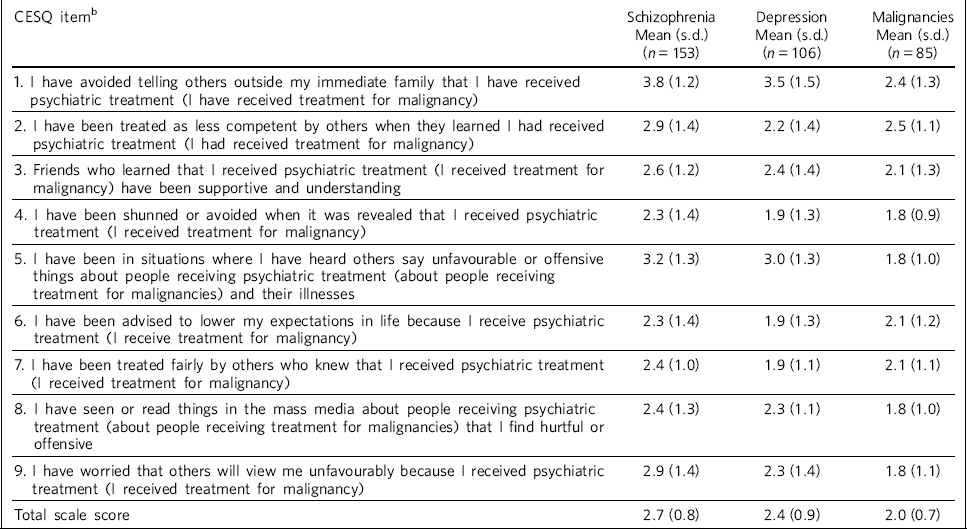
Table 2 presents the mean scores obtained by the participants on the CESQ. As can be seen, respondents with schizophrenia and respondents with depression scored highest (between 3 - ‘sometimes’ and 4 - ‘often’) on item 1 regarding concealing one's illness outside the immediate family and item 5 referring to overhearing people making negative comments about mental illness. Patients with malignancies on all CESQ items obtained scores below the midpoint of the scale (3 - ‘sometimes’).
Participants’ (N = 344) scoresa on the Consumer Experiences of Stigma Questionnaire (CESQ)
| CESQ itemb | Schizophrenia Mean (s.d.) (n = 153) | Depression Mean (s.d.) (n = 106) | Malignancies Mean (s.d.) (n = 85) |
|---|---|---|---|
| 1. I have avoided telling others outside my immediate family that I have received psychiatric treatment (I have received treatment for malignancy) | 3.8 (1.2) | 3.5 (1.5) | 2.4 (1.3) |
| 2. I have been treated as less competent by others when they learned I had received psychiatric treatment (I had received treatment for malignancy) | 2.9 (1.4) | 2.2 (1.4) | 2.5 (1.1) |
| 3. Friends who learned that I received psychiatric treatment (I received treatment for malignancy) have been supportive and understanding | 2.6 (1.2) | 2.4 (1.4) | 2.1 (1.3) |
| 4. I have been shunned or avoided when it was revealed that I received psychiatric treatment (I received treatment for malignancy) | 2.3 (1.4) | 1.9 (1.3) | 1.8 (0.9) |
| 5. I have been in situations where I have heard others say unfavourable or offensive things about people receiving psychiatric treatment (about people receiving treatment for malignancies) and their illnesses | 3.2 (1.3) | 3.0 (1.3) | 1.8 (1.0) |
| 6. I have been advised to lower my expectations in life because I receive psychiatric treatment (I receive treatment for malignancy) | 2.3 (1.4) | 1.9 (1.3) | 2.1 (1.2) |
| 7. I have been treated fairly by others who knew that I received psychiatric treatment (I received treatment for malignancy) | 2.4 (1.0) | 1.9 (1.1) | 2.1 (1.1) |
| 8. I have seen or read things in the mass media about people receiving psychiatric treatment (about people receiving treatment for malignancies) that I find hurtful or offensive | 2.4 (1.3) | 2.3 (1.1) | 1.8 (1.0) |
| 9. I have worried that others will view me unfavourably because I received psychiatric treatment (I received treatment for malignancy) | 2.9 (1.4) | 2.3 (1.4) | 1.8 (1.1) |
| Total scale score | 2.7 (0.8) | 2.4 (0.9) | 2.0 (0.7) |
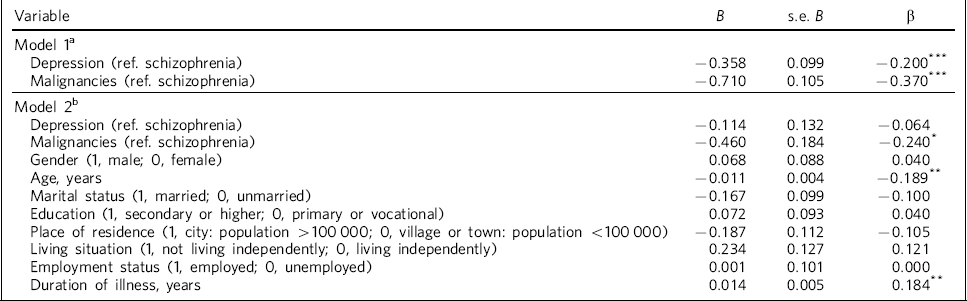
To assess the effect of diagnosis on the extent of stigmatisation, multiple regression analysis was carried out. In the first model, only two binary variables related to the diagnosis were entered into the regression equation: depression and malignancies (people with schizophrenia were treated as the reference group). As shown in Table 3, this model accounted for 12% of the variation in experienced stigma. The values of the regression coefficients indicate that people with depression and people with malignancies experienced significantly less stigmatisation than people with schizophrenia.
Summary of multiple regression analysis for variables predicting experienced stigmatisation (N = 344)
| Variable | B | s.e. B | β |
|---|---|---|---|
| Model 1a | |||
| Depression (ref. schizophrenia) | – 0.358 | 0.099 | – 0.200*** |
| Malignancies (ref. schizophrenia) | – 0.710 | 0.105 | – 0.370*** |
| Model 2b | |||
| Depression (ref. schizophrenia) | – 0.114 | 0.132 | – 0.064 |
| Malignancies (ref. schizophrenia) | – 0.460 | 0.184 | – 0.240* |
| Gender (1, male; 0, female) | 0.068 | 0.088 | 0.040 |
| Age, years | – 0.011 | 0.004 | – 0.189** |
| Marital status (1, married; 0, unmarried) | – 0.167 | 0.099 | – 0.100 |
| Education (1, secondary or higher; 0, primary or vocational) | 0.072 | 0.093 | 0.040 |
| Place of residence (1, city: population >100 000; 0, village or town: population <100 000) | – 0.187 | 0.112 | – 0.105 |
| Living situation (1, not living independently; 0, living independently) | 0.234 | 0.127 | 0.121 |
| Employment status (1, employed; 0, unemployed) | 0.001 | 0.101 | 0.000 |
| Duration of illness, years | 0.014 | 0.005 | 0.184** |
In the second model, the following background characteristics of the participants were entered into the regression equation as control variables: gender, age, marital status, education, place of residence, living situation, employment status and duration of illness. As can be seen inTable 3, this model accounted for 18.1% of the variance in stigma. Two of the eight control variables were significantly related to the level of experienced stigmatisation: age and duration of illness. Respondents who were younger or who had a longer duration of illness reported more frequent stigma experiences. After controlling for participants’ background characteristics, people with schizophrenia still had significantly higher stigma levels than people with malignancies, whereas the difference between people with schizophrenia and people with depression was no longer significant.
Discussion
The purpose of this study was to assess the extent of stigma experienced by people with schizophrenia compared with people with depression and people with malignancies. On the basis of the review of the studies of public beliefs and attitudes, we could expect people with depression to report less stigmatisation than people with schizophrenia. Reference Angermeyer and Dietrich5 Surprisingly, after controlling for the participants’ background characteristics, we did not find significant differences in the frequency of stigmatisation between the two groups. Possibly our samples were too small to detect existing differences, but we cannot exclude the possibility that people with different severe mental disorders in real-life situations are the objects of non-specific stereotyping and prejudice. Perhaps social responses to various types of mental disorder, which seem to differ in the artificial circumstances where the stimulus is simply a label or a vignette, become more standardised in situations of actual contact with people receiving psychiatric treatment.
Another explanation for our unexpected finding can also be taken into account. In one previous study it was found that people with schizophrenia reported concrete stigmatisation experiences more frequently than people with depression, but both groups anticipated stigmatisation similarly frequently. Reference Angermeyer, Beck, Dietrich and Holzinger11 In this context, it should be noted that although the main focus of the CESQ is on actual stigmatisation, two of its items refer to people's behavioural (avoidance of disclosure) or emotional (worrying) reactions to stigma resulting from anticipating social disapproval rather than to concrete stigma experiences. Furthermore, another two CESQ items ask about instances of what Wahl calls ‘indirect’ stigmatisation (i.e. not targeting the respondents directly but reflective of the stereotypes and prejudice widespread in society), Reference Wahl17 such as offensive media content or negative comments about people with mental illnesses. When responding to these items, participants probably did not differentiate between various psychiatric diagnoses but had in mind mental health service users in general. It may be the case then that people with schizophrenia and people with depression differ only in some aspects of the subjective experience of stigma (e.g. experiences of direct stigmatisation, but not anticipated or indirect stigmatisation), and instruments assessing these various constructs more specifically than the CESQ are needed to capture these differences.
Instead, the comparison of the strength of the stigma of schizophrenia and the stigma associated with malignancies in our study yielded results concordant with our expectations. In this respect our findings confirm what is well known from the literature on the nature of social stigma, which clearly reveals that although physical disability or somatic illness may be a cause of rejection, Reference Mason, Carlisle, Watkins and Whitehead18 it is usually less pronounced than in the case of mental disorders (e.g. Lai et al, Reference Lai, Hong and Chee10 Lee et al, Reference Lee, Lee, Chiu and Kleinman12 Corrigan et al, Reference Corrigan, Lurie, Goldman, Slopen, Medasani and Phelan15 Tringo Reference Tringo19 ).
This study has several limitations. The generalisability of our results should be made with caution because our participants were not selected randomly and came from just a few healthcare institutions in only two cities, so they may not be representative of the entire populations of people with schizophrenia, people with depression and people with malignancies in Poland. Furthermore, although our main sample was quite large, the size of the comparison groups was smaller, which reduces the statistical power of the between-group comparisons. We did not control for important factors such as between-group differences in the severity of symptoms, level of disability or intensity of service use. Finally, we cannot rule out that some of the respondents, apart from their main illnesses, had other psychiatric or somatic health problems that could contribute to their perception of being stigmatised.
Despite of these limitations, we believe that the present findings shed a little more light on the issue of the extent of stigma experienced by people with schizophrenia. Further research should explore in detail specific areas in which people with a diagnosis of schizophrenia are more likely to be stigmatised than people with other health conditions.
Funding
This study was supported by a grant from the Polish Ministry of Science and Higher Education ().


 Open access


eLetters
No eLetters have been published for this article.