


1. Introduction
Subduction systems may have operated on the Earth since Archean time, possibly in close association with the growth of the continental crust (Martin, Reference Martin1986; Drummond & Defant, Reference Drummond and Defant1990; Martin et al. Reference Martin, Smithies, Rapp, Moyen and Champion2005). The formation of calc-alkaline volcanic and plutonic rocks along Pacific-type convergent plate boundaries (Ernst, Reference Ernst2005) is elegantly explained by the melting of the mantle wedge (or of the downgoing slab itself) in response to the flux of fluids and melts liberated from subducting oceanic lithosphere (Tatsumi, Hamilton & Nesbitt, Reference Tatsumi, Hamilton and Nesbitt1986; Peacock, Rushmer & Thompson, Reference Peacock, Rushmer and Thompson1994; Pearce & Peate, Reference Pearce and Peate1995). Additionally, petrologic and geochemical studies have shown that many on-land remnants of oceanic lithosphere (ophiolites) also formed above subduction zones and not at mid-oceanic ridges (Miyashiro, Reference Miyashiro1973; Pearce, Lippard & Roberts, Reference Pearce, Lippard, Roberts, Kokelaar and Howells1984; Stern & Bloomer, Reference Stern and Bloomer1992; Shervais, Reference Shervais2001). It is generally accepted that these suprasubduction zone mafic–ultramafic complexes formed in a nascent or reorganized arc environment prior to the development of a magmatic arc (Casey & Dewey, Reference Casey, Dewey, Gass, Lippard and Shelton1984; Hawkins et al. Reference Hawkins, Bloomer, Evans and Melchior1984; Leitch, Reference Leitch1984; Stern & Bloomer, Reference Stern and Bloomer1992; Shervais, Reference Shervais2001). Such a complex could therefore provide direct information about the early evolution of an arc system that may not be readily attainable by study of the subsequent, more voluminous, arc granitoids or volcanic rocks.
Circum-Pacific arc magmatism has left a huge, nearly continuous granitoid chain, for example the Sierra Nevada batholith and Peninsula Range batholith in western North America, the Coastal batholith in Peru, and the East Asian granitoid belt along SE China through the Korean peninsula to Sikhote Alin in eastern Siberia. The subduction system responsible for the widespread occurrence of Phanerozoic (mostly Mesozoic) granitoids in the Korean peninsula is considered to have been activated by at least Middle Permian time (Cheong & Kim, Reference Cheong and Kim2012; Yi et al. Reference Yi, Cheong, Kim, Kim, Jeong and Cho2012), and may be traced back to Late Carboniferous time (Kim, Ree & Kim, Reference Kim, Ree and Kim2012). Although zircon Hf isotope data (Cheong et al. Reference Cheong, Yi, Kim, Lee, Lee, Geng and Li2013) demonstrate that relatively primitive melts almost invariably participated in the genesis of these granitoids, little attention has been given to the associated mafic–ultramafic complexes, probably due to their rare occurrence.
Recently Whattam, Cho & Smith (Reference Whattam, Cho and Smith2011) provided geochemical evidence for the magmatic formation in a suprasubduction zone setting of a peridotite and pyroxenite complex in SE Korea referred to as the Andong ultramafic complex (AUC). However, a lack of geochronological constraint hindered further discussion about how the formation of the AUC could be reasonably related to specific tectonomagmatic events that have occurred in the Korean peninsula.
We here present sensitive high-resolution ion microprobe (SHRIMP) zircon U–Pb and phlogopite Ar/Ar ages for the orthopyroxenites in the AUC, and discuss the tectonic significance of dating results in the context of Mesozoic arc evolution. We also report zircon Hf isotope data acquired by using laser-ablation multiple-collector inductively coupled plasma mass spectrometry (LA-MC-ICPMS) to delineate the source mantle characteristics. Our Hf data firstly provide a direct measure of the isotopic composition of Triassic lithospheric mantle beneath the Korean peninsula.
2. Geological background and sample description
The inland part of the southern Korean peninsula comprises two Precambrian massifs, the Gyeonggi and Yeongnam massifs, and the intervening Okcheon fold-and-thrust belt (Fig. 1). Basement rocks of the Precambrian massifs consist mainly of high-grade gneisses and schists with dominantly Late Archean – Early Proterozoic protolith ages (Lee & Cho, Reference Lee and Cho2012). The southeastern marginal part of the peninsula constitutes a Cretaceous arc platform and a back-arc basin, collectively referred to as the Gyeongsang arc system (Chough & Sohn, Reference Chough and Sohn2010). Approximately one third of the landmass of the southern Korean peninsula consists of Permian–Palaeogene granitoids (Fig. 1), and emplacement of these granitoids is related to subduction of the palaeo-Pacific plate beneath the Eurasian plate or to continental collision between the North and South China blocks (Sagong, Kwon & Ree, Reference Sagong, Kwon and Ree2005; Cheong & Kim, Reference Cheong and Kim2012). The relationship between these events and their linkage to the metamorphic and magmatic episodes are however unclear, partly because of insufficient geochronological data.
(a) Distribution of Phanerozoic granitoids in southern Korea (Cheong & Kim, Reference Cheong and Kim2012). AUC – Andong ultramafic complex; SCS – Sancheong syenite; MGM – Macheon gabbro-monzonite; YDA – Yeongdeok adakite. (b) Simplified geologic map of AUC and nearby areas (modified after Whattam, Cho & Smith, Reference Whattam, Cho and Smith2011).
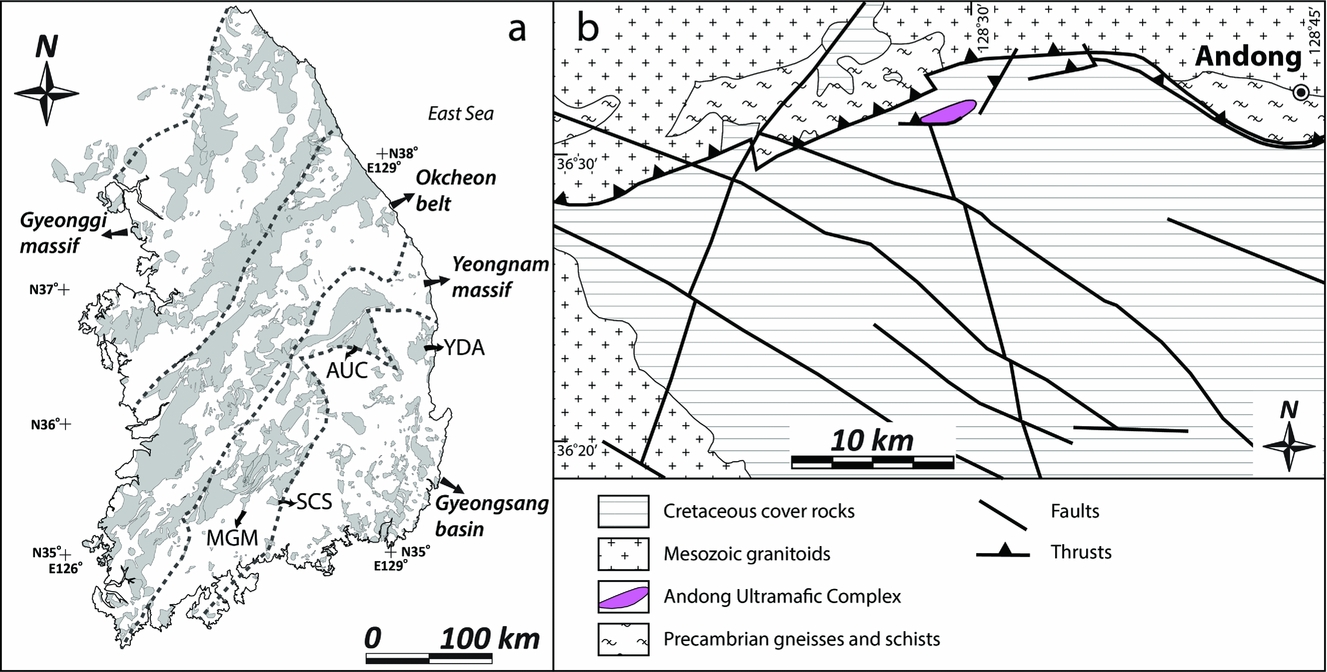
Phanerozoic arc magmatism in southern Korea appears to have begun with the intrusion of adakitic and tonalitic-trondhjemitic magmas in the northern Gyeongsang basin and central Yeongnam massif during Middle Permian – Early Triassic time (Cheong et al. Reference Cheong, Kim, Kim, Yi, Jeong and Cho2011; Yi et al. Reference Yi, Cheong, Kim, Kim, Jeong and Cho2012). The earlier (Late Carboniferous) subduction system was suggested by a recent detrital zircon study for the northeastern part of the Okcheon belt (Taebaeksan basin) (Kim, Ree & Kim, Reference Kim, Ree and Kim2012). Southeastern Korea was subsequently subjected to extensive Early–Middle Jurassic arc magmatism (Sagong, Kwon & Ree, Reference Sagong, Kwon and Ree2005; Kee et al. Reference Kee, Kim, Jeong and Kwon2010; Yi et al. Reference Yi, Cheong, Kim, Kim, Jeong and Cho2012). The AUC lies along the border between the Yeongnam massif and the Gyeongsang basin (Fig. 1), and is structurally controlled by the east–west-trending Andong fault system that reversely transferred Precambrian–Jurassic basement rocks of the hanging wall towards the SE during Cretaceous–Palaeogene time (Choi et al. Reference Choi, Lee, Choi, Hwang, Kwon, Ko and An2002). Lithologies of the AUC include dominant peridotites (wehrlite, plagioclase wehrlite and spinel-plagioclase wehrlite) and related serpentinites with subordinate pyroxenites (spinel-plagioclase-olivine-clinopyroxenite, spinel-plagioclase-olivine-orthopyroxenite and plagioclase-olivine websterite), gabbros (low-Ti gabbros and hornblende-biotite gabbros) and granitic dykes and sills (Whattam, Cho & Smith, Reference Whattam, Cho and Smith2011).
Phlogopite-bearing orthopyroxenite was discovered in the AUC by Jeong, Lee & Kwon (Reference Jeong, Lee and Kwon2012). The orthopyroxenite occurs in a c. 1-m-thick planar body within the serpentinite, and consists mostly of coarse subhedral to euhedral orthopyroxene crystals (>89 modal%). The chemical composition of the orthopyroxene is invariably dominated by the enstatite end-member (81.4±1.2%; Jeong, Lee & Kwon, Reference Jeong, Lee and Kwon2012). Minor minerals include clinopyroxene (c. 5%), phlogopite (c. 1–5%) and plagioclase (c. 2%) with trace chromian spinel, pentlandite, apatite and zircon. Clinopyroxene occurs as either exsolution lamellae or as interstitial fillings with phlogopite and plagioclase. Subhedral zircon occurs mostly interstitially or as inclusions in large orthopyroxene crystals. Reddish-brown phlogopite of 1–5 mm in size occurs in interstices of orthopyroxene crystals, which indicates late-stage crystallization. Some of the phlogopite grains were partly altered to serpentine, showing a deep green colouration. Orthopyroxene and clinopyroxene are partly altered to talc and amphibole, respectively, along grain boundaries, microcracks and cleavage planes. Plagioclase is partly altered to sericite and serpentine. We collected a relatively fresh orthopyroxenite specimen (sample SRP100) and a partly altered specimen (sample PS103). Zircons were separated from these two specimens, and fresh brown phlogopites were separated from sample SRP100.
3. Analytical details
Zircons were separated using magnetic and heavy liquid techniques and finally handpicked under a binocular microscope. Microscopic observation and SHRIMP analyses were conducted at the Korea Basic Science Institute (KBSI). Cathodoluminescence (CL) images of separated zircons were obtained using a scanning electron microscope (JEOL JSM-6610 LV). SHRIMP U–Pb dating mostly followed the analytical protocols of Williams (Reference Williams, McKibben, Shanks and Ridley1998). The SL13 (U = 238 ppm) and FC1 (1099 Ma; Paces & Miller, Reference Paces and Miller1993) standards were used in the analyses of uranium concentration and age calibration, respectively. Ages and concordia diagrams were produced using the Squid 2.50 and Isoplot 3.71 programs of Ludwig (Reference Ludwig2008, Reference Ludwig2009). Weighted mean ages were calculated using 207Pb-corrected 206Pb*/238U ratios after excluding outliers with a statistical t-test, and reported at 95% confidence.
Phlogopite grains were handpicked from the sand-size fraction of crushed orthopyroxenite. For 40Ar/39Ar dating, phlogopite grains were wrapped with pure (>99.5%) aluminium foil and set into a sample bucket. Flux monitoring minerals (Fisher Canyon sanidine; Renne et al. Reference Renne, Swisher, Deino, Karner, Owens and Depaolo1998) and salt (CaF2 and K2SO4) were also prepared to correct interfering isotopes during irradiation. The sample bucket was placed into an irradiation target made from pure aluminium and irradiated for three days in the IP11 position of the Hanaro reactor at the Korea Atomic Energy Research Institute. After irradiation, the samples and flux monitoring materials were placed in the glass sample chamber of the gas preparation system. The samples were heated from 600°C to 1400°C in vacuo with increment intervals of 25–60°C. The extracted gas was purified and analysed with a peak-jumping method using a VG5400 mass spectrometer installed at the KBSI. Corrections for argon produced by interactions of neutrons with K and Ca were made with the following correction factors: (40Ar/39Ar)K = 3.701, (36Ar/37Ar)Ca = 0.00811 and (39Ar/37Ar)Ca = 0.03427 (Tetley, McDougall & Heydegger, Reference Tetley, McDougall and Heydegger1980).
Zircon Hf isotopic compositions were analysed by using a Neptune MC-ICPMS combined with an ArF excimer laser ablation system (New Wave Research) at the Tianjin Institute of Geology and Mineral Resources. The Hf isotope analyses were targeted to the dated zircon spots or new spots within the same CL domains. The laser ablation system includes a short-pulse-width (<4 ns) excimer laser operated at 193 nm with an energy density of c. 15 J cm−2. The spot size was c. 50 μm. The nine Faraday collectors of the MC-ICPMS were statically aligned to simultaneously detect Yb, Lu and Hf isotopes. Details of the operational parameters are provided in Table 1. The Yb and Lu isotopic compositions employed for the correction of mass bias and isobaric interference were adopted from Vervoort et al. (Reference Vervoort, Patchett, Söderlund and Baker2004) and Chu et al. (Reference Chu, Taylor, Chavagnac, Nesbitt, Boella and Milton2002), respectively. The isobaric interference-corrected 176Hf/177Hf ratios were exponentially normalized to 179Hf/177Hf = 0.7325 (Patchett et al. Reference Patchett, Kouvo, Hedge and Tatsumoto1981). The 176Lu/177Hf and 176Yb/177Hf ratios were calculated following Iizuka & Hirata (Reference Iizuka and Hirata2005). Initial epsilon Hf values were calculated by using a 176Lu decay constant of 1.865 × 10⁻¹¹ a−1 (Scherer, Münker & Mezger, Reference Scherer, Münker and Mezger2001) and chondritic values suggested by Blichert-Toft & Albarade (Reference Blichert-Toft and Albarade1997). During the sample analysis, FC1 and GJ1 standard zircons respectively yielded average 176Hf/177Hf ratios of 0.282146±0.000037 (n = 24, 1σ standard deviation, recommended value 0.282184±0.000016; Woodhead & Hergt, Reference Woodhead and Hergt2005) and 0.281999±0.000028 (n = 28, 1σ, recommended value 0.282003±0.000018; Gerdes & Zeh, Reference Gerdes and Zeh2006). The 176Lu/177Hf and 176Yb/177Hf ratios measured for the FC-1 standard were quite scattered (0.00092±0.00027 and 0.0405±0.0122, 1σ), but these ratios of the GJ-1 standard were more tightly clustered (0.000256±0.000004 and 0.00933±0.00027, 1σ).
LA-MC-ICPMS instrumentation and operational parameters

4. Results
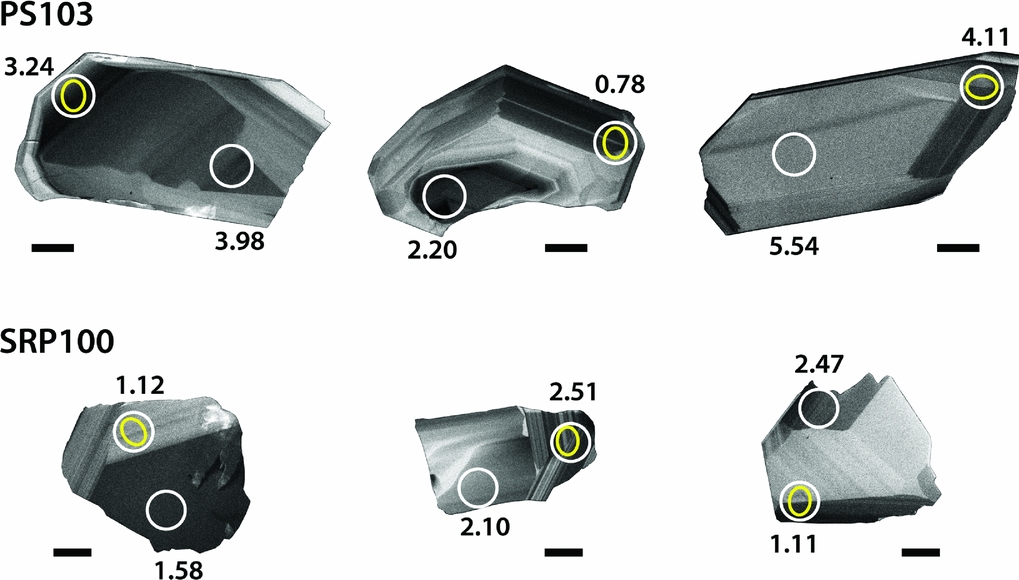
Zircons from the two specimens (PS103 and SRP100) are very similar in shape. They are transparent, equant, stubby crystals showing subhedral development of prisms and pyramidal terminations. Grains ranging from 150 to 400 μm in length mostly show aspect ratios of less than 1:3. Many zircons occur as broken parts of whole grains. They exhibit distinct oscillatory, sector or banded zoning under CL observation and are free of inclusions or premagmatic cores. Crystal faces are rarely resorbed with the development of a thin bright CL rim. Representative CL images of the zircons are shown in Figure 2.
Cathodoluminescence images of selected zircon grains. Small ellipses and large circles represent the locations of points for SHRIMP dating and LA-MC-ICPMS analysis, respectively. ɛ Hf(t) values are given with the locations. All scale bars are 50 μm in length.
The SHRIMP U–Pb zircon results are listed in Table 2. The U contents range from 923 ppm to 137 ppm with a narrow range of Th/U ratios all higher than 0.57. Common lead fractions (206Pbc) calculated by assuming 206Pb/238U–207Pb/235U age concordance were below 2.1%. Zircons from the two orthopyroxenites yielded indistinguishable 206Pb/238U ages of 221.7±1.6 Ma (sample PS103; n = 16, mean square weighted deviation or MSWD = 1.2) and 222.5±1.4 Ma (sample SRP100; n = 18, MSWD = 0.83) (Fig. 3). Because the oscillatory and sector zonings observed in CL and the relatively high Th/U ratios of the zircon provide a good indication of its magmatic origin, these ages represent the timing of zircon crystallization in a melt. The best estimate for the age of magmatism is 222.1±1.0 Ma (n = 34, MSWD = 1.00), obtained by pooling all data from the two samples.
Results of SHRIMP zircon U–Th–Pb isotope analyses (Pb*: radiogenic lead; Pbc: common lead)

† common lead corrected by 207Pb
‡ 207Pb corrected 206Pb*/238U age
Zircon concordia diagrams with mean 207Pb-corrected 206Pb/238U ages. Error ellipses are at the 1σ level. Data points represent 208Pb-corrected ratios.

The 40Ar/39Ar age spectrum (Table 3, Fig. 4) of phlogopite from sample SRP100 shows a rough U- or saddle-shaped release pattern. The anomalously old apparent date of the fourth step (429.5 Ma) is likely due to neutron-induced recoil loss of 39Ar from grain surfaces (Foland & Xu, Reference Foland and Xu1990) or to the presence of contaminating phases. The spectrum does not meet the criteria for defining a plateau age, for example three or more contiguous steps constituting more than 60% of the 39Ar (Ludwig, Reference Ludwig2008). However, steps 8–11 yield a total gas age of 220±6 Ma (2σ), which is identical to the zircon SHRIMP age within error ranges. This coincidence indicates that phlogopite and zircon crystallized in the same hydrous magma. The closure temperature of the phlogopite Ar system is commonly accepted to be c. 450°C (Reiners & Brandon, Reference Reiners and Brandon2006), apparently indicating rapid cooling of the magma. However, it is notable that phlogopite can retain radiogenic Ar at much higher temperature when nearly all of the K and Ar are partitioned into this phyllosilicate structure (Kelley & Wartho, Reference Kelley and Wartho2000), as is presumably the case for our analysed orthopyroxenite sample.
40Ar/39Ar data of phlogopite from sample SRP100

40Ar/39Ar age spectrum of phlogopite from sample SRP100.

Table 4 lists the LA-MC-ICPMS Hf–Yb–Lu isotopic data of zircon. The 176Hf/177Hf and 176Lu/177Hf ratios and the Late Triassic age constrained here yielded initial ɛ Hf values (222.1 Ma) ranging from +6.2 to −0.6. Zircons from sample SRP100 had slightly lower initial ɛ Hf values (1.7±1.1; 1σ) than those from sample PS103 (3.4±1.2; 1σ). The 176Lu/177Hf (0.00014–0.00090) and 176Yb/177Hf (0.0055–0.0371) ratios of the zircons are positively correlated with each other (R 2 = 0.97).
Results of zircon LA-MC-ICPMS Lu–Yb–Hf isotopic analyses (‘core’ and ‘rim’ refer to the relative position of the analysis point within the crystal)

5. Discussion
5.a. Change in Triassic subduction mode
The prominent enrichment of fluid-mobile elements (Cs, Rb, Ba, Th, U, K, light rare earth elements, Pb and Sr) and depletion of high-field-strength elements (Nb, Zr and Ti) in the AUC ultramafic rocks (Whattam, Cho & Smith, Reference Whattam, Cho and Smith2011; Jeong, Lee & Kwon, Reference Jeong, Lee and Kwon2012) are indicative of subduction-related fluid enhancement in the mantle source (Pearce, Reference Pearce and Thorpe1982; Ellam & Hawkesworth, Reference Ellam and Hawkesworth1988; Brenan et al. Reference Brenan, Shaw, Ryerson and Phinney1995; Ayers, Dittmer & Layne, Reference Ayers, Dittmer and Layne1997), which led Whattam, Cho & Smith, (Reference Whattam, Cho and Smith2011) to suggest that the AUC formed in a suprasubduction zone. This interpretation is reminiscent of the hinge rollback model (Stern & Bloomer, Reference Stern and Bloomer1992) in which new oceanic crust forms in response to the sinking of old, cold and dense oceanic lithosphere, which leaves a gap fed by melts flowing upwards from the asthenosphere shortly after the initiation of subduction. The rock assemblage of the AUC (wehrlites, pyroxenites and primitive gabbros) is typically associated with ongoing melting of a refractory mantle wedge (Shervais, Reference Shervais2001). Subduction of old, thick lithosphere results in a relatively steep subduction zone, an extensional regime in the overlying plate (Jarrard, Reference Jarrard1986), trench retreat and oceanwards migration of arc magmatism. A Late Triassic extensional tectonic setting in SE Korea is implicitly supported by the intrusion of the Sancheong syenite (Rb–Sr whole-rock age = 211±23 Ma, initial 87Sr/86Sr = 0.70598±0.00060; Park et al. Reference Park, Kim, Song and Cheong2006) and the Macheon gabbro-monzonite (thermal ionization mass spectrometry U–Pb zircon age = 223±3 Ma; Kim & Turek, Reference Kim and Turek1996; SHRIMP zircon age = 236.8±3.4 Ma, Kim et al. Reference Kim, Yi, Jeong and Cheong2011 b) in the southwestern part of the Yeongnam massif (Fig. 1). The nascent arc environment responsible for the formation of the AUC does not appear to have reached maturity during the Triassic because subsequent intrusion of the calc-alkaline intrusive suite did not occur in SE Korea until Early Jurassic time (Park, Lee & Cheong, Reference Park, Lee and Cheong2005; Kee et al. Reference Kee, Kim, Jeong and Kwon2010; Yi et al. Reference Yi, Cheong, Kim, Kim, Jeong and Cho2012). Alternatively, the change in the angle of convergence, convergence rate, subduction angle or their combination may have resulted in this magmatic gap.
The Late Triassic ‘Mariana’-type (Uyeda & Kanamori, Reference Uyeda and Kanamori1979) subduction mode suggested in this study is in striking contrast to the hot subduction mode envisioned from the occurrence of adakite to the east of the AUC (Fig. 1) in the Permian–Triassic transition period (Cheong, Kwon & Sagong, Reference Cheong, Kwon and Sagong2002; Yi et al. Reference Yi, Cheong, Kim, Kim, Jeong and Cho2012). Geochemical characteristics of the Yeongdeok adakite such as distinctly high La/Yb (37.5–114.6) and Sr/Y (138.2–214.0) (Cheong, Kwon & Sagong, Reference Cheong, Kwon and Sagong2002) are consistent with the signatures of high-silica adakites (Martin et al. Reference Martin, Smithies, Rapp, Moyen and Champion2005). Adakites are apparently restricted to hot subduction regimes having anomalously high heat flow that allows the subducted slab to melt rather than dehydrate. Subduction of young and hot lithosphere is the most widely accepted environment for the formation of adakites (Defant & Drummond, Reference Defant and Drummond1990; Martin, Reference Martin1999). Yi et al. (Reference Yi, Cheong, Kim, Kim, Jeong and Cho2012) suggested that subduction of the palaeo-Pacific ridge may have provided the additional heat to the arc system necessary to produce the Yeongdeok adakite. The development of a new subduction system in Late Triassic time, suggested by this study, may have been preceded by arc–arc or arc–continent collision. The geological records of these tectonic events may still remain in SE Korea or else have been erased by the intense Jurassic–Cretaceous magmatic overprints subjected to this region. In fact, arc–continent collision yielded very diverse tectonic architectures due to the complexities of involved continental margin and arc–trench complex, as revealed by studies on modern arcs (Brown et al. Reference Brown, Ryan, Afonso, Boutelier, Burg, Byrne, Calvert, Cook, Debart, Dewey, Gerya, Harris, Herrington, Konstantinovskaya, Reston, Zagorevski, Brown and Ryan2011). Further studies are needed to test our suggestion of the Permian–Triassic change in the subduction mode. Calc-alkaline granitoids were emplaced in the central Yeongnam massif after intrusion of the Yeongdeok adakite but before the onset of a new high-angle subduction (Kim et al. Reference Kim, Yi, Jeong and Cheong2011 b). This seemingly continuous Early–Middle Triassic arc magmatism is in contrast to a magmatic gap from 260 to 190 Ma in the SE coastal region of China, which is possibly attributed to flat slab subduction (Li & Li, Reference Li and Li2007; Li et al. Reference Li, Li, Chung, Lo, Xu and Li2012).
Our interpretation is not compatible with a recent tectonic model suggested by the detrital zircon ages of modern river sediments (Choi, Lee & Orihashi, Reference Choi2012), in which continuous subduction angle increase and resultant slab rollback were the driving forces of apparent Triassic south-eastward arc migration in southern Korea (249–202 Ma). Note, however, that Triassic granitic magmatism in central and SE Korea occurred under different tectonic environments, that is, post-collisional stabilization of tectonically overthickened crust in the former region (Cho, Lee & Armstrong, Reference Cho, Lee and Armstrong2008; Williams, Cho & Kim, Reference Williams, Cho and Kim2009; Kim et al. Reference Kim, Yi, Jeong and Cheong2011 a, b) and subduction of the palaeo-Pacific plate in the latter region (Cheong, Kwon & Sagong, Reference Cheong, Kwon and Sagong2002; Cheong et al. Reference Cheong, Kim, Kim, Yi, Jeong and Cho2011; Yi et al. Reference Yi, Cheong, Kim, Kim, Jeong and Cho2012). By detrital zircon ages alone, it is not possible to ascertain the tectonic environment of the host granitoids in which the zircons originally crystallized.
5.b. Zircon Hf isotopic constraints
According to Whattam, Cho & Smith (Reference Whattam, Cho and Smith2011), the AUC wehrlites and pyroxenites formed by fractional crystallization and accumulation processes, respectively, in suprasubduction zone magmas derived from a refractory mantle residue that underwent a high degree of melt extraction.
Geochemical and mineralogical studies have examined mantle xenoliths hosted by Cenozoic alkali basalts that ubiquitously occur in the Korean peninsula (Choi, Reference Choi2012), but information about the pre-Cenozoic mantle lithosphere is quite restricted because of the lack of Mesozoic or Palaeozoic mantle xenoliths on the peninsula. These Cenozoic xenoliths are unexceptional spinel peridotites without hydrous minerals or garnet, which is indicative of a relatively thin (25–90 km; Park, Reference Park2010) subcontinental lithospheric mantle (SCLM) beneath the peninsula. Choi et al. (Reference Choi, Kwon, Mukasa and Sagong2005) and Choi & Mukasa (Reference Choi, Lee and Orihashi2012) reported their primitive Sr–Nd–Hf isotopic compositions (whole-rock 87Sr/86Sr = 0.704542–0.702346, clinopyroxene 143Nd/144Nd = 0.513858–0.512712, clinopyroxene 176Hf/177Hf = 0.285092–0.283196) similar to Sr–Nd compositions of the fertile peridotite xenoliths derived from post-Archean lithospheric mantle in eastern China. The clinopyroxene ɛ Hf(t) values of the peridotite xenoliths hosted by Cenozoic alkali basalts in the eastern North China craton (Shandong Province) have also been reported to be consistently depleted mantle-like or more juvenile (mostly >+15; Chu et al. Reference Chu, Wu, Walker, Rudnick, Pitcher, Puchtel, Yang and Wilde2009). Our Hf isotope data for AUC zircons indicate that the Late Triassic lithospheric mantle beneath SE Korea was distinctly more enriched than the primitive Cenozoic mantle beneath Korea and eastern China.
Zircon ɛ Hf values of the AUC orthopyroxenites were plotted on a crystallization time versus ɛ Hf diagram (Fig. 5), together with previous data for the Permian–Palaeogene granitoids occurring within the Gyeongsang basin (Cheong et al. Reference Cheong, Yi, Kim, Lee, Lee, Geng and Li2013). From zircon Hf data of the granitoids, Cheong et al. (Reference Cheong, Yi, Kim, Lee, Lee, Geng and Li2013) postulated a hypothetical Early Palaeozoic crust beneath SE Korea whose recycling yielded Cretaceous–Palaeogene granitoids. As shown in Figure 5, the AUC zircon data plot well below the depleted-mantle trend and the evolution line regressed by the granitoid data, ruling out the possibility that the lower ɛ Hf values resulted from contamination by the Palaeozoic crustal protolith. Instead, the Late Triassic Hf isotopic enrichment of the lithospheric mantle is most likely attributable to melt or fluid addition during the course of prior subduction of the palaeo-Pacific plate that has occurred in SE Korea since Late Palaeozoic time (Cheong et al. Reference Cheong, Kim, Kim, Yi, Jeong and Cho2011; Kim et al. Reference Kim, Yi, Jeong and Cheong2011 b; Yi et al. Reference Yi, Cheong, Kim, Kim, Jeong and Cho2012). The primitive Sr–Nd–Hf isotopic compositions of Cenozoic mantle xenoliths from Korea and eastern China indicate that the SCLM beneath SE Korea returned to a juvenile signature after Late Triassic time. This recovery is also evidenced by whole-rock and mineral geochemical data indicating secondary metasomatism of the AUC wehrlites by mid-ocean ridge basalt (MORB) -like asthenospheric mantle melts (Whattam, Cho & Smith, Reference Whattam, Cho and Smith2011).
Plot of ɛ Hf versus crystallization ages of zircons from the Phanerozoic granitoids within the Gyeongsang basin (Cheong et al. Reference Cheong, Yi, Kim, Lee, Lee, Geng and Li2013) and the ACU orthopyroxenite. The evolutionary path of the depleted mantle is based on 176Hf/177Hf and 176Lu/177Hf ratios from Griffin et al. (Reference Griffin, Pearson, Belousova, Jackson, O'Reilly, Van Achterberg and Shee2000). A regression line constructed from zircon data of the granitoids is shown for reference.

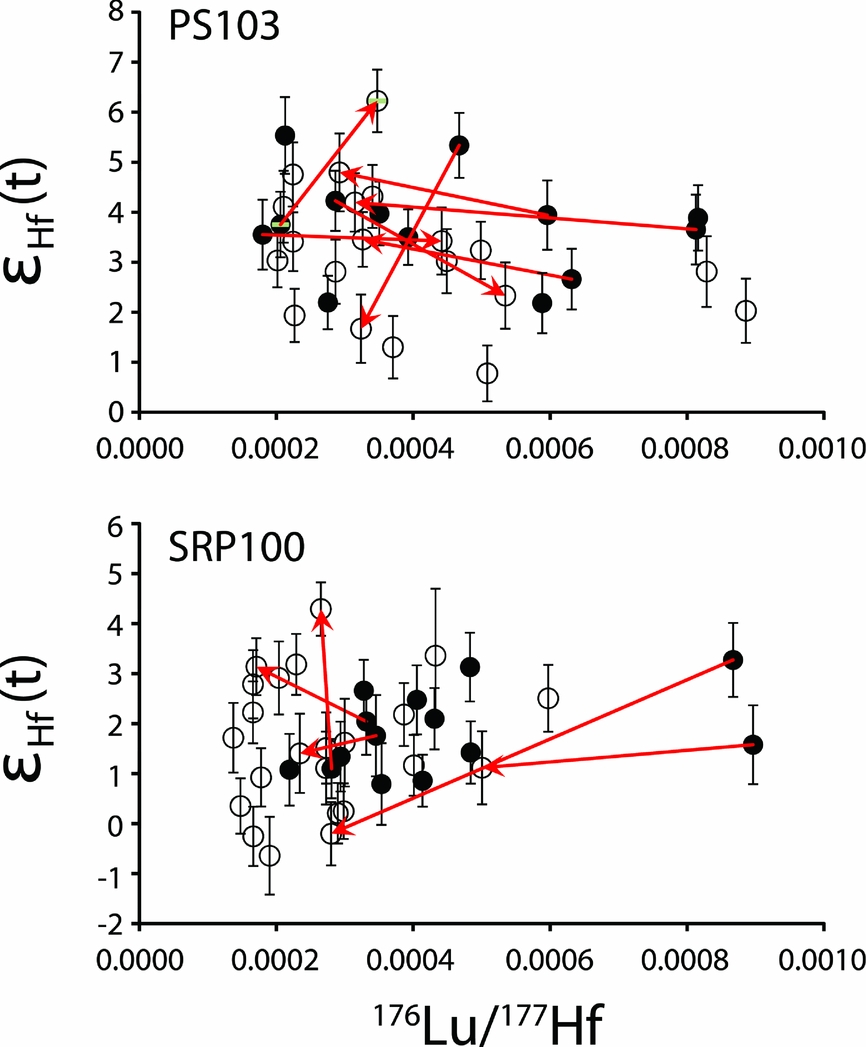
The ɛ Hf(t) values of points on zircons were plotted against the 176Lu/177Hf ratios (Fig. 6). The core-to-rim decrease in 176Lu/177Hf ratio of SRP100 zircons could be ascribed to progressive chemical change in the melts; this trend is not prominent in zircons from sample PS103 however. Most of these zircon grains show a restricted core-to-rim spread of ɛ Hf(t) values within ±2 epsilon units, but both decreasing and increasing core-to-rim trends outside analytical uncertainty were detected for some grains. This indicates an open-system evolution of the magma system involving interaction with pre-existing crustal materials and replenishment by fresh melt inputs. The most probable candidate for the crustal contaminant is Precambrian basement rocks in the Yeongnam massif. However, the crustal contamination must have been minor in the AUC magmas considering the significantly high Ni (596–5570 ppm; Whattam, Cho & Smith, Reference Whattam, Cho and Smith2011) and Cr contents (1118–3872 ppm; Whattam, Cho & Smith, Reference Whattam, Cho and Smith2011; Jeong, Lee & Kwon, Reference Jeong, Lee and Kwon2012) reported for the wehrlite and pyroxenite whole-rock samples and the lack of basement xenoliths in the AUC. Furthermore, the data do not show a systematic trend in Figure 6, which can be expected for the case of overall contamination by the Precambrian crust.
Plots of zircon ɛ Hf(t) versus the 176Lu/177Hf ratio. Core-to-rim variation is shown by arrowed tie lines connecting data from the same grain. Error bars indicate 2σ standard error. The closed and open symbols represent zircon cores and rims, respectively.
6. Conclusions
The zircon and phlogopite ages of this study reveal that the magmatic AUC formed in Late Triassic time, likely in response to the subduction of a dense oceanic slab during the initiation of an arc system. This cold subduction mode strikingly contrasts to the prior hot subduction mode envisioned from the occurrence of high-silica adakites that formed in the Permian–Triassic transition period. The ɛ Hf values of AUC zircons are distinctly more enriched than primitive values of Cenozoic mantle xenoliths from eastern China and the Korean peninsula. These lower ɛ Hf values are not attributable to contamination by the Palaeozoic crustal protolith beneath SE Korea because they plot below the evolution line formed by the zircon data of the granitoids within the Gyeongsang basin on the time–ɛ Hf diagram. The Late Triassic Hf isotopic enrichment of the lithospheric mantle beneath SE Korea is instead most probably due to melt or fluid addition that resulted from prior subduction of the palaeo-Pacific plate. Most AUC zircons show a restricted core-to-rim spread of ɛ Hf values; open-system behaviour, possibly associated with slight crustal contamination of the AUC magma system during magmatic differentiation, is however testified by the core-to-rim variations of some grains.
Acknowledgements
This research was supported by Korea Basic Science Institute (T33621) and National Research Foundation of Korea (NRF-2011–0028597) grants. Field work was partly supported by Korea Institute of Geoscience and Mineral Resources. LA-MC-ICPMS analysis of zircon Hf isotopes was supported by Chinese Geological Survey Project No. 12120113013900. We thank Professor Moonsup Cho and an anonymous reviewer for their detailed and constructive comments.



