Stress events have consistently been linked to the development of depression and anxiety disorders (Kendler, Karkowski, & Prescott, Reference Kendler, Karkowski and Prescott1999). Increased exposure to and severity of stress events have been associated with poorer clinical outcomes including more severe symptoms (Chapman et al., Reference Chapman, Whitfield, Felitti, Dube, Edwards and Anda2004), earlier onset (Kessler, Reference Kessler1997), recurrence (Francis, Moitra, Dyck, & Keller, Reference Francis, Moitra, Dyck and Keller2012), and reduced response to treatment (Nemeroff et al., Reference Nemeroff, Heim, Thase, Klein, Rush, Schatzberg and Keller2003).
When considering the available research, exposure to stressful events during prenatal life, throughout childhood, and in adolescence have all been associated with depressive/anxious illness later in life. However, their relative importance in predicting psychological outcomes remains in question. With regard to the timing of stress exposure, some data suggest that recent life stress events are more relevant predictors of depression than past events. Up to 80% of depression in the community occurs after a recent major life event (Mazure, Reference Mazure1998). Further, a 2007 meta-analysis of previous research found that the longer the time since the onset of the stress, the less effect it had on stress hormones (Miller, Chen, & Zhou, Reference Miller, Chen and Zhou2007). At the same time, it is clear that not all individuals who experience major life events will go on to develop depression, which suggests that other factors serve to increase risk for depressive symptoms after stress.
The theory has been proposed that sensitization to later stressors may occur in those who have been exposed to early adverse experiences (Hammen, Henry, & Daley, Reference Hammen, Henry and Daley2000; Heim et al., Reference Heim, Newport, Wagner, Wilcox, Miller and Nemeroff2002), such that early adversity increases vulnerability to depression in response to stress in later life (Espejo et al., Reference Espejo, Hammen, Connolly, Brennan, Najman and Bor2007). Similarly, chronic or cumulative stress sustained over a long period of time may increase the risk of affective illness, especially when combined with recent acute stressors (Hammen, Kim, Eberhart, & Brennan, Reference Hammen, Kim, Eberhart and Brennan2009; Schilling, Aseltine, & Gore, Reference Schilling, Aseltine and Gore2008; Vinkers et al., Reference Vinkers, Joels, Milaneschi, Kahn, Penninx and Boks2014). An alternative hypothesis suggests that moderate life stress early in life may confer some resilience against the negative effects of later life stressors, similar to an inoculation effect (Liu, Reference Liu2015). In such a case, the opportunity to develop an endogenous stress response early in life may confer an increased adaptive ability to respond adequately when the stress system is challenged again (Gunnar, Frenn, Wewerka, & Van Ryzin, Reference Gunnar, Frenn, Wewerka and Van Ryzin2009). It also follows that those deprived of any form of early life stress may be less prepared to respond appropriately to future stress exposures. This concept aligns with the “mismatch hypothesis,” which holds that individuals are more likely to suffer disease if a mismatch occurs between the early programming environment and the later life adult environment (Gluckman & Hanson, Reference Gluckman, Hanson, Gluckman and Hanson2006).
The timing of stress exposure may be important mechanistically as brain regions regulating the stress response (via the hypothalamus–pituitary–adrenal [HPA] axis) develop and mature at different ages (Lupien, McEwen, Gunnar, & Heim, Reference Lupien, McEwen, Gunnar and Heim2009). The hippocampus attains maturation at the age of 2 years, the prefrontal cortex matures between 8 and 14 years, and the amygdala continues to mature slowly until the late 20s (Giedd et al., Reference Giedd, Snell, Lange, Rajapakse, Casey, Kozuch and Rapoport1996). Exposure to high levels of stress during these critical windows of development can impair the growth and maturation of these brain regions (Lupien et al., Reference Lupien, McEwen, Gunnar and Heim2009). In utero, the fetus may be exposed to stress hormones via placental transfer from the mother. Prenatal stress exposure in animal models has been shown to affect neurodevelopment and increase the risk for behavioral changes in the offspring (Kofman, Reference Kofman2002; Weinstock, Reference Weinstock2001). Studies have associated prenatal stress or anxiety with later symptoms of anxiety and depression (Talge, Neal, Glover, & Early Stress Translational Research and Prevention Science Network, 2007; Van den Bergh, Mulder, Mennes, & Glover, Reference Van den Bergh, Mulder, Mennes and Glover2005) or increased stress reactivity (Davis, Glynn, Waffarn, & Sandman, Reference Davis, Glynn, Waffarn and Sandman2011) in the child. Epigenetic mechanisms have been proposed to mediate these effects (Conradt, Lester, Appleton, Armstrong, & Marsit, Reference Conradt, Lester, Appleton, Armstrong and Marsit2013; Meaney, Szyf, & Seckl, Reference Meaney, Szyf and Seckl2007; Pena, Monk, & Champagne, Reference Pena, Monk and Champagne2012; Tyrka, Price, Marsit, Walters, & Carpenter, Reference Tyrka, Price, Marsit, Walters and Carpenter2012). In addition, puberty is marked by dramatic changes in stress reactivity and exposure to stressors during this sensitive period can have a lasting impact on the stress response via the HPA axis (Romeo, Reference Romeo2010a, Reference Romeo2010b). This may contribute to the increase in psychological disorders seen to emerge during adolescence, especially in females. However, stress-provoking events rarely occur in isolation, and research shows that life stress events in an individual or family are highly correlated over time. Cole, Nolen-Hoeksema, Girgus, and Paul (Reference Cole, Nolen-Hoeksema, Girgus and Paul2006) found that the numbers of adversities experienced in childhood are positively associated with the number of life stress events in adolescence and adulthood. Most studies examining prenatal stress exposure are unable to control for stress exposure after birth, and so it remains to be seen whether the effect of prenatal stress exposure on mental health outcomes is independent of the effects of later life stress. Hence, prenatal stress and early life adversity may be associated with depression predominantly because they are followed by a trajectory of negative life stress events across the life span (Hazel, Hammen, Brennan, & Najman, Reference Hazel, Hammen, Brennan and Najman2008). Conversely, a recent life stress event may be more likely to trigger a depressive episode if it is preceded by a certain pattern of stress events from birth. Therefore, a life course approach is required to explore the relative impact of prenatal and postnatal timing of stress exposures on offspring mental health. The developmental pathway of stress exposure may play a role in identifying subgroups of children at higher risk of stress sensitivity (Liu, Reference Liu2015), optimal times for interventions (Heim & Binder, Reference Heim and Binder2012), and defining subgroups of depression likely to respond differently to treatment (Heim, Plotsky, & Nemeroff, Reference Heim, Plotsky and Nemeroff2004).
Many previous studies examining the link between stress exposure and mental health problems have been cross-sectional or retrospective in nature, or have not been able to adequately examine confounding factors such as early or recent life stress, socioeconomic status, or parental mental health. Very few studies have had the capability to examine stress exposure at different developmental stages in the same individuals and psychological outcomes. As stress events in the same family are highly correlated over time, analyses taking repeated measures from the same person into consideration are vital to our understanding of the relative timing of life stress exposure and psychiatric outcomes.
The Western Australian Pregnancy Cohort (Raine) Study provides a unique opportunity to examine family stress event exposure from the start of pregnancy to 17 years postbirth and subsequent symptoms of depression and anxiety in young adulthood. The first aim of this study was to examine longitudinal trajectories of postnatal stress exposure over the first 17 years of life and their relationship with symptoms of depression, anxiety, and stress at age 20 in males and females, adjusting for appropriate covariates. The second aim was to examine the relative contribution of prenatal versus postnatal stress events to depression, anxiety, and stress at age 20. We hypothesized, first, that trajectories involving high numbers of stress events during early life and adolescence would predict symptoms of depression and anxiety by early adulthood; second, that stress exposure from birth to age 17 would be more predictive of adult depression and anxiety symptoms than prenatal stress exposure; and third, that the impact of stress events across the life span on adult depression and anxiety would differ between males and females.
Methods
Participants
The Raine Study, established in 1989, is a prospective cohort study of 2,868 live births, with longitudinal follow-up from 16 weeks gestation to early adulthood (Newnham, Evans, Michael, Stanley, & Landau, Reference Newnham, Evans, Michael, Stanley and Landau1993). Mothers were recruited from the public antenatal clinic at King Edward Memorial Hospital and nearby private clinics. After the initial measures at 16–20 weeks gestation, follow-ups were conducted at 34 weeks gestation and ages 1, 2, 3, 5, 8, 10, 14, 17, and 20 years. Ethics approval for this study was obtained from King Edward Memorial Hospital, Princess Margaret Hospital, and the University of Western Australia. All procedures were carried out with parental written informed consent up to the age of 18. Participants provided their own consent at age 20. Racial characteristics were 2,473 (88.2%) Caucasian, 124 (4.4%) Chinese, 74 (2.6%) Indian, 67 (2.4%) Aboriginal, 66 (2.4%) other, and 64 (2.2%) not reported. Of the original 2,868 participants, 2,076 (72.4%) were retained until the age 20 review (1,473 completed the age 20 review, 603 deferred from participating, 519 had withdrawn from the study, 236 were lost to follow-up, and 37 had died). As with all long-term cohort studies, there has been attrition over time with those lost to follow-up more likely to have higher indices of social disadvantage. This loss of disadvantaged families to follow-up is partially offset in the Raine Study by the fact that the original cohort showed an overrepresentation of socially disadvantaged families (Robinson et al., Reference Robinson, Oddy, McLean, Jacoby, Pennell, de Klerk and Newnham2010).
Measurement of stress events
During pregnancy, at 18 weeks gestation, mothers filled out a questionnaire asking whether any of 11 life stress events had been experienced since becoming pregnant. At 34 weeks gestation, the questionnaire was repeated referring to the last 4 months. From age 1 to 17 primary caregivers reported on the same 11 life stress events occurring in the past 12 months. These life events were selected from the life stress inventory developed by Tennant and Andrews (Reference Tennant and Andrews1976). They included problems with pregnancy, death of a close relative, death of a friend, marital problems, separation or divorce, problems with children, own job loss (involuntary), partner's job loss (involuntary), financial hardship, residential move, and “other” stressful events, as used in other studies (Robinson et al., Reference Robinson, Mattes, Oddy, Pennell, Van Eekelen, McLean and Newnhan2011; Tearne et al., Reference Tearne, Allen, Herbison, Lawrence, Whitehouse, Sawyer and Robinson2015). We examined high stress during pregnancy (the sum of 18-week and 34-week events dichotomized as 3+ events vs. <3 events) and also looked at high stress early in pregnancy and late in pregnancy (3+ events vs. <3 events at 18 weeks and 34 weeks). Longitudinal stress exposure, composed of the total number of family stress events experienced at each age, was used in trajectory analysis (see below). Additional information detailing the number and distribution of stress event data at each time point can be found online in supplementary Figure S.1.
Measurement of depression and anxiety
Symptoms of anxiety, depression, and stress were measured using the Depression, Anxiety and Stress Scale (DASS-21) answered by the Raine young adults at age 20. The DASS-21 is a 21-item self-report questionnaire producing a total score and three subscale scores designed to measure the negative emotional states of depression, anxiety, and stress over the past week (Lovibond & Lovibond, Reference Lovibond and Lovibond1995). It is a shorter version of the original 42-item DASS, more suitable for research purposes in which final scores are multiplied by 2 to give the final values. The DASS-21 has been shown to produce similar results to the full DASS and has the same factor structure and excellent internal consistency and reliability with Cronbach α values >0.9 for the DASS total score (Crawford & Henry, Reference Crawford and Henry2003; Sukantarat, Williamson, & Brett, Reference Sukantarat, Williamson and Brett2007). We report the total DASS score as there is strong support for the derivation and use of the DASS-21 total scale score rather than independent scores (Osman et al., Reference Osman, Wong, Bagge, Freedenthal, Gutierrez and Lozano2012), in acknowledgement of extreme comorbidity between depression, anxiety, and stress. We use DASS severity ratings (normal, mild, moderate, severe, or extremely severe) to interpret the clinical significance of changes in DASS scores by stress exposure (Lovibond & Lovibond, Reference Lovibond and Lovibond1995).
Covariates
We examined a number of covariates that may confound the relationship between the occurrence of life stress events and young adult mental health problems.
Baseline covariates
Maternal education (12 or more years of education vs. less than 12 years of education); family income (total income ≤24,000 vs. >24,000 AUD per annum, in accordance with the poverty line at the time the data were collected); smoking during pregnancy (no cigarettes smoked vs. any cigarettes smoked); father living at home during pregnancy (living at home vs. not living at home); length of gestation (<37 vs. ≥37 weeks); and parity (0, 1, and 2 or more children). Birthweight and maternal age during pregnancy were used in their continuous form. The Socioeconomic Indices for Areas are relative summary measures of socioeconomic disadvantage created by combining information collected from the Australian Census data. We used the Index of Relative Socioeconomic Disadvantage in this study as a continuous socioeconomic indicator where lower numbers represent greater disadvantage (Australian Bureau of Statistics, 2006). This index incorporates many different measures of social and financial status, and we found it to account for more variability in our models than any other single socioeconomic variable.
Age 20 covariates
Living arrangements (living with family or relatives vs. living alone, with a partner, child, or flatmate); smoking at age 20 (no cigarettes smoked vs. any cigarettes smoked); body mass index (BMI, continuous); alcohol consumption (standard drinks per day); the Index of Relative Socioeconomic Disadvantage (see above); and vigorous exercise, moderate exercise, and walking in the form of number of hours per week were tested in their continuous form.
Parental mental health was measured at the age 14 and 17 reviews where the mother and father of the child were asked if they had ever been treated for an emotional or mental health problem (other than postnatal depression). A three-category parental mental health measure at each age was created for analyses (neither parent, one parent, or both parents). This measure is likely to incorporate both genetic and environmental components. The age 14 and 17 parental mental health measures were highly correlated, and both yielded the same overall results when used interchangeably in regression models. The age 14 measure was used in final analyses to minimize data loss as n = 1,790 compared to n = 1,404 at age 17.
Statistical analyses
We used a latent class growth analysis to derive trajectories of life stress events from age 1 to age 17 using PROC TRAJ within SAS (Jones, Nagin, & Roeder, Reference Jones, Nagin and Roeder2001), and we only included individuals in the analysis if they had greater than or equal to three measures of stress events over the time period (n = 2,497). This method is designed to identify clusters of individuals who have followed a similar developmental trajectory (Nagin & Odgers, Reference Nagin and Odgers2010) and assigns each person to a group depending on the probability of membership. We systematically compared a number of different models from two to seven trajectory classes with linear and quadratic functions for each group. To determine the best model we used the Bayesian information criterion statistic, probability diagnostics, and the practical value of the grouping with respect to the research question. The final groupings and the posterior probability diagnostics were exported to SPSS for linear regression analyses.
Covariates were included from baseline measures (pregnancy/birth) and at the time of the outcome (age 20), with the exception of the longitudinal measure of parental mental health. These covariates were examined as predictors of DASS outcomes in univariate analyses before multivariate linear regression models were constructed to examine the associations between stress exposure trajectory and young adult depression, anxiety, and stress. Those covariates that predicted outcomes significantly (p < .05) were included in the final multivariate models. Final linear regression models were weighted by the probability that each individual belonged to that particular trajectory, essentially giving greater weight to more accurate results. All analyses were conducted in SPSS Statistics version 19 and α was set at p < .05.
Results
Trajectories of stress events: Descriptive results
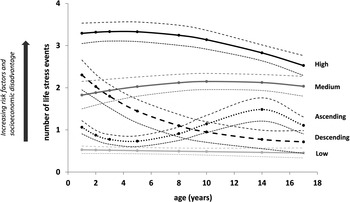
A five-class model was selected as best describing the trajectories of stress exposure over 17 years. The five-class model revealed the highest Bayesian information criterion and both an ascending and descending trajectory with meaningful numbers of individuals. This model also demonstrated good model fit based on posterior probabilities of membership to each trajectory group >70%. The five classes (Figure 1) involved three relatively consistent trajectories and two trajectories that changed over the life course. The low, medium and high trajectories displayed consistently low, intermediate, or high levels of stress exposure over 17 years.
Trajectories of stress exposure across the life course. The five trajectories of stress exposure and 95% confidence intervals.

The ascending trajectory showed relatively low stress exposure in early life, increasing in the early teens, representing an adolescent onset of stress exposure. The descending trajectory showed relatively high stress exposure in early childhood, decreasing over time to low levels during adolescence, representing early life stress only. Cohort percentages were as follows: low (16.7%), medium (30.7%), high (17.2%), ascending (27.5%), and descending (7.8%).
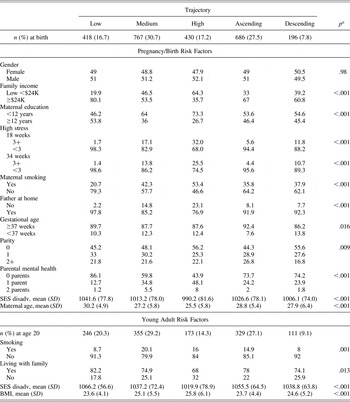
The characteristics of individuals classified into these trajectories are shown in Table 1. There were approximately equal proportions of males and females in each trajectory. Focusing initially on the three stress trajectories that remained consistent over time, in the increasing order of low, to medium, to high trajectories, there were increases in the proportions of low-income families, maternal smoking, and stress events during pregnancy and the percentage of parents treated for a mental health problem. Conversely, there were decreases in maternal age and education and fathers present in the family home in early life. Similarly, in the offspring at age 20, with higher levels of chronic stress, there were increases in BMI and smoking, and more young people were living outside the family home (comparing the low to the medium/high trajectory groups). In line with these observations, we observed lower socioeconomic status (SES) with higher chronic stress over the 20 years, as indicated by lower SES-disadvantage scores both before birth and at age 20.
Characteristics of participants in the five trajectories of stress exposure

Note: Data are shown as column percentages unless otherwise specified. In the final subset analyzed with mental health outcomes and covariates (n = 769), maternal education, prenatal stress, gestational age, and parity did not reach statistical significance < 0.05. SES, socioeconomic status; BMI, body mass index.
a Analysis of variance p values for continuous data, differences between groups; or χ2 p values for categorical data, differences between groups.
Focusing on the trajectories that change over time, the descending stress trajectory clearly displays higher numbers of stress events during pregnancy and the early years postbirth, at levels similar to the medium trajectory, while the ascending curve displays low early life stress events, increasing around ages 10–14. Both of these trajectories show similar maternal age and education, maternal smoking, proportion of fathers in the family home, and parental mental health, suggesting a similar SES. However, the Socioeconomic Indices for Areas scores at birth and age 20 indicate that the descending trajectory lies near the medium trajectory in terms of SES while the ascending trajectory SES is higher, lying between the low and the medium trajectories. Further, we note that mothers of children on the ascending stress trajectory had a higher chance of already having other children than the descending trajectory and the children exposed to the ascending (adolescent-onset) stress are more likely to be smokers at age 20 (Table 1).
Relationship of stress trajectories to depression/anxiety symptoms
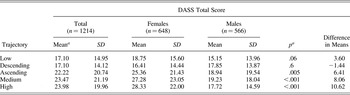
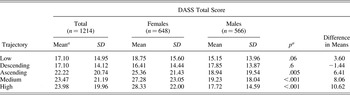
A total of 1,214 participants had stress trajectory data and completed the DASS at the age 20 review. The characteristics of the DASS scores by trajectory and gender are presented in Table 2. In the total population, DASS scores were higher in the high, medium, and ascending stress trajectories compared to the low trajectory. When we examined gender differences, the DASS scores were significantly higher in females than in males across all trajectories except the descending trajectory, where there were no gender differences in DASS scores. It is interesting to note that the range of DASS scores over the five life stress trajectories was approximately 4 points in males (15.15–19.23) and around 12 points in females (16.41–28.33), suggesting that a history of developmental stress may have a greater discriminating value in predicting depression/anxiety in females than in males.
Depression, anxiety and stress symptoms by trajectory of stress exposure and gender
Note: DASS, Depression, Anxiety and Stress Scale.
a Analysis of variance assessing effect of stress trajectory on DASS, F (4, 1209) = 6.44, p < .001.
b Analysis of variance p values assessing differences between males and females.
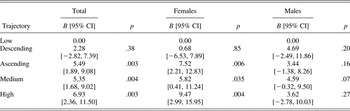
The medium, high, and ascending stress trajectories predicted significantly increased total DASS scores at age 20, with an increase of 5.4–6.9 in total DASS score compared to the low trajectory (see Table 3). These figures remained significant after adjustment for early life, socioeconomic, and parental mental health factors, and alcohol and cigarette exposure. Upon further investigation by gender, this relationship was only found in girls with predicted increases in DASS scores of 5.8–9.5 for females in the medium and high or ascending trajectories. There was a trend to significance for increased DASS score in boys in the medium trajectory. Formally testing for differences between males and females using a Trajectories × Sex interaction term in the model indicated that there was a significant difference between males and females in the high trajectory with depression/anxiety symptoms at age 20 (High Stress × Female), 8.15 (0.77, 15.54), p = .03. Other Trajectory × Sex comparisons were not significant and may be limited by small group sizes. Although the descending trajectory commenced with high numbers of stress events in the years after birth (levels similar to the medium trajectory), stress exposure reduced with time (to levels similar to the low trajectory) by adolescence, and there was no relationship with DASS scores at age 20.
Trajectory of stress exposure and association with depression and anxiety symptoms for adjusted models

Note: The final total was n = 769 adjusted for socioeconomic disadvantage at enrollment, gender, parental mental health, and smoking (low income, father living with family, maternal age and education, birthweight, gestational age, smoking in pregnancy, parity, age 20 body mass index, alcohol consumption, exercise, and living with family were also examined but were removed from models because of a lack of statistical significance and therefore limited contribution to the model). Analyses were weighted by the probability that each individual would fall into the allocated trajectory; however, weighted and unweighted analyses produced similar results.
Relationship of prenatal stress to depression/anxiety symptoms
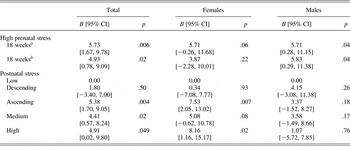
High prenatal stress throughout pregnancy (0–34 weeks) showed a trend to predicting depression/anxiety symptoms in the total population after adjustment for gender, SES, parental mental health, and smoking at age 20, B = 3.17 (–0.26, 6.60), p = .07, but was not statistically significant and the association reduced when examined separately in males, B = 3.47 (–1.39, 8.34), p = .16, and females, B = 2.56 (–2.29, 7.42), p = .30. However, when we examined the effect of timing of stress exposure in pregnancy, high stress early in pregnancy (0–18 weeks) significantly predicted higher DASS scores in the total population and in both males and females after adjustment for SES, parental mental health, and smoking at age 20 (see Table 4). In contrast, high stress later in pregnancy (18–34 weeks) was not associated with DASS scores after adjustment in the total population, B = –0.29 (–4.82, 4.23), p = .90, in females, B = –1.14 (–7.19, 4.90), p = .71, or in males, B = –0.14 (–7.14, 6.86), p = .97. Testing for gender differences in the total model by using a Sex × Prenatal Stress interaction term did not identify a significant difference, suggesting these results require replication for confirmation
Models for relative contribution of prenatal and postnatal stress trajectory to DASS score

Note: DASS, Depression, Anxiety and Stress Scale.
a Modeling prenatal stress alone, adjusted for socioeconomic disadvantage, gender, parental mental, health and smoking.
b Modeling prenatal stress with postnatal stress, adjusted as per previous model. Analyses were weighted by the probability that each individual would fall into the allocated trajectory; however, weighted and unweighted analyses produced similar results.
Relative contribution of prenatal stress and postnatal stress trajectories to depression/anxiety symptoms
In order to test whether there was a contribution of both prenatal stress and postnatal stress trajectories to depression/anxiety symptoms, we examined these together in adjusted regression models with total DASS scores as the outcome (Table 4). In the total population, there was a significant contribution of early prenatal stress, and the medium, high, and ascending postnatal stress trajectories to depression/anxiety symptoms in adulthood, after adjustment. However, when we separated the results by gender, in boys prenatal stress but not postnatal stress trajectory was significantly related to adult DASS score whereas the reverse was true in girls; postnatal stress trajectory but not prenatal stress predicted adult DASS score.
Discussion
In this study, we identified five postnatal trajectories of life stress events to measure the longitudinal impact of stress exposure over eight time points from age 1 to 17. These trajectories, consisting of the number and timing of life stress events, predicted depression, anxiety, and stress symptoms in early adulthood, especially in girls. In addition, high prenatal stress events early, but not late, in pregnancy also predicted affective symptoms. However, when considering both pre- and postnatal stress exposure, the effect of prenatal stress appeared to be more important in boys and postnatal stress more important in girls, although these results require replication in an independent sample. The results of this study provide evidence that the relative impact of pre- and postnatal stress on later life mental health may be gender specific.
Trajectories of life stress exposure and adult affective symptoms
We examined postnatal stress exposure by identifying five different life stress event trajectories. In the trajectories that were consistent throughout childhood and adolescence (low, medium and high trajectories), medium to high numbers of stress events predicted increased depression/anxiety symptoms in girls while there was only a trend to significance with medium stress events in boys. In contrast, consistently low numbers of stress events showed no significant associations with symptoms of depression/anxiety.
To put these changes into perspective, in this general population, although we see 85.6% participants displaying normal to mild symptoms and 14.4% showing moderate to extremely severe symptoms, a positive shift of 5 in DASS scores (as seen in this cohort with moving from low to medium stress) would result in 15% of the population shifting into a higher category of severity and 5% of the population moving from normal or mild symptoms into moderate to extremely severe symptoms of depression and anxiety. In the girls, we see 82.1% in the normal or mild category and 17.9% in the moderate to extremely severe category. A positive shift of 10 in DASS scores, as we see in the high versus low trajectory in girls, would result in almost 10% (9.6%) of the female population moving from normal to mild symptoms into moderate to extremely severe symptoms.
Our results are reinforced by other cross-sectional or retrospective work showing that the chronic accumulation of stress exposures across the life span increases depression risk (Vinkers et al., Reference Vinkers, Joels, Milaneschi, Kahn, Penninx and Boks2014), particularly in women (Hammen et al., Reference Hammen, Kim, Eberhart and Brennan2009). Families in the high/medium trajectories are more likely to continue experiencing high stress, and this may be due to the compounding effects of socioeconomic disadvantage (Goodman, Slap, & Huang, Reference Goodman, Slap and Huang2003). We show here that high chronic stress is associated with lower maternal age and education, reduced family income, and SES score.
Unlike responses to acute stressful events that are protective and adaptive in nature, chronic stress elicits physiological changes that may have deleterious consequences on higher brain functioning. This is supported by structural and functional magnetic resonance imagining measuring activity and volume of different brain regions after exposure to chronic stress (Ansell, Rando, Tuit, Guarnaccia, & Sinha, Reference Ansell, Rando, Tuit, Guarnaccia and Sinha2012; Frodl & O'Keane, Reference Frodl and O'Keane2013; Seo, Tsou, Ansell, Potenza, & Sinha, Reference Seo, Tsou, Ansell, Potenza and Sinha2014). Repeated exposure to stressful life events have been suggested to predispose individuals to depression and anxiety via increased allostatic load, or increased “wear and tear” on the stress system (Juster et al., Reference Juster, Bizik, Picard, Arsenault-Lapierre, Sindi, Trepanier and Lupien2011), and affective disorders may develop when the adaptive capacity of the stress system reaches its limit. Therefore, it is a matter of not only the numbers of stress events experienced over the life span but also their consistency that contributes to affective disorders in adulthood. Public health policies that focus on poverty reduction and education initiatives are likely to have a positive impact on the cost of chronic mental health problems that track across the life span.
In comparison with consistent stress exposures, the ascending trajectory predicted depression, anxiety, and stress symptoms in girls but not in boys. These results parallel those of Boardman and Alexander (Reference Boardman and Alexander2011), who identified four stress event trajectories in Black and White US adolescents from age 11 to 21. The two trajectories at greatest risk of depression were the chronic (increasing life stress events from age 11 peaking at age 14 with a second peak at age 21) and the peak at 15 (increasing life stress events from age 13, peaking at 15) but not the peak at 17 or minimal stress trajectories (Boardman & Alexander, Reference Boardman and Alexander2011). Puberty is marked by dramatic changes in neuroendocrinology, most notably via sex hormone production, but it is also associated with profound shifts in stress reactivity via the HPA axis (Romeo, Reference Romeo2010a, Reference Romeo2010b). Maturation of the HPA axis occurs during this period, and long-term levels of HPA activity are established that may impact vulnerability to future depression and anxiety disorders (Goel & Bale, Reference Goel and Bale2009; McCormick & Mathews, Reference McCormick and Mathews2010). Much evidence points to this window of development as being particularly sensitive to stress exposure. Therefore, certain events such as the death of a close relative or marital problems may be experienced more intensely at this age.
Given these results, adolescence appears to be the ideal time to examine exposure to stress in order to predict future depression/anxiety, especially in girls. However, to adequately capture an adolescent-onset trajectory, it is necessary to consider adolescent stress relative to early childhood exposure. Nonetheless, these results draw attention to a critical period in adolescence for the effects of stress impacting longer term mental health outcomes, justifying the need for targeted assessment and interventions between the ages of 10 and 14.
Our data suggest that the descending stress trajectory is not associated with depression and anxiety at age 20: the implications of this demonstrate the potential benefit of interventions to reduce exposure to stress in children. Despite starting life with relatively high early life stress and relatively low SES, a reduction in exposure to stress over the life course was protective against depression, anxiety, and stress symptoms. The benefit of stress reduction is further highlighted when we directly compare this trajectory to the medium trajectory where this decrease in stress exposure did not occur. Girls, in particular, were at higher risk of depression, anxiety, and stress symptoms in adulthood if they followed the medium trajectory. In addition, the descending trajectory showed low exposure to stress around the time of puberty and adolescence. The absence of an association with depression/anxiety suggests, first, that in girls early life stress alone may not be enough to increase the risk of affective illness in adulthood; and second, that interventions aimed at reducing the impact of life stress events in childhood, especially around puberty, are likely to have beneficial outcomes on rates of depression and anxiety in adult women.
The ascending and descending stress trajectories had very different associations with depression/anxiety symptoms; this raises questions about early life stress exposure and resilience. While girls in the ascending trajectory experienced relatively few early life stress events, they were at increased risk of depression/anxiety symptoms as adults. Conversely, girls in the descending trajectory, who experienced higher numbers of stress events early in life and lower numbers in adolescence, were at decreased risk of depression/anxiety symptoms in adulthood. It is possible that the experience of a moderate stress early in life provides an opportunity to develop resilience against future stress exposure (Sapolsky, Reference Sapolsky2015). The development of an endogenous stress response early in life may confer an increased adaptive ability to respond adequately when the system is challenged again (Gunnar et al., Reference Gunnar, Frenn, Wewerka and Van Ryzin2009). Mild to moderate stress in utero has been associated with greater motor and cognitive development (DiPietro, Novak, Costigan, Atella, & Reusing, Reference DiPietro, Novak, Costigan, Atella and Reusing2006). Further, while severe early life stress has been found to increase HPA axis reactivity, moderate early life stress reduced HPA axis reactivity compared to control children with relatively low early life stress (Gunnar et al., Reference Gunnar, Frenn, Wewerka and Van Ryzin2009). There is some evidence that those children who have never experienced how to respond to stress may be more sensitive to the negative effects of stress exposure later in life, especially during vulnerable windows such as puberty, as seen in the ascending trajectory here (Seery, Leo, Lupien, Kondrak, & Almonte, Reference Seery, Leo, Lupien, Kondrak and Almonte2013).
Prenatal stress and adult affective symptoms
While many studies have found a relationship between prenatal stress or anxiety and offspring mental health problems (Davis et al., Reference Davis, Glynn, Waffarn and Sandman2011; de Bruijn, van Bakel, & van Baar, Reference de Bruijn, van Bakel and van Baar2009; Kofman, Reference Kofman2002; Li, Olsen, Vestergaard, & Obel, Reference Li, Olsen, Vestergaard and Obel2010; Mueller & Bale, Reference Mueller and Bale2008; O'Connor, Heron, Golding, Glover, & ALSPAC Study Team, 2003; Talge et al., Reference Talge, Neal and Glover2007; Van den Bergh, Van Calster, Smits, Van Huffel, & Lagae, Reference Van den Bergh, Van Calster, Smits, Van Huffel and Lagae2008; Weinstock, Reference Weinstock2001), the relative contribution of prenatal stress on a child's long-term psychopathology is still under scrutiny due to the limited number of long-term studies in human populations (Glover & Hill, Reference Glover and Hill2012). When we examined prenatal stress without adjusting for stress exposure after birth, we found a significant contribution of high stress exposure early in pregnancy (first 18 weeks), but not stress exposure late in pregnancy (18–34 weeks) to affective disorder symptoms at age 20. This effect was not observed when we combined the two pregnancy time points (high stress exposure between 0 and 34 weeks).
The placental enzyme, 11B-HSD2, which inactivates cortisol, is expressed and active from early pregnancy. The expression of 11B-HSD2 in the placenta rises more than 12-fold over the course of pregnancy; at the same time there is a 3- to 4-fold increase in maternal cortisol levels (Konstantakou, Mastorakos, Vrachnis, Tomlinson, & Valsamakis, Reference Konstantakou, Mastorakos, Vrachnis, Tomlinson and Valsamakis2017). These physiological changes protect the developing fetus from exposure to high levels of glucocorticoids; however, this is only a partial barrier (Davis & Sandman, Reference Davis and Sandman2010). In the early stage of pregnancy, high (stress-induced) maternal cortisol combined with relatively lower expression of 11B-HSD2 may render the fetus more vulnerable to the effects of glucocorticoid overexposure whereas later in pregnancy the large increase in placental 11B-HSD2 potentially offers the developing fetus more protection. In addition, the maternal HPA axis becomes less responsive to stress toward the end of pregnancy, corresponding to rising cortisol levels, and this may have a relative protective effect compared to stress exposures in early pregnancy (Entringer et al., Reference Entringer, Buss, Shirtcliff, Cammack, Yim, Chicz-DeMet and Wadhwa2010).
Our results are comparable to one study finding maternal emotional complaints during first trimester to be associated with behavioral problems in boys (de Bruijn et al., Reference de Bruijn, van Bakel and van Baar2009); however, the authors also found emotional complaints during the third trimester were associated with behavioral problems in girls. Our results also contrast those of O'Connor et al. (Reference O'Connor, Heron, Golding and Glover2003), who found maternal anxiety during late pregnancy to be predictive of child emotional and behavioral problems. Given that specific fetal structures and physiological systems develop at different times during gestation, it is likely that the timing of environmental insult may be relevant, affecting those systems undergoing rapid change at that time. It has been suggested that maternal stress and anxiety may operate via different mechanisms throughout gestation (Van den Bergh et al., Reference Van den Bergh, Mulder, Mennes and Glover2005) or may impact different stress response pathways at different times during pregnancy (e.g., HPA axis vs. sympathetic nervous system; Vedhara et al., Reference Vedhara, Metcalfe, Brant, Crown, Northstone, Dawe and Smith2012). Our results suggest that interventions designed to reduce controllable stressors and the impact of stress around conception and early in pregnancy may prove beneficial for offspring mental health later in life.
Prenatal stress exposure relative to postnatal stress exposure and affective symptoms
The data from this longitudinal study suggest that prenatal and postnatal stress have different contributions to adult depression, anxiety, and stress symptoms in males and females. In females, after taking postnatal stress trajectory into account, prenatal stress exposure was no longer significantly related to DASS. In contrast, in males we found that the contribution of prenatal stress did not change after adjusting for postnatal stress trajectory, indicating the effect is independent of postnatal stress exposure. In other words, these results show that prenatal stress appears to be more important in males, while stress exposure after birth appears to be more important in females in terms of predicting affective symptoms in adulthood. Although our findings require replication, some animal studies are consistent with these results, where stress early in gestation increased behavioral and physiological stress responses in males. Epigenetic studies in these animals showed methylation differences in stress-related genes in the amygdala and hippocampus but only in male offspring (Mueller & Bale, Reference Mueller and Bale2008), suggesting a gender-specific response to the fetal environment. In addition, early life stress causing altered HPA functioning has previously been associated with depression in females but not males (Van den Bergh et al., Reference Van den Bergh, Van Calster, Smits, Van Huffel and Lagae2008). This may indicate that stress exposure manifests differently in males, and there are reports that boys are more likely to show other changes including learning and memory (Glover & Hill, Reference Glover and Hill2012), attention-deficit/hyperactivity disorder (Li et al., Reference Li, Olsen, Vestergaard and Obel2010; Rodriguez & Bohlin, Reference Rodriguez and Bohlin2005), and schizophrenia (Levine, Levav, Yoffe, & Pugachova, Reference Levine, Levav, Yoffe and Pugachova2014). This is consistent with the large study of Laceulle et al. (Reference Laceulle, O'Donnell, Glover, O'Connor, Ormel, van Aken and Nederhof2014), which found increased sensitivity to the effects of stressful life events on psychological difficulties during preadolescence in girls (Laceulle et al., Reference Laceulle, O'Donnell, Glover, O'Connor, Ormel, van Aken and Nederhof2014).
Gender-specific effects
The most frequently proposed mechanism to explain the impact of prenatal stress or anxiety on the future health of the child is in the way elevated maternal glucocorticoids cross the placental barrier and affect development of the fetal HPA axis. The placenta bears the same genetic information as the fetus (XX or XY), and while often overlooked, there are clear gender differences in placental size, shape, and function including blood flow, gene expression, action of the 11B-HSD2 enzyme, sensitivity to hormones, and responses to environmental stimuli (DiPietro & Voegtline, Reference DiPietro and Voegtline2017). These and other mechanisms are elegantly reviewed elsewhere and may explain some of the gender differences seen in response to prenatal stress (Beijers, Buitelaar, & de Weerth, Reference Beijers, Buitelaar and de Weerth2014). Early in postnatal life, the stress response forms in association with experience of physical and mental stressors, which are modified/ameliorated by primary caregivers/attachment (Beijers et al., Reference Beijers, Buitelaar and de Weerth2014). Later in adolescence, relationships with peers become more important although also in a sex-specific manner. In this study, we measured the family's exposure to life stress events. The effect on the child may be mediated by the parental response to stress, altered parenting quality, and family functioning, all of which may impact girls more than boys. There is also clear evidence that gender differences exist in the HPA axis physiological response to a psychosocial stress. That is, the release of ACTH from the pituitary and the subsequent secretion of cortisol from the adrenal glands. Adult male cortisol responses to the well-validated Trier Social Stress Test are reproducibly higher than female responses (Herbison et al., Reference Herbison, Henley, Marsh, Atkinson, Newnham, Matthews and Pennell2016; Kudielka & Kirschbaum, Reference Kudielka and Kirschbaum2005). Male and female sex hormones interact with receptors in the brain and the adrenal glands resulting in gender differences in stress regulation.
Strengths and limitations
This study has a number of strengths, including sample size, prospective longitudinal design, and the use of the same stress event measures across 10 time points from pregnancy to age 17. We have evaluated stress at 2 time points during gestation and examined gender differences. Further, we measured depression and anxiety at an age where Australian youth (18–24 years old) have the highest prevalence of mental illness among all age groups (Australian Bureau of Statistics, 2009). In addition, the population sample we use is not clinical; therefore, findings are relevant to the general Caucasian population.
It is worth mentioning that, although we have delineated five different stress trajectories, not everyone will fit directly into a specific trajectory. To take this into account, we weighted our analyses by the probability that an individual would belong to their designated trajectory. Our measures of stress also focus on the more common stress exposures in a population, and we do not examine severe trauma, maltreatment, abuse, and neglect in childhood that may have a different impact on the occurrence of affective disorders. Not all children are affected in the same way by prenatal or postnatal stress, many remain unaffected, and many of the symptoms displayed by participants in this study are in the subclinical range. Our measures of prenatal stress precluded the ability to examine middle pregnancy and late pregnancy separately. In addition, there are other factors, such as onset of puberty, individual coping mechanisms and changes in socioeconomic disadvantage, that were not tested in this study that may impact the mental health of the participants. There is also the potential for participants’ mental health conditions to develop and change in future years, possibly influenced by their experience of life stress events in the past. It is highly likely that the pathways of stress exposure over the life course interact with individual genetic and epigenetic predisposition, and Gene × Environment studies will be important for future investigation.
Conclusions
These results suggest that both prenatal stress and the pattern of postnatal stress exposure can influence adult mental health; further, there appear to be gender differences in the timing of stress exposure and impact on depression and anxiety symptoms. This is important as stress exposure is a potentially modifiable factor and may have generational effects (Gluckman, Hanson, Morton, & Pinal, Reference Gluckman, Hanson, Morton and Pinal2005).
At a population level these results have the potential to guide interventions in two different ways. The first is in driving preemptive strategies focused on stress management and reducing controllable stress events in early pregnancy and throughout early childhood. The second is in guiding the delivery of mental health support for adolescents at risk due to recent or prolonged stress exposure. These strategies are likely to have beneficial outcomes on rates of depression and anxiety in adults and reduce long-term mental health issues.
Supplementary Material
To view the supplementary material for this article, please visit https://doi.org/10.1017/S0954579417000372.