Introduction
Bulimia nervosa (BN) is a serious psychiatric disorder characterized by frequent episodes of binge eating and inappropriate compensatory behavior. Numerous trials have found that antidepressant medications, including both tricyclic antidepressants (TCAs) and selective serotonin reuptake inhibitors (SSRIs), produce consistently superior reductions in bulimic symptoms than those achieved with placebo (Shapiro et al. Reference Shapiro, Berkman, Brownley, Sedway, Lohr and Bulik2007). Although TCAs and SSRIs seem to have roughly equal efficacy, SSRI antidepressants have fewer side-effects and are better tolerated (Zhu & Walsh, Reference Zhu and Walsh2002). Fluoxetine, an SSRI, is the only antidepressant currently approved by the US Food and Drug Administration (FDA) for the treatment of BN. Two large multi-site studies, sponsored by Eli Lilly & Company, evaluated fluoxetine for the treatment of BN, and found that fluoxetine at 60 mg/day produced significantly greater reductions in bulimic symptoms when compared to fluoxetine 20 mg/day and placebo (Fluoxetine Bulimia Nervosa Collaborative Study Group, 1992; Goldstein et al. Reference Goldstein, Wilson, Thompson, Potvin and Rampey1995).
In general, it has proven difficult to identify reliable pretreatment predictors of response to psychiatric treatments. However, in recent years, an increasing number of studies have examined early or rapid response to treatment as an indicator of eventual response. Early response refers to the change in symptoms during the first several weeks of treatment and rapid response, or ‘sudden gains’, denotes a quick and clinically meaningful change in symptoms. Across psychiatric disorders such as mood and anxiety disorders, psychosis and eating disorders, early or rapid response can be useful in predicting treatment outcome (e.g. Grilo & Masheb, Reference Grilo and Masheb2007; Masheb & Grilo, Reference Masheb and Grilo2007; Kinon et al. Reference Kinon, Chen, Ascher-Svanum, Stauffer, Kollack-Walker, Sniadecki and Kane2008; le Grange et al. Reference le Grange, Doyle, Crosby and Chen2008; Pollack et al. Reference Pollack, Kornstein, Spann, Crits-Christoph, Raskin and Russell2008; Szegedi et al. Reference Szegedi, Jansen, van Willigenburg, van der Meulen, Stassen and Thase2009; Tao et al. Reference Tao, Emslie, Mayes, Nakonezny, Kennard and Hughes2009). In addition, for patients with eating disorders, early and rapid response are robust predictors of short- and long-term response to cognitive-behavioral therapy (CBT; Wilson et al. Reference Wilson, Loeb, Walsh, Labouvie, Petkova, Liu and Waternaux1999, Reference Wilson, Fairburn, Agras, Walsh and Kraemer2002; Agras et al. Reference Agras, Crow, Halmi, Mitchell, Wilson and Kraemer2000; Fairburn et al. Reference Fairburn, Agras, Walsh, Wilson and Stice2004; Grilo & Masheb, Reference Grilo and Masheb2007; Kaplan et al. Reference Kaplan, Walsh, Olmsted, Attia, Carter, Devlin, Pike, Woodside, Rockert, Roberto and Parides2009). However, data on response to antidepressant medications are more limited. An analysis of rapid response among patients with binge eating disorder found that non-response to medication (fluoxetine or placebo) in the first 4 weeks of treatment was associated with later non-response (Grilo et al. Reference Grilo, Masheb and Wilson2006). Grilo et al. (Reference Grilo, Masheb and Wilson2006) also observed that patients who did not demonstrate an early rapid response to CBT continued to improve throughout treatment whereas initial non-responders to medication experienced limited additional benefit from fluoxetine or placebo. Another study suggested that patients with BN who will not respond to antidepressant medication can be reliably identified early in treatment (Walsh et al. Reference Walsh, Sysko and Parides2006). Specifically, 80–85% of patients would be correctly identified as eventual non-responders to desipramine by the second week of treatment. However, this study had several important limitations, including the relatively small sample of patients with BN (n=77), and the now infrequent use of desipramine to treat BN.
Decreases in binge eating and purging may be evident among patients with BN in the first few weeks after antidepressant treatment is initiated. However, there are no guidelines for clinicians to indicate when the response should be declared inadequate and the treatment terminated (Sadock & Sadock, Reference Sadock and Alcott Sadock2007), and recommendations for prescribing antidepressants to patients with BN often omit information about the time course for discontinuing these medications (Becker et al. Reference Becker, Mickley, Derenne, Klibanski, Stern, Rosenbaum, Fava, Biederman and Rauch2008; Walsh, Reference Walsh, Tasman, Kay, Lieberman, First and Maj2008). The ability to recognize non-response rapidly would substantially enhance clinical management. Alternative psychological and pharmacological treatments could be implemented, reducing the delay to symptom relief and patient withdrawal from treatment because of frustration over lack of response. Thus, the purpose of the current study was to examine the response to antidepressant medication in the largest treatment trials conducted for BN (Fluoxetine Bulimia Nervosa Collaborative Study Group, 1992; Goldstein et al. Reference Goldstein, Wilson, Thompson, Potvin and Rampey1995) to determine whether clinically useful guidelines can be developed to predict eventual non-response to fluoxetine on the basis of symptomatic response during the first several weeks of treatment.
Method
Description of studies
Data for the current study were provided by Eli Lilly and Company from two previously published studies of fluoxetine (Fluoxetine Bulimia Nervosa Collaborative Study Group, 1992; Goldstein et al. Reference Goldstein, Wilson, Thompson, Potvin and Rampey1995) for the treatment of DSM-III-R BN. The first study (Fluoxetine Bulimia Nervosa Collaborative Study Group, 1992) randomly assigned patients with BN to either fluoxetine (20 or 60 mg/day) or placebo at 13 sites in the USA and Canada. A total of 387 patients participated in the study: 129 receiving placebo, 129 receiving 20 mg fluoxetine, and 129 receiving 60 mg fluoxetine). The second study (Goldstein et al. Reference Goldstein, Wilson, Thompson, Potvin and Rampey1995) enrolled patients at 15 sites across the USA, and examined fluoxetine at a 60 mg/day dosage in comparison to placebo. Two hundred and ninety-six patients were randomly assigned to receive fluoxetine and 102 patients to receive placebo for 16 weeks. Thus, the sample for this study included a total of 785 patients: 231 receiving placebo and 554 receiving fluoxetine (n=129 fluoxetine 20 mg; n=425 fluoxetine 60 mg). As the 1992 trial was only 8 weeks in duration, our primary analyses were limited to the first 8 weeks of antidepressant treatment.
The inclusion and exclusion criteria for the two studies were very similar. Patients in both studies were at least 18 years of age and met DSM-III-R criteria for BN (APA, 1987). Although twice-weekly episodes of binge eating over the prior 3 months are required by DSM-III-R and DSM-IV (APA, 2000) for a diagnosis of BN, these studies included patients with more severe symptoms. Specifically, individuals needed to report at least three episodes of binge eating weekly for the prior 6 months. Mean ages and body weights between the studies were very similar (1992 study: 27.2 years and 60.6 kg; 1995 study: 26.7 years and 58.0 kg). The 1992 study included only women and the 1995 study included 15 (1.9%) men. Both studies assessed binge eating and vomiting frequencies using a self-report weekly measure of binge eating and vomiting.
As the data provided by Eli Lilly and Company were completely anonymous, this project did not constitute human subjects research according to the federal definition [45CFR46.102(f)], and therefore approval by the Institutional Review Board was not required for this study.
Statistical analyses
Receiver operating characteristic (ROC) curves were constructed to assess whether symptom change during the first several weeks of treatment predicted eventual non-response to fluoxetine at the end of the trial. ROC curves provide a graphical display of the accuracy of a measure (e.g. number of binge episodes in the first 4 weeks of treatment) in correctly predicting an outcome (e.g. non-response to treatment at weeks 7 and 8). All possible values for ‘hits’ (sensitivity) and ‘false alarms’ (1 – specificity) are plotted for various thresholds of the measure, and the ROC curve can be examined to optimize the trade-off between sensitivity and specificity (McFall & Treat, Reference McFall and Treat1999). The ROC curves were used to assess the association between the change in symptoms (binge eating and vomiting) at weeks 1–4 and the primary binary outcome measure (responder or non-responder).
The primary ROC analyses used the entire patient sample, pooled across treatment arms, to predict non-response defined as the failure to achieve at least a 75% reduction in symptoms at weeks 7 and 8. Non-response was chosen as the primary outcome because patients who fail to respond and require a change in treatment are the more clinically important group to identify. The criterion of a 75% reduction in symptoms has been used as an outcome in other medications studies of BN (Pope et al. Reference Pope, Hudson, Jonas and Yurgelun-Todd1983; Walsh et al. Reference Walsh, Wilson, Loeb, Devlin, Pike, Roose, Fleiss and Waternaux1987; Fluoxetine Bulimia Nervosa Collaborative Study Group, 1992; Goldstein et al. Reference Goldstein, Wilson, Thompson, Potvin and Rampey1995) and allowed for comparisons with our earlier study of early response to desipramine (Walsh et al. Reference Walsh, Sysko and Parides2006). Furthermore, although abstinence is an important goal for a full course of treatment for BN, a 75% reduction is a clinically significant change in the first 7 or 8 weeks of treatment. In the previous analysis of early response (Walsh et al. Reference Walsh, Sysko and Parides2006), similar results were obtained for ROC analyses restricted to individuals receiving medication and analyses including both medication and placebo. Thus, we used the entire sample for our primary analyses and examined differences between treatment groups (20 mg fluoxetine, 60 mg fluoxetine, placebo) in secondary analyses. The area under the curve (AUC) was calculated for each ROC curve. The AUC measures the overall accuracy of the prediction, or how well the prediction separates the group being tested into those with and without the outcome in question (response versus non-response). As a general guideline, an AUC of 0.5 provides no discrimination (e.g. chance), AUCs between 0.7 and 0.8 are considered acceptable, AUCs between 0.8 and 0.90 are considered excellent, and AUCs>0.9 are considered outstanding (Hosmer & Lemeshow, Reference Hosmer and Lemeshow2000).
We conducted a variety of secondary analyses. First, ROC curves were constructed using alternative outcomes, including the prediction of other levels of response commonly used in studies of BN, including the failure to achieve at least a 50% decline or a 100% decline (full abstinence) from baseline. Second, separate ROC curves were derived for patients assigned to 20 and 60 mg of fluoxetine and placebo, and the data from the 1992 and 1995 studies. Third, we applied the method of Obuchowski (Reference Obuchowski2006), which generalizes the usual dichotomous ROC analysis to examine changes in the number of episodes of binge eating and vomiting as continuous outcome measures. Fourth, we analyzed the frequency of participants' binge eating and vomiting during weeks 7 and 8 using a Poisson regression with the following predictors: vomiting frequency at week 4; ethnicity; baseline body mass index (BMI). We allowed for possible overdispersion and estimated scale parameters using Pearson's χ2 statistic. Finally, we examined ROC curves predicting the failure to achieve a 75% decline from baseline among the subset of patients who received a longer course of treatment (outcome=average of weeks 15 and 16).
Results
Among the 785 patients randomized to medication or placebo, the average age of the patients was 28.0±7.8 (range 17.0–63.0) years and mean BMI was 22.3±3.7 (range 15.9–45.7) kg/m2.
Missing data
A total of four patients (1992 study, n=1 placebo group; 1995 study, n=3 fluoxetine 60 mg) reported no binge eating episodes at baseline, 67 (n=66 1992 study: n=26 placebo, n=20 fluoxetine 20 mg, n=20 fluoxetine 60 mg; 1995 study, n=1 placebo group) reported no vomiting at baseline, and one patient (1992 study, placebo) reported neither binge eating nor vomiting. The Fluoxetine Bulimia Nervosa Collaborative Study Group (1992) reported that 67 of 387 patients enrolled in the study did not use self-induced vomiting as their primary compensatory behavior. These individuals reported abuse of laxatives or diuretics, fasting, strict dieting or rigorous exercise, with many patients indicating the use of more than one method to prevent weight gain. Thus, the number of patients who did not report vomiting episodes at baseline in the 1992 study may be explained by the use of other forms of inappropriate compensatory behavior. It is not entirely clear why other patients (n=6) reported no binge eating or vomiting at baseline; however, this may be related to reactivity, including the timing of the baseline assessment, which occurred post-placebo wash-out, or the time-frame for the measurement, which was only the prior week. The 72 individuals without binge eating or vomiting at baseline were excluded from the ROC analyses described below, resulting in an initial sample of 713 patients. Among these 713 patients, the average number of binge eating episodes was 11.5±11.2 (range 1.0–150.0) and the average number of vomiting episodes per week was 13.6±16.5 (range 1.0–225.0).
Primary analysis: predicting non-response at weeks 7 and 8
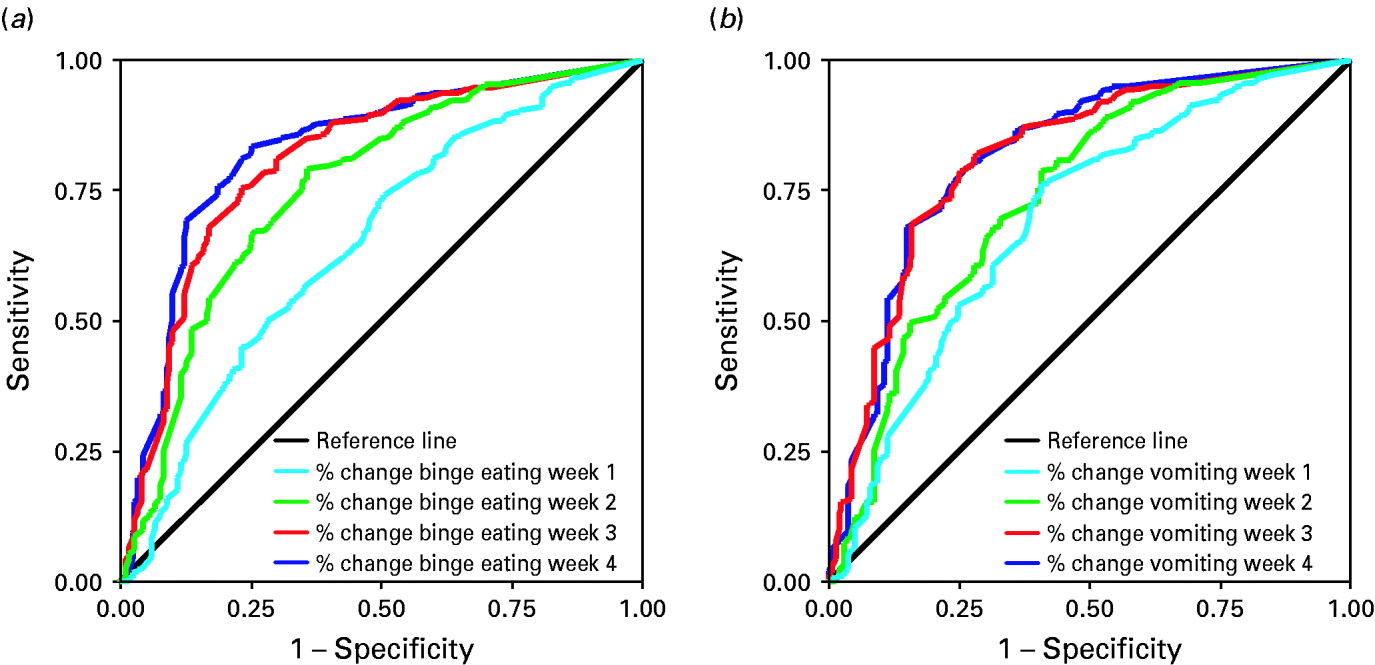
ROC curves predicted non-response at weeks 7 and 8 using the percentage change in binge eating or vomiting during the first 4 weeks of the study. Missing data are excluded from the fitting of ROC curves. At weeks 7 and 8, a total of 557 and 510 patients had data on binge eating frequency and vomiting respectively. A total of 375 patients (67.3%; n=108 placebo; n=74 fluoxetine 20 mg; n=193 fluoxetine 60 mg) failed to show a ⩾75% decrease in binge eating at weeks 7 and 8, and 348 (68.2%; n=100 placebo; n=56 fluoxetine 20 mg; n=192 fluoxetine 60 mg) were classified as non-responders for vomiting. Similar results were obtained when the ROC curves were fitted separately by treatment arms (placebo, fluoxetine 20 mg, or fluoxetine 60 mg), and by study (1992 or 1995). Data from the combined sample are presented in Fig. 1.
Receiver operating characteristic (ROC) curves predicting the failure to achieve a ⩾75% reduction in (a) binge eating or (b) vomiting by weeks 7 and 8 based on the change in symptoms from baseline during the first 4 weeks of treatment.

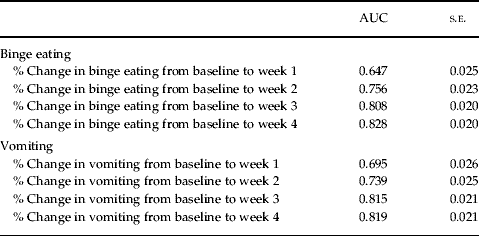
In the ROC analysis, the AUC indicates the accuracy of the prediction (Table 1). Starting with the week 3 data, the AUCs were in the excellent range (0.808 for binge eating, 0.815 for vomiting). Only the ROC curves constructed from data at week 4 had greater AUCs (0.828 for binge eating, 0.819 for vomiting), but these AUCs were still in the excellent range (Hosmer & Lemeshow, Reference Hosmer and Lemeshow2000), suggesting that the accuracy of the prediction from response at the fourth week of treatment was not substantially better. A large proportion of the patients who would fail to respond to medication by weeks 7 and 8 would be correctly classified by week 3. If medication was discontinued for patients who failed to demonstrate a reduction in binge eating of approximately 60% at week 3, our analyses indicate that 78% of patients who would have failed to respond to medication would be correctly identified (sensitivity), and 27.5% who would have responded to medication at weeks 7 and 8 would be misclassified as non-responders (1 – specificity). A similar pattern was observed for vomiting; with a cut-point of a decrease in vomiting of approximately 60% at week 3, 79% of the eventual non-responders would be correctly classified as failing to respond to fluoxetine and 26% of eventual responders would be misclassified as non-responders.
Areas under the curve for binge eating and vomiting at each week of treatment

AUC, Area under the curve; s.e., standard error.
Secondary analyses
Secondary ROC analyses predicting 50% and 100% reduction in binge eating and vomiting at week 8 found similar results to the analyses using 75% response. Specifically, the AUCs for week 3 were in the acceptable range when predicting a 100% reduction in binge eating (0.778), and in the excellent range when predicting a 50% reduction in binge eating (0.819) or vomiting (0.819), or a 100% response for vomiting (0.824). Exploratory analyses using the method of Obuchowski (Reference Obuchowski2006) for a continuous outcome for binge eating and vomiting did not produce more accurate predictions than the dichotomous indicator of response or non-response based on a 75% reduction in bulimic symptoms. The Poisson model, which included additional predictors, produced an ROC curve with an AUC slightly better than the AUCs for the percentage change in binge eating or vomiting at the first or second week of treatment, and similar to AUCs observed for change in binge eating or vomiting at the third or fourth weeks of treatment. A subset of patients had data on binge eating (n=327) and vomiting (n=304) at weeks 15 and 16. The ROC curves for the longer-term response identified week 3 as the most accurate in predicting non-response (AUC=0.763 for binge eating, 0.757 for vomiting). A cut-point of approximately 60% at week 3 would identify 69% and 68% of the eventual non-responders for binge eating and vomiting respectively, and 28% and 30% of eventual responders would be misclassified as non-responders respectively.
Discussion
The aim of the current study was to evaluate whether clinically useful guidelines could be developed to predict eventual non-response to fluoxetine on the basis of response during the first several weeks of treatment using the largest extant sample of patients with BN (Fluoxetine Bulimia Nervosa Collaborative Study Group, 1992; Goldstein et al. Reference Goldstein, Wilson, Thompson, Potvin and Rampey1995). The results suggest that a majority of patients with BN who will not respond to fluoxetine can be identified early in treatment, specifically by the third week. At week 3, if fluoxetine was discontinued for patients who demonstrated less than a 60% reduction in binge eating, approximately 73% would be correctly classified as eventual non-responders to fluoxetine and 23% of patients who would eventually respond to fluoxetine would be misclassified as non-responders. For patients with less than a 60% decrease in vomiting at week 3, approximately 72% would be correctly classified as non-responders and 22% would be misclassified.
These data, in combination with the findings of our previous research (Walsh et al. Reference Walsh, Sysko and Parides2006), suggest that eventual antidepressant treatment response in BN can be reasonably predicted from change in symptoms during the first several weeks of treatment. Furthermore, these results are consistent with studies of CBT in randomized controlled trials of adults with BN (NICE, 2004). Studies by Wilson et al. (Reference Wilson, Loeb, Walsh, Labouvie, Petkova, Liu and Waternaux1999, Reference Wilson, Fairburn, Agras, Walsh and Kraemer2002) suggest that response to CBT in BN begins in the first few weeks after the initiation of treatment, and early response to CBT is also predictive of longer-term outcome (Fairburn et al. Reference Fairburn, Agras, Walsh, Wilson and Stice2004). However, although early response is a reliably observed predictor of response to psychological and pharmacological treatments for patients with BN, the mechanisms of this phenomenon are not known.
The results of the current study also suggest applications for the clinical treatment of BN. Some patients with BN may be reluctant to take a medication (Wilson & Fairburn, Reference Wilson, Fairburn, Nathan and Gorman2007) but might be willing to consider a brief trial of fluoxetine to evaluate whether they are likely to eventually respond to antidepressant treatment. The ability to make rapid adjustments to the course of treatment if a patient does not experience a 50% reduction in symptoms by the third week might improve treatment efficacy and compliance. Although approximately 20% of non-responders are misclassified at week 3 using the 50% criterion, clinicians might still consider switching to another medication treatment or CBT at week 3 to evaluate whether a different intervention might provide greater symptom relief.
There are several limitations to the current study, including the use of retrospective analyses, and the use of criterion for response was based on data from a self-report daily diary and not an interview. In addition, as the analyses examined non-response only during acute treatment and not over a follow-up period, the findings may not generalize over longer periods of time or following the discontinuation of fluoxetine. Finally, this study focused on patients reporting vomiting as their primary means of compensation, and the results may be different for individuals with BN using other types of purging behaviors (e.g. laxatives). Strengths of the current study include the sample size, the consistency of the findings regardless of the cut-point or end-point (7–8 weeks v. 15–16 weeks) used for eventual response, and the examination of response to fluoxetine, the only medication currently approved by the FDA for the treatment of BN.
In summary, this study focused on early response to fluoxetine among patients with BN. By the third week of treatment, the majority of patients who will eventually fail to respond to fluoxetine can be identified with reasonable accuracy, and the medication can be discontinued for individuals who have not experienced a ⩾60% reduction in bulimic symptoms. As no reliable relationships between pretreatment characteristics and eventual response to pharmacotherapy have been identified, early response is one of the only available indicators to guide clinical management.
Acknowledgments
We acknowledge the assistance of Eli Lilly and Company, and Dr C. M. Beasley Jr., in particular, for generously providing the data presented here. This work was funded, in part, by the Rahr Eating Disorder Research Project Fund.
Declaration of Interest
Dr Sysko is supported, in part, by 5T32MH015144 from the National Institutes of Health. In the past two years, Dr Walsh received research support from Abbott Laboratories and AstraZeneca and Dr Duan received research support from Pfizer Pharmaceuticals. Dr Sysko reports holding stock in Pfizer Pharmaceuticals.