I. INTRODUCTION
During the past decade, the technology of phased arrays has taken up a great demand. When it comes to mobile participants, high gain paired with a steerable antenna beam is of great value. Thus, there is a demand for tunable microwave components such as phase shifters, which can be realized by different technologies such as micro electro mechanical systems (MEMS) [Reference Yamane, Yamamoto, Urayama, Yamashita, Toshiyoshi and Kawasaki1, Reference Xiaoyu, Toyoda and Ueda2] or monolithic microwave integrated circuit (MMIC) [Reference Lee3]. Another option is tunable dielectrics such as ferroelectrics [Reference Kozyrev, Osadchy, Pavlov and Sengupta4, Reference Nikfalazar5] and liquid crystal (LC) [Reference Dolfi, Labeyrie, Joffre and Huignard6, Reference Weil, Muller, Scheele, Best, Lussem and Jakoby7]. LC has been in the focus of microwave engineers of more than 20 years [Reference Dolfi, Labeyrie, Joffre and Huignard6]. Since then, its dielectric anisotropy has been increased for usage in microwave components while decreasing the dielectric loss significantly [Reference Weil, Muller, Scheele, Best, Lussem and Jakoby7]. Besides the material improvements, a lot of continuous tunable components such as varactors [Reference Goelden, Gaebler, Mueller, Lapanik, Haase and Jakoby8], phase shifters [Reference Dolfi, Labeyrie, Joffre and Huignard6], and polarizers [Reference Strunck, Karabey, Gaebler and Jakoby9] with LC have been investigated.
Components using LC provides several challenges. The LC is a liquid, which needs to be sealed into a proper reservoir. Also, a biasing structure is integrated into the structure, so the LC can be steered through an electric field. Both challenges can be solved using the low-temperature co-fired ceramic (LTCC), which allows integration of microwave components, cavities, and DC biasing network, using a multilayer approach [Reference Wolff10]. Earlier work describes the LTCC-integrated tunable phase shifter with LC [Reference Gaebler11, Reference Sanadgol, Holzwarth and Kassner12]. As an improvement in the work done before, the work presented here aims toward improved tuning speed and a higher tunability of the transmission line phase shifters. The phase shifter is part of a 4 × 1 phased array antenna module, which is stackable to a larger array, and has been briefly introduced in [Reference Strunck, Karabey, Weickhmann, Gaebler and Jakoby13], where S-Parameters and switching time measurements are presented.
In this paper, we present a detailed view of the design and the characterization of the substrate-integrated waveguide (SIW)-LTCC phase shifter. The fundamentals of LC are briefly explained in Section II, advancing to the design of the phase shifter in Section III. Eventually, the measurement results of the temperature dependency as well as repeatability studies are shown in Section IV.
II. LIQUID CRYSTAL
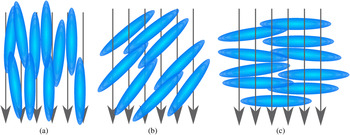
LC is a dielectric material, which has, in between the solid and liquid states, several mesomorphic phases [Reference de Gennes and Prost14]. The mesomorphic phase used here is the nematic phase. In the common liquid state, the material is isotropic, whereas in the nematic phase, the rod-shaped LC molecules have orientational order, which leads to an anisotropic behavior. Besides that the LC flows like a liquid and its orientation can be directed through an electric or magnetic field, where the LC aligns along the biasing-field vectors. The longer axis, which in this case has a higher permittivity, is named the parallel (‖, Fig. 1(a)) alignment, whereas the lower permittivities are called perpendicular (⊥, Fig. 1(c)). This allows for electromagnetic devices to tune the effective permittivity of a radio-frequency (RF) field as shown in Fig. 1. Using the transmission line approach, this is used to alter the propagation velocity of the wave to get relative phase differences between phase shifters.
LC molecule and the effective permittivities for the RF-field vectors.

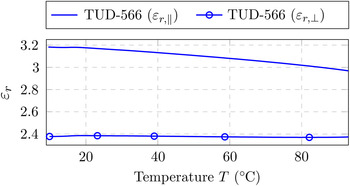
The LC mixture TUD-566 is used in this project and has permittivity values of ε r,‖ ≈ 3.11 and ε r,⊥ ≈ 2.32 at 30 GHz. The corresponding dielectric losses are tanδ ‖ = 0.0021 and tanδ ⊥ = 0.0066 at room temperature. The temperature dependency of TUD-566 is shown in Fig. 2. The clearing point at which TUD-566 becomes isotropic is approximately 115°C.
Relative dielectric constant over temperature of the LC mixture TUD-566.

In many applications as found in the LC-display technology [Reference Yang and Wu15, Reference Karabey, Gaebler, Strunck and Jakoby16], the LCs default orientation is parallel to the surface with metallization such as the ground plane or microstrip lines. When a voltage is applied across the ground and signal electrodes of the microstrip line, the LC changes its orientation toward a parallel orientation with respect to the RF field. When the voltage is turned off, the LC returns to the initial state. The tuned alignment depends on the voltage level, because equilibrium is found between the torque introduced by the biasing field and the elastic force between the LC molecules. For this approach, the LC molecules are to be anchored to the surfaces to ensure the realignment to the default state. In this work, however, the prealignment is omitted and an electric biasing field is used to steer the LC molecules to any direction. Therefore, only the direction of the biasing field is important, whereas the tuning speed of the LC is dependent on the LC viscosity and the applied biasing field strength. This allows for faster tuning, because the realignment does not depend only on the LC material parameters.
III. PHASE SHIFTER
A) Design
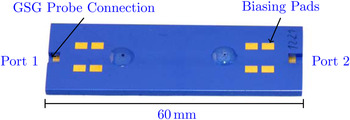
A photograph of the phase shifter is shown in Fig. 3. The LTCC-material is CT707 from W.C. Heraeus GmbH with a relative dielectric constant ε r of 7.1 and tanδ of 0.004. The phase shifter is an SIW with a buried cavity for the LC. The LC is used as a tunable dielectric to adjust the propagation velocity of the traveling wave. A characterization of a typical LTCC-SIW is shown in [Reference Li, Hong, Cui, Wu, Zhang and Yan17].
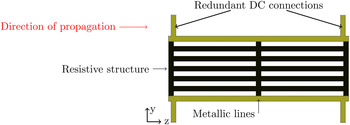
Schematic drawings of the resistive layers between the electrodes with metal electrodes left and right of the resistive layer.

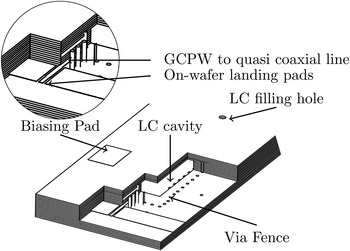
Besides the electromagnetic requirements, the LTCC has some design rules. Figure 4 shows the multilayer setup. The SIW is made up of two metallization layers for the top and bottom electric walls and via fences for the side walls to connect the layers. The distance between the vias is chosen as the minimum distance available in the given technological process to ensure good electrical shielding. A buried cavity for the LC is in this SIW. As a biasing network for the LC, the floor and the ceiling of the cavity are covered with a line structure of resistive paste with a square resistance of R s = 1 MΩ. The high resistivity is chosen to avoid unwanted coupling of the RF-waveguide mode into microstrip modes.
Wire drawing of the transition part of the phase shifter test module.

For characterization “on wafer Ground-Signal-Ground (GSG) probes” are used. Therefore, transitions from grounded coplanar waveguide (GCPW) to stripline and further to the SIW have been designed. The stripline leads into the SIW through a magnetic coupling via as reported in [Reference Yau, Huang, Shen, Chien and Wu18].
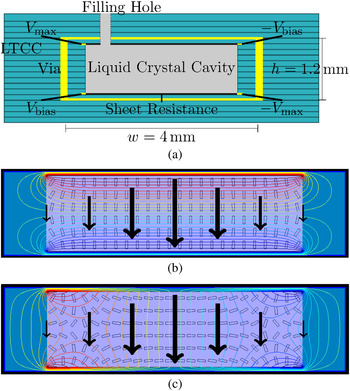
The cross-section of the phase shifter is shown in Fig. 5(a). One more layer of LTCC has been included in between the upper and lower waveguide boundaries and the cavity. This gives a total stack of ten LTCC layers with a total height of 1.2 mm and a width of 4 mm. Even with the high effective permittivity of the LC, modes of higher order will not propagate in the waveguide. The phase shifter prototype in Fig. 6 has been simulated and optimized using CST Microwave Studio®. The LTCC integrated structures need to be simulated with a three-dimensional simulation tool, due to its inhomogeneous layout.
Cross-section of the phase shifter with DC biasing field distributions and TE10-mode.

Photograph of the phase shifter module with ground-signal-ground (GSG) probe connections.

The filling hole has a diameter of 0.5 mm. When filling the cavity with LC, a cone is glued on top of the hole and filled with LC. The module is put into a vacuum bell jar with an air pressure of approximately 0.1 Pa, so the LC can fumigate and the air in the cavity evacuates through the LC reservoir. Eventually, when returning the air back into the vacuum bell jar, the LC is pushed into the cavity. The air bubble free filling is verified with an acoustic discharge measurement.
B) Biasing scheme for the LC
The basic biasing scheme in the waveguide cross-section is shown in Fig. 5(a). An electrostatic field, similar to that of a parallel plate capacitor, is induced, when V bias = V max, which can be any voltage level that is sufficiently high to align the LC in the desired timeframe. This forces the LC molecules to align in parallel to the RF-field vectors of the TE10-mode as seen in Fig. 5(b). If V bias = −V max, a current flow is induced in the resistive layers and a voltage drop is achieved. This enables the perpendicular alignment as shown in Fig. 5(c). All intermediate levels with −V max ≤ V bias ≤ V max can be applied to steer the effective permittivity in the SIW to the desired value continuously. The phase shifter with its LC-filled part is simulated with an in house two-dimensional (2D) FDFD solver, which includes the orientation of the LC molecules [Reference Gaebler, Goelden, Karabey and Jakoby19]. With these results, an optimization of the biasing field for the LC orientation is possible. The obtained phase constants at 28 GHz are β ⊥ = 37.7°/mm and β ‖ = 47°/mm, which gives a differential phase constant Δβ = 9.3°/mm . This results in a minimum length for the phase shifter of 38.7 mm, when assuming the necessary 360° phase shift. The phase shifter length is chosen to be 50 mm.
The biasing takes place with a maximum of 400 V which results in a medium field strength of E min = 13.33 kV/m for the perpendicular alignment as shown in Fig. 5(c). The parallel alignment in Fig. 5(b) benefits from the rectangular structure of the SIW. Therefore, the medium field strength is E = 40 kV/m and the tuning into parallel alignment is faster as seen in Section IV.
Because of the ohmic losses within the resistive layers, heating occurs in the cavity. The self heating, which leads to a degredation in tunability, has been discussed in [Reference Strunck20]. In that paper, we have shown a phase shifter with a full resistive layer, which had a maximum power dissipation of 1.6 W which leads to a self-heating of the LC and therefore a reduction of phase shift over time. A layout for the resistive layers, which prevents excessive self heating, has been designed as shown in Fig. 3. Most of the power dissipation takes place when biasing the LC to the perpendicular alignment because of the current flow through the resistive layers. Three lines, each with a width of 0.2 mm form the resistivity value, whereas the comb-like structures help distributing the biasing potential along the whole waveguide. The values obtained from several prototypes are in the range from 10.8 to 16 MΩ. The huge variance in the resistivity values is due to uncertainties with the buried layers in the LTCC process [Reference Birol, Maeder, Jacq and Ryser21].
IV. MEASUREMENT RESULTS
The final modules were then filled with LC and characterized using the VNA 37397c from Anritsu. Besides the spectral characterization to investigate the transmission and reflection of the device, the switching times over temperature are measured with a continuous wave excitation. This allows for a better physical understanding of the device when looking at real-life scenarios.
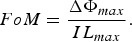
To compare different passive phase shifter technologies, a frequency-dependent figure of merit (FoM) as defined in [Reference Koul and Bhat22] has been used:
 $$FoM=\displaystyle{{\Delta {\Phi _{max}}} \over {I{L_{max}}}}.$$
The FoM values for the phase shifter are moderate but due to the high perpendicular losses and the LTCC-substrate not in the region of other LC-phase shifters, which reach an FoM of more than 100°/dB (see Table 1).
Comparison of recent electrically tunable liquid crystal phase shifters.

A) Temperature dependencies
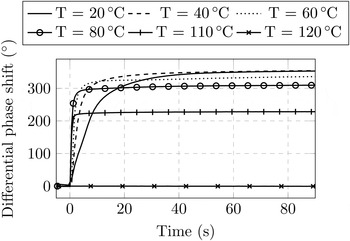
The temperature dependency of the LC (shown in Fig. 2) also influences the maximum differential phase shift. The investigation has been carried out with a hot plate to increase the ambient temperature step by step. This gives, as seen in Fig. 7, the maximum phase shift as well as the switching time, which decreases due to a lower viscosity of the LC when heating up. The clearing point of the LC is 115°C, so the 120°C curve shows a non-tunable system behavior. When looking at the characteristics shown in Fig. 2, the results are in good agreement with the material characteristics. The differential phase shift drops from the initial 360° at room temperature to about 310° at 80°C.
Differential phase shift over time with different ambient temperature values up to the clearing point of the LC at 28 GHz with V bias switched between −200 and 200 V.

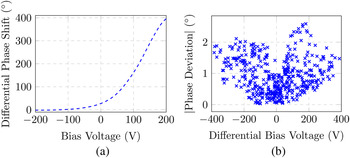
As one can see in the voltage to phase shift characteristic (Fig. 8(a)), the maximum differential phase shift dropped from 400° to about 360°. This is because of leakage due to expansion of the LC after heating up. Nevertheless, the effect on the differential phase shift after increasing the temperature is still valid, especially when looking at difference.
Voltage to differential phase shift and Monte Carlo measurement.

B) Voltage to differential phase shift
The characterization of the differential phase shift over the applied biasing voltage V bias is essential for the operation of the phase shifter. These curves are obtained by applying a voltage V bias and after a settling time of 10 min, the S-parameters are recorded. The graph in Fig. 8(a) shows the curve for 28 GHz. The result lead to a Δβ meas = 7.9°/mm, which is less than the value of Δβ sim = 9.3°/mm obtained through the previously mentioned 2D mode calculation. There are several reasons for that. The biasing scheme from the 2D simulation does not take the line structure from Fig. 3 into account. Since the LTCC is sintered under pressure, the cavity is reduced in height, especially in the middle, which can lead to a waveguide with less height and therefore less LC.
The measurement based on the Monte Carlo method show a repeatability study, which for the first time, shows the reliability of an LC phase shifter. During these measurements, a random biasing voltage is applied to the biasing network. The measurement is taken as the correct characteristic for this study. The S-parameters are either recorded after a maximum time of 5 min or if the results are within a predefined phase of 3°. The graph in Fig. 8(b) shows the measurement results. It shows clearly that the phase deviation is increased with higher differential bias voltage and the overall deviation is reduced for smaller changes. These measurements were taken in a temperature controlled environment at room temperature.
V. CONCLUSION
A phase shifter for beam-tracking applications has been implemented and analyzed intensively. The embedded SIW transmission line phase shifter provides a differential phase shift of 400° at 28 GHz. The integration level of LTCC allows an easy implementation of cavities for the LC along with all the lines required to build easily implementable phased arrays. The analog steering gives a high repeatability regarding the phase shift with an absolute error margin of maximum 3°.
Because of the tuning time the phase shifter is mostly suited for array applications, which do not go for space division multiple accesses but rather for slowly adjusting the direction of the main lobe. Investigations as in [Reference Fritzsch, Strunck, Bildik and Jakoby27] of arrays with slow phase shifters show, that the steering can be about three times faster than the single phase shifter. The LC has a temperature dependency, which needs to be considered when designing a phased array. This behavior can either be countered using a temperature measurement to include into the voltage selection or the implementation of a full control loop using phase measurement.
ACKNOWLEDGEMENTS
This work was supported by DLR (German Aerospace Center Space Administration) research Grant number FKZ 50YB0921 (Liquida 2). The authors acknowledge the company CST AG, Darmstadt, Germany for providing their simulation software.
 Sebastian Strunck received his Dipl.-Ing. (BA) degree in Electrical Engineering from the University of Cooperative Education in Mannheim, Germany, in cooperation with Continental Teves in 2007. In 2009, he received his M.Sc. degree in Information Technology from the University of Applied Science in Mannheim, Germany. He is currently working in the Institute of Microwaves and Photonics (IMP) of the Technische Universitaet Darmstadt, Germany, as a Research Assistant. His current research is directed toward waveguiding components, such as phase shifters and polarizers, based on liquid crystal as a tunable dielectric to perform manipulations of the transmission properties of the rf-field.
 Alexander Gaebler was born in Cottbus, Germany, in 1977. He received his Dipl. Ing. degree in Electrical Engineering and B.S. degree in Information and Media Technique from the Brandenburgische Technische Universitaet Cottbus, Cottbus, Germany in 2005 and 2006, respectively. He finished his Ph.D. degree in 2013.
 Onur H. Karabey received his B.S. degree from the Middle East Technical University, Ankara, Turkey, in 2006, and the M.Sc. and Ph.D. degrees from the Technische Universitaet Darmstadt, Darmstadt, Germany, in 2008 and 2013, respectively, all in Electrical and Electronics Engineering. His current research is focused on broadband material characterization for microwaves and design of tunable passive microwave components, as well as reconfigurable antennas based on tunable dielectrics. Dr. Karabey was the recipient of the New Idea Prize of the Technische Universitaet Darmstadt in 2011 and the VDE ITG literature prize 2013. He is also one of the recipients of IEEE Leopold B. Felsen Award for Excellence in Electromagnetics in 2013, which is given by Dogus University (Istanbul) and Leopold B. Felsen Fund (Boston).
 Andreas Heunisch studied Materials Science and Engineering at the Friedrich-Alexander-University Erlangen-Nuremberg and received his Dipl.-Ing. in 2009. Since 2010, he has been working as a Research Assistant at the Federal Institute for Materials Research and Testing (BAM), Division Advanced Technical Ceramics, Berlin, Germany. His current research focuses on the implementation of embedded cavities in low temperature co-fired ceramic multilayer and non-destructing testing methods for ceramic multilayer devices.
 Baerbel Schulz received her diploma degree in Materials Engineering from the University of Architecture and Building in Weimar, Germany, in 1982. From 1982 to 1991 she worked as a Research Assistant in the field metal/ceramic packages at the factory for television electronics in Berlin, Germany. Since 1993 she has been a Research Assistant at the Federal Institute for Materials Research and Testing in Berlin, where she works on the production of laminated composites in LTCC multilayer technology and the material parameter identification. In various projects, ceramic multilayer modules were developed for LTCC-applications, such as strain gauges for micro sensors or bioceramic membrane adsorbers.
 Torsten Rabe was born in Fuerstenberg, Germany, in 1957. He received his Dipl.-Ing. and Ph.D. degrees in Material Science at Bauhaus University in Weimar/Germany, in 1980 and 1983, respectively. In 1983, he joined Division Ceramic Materials at Academy of Sciences in Berlin. Since 1991, he has been working in the Division Advanced Technical Ceramics at the German Federal Institute for Materials Research and Testing (BAM). He is the head of the laboratory Functional Ceramics and Multilayer Technology. The main focus of his research activities is material development (LTCC and HTCC), tape casting, multilayer technology, brazing of ceramic materials, and non-destructive testing of green and sintered ceramic components.
 Ruediger Follmann studied Electrical Engineering at the RWTH Aachen, Germany. In 1994, he joined IMST, where he worked on non-linear device characterization and modeling. After receiving his Ph.D. in 1998 from the University Duisburg, Germany, he became head of the section MMIC design at the IMST, where he developed several sensor and radar components. Since 2002, he has been head of the section RF components. The main focus of the section is set to integrated high-frequency components and chip sets based upon different material systems. Since 2012, Dr. Follmann has been the “Director Integrated Solutions”.
 Juergen Kassner received his diploma degree in Electrical Engineering from the University of Ulm, in 1996. From 1996 to 1999, he was a Research Assistant at the University of Ulm in the Division of Microwave Techniques. There he worked in the area of interconnects and packaging on multi-layer LTCC. He was given the Dr.-Ing. degree from the University of Ulm, in 2000. In 1999, he joined the IMST GmbH in Kamp-Lintfort, Germany. Since then he has been working in the subdivision of RF Modules in the RF Circuits and Systems Department. His respective design activities cover 2D- and 3D-circuit development in the mm-wave frequency range. He is engaged in research activities for power distribution networks for antennas, waveguide interconnects, and communication systems. His areas of interest are ceramics multi-layer substrates, active and passive circuit design, mm-wave interconnects, and system aspects.
 Dietmar Koether received his Electrical Engineering degree (M.S.) from the University Duisburg in 1984, where he also received the Ph.D. degree in 1989. Since 1993, he has been with IMST GmbH. From 1996 to 2011, he was head of the section “RF Test Centre”, which operates an ISO/IEC 17025 certified laboratory. Main focus of this laboratory is still the characterization of components and circuits as well as production of subsystems for space flights. From 2011 until now, he is the Director Integration and Test responsible for industrial and space-related systems and subsystems. Since 2005, he has also been the Chairman of the VDE (German Association for Electrical, Electronic and Information Technologies) ITG (Information Technology Society) chapter 9.1 “Measurement procedures for information techniques”.
 Atsutaka Manabe received his Masters degree in Applied Physics from the University of Tokyo, Japan. Since 1998, he has been working in Liquid Crystal Research Physical Division at Merck KGaA, Germany. His research area covers establishing mixture design concept and reliability improvements for TVs, monitors, mobile phones as well as front- and rear-projectors. Since 2006, he has been engaged as a project leader in liquid crystal development for microwave application such as phased array- and reflect array antennas.
 Rolf Jakoby received his Dipl.-Ing and Dr.-Ing. degrees in Electrical Engineering from the University of Siegen, Germany, in 1985 and 1990, respectively. In January 1991, he joined the Research Center of Deutsche Telekom in Darmstadt, Germany. Since April 1997, he has been a full professorship at TU Darmstadt, Germany. His interdisciplinary research is focused on RFID, micro- and millimeter wave detectors and sensors for various applications, and in particular on reconfigurable RF passive devices using novel approaches with metamaterial structures, liquid crystal, and ferroelectric thick/thin-film technologies. He is an Editor-in-Chief of FREQUENZ. He has been a Chairman of the European Microwave Conference 2007 and the German Microwave Conference 2011. In 1992, he received an award from the CCI Siegen and in 1997, the ITG-Prize for an excellent publication in the IEEE AP Transactions. He owns 9 patents and has received 11 awards in the last 6 years.