Introduction
In July 2019 the Polish city of Białystok held its first ever Equality Parade. What was meant to be a public demonstration of support for sexual diversity quickly descended into violence, with thousands of far-right protestors throwing rocks and bottles at the marchers, while chanting “God, honour and motherland”.Footnote 1 The attackers’ appeals to religion and the nation chimed with public proclamations by representatives of the Polish Catholic Church and the ruling Law and Justice Party (Prawo i Sprawiedliwość or PiS): on the day of the march, Białystok’s Archbishop Tadeusz Wojda called upon the city’s residents to defend Christian values by attending a family picnic in one of the city parks, while, in the run-up to the European Parliament elections a few months earlier, Jarosław Kaczyński, the leader of the populist PiS party, referred to the LGBT rights movement as “a foreign import that threatens the Polish nation”.Footnote 2 Kaczyński’s statement is indicative of the centrality of nationalism in Polish debates about the position of LGBTFootnote 3 individuals in Poland, where nationalism is understood to refer to “the cultural idea of the nation as one’s primary identity, and a moral idea of justification of action to protect the rights of the nation against the other” [Barrington Reference Barrington1997: 713]. While opposition to LGBT rights among Poles has lessened in recent years, it is still among the highest in the EU.Footnote 4 The aim of this article is therefore to explain prejudice towards homosexuals among Poles with reference to the belief that gays and lesbians pose a threat to the nation.
Our paper builds on previous research which shows how discourse constructing homosexuality as a threat to the nation and its national identity has been used to legitimize homophobic rhetoric and behaviour [Mole Reference Mole2011, Reference Mole, Slootmaeckers, Touquet and Vermeersch P.2016]. However, such research does not show whether nationalism predicts homophobia at the level of individual beliefs.Footnote 5 While our study is not the first to seek to explain homophobia with reference to nationalism, we argue that the latter concept is too broad to explain why attitudes towards gays and lesbians should be related to people’s beliefs about their nation. We also argue that not all positive beliefs about a nation are related to homophobia. To say that an individual is “nationalist” can mean a host of different things depending on the context. Drawing on research in social psychology, we therefore seek to provide greater nuance by differentiating between “national in-group satisfaction” and “national collective narcissism”. We explain the distinction below.
National in-group satisfaction is the belief that membership of the nation is valuable and a source of pride and satisfaction. It is associated with high self-esteem, pro-sociality and intergroup tolerance. In other words, the nation and its achievements make members of the nation feel good about themselves; they have an inclusive attitude towards minorities within the nation as well as a co-operative approach in international relations [Golec de Zavala, Dyduch-Hazar and Lantos, Reference Golec de Zavala, Dyduch-Hazar and Lantos2019; Golec de Zavala and Lantos Reference Golec de Zavala and Lantos2020]. In the context of populist Poland, however, we argue that the dominant nationalist discourse is best captured by the concept of “national collective narcissism”, a concept introduced by Fromm [Reference Fromm1964] and Adorno [Reference Adorno1997] as narcissism elevated to the level of the group. In more contemporary work it is defined as the “belief that one’s own group (the in-group) is exceptional and entitled to privileged treatment but it is not sufficiently recognized by others” [Golec de Zavala, Dyduch-Hazar and Lantos Reference Golec de Zavala, Dyduch-Hazar and Lantos2019: 37; see also Cichocka and Cisłak Reference Cichocka and Cislak2020; Federico, Golec de Zavala and Baran Reference Federico, Golec de Zavala and Baran2021].Footnote 6 We suggest that this distinction will provide sociologists of nationalism with greater nuance in their understanding of the different contents that nationalist discourse can have and their different associations with attitudes towards minorities.
In addition, while there exists a rich sociological literature on nation formation and reproduction [Gellner Reference Gellner1983; Anderson Reference Anderson1983; Smith Reference Smith1986; Brubaker and Cooper Reference Brubaker and Cooper2000; Fox and Miller-Idriss Reference Fox and Miller-Idriss2002], these works are less successful at explaining the co-existence of different nationalistic beliefs at the level of the individual. We hope that our research can help advance research on societal processes through which some of those beliefs become dominant and define the discourse about the national identity at a given time.
In the first part of the article we present the social and historical context of our case study, analysing the upsurge in nationalism in the early post-communist years and the rise of populism in the new millennium, highlighting how the merging of the two ideologies resulted in the dominant definition of nationalism in Poland taking the form of national collective narcissism. We then discuss the ways in which different actors sought to attach specific meaning to non-normative sexualities, before analysing the perceived relationship between nationality and homosexuality in a bid to explain theoretically why nationalists tend to exhibit high levels of hostility towards sexual minorities. Following the presentation of our methodology, we set out and then discuss the results of the studies and draw overall conclusions.
Case Study: Homophobia in Post-Communist Poland
When examining non-normative sexualities in specific geographical contexts, it is important to remember that the meaning attached to sexuality is culturally and historically contingent. As Jeffrey Weeks explains, “homosexuality, like all forms of sexuality, has different meanings in different cultures—so much so that it becomes difficult to find any common essence which links the different ways it is lived” [Reference Weeks, Schmitt and Sofer1992: xi]. Homosexuality in Poland thus has its own history, its own meanings, its own culture and its own language. Space prevents us from analysing the latter in detail but we recommend further reading in the footnote.Footnote 7 For the purpose of our argument, we will limit the analysis below to the politicisation of homophobia after 1989.
Poland was unique in the communist bloc in having never criminalized homosexuality.Footnote 8 Nevertheless, same-sex relations were presented by the regime as “a symptom of ‘Western depravity’” and as inconsistent with “socialist morality” [Kliszyński Reference Kliszyński and Flam2001: 161], with the Civic Militia and Security Services often keeping tabs on gay men with a view to using their homosexuality “as a means of recruitment or blackmail” [Tomasik Reference Tomasik2012: 20]. Following the collapse of communism in 1989, life for LGBT Poles certainly improved. They had less to fear from the state, and gay and lesbian venues opened throughout the country—at least in the larger cities. However, the long-hoped-for liberation for LGBT Poles soon came into conflict with attempts to redefine Polish identity after 50 years of communist rule.
Poland went through a period of massive upheaval and uncertainty in the 1990s. Not only did the Soviet-style economic system need to be dismantled and new, democratic political institutions rebuilt from scratch but a new cognitive framework had to be found through which citizens could make sense of the world around them and guide their decisions about whom to trust and with whom to co-operate. In this context, nationalism provided Poles with a sense of cohesion and stability in that it offered a credible explanation of the past and a guide for the present and the future. (It should be noted that this was true of many other post-communist societies; see Mole Reference Mole2011.) In many ways, it was the past that served as the guide for the present and the future. In rejecting the despised communist era, Polish political elites harked back to the inter-war Second Republic and its traditional norms and values. As this period was held up as the opposite of the abnormal communist era, traditional was equated with normal, with traditional gender and sexual roles seen as “an important aspect of the nostalgia for ‘normality’” [Watson Reference Watson1993: 472-473]. However, what was seen as “normal” was defined strictly in national, Catholic and heterosexual terms. In the Polish context, the three concepts are largely understood as indivisible: to be Polish is to be Catholic and heterosexual. In the search for stability, any form of diversity can seem threatening [Inglehart and Baker Reference Inglehart and Baker2000: 28]. In Central and Eastern Europe, there was thus a tendency among individuals disoriented by the social, economic and political upheaval to “cling to traditional gender roles and sexual norms, and emphasize absolute rules and familiar norms in an attempt to maximize predictability in an uncertain world” [Ibid.]. The framing of non-normative sexualities and gender identities as a threat to the Polish nation was thus evident from the early post-communist period and remained a key discursive trope among church leaders and nationalist politicians over the decades that followed.
Having acted as the de facto political opposition to the Communist Party throughout the period of state socialism, the Polish Catholic Church acquired even greater legitimacy and political power after 1989, establishing its hegemony as the ultimate arbiter of national values, particularly with reference to issues of gender and sexuality. Far from restricting its views to the pulpit, the Catholic Church actively lobbied successive Polish governments in the 1990s to ensure that their position on issues relating to sexuality was in line with Catholic dogma. According to former MP Robert Biedroń, the Church succeeded, for example, in ensuring there was no reference to sexual orientation in the non-discrimination clause of the Polish Constitution [Selinger Reference Selinger2008: 25].
The safeguarding of traditional sexual and gender norms emerged as a major campaign issue in Polish politics following the country’s accession to the European Union in 2004. Given the latter’s introduction of various measures aimed at promoting the legal equality of sexual minorities, nationalist politicians in Poland constructed the EU as elitist and out-of-touch, with its more liberal position towards LGBT rights seen as a threat to traditional Polish values [Graff Reference Graff2010]. However, right-wing political actors not only sought to limit EU support for the promotion of LGBT rights in Poland; they also promoted “a new East to West evangelism”, seeking to “maintain and spread Catholic values via their return to Europe” [Ayoub Reference Ayoub2016: 171].Footnote 9 In his research, Ayoub demonstrates that “religion plays a role in moderating the effect of international LGBT norms, but only in contexts where it has become linked to the popular nation” [Ayoub Reference Ayoub2016: 162]. As we argue above, Poland is an example par excellence of the fusion of religion and nation. This relationship also helps to explain why homophobia is more pronounced in some Catholic countries of Eastern Europe, such as Lithuania, than others, such as Slovenia.
In the run-up to the 2005 parliamentary elections, nationalist parties used the issue of LGBT rights to construct an us-versus-them dichotomy between the “decadent West” and “traditional Poland”, the latter grounded in the true European values of Christian morality, with attitudes towards sexuality becoming “a reference point for political self-definition and national pride” [Graff Reference Graff2010: 584]. Following criticism from the European Parliament over its failure to respect the rights of its LGBT citizens [European Parliament 2007], it became a matter of sovereignty that Poland be allowed to criticize sexual minorities, with homophobia becoming “the new voice of patriotism” [Graff Reference Graff2010: 590]. Further research clarified that it is national collective narcissism, rather than patriotism, that is related to homophobia in Poland [Górska and Mikołajczak, Reference Górska, Mikołajczak, Stefaniak, Bilewicz and Winiewski2015].
The discursive trope of “homosexuality as a threat to the nation” became so hegemonic among opponents of same-sex rights in Poland by the late-1990s/mid-2000s that Polish activists were prompted into a strategic response, whereby they reframed support for LGBTQ equality from being a universal human rights and Europeanisation issue to “a more rooted politics of being Polish” [Ayoub and Chetaille Reference Ayoub and Chetaille2020: 22]. As Ayoub and Chetaille explain, “activists were inclined to use national symbols such as the Polish flag” in a bid to reclaim Polish national identity for sexual minorities, while the choice of “Love thy neighbour” as the theme of the 2007 Equality Parade in Warsaw was meant to resonate with Catholic values and “national identity and root the movement in the local context” [Ibid.: 33].
With reference to Warsaw’s relations with Brussels, the “pure Poles v. elitist EU” rhetoric employed by PiS politicians signalled the shift towards populism in the party’s political strategy. While it is a contested concept, populism is used here to refer to “a thin-centred ideology that considers society to be ultimately separated into two homogenous and antagonistic camps, ‘the pure people’ versus ‘the corrupt elite,’ and which argues that politics should be an expression of the volonté générale (general will) of the people” [Mudde and Rovira Kaltwasser Reference Mudde and Rovira Kaltwasser2017: 6]. As a thin ideology, populism is always “thickened” by being grafted onto other ideologies, so as to ensure that the political message appeals to the broadest-possible audience in the specific local context.
Populism appeals particularly to the left-behind, those who failed to benefit from the economic policies championed by neoliberal politicians or who feel disorientated by the rapid social and cultural change brought about by globalization [Inglehart and Norris Reference Inglehart and Norris2016]. Such economic, social and cultural change often results in a loss of status for members of previously advantaged groups and, at the same time, greater empowerment for women and sexual and ethnic minorities. Taken together, these processes undermine the sense of entitlement of formerly privileged individuals, which populists promise to restore “by offering backwardly oriented utopias and historical narratives that glorify traditional communities with ethnic, national and cultural homogeneity” [Salmela and von Scheve Reference Salmela and Scheve2017: 577]. To achieve this goal, populism in the Polish context is thickened with nativist nationalism, which “alludes to the notion that states should be inhabited exclusively by members of the native group (“the nation”) and that non-native (“alien”) elements are fundamentally threatening to the homogenous nation-state” [Mudde and Rovira Kaltwasser Reference Mudde and Rovira Kaltwasser2017: 34].
In contemporary Poland, the shift towards populism and the ensuing nativist redefinition of the nation have resulted in Polish nationalism harvesting national collective narcissism as a predominant narration about Polish national identity [Federico, Golec de Zavala and Baran, Reference Federico, Golec de Zavala and Baran2021; Golec de Zavala, Lantos and Keenan, Reference Golec de Zavala, Lantos, Keenan, Forgas, Crano and Fiedler2021]. According to psychological research, collective narcissists demand privilege for the nation, not equality, and invent enemies both inside and outside the national in-group, whom they blame for standing in the way of this privilege being achieved. Collective narcissism is linked to an exclusive and narrow definition of who can be a “true” member of the in-group, whereby national collective narcissists do not consider minorities as equally valued members of the nation but rather as a threat to its identity.
As shown in the introductory quote by Kaczynski, it is not just ethnic minorities that are considered to be a threat to the Polish nation and its identity but also LGBT individuals. Populist politicians in Poland use the supposed alien-ness of homosexuality and its association with Western values to portray LGBT people as disloyal enemies of the state. Even more vociferously, they have sought to portray homosexuals as a threat to the nation and its values [O’Dwyer and Vermeersch Reference O’Dwyer, Vermeersch, Slootmaeckers, Touquet H and Vermeersch2016]. So why do they see homosexuality as a threat to the nation? What is the mechanism through which nationalism fuels homophobia? To answer these questions, we must examine the theoretical literature on the relationship between the nation and homosexuality.
Homosexuality as a Threat to the NationFootnote 10
The first thing to make clear when discussing the relationship between the nation and homosexuality is that there is no a priori relationship between the nation and homosexuality. It is perfectly possible for individuals for whom membership of the nation is an important part of their self-definition to be fully accepting of gays and lesbians.Footnote 11 However, history has shown that those who understand the nation to be a natural phenomenon, growing out of extended kin groups, are more likely to support a patriarchal gender order and absolute rules on sexuality and are thus more likely to oppose homosexuality [Nagel Reference Nagel2000, Reference Nagel2003]. Right-wing populists inspired by national collective narcissism tend to adhere to this understanding of the nation. Our review of the existing theoretical literature identified four key threats that homosexuals are believed to pose to the nation: (i) they fail to contribute to its biological reproduction; (ii) they fail to contribute to its cultural reproduction; (iii) they fail to adhere to national stereotypes of masculinity and femininity; and (iv) they deviate from shared national norms, especially those derived from religious teaching.
The biological reproduction of the nation is maintained by means of the patriarchal family, underpinned by heteronormative and patriarchal conceptions of masculinity and femininity. The most important role that women can play in the nation is that of the mother, producing sons and daughters for the nation and inculcating in them the ethnic language and culture, while men act as defenders and decision-makers. As the focus on the biological reproduction of the nation presupposes it to be heterosexual, gays and lesbians—by not having children—undermine the idea of the nation as a unified collectivity with a communal future [Yuval-Davis Reference Yuval-Davis1996]. The construction of gay men as weak and effeminate and lesbians as strong and masculine confuses the patriarchal gender order and the public and private roles of men and women central to most ethno-national discourses [Nagel Reference Nagel1998].
To maintain a clear boundary and hierarchical relationship between the Self and Other, nationalism works to convey the idea of internal homogeneity through shared norms and values. In his seminal work on nationalism and sexuality, George Mosse shows how “nationalist ideologies which arose in late eighteenth and early nineteenth-century Europe were associated with attempts on the part of national bourgeoisies to create national collectivities in their own image. This image was grounded in a specific gender division of labour, sexual orientation and ethnicity which involved notions of respectability and appropriate sexual behavior” [Charles and Hintjens Reference Charles and Hintjens1998: 2]. Heterosexuality therefore became a taken-for-granted attribute of the nation and dominant group norm, against which actions and beliefs were judged.
Homosexuality is seen not just as deviating from but actually threatening the norms on which the nation is built. In terms of nation-building, the presence of gay men threatens the homosocial male bonding required to forge the nation and defend it militarily, while homosexuals are also perceived as not possessing the typically masculine virtues of “willpower, honour, courage” needed to inspire action in the name of the nation [Nagel Reference Nagel1998: 245; see also Slootmaeckers 2019]. As Mosse argues, the “ideal of masculinity […] as a symbol of personal and national regeneration” requires a countertype, an Other lacking in masculinity, against which the normative masculine ideal is strengthened and legitimized [Reference Mosse1996: 4]. These countertypes, of which homosexuals are a key group, do not just represent different types of masculinity but are constructed as “enemies”, whereby the “line between modern masculinity and its enemies had to be sharply drawn in order that manliness as the symbol of a healthy society might gain strength from this contrast” [Mosse Reference Mosse1996: 67-68].Footnote 12 Violence towards public manifestations of (what are perceived to be) the effeminacy and unmanliness of homosexual men is therefore legitimized with reference to their “enemy” status. Homosexuality is dangerous because it blurs the clearly defined and stoutly maintained “distinction between normality and abnormality” [Mozaīka Reference Mozaīka2007: 30], which, according to Mosse, has always “provided the mechanism that enforced control and ensured security” [Reference Mosse1985: 10].
In Poland, one of the powerful national norms is religious adherence, another factor explaining opposition to LGBT rights. Throughout the centuries the words of St Paul [Romans I: 26-28] have been used to condemn homosexuality. Indeed, the main branches of the Christian Church in Central and Eastern Europe have been vocal in their condemnation of non-heteronormative sexuality. The current position of the Catholic Church with respect to homosexuality is closely tied to procreation. Same-sex acts are considered sinful in that sexuality is presented as being “naturally ordered to the good of spouses and the generation and education of children” [Catechism of the Catholic Church 2353]. Homosexual acts thus “do not proceed from a genuine affective and sexual complementarity. Under no circumstances can they be approved” [Catechism of the Catholic Church 2357].
What the above analysis shows is that the continuity of the nation is believed to be ensured by means of endogenous biological reproduction, a myth that can be maintained only by naturalizing the patriarchal family and the associated public and private roles of men and women. Gays and lesbians are thought to threaten the national narrative by undermining the patriarchal family underpinning the national community, failing to contribute to its biological and cultural reproduction, failing to adhere to national stereotypes of masculinity and femininity, confusing the traditional public and private roles of men and women, and deviating from its shared norms, especially those derived from religious teaching.Footnote 13
Hypotheses, Data and Methods
Having identified the mechanism through which homosexuality is constructed as a threat to the nation, we now proceed to test the articulated relationship by formulating a hypothesis capturing our theory:
H1: National and Catholic collective narcissism (whereby the in-group is defined in national and Catholic terms) should predict higher levels of homophobia.
As our theoretical discussion showed that people who hold collective narcissistic beliefs about the nation oppose homosexuality because they believe gays and lesbians (i) fail to adhere to traditional group norms on appropriate masculinity and femininity, and (ii) threaten the biological and cultural reproduction of the nation, we developed a further hypothesis:
H2: National and Catholic collective narcissism should predict homophobia via the belief that gender roles should be grounded in traditional national and religious values, which in turn predict a tendency to uphold traditional beliefs in gender roles, which therefore engenders the belief that homosexuality is a threat to the nation. In other words, the relationship between national and Catholic collective narcissism and homophobia should be sequentially explained by three mediators: the belief that gender roles should be grounded in national and religious values; the tendency to uphold the traditional beliefs about gender roles; and the belief that homosexuality is a national threat.
To test these hypotheses, we carried out two studies. The first study sought to construct a model, establishing the predicted relationships between the variables, while the second sought to replicate it. For study 1, a representative sample of 543 Polish adults (56.2% female/43.8% male; M age = 30.46; SD age = 15.19; median age = 31) was recruited by the Ariadna online research panel.Footnote 14 As the aim of the research is to explain homophobic prejudice, only those participants who stated that they were heterosexual were included in the analyses.Footnote 15 A cumulative 20% of the sample reported themselves to be very conservative, conservative or somewhat conservative, with 38% of the sample placing themselves in the centre and the remaining 42% on the liberal end of the spectrum.
We utilized multiple techniques from the broad structural equation modelling framework as our empirical strategy. In the first step, we employed a graded response model from item response theory applications to improve the psychometric qualities of the measurements of all variables. This method treats the responses as ordinal categories and is instrumental in assessing the quality of individual items and the measurement as a whole. Next we used confirmatory factor analyses to identify the factors that correspond to the organizing latent variables, before turning to path analyses to test the hypotheses about the relationships between the variables. The Online Appendix elaborates on the psychometric qualities and the measurements models, and provides descriptive statistics of the full scales.
We used measurements corresponding to six psychological constructs. We used Catholic and National Collective Narcissism as our independent variables [Golec de Zavala et al., Reference Golec de Zavala, Cichocka, Eidelson and Jayawickreme2009; Golec de Zavala and Bierwiaczonek, Reference Golec de Zavala and Bierwiaczonek2020]. (National Collective Narcissism sample item: “If the Polish nation had a greater say in the world, the world would be a much better place.” Catholic Collective Narcissism sample item: “The Catholic Church deserves special treatment.”) As the separate National and Catholic Collective Narcissism scales were strongly positively correlated and made the same predictions, we merged the two into a higher-order scale and labelled it “National Collective Narcissism”. This improved the power of collective narcissism to predict homophobia. The outcome variable in the model that measured explicit prejudice against homosexuals is the refined and shortened version of the Modern Homonegativity scale for homosexual men developed by Morrison and Morrison [Reference Morrison and Morrison2002]. (Modern Homonegativity sample item: “Gay men should stop complaining about the way they are treated in society and simply get on with their lives.”)
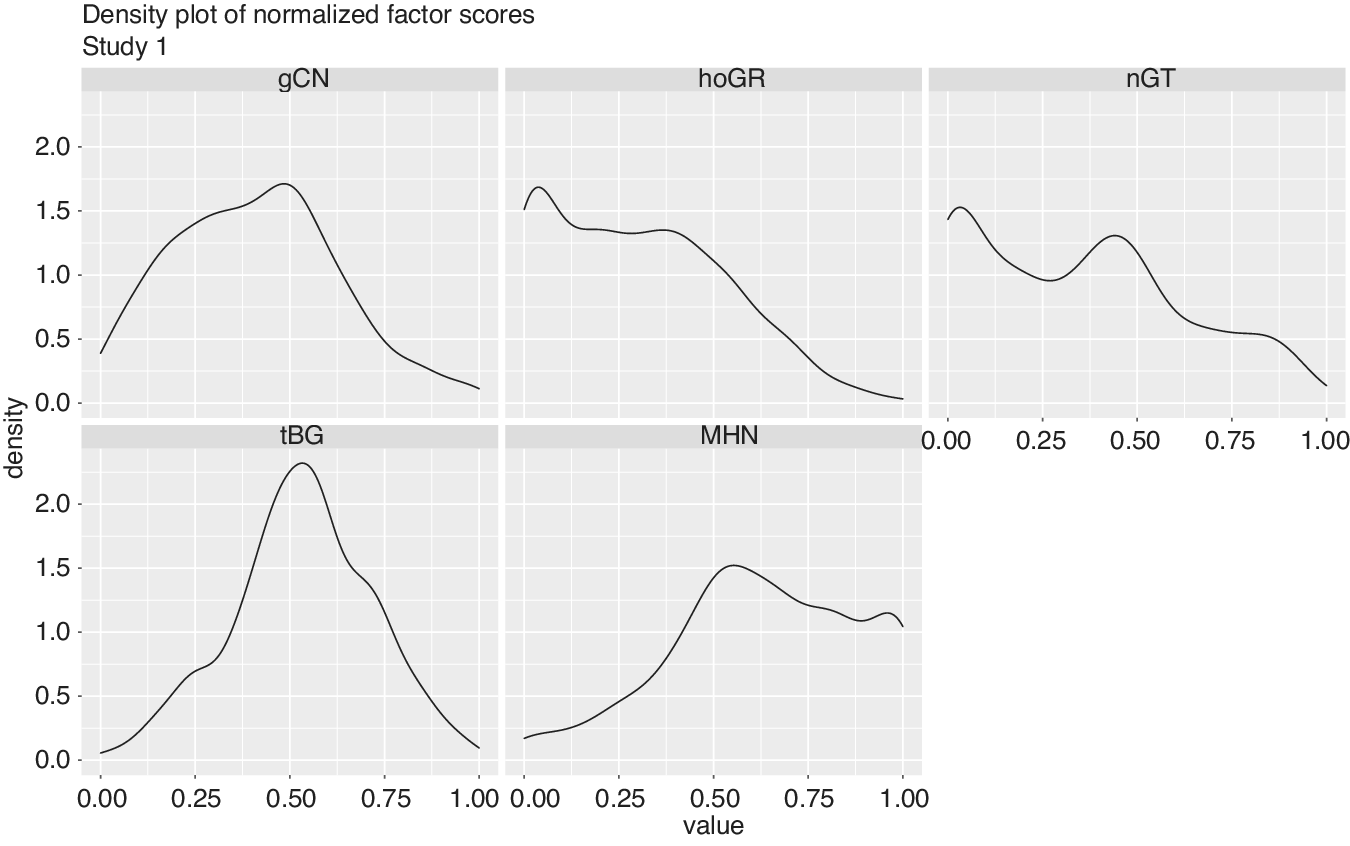
We hypothesize three constructs mediating the relationship between national collective narcissism and explicit prejudice against homosexuals. The first is another higher-order construct that merges the belief in religious and national values as bases for the definition of gender roles in Poland. We labelled this construct “Religious and National Beliefs about Gender Roles”. (Religious and National Beliefs about Gender Roles sample item: “Women should ‘respect themselves’ for the good of the nation.”) The second mediator reflects “Traditional Beliefs about Gender Roles”; here we used the scale by Dasgupta and Rivera [Reference Dasgupta and Rivera2006]. (Traditional Beliefs about Gender Roles sample item: “Men lose more than they gain from women’s emancipation.”) While the latter mediator defines traditional gender roles per se, the former specifies that gender roles are best defined by the nation and religion. The third mediator is the “Homosexuality as a National Threat” belief, which measures the perception that homosexuality is a threat to the reproduction of the Polish nation. (Homosexuality as a National Threat sample item: “By not having children, gays and lesbians threaten the continued existence of the nation.”) Table I displays the descriptive statistics of the psychological constructs and Figure I shows the distributions. Further information about the measurement instruments, item wordings, etc., can be found in the Online Appendix.Footnote 16
Density plot of normalized factor scores – Study 1

Descriptive statistics of constructs used in Study 1

All constructs are normalized factor scores. See Online Appendix for the measurement models and psychometric quality.
Ethical approval for the research was provided by the Research Ethics Committee of UCL [3596/002] and the Scientific Research Ethics Commission of the University of Social Sciences and Humanities, Warsaw [53/2018].
Study 1: Results
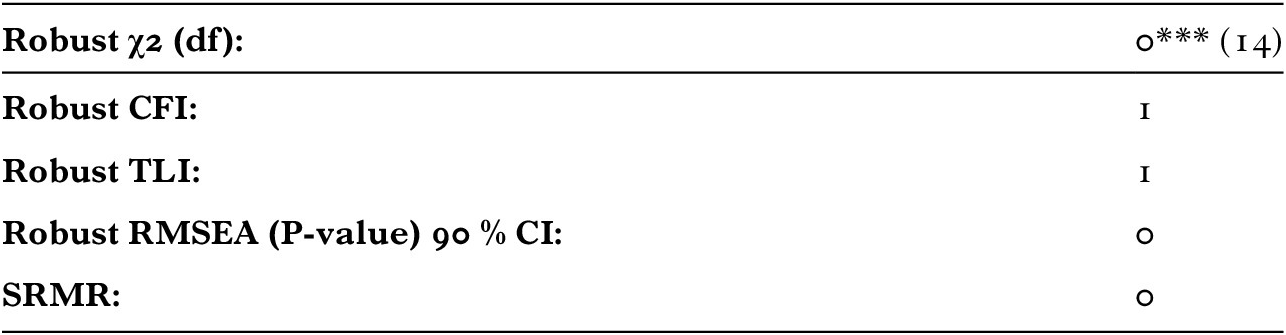
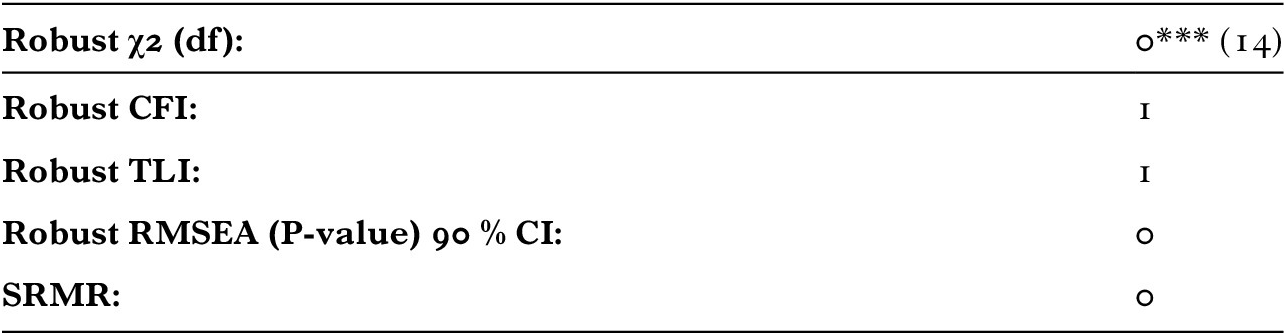
The first model evaluates whether “Religious and National Beliefs about Gender Roles”, “Traditional Beliefs about Gender Roles” and “Homosexuality as a National Threat” sequentially mediate the relationship between “National Collective Narcissism” and explicit prejudice towards homosexuals. All results are based on 10,000 times resampled data; bias-adjusted bootstrapped confidence intervals and all coefficients are provided in the tables that follow the path diagrams. Note that, since we use a fully saturated model to test serial mediation (paths present between all variables), goodness-of-fit statistics are perfect and should not be interpreted, except the R2, which is the explained variance. Table II shows the goodness-of-fit statistics for the path model in Study 1.
Goodness-of-fit statistics for path model Study 1

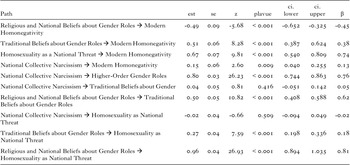
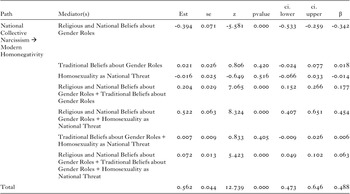
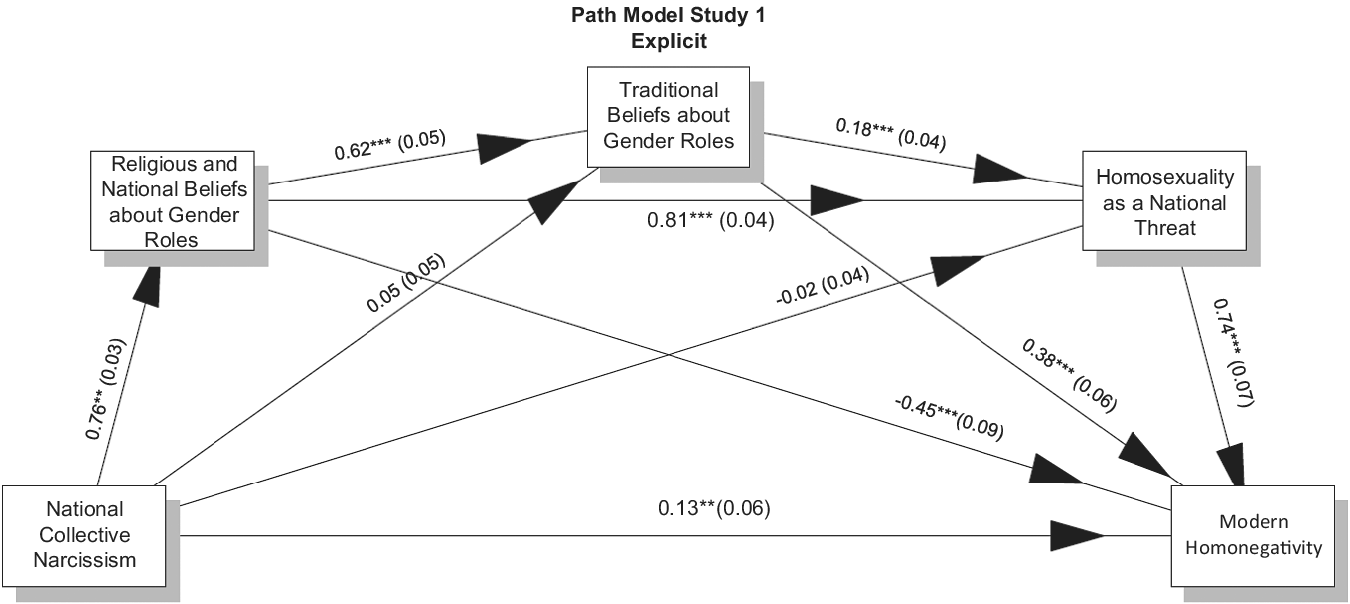
The results reveal that the total effect of “National Collective Narcissism” on “Modern Homonegativity” is statistically significant (β = 0.488; 95% CI [0.473, 0.646]; z = 12.739; p< 0.000). Those results are in line with Hypothesis 1. In order to test the psychological mechanism underlying this association and test the theoretical model outlined by Hypothesis 2 we looked at the sequential indirect mediation of variables linking “National Collective Narcissism” to “Modern Homonegativity.” The predicted relationship between “National Collective Narcissism” and “Religious and National Beliefs about Gender Roles” is significant (β = 0.76; 95% CI [0.744, 0.863], z = 26.23; p< 0.001). The predicted relationships between the three mediators are all statistically significant, which enables the test for serial multiple mediation. The serial mediation that includes all the mediators in the predicted order is significant (β = 0.063; 95% CI [0.049, 0.102]; z = 5.423; p< 0.000, Figure I). Additionally, the sequential indirect path between “National Collective Narcissism” and “Modern Homonegativity”, mediated by “Religious and National Beliefs about Gender Roles” and “Traditional Beliefs about Gender Roles” is also significant (β = 0.177; 95% CI [0.152, 0.266]; z = 7.065; p< 0.000). The indirect path between “National Collective Narcissism” and “Modern Homonegativity” mediated by “Religious and National Beliefs about Gender Roles” and “Homosexuality as a National Threat” is also statistically significant (β = 0.454, 95% CI [0.407, 0.651]; z = 8.324; p< 0.000). Finally, after the previous direct and indirect effects are taken into account, the indirect path between “National Collective Narcissism” and “Modern Homonegativity,” mediated by “Religious and National Beliefs about Gender Roles” is negative and statistically significant (β = -0.342; 95% CI [-0.533, -0.259; z = -5.581; p< 0.000). The model holds controlling for demographic predictors of homophobia identified in previous research: age, gender and political conservatism [Bouton et al. Reference Bouton, Gallaher, Garlinghouse, Leal, Rosenstein and Young1989]. Total explained variance in explicit prejudice against homosexuals is 56%. All coefficients are shown in Table III and Table IV. Those results are in line with Hypothesis 2.
Coefficients in the path model explaining the explicit prejudice against homosexuals in Study 1

Coefficients from the mediation analysis: explicit prejudice against homosexuals

In Study 2, we aimed to replicate the results of Study 1 as the measurements used in Study 1 were constructed on the basis of data obtained in this study. We aimed to test the same hypotheses with measurements obtained from Study 1.
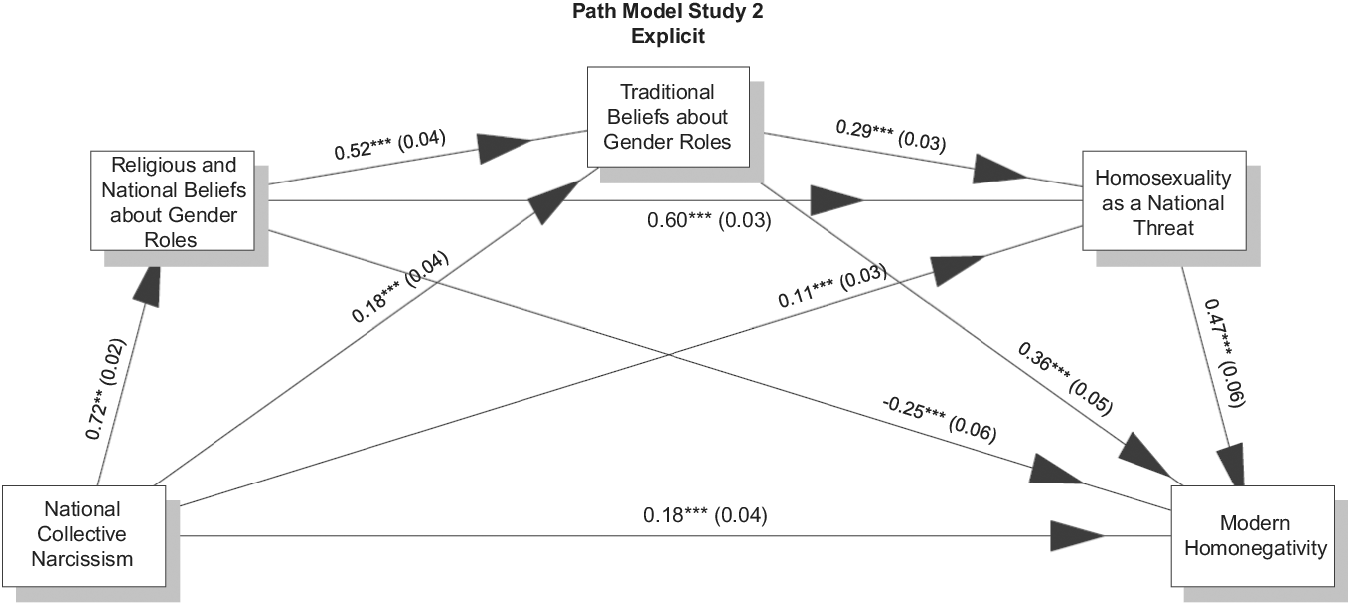
Path diagram explaining explicit prejudice against homosexuals
Standardized coefficients are reported as path coefficients; standard error in parentheses;** p<0.01, *** p<0.001. R2Modern Homonegativity = 0.555; R2Homosexuality as a National Threat = 0.855; R2Traditional Beliefs about Gender Roles = 0.431; R2Religious and National Beliefs about Gender Roles = 0.577

Study 2: Methods
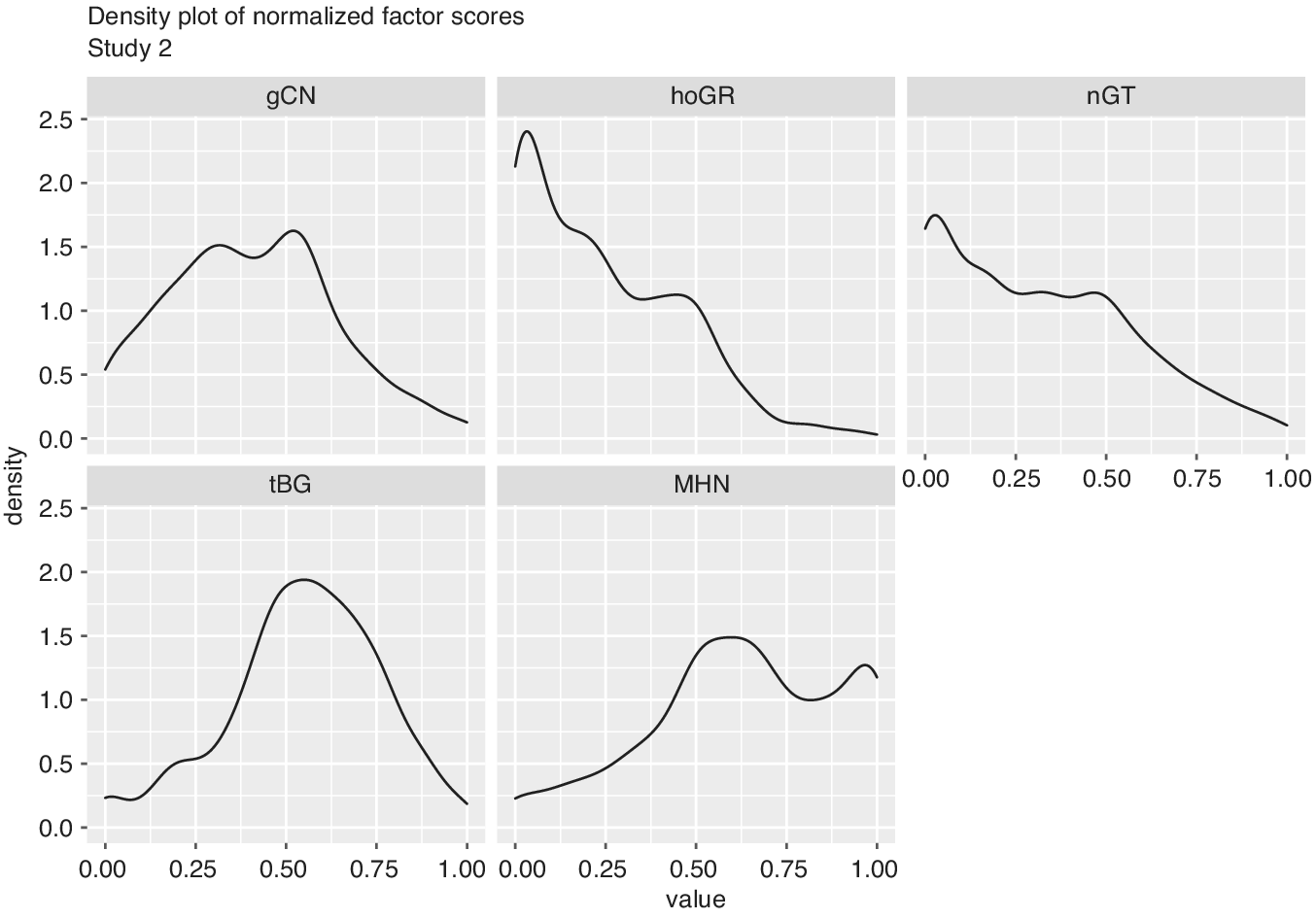
We obtained data from an independent, nationally representative sample of 879 Polish adults (47.5% female/52.5% male; M age = 43.17; SD age = 13.59; median age = 42) to test whether the results from Study 1 replicate. As in Study 1, the data collection was supported by the Ariadna online research panel. Only participants who stated that they were heterosexual were included in the analyses. 22% of the sample placed themselves on the conservative side of the political orientation spectrum, 36% in the middle, and 42% reported that they were somewhat liberal, liberal or very liberal. We repeated the same measures and the methods employed in Study 1. Item-level descriptive statistics and the details of the measurement models can be found in the Online Appendix. Table V displays the descriptive statistics of the constructs in Study 2. Table VI shows the goodness-of-fit statistics for the path model in Study 2. Figure II sets out the path diagram for Study 1. Figure III shows the distributions (see also online Appendix).
Descriptive statistics of constructs used in Study 2

Goodness-of-fit statistics for path model Study 2

Density plot of normalized factor scores in Study 2

Study 2: Results
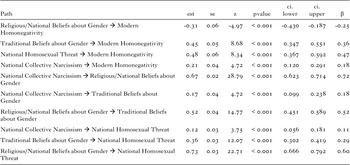
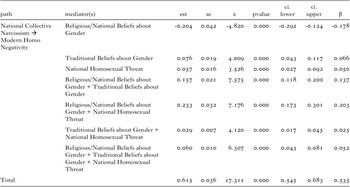
All the paths in the model are statistically significant; all the associations between “National Collective Narcissism” and all the mediators are significant. The indirect path between “National Collective Narcissism” and “Modern Homonegativity”, mediated by “Religious and National Beliefs about Gender Roles” is negative and statistically significant (β = -0.178; 95% CI [-0.292, -0.124; z = -4.820; p< 0.000). The indirect paths via “Traditional Beliefs about Gender” (β = 0.066; 95% CI [0.043, 0.117; z = 4.009; p< 0.000) and “National Homosexual Threat” (β = 0.050; 95% CI [0.027, 0.092; z = 3.526; p< 0.000) are also significant, and positive. The indirect path between “National Collective Narcissism” and “Modern Homonegativity”, mediated by “Religious and National Beliefs about Gender Roles” and “Traditional Beliefs about Gender Roles” is significant (β = 0.137; 95% CI [0.118, 0.200]; z = 7.575; p< 0.000). The indirect path mediated by “Religious and National Beliefs about Gender Roles” and “Traditional Beliefs about Gender Roles” significant (β = 0.177, 95% CI [0.152, 0.266]; z = 7.065; p< 0.000). The same is true for the other indirect paths that include two mediators: “Religious and National Beliefs about Gender Roles + Homosexuality as National Threat” (β = 0.203; 95% CI [0.173, 0.301]; z = 7.176; p< 0.000) and “Traditional Beliefs about Gender + National Homosexual Threat” (β = 0.025; 95% CI [0.017, 0.045]; z = 4.120; p< 0.000). Finally, the indirect path with all the three mediators is also significant (β = 0.052; 95% CI [0.043, 0.081]; z = 6.307; p< 0.000). The total effect of “National Collective Narcissism” on “Modern Homonegativity” is significant (β = 0.535; 95% CI [0.545, 0.683]; z = 17.311; p< 0.000), which is in line with Hypothesis 1. All the indirect effects and the serial mediations are statistically significant. All predictors explain 51% of the variation in explicit prejudice against homosexuals. The model holds controlling for demographic predictors of homophobia identified in previous research: age, gender and political conservatism [Bouton et al. Reference Bouton, Gallaher, Garlinghouse, Leal, Rosenstein and Young1989]. Figure IV sets out the path diagram for Study 2. Tables VII and VIII include all the coefficients.
Coefficients in the path model explaining the explicit prejudice against homosexuals in Study 2

Coefficients from the mediation analysis: explicit prejudice against homosexuals

Path diagram explaining explicit prejudice against homosexuals
Standardized coefficients are reported as path coefficients; standard error in parentheses; p<0.01, ***. R2Modern Homonegativity = 0.509; R2Homosexuality as a National Threat = 0.812; R2Traditional Beliefs about Gender Roles = 0.444; R2 Religious and National Beliefs about Gender Roles = 0.542

Discussion
The increased visibility of LGBT people in Poland since the collapse of communism has been met with a counter-reaction in the form of homophobic rhetoric and violence, with various surveys confirming that attitudes towards sexual minorities in Poland are among the worst in the EU. Intolerance towards sexual minorities cannot be explained with reference to a single factor but is the cumulative effect of a range of social influences. Nevertheless, numerous studies have shown that homosexuality in Central and Eastern Europe, including Poland, is particularly reviled because it is constructed as a threat to the continued existence of the nation and the core values defining national identity—particularly those derived from religion. However, these studies tend to focus on attempts by right-wing politicians to justify their homophobic rhetoric and attempts to marginalize LGBT citizens in the name of religion and nationality but without examining whether nationalist beliefs can predict homophobia at the level of individual beliefs. Nor do they take account of the emergence of right-wing populism in the region, whereby populists have sought to redefine membership of the nation in nativist terms, justifying it by national collective narcissism. This article seeks to address these omissions.
While ours is not the first study to seek to explain homophobia with reference to nationalism, we argue that the latter concept is too broad to explain why attitudes towards gays and lesbians should be related to people’s beliefs about their nation. We also argue that not all positive beliefs about a nation are related to homophobia. For this reason, we have sought to provide greater nuance by introducing the concept of “national collective narcissism” (the belief that one’s own nation is exceptional and entitled to privileged treatment but it is not sufficiently recognized by others). As homophobic rhetoric and violence have spiked since right-wing populism came to dominate Polish politics and as right-wing populists promote a nativist understanding of the nation, appealing to those who feel left behind by globalization and cultural change, we argue that, in the contemporary Polish context, national collective narcissism merged with Catholic collective narcissism is the most precise conceptualization of the belief about national identity that underlies homophobia. We therefore selected “National Collective Narcissism” as our predictor.
Given that Catholic religiosity defines the content of national identity popularized by right-wing populists in Poland, we assessed Catholic collective narcissism as well as national collective narcissism. As expected, our analysis showed that Catholic and national collective narcissism overlap almost entirely in their prediction of homophobia and beliefs leading to homophobia in Poland. This suggests that “Catholic” and “Polish” grandiosity have become fused in the minds of the respondents who scored high on both collective narcissism scales. From this we can infer that self-righteous but threatened Catholicism has become central in defining what it means to be Polish among these respondents. Given the antipathy of the Catholic Church, in general, and Polish bishops, in particular, towards sexual minorities, and given the power of the Catholic Church to define family, marriage and appropriate gender norms, the conflation of Polish and Catholic inevitably constructs individuals not adhering to Catholic principles of morality and behaviour, such as non-heterosexuals, as “not real Poles”. This then legitimizes attempts by nationalist and populist politicians to cast gay and lesbian Poles as less deserving of full citizenship and, in extreme cases, as enemies of Poland.
To explain the relationship between national collective narcissism and homophobia, we explored the theoretical literature on the relationship between the beliefs about the nation and homosexuality. Previous research has identified various threats that homosexuals are believed to pose to the nation and could therefore explain homophobia: namely, non-heterosexuals threaten the biological and cultural reproduction of the nation; fail to adhere to stereotypes of masculinity and femininity; confuse the traditional public and private roles of men and women; and deviate from the nation’s shared norms, especially those derived from religious teaching. “Homosexuality as a National Threat” was thus chosen as the first intervening variable between collective narcissism and homophobia. Given that the factors mediating the relationship between the nation and homosexuality in the literature relate primarily to gender roles, we selected “Traditional Beliefs about Gender Roles” and “Religious and National Beliefs about Gender Roles” as two further intervening variables.
In Study 1 we established the basic relationship between collective narcissism and explicit homophobia via the three mediating variables. In Study 2 we replicated the study, with different respondents, to test the validity of the model. Supporting our hypothesis, our analysis shows that the total effect of “National Collective Narcissism” on explicit homophobia in both studies was statistically significant. Thus, in Poland, homophobia could be explained with reference to the respondents’ national and religious collective narcissism. Our studies explored this association further, determining the underlying psychological mechanism. It consists of beliefs associated with national and religious collective narcissism with reference to gender and sexuality. Most immediately, religious and national collective narcissism engenders support for traditional religious teaching on those issues which resulted in traditional gender beliefs and a more specific belief that homosexuality is a threat to national identity. Most of the results were consistent between the two studies, especially the results in line with the tested hypotheses. One finding was not consistent. The associations between “National Collective Narcissism” and “Religious and National Beliefs about Gender Roles” was significant in a larger sample in Study 2 but did not reach the conventional level of statistical significance (although it was in the predicted direction) in the smaller Study 1.
From this we can conclude that the threat that homosexuals are believed to pose to the Polish nation relates primarily to the perception that they undermine traditional gender roles—defined by the Church for the good of the nation—rather than the threat they are believed to pose to the nation’s reproduction. In other post-communist states, such as Latvia, the presence of large ethnic minorities gave rise to fears that their physical nations were at risk of dying out, allowing right-wing politicians to attack gays and lesbians for failing to have children and thereby ensuring the continued existence of the nation [Mole Reference Mole2011: 551]. The high degree of ethnic homogeneity in Poland makes it more difficult for such fears to take hold there. Rather than being seen as a threat to the physical nation, homosexuality in Poland is understood as a threat to the patriarchal gender order underpinning the Polish nation. In the Polish context, the implications of this finding are particularly worrying in view of the “gender ideology” discourse being propagated by the Catholic Church and right-wing social and political actors [see Graff and Koroloczuk Reference Graff, Korolczuk, Paternotte and Kuhar2017]; any attempts to define gender and sexuality outside the narrow confines of patriarchal heteronormativity are constructed as a deliberate attack on the traditional Polish family, as Jarosław Kaczyński has repeatedly confirmed. At a PiS rally in the run-up to the 2019 European Parliament elections, when discussing the “threat” posed by the LGBT Declaration signed by Rafał Trzaskowski, the liberal Mayor of Warsaw, Kaczyński declared:
This threat is an attack on the family. […] At all times the natural identities of boys and girls are to be questioned. The whole mechanism of preparing children for the future roles of mother and father is to be destroyed. [Gernand Reference Gernand2019]
Given the strength of populism across Europe, our findings about Poland could help to explain homophobia in other contexts, providing a means to identify the specific aspects of the nation that homosexuality is believed to threaten: religious values, gender norms, reproduction or a combination of all three. (This would, of course, require further research on individual case studies.) Our finding regarding the fusion of national and religious collective narcissism in Poland can also help explain why homophobia is higher in Catholic countries of Eastern Europe where Catholicism is a core national value, such as Lithuania, than in others, such as Slovenia.
An additional future line of research would be to capitalize on the distinction between national collective narcissism and national in-group satisfaction [Golec de Zavala, Dyduch-Hazar and Lantos, Reference Golec de Zavala, Dyduch-Hazar and Lantos2019] to better understand how beliefs about the same nation can predict different attitudes towards sexual minorities. National in-group satisfaction is a positive evaluation of the nation without narcissistic grandiosity and resentment. It is associated with intergroup tolerance and lower prejudice [Golec de Zavala and Lantos, Reference Golec de Zavala and Lantos2020]. This presents a testable possibility that national in-group satisfaction and national collective narcissism predict opposite attitudes towards homosexuals. This also suggests that emphasizing the importance of positive national satisfaction and deemphasizing national collective narcissism in the definition of Polish national identity may offer a route towards the reduction of homophobia in Poland.
In line with research by Ayoub and Chetaille [Reference Ayoub and Chetaille2020], LGBT activists could use findings produced using our approach to frame their claims accordingly. In the Polish context, for example, our finding that homosexuality is understood as a threat to the gender order underpinning the Polish nation rather than to its biological reproduction (as is the case elsewhere in Europe) could then be used strategically by activists to frame Polish gays and lesbians as sharing the same values as heterosexual men and women in terms of “willpower, honour, courage” [Nagel Reference Nagel1998: 245] and inculcating in children Polish language and culture, respectively.
The need for LGBT activists to continually refine their strategies is essential. As scapegoating LGBT people has proved to be a successful electoral strategy, the instrumentalisation of homophobia by populists in Poland and many other European countries is unlikely to disappear any time soon.
Supplementary Materials
To view supplementary material for this article, please visit http://dx.doi.org/10.1017/S0003975621000072.