Introduction
Marine predators must be able to acquire their food resources in highly heterogeneous and unpredictable environments, and their foraging behaviour is inevitably linked to prey distribution and abundance (Hückstädt et al., Reference Hückstädt, Koch, Mc Donald, Goebel, Crocker and Costa2012). The South American sea lion (SSL) Otaria byronia (Blainville, 1820) is one of the most important top predators of the Patagonian marine ecosystem, with an estimated population of 121,000 individuals (Crespo et al., Reference Crespo, Oliva, Dans and Sepúlveda2012). Foraging trips, recorded by satellite telemetry in lactating female and adult male SSL in northern Patagonia, have indicated that they are confined to temperate waters of the Patagonian continental shelf, though males may travel greater distances than females (Campagna et al., Reference Campagna, Werner, Karesh, Marín, Koontz, Cook and Koontz2001).
In order to understand the ecological role of this otarid species in the local marine food webs, several dietary studies have already been performed using traditional methods (scats and stomach content analysis) or measuring the stable isotopic values from different tissues (e.g. bones, muscle, vibrissae) of SSL (George-Nascimento et al., Reference George-Nascimento, Bustamante and Oyarzun1985; Thompson et al., Reference Thompson, Duck, McConnell and Garret1998; Naya et al., Reference Naya, Vargas and Arim2000; Koen Alonso et al., Reference Koen Alonso, Crespo and Pedraza2000; Drago et al., Reference Drago, Cardona, Crespo and Aguilar2009, Reference Drago, Cardona, Crespo, Garcia, Ameghino and Aguilar2010; Bustos et al., Reference Bustos, Daneri, Volpedo, Harrington and Varela2012, Reference Bustos, Daneri, Volpedo, Harrington and Varela2014). These studies have indicated that fish, cephalopods and, to a lesser extent, crustaceans, constitute their most important prey. Within these, cephalopods preyed on by otariids in the Patagonian shelf region are still poorly known in regard to their feeding ecology and habitat exploitation (Guerra et al., Reference Guerra, Castro and Nixon1991; Iribarne et al., Reference Iribarne, Fernández and Zucchini1991; Xavier et al., Reference Xavier, Allcock, Cherel, Lipinski, Gomes-Pereira, Pierce, Rodhouse, Rosa, Shea, Strugnell, Vidal, Villanueva and Ziegler2015).
One of the most important cephalopod fishery zones is placed in the Patagonian shelf region, as part of the South-west Atlantic region (Area 41, FAO), targeting mainly short finned squid, Illex argentinus (Arkhipkin et al., Reference Arkhipkin, Rodhouse, Pierce, Sauer, Sakai, Allcock, Arguelles, Bower, Castillo, Ceriola, Chen, Chen, Diaz-Santana, Downey, González, Amores, Green, Guerra, Hendrickson, Ibáñez, Ito, Jereb, Kato, Katugin, Kawano, Kidokoro, Kulik, Laptikhovsky, Lipinski, Liu, Mariátegui, Marin, Medina, Miki, Miyahara, Moltschaniwskyj, Moustahfid, Nabhitabhata, Nanjo, Nigmatullin, Ohtani, Pecl, Perez, Piatkowski, Saikliang, Salinas-Zavala, Steer, Tian, Ueta, Vijai, Wakabayashi, Yamaguchi, Yamashiro, Yamashita and Zeidberg2015). Other squid species, such as Doryteuthis gahi, Doryteuthis sanpaulensis and Martialia hyadesi, support small domestic fisheries in the region (Brunetti et al., Reference Brunetti, Ivanovic and Sakai1999). On the other hand, the small Tehuelche octopus (Octopus tehuelchus) supports an intertidal, artisanal fishery at the southern limit of its distributional range in the San Matías Gulf (Narvarte et al., Reference Narvarte, González and Fernández2006).
These squid species have different, but overlapping distributions and ecology. The geographic distribution of D. sanpaulensis extends from 20°S to 46°S in the South-western Atlantic, being a neritic species which inhabits temperate waters between 20 and 120 m depth. Doryteuthis gahi instead inhabits the South-western Atlantic between 36°S and 38°S over the continental slope and spreads over the Argentine continental shelf up to 55°S. It is particularly abundant in cold waters, from the surface to 350 m depth. Both of these loliginid species overlap partially in their geographic distribution mainly in the intermediate zone of the Patagonian shelf between 42°S and 46°S (Brunetti et al., Reference Brunetti, Ivanovic and Sakai1999). In relation to Ommastrephid squid, M. hyadesi is an oceanic shelf squid species whose distribution extends from the open ocean in the Antarctic Polar Frontal Zone to the Patagonian Shelf edge (González et al., Reference González, Trathan, Yau and Rodhouse1997), whereas I. argentinus is widely distributed in the South Atlantic coasts of Brazil and Argentina, especially along the Patagonian shelf and slope, from ~22°–54°S (Xavier et al., Reference Xavier, Croxall and Rodhouse2002). Octopus tehuelchus is a small-sized benthic intertidal and shallow-subtidal species distributed in the Atlantic Ocean from Brazil (17°S) to San Jorge Gulf, Argentina (43°30′S) reaching up to 90 m depth. This octopod presents high population densities in the intertidal and subtidal zones of San Matías Gulf (41°–42°S, 63°30′–65°W) (Iribarne et al., Reference Iribarne, Fernández and Zucchini1991).
In recent years, top predators, such as seabirds and seals, have been used as biological samplers in order to collect information on the cephalopod fauna of the Southern Ocean (Daneri et al., Reference Daneri, Carlini and Rodhouse2000; Cherel et al., Reference Cherel, Duhamel and Gasco2004; Daneri et al., Reference Daneri, Carlini, Negri, Allcock and Corbalán2012; Alvito et al., Reference Alvito, Rosa, Phillips, Cherel, Ceia, Guerreiro, Seco, Baeta, Rui, Vieira and Xavier2015; Negri et al., Reference Negri, Daneri, Ceia, Vieria, Cherel, Coria, Corbalán and Xavier2015; Seco et al., Reference Seco, Roberts, Ceia, Baeta, Ramos, Paiva and Xavier2015, Reference Seco, Daneri, Ceia, Vieira, Hill and Xavier2016; Xavier et al., Reference Xavier, Cherel, Ceia, Queirós, Guimarães, Rosa, Cunningham, Moors and Thompson2018). The increasing knowledge on the morphology of cephalopod beaks (chitinous hard structures that resist digestion) has allowed the identification to species level of most of the accumulated items found in predator stomachs in the region (Clarke, Reference Clarke1986; Xavier & Cherel, Reference Xavier and Cherel2009). In addition, a relatively recent tool has been applied to investigate the trophic structure of cephalopods by combining the use of their predators as biological samplers together with measurements of the stable isotopic values of the beaks (Cherel & Hobson, Reference Cherel and Hobson2005; Xavier et al., Reference Xavier, Ferreira, Tavares, Santos, Mieiro, Trathan, Lourenço, Martinho, Steinke, Seco, Pereira, Pardal and Cherel2016). Applying these techniques to cephalopod beaks found in the diet of South American sea lions can provide new and useful information about trophic relationships among species and on the diversity, distribution, relative abundance and trophic ecology of cephalopods occurring within the foraging range of this otarid species. Thus, the aims of the present study were (A) to determine the taxonomic composition of the cephalopod component in the diet of Otaria byronia on the coast of Río Negro province by means of scat analysis; (B) to assess the habitat use and trophic ecology of the main cephalopod prey taxa identified by measuring the stable isotopic values of their beaks.
Materials and methods
A total of 1112 fresh faecal samples were collected between May 2005 and February 2008 from two SSL rookeries located at Punta Bermeja (41°09′S 63°05′W, N = 566: summer = 137, autumn = 144, winter = 142, spring = 143) and Caleta de los Loros (41°00′S 64°10′W, N = 546: summer = 136, autumn = 141, winter = 134, spring = 135), at a distance of ~90 km from each other.
Punta Bermeja represents an important reservoir of juveniles, with small breeding areas in constant growth representing one of the largest rookeries of the northern coast of Patagonia. Caleta de los Loros is a small breeding colony with a lesser number of individuals (Dans et al., Reference Dans, Crespo, Pedraza and Koen Alonso2004; Grandi et al., Reference Grandi, Dans and Crespo2008). Both rookeries are permanent (i.e. presence of individuals throughout the whole year) with seasonal variation in their numbers. During the study period, the maximum peak of sea lions occurred in the late winter and the minimum in summer (Punta Bermeja N = 4700 vs N = 3000; Caleta de Los Loros N = 1400 vs N = 450, respectively) (Bustos pers. comm.).
The samples were kept in plastic bags with 70% ethanol, and the hard cephalopod prey remains (beaks, eye lenses and pens) were extracted using sieves of different mesh sizes (range: 2.5–0.5 mm). Eighty-eight scats that did not contain prey remains were excluded from further analysis. All the lower beaks were identified to the lowest possible taxonomic level using available guides (Clarke, Reference Clarke1986; Pineda et al., Reference Pineda, Aubone and Brunetti1996; Xavier & Cherel, Reference Xavier and Cherel2009) and reference material (Laboratorio de Sistemática, Anatomía y Bioecología de Mamíferos Marinos, División Mastozoología, Museo Argentino de Ciencias Naturales ‘B. Rivadavia’). The frequency of occurrence (%FO) and numerical abundance (%N) were calculated for the different cephalopod taxa. Additionally, the mantle length (ML) and mass of the cephalopod species were estimated from the lower hood length (LHL) of octopod beaks (N = 702) and lower rostral length (LRL) of squid beaks (N = 330), using allometric equations (Clarke, Reference Clarke1986; Xavier & Cherel, Reference Xavier and Cherel2009).
A total of 17 lower beaks randomly selected from the two main cephalopod prey species (O. tehuelchus N = 10 and D. gahi N = 7), representing sizes of individuals in the diet assumed as those with %FO and %N values ≥30, were separated, cleaned and kept in 70% ethanol for stable isotopic analysis. Prior to the analysis, the whole beaks were dried at 60°C and ground into a fine powder; 0.30–0.55 mg of each beak sample were placed in a tin capsule and the relative abundance of carbon (C) and nitrogen (N) stable isotopes were determined with a continuous flow Isotope ratio mass spectrometer (Delta V Advantage, Thermo Scientific) coupled to an elemental analyser (Flash EA1112, Thermo Scientific). Results were presented in the δ notation relative to Vienna-PeeDee Belemnite (V-PDB) and atmospheric N2 for δ13C and δ15N, respectively. Replicate measurements of internal laboratory standards (acetanilide) indicate measurement errors <0.2‰ for both δ13C and δ15N values. Differences in the beak isotopic values of the two main cephalopod prey species were assessed using a Mann–Whitney U-test.
To analyse stable isotope data in the context of isotopic niche width, we adopted the more recent metrics based in a Bayesian framework (Stable Isotope Bayesian Ellipses in R: SIBER; Jackson et al., Reference Jackson, Inger, Parnell and Bearhop2011) for beak isotopic values, which allows for robust statistical comparisons. The area of the standard ellipse (SEAc, an ellipse obtained by Bayesian inference that contains 40% of the data regardless of sample size) was calculated after small sample size correction, and adopted to compare isotopic niche (i.e. overlap/segregation) between the two species, and test for differences in niche widths. We used the computational code to calculate the metrics from SIBER implemented in the package SIBER (Parnell et al., Reference Parnell, Inger, Bearhop and Jackson2010) under R 3.2.1.
Results
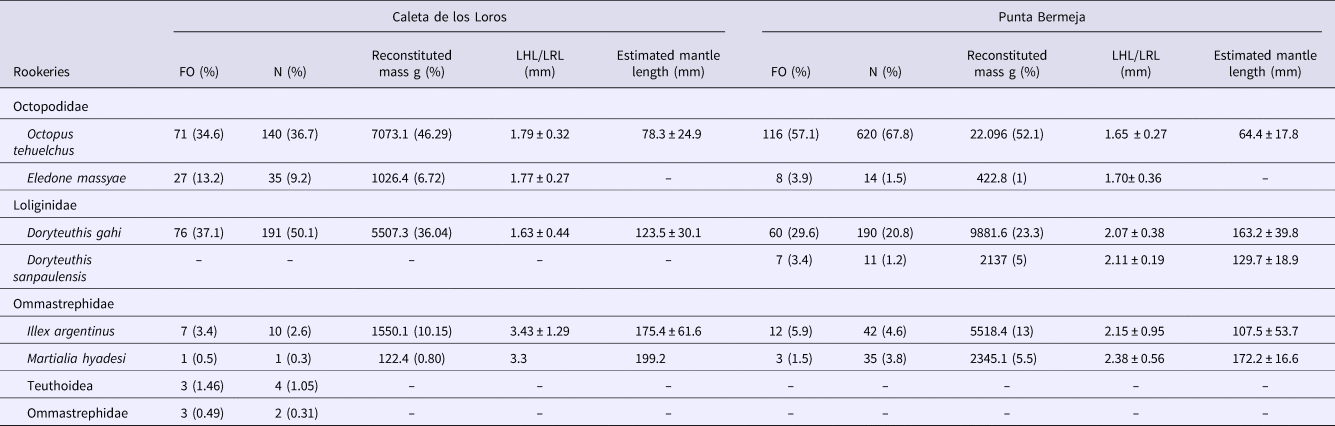
The overall analysis of scats indicated that cephalopods occurred in 39.4% of samples containing prey remains (N = 1024). Other prey taxa identified were fish, which had the highest frequency of occurrence (98.9%) and crustaceans, of lesser relevance (28.9%). A total of 2238 beaks (943 upper and 1295 lower beaks) were obtained and 1288 (i.e. 99.5%) of the lower beaks were identified to species level. Cephalopods were represented by two octopod species and four squid species (Table 1). The dominant prey species was Octopus tehuelchus, which occurred in almost 45.8% of scats containing cephalopod remains, and represented 58.7% in terms of numerical abundance and 52.0% in mass of cephalopods consumed. The second most important species was the myopsid Doryteuthis gahi, occurring in 33.3% of samples, and representing respectively 29.4 and 26.0% in terms of numbers and biomass of cephalopods consumed.
Taxonomic composition of the cephalopod prey of the South American sea lion (Otaria byronia) at two colonies of Río Negro province

Mantle length (mean ± SD).
FO, frequency of occurrence; N, numerical abundance; LHL, lower hood length; LRL, lower rostral length.
The LHL of the different octopod prey species ranged from 1–3 mm, which represented specimens of 7.9–184.7 mm ML, while the LRL of the squids ranged from 0.3–4.5 mm representing specimens of 40.7–236.1 mm ML (Table 1). The sizes of the beaks used for stable isotopes analysis were for O. tehuelchus (LHL mean ± SD = 1.73 ± 0.28) and D. gahi (LRL mean ± SD = 2.11 ± 0.49).
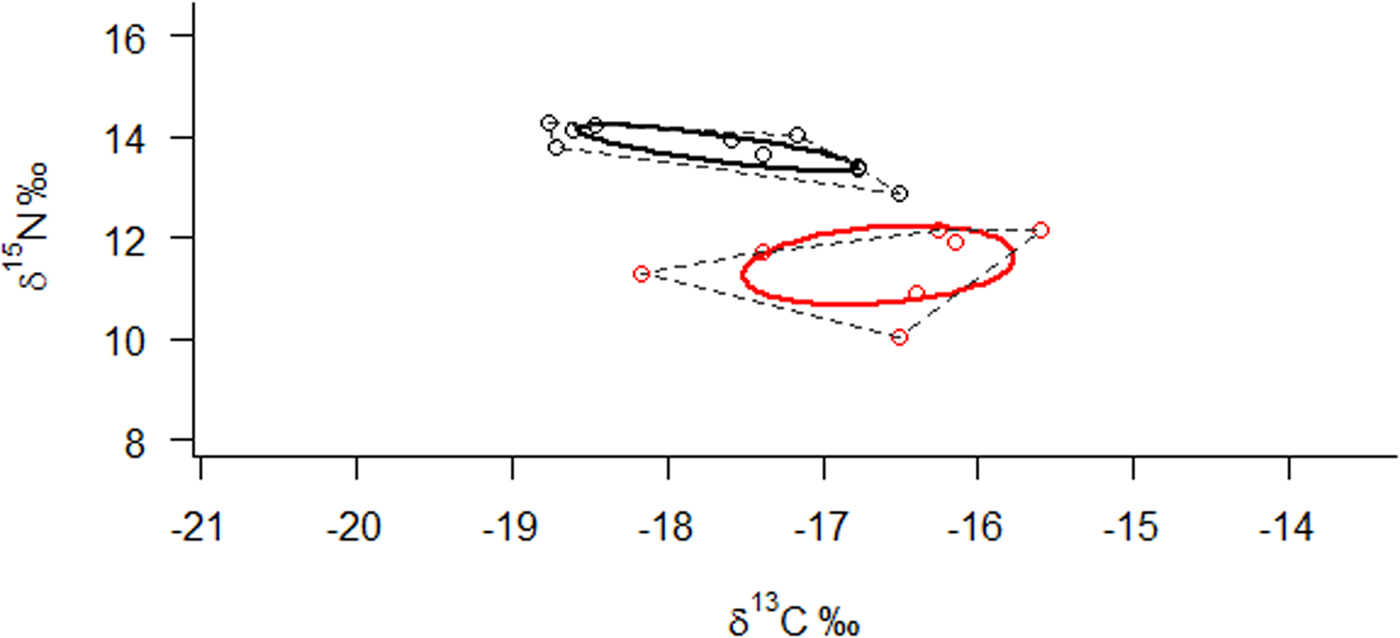
δ13C values in beaks of the two main cephalopod prey species (O. tehuelchus mean ± SD = −17.7 ± 0.9 and D. gahi −16.6 ± 0.9) were significantly different (Mann–Whitney U Test; Z = −2.2, P = 0.028). Additionally, beak δ15N values (O. tehuelchus 13.8 ± 0.4 and D. gahi 11.5 ± 0.8) were highly statistically significant between the two species (Mann–Whitney U Test; Z = 3.4, P < 0.001). Figure 1 shows the δ13C and δ15N values of these two species. SIBER analyses showed a complete segregation in the isotopic niche between them, and a significant higher isotopic niche width of D. gahi (P = 0.038).
Stable Isotope Bayesian Ellipses in R (SIBER) output for O. tehuelchus (black point) and D. gahi red point. Standard ellipse areas (solid lines) and their respective convex hulls (dashed lines).

Discussion
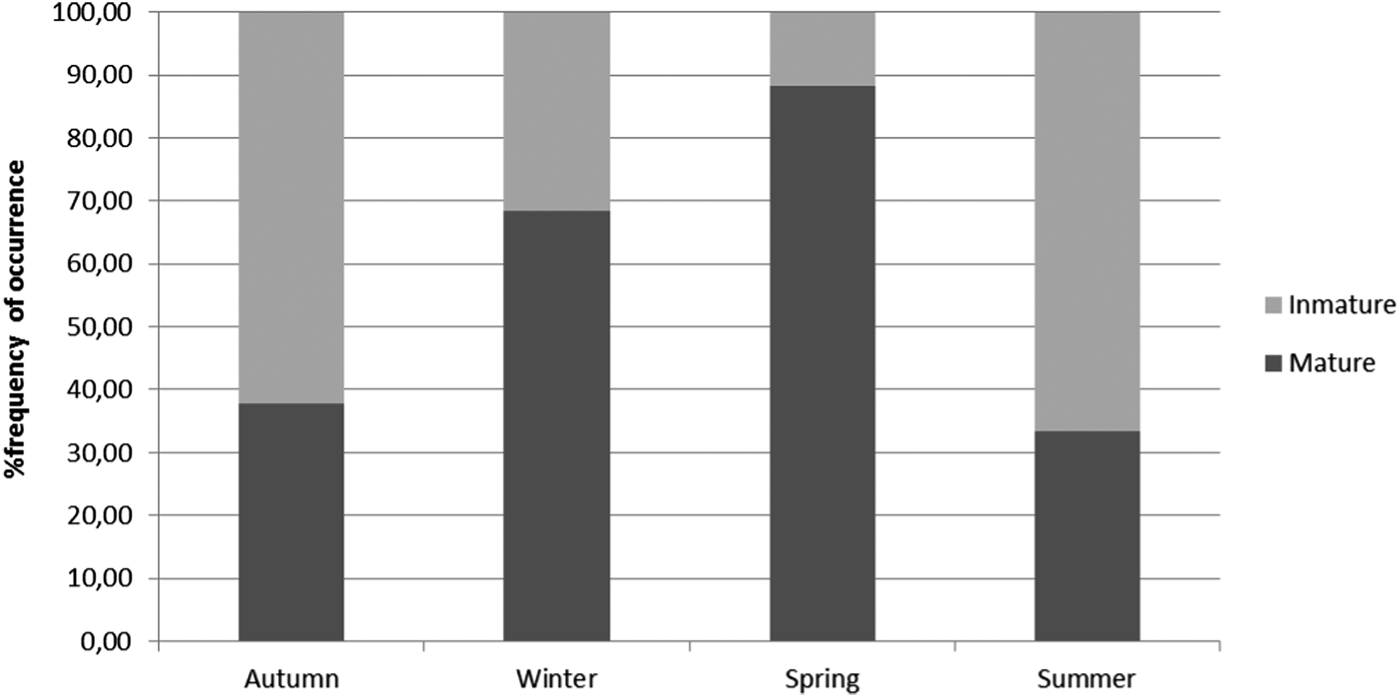
Consumers are typically enriched in 15N relative to their food (typically around 3‰) and consequently δ15N measurements serve as indicators of a consumer's trophic position (Cherel & Hobson, Reference Cherel and Hobson2005). By contrast, δ13C values vary little along the food chain (typically ~0–1‰) and are mainly used to determine primary sources in a trophic network (Cherel & Hobson, Reference Cherel and Hobson2005). The results from our Bayesian ellipses (Figure 1) suggest that O. tehuelchus and D. gahi occupy different trophic levels. This is in line with previous dietary information indicating that D. gahi feeds mainly on euphausids and Munida gregaria (Decapoda) (Guerra et al., Reference Guerra, Castro and Nixon1991), while O. tehuelchus feeds on crabs, bivalves and to a lesser extent on fish and polychaetes (Iribarne et al., Reference Iribarne, Fernández and Zucchini1991). In relation to the δ13C values of O. tehuelchus and D. gahi, these are in general accordance with the habitat of both species which inhabit similar neritic waters of the Patagonian shelf. The large dispersion in δ13C values observed in D. gahi might be explained by the ontogenetic horizontal migration of this squid species throughout its life cycle (Brunetti et al., Reference Brunetti, Ivanovic and Sakai1999; Arkhipkin et al., Reference Arkhipkin, Campana, FitzGerald and Thorrold2004a, Reference Arkhipkin, Grzebielec, Sirota, Remeslo, Polishchuck and Middleton2004b). This is characterized by immature individuals living in offshore waters and adults that return to coastal neritic areas for spawning in winter and spring (Arkhipkin et al., Reference Arkhipkin, Campana, FitzGerald and Thorrold2004a, Reference Arkhipkin, Grzebielec, Sirota, Remeslo, Polishchuck and Middleton2004b). This migratory behaviour of D. gahi was also reflected in the higher proportion of adult individuals that were preyed upon by SSL during the winter and spring seasons (Figure 2).
Percentage frequency of occurrence of sexually mature and immature individuals of D. gahi preyed upon by O. byronia during the different seasons.

The δ13C values of O. tehuelchus probably reflect the existence of two different groups (Figure 1): that comprising beaks more depleted in 13C which belong to the SSL rookery of Punta Bermeja and the other group, with beaks less depleted in 13C, from the colony of Caleta de los Loros. This might be explained by a different contribution of primary carbon sources in the area of the former colony (Punta Bermeja) given its proximity (~30 km) to the Río Negro estuary; a fact that could affect the carbon stable isotope composition by influence of estuarine water masses. Further dietary studies in this region, based on a higher number of samples (beaks), are needed in order to corroborate or refute this hypothesis.
Finally, regarding the habitat of the dominant cephalopod prey taxa identified in this study, we conclude that SSL fed mainly on coastal benthic species and secondarily on pelagic neritic prey, associated with the continental shelf and the shelf break. From the results obtained in this study, we strongly recommend to investigate the feeding ecology of cephalopods by combining the use of a top predator, such as Otaria byronia, as a biological sampler, together with measurements of the stable isotopic signature of the beaks. This will enhance our knowledge about migration patterns, distribution and role of poorly known cephalopods in the Patagonian marine ecosystem. Even though the two dominant cephalopod prey species of SSL here identified (O. tehuelchus and D. gahi) are not, at present, the main target of commercial fisheries in the study area, a sustained monitoring programme of the ecological interactions between cephalopods and sea lions at Northern Patagonia is recommended. This would permit to assess the implications of future fishery activities directed to these cephalopod species on the conservation status of O. byronia.
Financial support
This study was supported by the Investigator FCT program (IF/00616/2013) in collaboration with SCAR AnT-ERA programme, SCAR EGBAMM and ICED. We are also grateful to CONICET, Universidad de Buenos Aires (UBACYT 20620110100007), Agencia Argentina para la Promoción de la Ciencia y la Tecnología (ANPCyT) Proyecto PICT 2010-1372 and Society for Marine Mammalogy for financial support. FRC acknowledge the postdoctoral grant (SFRH/BPD/95372/2013) attributed by the Foundation for Science and Technology (FCT; Portugal) and the European Social Fund (POPH, EU). This study benefited from the strategic programme of MARE, financed by FCT (MARE – UID/ MAR/04292/2013).