Religious interest groups are active participants in debates over public policies. The names of religious groups appear in news coverage of policy debates as group leaders work to persuade policymakers and the public of the merits or harms of a particular policy. The arguments these, and other, participants make reflect competing attempts at framing. The framing of an issue affects policy outcomes in that it helps to set the terms of debate and establishes guidelines for acceptable and unacceptable policy outcomes (Andrews and Edwards Reference Andrews and Edwards2004; Baumgartner and Jones Reference Baumgartner and Jones1993; Entman Reference Entman1993; Gamson and Modigliani 1987; Kingdon Reference Kingdon1995; Nelson, Oxley, and Clawson Reference Nelson, Oxley and Clawson1997). As a result, the types of arguments that religious groups make can influence the type of policies public officials create. Groups strategically choose which arguments to use to support their preferred policy positions, and group leaders must do this with an eye to the way both group members and policymakers will react to the chosen arguments (Andrews and Edwards Reference Andrews and Edwards2004). When it comes to the types of arguments groups make, some evidence suggests that political and strategic flexibility may be more acceptable in some groups than it is in other groups.
A body of research on religious groups suggests that these groups, in particular, may be unwilling or unable to utilize a variety of arguments or to frame arguments in different ways, which in turn causes them to be less effective in the political realm (Hofrenning Reference Hofrenning1995; Rohlinger Reference Rohlinger2002). On this view, religious groups are unlikely to stray from their “prophetic politics” as they pursue an unyielding political agenda (see, for example, Crawford Reference Crawford1980; Diamond Reference Diamond1998; Domke Reference Domke2004; Gutterman Reference Gutterman2005). If framing affects legislative outcomes and if some groups are able to use a wider range of argument frames than other groups, it follows that the range of frames developed and used by religious groups may have a significant impact on the degree to which these groups achieve policy success.
Several questions emerge from these findings. First, do religious group leaders appear more constrained in the types of arguments they can offer compared with leaders of nonreligious groups?Footnote 1 If so, the internal dynamics of the group might help explain the reluctance of religious groups to compromise or modify their arguments. Tension between member preferences and group strategy, what I term “member-group constraint,” reflects the degree to which group leaders are free to offer a range of positions or arguments based on strategic considerations. Group leaders whose members allow them to stake out a wide range of arguments experience a low level of constraint, while leaders without such freedom experience a high level of constraint. A single argument is not likely to be sufficient to win over a majority of policymakers, especially in the presence of persuasive counterarguments; so groups must actively seek out new and more convincing reasons to persuade policymakers to support their positions. Successful groups can adapt to the political environment by abandoning arguments that fail to resonate with policymakers or the media and shifting to arguments that do resonate. In short, successful groups are strategic in terms of the arguments they offer in support of their preferred policy positions. The concept of member-group constraint addresses the factors that may enhance or impede a group's ability to pursue these rhetorical strategies.
A second question that emerges is whether the range of arguments made by religious groups is constrained by those who serve as filters of group arguments, such as the mass media. “Media-group constraint” reflects the fact that journalists play an important gate-keeping role in deciding which arguments to include in media coverage of policy debates. Groups experiencing low levels of media-group constraint will have an easier time communicating their preferred messages in the media while groups experiencing high levels of constraint will find it difficult to get coverage of their arguments. Groups that have freedom to communicate their preferred frames to the public and policymakers through mass media are likely to experience more success when it comes to influencing policymaking.
This article examines the extent to which religious groups display evidence of constraint in media coverage of policy debates and seeks to explain the source of constraint. I begin with an overview of the theoretical underpinnings of the concept of framing and then discuss constraint, particularly as it relates to framing. I then outline several hypotheses derived from the literature and explain the data used to test these hypotheses. Finally, I present the results of these tests, which demonstrate that religious groups do appear more constrained in media coverage. However, I find that constraint is imposed by journalists rather than self-imposed.
FRAMING AND RELIGIOUS INTEREST GROUPS
Framing is “the process by which a communication source constructs and defines a social or political issue for its audience” (Nelson, Oxley, and Clawson Reference Nelson, Oxley and Clawson1997, 221). Framing involves the strategic packaging of information to communicate a preferred version of problems, policies, or potential solutions. Numerous studies find that frames can dramatically change the decision-making context and can alter the outcome of debates (Baumgartner and Jones Reference Baumgartner and Jones1993; Entman Reference Entman1993; Kinder and Sanders Reference Kinder and Sanders1996; Kingdon Reference Kingdon1995; Nelson, Oxley, and Clawson Reference Nelson, Oxley and Clawson1997; Terkildsen, Schnell, and Ling 1998). Framing is successful because policy issues are multidimensional and are, thus, ready targets for interpretation.
Political actors and journalists all participate in the framing process with varying degrees of success (Jacoby Reference Jacoby2000; Kinder and Sanders Reference Kinder and Sanders1996). Interest groups, in particular, work to frame issues through the advancement of argument frames — arguments that try to get people to think about particular aspects of the issue (Nelson, Oxley, and Clawson Reference Nelson, Oxley and Clawson1997). Studies of interest groups find that groups actively work to frame political issues in ways that advance their political goals. For example, interest groups have the power to shape how journalists approach the issue in question and how political actors think and talk about a particular issue (Andsager and Smiley Reference Andsager and Smiley1998; Terkidsen, Schnell, and Ling Reference Terkidsen, Schnell and Ling1998; Nelson and Oxley Reference Nelson and Oxley1999; Callaghan and Schnell Reference Callaghan and Schnell2001; Rohlinger Reference Rohlinger2002). Groups strategically choose which arguments to use to support their preferred policy positions, and group leaders must do this with an eye to the way both group members and policymakers will react to the chosen arguments (Andrews and Edwards Reference Andrews and Edwards2004). Success in politics involves strategic compromise as well as sensitivity to, and flexibility in, responding to the political environment (Edelman Reference Edelman1988). Successful groups will be able to construct frames that resonate with the public and elected officials, and they will be able to respond to changes in the political environment through the elimination of unsuccessful frames and the constructing of new argument frames.
MEMBER-GROUP CONSTRAINT AND FRAMING
While it is clear that framing influences political outcomes, we know less about how the characteristics of groups affect the frames groups work to communicate. Most studies of group influence direct attention to the relationship between groups and other political actors involved in the decision-making process. A full understanding of the dynamics of these outward relationships, however, must also account for the internal dynamics of the groups (Salisbury Reference Salisbury1984; Leech and Baumgartner Reference Leech, Baumgartner, Cigler and Loomis1998; Hojnacki and Kimball Reference Hojnacki and Kimball1999). Interest groups are collections of individuals who share a set of preferences. In some cases, those shared preferences are public policy-oriented, but as many scholars point out, people join groups for reasons other than those associated with the political stands of the group (Clark and Wilson Reference Clark and Wilson1961; Salisbury Reference Salisbury1969; Olson Reference Olson1971). Regardless of why members join the group, group leaders use members to help promote the policy goals of the group. There is some evidence that elected policymakers and journalists tend to be attentive to groups with active and easily mobilized members (Andrews and Edwards Reference Andrews and Edwards2004). Therefore, the membership of groups, while not always a central focus of lobbying strategies, is significant.
Members may be particularly important in the process of determining to which issues groups will devote their attention, the positions groups will take regarding those issues, and how groups will construct arguments to reflect those policy positions. Groups have policy preferences, although not all members of the group may share those preferences and though members of the group may differ in the intensity of shared beliefs (Clark and Wilson Reference Clark and Wilson1961). Although most group members are not paying attention to all of the messages emanating from group leaders, leaders do not have unlimited freedom (Clark and Wilson Reference Clark and Wilson1961; Hofrenning Reference Hofrenning1995). The connection between the messages advanced by group leaders and the messages acceptable to group members reflects member-leader constraint. Group leaders whose members allow them to stake out a wide range of arguments based on strategic considerations experience a low level of constraint, while leaders without such freedom experience a high level of constraint.
Several scholars of interest groups point to findings that lead to the conclusion that religious groups may be more constrained than nonreligious groups in the type of argument frames they are “allowed” to use by group members. In his study of religious interest groups active in Washington politics, Hofrenning (Reference Hofrenning1995, 6) argues that religious groups operate under a “principled and moralistic vision” that he terms “prophetic politics.” According to Hofrenning (Reference Hofrenning1995, 13), “religious lobbyists seek fundamental change and are less willing to compromise” than are other lobbyists. “Contact with elites usually means bargaining and compromise, which religious lobbyists avoid” (Hofrenning Reference Hofrenning1995, 11), driving them to adopt an “outsider” strategy. When it comes to deciding on which issues to focus, Hofrenning (Reference Hofrenning1995, 69) suggests that religious groups are constrained by member attention and opinion. “On contentious high-salience issues, which are of concern to members, leaders will avoid offending member opinion because they know members are likely to protest.” By contrast, “on low-salience issues, when members are not likely to be aware of the lobbying activities of their leaders, religious lobbyists are free to ignore member opinion” (Hofrenning Reference Hofrenning1995, 69). Hofrenning argues that group leaders are able to build-up “capital” by following member preferences on certain key issues that they can then “spend” on issues about which members do not feel as strongly. His study provides great insight into how religious groups select the issues on which they will devote lobbying time and attention, and the strategies these groups use to influence policy decisions. Hofrenning's findings suggest that salience is particularly important in explaining the constraint experienced by religious groups.
More evidence of constraint comes from a case study of two organized interest groups active in the abortion debate. Rohlinger (Reference Rohlinger2002, 482) argues that “flexibility in language is particularly important as organizations attempt to adapt their messages to oppositional activity and changes in the larger political environment.” She suggests “a group organized around narrow and particularistic values may have difficulty constructing frames and packages that appeal to a broader audience” (Rohlinger Reference Rohlinger2002, 482). Rohlinger found that the religious group in her study ultimately made little to no attempt to “stretch” its frames, whereas the nonreligious group used formal and informal research to develop additional frames to add to its argument repertoire. Rohlinger's conclusion leads to the expectation that religious groups will be more constrained in the types of arguments they will make in public deliberations.
More broadly, many scholars examine the political behavior of religious groups and find them to be unyielding in their pursuit of specific political objectives (Diamond Reference Diamond1998; Gutterman Reference Gutterman2005). In examining the rhetoric of President George W. Bush, Domke (Reference Domke2004, 25) describes the beliefs of religious fundamentalism, which he argues is reflected in Bush's rhetoric, as setting “black-and-white boundaries through the establishment of rigid norms and behavioral codes.” This mindset, he argues, results in a binary discourse, creating a clear “us versus them mentality.” Unlike the previous authors discussed, Domke concludes that Bush's use of this unyielding rhetoric was actually quite effective.
While these studies suggest that religious groups may be more constrained than nonreligious groups, the work of other scholars of religion and politics points to the increasing political sophistication of religious groups that may affect their willingness to experiment with a variety of argument frames. In a study of religious lobbies in Washington, Hertzke (Reference Hertzke1988, 93) finds that leaders of religious groups are increasingly interested in what he calls “tactical pragmatism.” He concludes that, “particularly for those groups who wish to win and not just ‘witness,’ the norms and rules of the game dictate a molding of political messages into acceptable — meaning consensus-producing forms.”
Similarly, Rozell and Wilcox (Reference Rozell and Wilcox1996), who focus particularly on the rise of Christian Right political candidates, suggest that political actors driven by religious motivations are becoming more amenable to compromise. Compared to the Christian Right of the 1970s and 1980s, the Christian Right of the 1990s developed “far more effective organizational structures, far larger and more inclusive coalitions, and …more pragmatic strategies” (Rozell and Wilcox Reference Rozell and Wilcox1996, 272). Rozell and Wilcox credit the change to the political learning of activists, suggesting that contemporary religious groups may have similarly adapted to the political reality of the need for compromise. This evolution from a naïve, ideological, and uncompromising approach to politics to a more politically strategic approach reflects the impact of political learning and experience over time.
Moen (Reference Moen1994, 352) also finds evidence that religious groups, specifically the Christian Right, shifted their political and rhetorical strategies to become more flexible. Moen argues that the Christian Right now “employs the more familiar and widely accepted language of liberalism, with its focus on rights, equality, and opportunity.” In a related line of research, Dillon (Reference Dillon1993; Reference Dillon1995), finds that religious groups active in the debate over abortion display more “integrative complexity” than a prophetic politics model suggests.Footnote 2 Groups with integrative complexity view political issues as having multiple dimensions and avoid “rigid black-and-white positions” (Dillon Reference Dillon1993, 305). Dillon concludes that religious pro-life groups were no less likely to offer complex arguments than other groups active in the abortion debate. In a study of the National Conference of Catholic Bishops, Dillon also finds that the “complexity of the Church's general public and legal arguments” increased over time (Dillon Reference Dillon1995, 148). Thus, there is reason to suspect that religious groups may not be as constrained in their arguments as some scholars suggest.
These conflicting conclusions leave open the question of whether religious groups display a higher level of member-group constraint than nonreligious groups. This question is particularly important because the research on framing suggests that the ways in which groups frame political preferences have a major impact on the policymaking process.Footnote 3 Practically speaking, if religious groups experience constraint from group members that results in less flexibility in rhetorical strategies, they are likely to experience limited success in the policy arena. Conversely, if religious groups are free to construct new and more persuasive arguments, they are likely to experience greater success.
MEDIA-GROUP CONSTRAINT AND FRAMING
A second dimension of constraint involves the interactions between groups and the media outlets that report their messages. The mass media serve as a forum for public deliberation of political issues (Ferree et al. Reference Ferree, Gamson, Gerhards and Rucht2002; Gamson Reference Gamson1992; Gans Reference Gans1979). However, limits on space mean that journalists and editors must make decisions about which voices to include and which to ignore. This tendency of gate-keeping, especially as it concerns government sources, is well documented (Bennett Reference Bennett1990; Reference Bennett2009; Cook Reference Cook1998; Gans Reference Gans1979; Sigal Reference Sigal1973). As Bennett (Reference Bennett2009) reports, 70 to 90 percent of news stories are based on press conferences, interviews, or press releases that are controlled by government officials. However, journalists also operate under strong norms of fairness and objectivity (Bennett Reference Bennett2009; Blumler and Gurevitch Reference Blumler, Gurevitch, Nimmo and Sanders1981). To create a fair and balanced story, journalists will often turn to sources outside of government, such as organized interest groups.
In addition to choosing which groups to include in coverage of policy debates, journalists play an important role in deciding what arguments and aspects of the debates to cover (Bennett Reference Bennett2009; Cappella and Jamieson Reference Cappella and Jamieson1997; Iyengar Reference Iyengar1992). Journalists have latitude both in terms of how they frame the story and in terms of which group arguments they include. Several studies confirm that journalists have the upper hand in selecting what frames to associate with particular groups (Andrews and Edwards Reference Andrews and Edwards2004; Andsager and Smiley Reference Andsager and Smiley1998; Terkildsen, Schnell, and Lang 1998). Terkildsen, Schnell, and Lang (1998) conclude that media greatly shaped a 20-year portion of the debate over abortion. Similarly, Abbott (Reference Abbott2006) found that television media played an important role in framing the religious group Promise Keepers in a positive light during coverage of the “Stand in the Gap” rally in 1997. However, as Andsager (Reference Andsager2000, 578) points out, “the framing process — whether journalists are aware of it or not — can easily be influenced by rhetoric because, in ongoing social debates, interest groups' rhetorical positions become pervasive.” More specifically, Andsager found that pro-life groups were very successful in framing the late-term abortion debate. These conflicting findings regarding the role religious groups might play in framing an issue suggests that more research is needed.
Research addressing religion and the media tends to focus either on the coverage of religious news — news about the church or spirituality — or on religious media (Diamond Reference Diamond1998; Hoover Reference Hoover1998; Silk Reference Silk1995). However, some research suggests that, although religious groups make up a miniscule proportion of the groups covered by television media (Danielian and Page Reference Danielian and Page1994), the media is becoming much more sensitive to the coverage of religion. More news outlets are hiring specialists to write religion columns, and articles about religion are no longer confined to Saturday religion columns (Shepard Reference Shepard1995). Despite these favorable changes, journalists and editors still have the ability to filter the arguments made by religious groups in political debates. Therefore, it is likely that groups may try to offer more argument frames than they are “given credit” for in news coverage. I examine this possibility of media-group constraint by comparing the argument frames used by groups in press releases with the argument frames reported by journalists.
HYPOTHESES
Debates within the literature raise several questions related to constraint. First, do religious groups display more evidence of constraint than nonreligious groups? Consistent with the prophetic politics theory, I expect to find that religious groups will be more constrained than will nonreligious groups, as evidenced by their use of fewer argument frames in mediated debates.
A variety of factors might influence the degree of member-group constraint experienced by interest groups such as the visibility of the issue, the dominant framing of the issue, and the membership structure of the group. Research on decision-making indicates that the visibility, or salience, of an issue should affect the way political actors approach the development of arguments (Arnold Reference Arnold1990; Hofrenning Reference Hofrenning1995). Additional research finds that religious groups are more likely to be included in media coverage of debates when the policies in question are framed as moral issues (Stenger Reference Stenger2005). Framing issues as moral issues creates a perceived zone of legitimacy for the participation of religious groups. Journalists are more likely to turn to religious groups as sources when writing about these stories regardless of the activity level of the groups (Stenger Reference Stenger2005).
These factors lead to several hypotheses regarding the conditions under which religious groups might display evidence of member-group constraint. First, I expect that religious groups will use fewer argument frames in debates concerning highly visible issues, as measured by the number of articles published on the subject. Second, I expect that religious groups will use fewer argument frames in morally framed debates. Finally, I expect that religious groups whose primary purpose is political (interest groups and think tanks, for example) will use more argument frames than religious groups whose primary purpose is religious or social (denominations or social service organizations, for example).
A second set of questions involves the impact of journalists on the types of arguments that religious groups make in media coverage of debates. Do journalists constrain the arguments made by religious groups? Because the media play a gate-keeping role, evidence of constraint may not reflect actual rhetorical strategies of groups. The primary hypothesis for this portion of the analysis is that religious group press releases should contain more argument frames than groups are associated with in news coverage of the issues. Beyond that, I expect patterns similar to those found in news articles. Press releases from religious groups will use fewer argument frames in debates concerning highly visible issues. Second, I expect that religious group press releases will feature fewer argument frames in debates over morally framed policies. Finally, I expect that religious groups whose primary purpose is political will use more arguments in their press releases than religious groups whose primary purpose is religious or social.
DATA AND METHODS
To test these hypotheses, I draw upon newspaper and interest group press release data to examine coverage of the debates over school vouchers, low-income housing, the faith-based initiative, human cloning (and later, stem cell research), and same-sex marriage. The newspaper data consists of 816 articles published in the Washington Post and the New York Times between 1995 and 2003. These two newspapers were selected for analysis because they are national in scope and are read by opinion leaders and policy elites (Sigal Reference Sigal1973; Baumgartner and Jones Reference Baumgartner and Jones1993; Ferree et al. Reference Ferree, Gamson, Gerhards and Rucht2002). Additionally, copies of each are easy to access and search through the Lexis-Nexis database. There were few differences between the Times and the Post in terms of the level of coverage or their inclusion of references to interest groups.
I read each article and recorded the name of each group mentioned in the article, later collapsing these coded groups into two main categories: religious and nonreligious. I used information from group websites to make the distinction between religious and nonreligious groups for this analysis. Groups were coded as religious if they specifically mentioned belief in God, faith, a religious or spiritual motivation on their websites, or if they displayed religious symbols (such as a cross, ichthus, or Star of David) or quotations from religious texts. Some groups appearing in the sample addressed issues of religion, but from a secular perspective. I coded these groups (such as American Civil Liberties Union or Americans for Religious Liberty) as nonreligious.Footnote 3 The broad category of religious groups includes religious denominations, coalitions of denominations, individual membership based groups founded and operating on religious principles, social service agencies founded and operating on religious principles, and think tanks or foundations founded and operating on religious principles. In total, I identified 83 religious groups and 179 nonreligious groups. In the regression analyses that follow, the dichotomous variable “religious affiliation” indicates religious groups, regardless of denominational affiliation.
In addition to recording the interest groups mentioned, I coded the arguments made in each article and noted when an argument was attributed to a particular group. I operationalize arguments as specific reasons groups give in favor of, or in opposition to, a policy. The result is information about what distinct arguments a group may have made at a specific point in the debate as well as information about what arguments a group made over the course of the policy debate. I grouped arguments into one of nine general frames: Morality, science, economics, practicality/feasibility, politics/political strategy, democratic health/public opinion, legality, religion, and other. These frame categories allow for comparison across the five issues and they also help distinguish differences among arguments that are significant when attempting to measure constraint.
In this analysis, I include two models: one, which includes all arguments, and one, which excludes arguments that fall into the morality frame. Groups framing an issue in moral terms often state outright that the issue is a moral question. For example, in the case of cloning, groups referred to the debate as a “moral” or “ethical” problem. In the case of cloning, moral frames mentioned “playing God” or the God-given ability to create. In the debate over gay marriage, moral frames included arguments suggesting that gays and lesbians were going “against God's will,” or the arguments emphasized protecting the traditional family structure, protecting equal rights, and protecting children. I exclude these arguments in part of the analysis because these are the types of arguments that we might expect religious groups to make. It is particularly interesting when religious groups move beyond these traditional arguments in discussing political issues.
To complement the newspaper data, I examine press releases issued by a sample of 11 active religious interest groups taken from the list of groups mentioned in the newspaper articles on all five topics. A full explanation of the rhetorical strategies of religious interest groups requires accounting for the original frames advanced by the groups. The variety of frames associated with religious groups mentioned in news coverage of policy debates might simply reflect the arguments made by the groups. Alternately, religious groups might make more arguments than journalists report.
Not all of the religious groups mentioned in media coverage keep archives of press releases, but enough do to get a strong sense of the types of arguments religious groups make. From the entire list of religious groups mentioned in the articles, I selected a stratified sample of groups to reflect a variety of religious traditions, policy positions, and political ideologies. I also sought to include commonly mentioned groups as well as those that were not common voices in the media. I used press release archives on each group's website to collect 269 press releases from each group addressing all of the five issues regardless of whether the group was mentioned in the mediated debate of the issue. I then coded the press releases using the same method used to code the news articles. This method allows for an exploration of cases where groups were active on an issue but did not receive any media attention.Footnote 4
FINDINGS: MEMBER-GROUP CONSTRAINT IN MEDIA COVERAGE
The first question addressed in this article involves the extent to which religious groups appear constrained in terms of the types of arguments they make in mediated policy debates. The data suggest that religious interest groups do appear constrained in mediated debates. Religious groups make fewer arguments than do nonreligious groups in media coverage of policy debates. In a single news article, nonreligious groups make between zero and five distinct arguments (Mean = 0.75; S.D. = 0.78) while the range for religious groups is zero to three (Mean = 0.45; S.D. = 0.66). This pattern of nonreligious groups making more discrete arguments holds true for four of the five issues. In the case of same-sex marriage, religious groups made slightly more arguments, on average, than did nonreligious groups. The biggest difference between religious and nonreligious groups was in the debate over low-income housing. In this debate, nonreligious groups offered an average of 1.1 arguments in each article, while religious groups used an average of 0.67 arguments. These averages are low because in many cases, journalists mention groups in a news article without any connection to a particular argument. The most common example of this is when journalists list groups that support or oppose a policy without including any of the specific reasons groups give for their positions.
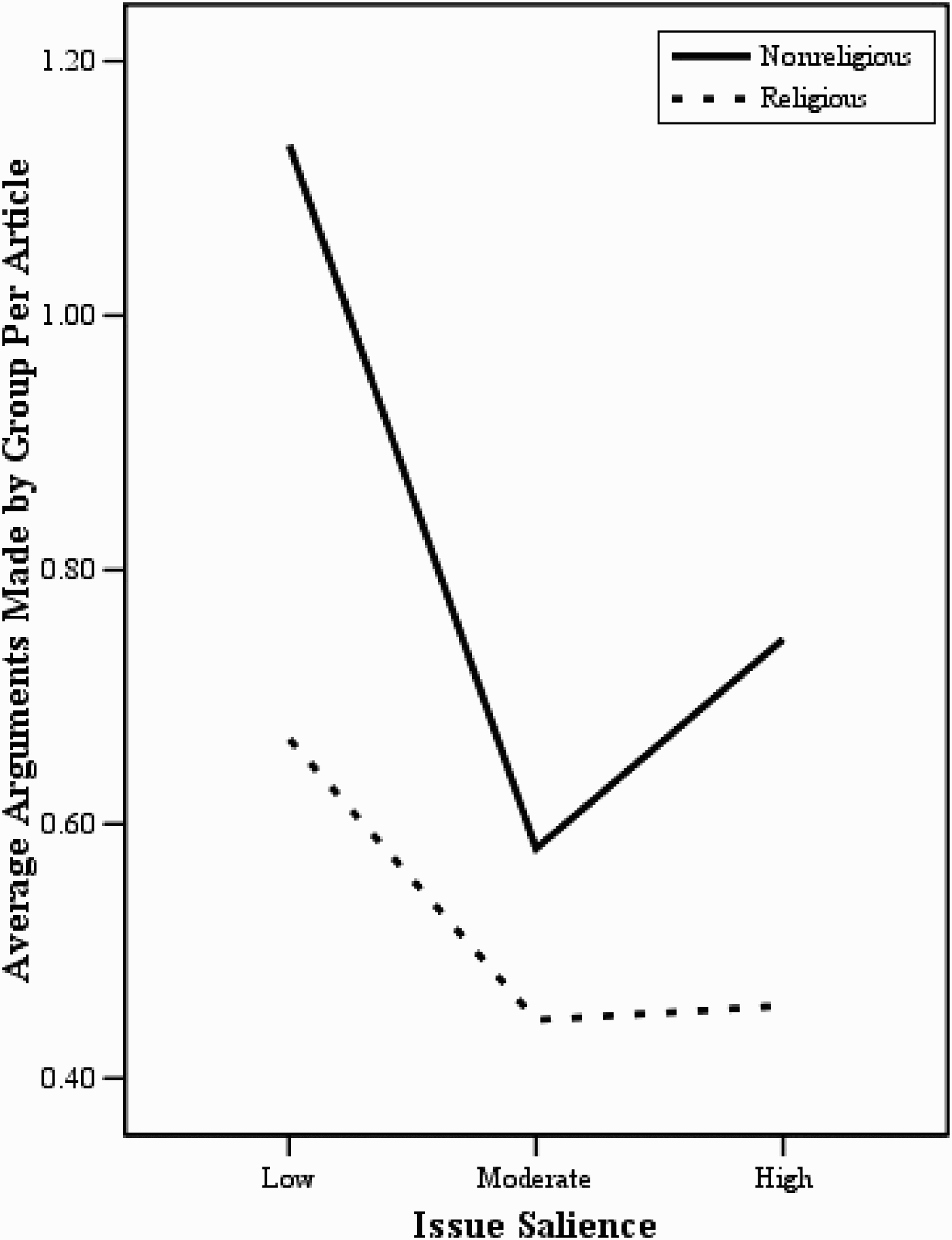
Hofrenning finds that religious lobbyists build “capital” when working on high profile issues that allows religious lobbyists to advance less popular positions on issues that are not of central importance to group members. This suggests that we should expect to find that religious groups are more constrained in terms of the argument frames they advance in deliberations over high-profile issues, and less constrained in deliberations over issues that have less salience. The five issues included in this analysis received varying levels of media coverage. Only 84 articles discussed low-income housing during the period studied, while over 250 articles discussed human cloning and school vouchers. To test the salience hypothesis, I grouped the issues into high, moderate, and low coverage categories based on their news coverage relative to each other.Footnote 5 As Figure 1 shows, both religious and nonreligious groups active in the low salience debates averaged the most distinct arguments per issue. Interestingly, nonreligious groups active in high salience debates used more arguments than did those active in moderately salient issues. For religious groups, however, the average number of arguments is relatively stable, suggesting a preliminary confirmation of Hofrenning's findings regarding the impact of issue salience on group strategy.
Impact of Issue Salience on Group Argument Use.
Closely related to the issue of salience is that of framing. Some issues come to be framed as questions of morality, while others resist this framing despite attempts to the contrary (Stenger Reference Stenger2005). Morally framed issues are “characterized, first and foremost, by debate over first principles…” (Mooney Reference Mooney and Mooney2001, 3). In this project, clear patterns developed in media coverage of these issues. Media coverage framed debates over the faith-based initiative, human cloning, and gay marriage as moral questions. Journalists portrayed the debate as being between two sides and emphasized the ways in which the core values of each side were threatened. In contrast, media coverage of debates over school vouchers and low-income housing did not frame them as moral issues even though many participants in the debate argued there was a moral component to the policy. The presence or absence of a moral frame seems to affect the perceived legitimacy of religious groups who wish to participate in mediated policy debates (Stenger Reference Stenger2005). Therefore, the presence of absence of a moral frame might also affect the argument strategy of religious groups.
My hypothesis predicts that religious groups will be more constrained in debates that are framed in moral terms. This stems partially from the fact that morally framed issues tend to have a higher visibility in the media, and partially because groups active in issue debates not framed in terms of morality may need a larger argument repertoire in order to gain the attention of journalists. Figure 2 shows a clear connection between the framing of an issue and the average number of arguments groups offer. Both religious and nonreligious groups use significantly fewer arguments in mediated debates featuring morally framed issues than they do in debates not framed in predominantly moral terms.
Impact of moral frame on group argument use.

Both religious and nonreligious groups make more arguments when issues have low salience and no dominant moral frame. However, a clear gap still exists between religious and nonreligious groups despite similarities in the pattern of the relationship, which suggests that internal factors might play a role in explaining the difference. Aside from religious affiliation, one such internal factor is the primary purpose of the group. Some of the groups in the sample are expressly political. While they espouse religious convictions, their primary purpose is to impact political outcomes. Other groups primarily have a religious or social purpose. Religious denominations and social service agencies may be tangentially interested in political outcomes, but their primary goals are providing spiritual or social services to those in need.
My hypothesis predicts that groups whose primary purpose is political rather than religious or social will be less constrained. This is because these groups are more likely to be sensitive to political realities such as the need for compromise and strategic approaches. Figure 3 suggests this is true. Religious groups with a primary purpose of providing religious or social benefits make fewer arguments than do religious groups with a primarily political purpose. Religious groups with a political purpose are quite similar to nonreligious groups with a political purpose in terms of the number of arguments they average. Further highlighting the impact of religion on the behavior of groups are the nonreligious groups that have a primarily social purpose. These groups are the least constrained of all the categories.
Impact of group type on group argument use.

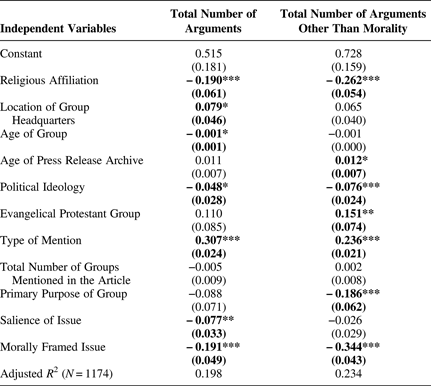
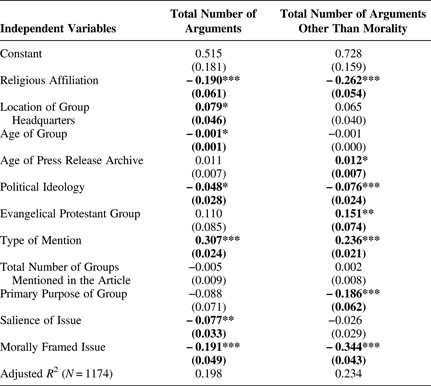
These various analyses, however, give us little indication of the relative importance of each of these factors compared to the others. Table 1 assesses the impact of these factors using two linear regression models. The unit of analysis for both of these models is the individual mention of an interest group within a news article. The first model uses the total number of arguments mentioned by a group within a particular article as the dependent variable and the second model uses the total number of arguments excluding morality arguments. The first model reflects a general measure of constraint because it includes all of the various arguments a group may have made in a mediated debate. The second model more specifically addresses the impact of constraint for religious groups because it eliminates the moral arguments that religious groups would theoretically be “allowed” to make by group members. Thus, the final argument count reflects those issues that are outside the traditional rhetorical territory of religious groups.
Factors impacting number of arguments in news stories
Note: Standard Errors are in parentheses. *p < 0.10; ** p < 0.05; ***p < 01.
In addition to the variables analyzed above, I include a number of group variables that may affect the level of constraint such as the location of the group,Footnote 6 the age of the group, the presence of a web-based press release archive, and the political ideology of the group.Footnote 7 A dummy variable indicates evangelical Protestant groups, often singled out in news coverage of religious groups as being particularly hostile to compromise. Two variables capture some features of the news articles that may be relevant, such as the total number of groups cited in the article and the way a group was cited (being mentioned, paraphrased, or quoted directly). Finally, I include the salience, moral frame, and primary purpose variables discussed above.
Looking first at the overall number of arguments made by a group in each article, the negative sign on the significant religious affiliation variable indicates that nonreligious groups use more arguments per article than do religious groups even taking into account other factors. The location of group headquarters has a small impact, with Washington-based groups likely to use more arguments. Younger groups and liberal groups are slightly more likely to use more arguments than are older and conservative groups. Not surprisingly, groups that are quoted directly, rather than paraphrased or simply mentioned, use more arguments. As with the previous analysis, the salience and framing of an issue matter, but the primary purpose of the group is not a significant factor.
When I exclude moral arguments from the count, the impact for religious and nonreligious groups is even more pronounced. Two findings, however, are particularly surprising: when moral arguments are excluded, evangelical Protestant groups and religious and social service organizations make more arguments rather than fewer arguments as expected. Many observers criticize evangelical Protestant groups for being single-minded and uncompromising. Focus on the Family, the Traditional Values Coalition, and the Christian Coalition are among the groups that fall into this category, but the data show that this conventional wisdom may be inaccurate. Similarly, religious groups primarily focused on providing spiritual services appear to be quite comfortable making economic and social arguments. This indicates that they may feel less constraint in terms of the types of arguments they can offer perhaps because members of these groups join or utilize them for spiritual or social reasons rather than for political reasons.
FINDINGS: MEDIA-GROUP CONSTRAINT IN MEDIA COVERAGE
While the content reflected in news articles is informative, it does not provide a complete picture of the argument strategies of religious groups because journalists operate as a filter of news content. To supplement this information and to provide a closer look at the actual rhetorical strategies of religious groups, I analyzed press releases on these five issues from a sample of religious groups. The data gleaned from these press releases provides a clearer understanding of group strategies and the impact of media-group constraint.
Religious interest groups offer a much wider range of arguments in press releases than are attributed to them in news coverage of policy debates. Group press releases show that groups offer up to seven distinct arguments to support their preferred policy position. The mean number of arguments offered in a single press release in this sample is 1.83 (S.D. = 1.24). Compared to the mean number of arguments attributed to religious groups in news stories (0.45), this is a substantial difference. Even when the traditional morality-based arguments are excluded from the count, religious group press releases feature up to five separate arguments, with a mean of 1.03 (S.D. = 1.10). This means that religious groups are much more willing to offer a variety of arguments than the media report. More importantly, it suggests that religious groups may not be inherently constrained in terms of the types of arguments they can make, but that journalists constrain religious groups by filtering arguments. This may be because of simple space constraints, but it might also be because the frames offered by religious groups do not correspond with the stereotype of religious groups held by journalists.
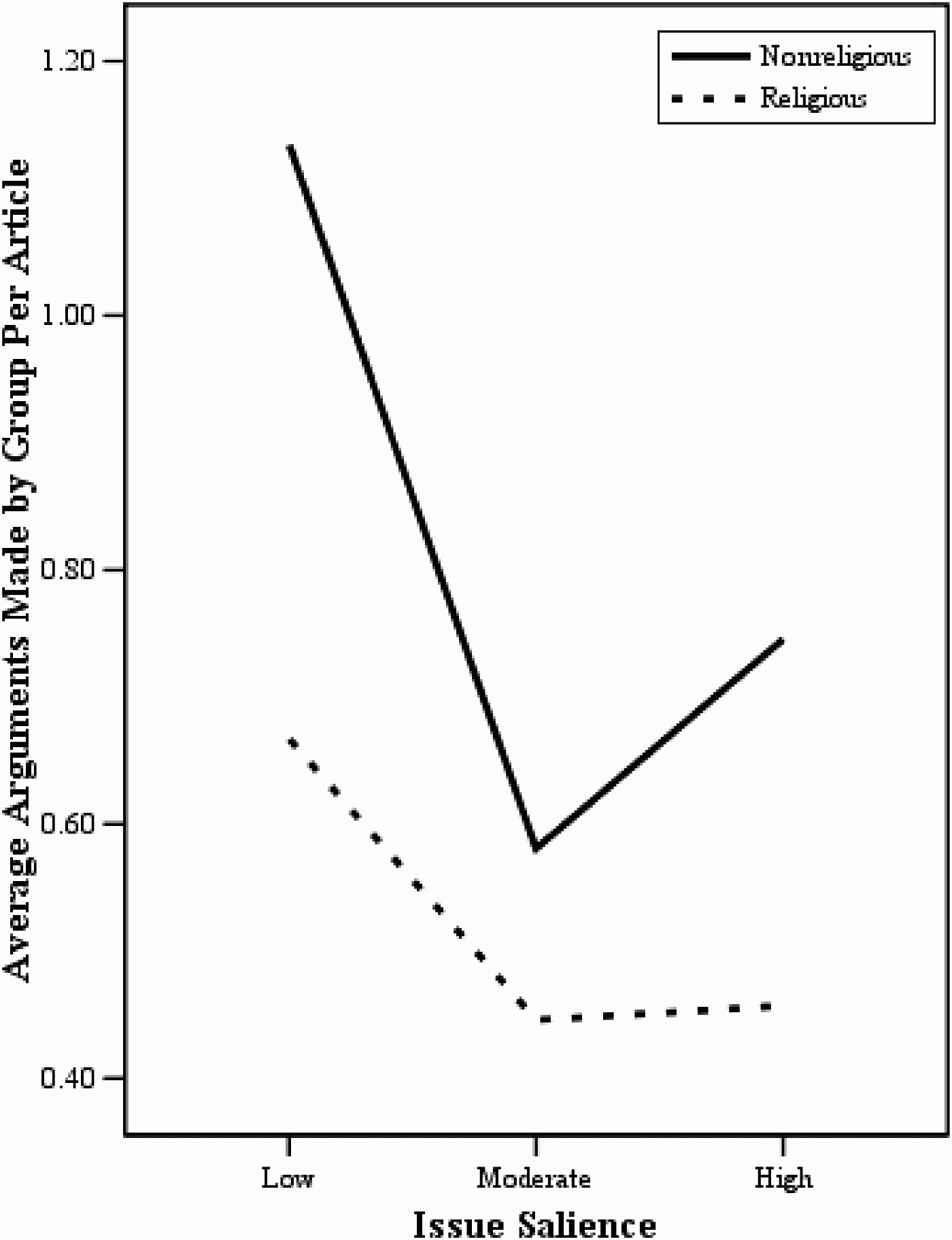
Furthermore, group press releases diverge from the pattern found in news coverage in regards to issue salience and morality framing. Instead of using fewer arguments in highly salient issue debates, religious groups offered more arguments in press releases pertaining to these issues. This pattern is true when counting all arguments as well as when morality arguments are excluded from the count. Figure 4 displays this pattern between salience and arguments, a relationship that is statistically significant at the 0.01 level.
The impact of issue salience on arguments offered in group press releases.

Similarly, where we might expect religious groups to display more constraint in the types of arguments they issue in debates over policies framed in terms of morality, these groups actually display less constraint on morally framed issues. In the three issues framed in the media as moral issues, religious group press releases contained more arguments on average (Mean = 2.11; S.D. 1.23) whereas in press releases issued on the two issues not framed as moral issues, groups tended to use fewer argument frames on average (Mean = 1.54; S.D. = 1.19). While religious groups did offer a number of arguments classified within the moral frame (215 references to a morality-based argument in 269 group press releases), they offered even more arguments not based in morality (503 arguments reflecting other dominant frames). Both of these pieces of information point to the conclusion that religious interest groups are not as constrained in their unfiltered rhetoric as the prophetic politics model suggests. Rather, religious groups offer a variety of arguments, many of them not based in traditional conceptions of morality, that reflect a degree of political strategy and sophistication consistent with nonreligious groups.
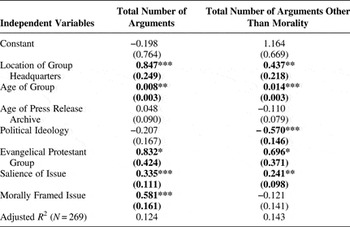
The behavior of religious groups in highly salient debates framed in multiple terms suggests that groups operate within high-profile debates in a strategic way, issuing a variety of arguments, many of those not based in morality, in hopes of influencing policy outcomes. Table 2 provides the results of two regression analyses that parallel the earlier analyses using group press releases rather than group mentions in news stories as the unit of analysis. I measure all of the dependent variables in the same way as they were in the first set of regression analyses, with the exception of the primary purpose variable, which I exclude because nearly all the groups have a political focus. The results point to location, political ideology, salience, and framing as particularly important variables. When including all argument frames, the results suggest that groups headquartered in the Washington area, commenting on high-profile policy debates framed in moral terms offer more arguments in their press releases.
Factors impacting number of arguments in group press releases

Note: Standard Errors are in parentheses. *p < 0.10; **p < 0.05; ***p < 01.
Liberal groups were significantly more likely to use a greater variety of argument frames when excluding moral frames from the count. The political ideology variable reflects this conclusion by carrying a negative sign in all four models. Political ideology was significant both in news article models and in the press release model that excludes moral frames. As expected, liberal groups seem to experience a lower degree of constraint than conservative groups in their press releases. Evangelical groups, however, also experienced lower levels of constraint in press releases. In both models, the evangelical Protestant variable is statistically significant and positive. Taken together, these findings seem incompatible since Evangelical groups tend to be politically conservative. This finding may be the result of the small sample and the magnitude of this relationship could differ with a larger sample size.
Finally, the salience variable is worth mentioning, since it seems to conflict with expectations based on the “prophetic politics” model. The data show that, rather than being more constrained on high-profile issues, religious groups offer a wider range of argument frames in these debates. This finding is consistent even when excluding moral frames from the count. The salience variable, however, does not indicate whether the issue is among the issues that are of primary interest to each of the groups. Religious groups in search of real political influence may feel the need to comment on high-profile political issues even when those issues are not within their primary area of expertise. In a sense, their participation in these varied issues is itself a form of prophetic politics in that they sense a need for a religious perspective in debates over critical issues.Footnote 8 Regardless of how they frame arguments, the simple participation of these groups in the national debate provides an outlet for religious voices in public discourse.
DISCUSSION AND CONCLUSION
These findings indicate that, in news coverage, religious groups do appear to be more constrained than nonreligious groups. The variety of argument frames offered by both religious and nonreligious interest groups increases in debates over issues not framed in moral terms and debates that are not highly visible. However, compared with nonreligious groups, religious groups offer fewer arguments in these debates regardless of variations in salience and framing. This finding offers support to those scholars who have identified religious groups as occupying a “prophetic” role in the public sphere because religious groups do appear to stick to a specific and limited message. The average citizen, who receives reports of political activities through mediated sources, could easily conclude that religious groups are quite limited, maybe even dogmatic, in terms of the messages they communicate.
However, a review of press releases issued by religious groups indicates that these patterns have less to do with the groups themselves and the constraint they might feel because of their religious beliefs. Instead, this analysis suggests that the observed patterns of constraint are more likely a result of journalistic choices than a reflection of the breadth and depth of arguments offered by religious interest groups. In fact, religious groups offer a wide variety of argument frames in their press releases, especially when they participate in high-profile issues and in morally framed debates. The result is that religious groups tend to be much more complex and strategic in their approach to political problems than media accounts of their positions suggest. This finding lends support to research concluding that journalists have the upper hand when it comes to framing.
This finding also points to a potential redefinition in the way we think about the political strategies of religious interest groups. Instead of thinking of religious groups as being concerned primarily with a limited set of political issues and being constrained in the arguments they make, religious groups may use their prophetic voice to raise a number of critical questions related to economic and social aspects of policies, even when those policies tend to be located outside their scope of expertise. Additionally, it is clear that religious groups talk about these issues in ways that reflect a level of political sophistication not always associated with religious groups. Religious interest groups do offer a variety of argument frames, which gives them the ability to react strategically as policy debates develop over time. As Dillon (Reference Dillon1995), Hertzke (Reference Hertzke1988), Moen (Reference Moen1994), and Rozell and Wilcox (Reference Rozell and Wilcox1996) suggest, religious interest groups seem to have realized that success in politics requires flexibility in pursuing multiple rhetorical strategies.
The questions of how characteristics of a group impact the messages groups communicate and how group messages filter into policy debates are critically important in the study of interest groups. These findings lead to many additional questions. Future research might examine a greater variety of policy debates and a greater variety of interest groups, including expanding the analysis of press release data to nonreligious groups. Journalistic bias could be even more powerful than these findings indicate if further analysis finds than nonreligious groups experience less media-group constraint than religious groups. Future research should also continue to explore the concept of constraint in different aspects of religious group behavior such as how it might affect decisions about fundraising, campaign donations, or issue selection.