INTRODUCTION
The Early Bronze Age (EBA) is a period characterized by the passage to bronze working and alloying technology. During this time, metal workers and traders, who became the elite, introduced new habits for feasting ways. Sea and land-based trading networks were established so as to exchange both prestige goods and new ideas (Kouka Reference Kouka2013). Canoe-based networks were created leading to “long-range sea traffic,” as described by Broodbank (2013). There were large changes in the pottery, from fine clays and highly decorated styles and shapes in the Neolithic period to more plain and coarse vessels and small pithoi, which indicate a much higher need for storage. There were also changes in ornaments and other luxurious items. All these changes indicate most probably a different culture that emerged or arrived in the Aegean together with bronze-alloying technology. Similarly, there are also theories that this is the period when the first Greeks came into the Aegean bringing the Greek language (Coleman Reference Coleman2000).
The Aegean Bronze Age describes an area and period that has been under research for many years and yet there is always more to understand and reveal (Cavanagh et al. Reference Cavanagh, Mee and Renard2016). The term Early Bronze Age (EBA) covers all regions but it may be regionally specified to Early Cycladic (EC) when one discusses the Cycladic Islands or Early Helladic (EH) when one refers to mainland Greece. Renfrew (Reference Renfrew1972) in his book, The Rise of Civilization, was the first to deal with this interesting period in human history and interpreted in detail the 3rd millennium BC, when the EBA emerged in the Cyclades and the Aegean. Manning (Reference Manning1995) wrote a brief chapter on the absolute chronology of the Aegean Early Bronze Age based on published dates till that time. An International Conference devoted entirely on “The Early Bronze Age in the Aegean” was organized in Athens in April 2008. More recently, Cline (Reference Cline2010) published a handbook for the Aegean Bronze Age. Regev et al. (Reference Regev, De Miroschedji, Greenberg, Braun, Greenhut and Boaretto2012) published the results of a similar project focused on the southern Levant. Iberall (Reference Iberall1988) set Troy as a “bellwether marker” for the beginning of the EBA at the Aegean Area, although a more recent publication and treatment of all the Troy radiocarbon (14C) dates shows a later appearance of the EBA there (Weninger and Easton Reference Weninger and Easton2014) than in Greece. Shennan (Reference Shennan1986) claimed that the transition to the European EBA was a result of evolution which could be explained in a wider socioeconomic framework. It is an open question if this occurred simultaneously in many places or was progressively transmitted by migration.
RATIONALE
This work is an attempt to contribute to the above discussion and questions by determining the absolute timeframe of the appearance of the EBA and the transitions between EBA I, EBA II, and EBA III in different geographical areas of Greece. This is done by the accumulation and treatment of a large number of 14C dates from the mainland Greece and the Aegean islands, enriching existing data and statistical models with newly published and unpublished dates and creating new models where necessary. Using the outcome as a time-geographical vector, we try to provide more evidence for the onset and spread of the EBA in the Aegean. We seek to determine if the changes signaling this new era were transmitted as knowledge from place to place through the trading routes or were based on physical migration of people carrying the new culture and technology and establishing progressively new settlements. The first option would be expected to produce a fast and contemporary spread, while the migration of different people would be a slower one. The information provided by the sequences of 14C dates, irrespective of which of the above two patterns of cultural contact prevailed, would allow us to trace the cradle of EBA in the Aegean.
Our approach was first to place the raw dates from settlements rising to EBA in a chronological plot for direct inspection of the range of dates available and time span of each settlement. Second, to treat statistically the dates of each settlement separately and define the beginning of the EBA I and the transitions to EBA II and III and then make absolute time comparisons between these settlements individually but also in regional groups using the following three different geographic regions:
1. Southern Greece (including Boeotia, Peloponnese, and the island of Aegina),
2. Northern Greece (including the island of Thasos and the Thessalian settlement of Argissa), and
3. Cycladic Islands (including Skyros).
Finally, we ran regional statistical models for each group of sites belonging to the above three geographical regions, which lead to a better definition of the EBA I, EBA II, EBA III or their equivalent terms EC I, EC II, EC III and EH I, EH II, EH III in the Cyclades and mainland Greece, respectively.
With the above multilevel approach, the time of appearance of the EBA in each settlement and the time shift from settlement to settlement or from region to region could be assessed and the pattern of transmission of the new technology and culture revealed.
Crete was not included in this study because of the lack of systematic sequences of 14C dates and also the considerable confusion about the transition from Neolithic to EBA regarding to what precisely was or was not characteristic of the beginning of the Early Minoan I (EBA I) leading to the same pottery groups being termed Neolithic or EM I by different scholars (Papadatos and Tomkins Reference Papadatos and Tomkins2014; Tomkins Reference Tomkins2014).
EXPERIMENTAL METHODS
All 14C dates were calibrated or recalibrated using the calibration program OxCal v4.2.4 (Bronk Ramsey 2009a), with the latest atmospheric dataset IntCal13 (Reimer et al. Reference Reimer, Bard, Bayliss, Beck, Blackwell, Bronk Ramsey, Buck, Cheng, Edwards, Friedrich, Guilderson, Haflidason, Hatté, Heaton, Hogg, Hofmann, Hughen, Kaiser, Kromer, Manning, Niu, Reimer, Richards, Scott, Southon, Staff, Turney and van der Plicht2013), in order to ensure uniformity and direct comparison of the calibrated calendar dates between the sites examined. Bayesian analysis models available with the OxCal v4.2.4 (Bronk Ramsey 2013) were run for each site separately and also in three major geographical groups (southern Greece, the Cycladic Islands, and northern Greece), using as prior constraints the archaeological cultural phases (EBA I, II, III and subdivisions of them) whenever available. Existing Bayesian analysis models published in the literature for individual sites were re-run in order to obtain numerical values for the start and phase transition boundaries and the existing regional models for southern Greece and the Cyclades were improved by adding new dates. The groupings of samples in the different cultural phases were taken as proposed by the excavators or archaeology researchers according to the archeological data from stratigraphy and context. We tried to use information from well-stratified layers wherever these were available, but it should be noted that the correctness of the Bayesian phase analysis relies on the correctness of the definition of the stratigraphy and the cultural phases by the archaeologists. Outlier models (Bronk Ramsey 2009b) were run where necessary and outliers with posterior probability over 50% were excluded from new runs for further refinement of the results.
ARCHAEOLOGICAL SITES MODELED
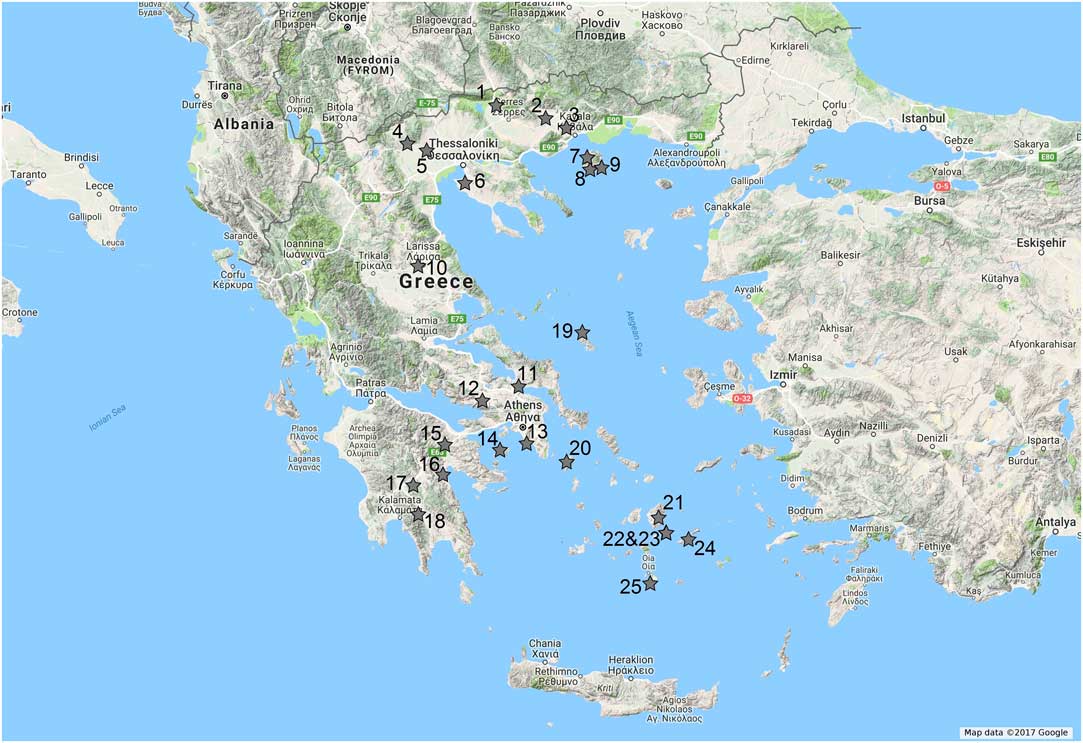
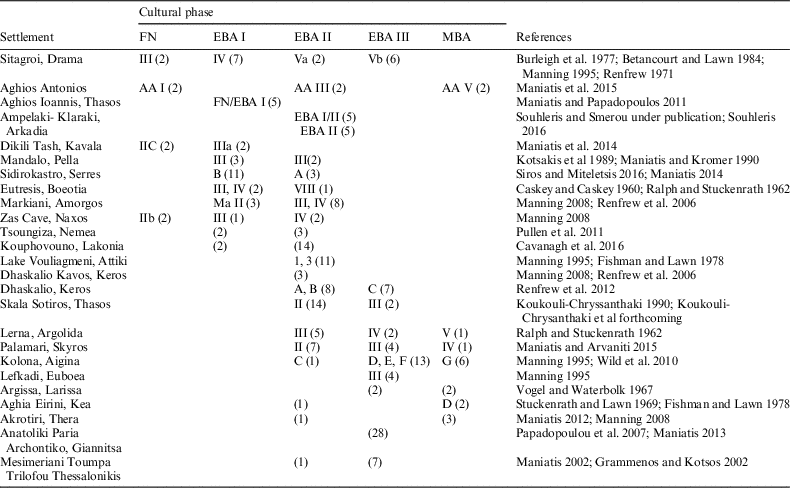
The number of dates considered and treated in this work numbered to more than 200 from 25 different sites (Table S1 in the supplemental information). Only Aegean settlements with Early Bronze Age horizons for which there were available 14C dates accompanied with archaeological information are taken into consideration. The locations of the sites where the dates come from are presented in the map of Figure 1, whereas the source of information for each site is presented in Table 1. This table also presents the number of samples available for each settlement (in parenthesis) categorized according to cultural phase. Wherever Final Neolithic (FN) and Middle Bronze Age (MBA) cultural phases were present these are also indicated in Table 1 so as to better denote the overall lifetime span of each settlement. A detailed list with all dates, sample types, location, cultural phase, relevant citation and the individual calibrated ages without any modeling is given in the supplemental information (Table S1). The Bayesian models used in each case, the prior constraints, phases and the samples included in each model and phases are adequately explained in the appropriate sections according to Bayliss (Reference Bayliss2015).
Map showing the Aegean EBA sites included in this work: 1. Sidirokastro, Serres; 2. Sitagroi, Drama; 3. Dikili Tash, Kavala; 4. Mandalo, Pella; 5. Archontiko/Anatoliki Paria, Yannitsa; 6. Mesimeriani Toumpa, Trilofo Thessalonikis; 7. Skala Sotiros, Thasos; 8. Aghios Antonios, Thasos; 9. Aghios Ioannis, Thasos; 10. Argissa, Larissa; 11. Lefkadi, Euboea; 12. Eutresis, Boeotia; 13. Lake Vouliagmeni, Attiki; 14. Kolona, Aigina; 15. Tsoungiza, Nemea; 16. Lerna, Argolida; 17. Ampelaki Klaraki, Arkadia; 18. Kouphovouno, Lakonia; 19. Palamari, Skyros; 20. Aghia Eirini, Kea; 21. Zas Cave, Naxos; 22. Kavos-Dhaskalio, Keros; 23. Dhaskalio, Keros; 24. Markiani, Amorgos; 25. Akrotiri, Thera.

EBA settlements considered in this work and their literature source. The occupational or cultural phase code numbers are as given by the excavators. The number of samples dated in each phase is shown in parentheses.

RESULTS AND DISCUSSION
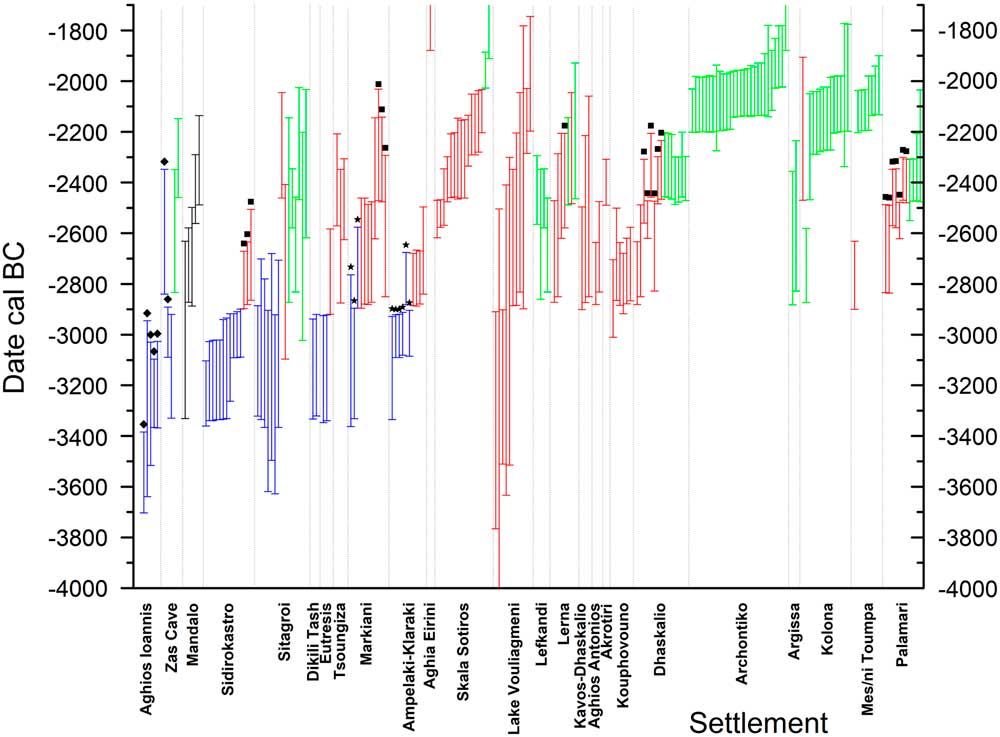
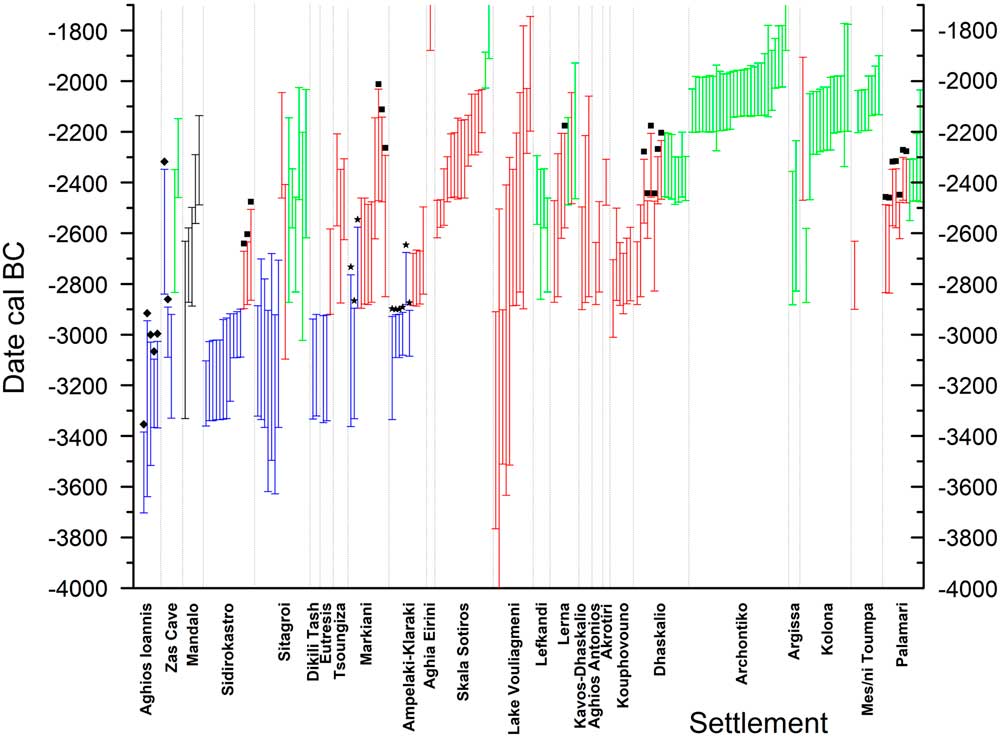
The 2σ (95.4%) calibrated dates for the settlements considered in this work are presented in Figure 2 in diagrammatic form. For simplicity we use the general term EBA for all sites although the equivalent terms EC for the islands and EH for the mainland Greece are used in individual publications, as discussed earlier. Several settlements contain also earlier (Neolithic) and later (Middle Bronze Age) horizons (Table 1) however, in the plot of Figure 2 only the dates belonging to EBA horizons were used. The dates are grouped and presented according to the main cultural phases EBA I, II, III in different colors. In the cases where intermediate phases were defined by the archaeologists, such as Final Neolithic/Early Bronze Age I (FN/EBA I), Early Bronze Age I/II (EBA I/II), or Early Bronze Age II/III (EBA II/III), the groups of dates belonging to these transitional phases are marked on the plot with a symbol above the relevant dates.
Plot showing all the calibrated dates (intervals expressed at two standard deviations–95.4% probability) from the various sites using the IntCal13 atmospheric curve (Reimer et al. Reference Reimer, Bard, Bayliss, Beck, Blackwell, Bronk Ramsey, Buck, Cheng, Edwards, Friedrich, Guilderson, Haflidason, Hatté, Heaton, Hogg, Hofmann, Hughen, Kaiser, Kromer, Manning, Niu, Reimer, Richards, Scott, Southon, Staff, Turney and van der Plicht2013) with OxCal v.4.2.4 (Bronk Ramsey 2009a). Each date is colored according to its cultural context. EBA I dates are presented in blue, EBA II in red, and EBA III in green. A rhombus symbol above the relevant date relates to FN/EBA I, a star symbol relates to EBA I/II and a square symbol relates to EBA II/III. (See online version for colors.)
For two sites in northern Greece, the archaeological publications do not categorize the horizons where the dated samples come from into the main subdivisions of EBA (I, II, III) but class them simply as EBA.
One of these sites is Mesimeriani Toumba at Trilofo Thessalonikis for which however the excavators (Grammenos and Kotsos Reference Grammenos and Kotsos2002: 159) provide useful comparisons of cultural similarity with other dated sites, such as Archontiko Yannitson dating to the latest phase of EBA (hence EBA III) (Papadopoulou et al. Reference Papadopoulou, Papanthimou and Maniatis2007; Maniatis Reference Maniatis2013) and Skala Sotiros (dating to the EBA II and EBA III phases) (Koukouli-Chryssanthaki and Papadopoulos Reference Koukouli-Chryssanthaki and Papadopoulos2016). Using this information we were able to classify most of the Mesimeriani Toumba samples to EBA III except one sample (HD-20456), which should belong to EBA II.
The second site with a series of EBA dates but no subdivision information is the site of Mandalo Pellas (Kotsakis et al. Reference Kotsakis, Papanthimou-Papaefthimiou, Pilali-Papasteriou, Savopoulou, Maniatis and Kromer1989; Maniatis and Kromer Reference Maniatis and Kromer1990). These dates are wide ranging and may belong to more than one subphases of the EBA (EBA I, EBA II or III). However, since there is no further archaeological information or comparison with other sites, we left these uncategorized, plotting them in black (Figure 2).
A serious problem appears with the raw dates of the Lake Vouliagmeni site in Attica. Several samples exhibit unrealistically high ages for this period and in addition the error bars in the radiocarbon age (BP) for most of the samples are huge (±200 or ±300 yr) making any comparison meaningless. These dates are presented in Figure 2 but excluded from any further statistical treatment and discussion.
The three dates from Zas cave in Naxos seem also problematic. Only the lower (older) date coming from an EBA I horizon can be accepted. The other two, a sea shell and a bone, coming from older horizons (FN/EBA) give younger ages (!) and hence are excluded from any further treatment and discussion.
Despite these few discrepancies and problems, Figure 2 gives a good overview of the earliest and latest appearance of the EBA in different settlements of the Aegean and also provides a direct comparison between sites in absolute calendar dates. The following information can be deduced from Figure 2:
The Earliest EBA
The earliest site appears to be Aghios Ioannis in Thasos, starting around the middle of the 4th millennium BC in unmodeled calibrated dates, although it competes closely with Sitagroi IV. However, the error bars of the Sitagroi dates are very large compared to Aghios Ioannis, a fact that does not allow a clear discrimination or synchronization between the two sites. Nevertheless, both sites have pottery with common styles found in the transition period of Final Neolithic to the EBA but also maintained in the EBA I period (Johnson Reference Johnson1999; Maniatis and Papadopoulos Reference Maniatis and Papadopoulos2011). The same features are said to be maintained in the early phases of EBA in other sites as Eutresis III-IV (Caskey and Caskey Reference Caskey and Caskey1960), the cave of Kataraktes at Sidirokastro (Siros and Miteletsis Reference Siros and Miteletsis2016) and some other sites not included in this work. Thus, the earliest dates observed at Aghios Ioannis, Sidirokastro, and Sitagroi may reflect continuous habitation at these sites from earlier periods, or an early settling of people at these previously abandoned sites (Maniatis and Papadopoulos Reference Maniatis and Papadopoulos2011; Maniatis et al. Reference Maniatis, Tsirtsoni, Oberlin, Darcque, Koukouli-Chryssanthaki, Malamidou, Siros, Miteletsis, Papadopoulos and Kromer2014, Reference Maniatis, Oberlin and Tsirtsoni2016) still carrying the FN traditions.
The EBA II Phase
This phase appears to begin at about the same period for most of the settlements with two exceptions; Sitagroi and Skala Sotiros (the Lake Vouliagmeni dates are not considered as discussed above). Regarding Sitagroi, there are two dates whose age ranges seem to extend to much earlier times compared to all other sites but this could be probably an effect of the larger error bars. Contrary to this, Skala Sotiros in Thasos seems to begin much later than the rest, which characterizes it as the last settlement in time to enter the EBA II phase.
The single date from Aghia Eirini deviates seriously from the general time span for the EBA II phase of all the other settlements, while the single date from Akrotiri falls into the general time span of the period.
The Kastri Group is a term used in the Cyclades and other Aegean sites having taken its name from a characteristic pottery style found first at the site of Kastri on Syros Island. It has often been suggested in the literature that this is a separate cultural phase and not necessarily a “chronologically coherent entity” (Angelopoulou Reference Angelopoulou2008). The Kastri phase is archaeologically dated either in the later part of EBA II or in the early EBA III (Sotirakopoulou Reference Sotirakopoulou1993; Manning Reference Manning2008; Marangou et al. Reference Marangou, Renfrew, Doumas and Gavalas2008), but usually in an intermediate period EBA II/III (Renfrew et al. Reference Renfrew, Boyd and Bronk Ramsey2012). Sites with settlements exhibiting a Kastri phase are Akrotiri, Dhaskalio (phase B), Markiani (phase IV), Palamari (phase II) and Zas (phase IV). The group of dates belonging to Kastri phase (EBA II/III) are marked on the diagram of Figure 2 with a square symbol above them.
The EBA III Phase
Lefkadi and Argissa are shown to enter first the EBA III while Sitagroi, Lerna, Dhaskalio, Palamari and Kolona follow. Skala Sotiros marks the last settlement to enter EBA III though Archontiko dates are fairly close.
STATISTICAL TREATMENT OF THE DATES
Individual Settlement Models
In order to get statistically sound calibrated ages for the beginning of the EBA phase and the transitions to EBA II and EBA III we treated the dates presented in Figure 2 and listed in the Supplemental information (Table S1), with Bayesian analysis using the program OxCal v4.2.4 (Bronk Ramsey 2013).
Concerning the settlements of Aghios Antonios, Aghios Ioannis, Dikili Tash, Sidirokastro, Kouphovouno, Dhaskalio, Kolona, Archontiko-Anatoliki Paria, and Palamari there are publications (Table 1) where a Bayesian model for each settlement can be found. These models were re-run in order to obtain the necessary information for the start boundary of the EBA and the subphase transitions in the cases where this information was not given numerically in the publication. For the sites of Sitagroi, Mandalo, Markiani, Skala Sotiros, Lerna, Lefkadi, Mesimeriani Toumba and Ampelaki-Klaraki, there were not published Bayesian models in the literature. Thus, for each of these settlements a model was constructed using the available dates in each cultural phase and subphase, as defined by the archaeologists in the relevant publications (Table 1), as prior constraints. These models included, wherever available, dates from late Neolithic horizons and Middle Bronze Age horizons for a better definition of the beginning and end of the EBA. An interval was inserted between the end of Neolithic and beginning of EBA whenever applicable since an occupation gap is documented to exist between these two periods in many sites especially in northern Greece and southeastern Europe (Maniatis et al. 2013, Reference Maniatis, Tsirtsoni, Oberlin, Darcque, Koukouli-Chryssanthaki, Malamidou, Siros, Miteletsis, Papadopoulos and Kromer2014, Reference Maniatis, Oberlin and Tsirtsoni2016; Maniatis Reference Maniatis2014; Weninger and Harper Reference Weninger and Harper2015). The code used for inserting a hiatus is as follows:
Boundary ("Neolithic End");
Interval ("Hiatus");
Boundary ("EBA Start");
This was also used for the site of Mandalo between the Neolithic and the EBA phase, however, all dates in the EBA were included in one phase (EBA) since there is no subphase information for this site as discussed earlier.
For the sites with few and scattered dates, e.g. Eutresis (2 dates in EBA I and 1 date in EBA II), Tsoungiza (1 date in EBA I and 3 dates in EBA II), and Zas cave (1 date in EBA I), the Bayesian analysis produced unrealistically high age boundaries and with very large errors. Thus, for these sites we used the weighted mean of the calibrated age for a phase with just one date and the weighted mean of the oldest date as start for the phase with two or three dates.
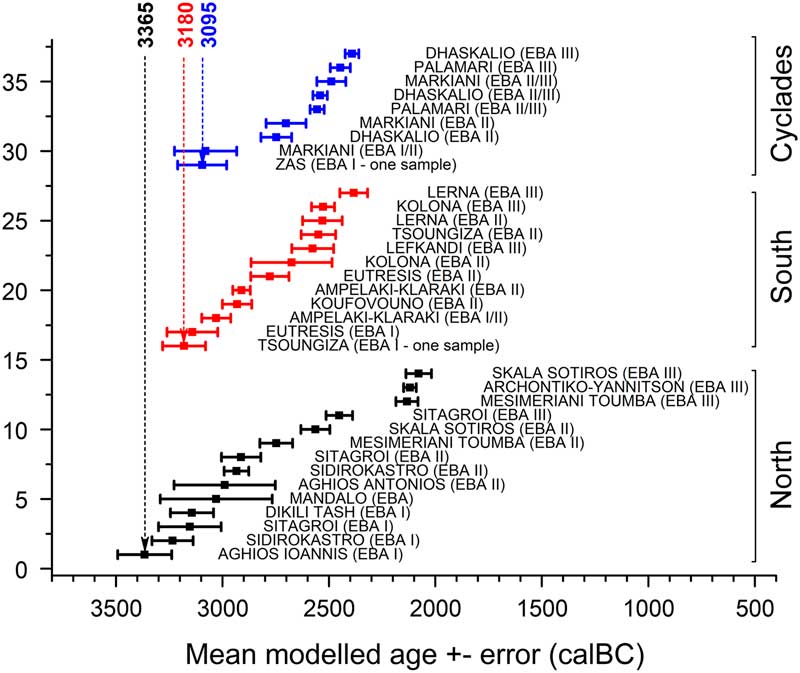
The mean age with its±1σ error bar for the start of each available cultural phase, determined as described above for every settlement, is plotted in the bar diagram of Figure 3. They are ordered according to the value of the mean age from the earliest to the latest. An absolute time sequence can therefore be constructed which allows the time shifts for each settlement and phase to be easily compared. Furthermore, the settlements are divided into three groups following the regional grouping criterion as discussed earlier. In particular, the lower group (black color) contains settlements from northern Greece including the settlements on Thasos Island, the middle group (red color) contains the settlements from southern mainland Greece including Kolona on Aegina and Lefkandi on Euboea islands and the upper third group (blue color) contains the settlements on the Cycladic Islands including Palamari on Skyros island.
Plot presenting the mean modeled calibrated age with its ±1σ error bar for the start of the available cultural phases per settlement, extracted from the output of the Bayesian analysis models or with the procedure indicated in the text. (See online version for colors.)
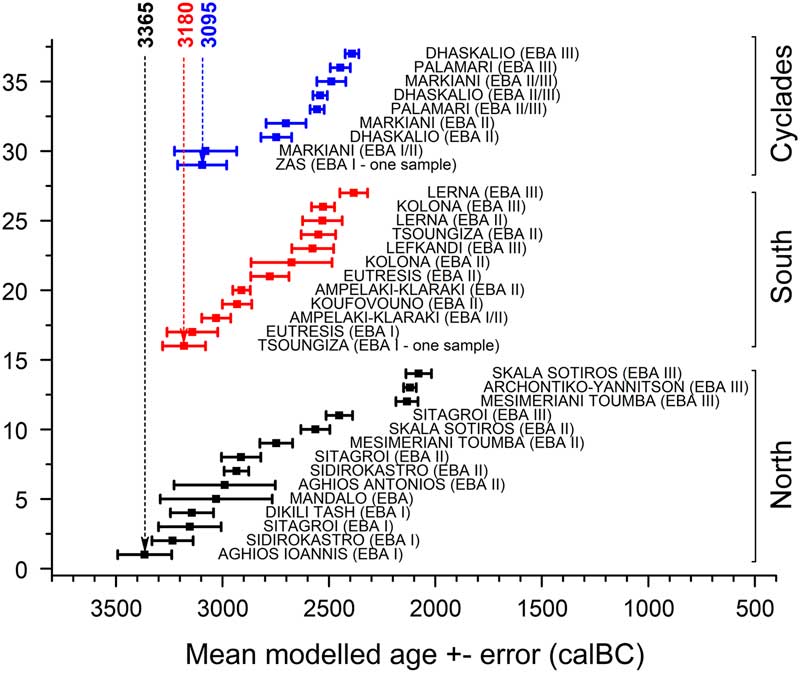
Considering northern Greece, the earliest statistical start of the EBA I among all sites considered in this work occurs at Aghios Ioannis on Thasos island, which gave an age of 3365±127 BC. It is followed by Sidirokastro (Kataraktes Cave) with a date of 3234±97 BC and this is followed by Sitagroi at 3153±147 BC, the latter being almost in full synchronization with Dikili Tash. All these sites are from northeast Greece including the nearby island of Thasos. The mean start of the EBA for Mandalo has a large error due the wide spread of dates, which may belong to different subphases as discussed earlier, so it cannot be really compared with the rest at this stage. Around 3000 BC or slightly thereafter, the EBA II phase seems to start at different sites with the earliest one Aghios Antonios, again in Thasos, although with a large error due to a small number of dates (Maniatis et al. Reference Maniatis, Nerantzis and Papadopoulos2015), and Sidirokastro with a more precise age at 2934±58 BC. It is interesting to note that the start of the EBA II ranges in the different sites from close to 3000 BC at Aghios Antonios and Sidirokastro to about 2600 BC; the latest site to enter this phase being Skala Sotiros in Thasos. The earliest start at the EBA III phase appears at Sitagroi at about 2500 BC, while at the sites of Skala Sotiros in Thasos and at Archontiko Yannitson and Mesimeriani Toumba in central northern Greece this last phase of EBA appears several centuries later and at about 2150 BC.
In southern mainland Greece, as also seen from Figure 3, the only site that contains EBA I (EH I) dated horizons is Tsoungiza in Peloponnese (one sample!) and Eutresis in Boeotia (two samples). This gives a tentative start for the earliest Bronze Age phase at 3180±101 BC in this region, which is at least a century later than the earliest start of EBA I in northern Greece. However, due to the large error this may overlap partially with Sidirokastro. The next site that follows Tsoungiza and Eutresis in our timeline is Ampelaki-Klaraki in Arkadia, Peloponnese (for a description of the site see Souhleris and Smerou under publication; Souhleris Reference Souhleris2016). The dating results of this site are not published yet, however as stated by the excavators the dates can be grouped into two phases; an earlier one corresponding to the intermediate EBA I/II (EH I/II) cultural phase and a later one corresponding to EBA II (EH II)Footnote 1 . According to the data analysis the earliest phase at this site (EBA I/II) starts at 3029±68 BC. All other dated sites in southern mainland Greece begin in the EBA II with the earliest example Kouphovouno in Peloponnese (Cavanagh et al. Reference Cavanagh, Mee and Renard2016) starting at 2931±69 BC and the latest Kolona in Aegina at 2675±190 BC. The EBA III begins first at Lefkandi in Euboea at 2576±98 BC and last at Lerna in Peloponnese starting at 2383±65 BC.
In the Cycladic Islands (including Skyros) there is only one site, the Zas cave in Naxos, with an EBA I (EC I) horizon represented only by one 14C date with a mean and 2σ at 3095±115 BC. Markiani on Amorgos island is the next earlier settlement with EBA I/II horizons (Markiani II), the start of which is dated at 3079±146 BC. Dhaskalio, which is an islet off Keros (Renfrew et al. Reference Renfrew, Boyd and Bronk Ramsey2012), begins in the EBA II phase at 2747±72 BC, followed closely by Markiani III and then the Early Kastri phase (EBA II/III) starts first at Palamari in Skyros at 2555±33 BC and almost simultaneously with the same phase at Dhaskalio. The EBA III phase starts with a small difference of about 50 years first at Palamari (2446±47 BC) and then at Dhaskalio (2391±32 BC).
In summary, from this individual treatment of sites and regional grouping we can assert that the onset of the EBA era appears first in northeast Greece. This observation is documented with results from at least four different sites. In contrast, the EBA I in southern mainland Greece or the Cyclades is not so clearly documented, and is detected only in one site or hardly in two in each region (Eutresis in Boeotia, Tsoungiza in Peloponnese and Zas in Naxos). In addition, these few sites are represented also by a very small number of samples indicating less-well established settlements in these early phases and these samples dating more than a century later than northern Greece. The EBA II is better established in the southern mainland Greece and it is almost contemporaneous with northern Greece, but it is manifested later in the islands. Finally the EBA III may be established simultaneously in southern Greece and the islands but the picture is more complicated in northern Greece where Sitagroi phase Vb starts much earlier, while all the other settlements (Mesimeriani Toumpa, Archontiko and Skala Sotiros) start much later.
Regional Statistical Models
In an attempt to produce more globally statistical dates for the EBA phase as a whole and the subphases in the three regions considered, we ran Bayesian analysis models for each region grouping the dates from samples belonging to the same cultural phase together.
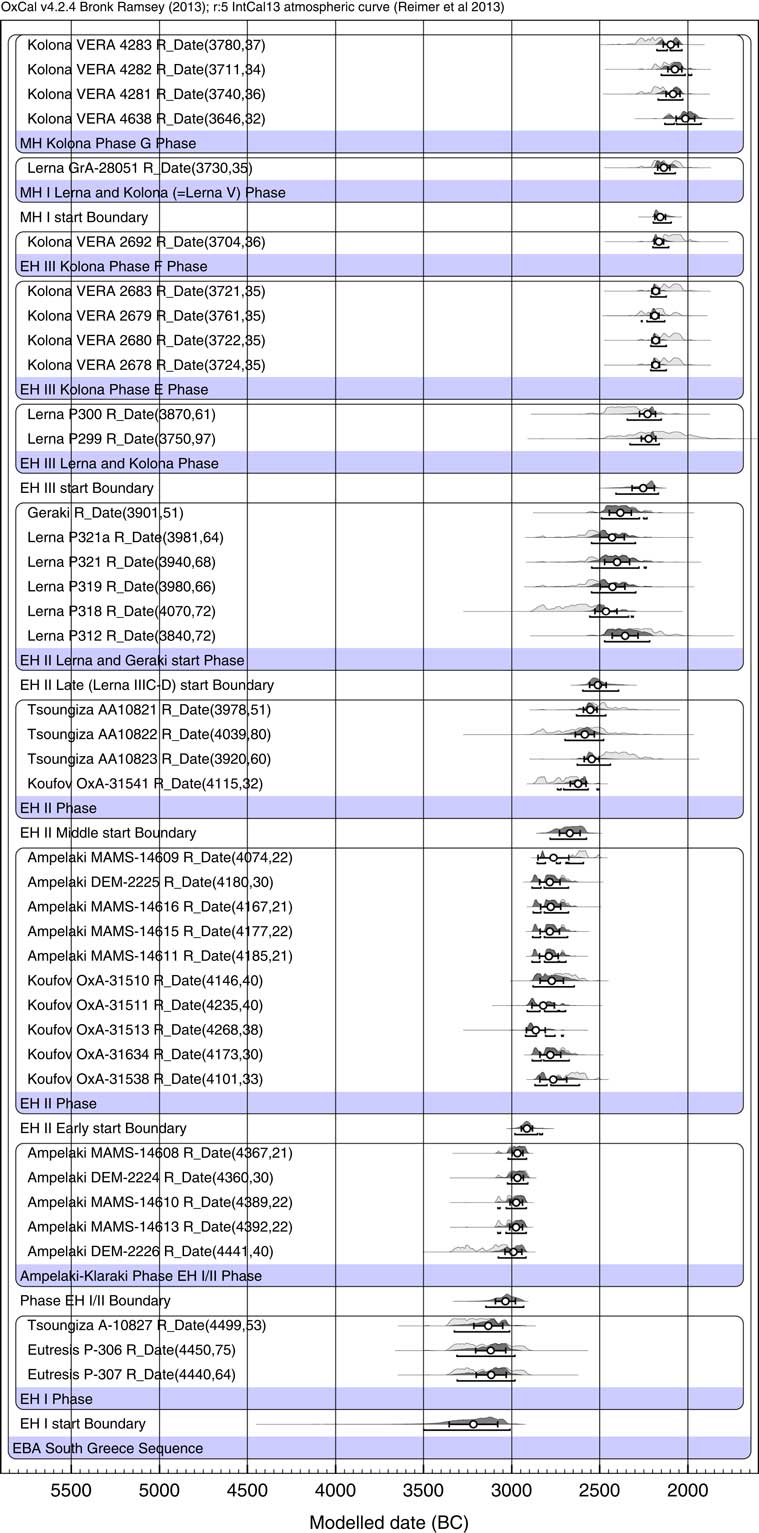
Southern Mainland Greece (Including Euboea and Aegina Island) (Figure 4)
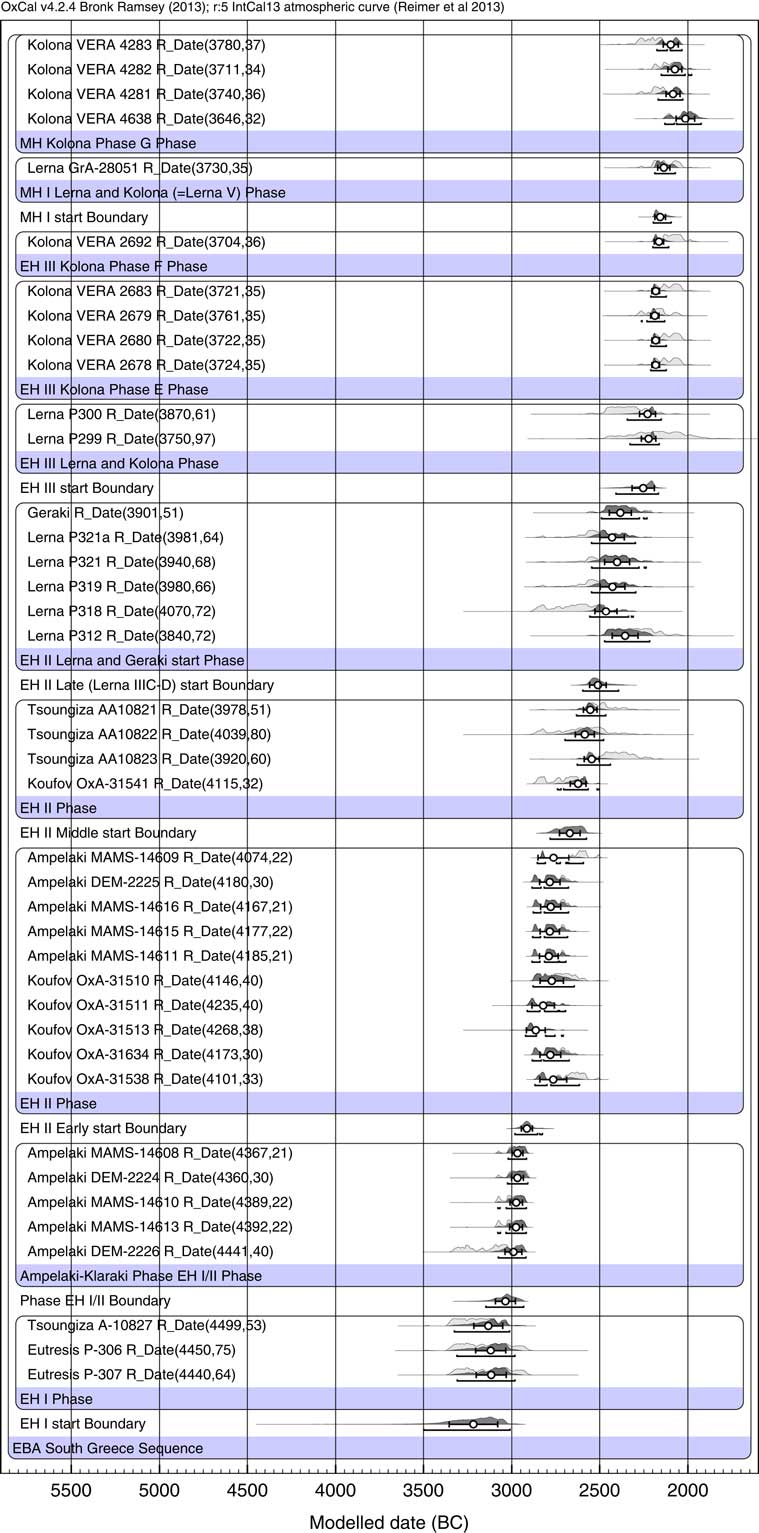
A recent model constructed and published by Cavanagh et al. (Reference Cavanagh, Mee and Renard2016) included the sites of Eutresis, Tsoungiza, Kouphovouno, Lerna, Geraki, and Kolona. This model was divided into several subphases of the EBA II (EH ΙΙ) according to pottery group associations. It also included different subphases in EBA III (EH ΙΙΙ). Starting with this existing model and keeping the prior constraints as defined and published by Cavanagh et al. (Reference Cavanagh, Mee and Renard2016), we refined it by adding the new dates from Ampelaki-Klaraki divided into two phases, EBA I/II (EH I/II) and EBA II (EH II) as discussed earlier. For the EH I/II dates we entered a new prior phase in the model called “EH Ι/ΙΙ” (EBA I/II) with appropriate boundaries between the phases EH Ι and “EH ΙΙ-Early Kouphovouno” of the previous modelFootnote 2 . The dates of the EBA II of Ampelaki-Klaraki were grouped into phase “EH II-Early Kouphovouno” together with the existing Kouphovouno dates in the model. The model ran smoothly with a convergence of over 95%. The posterior probability distributions are presented in Figure 4 and the numeric results for the boundaries of each phase are shown in Table 2.
Southern Greece model improved from Cavanagh et al. (Reference Cavanagh, Mee and Renard2016) with the addition of new dates from Ampelaki-Klaraki, Arcadia.
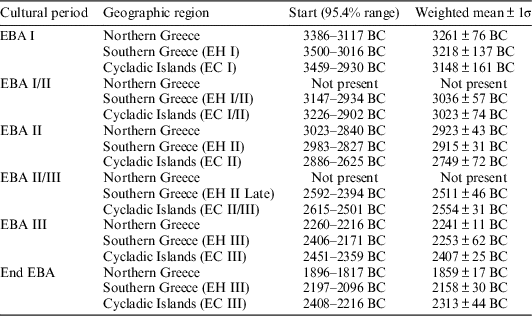
Results of the statistical analyses from the regional models for northern Greece, southern mainland Greece, and the Cycladic Islands.

As it can be seen the new Ampelaki dates of the EH I/II period fit perfectly well in between the EH I and EH II phases (Figure 4) improving greatly the model in the early phases of the EBA. Furthermore, the Ampelaki ΕΗ II dates match very nicely with the Kouphovouno dates of the same period enriching statistically this phase. The outcome is a better defined start for the EBA I (EH I) in southern Greece giving a 95% range of 3500–3016 BC with a mean at 3218 BC compared with a range of 3579–2935 BC and a mean of 3257 BC of the previous Cavanagh et al. model. The same holds for the start of the EH II phase in our refined model giving a 95% range of 2983–2827 BC (mean 2915 BC) compared with the rather broad range of 3126–2778 BC (mean 2951 BC) produced by the previous Cavanagh et al. model. Using the mean values, it appears that the earliest start of the EBA in southern Greece occurs a few decades later according to our refined model than previously predicted. Otherwise the other phase transitions are in agreement within a year between the two models.
Exploring the possibility of an old wood effect influencing the charcoal sample dates and consequently the whole model we note that the samples here are fairly mixed coming from seeds, animal bones, carbonized wood and charcoal (see Table S1 in the supplemental information). For example, the Kouphovouno dates are from animal bones, the Eutresis dates are from carbonized wood, the Kolona dates are from seeds and animal bones and the Ampelaki dates we added are charcoal from small hearths. The rest are charcoal or unknown material. A close inspection of the dates in this model reveals that there is no indication that any of the charcoal dates may be older than the short-lived sample dates. Some charcoal dates may be seen shifted slightly towards an older age and others seem shifted slightly to younger ages compared to the rest in the same phase. A similar effect could be also seen with some seed or animal bone samples indicating a natural age span of the particular phases. A small possible shift in the calibrated ages of some samples due to the recently recognized potential issue when comparing very short-lived samples, like seeds, against the smoothed calibration curve of 2013 based on decadal determinations cannot be excluded. However, this effect, if present, would be of the order of a few decades and only in a few samples, hence it is not really expected to influence the overall sequence we have compiled based on different types and kinds of samples. The fact that the dates of samples in each phase follow neatly the stratigraphic order of the phase is a very encouraging result indicating that there are no systematic effects, neither old wood effect nor short-lived sample calibration problems in this regional model.
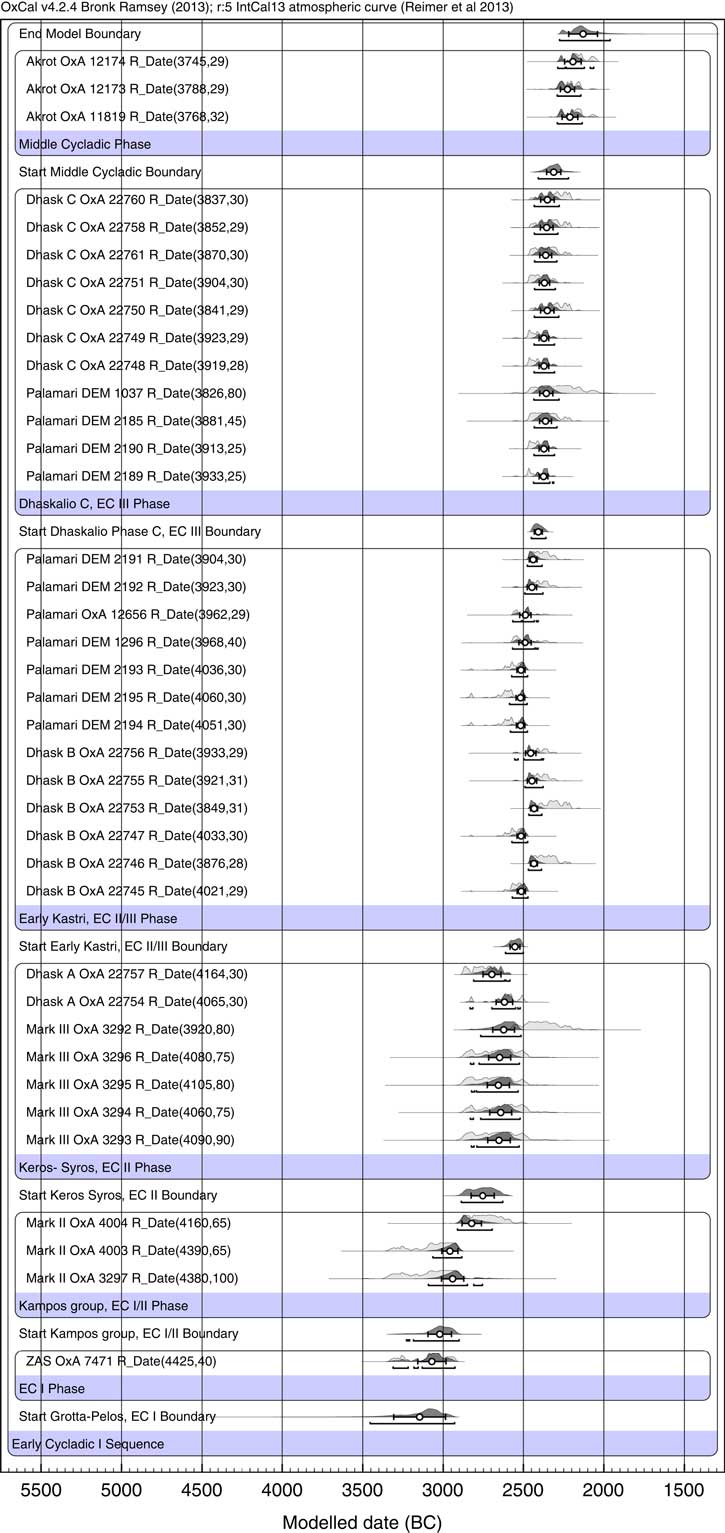
Cycladic Islands (Including Skyros) (Figure 5)
A relatively recent model was published by Renfrew et al. (Reference Renfrew, Boyd and Bronk Ramsey2012) for the Cycladic Islands using the following cultural phases: (1) the EC I/II (EBA I/II) phase (Kampos group) which included the Markiani II dates; (2) the EC II (EBA II) phase (Keros-Syros phase) which included the dates from Markiani III and Dhaskalio A; (3) the EC II/III (EBA II/III) phase (Early Katri group) which included the Dhaskalio B dates; (4) the EC III (EBA III) phase which included the Dhaskalio C dates; and (5) the Middle Cycladic (MBA) phase which included three dates from Akrotiri on the island of Thera. The names in brackets refer to the usual archaeological terminology used for the islands and some other Aegean sites defined by characteristic pottery groups named after the sites in which they were first observed. This model was rerun by Cavanagh et al. (Reference Cavanagh, Mee and Renard2016) after adding the only one existing date for the earliest Cycladic phase (EC I), the so called Lakkoudhes phase, from Zas cave on Naxos island as discussed earlier. The Cavanagh et al. model gives a start date range for the earliest appearance of the Bronze Age (EC I) in the Cyclades of 4449–2931 BC (95% range) and a mean of 3311 BC. Both the range and mean of this date must be obviously typo errors as they are far earlier than any of the dates used in the model and far earlier than the previous Renfrew et al. (Reference Renfrew, Boyd and Bronk Ramsey2012) model giving a mean of EC I start slightly above 3000 BC. The Cavanagh et al. model gives also a slightly increased start of the EC I/II phase (2774 BC mean value) compared to the earlier Renfrew et al. (Reference Renfrew, Boyd and Bronk Ramsey2012) model (2745 BC mean value). We improved further this model by adding 11 recently obtained dates of animal bones from Palamari on Skyros Island (Maniatis and Arvaniti Reference Maniatis and Arvaniti2015). These new dates come from two main occupation phases at Palamari. These are Palamari II, which according to the excavators (Parlama and Theochari Reference Parlama and Theochari2015) relate to EBA II/III associated with the Early Kastri group EC II/III and Palamari III which relates to the EBA III (EC III) phase. The 7 dates of Palamari II phase were added in the Early Kastri group (EC II/III) together with the Dhaskalio B dates and the 4 Palamari III dates in phase EC III of the existing model together with the Dhaskalio C dates. The model ran smoothly with one outlier (OxA-3292; characterized as such also in the Renfrew et al. model) and produced convergence above 95%. The posterior probability densities of this Cycladic Island model are presented in Figure 5 while the numeric results from the phase boundaries are listed in Table 2.
Cycladic Island model improved from Renfrew et al. (Reference Renfrew, Boyd and Bronk Ramsey2012) and Cavanagh et al. (Reference Cavanagh, Mee and Renard2016) with the addition of new dates from Palamari, Skyros.
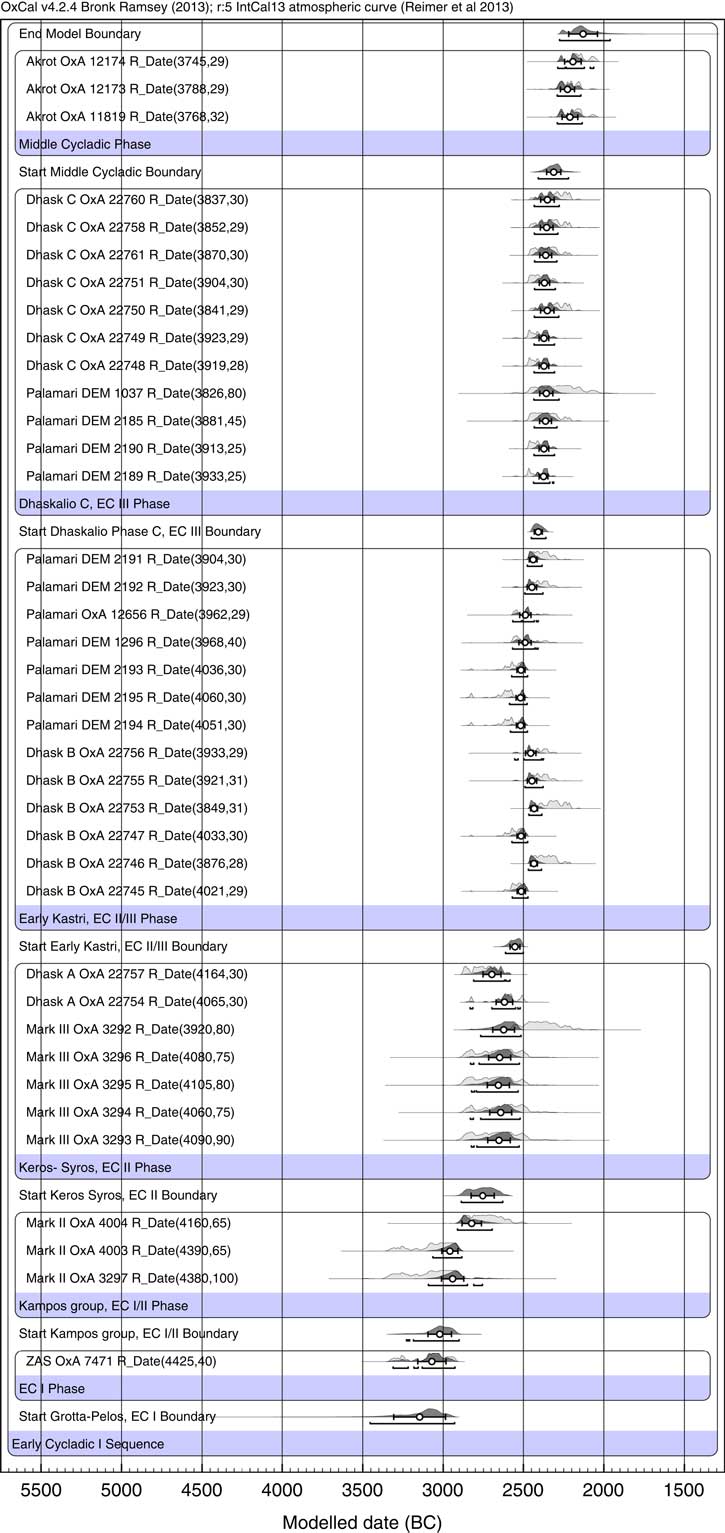
Since our model is enriched with more dates it produced a much better defined date range and mean value for the start of the EC I period as well as for the EC I/II transition compared to the Cavanagh model. Apart from that, our model produced a very close matching with the Renfrew et al. (Reference Renfrew, Boyd and Bronk Ramsey2012) mean dates for the beginning of the EC I phase (3148 BC vs. ca. 3100Footnote 3 BC), the transition to EC II phase (2749 BC vs. 2746 BC), the transition of EC II/III (2554 BC vs. 2540 BC), the transition to EC III (2407 BC vs. 2391 BC) and the end of EC III (2313 BC vs. 2290 BC). The first date in the parenthesis is our modeled boundary mean date (Table 2) while the second one is from Renfrew et al. (Reference Renfrew, Boyd and Bronk Ramsey2012).
Regarding the type of samples used in this model it should be noted that all dates in the previously published models are from charcoal samples, except one (OxA-22756) which is plant remains. The Palamari dates which we added are all short-lived samples from animal bones. One can observe in Figure 5 that the Palamari III (EC III) dates show remarkable matching with the charcoal dates from Dhaskalio of the same phase, while the Palamari II (EBA II/III) dates show an equal spread as the equivalent charcoal samples from Dhaskalio, perhaps due to the difficulty in recognizing clearly, stratigraphically and typologically, this intermediate phase (EBA II/III). Evidently, no bone date is younger than the youngest charcoal date indicating that there is no obvious old wood effect in the charcoal samples (as argued by Jung and Weninger (Reference Jung and Weninger2015) for the Dhaskalio dates) or any “hard water effect” (see specific section below), influencing the model.
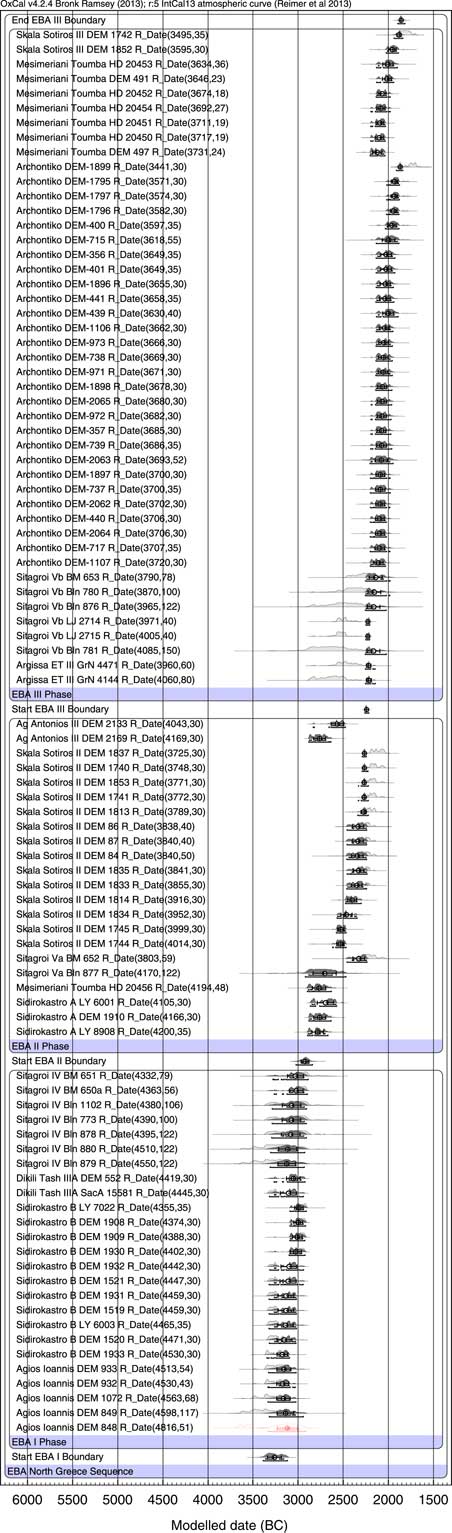
Northern Greece (Including the Island of Thasos) (Figure 6)
There was no existing model for northern Greece prior to this work, neither geographically restricted nor broader. Constructing such a model that merges dates from different sites for a large area in northern Greece is not trivial. The pottery groups and contexts are not always easily comparable and the excavators are hesitating in some instances to assign the archaeological horizons to the standard classification of EBA I, II, III although comparisons between various sites are possible. Using the available recent information from the excavators and published papers we constructed a new overall model for the EBA period in northern Greece. This model contains the three main phases EBA I, II, and III (Figure 6).
Bayesian analysis output of three-phase model for northern Greece (calibration program OxCal v4.2.4, Bronk Ramsey 2013).
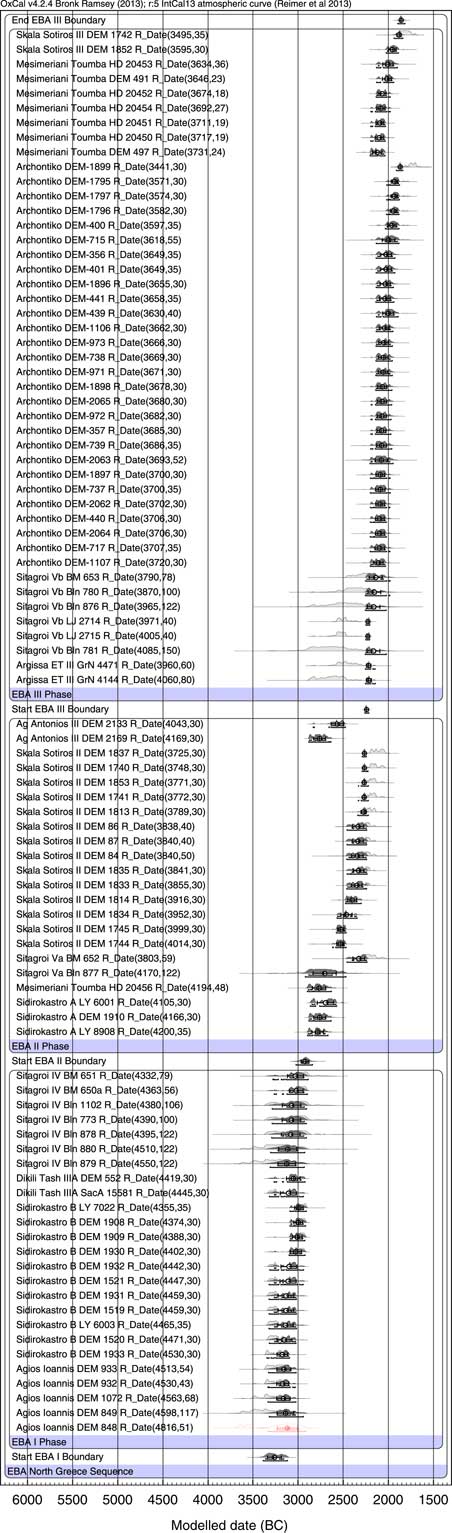
The EBA I phase includes the five available dates from Aghios Ioannis, Thasos, with the earliest date (DEM-848) assigned as an outlier with prior 100% following exactly the published model for this site (Maniatis and Papadopoulos Reference Maniatis and Papadopoulos2011). In the same phase we added 11 dates from Sidirokastro (Kataraktes Cave) B phase, belonging to the EBA I period according to the excavators (Siros and Miteletsis Reference Siros and Miteletsis2016) and the model published by Maniatis et al. (Reference Maniatis, Tsirtsoni, Oberlin, Darcque, Koukouli-Chryssanthaki, Malamidou, Siros, Miteletsis, Papadopoulos and Kromer2014). Also in the same phase we included 7 dates from Sitagroi IV, belonging to the EBA I period (Renfrew Reference Renfrew1971) and two dates from Dikili Tash IIIA (Maniatis et al. Reference Maniatis, Tsirtsoni, Oberlin, Darcque, Koukouli-Chryssanthaki, Malamidou, Siros, Miteletsis, Papadopoulos and Kromer2014).
The EBA II phase in the model includes three dates from Sidirokastro A, coming from horizons containing mostly EBA II material (Siros and Miteletsis Reference Siros and Miteletsis2016). In this phase we also added one date from Mesimeriani Toumba at Trilofo Thessalonikis (Maniatis Reference Maniatis2002), which although not assigned specifically to this phase by the excavators (Grammenos and Kotsos Reference Grammenos and Kotsos2002), should belong to the EBA II and two dates from Sitagroi Va associated with EBA II (Renfrew Reference Renfrew1971). This phase also contains 14 dates from Skala Sotiros IIa which is associated with EBA II (Koukouli-Chrysanthaki and Papadopoulos 2016; Koukouli-Chryssanthaki et al. forthcoming). We also included two dates from Aghios Antonios III belonging to EBA II (Maniatis et al. Reference Maniatis, Nerantzis and Papadopoulos2015). Since all dates conformed well to this phase of the model, no outliers were designated for this phase.
The EBA III phase includes six dates from Sitagroi Vb phase associated with EBA III. To these, we added two dates from Argissa (Thessaly) belonging to the Early Thessalian III period (Vogel and Waterbolk Reference Vogel and Waterbolk1967) in order to have a comparison between Thessaly and Sitagroi, which they were reported to be compatible. In this phase, we also included 28 available dates from Anatoliki Paria of Archontiko belonging to the latest phase of EBA (Papadopoulou et al. Reference Papadopoulou, Papanthimou and Maniatis2007; Maniatis Reference Maniatis2013), seven dates from Mesimeriani Toumba and finally two dates from Skala Sotiros III which are associated with EBA III (Koukouli-Chrysanthaki and Papadopoulos 2016).
The posterior density distribution of this new northern Greece regional three-phase model is presented in Figure 6.
The Mandalo EBA dates were not included in this model since as discussed earlier there is no information to which of the EBA subphases each one belongs. However, comparing the raw dates (Figure 2) with this phase model they seem to fit in the EBA II period.
Inspecting the output of this model one can see that there are settlements whose dates fit nicely in the appropriate phases, but also settlements whose dates do not fit in the particular phases to which they were assigned.
In particular, the EBA I phase, which contains dates from Aghios Ioannis, Sidirokastro B, Sitagroi IV, and Dikili Tash IIA seems to form a coherent group fitting quite well to this phase with a good posterior agreement (A for all >90%) and rather well defined boundaries.
The EBA II shows a bigger span than EBA I and most of the samples assigned to this phase, from Sidirokastro A, Mesimeriani Toumba, Sitagroi Va, Skala Sotiros II, and Aghios Antonios III are in good agreement. However, the Skala Sotiros II samples show a tendency to shift to younger ages with two of them (DEM-1740 and DEM-1837) producing poor posterior agreement (A<35%) as their dates shift more than the rest and slightly beyond the statistical variance of this phase. A shift to younger ages is shown also by one Sitagroi sample (BM-652). The systematic tendency of the Skala Sotiros II samples to younger ages was also observed in the individual site analysis (Figure 3) and reflects most probably a local peculiarity of this Thasos site where the EB II started slightly later than other sites and extended also to later ages.
The EBA III phase shows also good convergence on the whole, however there is some lack of coherence between the two Argissa dates and the four consecutive Sitagroi Vb dates (Bln-781, LJ-2715, LJ-2714, and Bln-876). In spite of their huge errors in their 14C dates, these sites produce older dates than the rest in this phase. In general Sitagroi Vb seems to cluster at the earliest part of this phase indicating that Sitagroi is the first of all the northern Greece settlements to enter the EBA III period, in synchronization perhaps with Argissa in Thessaly. The earlier start of EBA III phase at Sitagroi is also evident from the mean value of the start calculated from its individual sequence analysis presented in Figure 3. The remainder of the sites, Archontiko, Mesimeriani Toumba and Skala Sotiros cluster close to or a little after the end of the 3rd millennium (2000 BC) indicating that the EBA III at these sites occurred at a much later time compared to Sitagroi and Argissa, extending the overall duration of this period to around 2000 BC, contrary to the traditional assumption that the EBA ends at 2300 BC (Andreou et al. Reference Andreou, Fotiadis and Kotsakis1996). Similar dates (2060–2010 BC) were obtained from samples at Aghios Mamas Toumba in Prehistoric Olynthos, which belong to a transitional period between EBA and MBA (Hänsel and Aslanis Reference Hänsel and Aslanis2010).
Commenting on the type of samples composing this model (Table S1, supplemental information), one can see that apart from the charcoal samples there are bone samples included in Skala Sotiros and Aghios Ioannis series, charred bark and charred branches in Sidirokastro, and charred fruits and seed samples in Dikili-Tash, Sitagroi, and Archontiko. Observation shows that there is not a specific tendency of the charcoal samples to give older ages than the short lived ones and some extensions of the calibrated ranges are due to large errors associated with the BP dates and the calibration curve wiggles. The observed shifts of some samples to older or younger ages can all be explained by the characteristics of the individual sites which may show younger (e.g. Skala Sotiros) or older ages (e.g. Sitagroi) in almost all cultural phases. In summary, there is no evidence of any serious old wood effect which would influence the overall model more than the variations between the sites. Regarding, the possible shifts in age of the short-lived samples (e.g. seeds) when compared to the smoothed decadal calibration curve of 2013, mentioned above, we observe that in the sequences of most sites each phase includes seeds and charcoals or seeds, bones and charcoals. Yet, the seed dates fall always within the range of the other types of samples indicating that if any such effect is present it would be at a non-traceable level and within the errors.
Notes on Possible Hard Water or Reservoir Effects
It has been suggested that plants growing on limestones or next to lakes, rivers etc, may be enriched in dead carbon due to hard freshwater uptake, known as “hard water effect.” Consequently, bones of humans or animals eating these plants or seafood may exhibit reservoir effects and hence their 14C ages may appear older than expected (effects summarized by Wiener Reference Wiener2011 and Wiener and Earle Reference Wiener and Earle2014).
In our case, the charcoal, seeds and fruit samples come from terrestrial plants so the only possible contamination effect one could consider would be a possible “hard water effect” (Wiener Reference Wiener2011; Wiener and Earle Reference Wiener and Earle2014). As discussed in the “Regional Statistical Models” section we have not observed any systematic differences between short-lived and long-lived samples or between these and the bone samples, which indicates that hard water or other effects are not likely. However, as a further confirmation we have examined the δ13C values obtained with IRMS for a number of the dated samples of charred seeds, fruits and charcoals. As it appears the δ13C values of charcoals vary in all sites between −23.00 and −25.00‰, while those of seeds are typically around −22.00‰, indicating that there is no influence of carbon from carbonates. Very rare charcoal samples exhibit values of −26.00 or −27.00‰ but this could be better explained by the nature of the samples (specific plants, bark, etc.) rather than the influence of any hard water uptake. These values are within the range of the whole database of the lab coming from all over Greece (Maniatis and Papadopoulos Reference Maniatis and Papadopoulos2011). Furthermore, the dates of these particular samples are by no means older than the rest of samples in the specific occupation phase in which they belong. Thus, a hard water effect can be excluded or if present it would be influencing the 14C dates uniformly at very many sites in the Aegean given the fact that the bedrocks of Greece and Asia Minor are basically consisting of limestone and marble.
Regarding possible reservoir effects on bones, we should note that the bone samples used in this work are bones from terrestrial herbivore animals (sheep, goat, cattle, and occasionally some pigs), which are not usually expected to exhibit reservoir effects. However, we have investigated the possibility of such effects on the bone samples used in this work. The main sequences containing numerus bones each that are worth investigating come practically from two sites: (1) Skala Sotiros on Thasos Island and (2) Palamari on Skyros Island. Skala Sotiros is a coastal site at the mouth of a valley obviously the delta of an ancient river. Palamari is also a coastal site again at the delta of rivers which in those times formed a lagoon close and around the site. We checked the δ13C values of those bones and as it appears the values for Skala Sotiros for the majority of the bone samples (11 out of 13) cluster in the narrow range –19.0 to –20.3‰, which are typical values of prehistoric herbivores in the Aegean (Vika Reference Vika2011; Kontopoulos and Sampson Reference Kontopoulos and Sampson2015). Two samples (DEM-1853, 1814) show slightly higher values, −18.0 and −17.5‰ respectively, but their 14C dates are within the normal distribution of the rest of the bone and charcoal samples within this phase (EBA II) (see supplemental information and Figure 6). The slightly higher δ13C values of these two bone samples may be explained by the presence in the sample of some bone fragments from animals of a relatively mixed diet (e.g. pigs). Similarly, the Palamari bone δ13C values cluster all (10 samples) in also the same narrow range −19.25 to −20.55‰ (Maniatis and Arvaniti Reference Maniatis and Arvaniti2015), and are totally unrelated to the their 14C age. In addition, the dates of the bones are compatible with the dates of charcoals (see supplemental information and Figure 5). Hence, there is no evidence to suggest that any measurable reservoir effect would have shifted the animal bone dates and hence distort the picture of the boundary dates for the EBA at individual sites or regions.
Discussion of the Regional Models
The numerical results for the start boundaries for each phase of the above three models are presented in Table 2. We can conclude from this table that EBA I appeared earlier in northern Greece with a mean date of 3261±76 BC than in southern mainland Greece (3218±137 BC) and the Cyclades (3148±161 BC). These differences may be less discernible when the errors produced by the models are taken into account. However, as shown in Figure 3, the EBA I is better documented in northern Greece with more sites and more samples/layers. Contrary to this the EBA I in southern mainland Greece is present with only three scarce samples (two at Eutresis and one at Tsoungiza), while in the Cycladic Islands with only one sample at one site (Zas Cave). We therefore conclude that during the early phases of the Bronze Age period, there was little activity in the south and the islands.
The earlier appearance of the Aegean EBA in the north of Greece and more specifically in the area of northeast Macedonia and the nearby island of Thasos, as revealed with these results, may be related to the fact that EBA I cultures appear to be established earlier further north inside southern Bulgaria (Upper Thrace).14C dates giving ages close to the middle of the 4th millennium BC have been reported (Nikolova and Görsdorf Reference Nikolova and Görsdorf2002). Furthermore, similarities of Sitagroi cultural material with Bulgarian and other Balkan cultures have been also discussed by Renfrew (Reference Renfrew1971). An interesting outcome from this analysis is also the simultaneous appearance of the EBA III, the last phase of EBA, in the north and south mainland a couple of centuries earlier than in the islands, a phenomenon that needs further investigation. Finally, the end of the EBA in the Aegean, determined at 2300 BC for the Cycladic Islands, 2160 BC for the southern mainland Greece, and 1900 BC for northern Greece indicates that the following phase (MBA period) is established earlier in the Islands and later in the southern mainland of Greece, while it is short and obscure in northern Greece (Maniatis Reference Maniatis2014) following a much prolonged EBA.
Jung and Weninger (Reference Jung and Weninger2015), based on detailed treatment of a few specific sites in southern mainland Greece, come to the conclusion that the end of EBA could be around 2100 BC which is in agreement with our results for a date of 2160 BC resulting from a larger number of sites. For the Cycladic Islands their results also point to an earlier end, not later than 2200 BC. They present no data for northern Greece. The same authors discuss also the climatic event at 2400–2000 BC in the central Mediterranean and the Aegean, with “perhaps” the strongest climatic perturbation at around 2160 BC (the so called 4.2 ka cal BP event), and its possible impact on the Aegean settlements. They come to the conclusion that it has not affected the transition EBA IIB to EBA III when the existence of an occupation gap had been suggested in earlier publications, based on archaeological evidence (Rutter Reference Rutter1979, Reference Rutter1983, Reference Rutter1984), and which is bridged anyway with more evidence recently (Kouka Reference Kouka2013; Pullen Reference Pullen2013), but if anything this could have affected the end of EBA III. The 14C evidence we have accumulated here shows that there is no time-gap in the transition from EBA II to EBA III. As far as the end of EBA III is concerned, in the Cyclades the end is earlier than the peak of the climatic event of 2160 BC, while in the mainland Greece the end at around 2160 BC seems to coincide with the climatic event, but at Kolona (Aegina) for which there are systematic 14C dates life continues without interruption into the MBA period until after 2000 BC. Finally, in northern Greece the EBA III seems to continue well through the climatic event and until 1900 BC.
CONCLUSIONS
We have accumulated a large number of 14C dates from various settlements in the Aegean (mainland Greece and the Cycladic Islands) in an attempt to define the geographical area of the earliest start of the Bronze Age culture and the way it spread in an absolute time frame.
We ran Bayesian statistical analysis models for each individual site considered in this work as well as regional models for northern Greece, southern Greece, and the Cycladic Islands.
A regional model for northern Greece is constructed and presented for the first time. In addition, we improved and refined pre-existing regional models for southern Greece and the Cyclades by adding new sites and dates.
From the combination of the individual site analysis and the regional models, an overall picture for the Aegean EBA time span and geographical spread can be produced.
The picture which emerges is very interesting although complex to a certain degree. One complication is that each settlement or area may have some unique features not readily comparable. A second complication is that the change from the Late Neolithic to the EBA is not easily discerned in some places from the pottery or other material evidence. In any case, and keeping in mind these complications, we may summarize the results as follows:
1. The earliest start of the EBA I seems to occur at about 3261±76 BC in northern Greece. The site of Aghios Ioannis in Thasos is the earliest followed by Kataraktes Cave at Sidirokastro and Sitagroi in Drama. These sites are all in northeastern Macedonian Greece, indicating that this area is probably the cradle of the rise of the Early Bronze Age culture in the Aegean and this may be tentatively related to the earlier appearance of the EBA in sites further north in Bulgaria.
2. In contrast, the EBA I in the south and the Islands is less well represented.
3. The EBA II phase is more widely distributed all over the Aegean starting almost simultaneously in northern and southern Greece while in the Cyclades the appearance of EBA II is delayed for more than a century.
4. There is a different picture for the onset of EBA III when Cyclades seem to enter first this phase with the exception of one site in the north (Sitagroi) and one in the south (Kolona) that they start earlier.
The whole EBA period in the Aegean ends in the Cyclades about 200 years earlier than the southern mainland Greece and about 400 years earlier than northern Greece where the end of EBA is particularly prolonged.
Further research should be carried out to enrich the results with more settlements from around the Aegean and mainly with settlements from Crete and Anatolia.
ACKNOWLEDGMENTS
We would like to thank the archaeologists and excavators who trusted to us their samples and for their cooperation. We would also like to thank the Radiocarbon Laboratory of Heidelberg University (Bernd Kromer and Samuel Hammer) for their continuous technical support. Thanks are also due to Chris Ramsey of the Oxford Accelerator Unit for his help on the use of outlier models.
Supplementary material
To view supplementary material for this article, please visit https://doi.org/10.1017/RDC.2018.28