Performance limitations have frequently been invoked as an explanation for children’s language errors and non-adult-like patterns of language use. The general idea is that immature cognitive abilities mask an underlying representational competence; children’s errors stem from an inability to access or deploy that competence. However, the exact cognitive mechanisms that impede performance have rarely been directly specified or measured. Instead, they have been deduced from the ways that changes to the stimuli or context change performance (e.g., Crain & Thornton, Reference Crain and Thornton2000; Musolino & Lidz, Reference Musolino and Lidz2006; Papafragou & Musolino, Reference Papafragou and Musolino2003; Valian & Aubry, Reference Valian and Aubry2005; Valian, Hoeffner, & Aubry, Reference Valian, Hoeffner and Aubry1996). The current work delves more specifically into the nature of performance limitations as a source of children’s non-adult-like performance. It examines a well-studied underextension found in children’s production and comprehension of aspect morphology (i.e., the imperfective marker –ing and the simple past/perfective marker –ed) and includes independent assessments of neurocognitive skills that are plausibly connected to appropriate performance with the linguistic elements, above and beyond the needed linguistic competence.
Aspect: a task analysis
Aspect refers to two distinct ways that languages mark the temporal properties of events (the third major way is tense; cf. Comrie, Reference Comrie1976; Klein, Reference Klein1994; Smith, Reference Smith1991; Vendler, Reference Vendler1967). Lexical aspect refers to the temporal properties of a predicate: specifically, it refers to the properties conveyed through the meanings of lexical items in the sentence, particularly the verb and its arguments. The primary division for this category centers on whether an event is described as having an inherent endpoint (called telic) or as a state or action that can occur for an indefinite period of time (called atelic). A telic predicate like paint a circle specifies when the event is over, namely, when there is a completed circle. By contrast, an atelic predicate like listen to music describes something that could happen for any arbitrary length of time. Grammatical aspect refers to the perspective that a speaker takes on an event and is conveyed through grammatical means—in English, through verb morphology. The primary division for this category centers on whether an event is described from an external perspective that includes its entirety (called perfective) or from an internal perspective that focuses on the event’s ongoing progress (called imperfective). In English, perfective meaning is conveyed through the simple past tense form on a verb (e.g., Marie painted a circle), whereas imperfective meaning is conveyed through the progressive –ing form (e.g., Marie was painting a circle).
Lexical and grammatical aspect are largely independent of each other and most predicates (both telic and atelic) can appear with either perfective or imperfective marking. However, cross-linguistically, children show a strong preference for only some combinations of lexical and grammatical aspect, yielding a pattern of underextension (e.g., Antinucci & Miller, Reference Antinucci and Miller1976; Berman, Reference Berman1983; Bloom, Lifter, & Hafitz, Reference Bloom, Lifter and Hafitz1980; Bronckart & Sinclair, Reference Bronckart and Sinclair1973; Shirai & Andersen, Reference Shirai and Andersen1995; Weist, Wysocka, Witkowska-Stadnik, Buczowska, & Konienczna, Reference Weist, Wysocka, Witkowska-Stadnik, Buczowska and Konienczna1984). Specifically, children preferentially produce and show better understanding of telic predicates with perfective marking over imperfective marking, and of atelic predicate with imperfective marking over perfective marking. That is, children prefer The girl painted a circle (telic + perfective) over The girl was painting a circle (telic + imperfective), and The girl was listening to music (atelic + imperfective) over The girl listened to music (atelic + perfective).
While some researchers have argued that this pattern reflects an immature grammar (e.g., Radford, Reference Radford1990) or is a consequence of an inability to think sufficiently abstractly about time (e.g., Bronckart & Sinclair, Reference Bronckart and Sinclair1973), the dominant explanation in the literature for this pattern of underextension is that it stems from performance limitations on the part of the child: children possess the necessary linguistic and cognitive representations for the full range of forms, but they have difficulty deploying them (see Wagner, Reference Wagner and Binnick2012, for a review). The evidence in favor of this position comes from several sources, all of them indirect. For example, adults show a general (if less extreme) preference for the same combinations as children (Andersen & Shirai, Reference Andersen and Shirai1994; Fedder & Wagner, Reference Fedder and Wagner2015; Shirai & Andersen, Reference Shirai and Andersen1995; Wagner, Reference Wagner2009; Yap et al., Reference Yap, Chu, Yiu, Wong, Kwan, Matthews and Shirai2009). As adults are fully competent with their morphosyntax and have well-developed vocabularies, performance issues are the only viable explanation for their underextensions, and thus, by parsimony, they are the best explanation for children’s patterns. Moreover, children’s performance (as well as that of adults) is influenced by the specific cues provided within an experiment: with more contextual information about the situation, children are better able to interpret the less-preferred forms (Kazanina & Phillips, Reference Kazanina and Phillips2007; Wagner, Reference Wagner2009). The nonpreferred forms are argued to be “harder” and therefore require additional cognitive processing, some of which impedes children’s (and sometimes adults’) ability to succeed in the task.
The sense in which the nonpreferred forms are harder has been described as a prototype effect: the preferred forms are easier by virtue of being more prototypical than the less preferred ones. However, the underlying mechanism generating the prototypes has been articulated in two (not mutually exclusive) ways. The first is a frequency-based account: prototypes are the most common exemplars for a concept (Rosch, Reference Rosch1973; Rosch & Mervis, Reference Rosch and Mervis1975), and the preferred combinations are more frequent in the adult language (Li & Shirai, Reference Li and Shirai2000; Shirai & Andersen, Reference Shirai and Andersen1995). Children’s preference for the prototypical combinations is just a (somewhat more extreme) reflection of the frequency patterns of their input. Producing and interpreting non-prototypical combinations, therefore, requires children to inhibit a dominant response toward a high-frequency pattern.
The second type of account aims to explain the origin of the prototypes in linguistic and information-processing terms (Li & Shirai, Reference Li and Shirai2000; Wagner, Reference Wagner2009, Reference Wagner and Binnick2012); in this account, the frequency differences are a by-product of more principled connections. At a linguistic level, the different semantic structures of telic and atelic predicates interact with grammatical aspect in systematically different ways (see Bohnemeyer & Swift, Reference Bohnemeyer and Swift2004; Comrie, Reference Comrie1976; Klein, Reference Klein1994; Smith, Reference Smith1991; Vendler, Reference Vendler1967). Consider first telic predicates. These predicates have a natural progression that works toward a distinctive ending. The ending is a defining feature of the event, and in many cases, the stages of the event before the ending build progressively toward the ending: if The girl built a house in a week, then each day she has a little more of the house, and on the last day, she has a completed one. The prototypical grammatical aspect morphology for telic predicates is perfective, which asks the listener to take an exterior perspective that includes all the stages of an event, including the defining final one. By contrast, the non-prototypical combination of imperfective + telic asks the listener to take an internal perspective on the event which does not include its final boundary point. Linguistically speaking, the imperfective removes the entailment of completion on the telic predicate and allows one the freedom to consider alternative possible endings: The girl was building a house but she lost financing and never finished. In this case, the predicate—spelled out in the lexical content words of the sentence—provides information about the girl’s intention but not necessarily about the outcome of the event: the lexically named outcome of the event must be set aside to allow for the alternatives.
For atelic predicates, the interactions work differently. Atelic predicates describe events in a homogeneous way where each subpart of the event is essentially the same. Thus, if The girl listened to music (an atelic description) from 3:00 to 4:00 p.m., she also listened to music from 3:15 to 3:45 p.m., and from 3:20 to 3:25 p.m. Because the event is conceptualized as the same throughout, the same predicate applies equally to all of its subparts. The prototypical grammatical aspect morphology for atelic predicates is imperfective. In this case, taking an internal perspective poses no difficulty as the internal stages are the same as the whole. If one can truthfully say that The girl was listening to music (imperfective), then one can also truthfully say that The girl listened to music (perfective). The non-prototypical pairing of atelic predicates with perfective marking does not lead to a principled linguistic difficulty, but it does lead to a practical one: without a characteristic end point for the event, how can one decide that an event is over? One needs to marshal knowledge about specific word meanings (sleeping is something that typically takes longer than swimming) and real-world contexts (there can be pauses in the music while you are still listening to it, but pauses in breathing arguably stop the entire event) in order to assess whether a perfective perspective is true.
While the literature has agreed that the prototypical combinations of lexical and grammatical aspect are easier to process than the non-prototypical combinations, there have been no attempts to directly link the analyses just provided to specific cognitive dimensions. We hypothesize that executive function skills, rich world knowledge, and lexical representations are the most likely candidates for generating the performance limitations reflected in the underuse of non-prototypical combinations.
Inhibitory control, cognitive flexibility, and aspectual representation
Executive function refers to a suite of higher order, top-down processing skills that allow for planned, effortful behaviors; two of the core skills within this suite are inhibitory control and cognitive flexibility/set shifting (Miyake et al., Reference Miyake, Friedman, Emerson, Witzki, Howerter and Wager2000; Zelazo, Müller, Frye, & Marcovitch, Reference Zelazo, Müller, Frye and Marcovitch2003). These skills develop throughout childhood and the adolescent years (Welsh, Pennington, & Groisser, Reference Welsh, Pennington and Groisser1991; Zelazo & Müller, Reference Zelazo, Müller and Goswami2002) and their trajectory coincides with protracted maturational changes in the prefrontal cortex up through early adulthood (Gogtay et al., Reference Gogtay, Giedd, Lusk, Hayashi, Greenstein, Vaituzis and Thompson2004; Moriguchi & Hiraki, Reference Moriguchi and Hiraki2011). Executive function has been shown to support online language comprehension and recovery from garden-path sentences, and in the resolution of lexical ambiguity (Khanna & Boland, Reference Khanna and Boland2010; Novick, Hussey, Teubner-Rhodes, Harbison, & Bunting, Reference Novick, Hussey, Teubner-Rhodes, Harbison and Bunting2014; Novick, Trueswell, & Thompson-Schill, Reference Novick, Trueswell and Thompson-Schill2005; Vuong & Martin, Reference Vuong and Martin2014, Reference Vuong and Martin2015).
On a frequency account of the aspectual prototype effects, inhibitory control would be a critical dimension for processing both of the non-prototypical combinations. High-frequency items are typically accessed more quickly and more easily than low-frequency items (Ellis, Reference Ellis2002; Nosofsky, Reference Nosofsky1988; Rosch, Simpson, & Miller, Reference Rosch, Simpson and Miller1976). To produce or interpret the non-prototypical items, the fast and dominant response to the prototypical items would have to be blocked to allow access to the lower frequency combinations.
On a more linguistically based account of the prototypes, however, inhibitory control and set-shifting skills would be particularly useful only for processing the non-prototypical combination of telic + imperfective sentences. For these sentences, what children must do is ignore the ending specified by the lexical items in the sentence: they must interpret She was building a house without regard to the end point (a house) that is mentioned in the sentence. Inhibitory control would allow children to suppress the use of the critical ending information and set shifting would allow children to switch from an interpretation involving the ending to one without it. In contrast, for the non-prototypical combination of atelic + perfective, set-shifting and inhibitory control skills are not especially necessary for the interpretation.
Vocabulary size and aspectual representation
The size of a child’s receptive vocabulary is not only a marker of how many words she knows but also a proxy for overall linguistic ability and exposure to a variety of life experiences (e.g., Hart & Risley, Reference Hart and Risley1995; Lee, Reference Lee2011) and has been linked to reading ability, inference making, and narrative understanding (Currie & Cain, Reference Currie and Cain2015; Florit, Roch, Altoè, & Levorato, Reference Florit, Roch, Altoè and Levorato2009; Oakhill & Cain, Reference Oakhill and Cain2012). Vocabulary size is a plausible measure of the richness of children’s lexical representations as well as of their ability to interpret words across contexts. In the case of aspect, such skills would be particularly useful for interpreting the non-prototypical combination of atelic + perfective sentences. For these cases, children must draw on world knowledge about how events unfold as well as about the words typically used to describe them. However, vocabulary size is not obviously linked to a frequency-based account of prototypicality. Knowing more words just provides more evidence for the prototypes as the adult language shows the same frequency skew in favor of the prototypical forms, and contextualizing world knowledge has no direct impact on frequency counts within the linguistic forms. Moreover, vocabulary size is also not obviously linked to interpreting telic + imperfective sentences, which involves focusing on a subpart of a named event.
Experimental overview
The following experiment used a classic aspect interpretation task from the literature in which participants matched a sentence to one of two pictures (cf. Wagner, Reference Wagner2009; Weist, Wysocka, & Lyytinen, Reference Weist, Wysocka and Lyytinen1991). The sentences were either imperfective or perfective. The pictures showed the same event at two different phases: a middle phase where the action was ongoing and the ending not yet accomplished (the correct match for the imperfective sentence), and an ending phase where the action was over and the event complete (the correct match for the perfective sentence). We predicted that, overall, we would replicate the established result that participants would be more successful at correctly matching the prototypical combinations (telic + perfective and atelic + imperfective) than the non-prototypical combinations (telic + imperfective and atelic + perfective).
Following the aspect interpretation task, participants were assessed for the following: inhibitory control using the Flanker task; cognitive flexibility using the Dimensional Change Card Sort task; and receptive vocabulary size using a picture vocabulary test. In addition, children were given a picture comparison task to complete. In order to differentiate the pictures of the two phases of the events, participants need to be able to quickly notice relevant differences, and this measure served as a control for demands of the specific aspect task used.
Our analyses focused on the links between neurocognitive and receptive vocabulary abilities and performance on the aspect task. If a simple frequency account of prototypes is correct, then we predict a positive correlation between inhibitory control and both kinds of non-prototypical forms. If prototypes depend more thoroughly on principled linguistic and information processing structures, then we predict (a) a positive correlation between the two executive function measures (inhibitory control and set shifting) and success with the telic + imperfective sentences, and (b) a positive correlation between vocabulary size and the atelic + perfective sentences. Both children and adults were tested, and we predict that while adults would outperform children in general, they would nevertheless still show small decrements in performance for the less-preferred combinations, as well as positive correlations with the neurocognitive measures.
Method
Participants
All participants were recruited and tested at a local science center. There were 32 participants in the child group (mean age = 5.82 years, ranging from 4.81 to 6.94 years, 16 boys and 16 girls). According to parental report, all children had typical speech and language development and were monolingual speakers of English; 72% of the children were identified by their parents as Caucasian, 22% were identified as African American, and the remainder were identified across other categories. All participants came from a moderate to high socioeconomic status background based on the zip codes in which they lived. An additional 7 children were not included in the final analyses because they failed to complete all the tasks in the study (e.g., fatigue or refusal to continue). The adult group consisted of 32 adults (mean age = 21.94 years; ranging from 18.05 to 32.32 years, 16 men and 16 women). This group self-reported typical speech, language, hearing, and developmental histories and indicated that English was their native or primary and dominant language. Demographic characteristics of the adults were very similar to the children: 75% were Caucasian, 19% were African American, and the remainder identified across other categories; adults also came from moderate to high socioeconomic status backgrounds. This study was approved by a university institutional review board.
Materials
Aspect task
The stimuli for the aspect task consisted of pairs of still pictures and recorded sentences presented using E-Prime. In each picture-pair, one picture depicted an ongoing representation of an event (e.g., a woman halfway through painting a circle with a paintbrush in hand and an incomplete circle in front of her) and the other picture depicted a completed representation of that same event (e.g., the same woman sitting happily by a fully painted circle). There were 16 unique events depicted, half of which were described with telic predicates and half of which were described with atelic predicates. Telic predicates describe the end point of an event, and the pictures showing the completed versions of Telic events always included the designated ending. Atelic predicates do not describe their event’s ending, and the pictures showing the completed versions of atelic events relied on conventional inferences (e.g., the woman had put down her tools) to indicate the event was over. Both the verbs and the argument NPs were considered in determining telicity. For atelic predicate types, the actor was never actively engaged in the completed version of the event, and she was always actively engaged in the ongoing version of the event. The methods used for the aspect task, including stimuli and trial numbers, are consistent with previous studies evaluating tense–aspect comprehension in children (e.g., Weist et al., Reference Weist, Wysocka and Lyytinen1991; Wagner, Reference Wagner2001).
All participants saw the same 16 picture-pairs, but each participant matched only a presented target sentence (either imperfective or perfective) to a picture within a given pair (which was counterbalanced and randomized within each group). Thus, each participant received four items in each of the four conditions: telic + perfective, telic + imperfective, atelic + perfective, and atelic + imperfective. Target sentences were presented via audio recordings and contained a directive to choose a picture. Sentences, spoken by a female native American-English speaker, were digitally recorded in a double-walled sound booth and equated for total root mean square amplitude. Every participant was presented with half of the telic predicates and half of the atelic predicates with perfective morphology (the simple past form: “Choose the picture where the girl blew up the balloon”; “Choose the picture where the girl played with the toys”) and the remaining telic predicates and atelic predicates with imperfective morphology (the past progressive form: “Choose the picture where the girl was drinking the glass of juice”; “Choose the picture where the girl was carrying the box”). Thus, all participants were presented with all four combinations of lexical and grammatical aspect (telic + perfective, telic + imperfective, atelic + perfective, and atelic + imperfective), and across counterbalanced lists, each picture-pair was described with both an imperfective and a perfective target sentence. Two atelic and two telic predicates took irregular past forms, and the rest used regular past tense forms. Figure 1 shows some example trials and Table 1 lists the full set of target sentences.
Trial schematics for one telic and one atelic predicate. Note that each participant heard only one target sentence (either perfective or imperfective) per pair.

Target sentences for the aspect task

Note: All sentences were embedded within the carrier phrase “Choose the picture where ….”
To maximize attention to the target morphological contrast, participants were shown a pair of example pictures and provided with both kinds of grammatical aspect descriptions (e.g., “In one of these pictures, the girl was covering the box, and, in the other picture, she covered the box”) before beginning the test trials. Participants were not asked to make any choice for this pair; its purpose was to make it explicit that each picture in the pair best matched one of the description types. For coding purposes, the correct match for the imperfective sentences was the picture depicting the ongoing representation of the event and the correct match for the perfective sentences was the picture depicting the completed representation of the event.
Dimensional change card sort test (NIH toolbox)
Cognitive flexibility was assessed using the Dimensional Change Card Sort test (DCCS) from the NIH Toolbox iPad Application (Gershon et al., Reference Gershon, Wagster, Hendrie, Fox, Cook and Nowinski2013; National Institutes of Health and Northwestern University). All participants were administered an age-normed version of the DCCS task in which test images are matched to one of two target images according to a specified dimension: color or shape. During the first few trials, participants match images based on the same specified dimension (e.g., color). However, after an initial set of trials, the dimension of interest switches (e.g., from color to shape) and then shifts back to the initial dimension of interest (e.g., from shape back to color). Age-normed scores were derived based on a combination of a participant’s accuracy and reaction time.
Flanker inhibitory control and attention test (NIH toolbox)
Inhibitory control and attention was assessed using the Flanker Inhibitory Control and Attention Test (Flanker task). The Flanker task requires a participant to focus on and indicate the direction of an arrow while flanking arrows either point in the same direction (congruent direction) or in the opposite direction (incongruent direction) as the target arrow. Incongruent-direction conditions require participants to ignore competing information from direction-incongruent flanking stimuli, and instead direct their attention to the target arrow and inhibit irrelevant information from the nontarget arrows.
Children begin with fish instead of arrows. If a child scores 90% or above with the fish stimuli, an additional 20 trials are administered using arrow stimuli. All children in this study reached the arrow trials, and data analysis was derived from performance on the arrow trials only. Age-normed scores are derived based on a combination of accuracy and reaction time.
Picture vocabulary test (NIH toolbox)
Participants’ receptive vocabulary was measured using the Picture Vocabulary Test (PVT). The PVT is a forced-choice task in which participants hear a word and are then required to select one of four pictures that best represents the meaning of the presented word. The PVT is a variable-length computer adaptive test that uses approximately 25 items to measure a participant’s performance. For each subject, an age-corrected standard score was derived (normative mean of 100 and standard deviation of 15); scores allow for the comparison of a participant’s score to the national average of those who are the same age as the subject.
Pattern comparison processing speed test (NIH toolbox)
Nonverbal visual comparison abilities were assessed using the Pattern Comparison Processing Speed Test (PCPST). This task served as a control for participants’ abilities to make comparative distinctions between two pictures without explicit verbal cues. Participants were required to indicate whether two simultaneously presented images were identical to or different from one another. This task assesses the speed of processing required to make quick and correct comparisons between two presented images. Accuracy and reaction time were assessed for each response and an age-normed score is derived from the correct number of comparisons made within a 90-s test interval.
Procedure
All tasks took place in a research lab located within a science museum. Participants started with the aspect task. Participants provided responses using a serial-response button box. They were familiarized to the response-box buttons with a simple color-matching task, and participants could not advance until the proper selection was made. Participants then proceeded with a sequence of eight practice trials in which they were asked to choose one of two target nouns in a picture-pair and were positively reinforced for correct responses. When participants advanced to the aspect task, additional object/noun catch-trials were reintroduced after the 6th and 12th test trials to ensure that participants were attending to the task; all participants correctly responded to both catch trials. Trial responses were not recorded until the sentence had completed, thus guaranteeing the entire sentence was presented. Following the task, participants were given an iPad to use for the neurocognitive and receptive vocabulary assessments.
The aspect task took approximately 5 min to administer and the entire NIH Toolbox battery took about 15 min to complete. Participants completed the aspect task first, followed by the Picture Vocabulary Test, the Dimensional Change Card Sort, the Pattern Comparison Processing Speed Test, and the Flanker task. The Flanker task was positioned at the end of each session because of concerns about the extra time needed to complete the test for children (which included both fish and arrow trials). Only participants who completed all assessments in their entirety were included in the data analysis.
Results
Performance on individual tasks
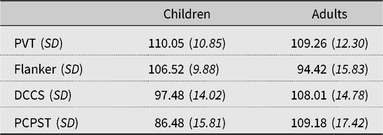
Table 2 shows the age-corrected standard scores for each of the neurocognitive tasks from the NIH Toolbox battery. For both age groups, the average normed score was within 1 SD of the normalized age-corrected standard mean of 100 for each assessment. In addition, the standard deviations for these tasks among both age groups reveals reasonable variability in performance for both age groups. Performance on the two executive function measures, the Flanker task and the DCCS, were significantly positively correlated with each other for both children, r (30) = .453, p = .009, and adults, r (30) = .550, p = .001. Neither the PCPST nor the PVT was significantly correlated with any of the NIH Toolbox measures for either age group.
Average age-corrected standard scores and standard deviations (SD) on NIH Toolbox measures

Note: PVT, Picture Vocabulary Test. DCCS, Dimensional Change Card Sort. PCPST, Pattern Comparison Processing Speed Test. Age-corrected scores are derived from normative data with a mean of 100.
The average scores for the different conditions in the aspect task are shown in Figure 2. An omnibus three-way between-subjects repeated-measures analysis of variance was performed using morphology (perfective, imperfective) and telicity (telic, atelic) as within-subjects factors and age group (adults, children) as the between-subjects factor. A significant main effect for age group was present in which adults performed better than children, F (1, 62) = 193.9, p < .001. Significant main effects were also present for morphology, where imperfective trials were easier than perfective trials, F (1, 62) = 122.4, p < .001, and telicity, where telic trials were easier than atelic trials, F (1, 62) = 56.8, p < .001. Neither the morphology nor the telicity main effects were predicted, but they appear to reflect a general preference for choosing the ongoing picture, albeit a preference tempered by prototypicality effects. These effects will be taken up in the general discussion. There was, critically, a significant interaction between telicity and morphology, F (1, 62) = 270.9, p < .001. As demonstrated in Figure 2, this interaction reflects a strong effect of prototypicality: the prototypical combination of imperfective + atelic led to higher accuracy scores than the non-prototypical combination of imperfective + telic, and similarly, the prototypical combination of perfective + telic led to higher accuracy scores than the non-prototypical combination of perfective + atelic. No other two-way interactions were significant, but there was a significant three-way interaction between telicity, morphology, and age group, F (2, 62) = 13.174, p = .01, reflecting the fact that the prototypicality effects between telicity and morphology were driven by the children and not the adults.Footnote 1
Average performance (+/– 1 SD) on prototypical and non-prototypical trials for children and adults. Children demonstrated characteristic prototypicality biases, and adults also demonstrated some continuity for aspectual biases.

Relations between neurocognitive tasks, receptive vocabulary, and aspect prototypicality
Because neurocognitive and receptive vocabulary comprehension tasks were predicted to have their primary effects on performance with the more difficult, non-prototypical items, the aspect conditions were recoded as being either prototypical (telic + perfective and atelic + imperfective) or non-prototypical (atelic + perfective and telic + imperfective). Multiple linear regression analyses were performed estimating accuracy on prototypical and non-prototypical aspect items from the two executive function tasks (Flanker and the DCCS), the visual comparison-making task (PCPST), and the vocabulary assessment (PVT).
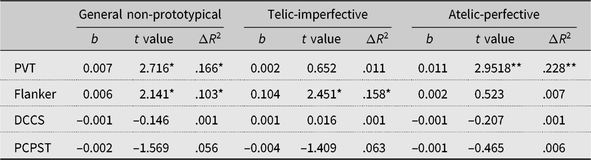
For accuracy on prototypical items, the regression model was not significant for either children, F (4, 27) = 1.466, p = .24, or adults, F (4, 27) = 1.657, p = .189. Given the overall very high accuracy rates on these easy items, that result is not surprising. For non-prototypical items, the regression model was not significant for the adults, F (4, 27) = 1.052, p = .399, but was significant for the children, R 2 = .392, F (4, 27) = 4.349, p = .008. To evaluate the variability explained by each of the variables in the model, a stepwise regression model was performed. Following this procedure, both the PVT, ΔR 2 = .166, F (1, 27) = 7.377, p = .011, and the Flanker, ΔR 2 = .103, F (1, 27) = 4.583, p = .041, significantly predicted performance on general non-prototypical accuracy among children. To examine the predictions that different aspects of neurocognition would predict performance on the two types of non-prototypical items, separate regression analyses were conducted with the telic + imperfective and atelic + perfective scores. Estimating telic-imperfective accuracy from the PVT, Flanker, DCCS, and PCPST found that the model was borderline significant for children, R 2 = .288, F (4, 27) = 2.732, p = .05. Stepwise regression analyses revealed that the Flanker inhibitory control performance significantly predicted accuracy for telic-imperfective trials, uniquely explaining 15.8% of the variance, ΔR 2 = .158, F (1, 27) = 6.006, p = .021. Estimating atelic-perfective accuracy from the PVT, Flanker, DCCS, and PCPST revealed a significant model for children, R 2 = .291, F (4, 27) = 2.772, p = .047. Again, stepwise analyses revealed that the PVT vocabulary test significantly predicted accuracy for atelic-perfective trials, uniquely explaining 22.9% of the variance, ΔR 2 = .229, F (1, 27) = 8.711, p = .006. Regression models for children are shown in Table 3.
Non-prototypical accuracy estimated from predictor variables among children

Note: Combined results of separate multiple linear regression analysis among children in which accuracy on non-prototypical trials was estimated from receptive vocabulary (Picture Vocabulary Test; PVT), inhibitory control (Flanker), cognitive flexibility (Dimensional Change Card Sort; DCCS), and visual comparison (Pattern Comparison Speed of Processing Test; PCPST) abilities. *p < .05. ** p < .01.
Converging with the regression results, correlational analyses revealed that children’s general non-prototypical accuracy was significantly associated with age-corrected Flanker performance, r (30) = .351, p = .049, and with age-corrected PVT performance, r (30) = .474, p = .006. No correlations were significant between general accuracy on non-prototypical items and the PVT, r (30) = .281, p = .119; Flanker, r (30) = .215, p = .237; DCCS, r (30) = .035, p = .848; or PCPST, r (30) = –.108, p = .558. Looking at the different types of non-prototypical items for children, Flanker (inhibitory control) performance was significantly correlated with accuracy on non-prototypical telic + imperfective trials, r (30) = .436, p = .013; by contrast, non-prototypical atelic-perfective accuracy was significantly correlated with performance on the PVT (vocabulary) assessment, r (30) = .529, p = .002. These results are shown in Figures 3 and 4.
Correlations between age-corrected inhibitory control (Flanker) performance with children’s accuracy on the two non-prototypical combinations: telic-imperfective and atelic-perfective. Inhibitory control significantly correlated with telic-imperfective accuracy among children (p < .05).

Correlations between age-corrected receptive vocabulary (Picture Vocabulary Test) performance with children’s accuracy on the two non-prototypical combinations: telic-imperfective and atelic-perfective. Receptive vocabulary significantly correlated with telic-imperfective accuracy among children (p < .01).

Discussion
The purpose of this study was to pay back a promissory note from previous research by showing how specific limitations in children’s linguistic performance were linked to specific dimensions of neurocognitive processing and receptive vocabulary knowledge. It investigated a well-documented underextension in children’s production and comprehension of aspect, and the results found support for linking inhibitory control (as measured by the Flanker task) to performance with telic + imperfective combinations (e.g., The girl was building a house) and for linking overall vocabulary levels (as measured by a Picture Vocabulary Test) to performance with atelic + perfective combinations (e.g., The girl played with toys). These results mark the first time that a study has connected children’s performance on aspect morphology with independent measures of neurocognitive abilities and receptive vocabulary knowledge.
Previous evidence supporting the idea that children’s production and use of aspectual morphology was limited by their cognitive abilities was indirect in nature and vague about which dimensions of cognition were relevant. On a classic frequency-based account (Li & Shirai, Reference Li and Shirai2000; Shirai & Andersen, Reference Shirai and Andersen1995), children’s dis-preference for saying non-prototypical combinations and their difficulties in comprehending them stemmed from the fact that such combinations were less frequent in their input (and in the adult language more generally). The most straightforward neurocognitive skill that would assist performance on this analysis is inhibitory control: the source of children’s difficulty is ignoring (or inhibiting) a highly frequent and, therefore, more easily accessible form, in favor of a lower frequency and less accessible one. However, a frequency account applies equally to both kinds of non-prototypical combinations, and the results here showed that inhibitory control was linked only to the telic + imperfective combination and did not predict performance on the atelic + perfective combination. Thus, while frequency may still be an important factor in children’s aspect processing, it cannot be the only one that drives performance.
More detailed analysis of the links between neurocognition and aspect showed that performance was sensitive to the specific kinds of processing hypothesized to be needed for the different non-prototypical forms. For the telic + imperfective combination, the child must ignore their knowledge of an event’s inherent ending as specified by the lexical items in order to adopt an interior perspective on the event, as specified by the verb morphology, that permits alternative outcomes. For the sentence The girl was painting a circle, the predicate identifies a specific ending (the completed circle) but asks the listener to view the event from before the ending occurs—at a time when it might not ever be achieved (The girl was painting a circle but she ran out of paint before she finished it). We had hypothesized that both inhibitory control and set shifting would help children succeed with these items: inhibitory control would be needed to ignore the ending, and set shifting would be needed to switch to the alternative perspective. Although scores on those two tasks were correlated with each other, only inhibitory control was a significant predictor of the telic + imperfective accuracy scores for children.
By contrast, neither of the executive function tasks predicted performance on the other non-prototypical combination of atelic + perfective (e.g., The girl ran), although vocabulary level did. For these items, the words in the sentence themselves describe the action of the event, but they provide no information about what the event would involve after it was over, which is what was depicted in the completed phased. To interpret the perfective form, therefore, a child must use his or her world knowledge about how events work and his or her lexical knowledge about how events are typically described: one is wet after swimming, tired after running, in a messy room after playing with toys. We had hypothesized that overall vocabulary levels would provide a measure of the depth of children’s lexicon and their ability to use words in context and would therefore predict their performance on the atelic + perfective items. The results supported this prediction.
From the perspective of linguistic theory, the two non-prototypical combinations pose processing difficulties of different sorts and should draw on different neurocognitive skills and access to rich world knowledge and lexical representations. The fact that the different non-prototypical combinations were predicted by different—and sensible—neurocognitive and receptive vocabulary abilities supports the idea that children are drawing on linguistic representations in this task and, further, that those representations are approximately those that have been articulated by the theoretical linguistics literature.
There were two main limitations of the strength of the findings. First, there was a pervasive bias in the aspect task to choose the picture depicting the event in its ongoing phase. A general bias for choosing an action-in-progress over other event phases has been found in previous work (cf. Wagner, Reference Wagner2001) and reflects the fundamental contribution of pragmatics for aspectual interpretation. On a formal semantic account, both the perfective and imperfective forms of an atelic predicate can be truthfully applied to the ongoing picture. If an event has happened sufficiently to warrant using the imperfective (which was depicted with an ongoing picture) then it has happened sufficiently to warrant using the perfective: if The girl was crawling from 2:00 to 3:00 p.m., then it is also true that The girl crawled from 2:15 to 2:45 p.m. The homogeneous nature of atelic predicates means that there are no specified criteria to use for deciding what the boundary of the event is, and it can be placed anywhere after the initial moment of the event at the listener’s discretion. We tried to encourage participants to link the boundary point of the atelic items to the depiction in our completed picture: the two pictures were provided together to form a contrasting set, and there was an initial trial at the beginning making it clear that both perfective and imperfective target sentences would be used in the task. Such pragmatic signals had been shown to be effective in previous studies (Wagner, Reference Wagner2002, Reference Wagner2009), but in the current task, they were not.
Because the ongoing picture was coded as the correct answer for the imperfective target sentences for all items, this bias also led to higher scores overall for sentences in the imperfective relative to the perfective. As one might expect given the formal semantics just noted, this bias can be seen most dramatically with the atelic predicates, where participants were near 100% at choosing the ongoing picture when the target sentence was in the imperfective (the correct answer) and as high as 80% at choosing the ongoing picture with the perfective form (the incorrect answer). However, although the ongoing bias was the dominant response, it is nonetheless the case that both children and adults differentiated their perfective and imperfective performance even with the atelic items: they chose the ongoing picture less for atelic + perfective than for atelic + imperfective items, showing that the pragmatic contrasts were at least minimally effective.
Moreover, however potent the bias was for the ongoing picture, it still was not more potent than the prototypicality effect, at least for the children. As can be seen in Figure 2, with telic predicates, children favored the picture of the completed phase. Thus, they showed a high success rate with the prototypical telic + perfective items (where the completed phase is the correct response) and were even less prone to choosing the ongoing picture with the telic + imperfective items relative to their atelic performance. More generally, the core interaction between aspect morphology (perfective and imperfective) and predicate type (telic and atelic) held up, demonstrating that children made preferential links between the prototypical combinations relative to the non-prototypical ones.
A second limitation of these data was the fact that the task failed to show core results in adults. Adults succeeded on the aspect task, but they did not show the effects of the prototypes. Perhaps relatedly, adults also showed no links between any of the neurocognitive tasks and their performance on the aspect task. Previous research has shown that adults, like children, preferentially produce, comprehend, and otherwise judge prototypical aspectual combinations relative to non-prototypical ones (Andersen & Shirai, Reference Andersen and Shirai1994; Fedder & Wagner, Reference Fedder and Wagner2015; Yap et al., Reference Yap, Chu, Yiu, Wong, Kwan, Matthews and Shirai2009). Adults’ preferences are more subtle than those of children, and it appears the task here was not sufficiently sensitive to capture the preferences among adults. However, this absence leaves in question whether or not adults’ performance with non-prototypical items, like that of children, is linked to specific neurocognitive pathways. On the strongest performance account, it should be. Future research will have to investigate this question with more sensitive measures.
Conclusion
This study examined how specific neurocognitive and language skills were linked to performance with specific linguistic constructions by considering the case study of aspectual morphology. The results revealed that inhibitory control (as measured by the Flanker task) predicted children’s ability to interpret telic + imperfective combinations such as The girl was blowing up the balloon, in which children must set aside the lexically designated ending of the event (the blown-up balloon) and consider an incomplete, intermediate stage of the event. They further revealed that vocabulary level (as measured by a picture vocabulary test) predicted children’s ability to interpret atelic + perfective combinations such as The girl crawled, in which interpretation depends on pragmatic inferences using real-world knowledge. This study showed how the general concept of performance limitations can be made concrete and lead to a precise understanding of how cognition supports language use.