

Introduction
The word “sting” finds its genesis in the 1973 film starring Paul Newman and Robert Redford, titled The Sting wherein the protagonists are two con artists who scheme to defraud a gang leader out of a substantial sum of money (Tiwari Reference Tiwari2023). Henceforth, the phrase “sting operation” evolved as a technique employed by law enforcement agencies or the press to lure criminals into committing a crime and be taped or caught red-handed, which may act as potential evidence of their culpability (Johar Reference Johar2021).
In the Indian subcontinent, a histrionic sting operation named Operation West End in 2001 unearthed the appalling corruption in defence procurement, leading to high-profile resignations and the conviction of Jaya Jaitly (Tummala Reference Tummala2014). Aaj Tak’s Operation Janma Bhoomi unveiled the Babri Masjid conspiracy, and the 2005 Operation Duryodhana led to expulsion of 11 Members of Parliament under the cash-for-questions scam (Kumar Reference Kumar2023). These crusades not only unveil the dark underbellies of corruption but also disinfect the festering wounds in society through the unwavering beacon of investigative journalism, which is steadfast on becoming the seeing eyes of the blindfolded Lady Justice (Srivastava Reference Srivastava2016).
Despite this, the Indian legal framework dismayingly fails to award formal recognition to sting operations and lacks clear guidelines on their admissibility. Evidence is the foundation of any justice delivery system, with its probative value determining its ability to prove relevant facts. Thus, operations enticing suspects into revealing their transgressions are deemed as legitimate investigative exercises in various jurisdictions worldwide and bestowed with evidentiary value despite the general common-law standard that evidence is to be disregarded if it is gathered by beguiling the accused into executing an offence.Footnote 1 In India, the courts have disregarded this principle in a few instances considering the overriding public interest; however, conflicting views which deem such evidence as entrapment and thus inadmissible highlight the need for clarity regarding India’s legal stance on sting operations.
The dichotomy surrounding the admissibility of sting operations resembles a tightrope walk. Though sting operations pose a risk of manufacturing criminality or being used as a tool for a vendetta, completely uprooting this valuable tool would lead to the beginning of a dark chapter in the book of India’s criminal justice delivery. Jurisprudentially, the most compelling critique against sting operations lies in the deontological approach, which emphasizes the morality of actions based on a body of norms which are independent from the result they aim to achieve. From this standpoint, the method of procuring evidence through sting operations is deemed unacceptable due to the Constitutional violations of privacy and fair trial which entail. At the other end of the spectrum, consequentialism posits that the ends must justify the means; thus the broader public interests of justice delivery outweigh or justify the abridging of privacy of an individual. Thus, a framework ought to be devised to navigate through this ethical and legal terrain by acknowledging that sting operations might not be entirely legal, but, however, must be regulated to safeguard individual rights while recognizing their societal benefits. By fostering accountability and transparency, sting operations, when employed judiciously, can serve as a powerful catalyst for exposing crimes and pioneering a path towards a more even-handed world, where justice reigns supreme without sacrificing the bedrock of human dignity.
Thus, in an attempt to shed light on this indispensable issue, the research objectives of the paper are analysing the current legal landscape surrounding sting operations by a critical examination of various conflicting arguments for and against the formal recognition and admissibility of evidence gathered through sting operations. This entails exploring the potential conflict of the individual rights of privacy and fair trial with broader societal interests associated with investigative journalism and enhanced justice dispensation. Subsequently, while delving into the diverse approaches undertaken by the United States of America and Canada to tackle complexities of sting operations, the authors also endeavour to dissect the legislative and judicial intent through a comprehensive review of precedents, international benchmarks and contemporary developments, thereby elucidating the authors’ stance on the issue alongside proposing actionable recommendations to uphold public interest without abandoning individual rights.
The research was undertaken using qualitative and quantitative methods of doctrinal research using secondary data. The qualitative aspect included analysis of academic articles, journals, reports, news articles and case law, gathered from reputable databases and organizations working in the field of criminal justice. The quantitative aspect included analysis of relevant statistical data collected from official websites and databases. The right balance of both helps in providing a comprehensive picture of the issue and aids in devising a practical solution.
Sting Operations: Discerning the Indian Legal Standpoint
In an attempt to fulfill the objectives of this paper, it is imperative to primarily analyse and cognize the Indian legal standpoint on evidence gathered through sting operations. In the Indian legal landscape, the foregoing Indian Evidence Act, 1872 (IEA) and the new Bharatiya Sakshya Adhiniyam (BSA) lay down a “triple benchmark test” of “relevancy, reliability and admissibility” for any oral testimony, electronic record or document to be recognized as valid evidence (Sethia Reference Sethia2016). The first stage of the test deals with relevancy. The word “relevant” is defined under section 2(k) of the BSA which expounds that any fact is relevant to the other if the same is provided in the BSA under the provisions relating to relevancy of facts.Footnote 2 Chapter II of the BSA, ranging from sections 3 to 50, exhaustively deals with the relevancy of facts. Section 3 of the BSA clarifies that evidence may be adduced only for the facts which are laid down as relevant by the Adhiniyam.Footnote 3 Relevancy signifies the likelihood of existence or non-existence of a set of facts on the basis of the normal course of events or human behaviour.
Contrastingly, the second stage of the test deals with “admissibility”, which delves into the narrower scope of whether or not the evidence can be legally considered under the BSA or other relevant laws. “Relevance” and “admissibility” are often used interchangeably; however, they have distinctive legal implications. While all admissible evidence is relevant, not all relevant evidence is admissible. A perusal of the BSA reveals that the crucial discussion on admissibility of illegally obtained evidence is missing from the Act and, analogous to the British regime, the principal test for considering a piece of evidence is laid down as “relevancy”.Footnote 4
Additionally, section 141 of the BSA (section 136 of the IEA) bestows discretion upon the judge to decide the admissibility of evidence;Footnote 5 however, such discretion is limited to whether or not the evidence is “relevant” to the case. As seen in the Pooran Mal case,Footnote 6 the court abstained from issuing a writ of prohibition to discard the illegally obtained evidence, noting that nothing in the Act excludes a relevant piece of evidence solely on the grounds of its procurement.Footnote 7
In the same regard, in 1973, the accused in a corruption case argued against the evidence obtained illegally by the police through a recording device capturing the accused accepting a bribe. However, the court, while emphasizing the need of care and caution to be exercised by the judge while scrutinizing such evidence, permitted the same to be admissible.Footnote 8 More importantly, the Apex Court in Piara Singh v. State of Punjab Footnote 9 suggested that sting operations disclose nothing but extrajudicial statements given to a third party under special circumstances and thus shall be admissible in the court of law.
Furthermore, the recent expansion of documentary evidence under the BSA to encompass electronic data and records paves the way for introduction of such evidence;Footnote 10 however, the mandate of filing the certificate of authentication persists,Footnote 11 in an attempt to warrant integrity and fairness in the process as seen in the recent “Ghoos Mehal” case.Footnote 12 In this case, the court, while reiterating that the right to fair trial of the accused shall not be hampered, allowed the certificate under section 65B of the IEA to be produced at a later stage of the trial considering the significance of the electronic evidence dealing with a sting operation exposing authorities and officials of the Sales Tax Department in Delhi accepting bribes.
Besides the BSA, there are certain other acts and rules pertinent to sting operations. A vital component of sting operations is “wiretapping”, which is regulated by the Indian Telegraph Act of 1885.Footnote 13 Furthermore, the Prevention of Corruption Act, 1988 permits law enforcement agencies to deceive the perpetrators by offering them marked notes.Footnote 14 In India, the only law which impliedly makes a reference to sting operations is the Pre-Conception and Pre-Natal Diagnostic Techniques (PCPNDT) Act, 1994 relating to illegal sex determination of unborn children.Footnote 15 This was seen in the case of Rekha Sengar v. State of M.P.,Footnote 16 wherein a team of officers portrayed to be pregnant women interested in sex determination and sex-selective abortion. The perpetrator accepted Rs. 7,000 and, after a search of her residence, an unregistered ultrasound machine and other medical instruments were seized. This endeavour, alongside the evidence, was considered sufficient to establish a prima facie case against the accused.
Despite the aforementioned laws governing certain aspects of such operations, they lack clarity, necessitating a judicial inquiry into the matter. However, a catena of judgments with conflicting opinions and varied rationales have led to the spectacles of law becoming foggy and unclear. Thus, scrutinizing the arguments for and against such operations becomes crucial for crafting a well-rounded and insightful stance.
Comprehensive Critique on the Limitations of Sting Operations
In an attempt to comprehensively analyse the merits and demerits of sting operations, the authors undertake an in-depth review of their limitations and drawbacks in the present section of the paper, and their necessity and justifications in the subsequent section.
Right to Privacy
The sacred right to privacy is duly recognized internationally under Article 12 of the United Nations Declaration of Human Rights (UDHR) 1948Footnote 17 and Article 17 of the International Covenant on Civil and Political Rights (ICCPR) 1966 which clearly prohibit the arbitrary and unlawful interference with one’s privacy.Footnote 18 In the India landscape, right to privacy is a crucial aspect of one’s being and is upheld by the Apex Court to be a fundamental right,Footnote 19 guaranteed under Article 21 of the Constitution.Footnote 20 Hence, though the proponents of sting operations consecrate these manoeuvres as a quest for justice, the fundamental right to privacy of a suspect cannot be jeopardized (Das and Jaiswal Reference Das and Jaiswal2022).
The obiter dicta of the landmark R. Rajagopal case clearly lays down that publishing about a person without his consent, whether truthful or otherwise and whether adulatory or condemning, is violative of their right to privacy and is actionable.Footnote 21 Furthermore, the court in People’s Union for Civil Liberties deemed wiretapping to be a significant violation of a person’s right to privacy,Footnote 22 and laid down comprehensive guidelines if the government intends to employ this tool. This was further re-emphasized in the Ved Prakash judgment wherein the court deliberated that such evidence is inadmissible on account of its method of procurement being stained with “influence” and “involuntariness”.Footnote 23 Thus, the protection of right to privacy of a person thus makes a strong case against the admissibility of sting operations as evidence.
The most pressing concern surrounding sting operations is that media houses have started a sting expedition in a quest to boost their ratings, and the pursuit for viewership has left personal lives and liberties in ruins in the aftermath. Embodying this concern is the horrendous sting operation broadcasted by “Live India” in 2008 wherein a government schoolteacher, Uma Khurana, was shown as part of a prostitution racket.Footnote 24 This aroused anger and disgust in the viewers, ultimately leading to a violent mob of men attacking her and stripping her not just of her clothes but her dignity. Considering the aggravating circumstances, the court took suo moto cognizance and discovered her in reality to be innocent. The channel was subsequently sued for defamation, which was settled for a large amount; however, the life of Uma Khurana was ruined forever. The court, thus, underlined the poignant observations made in the US Supreme Court that: “In their zeal to enforce law, law protectors must not originate a criminal design, and then induce commission of the crime so that the government may prosecute.”Footnote 25
Entrapment: Ethical and Moral Concerns
In the dark era of the 2000s, Operation Kalank, also called “The Truth: Gujarat 2002”, was published by the Telheka magazine, based on the long-drawn-out sting operations undertaken to uncover the perpetrators of the riots (Singh Reference Singh2014). The report claimed the involvement and support of the police along with the then Chief Minister Narendra Modi; however, the designated judge PR Patel rejected the evidence and condemned the operation, citing the Apex Court’s strong disapproval of such evidence.Footnote 26 This entire episode, apart from haunting the conscience of the country, also raised several concerns surrounding journalistic ethics. A Columbia University scholar, Arthur Dudney, aptly wrote: “From the perspective of squeaky-clean journalism, Khetan has broken two rules: Firstly, misrepresenting his identity as a journalist and secondly, making false promises about confidentiality” (Dudney Reference Dudney2007).
Thus, sting operations not only raise privacy issues but also spark ethical and moral concerns. Sometimes these operations induce a person to commit a crime and then hold him responsible for committing it (Dolginov Reference Dolginov2015), leading to the dilemma of whether the sting operator had a part to play in the commission of the crime and whether he shall be held liable for abetment of such offence under section 45 of the Bharatiya Nyaya Sanhita (Heydon Reference Heydon1973).Footnote 27
Furthermore, the Apex Court in Vijay Shekhar v. Union of India observed that a warrant in lieu of a sting operation is illegal and shall be deemed to be a fraud, which underscores the necessity of eliminating the same, as fraud and justice never co-exist.Footnote 28 Correspondingly, it is also possible that the sting operator uses such evidence to extort the person or is willing to commit some other criminal offence before or after procuring the evidence (Norris Reference Norris2021). While acknowledging this issue, the Supreme Court explicitly held that a mere justification in the name of the “public interest” does not negate the crime committed and thus a sting operator can be separately tried for offences committed during such operations.Footnote 29
In Western jurisdictions, such sting operations fall into the exclusionary rule and are inadmissible as evidence due to the “Fruits of the Poisonous Tree Doctrine”. This doctrine lays down that the fruits of evidence plucked from a poisonous tree of illegality are also poisonous (illegal) and thus inadmissible (Thuyen Reference Thuyen2025). This doctrine was propounded in Nardone v. United States,Footnote 30 wherein the federal court deemed the evidence gathered in violation of the Communications Act of 1934, through wiretapping, as illegal and thus inadmissible.
Indian courts, however, are yet to sympathize with this approach and eliminate the traces of English jurisprudence where the Queen’s Bench in R v. Leathem loosely declared that: “… it matters not how you get it, if you steal it even, it would be admissible in evidence”.Footnote 31
Media Biases: Contravening the Right to Fair Trial
The right to a free and fair trial is the bedrock of the criminal justice delivery system and guaranteed by the Constitution of India. This right to a fair trial can be violated due to prejudice developed by the judges against the accused as a consequence of the media broadcasting the sting operation. The Apex Court in the Best Bakery case has emphatically explained the concept of a fair trial.Footnote 32 The court unequivocally opined that the primary object of the justice system is to guarantee that all the parties are bestowed with the valuable right to a fair trial. A trial that, alongside unearthing the truth, is devoid of any bias or prejudice, either in favour of or against the accused, the witnesses, or the issue being decided, is deemed to be fair.Footnote 33
Thus, the right to a fair trial implies a trial free from any bias or prejudice, and is an essential part of one’s right to life and personal liberty. This right is, however, contravened by sensationalized media coverage of sting operations, leading to tainting the mind of the judge and making the arrival at an impartial verdict unachievable (Fitzpatrick Reference Fitzpatrick2001). As underlined by the Delhi High Court relating to the broadcasting of the documentary India’s Daughter, “Media trials do tend to influence judges. Subconsciously a pressure is created and it does have an effect on the sentencing of the accused/convict.” Footnote 34 For this reason, the Seventeenth Law Commission in its 200th Report recommended the Parliament to enact a law that fetters the unchecked power of media to infringe the fundamental rights of individuals under the garb of investigative journalism (Law Commission of India 2006). Furthermore, the Tenth Law Commission in its 94th Report also recommended the Parliament to amend the IEA to add section 166A which bestows the court with discretion to exclude illegally obtained evidence, if the admission of such evidence might ridicule or make a mockery of justice (Law Commission of India 1983). However, lamentably, no such law has been introduced to date.
Thorough Examination of the Justifications and Merits of Sting Operations
Investigative Journalism: Preserving Freedom of Press
The fourth pillar of India’s democracy, the media, is entrusted with the task of providing support to the other three pillars in an attempt to ensure that the foundations of democracy are built on “accountability” and “public trust” (Khan and Kashyap Reference Khan and Kashyap2018). However, the acute condition of the free press in India is evident in its ever-declining rank in the Press Freedom Index as illustrated in Figure 1 (Reporters sans Frontiers 2024).
India’s ranks in the Press Freedom Index (2015–24).
Source: Reporters sans Frontières (2024).

The media acts as the eyes, ears and mouth of the populace and strives to uphold the principles of the nation. As upheld in the landmark Bennett Coleman case,Footnote 35 the right to free press is an implicit right under Article 19(1)(a) of the Constitution,Footnote 36 the corollary of which was established in the subsequent decisions wherein Justice Mathew underscored the right of the citizens to know public affairs and the need and duty of the media to provide it to them for the transparency and accountability of the democratic units to be maintained.Footnote 37 This salient function of the media bolsters the case in favour of bestowing legality upon sting operations.
On July 8, 2024, the court in Pradeep v. State of Kerala highlighted the growing concerns surrounding the authenticity and reliability of such evidence.Footnote 38 Though the court ruled that sting operations might not obtain blanket immunity under the “freedom of the press”, however, it laid down that those conducted by recognized media houses shall be dealt with differently, acknowledging the crucial democratic role the media plays. The court also held that a case-by-case approach shall be employed to eliminate malicious operations and ensure that sting operations are conducted solely with the bona fide intent to uncover the truth. This decision emphasizes the need for ethical considerations and transparency alongside the recognition of sting operations as a legitimate investigative exercise for the safety and progress of the nation.
Overriding Public Interest
Public interest is an overriding factor which further tilts the scales in favour of sting operations. If a sting operation is conducted with the intent of gathering certain pieces of evidence which ultimately favour the larger public interest and aid the judiciary in taking the right decision, such an act must be permissible for the welfare and protection of society (Phillips Reference Phillips2020).
The BMW hit-and-run case is a prime example,Footnote 39 wherein a young boy who hailed from a resourceful background struck six people while driving, three of whom were police officers. While the matter was sub judice, a sting operation was orchestrated which revealed collusion between the advocates from opposing sides to bribe prime witnesses. After due deliberation and weighing both sides of the argument, the three-judge bench of the Apex Court upheld the validity of sting operations wherein the evidence gathered through them reveals that there exists an overriding public interest.Footnote 40
In this case, while asking the rhetorical question of would it have been better to let the advocates suborn a witness or to bring this mischief in front of the public gaze, the Supreme Court deemed it to be an “obvious” choice considering that it served a public cause.Footnote 41 This was further reiterated by several courts while accepting the legality of a sting operation exposing the Members of Parliament accepting bribes.Footnote 42
Additionally, referring to Article 19 of the UDHR,Footnote 43 the Supreme Court in the Indian Express Newspapers case reiterated that foundations of journalism lie in the “greater good of the public”.Footnote 44 Thus, sting operations shall be permitted to assist the media in performing their quintessential role of providing non-partisan coverage of events of public importance, echoing the thoughts of John Milton when he said, “Give the liberty to know, to utter and argue freely according to conscience above all liberties” (Milton Reference Milton1868).
Need for Sting Operations: Uncovering Shrouded Crimes
“I thank god and the media for helping me out in this long battle” (Mathur Reference Mathur2016). These are not just words but the heartfelt gratitude of the victim’s mother in the Nitish Katara murder case, wherein in the darkest hours the media played the role of a saviour by conducting a sting operation to provide concrete evidence, aiding the judiciary in delivering justice.Footnote 45 This case is a testament to the unwavering efforts of the media which brought solace to a devastated family.
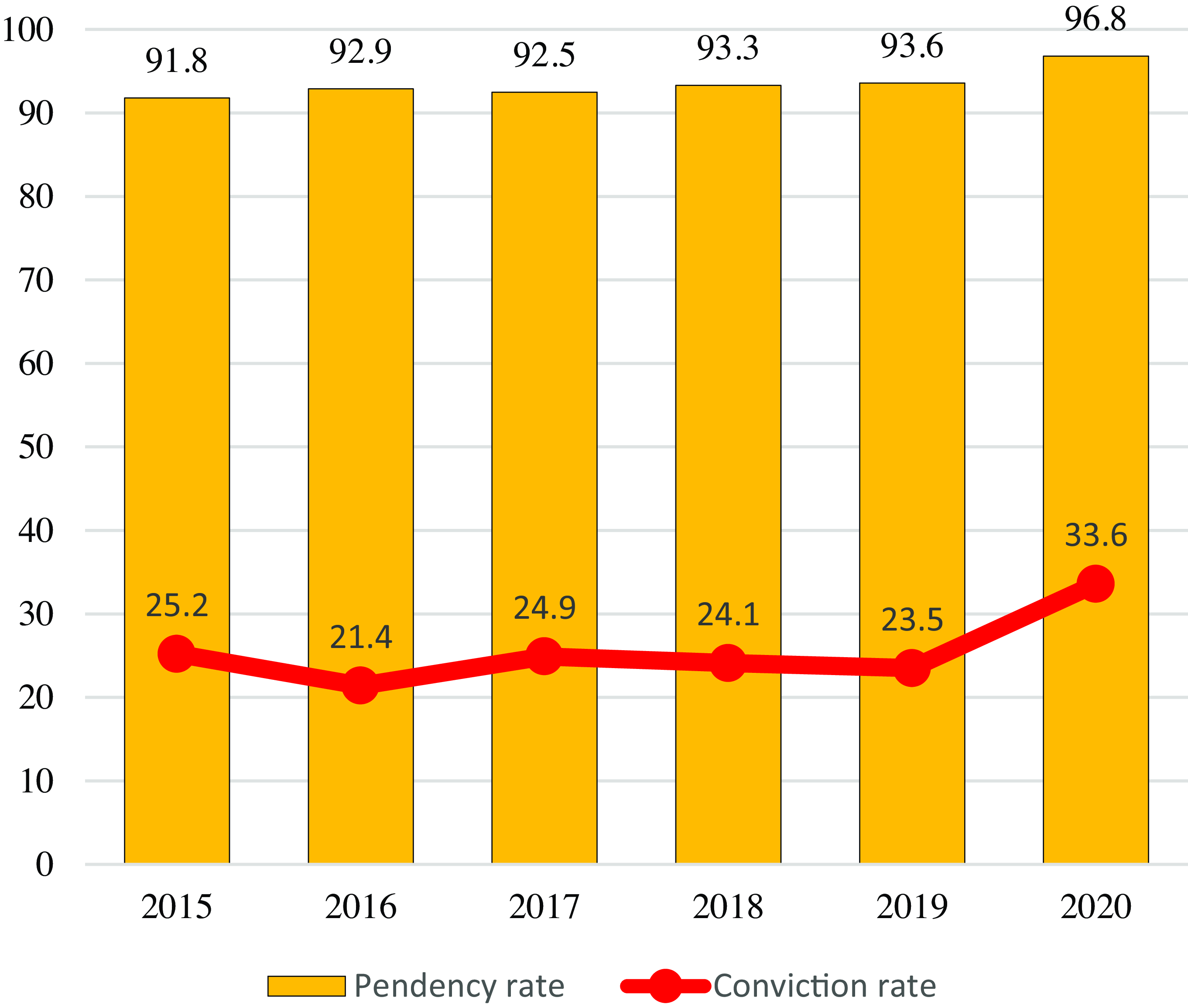
Sting operations can prove to be an indispensable wing of investigation due to their unique ability to unearth clandestine activities and procure evidence that would otherwise be difficult for traditional investigative methods to secure. This method can be of immense help, particularly in cases involving intricate criminal networks and sophisticated economic offences including bribery and corruption, wherein India is experiencing disturbingly high pendency coupled with low conviction rates, as illustrated in Figure 2 (National Crime Records Bureau 2020). The nature of such a crime is often victimless and neither of the parties involved is willing to come forward. In such cases, sting operations serve as weapons in the investigative arsenal because they can penetrate through layers of secrecy and deception to yield concrete evidence for conviction which reverberates into disruption of criminal activities.
High pendency and low conviction rates in economic offences (%).
Source: National Crime Records Bureau (2020).

Furthermore, the Supreme Court, in the Umesh Kumar case,Footnote 46 assertively declared its repulsion towards the contention of illegally obtained tapes and photographs being violative of fundamental rights enshrined in the Constitution. This stance of the judiciary prioritizes the probative value of evidence over potential violations of fundamental rights, reflecting a reluctance to adopt the exclusionary rule by diagnosing the dire need for a more potent investigative technique.
Cross-Jurisdictional Analysis of Sting Operations: Evaluating American and Canadian Models
United States of America
The United States Supreme Court through a catena of judgments recognized the necessity of using the tactics of sting operations for investigating sophisticated crimes and complex syndicates. Though there is no requirement for a prior judicial authorization, the operations are carried out under the Attorney General’s supervision and are subject to constitutional constraints. More often than not, the defendants in such cases invoke one of the two primary defences: entrapment and due-process violation (Luibrand Reference Luibrand2020). The entrapment defence is available to protect the defendant in situations wherein the government induces a crime and implants criminal intent (Bilius Reference Bilius, Meško and Lobnikar2016). However, this defence would fail if the government merely provides an “opportunity to commit” the offence and entraps the perpetrator (Field Reference Field2019). The second defence claims a dismissal of charges on the grounds of misconduct by the sting operator which offends the fundamental due-process mandate of investigations. However, the viability of this defence has been challenged in various decisions.
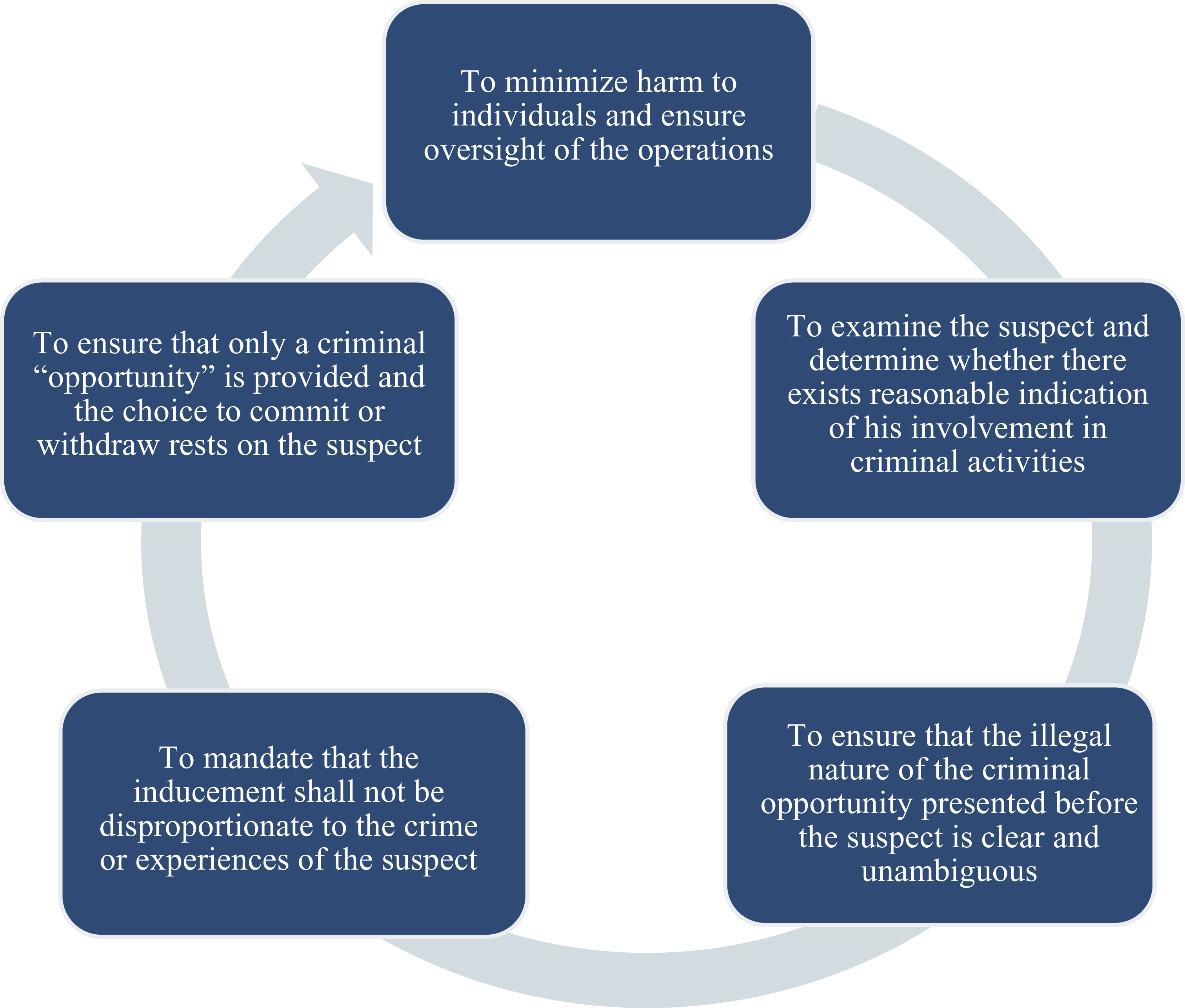
Furthermore, in an attempt to adequately supervise this emerging investigative technique, the US Department of Justice released the Undercover Guidelines on December 31, 1980 alongside the Criminal Undercover Operations Review Committee which aims at ensuring the adherence to guidelines alongside addressing various concerns. The Review Committee plays a multifaceted task, as depicted in Figure 3 (Stephens Reference Stephens1986).
Multifaceted role of the Criminal Undercover Operations Review Committee.

Canada
In Canada, undercover operations are employed when the conventional methods of investigation go pear-shaped. These operations, termed as “Mr. Big Operations”, entail an undercover officer pretending to be a part of a criminal organization and befriending the suspect. Subsequently, as the suspect becomes more involved in the scheme, he is introduced to the leader of the (fictitious) syndicate known as Mr. Big. In the finale, Mr. Big clandestinely records the interview where he presses the suspect to confess his involvement in a previous crime (Puddister and Riddell Reference Puddister and Riddell2012). This tactic, however, is not looked upon with pleasing eyes, as when other investigative techniques fail, this acts as a “Hail Mary” to secure a confession (Moore, Copeland, and Schuller Reference Moore, Copeland and Schuller2009).
On August 4, 2002, the three-year-old twin daughters of Nelson Hart tragically drowned during an excursion. Hart claimed that he did not know how to swim and, thus, immediately drove to seek help. During investigation, the police was unable to gather sufficient evidence and thus launched the “Mr. Big” operation, enticing him into a fictitious criminal world flooded with money and luxuries. When at last he met Mr. Big, he was asked the truth about his daughters’ deaths to which Hart initially insisted that it was an accident; however, upon continuous provocation and the threat of losing the luxuries, he confessed to having murdered them.Footnote 47
While deciding on the matter, the Supreme Court of Canada introduced a “two-pronged assessment” (Goldberg Reference Goldberg2022) for the admissibility of confession. It first laid down that such illegally obtained confessions would be inadmissible and secondly, the use of veiled threats and incentives to induce confession from vulnerable individuals would amount to impermissible police conduct.
Thus, this comparative analysis assists in deducing that different legal systems have a spectrum of approaches towards sting operations; however, a common thread binding them is the insistence of the judiciary to not abandon individual rights in an attempt to chase the larger public interest.
Conclusion and Suggestions
In the gruelling war against crimes in society, where perpetrators employ sophisticated methods shrouded in layers of secrecy, sting operations emerge as an invaluable tool in justice’s arsenal. However, when evidence is procured through methods skirting the law, the prickly question regarding legality of the act and admissibility of such evidence emerges.
The ethical and legal quandaries surrounding string operations are undeniable. On one hand, this form of investigation promises exposure of complex criminal acts which are decaying society and thus serving a larger public interest by putting away criminals. However, on the other hand, the dark shadows of privacy and other ethical concerns loom, threatening to engulf the innocent bystanders and overshadow the right to a fair trial (Joh and Joo Reference Joh and Joo2015).
In such a labyrinthine situation, striking a balance between the two sides does not relate to picking a side but rather weaving a safety net which upholds the ideals of justice without sacrificing the fundamental rights of the parties involved. Thus, on scrutinizing the international landscapes of Canada and the United States of America, in conjugation with a plethora of judgments and recommendations made within the country, the authors opine that India’s legal framework must give formal recognition to sting operations along with providing strict judicial oversight, clear media regulations, ethical standards to focus on exposing crimes rather than creating them, and empowering the judge with discretion to exclude evidence deemed to disproportionately contravene the fairness of a trial. Furthermore, the authors, in lieu of the recommendations by the Law Commission (underpinned in Kuruma v. R),Footnote 48 also believe that though the court must have discretion to exclude illegal evidence, while dealing with sting operations such discretion shall lead to exclusion “only when” it compromises the fairness of the trial.
Additionally, beyond the defence of entrapment and due-process violation, the authors would also like to highlight a pertinent caveat attempted to be laid down in United States v. Jacobson.Footnote 49 The case illustrates the horrors of unbridled discretion to sting operators which may lead to innocent individuals being forcefully turned into criminals on account of minor misconducts. Therefore, a “reasonable suspicion requirement” must be introduced for the sting operator to prove before launching the operation, as only then can this investigative tool empower justice without compromising individual rights (Larkin Reference Larkin1992). Therefore, on the basis of the suggestions deliberated upon, the authors recommend the following model draft of the section dealing with sting operations for a potential amendment to the new BSA:
Section X: Admissibility of Evidence from Sting Operations
-
(1)
-
(a) A “sting operation” for the purpose of this Act refers to an investigative technique where a law enforcement officer or news media, with the prior approval in writing and under constant supervision of the Sting Operations Oversight Panel, acts undercover to provide an opportunity to the target to commit a crime he is accused of or known to have committed in the past, in order to expose the illegal activity or elicit information about potential wrongdoing.
-
(b) “News media” shall include newspapers, wire service and non-wire service news agencies, news feature agencies, electronic media agencies and organizations containing news and comments on public news.
-
(c) “Sting Operations Oversight Panel” (SOOP) refers to a panel constituted by the Union Ministry of Law and Justice. The committee shall include a judicial officer or a retired judge of any Appellate Court, two police officers not below the rank of Superintendent of Police and two eminent persons with experience in social justice nominated by the Chief Justice of India. The panel shall handle, support, accept or reject prior permission application on the basis of availability of reasonable suspicion and review the findings of the operation ensuring its legality and adherence to ethical guidelines.
-
-
(2) Evidence procured from sting operations may be admitted in a court of law subject to the following conditions:
-
(a) A detailed report of the sting operation, including the planning, execution, and recording process, after being scrutinized and approved by SOOP is presented to the court.
-
(b) The operation ensures minimum intrusion of the privacy of individuals not suspected of wrongdoing.
-
(c) The operation does not involve implanting criminal intent or inducing the suspect to engage in a crime he would not have otherwise committed.
-
(d) The evidence obtained is directly relevant to the alleged crime and discernibly reliable, devoid of any manipulation or fabrication.
-
-
(3) The court may, at its discretion, exclude such evidence if it deems that the sting operation violated any provision under sub-section (2) or if its admission would prejudice the fairness of trial.
In conclusion, cultivating a pragmatic stance and appreciation for the nuances of sting operations is paramount to navigating the complex legal and societal terrain, ensuring that justice is served without slaughtering the inherent dignity of all individuals as Benjamin Franklin precisely declared: “Those who would give up essential Liberty, to purchase a little temporary Safety, deserve neither Liberty nor Safety” (Franklin Reference Franklin and Leonard1755 [1963]).
Competing interests
The authors declare that they have no known competing financial interests or personal relationships that could have appeared to influence the work reported in this paper.
Laadli Singhania is an aspiring lawyer hailing from New Delhi. She is currently pursuing her BA LLB. (Hons) from Symbiosis Law School, Symbiosis (Deemed University), Pune with a keen interest in constitutional law, criminal law and human rights. Passionate about legal research and policy analysis, she has actively engaged in academic writing, mooting and legal discourse on contemporary issues to explore the intersection of law, ethics and justice.
Virendra Singh Thakur is presently working as an Assistant Professor at Symbiosis Law School, Symbiosis (Deemed University), Pune. He is currently pursuing a PhD in Law from Symbiosis International University, Pune (India). He has completed his LLM from National Law Institute University, Bhopal with a specialization in Constitutional Law and Administrative Law. With extensive experience in teaching and research, he has been actively engaged in academia since 2014, instructing both undergraduate and postgraduate students. Passionate about legal scholarship, he has always aspired to consistently contribute to the evolving discourse through his valuable contribution and thus has several notable publications to his name in the field of constitutional, criminal and environmental law.