1. Introduction
Human society derives a variety of benefits from ecosystems, known as ecosystem services or environmental services (ES)(MEA, 2005). Payments for Environmental Services (PES), an incentive-based environmental policy tool, has gained much traction recently (Landell-Mills and Porras, Reference Landell-Mills and Porras2002; Pagiola et al., Reference Pagiola, Arcenas and Platais2005; Wunder, Reference Wunder2005, Reference Wunder2007; Zbinden and Lee, Reference Zbinden and Lee2005; Jack et al., Reference Jack, Kousky and Sims2008). PES is a voluntary and conditional transaction between an ES buyer and an ES provider, on the provision of a well-defined ES or a land use presumed to deliver that ES (Wunder, Reference Wunder2007).
PES programmes have been used to finance conservation in many geographic regions (Landell-Mills and Porras, Reference Landell-Mills and Porras2002; Pagiola et al., Reference Pagiola, Ramirez, Gobbi, Haan, Ibrahim, Murgueitio and Ruiz2007; Fisher et al., Reference Fisher, Turner and Zylstra2008; Jindal et al., Reference Jindal, Swallow and Kerr2008) and have largely focused on watershed protection, biodiversity conservation and carbon sequestration.Footnote 1 In the developing world, Costa Rica, Mexico and China have been leading efforts to make direct payments through governments to landowners or land users – typically at the household level – for undertaking specific land use practices that would increase the provision of water, biodiversity or carbon services (Uchida et al., Reference Uchida, Xu, Xu and Roselle2007; Bennett, Reference Bennett2008; Jack et al., Reference Jack, Kousky and Sims2008; Pagiola et al., Reference Pagiola, Rios and Arcenas2008; Gong et al., Reference Gong, Bull and Baylis2010).
Households that participate in PES programmes generally derive a small net financial benefit (Wunder, Reference Wunder2008; Mahanty et al., Reference Mahanty, Suich and Tacconi2013). However, a key challenge for PES programmes is selecting the households to participate in a project. Relatively limited research has investigated household participation issues (Miranda et al., Reference Miranda, Porass and Moreno2003; Kosoy et al., Reference Kosoy, Corbera and Brown2008; Pagiola et al., Reference Pagiola, Rios and Arcenas2008, Reference Pagiola, Rios and Arcenas2010; Arriagada et al., Reference Arriagada, Sills, Pattanayak and Ferraro2009; Fisher, Reference Fisher2012; Mahanty et al., Reference Mahanty, Suich and Tacconi2013), despite the fact that PES programmes often have a stated objective of benefiting the poor. In Africa, only one case study has examined the reasons, including cash payments and other environmental values, for household participation in a PES programme in Uganda (Fisher, Reference Fisher2012). While these studies have provided some insights, none of them has empirically examined how a household's forest resource dependence will influence the participation decision, particularly where participants self-select to participate.
Building on the previous work, we focus on one of the few longstanding African PES cases: Nhambita in Sofala Province, Central Mozambique. Using econometric analysis, we determine socio-economic factors influencing household participation, focusing on self-selection bias in the participant sample. The programme in question had a fairly low household participation rate (30 per cent), which may raise concerns about the adequacy of ES provision and the programme's capacity to alleviate poverty. Our findings add to the PES debate by highlighting participation determinants, particularly in an African context characterized by extreme poverty. The remainder of this paper introduces the study site, describes the experimental design, identifies the key results and discusses the main findings.
2. Methods
2.1. Study area
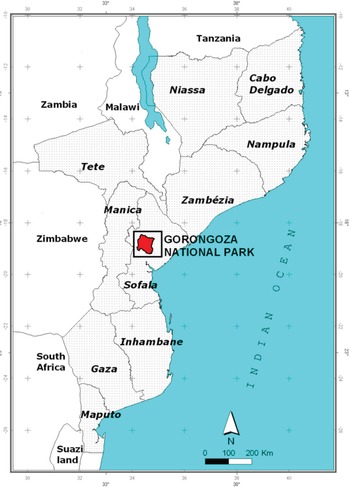
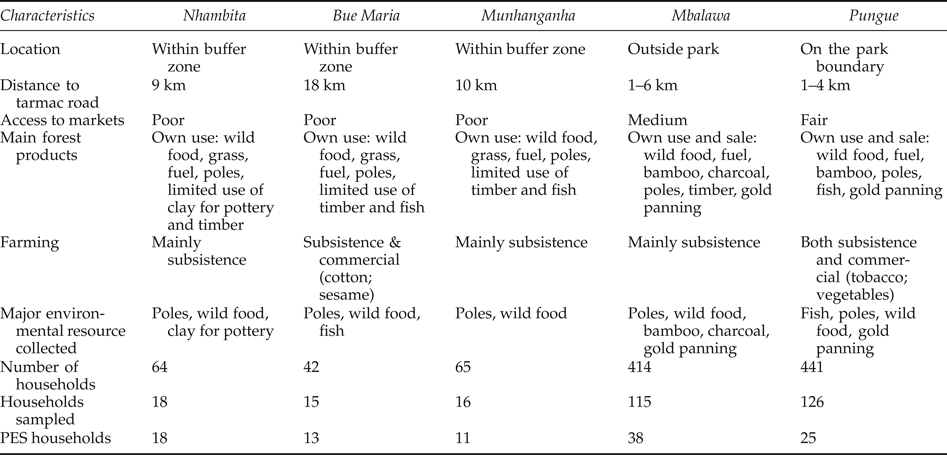
This study was undertaken in Chicale Regulado (Traditional Authority), located in the buffer zone of the Gorongosa National Park (GNP) in Sofala Province, Mozambique (figure 1). Chicale Regulado covers a total area of about 20 km2, with over 1,100 households spread over five villages: Nhambita, Bue Maria, Munhanganha, Pungue and Mbulawa (Hegde, Reference Hegde2010). The first three are located close to each other within the GNP buffer zone. Mbulawa is located outside of the GNP, while one part of Pungue is located inside the Park and the other outside. Table 1 summarizes some of the key characteristics of the five villages under study.
Study area location

Key characteristics of the villages

Traditionally, households in Chicale Regulado practise shifting cultivation, where they clear and burn the miombo woodland to start their mashamba (farm). They grow subsistence crops mainly for three to four years, including corn, sorghum, peas, cucumbers and other vegetables, after which they clear land in another location and leave the former mashamba site to regenerate for 20–25 years. Households require permission from the Regulo (traditional chief) to clear any fresh forest, but enforcement of this is weak.
In 2002 a small-scale agro-forestry based carbon sequestration pilot programme, known as the Nhambita Carbon Livelihoods Project, was implemented in the Regulado (Hegde, Reference Hegde2010). The programme offered conditional cash payments to smallholders for planting trees on their farm. Initial programme funding, provided by the EU, was used for programme implementation, livelihood support activities and to cover part of the transaction costs in the pilot phase (2002–2008). Since 2008, the programme has been financed from revenue generated from carbon sales (Envirotrade, 2010). A consortium of partners, consisting of EnviroTrade (a private firm based in the UK, and the lead partner), the University of Edinburgh and the Edinburgh Centre for Carbon Management, is implementing the programme. The programme aims to conserve and regenerate the miombo woodlands by offering both conditional financial compensation (i.e., PES) and alternative livelihood options through a community developmentFootnote 2 component. The pilot phase was limited to the villages of Nhambita, Bue Maria and Munhanganha, and was later expanded to Mbalawa and Pungue.
Households participating in the programme must ensure specific minimum seedling survival rates during the first three years, and avoid the clearing or burning of forestland other than that which has been pre-agreed on (thus eliminating commercial charcoal and firewood extraction). In cases of non-compliance, payments will be stopped and the farmer may be asked to return earlier received payments. Seven annual instalments are paid: 30 per cent (year 1), 12 per cent (years 2–6) and 10 per cent (year 7).Footnote 3 After year 7, tree-based benefits (i.e., harvested fruits, small-diameter timber) are assumed to provide sufficient proper incentives for tree retention.
The carbon sequestered is monitoredFootnote 4 under a Plan VivoFootnote 5 system. The Verifiable Emission Reduction (VER) credits generated are sold in voluntary carbon markets. Part of the proceeds is deposited into a trust fund used to pay participant farmers (conditional payments), while another portion finances village development activities (community benefits). Initial contracts were for US$9 per tCO2 equivalent, but the average price over the course of the programme was US$4.50, which was higher than prevailing prices in the voluntary carbon market (UOE 2008; Jindal et al. Reference Jindal, Kerr and Carter2012).
2.2. Research design
Quarterly household surveys were our main source of data. The surveys explicitly integrated quantitative environmental resource use data with household income and tree planting data for PES participant households. In addition to the four quarterly surveys, two annual household surveys and two village focus group discussions were undertaken (Hegde, Reference Hegde2010). Questionnaires developed by CIFOR-PENFootnote 6 were customized for our objectives.
Households in each village were selected randomly.Footnote 7 We opted for a large sample (335 households), given local heterogeneity, but lost 45 due to temporary or permanent migration, thus ending up with 290 households.
We used grossFootnote 8 income to measure household welfare, defined as the sum of cash income, net gifts/transfers and monetized subsistence income including environmental income (all non-cultivated products collected for subsistence or cash). Incomes were reported in the local currency, metical (plural, meticais; MTSFootnote 9 ).
Environmental resources were valued by asking households to report sale prices.Footnote 10 When not marketed, an individual willingness-to-pay (WTP) value was solicited (Wunder et al., Reference Wunder, Luckert, Smith-Hall, Angelsen, Larsen, Lund, Smith-Hall and Wunder2011), which was averaged at the village level on a quarterly basis. Most products were not traded, yet households generally reported consistent WTP values, which we cross-checked with locally traded substitute prices wherever possible.
Fieldwork was undertaken from January to December 2006. Eight enumerators – each of whom had at least a high school education – were recruited and trained. These enumerators conducted the interviews in the local language (Sena), under the supervision of the lead author.
2.3. Analytical framework
Evaluating the costs and benefits of participating in any programme to modify household behaviour is critical to the implementation of an economic incentive programme such as PES (Ostrom, Reference Ostrom1999; Jumbe and Angelsen, Reference Jumbe and Angelsen2007). Notably, economic theory underpinning agricultural household behaviour has been extensively studied and reported (e.g., Singh et al., Reference Singh, Squire and Strauss1986).
The following assumptions are made in this analysis. We assume an imperfect labour market in that a household may rent out labour, but does not hire labour (which was typical).Footnote 11 We assume that markets for agricultural and forest products function perfectly (such markets existed even in remote areas), allowing us to focus on income and consumption, rather than individual goods (Jumbe and Angelsen, Reference Jumbe and Angelsen2007).
Our model is static, as it does not involve any feedback effect. In following Jumbe and Angelsen (Reference Jumbe and Angelsen2007), households maximize a twice-differentiable quasi-concave utility function, which depends on total consumptionFootnote 12 (C) and leisure (L H ):
 $$Max\, U = U\lpar C\comma \; L_{H\colon }\, H\rpar $$
The household faces a set of technological, time and budget constraints. Household labour (L) is allocated to forest production (L F ), agriculture (L G ), wage labour (L W ), PES planting and tending (L P ) and leisure (L H ). Household income includes the value of agricultural commodities (Q G ) and forest commodities (Q F ), valued at their respective market prices (P G and P F ), as well as wage income (wLw) and exogenous income (E). Agricultural production depends on land area, family labour and exogenous production technology (Ω). Collection of forest commodities depends on labour hours spent, access to forest resources (D), technology (ϕ) and exogenous forest resource characteristics (R). Access to forest resources also depends on household and village characteristics (H and V). We posit that PES programme participation limits access to forest resources. When the market wage is below shadow wage rate (ω), a household prefers working in agriculture, leisure and possibly forestry.
We are interested in the household participation decision, and thus write the model in a semi-structural form:
 $$U=U^* \lpar P\semicolon \; P_{G}\comma \; P_{F}\comma \; \omega\comma \; E\comma \; \Omega\comma \; \phi\comma \; L_{P}\comma \; H\comma \; V\comma \; R\rpar \comma \; P = 0\comma \; 1$$
The net gain from participation (B) is defined as:
 $$B=U^* \lpar 1\rpar - U^* \lpar 0\rpar = B \lpar P_{G}\comma \; P_{F}\comma \; \omega\comma \; E\comma \; \Omega\comma \; \phi \comma \; L\comma \; H\comma \; V\comma \; R\rpar $$
A household will participate in the programme if the difference in utility between participation and non-participation (B) is non-negative, i.e.,
 $$\eqalign{& P = 1 \quad {\rm if \ } B\geq 0 \cr & P = 0 \quad {\rm if\ } B \lt 0. } $$
In this model, participation is assumed to affect utility in four ways. First, participation limits the access to forests, therefore D(1) < D(0). Higher prices of forest products (charcoal, fuelwood and timber) will reduce benefits from participation. In general, we can expect that households that are heavily involved in fuelwood and charcoal production have less incentive to participate in PES. Secondly, participant households face reduced agricultural productivity (from less swidden agriculture),Footnote 13 and labour costs associated with planting and tending the trees. Factors such as low agricultural prices (P G ), and poor technologies (ϕ) will increase the value of B. Thirdly, participant households require more labour for planting and tending the trees. The higher the labour cost for participation (L P ), the lower B is. For the households participating in the labour market, the opportunity cost of time is given by the market wage rate (w). Participation cost increases with the wage rate. For households outside the labour market, we can expect poor households to have a lower shadow wage, and hence to be more likely to participate, ceteris paribus. Fourthly, we assume that social capitalFootnote 14 influences participation (i.e., participation requires that a household perceive the community as friendly, helpful and trustworthy). Research has shown that trust is an important indicator of social capital which facilitates cooperation (Knack and Keefer, Reference Knack and Keefer1997; Thoni et al., Reference Thoni, Tyran and Wengström2012). We also probed each household's perception of the community as a liveable place which influences long-term decisions such as PES-induced tree planting, and migration plans which are common in rural Africa.
2.4. Empirical model
The decision to participate in the PES programme depends, inter alia, on provided cash income, maintaining resource access, costs for crop production and labour requirements. Our key model is the probit participation model, which is a function of factors influencing household participation, including forest dependence. However, forest dependence is potentially endogenous.Footnote 15 This implies that households depending on forest income (e.g., charcoal producers) may prefer unrestricted forest access, and thus opt not to participate in PES. We thus specify the following interrelationships between forest dependence and PES participation:
 $$y_{i}^{\ast} = Z_{i}\beta + u_{i}\quad \lpar \hbox{forest dependence}\rpar $$
 $$P_{i} = W_{i}\zeta + \phi y_{i} + e_{i}\quad \lpar \hbox{participation}\rpar$$
where y i * is a latent variable for forest dependence; P i is a dummy variable for the participation; i = 1, …, N denotes households; y i denotes forest dependence as the ratio of forest cash income (sum of cash income earned from sale of forest products) to the household income; Z i and W i are vectors of exogenous variables that determine forest dependence and participation, respectively; β, ζ and ϕ are unknown parameters, and e i and u i are the error terms. Since the aim of this study is to examine the link between forest dependence and participation, we focus on the coefficient in equation (6).
From (5) and (6) y i and y i * are related as y i > 0 if y i * > 0 and y i = 0 if y i * ≤ 0. Further, y i * and e i are correlated because the same characteristics influence P i and y i *. As a result of this relationship, determining the impact of forest dependence on participation is not straightforward, since the correlation between y i * and e i will produce biased estimates of determinants of PES participation.
Given the considerable overlap between the determinants of forest dependence (5) and participation (6), we jointly estimate the two equations. Instrumental variables (IV) probit based on Amemiya Generalized Least Squares (AGLS) with endogenous variables permits a solution to this problem (Maddala, Reference Maddala1983; Newey, Reference Newey1987). Specifically, it produces a new ŷ i (predicted y i *) that is uncorrelated with the resulting error term, e i . Because Z is assumed to be uncorrelated with e i , it serves as the instrument in producing ŷ i . Inclusion of instrumented ŷ i into the participation equation purges any correlation between forest dependence and the new error term, u, and produces unbiased estimates of PES participation determinants (Alon, Reference Alon2007).
The IV included in Z i are the following: (i) household head born in the village: dummy = 1 if the household head was born in the village; (ii) duration of residence: number of years the household head has been living in the village; (iii) ethnicity: dummy = 1 if household head belongs to the village major ethnic group; (iv) business ownership: dummy = 1 if the household operated some kind of business; and (v) off-farm income: income earned from wages and remittances. These are plausible instruments for forest dependence. There is literature suggesting that household factors such as ethnicity, migrant status and off-farm income determine forest use in Africa and elsewhere (Sah and Heinen, Reference Sah and Heinen2001; Jumbe and Angelsen, Reference Jumbe and Angelsen2007; Balslev et al., Reference Balslev, Knudsen, Byg, Kronborg and Grandez2010; Houehanou et al., Reference Houehanou, Assogbadjo, Kakai, Houinato and Sinsin2011; Nawrotzki et al., Reference Nawrotzki, Hunter and Dickinson2012). If the household head was born in the village, s/he is likely to have more knowledge about the surrounding forest resources, favouring increased forest extraction. Similarly, research has found that migrant village members use forest resources more heavily than long-term resident natives (Sah and Heinen, Reference Sah and Heinen2001). The purpose of the ethnicity variable was to capture any influence on the collection of woodlands products. Business and off-farm employment provide alternative livelihoods to the collection and sale of woodland products, which may explain the correlation between off-farm income and forest dependence. There is no reason for these variables to be correlated with PES participation, as the programme was open to all community members regardless of their socio-economic attributes. The model was estimated in the IV probit framework using Stata 10 (StataCorp, 2010).
3. Results
3.1. Factors influencing programme participation
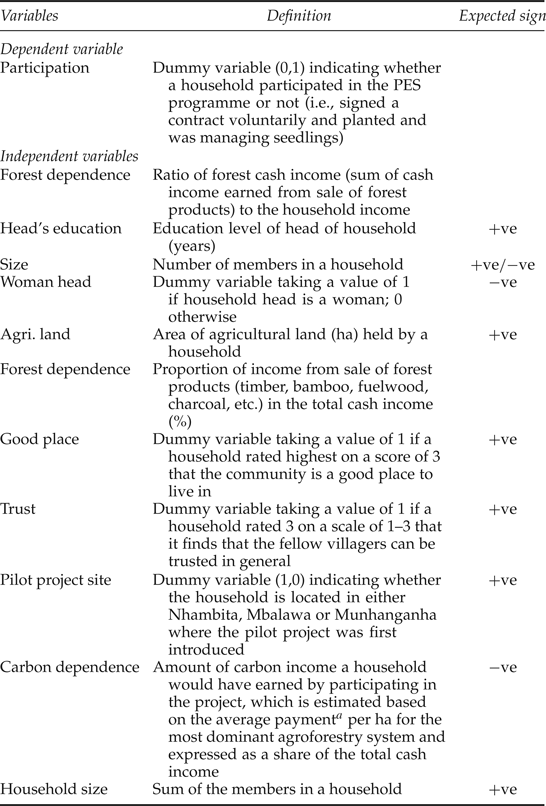
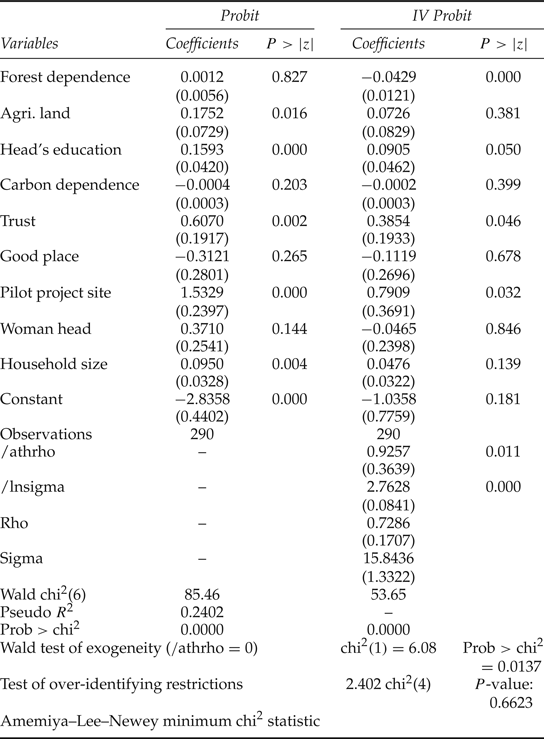
Table 2 summarizes the variable definitions used in the empirical modelling. Table 3 presents the results from the probit regressions. The first model is a simple probit model of PES participation, ignoring the endogeneity between forest dependence and PES programme participation. The second model is an IV probit model that instruments forest dependence.
Definitions of variables used in instrumental variables model

Notes: a The average payment per ha was estimated to be about MTS 3,416,000 (equivalent to US$129), which represented the upfront 30% payment for the mixed rows planting system which was the most dominant. It is ‘potential’ income because not all households participate in the project. It is a variable that reflects the carbon price facing a household.
Determinants of participation

In the simple probit model, size of agricultural land, household head's education level, length of head's residence in the community, trust, household size and household location in the pilot programme area (Site 1) positively influenced the household participation decision.
The results of the IV probit estimation offer some interesting insights. To begin with, the Wald test of exogeneityFootnote 16 provides evidence that forest dependence is, indeed, an endogenous variable. The validity of the instruments was tested using the Amemiya–Lee–Newey over-identification test (Baum et al., Reference Baum, Schaffer, Stillman and Wiggins2006),Footnote 17 from which we fail to reject the null hypothesis of the validity of the instruments used in the model specification and conclude that the instruments are valid. The results indicate that forest dependence had a statistically significant negative influence on PES programme participation. Household head's education and trust positively influenced the household participation decision. The statistical significance of the pilot project site variable implied that programme participation was likely to be higher in the piloted ‘first-generation’ programme areas where at least one cash payment had been made.
4. Discussion
Our research identified various factors influencing household participation. Forest dependence is a key factor that negatively affected participation, as could be expected for a PES programme restricting degrading forest uses. At the time, the Nhambita programme had low household participation rates (about 30 per cent). They improved subsequently to about 80 per cent, but forest-dependent groups such as charcoal producers unsurprisingly remained marginalized (Jindal et al., Reference Jindal, Kerr and Carter2012). Charcoal production is a key driver of land-use change in Nhambita. Herd (Reference Herd2007) estimated that 35 ha of woodlots were lost annually in the Chicale Regulado from charcoal production. Programme implementers were thus considering establishing special woodlots for charcoal production and providing more fuel efficient kilns to provide productive alternatives to charcoal producers (Jindal et al., Reference Jindal, Kerr and Carter2012).
TrustFootnote 18 was another key factor influencing household participation. Trust fosters cooperation, underpinning economic development in low-income countries with less well-developed financial sectors, insecure property rights and unreliable contract enforceability (Knack and Keefer, Reference Knack and Keefer1997; Thoni et al., Reference Thoni, Tyran and Wengström2012). The importance of trust is also confirmed by the positive relationship between programme participation and the pilot project site variable. Household participation was high in the pilot project site given that the pilot stage households had already received the first-year carbon payments when participation was opened up in the second year, which increased households' sense of trust in the programme and motivated more people to participate. Some households indicated during focus group discussions that when the PES programme was introduced they mistrusted it, since the idea of making payments for tree planting did not make any sense to them; they were convinced only when they saw payments were made. While initial trust is important, consistent contract enforcement and regular payments will reinforce a sense of household trust during the programme implementation stages.
The positive relationship between education and participation confirms the conventional knowledge on the relationship between education and technology adoption including for PES participation (Zbinden and Lee, Reference Zbinden and Lee2005). Education is known to improve knowledge and skills and to foster an attitude of being more receptive to innovation, such as a PES programme (Pattanayak et al., Reference Pattanayak, Mercer, Sills and Yang2003).
On the other hand, variables such as crop-land availability and potential carbon incomes were not statistically significant for PES participation. This contrasts with findings in Latin America, where land tenure and size were key threshold factors for PES enrolment (Grieg-Gran et al., Reference Grieg-Gran, Porras and Wunder2005). In Africa, smallholder farmers operate on multiple smaller plots (typically 0.5–1 ha). The programme offered the flexibility of using the same agroforestry system on multiple plots or combining different systems on the same plot (e.g., boundary planting, mixed row planting with crops and fruit orchard). Nevertheless, the size of land was not a significant variable.
Similarly, households that had more cash income other than PES (from produce sales, wages, business) had greater likelihood of participation (see Jindal et al. Reference Jindal, Kerr and Carter2012 for a similar finding). Similarly, Zhou et al. (Reference Zhou, Herzfeld, Glauben, Zhang and Hu2008) also noted that an increase in household farm income improved the probability of adoption of water-saving technology among Chinese farmers. Perhaps regular income flows increase farmers' risk-bearing ability, resulting in more land being allocated to cash crops (Fafchamps, Reference Fafchamps1992). As expected, the female-headed households are less likely to participate in the programme, having lesser labour resources as required for tree planting and nurture.
Planting trees on farms and homesteads is a common practice in rural Africa, so the PES-induced activities did not pose technological limitations for participation (Pagiola et al., Reference Pagiola, Rios and Arcenas2008). The economic incentive should be the key factor influencing the participation. However, participants are contractually bound to commit their land to tree cover for 25 years, yet cash payments cease after seven years.
The Nhambita programme had in place a strong institutional framework involving voluntary participation, flexible and reasonable contracting terms, and a robust monitoring, verification and certification system (Hegde and Bull, Reference Hegde and Bull2011; Jindal et al., Reference Jindal, Kerr and Carter2012). Upon initiation, the programme invited all smallholder farmers to join. The participating farmers signed voluntary contracts to plant indigenous and fruit tree plantsFootnote 19 on their mashamba (either on farm boundaries or in mixed rows along with crops) and manage the same for 25 yearsFootnote 20 in return for conditional cash payments. However, the long-term success of the programme may depend on some continued enforcement of the contracts.
Cash payment to the participating households was estimated to be MTS 5,270,505 per household for the planted area, representing 30 per cent payment; this is equivalent to MTS 3,416,000 per ha (MTS 1,626,667 per ha/year, or about US$60). This constituted 10 per cent of households' (very low overall) cash incomes – an important share (Hegde, Reference Hegde2010; Hegde and Bull, Reference Hegde and Bull2011), though not as high as some PES schemes in Latin America reaching 30 per cent (Miranda et al., Reference Miranda, Porass and Moreno2003; Kosoy et al., Reference Kosoy, Corbera and Brown2008). However, some risk from tree planting for crop yields may not have been effectively offset by the programme (Hegde and Bull, Reference Hegde and Bull2011). Still, the tree species planted also represented an economic asset for the farm households beyond the programme period. Considering all the factors, the private benefits of participation may predominantly outweigh private costs.
While the programme paid the farmers for PES planting, it also generated broader community-level development benefits, such as building schools or digging wells, which were shared with non-participant households. This component also catalysed forest-based enterprises such as carpentry, beekeeping and nursery units, improved gardening techniques, and so on. In total, the programme provided full-time employment for about 100 people, as well as limited seasonal employment for forest fire prevention. Besides cash payments to households for VERs and provision of direct employment, the programme also distributed guinea fowls for rearing, beehives for beekeeping and red gram seeds for cultivation (Hegde and Bull, Reference Hegde and Bull2011).
The high transaction costs of contracting with multiple smallholders can be a key anti-poor participation obstacle in PES programmes (Grieg-Gran et al., Reference Grieg-Gran, Porras and Wunder2005). Transaction cost was not a dominant factor in our selection of PES participants. The Plan Vivo system applied in the Nhambita PES programme is generally believed to be cost effective in working with a large number of small-scale farmers and rural communities (Cacho et al., Reference Cacho, Marshall and Milne2005). The contract terms offered were quite flexible. However, it is likely that about two-thirds of carbon revenues were spent on programme overheads and transaction costs, including though community development activities (UOE, 2008). Correspondingly, more PES paid conditionally for more years to farmers might also, hypothetically speaking, have attracted higher participation rates. Strategies were considered to reduce transaction costs, e.g., by bundling practices for enhancing ES (UOE, 2008; Jindal et al., Reference Jindal, Kerr and Carter2012). If the programme succeeds in paying farmers larger proportions of revenues from carbon sales, this may also strengthen incentives for participation.
5. Conclusion
The PES model is experiencing growing adoption in developing countries, but little empirical research informs us about the extent of participation by the ES providers, particularly resource-poor households, especially in Africa. Our analysis focused on the household-level factors that influenced participation in the Nhambita PES programme in Mozambique. The programme offers cash payments to smallholder farmers for agroforestry planting, resulting in carbon sequestration. Three key insights emerge from this study. First, the PES programme targeted forest clearing and burning, including charcoal and fuelwood production, as the main threats to the miombo woodlands. Yet households that were strongly engaged in these practices chose not to participate in the PES programme, as their opportunity costs were likely not covered. While the participation rates have increased since the completion of our field research (Envirotrade, 2010; Jindal et al., Reference Jindal, Kerr and Carter2012), further efforts were still needed to increase participation levels, particularly among the most forest dependent households (Jindal et al., Reference Jindal, Kerr and Carter2012). Secondly, the results highlight that social capital, such as indicated by the degree of trust, can be a powerful factor influencing household participation in PES programmes. As PES involved long-term contracts with landowners, implementers should pay particularly attention to strengthening social capital. Thirdly, an important part of the carbon revenue was used for community-level infrastructure such as building schools and wells, but this expensive ICDP component may eventually have absorbed too large a share of the carbon revenues, thus leaving PES payments proper insufficiently attractive, triggering too modest household participation.
On aggregate, we believe that the Nhambita PES programme and its valuable pilot lessons hold good potential for informing various PES initiatives and incentive programmes in sub-Saharan Africa. This also includes the emerging Reducing Emission from Deforestation and forest Degradation (REDD) activities in Mozambique, and the community participation and benefit-sharing mechanisms that this process entails.