Children's emotion regulation has received substantial attention over the last 10 years (Cole, Martin, & Dennis, Reference Cole, Martin and Dennis2004; Morris, Silk, Steinberg, Myers, & Robinson, Reference Morris, Silk, Steinberg, Myers and Robinson2007) based on the premise that regulation of emotional responses is an essential component of successful development (Thompson, Reference Thompson1994). Children who have difficulty in regulating negative emotions appear to be at increased risk for emotional and behavioral problems (Eisenberg et al., Reference Eisenberg, Cumberland, Spinrad, Fabes, Shepard and Reiser2001; Silk, Steinberg, & Morris, Reference Silk, Steinberg and Morris2003). However, extant research on the contribution of emotion dysregulation to risk for child behavior and emotional problems is limited in several ways. First, emotion regulation has often been defined as a relatively nonspecific construct rather than focusing on the regulation of specific emotions, each of which may be distinct in origin, expression, and function (Campos, Connor, Saltzman, Thompsen, & Wadsworth, Reference Campos, Connor, Saltzman, Thompsen and Wadsworth2001; Forbes & Dahl, Reference Forbes and Dahl2005; Izard, Reference Izard1977).
Second, emotion regulation is typically measured by averaging parameters of emotion display or experience across time and situations based on parents' report or global ratings of observed social interaction (Eisenberg, Morris, & Spinrad, Reference Eisenberg, Morris, Spinrad and Teti2005). Although informative, this aggregate measurement approach does not provide detail about the frequency, intensity, and chronometry of emotional responses typically emphasized in definitions of emotion regulation (Morris et al., Reference Morris, Silk, Steinberg, Myers and Robinson2007). In contrast, observation and statistical modeling of the real time dynamics (frequency, duration, intensity, time to recurrence) of specific emotions in relation to controlling events and processes (Snyder, Stoolmiller, Wilson, & Yamamoto, Reference Snyder, Stoolmiller, Wilson and Yamamoto2003; Stoolmiller & Snyder, Reference Stoolmiller and Snyder2006) would more closely capture typical definitions of emotion regulation.
Third, the manner in which child characteristics may moderate the relation of socialization to child emotion regulatory capacity has not been systematically assessed. For example, sex differences in verbal ability and in maturation of neuroregulatory systems during early to middle childhood may moderate the effects of emotion socialization by parents (Morris et al., Reference Morris, Silk, Steinberg, Sessa, Avenevoli and Essex2002). Boys and girls may also be socialized to regulate emotional experiences and displays in different ways as a result of parents' explicit or implicit gender schemas (Morris et al., Reference Morris, Silk, Steinberg, Myers and Robinson2007).
Emotions, Emotion Regulation, and Emotion Socialization
Each emotion may have a different and adaptive function (Saarni, Mumme, & Campos, Reference Saarni, Mumme, Campos, Damon and Eisenberg1997) in instigating and organizing behavioral responses to salient social–environmental events. For example, fear and sadness signal submission and help seeking, whereas anger indicates displeasure and activates countercontrol in response to environmental challenge. Although emotions are grounded in interrelated brain networks, their expression and regulation are shaped as a result of experience. Socialization by parents can modify what events trigger children's emotional responses, the nature of those responses, and the manner in which emotions are expressed and regulated (Morris et al., Reference Morris, Silk, Steinberg, Myers and Robinson2007).
Family socialization shapes children's expression and regulation of emotion in two ways. The first involves parents' immediate responses toward their children. These parenting behaviors both evoke the occurrence of specific types of emotion displays and shape the intensity and duration of those displays once they occur (Eisenberg & Fabes, Reference Eisenberg and Fabes1994; Gottman, Katz, & Hooven, Reference Gottman, Katz and Hooven1997). For example, Snyder et al. (Reference Snyder, Stoolmiller, Wilson and Yamamoto2003) found that maternal punitive responses served two functions in relation to child anger displays. Children's anger displays became increasingly likely as punitive maternal responses toward the child accumulated during ongoing interaction (an evocative function). Punitive maternal responses to children's displays of anger interfered with children's capacity to downregulate those anger displays (a shaping function).
The second source of emotion socialization in the family involves the more general emotional climate to which the child is exposed (Morris et al., Reference Morris, Silk, Steinberg, Myers and Robinson2007). Prevailing parental moods observed by but not specifically directed toward the child may affect children's emotional reactivity, expression, and regulation through processes of contagion, imitation, and social referencing. For example, children exposed to recurring interparent conflict and anger (Davies & Cummings, Reference Davies, Cummings, Cicchetti and Cohen2006) or to persistent maternal depressive affect (Silk, Shaw, Skuban, Oland, & Kovacs, Reference Silk, Shaw, Skuban, Oland and Kovacs2006) appear to be more emotionally reactive or to suppress emotional expression. However, the effects of such exposure may depend on the nature of the dominant parental mood to which a child is exposed. For example, Thompson and Meyer (Reference Thompson, Meyer and Gross2007) suggest frequent exposure to parent anger and hostility may be likely to increase children's displays of fear and sadness in order to avoid becoming a target of anger. Davis, Sheeber, and Hops (Reference Davis, Sheeber, Hops, Reid, Patterson and Snyder2002) report that maternal depressive behavior is associated with reductions in child anger and aversive behavior because those reductions decrease the recurrence of maternal depressive behavior. Prevailing parent moods provide ongoing social contexts in which children's emotional displays are shaped in order to constructively engender parental support and to mitigate parental inattention and irritability.
Emotion socialization in the family is not the only source of individual differences in children's emotion regulation. Child temperament and adjustment also organize and influence children's emotion expression and regulation (Zahn-Waxler, Klimes-Dugan, & Slattery, 2000). Frequent expressions of sadness and fear along with low rates of positive emotion appear to be reliably associated with youth depression (Forbes & Dahl, Reference Forbes and Dahl2005). Frequent and intense anger is associated with overt conduct problems involving reactive defiance and aggression (Caspi, Reference Caspi2000). Low anger and fear reactivity may characterize children who are instrumentally aggressive (Frick & Morris, Reference Frick and Morris2004) and engage in covert conduct problems (Snyder, Schrepferman, McEachern, & DeLeeuw, 2010). To clearly understand the degree to which parental moods affect children's emotion expression and regulation, the contribution of children's adjustment must be simultaneously considered.
Child gender is another potential source of variation in emotion socialization by parents. Parents hold discrepant expectations and respond differently to their sons' and daughters' expression of emotions (Eisenberg, Cumberland, & Spinrad, Reference Eisenberg, Cumberland and Spinrad1998), and boys and girls hold similar expectations about their parents' reactions to emotion displays (Birnbaum & Croll, Reference Birnbaum and Croll1984). Compared to girls, boys' expression of sadness, fear and other vulnerable emotions is typically discouraged whereas boys' expression of anger is encouraged (Garside & Klimes-Dougan, Reference Garside and Klimes-Dougan2002; Zahn-Waxler, Ridgeway, Denham, Usher, & Cole, Reference Zahn-Waxler, Ridgeway, Denham, Usher, Cole, Emde, Osofsky and Butterfield1993). Parents have been reported to preferentially support more relationship-oriented emotion regulation strategies by girls and more active, instrumental strategies by boys (Eisenberg et al., Reference Eisenberg, Cumberland and Spinrad1998). Research on gender differences in how children's emotion displays are socialized has focused primarily on parents' immediate and direct responses to children's emotion displays. The degree to which expression and regulation of anger and sadness/fear by boys and girls are differentially affected by exposure to parents' prevailing moods is unclear and merits detailed empirical attention.
Theoretical Model and Hypotheses
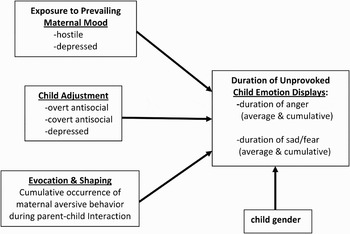
This report examines how children's capacity to regulate displays of anger and sadness/fear during mother–child interaction is related to children's exposure to maternal hostile and depressive mood. To clearly assess this relationship, several other potent influences on child emotion regulation must be simultaneously modeled and statistically controlled. The first is the immediate and proximal evocation and shaping of child emotion displays by during ongoing parent–child interaction. This influence can be controlled in part by modeling the duration and recurrence of children's expression and regulation of unprovoked anger and sadness/fear (i.e., those child emotion displays occurring only in the immediate social interactional context of parental neutral behavior). The direct evocative and shaping functions of parent behavior can be further controlled by explicitly modeling the cumulative influence of parent aversive behavior toward the child during ongoing parent–child interaction. The second influence is the association of child adjustment with the rates, duration, and recurrence of child emotion displays. This influence can be addressed in part by examining the relation of prevailing parental moods to child emotion regulation while simultaneously modeling concurrent child conduct problems and depressive symptoms as covariates. The full theoretical model tested in this report is shown in Figure 1.
The theoretical model of the sources of influence in assessing the indirect effects of prevailing maternal moods on child emotion regulation.

The association between parental moods and child emotion regulation may be particularly salient during earlier childhood because children's ongoing dependence and need for emotional security in the family is balanced with children's increasing capacity to manage their own emotional responses to environmental challenges (Thompson & Meyer, Reference Thompson, Meyer and Gross2007). In addition, most research on parents' socialization of child emotion expression and regulation has focused on early and middle childhood periods. The relative importance of children's exposure to prevailing maternal moods to emotion expression and regulation may be powerfully tested during this developmental period as it coincides with parents' efforts to directly socialize their children's emotion displays and regulation, and with the increasing association between children's adjustment and their capacity for emotion regulation.
Analytic Approach to Emotion Regulation: Bayesian Event History Analysis
The frequency, time to recurrence, and duration of negative emotions in an ongoing stream of behavior are often described as critical parameters of emotion regulation. Traditional statistical approaches to sequential behavioral data are flawed because they fail to account for two types of correlations inherent in repeated behavioral events. The first source is heterogeneity, which occurs when the parameters for repeated behavioral events across time for an individual are more alike than those across individuals. Ignoring such within-individual correlations underestimates standard errors for the effects of covariates on the temporal dynamics of emotion displays (Diggle, Heagerty, Liang, & Zeger, Reference Diggle, Heagerty, Liang and Zeger2002). A multilevel model takes such heterogeneity into account by considering random effects or frailties as they are called in event history models (Stoolmiller & Snyder, Reference Stoolmiller and Snyder2006). The second source of error, event dependence, occurs when time to recurrence or the duration of a behavioral event is dependent on previous occurrences of that event. Analyses treating repeating events as independent when they are not overestimate the amount of information each event contributes. This tends to bias standard errors and restricts the association of covariates to be the same across repeating events when covariates may be associated at different strengths with events as those events accumulate over time. In the analyses used in this report, the effects of heterogeneity and event dependence will be explicitly incorporated using multilevel, conditional frailty event history models with time-fixed covariates.
The application of these models to observed child emotion displays can be described as follows. Once a child initiates display of a specific emotion, the child displays that emotion for some duration before moving to another emotional state (including neutral). The term hazard reflects the rate at which one emotion (e.g., anger) lasting for time t was terminated by another state. The time to the offset of an emotion display can be construed as one indicator of the capacity to downregulate that emotion. Let the total number of individuals in a sample be m and the cumulating number of specific emotion displays be expressed as n. The hazard for a transition from one specific emotion display to the display of another emotion after duration t (i.e., downregulation) for the ith individual (where i = 1, … , m) at the jth occurrence of the emotion in ongoing interaction (where j = 1, … , n i) is denoted by the hazard rate, h ij(t), and is given by the following:

where μi is the dyadic-specific frailty, which is assumed to have a normal distribution with mean zero and variance τ2, quantifying the heterogeneity among dyads; and h 0ij(t) is the baseline hazard rate, assumed to have a Weibull distribution (Weibull, Reference Weibull1951). This distribution is most frequently used in duration modeling. Here, X is a vector of covariates and exp(X iβ) is the relative risk associated with the covariates.
The model in Equation 1 explicitly takes into account event dependence of the jth event for the ith dyad. Event dependence enters the model in the form a hazard function, h 0ij(t), which depends on the jth event. If the hazard function is the same for all events, there is no event dependence. Event dependence occurs when the hazard varies as some function of j or order of an event occurrence. For example, in this paper, we assess event dependence by h 0ij(t) = exp(δj)h 0i(t), where δ measures the effect of the order of event occurrences, for example, the degree to which the hazard rate (duration) for child anger or sadness/fear displays may get larger or smaller with their recurrence over time; and h 0i(t) is the baseline Weibull distribution defined as h 0i(t) = γt γ–1, which is monotone in duration t such that if γ < 1 it is decreasing, if γ > 1 it is increasing, and if constant it is γ = 1. The proposed model can be used to test hypotheses concerning the association of the hazard rates for terminating (i.e., capacity for downregulation) anger and sadness/fear as those displays accumulate over time with (a) maternal hostile and depressive moods after controlling for (b) child adjustment and (c) the immediate evocative effects of maternal aversive behavior toward the child.
A Bayesian estimation method was used to fit Model 1 (Dagne, Brown, & Howe, Reference Dagne, Brown and Howe2003). This method gives point estimates of covariate effects and the entire posterior distributions for model parameters, conditional on dyad-specific frailty (Gelman & Rubin, Reference Gelman and Rubin1992; Gilks, Richardson, & Spiegelhalter, Reference Gilks, Richardson and Spiegelhalter1996). In addition, it provides more stable estimates of variability than under likelihood analysis (Gelman, Carlin, Stern, & Rubin, Reference Gelman, Carlin, Stern and Rubin1995) for small data sets.
Method
Participants
The participants were 133 girls and 134 boys whose mean age was 5.3 years at the initiation of the research (fall of kindergarten) and 5.6 years at the last data collection point used in this report. This community sample was obtained by recruiting all kindergarten children (n = 352, participation rate = 76%) who enrolled in one elementary school serving a low socioeconomic neighborhood. Parental consent and child assent were obtained at initial recruitment using procedures approved by the University IRB. Participants were reimbursed for involvement at an approximate rate of $10/hr. Twenty-nine percent of the children were identified by their parents as African American, Hispanic/Latino, or other minority status. At kindergarten entry, 43% of children lived in intact families with two biological parents, and the remainder resided in other family configurations. The median family income was $25,000 (in 1998 US dollars); 28% of the families had incomes below the poverty line, 21% had incomes ranging from $30,000 to $50,000 per year, and 11% had incomes greater than $50,000 per year. Forty-six percent of the parents had not completed education beyond high school, and 20% had less than a high school education. With the exception of underrepresentation of Hispanic and Asian Americans, the demographic characteristics of the sample families were not substantially different than families in the United States with children under the age of 10.
Procedures
After face-to-face recruitment at school and subsequent informed consent in the fall of their children's kindergarten year (average child age = 5.3 years), mothers completed scales concerning their own predominant moods and their children's adjustment. Parents and the target children were then invited to participate in a series of mother–child interaction tasks for 1 hr on each of two occasions (separated by an average of 2.3 weeks). These interactions were videotaped for behavioral coding. These interactions were organized around a series of specified tasks, including playing a competitive game, problem solving, talking about the child's day at school, instruction and practice in numeracy and literacy tasks slightly above the child's academic level, and a match to sample collaborative visual–motor construction task. The first occasion of mother–child interaction typically occurred within 2 to 3 weeks after the parent completed scales about their own prevailing mood (time interval: mean = 14.7 days, median = 7.2 days, SD = 10.6 days).
Measures
Brief Symptom Inventory (BSI)
The BSI is a 53-item self-report scale (Derogatis & Melisaratos, Reference Derogatis and Melisaratos1983) completed by mothers about their subjective experiences over the previous 7 days. The BSI has good psychometric properties and well-established norms (Boulet & Boss, Reference Boulet and Boss1991; Derogatis, Reference Derogatis1993; Hayes, Reference Hayes1997). The internal consistency coefficients of the scales typically range from 0.70 to 0.85, and test–retest reliability over 2 weeks ranges from 0.70 to 0.91. The convergent validity of the BSI has been demonstrated in relation to a number of symptom scales (Long, Haring, Brekke, Test, & Greenberg, 2007). The internal structure of the BSI has most often been tested using exploratory factor analyses, with recovery of most of its separate subscales (including the two used in this report), although subscale or factor correlations are often quite high (e.g., .60 to .70). Many of these factor analytic studies suffer from analytic flaws, but recent more sophisticated analyses indicate longitudinal factor invariance for the subscales of the BSI (Long et al., Reference Long, Harring, Brekke, Test and Greenberg2007).
Two scales from the BSI were used in this report: a five-item scale for hostile mood and a seven-item scale for depressive mood. The parents in this sample reported high levels of hostile (M item = 0.91, SD = 1.15) and depressive mood (M item = 1.15, SD = 1.03) relative to norms for mothers of 8-year-old children (hostility: M = 0.40, SD = 0.47; depression: M = 0.35, SD = 0.54) (University of North Carolina Prevention Research Center, 2003). In the current sample, 40% of the mothers reported depressive mood and 57% reported hostile mood greater than 1 SD above these norms. Maternal BSI scores for hostile and depressive moods were correlated .68 (p < .001). Maternal BSI scores for depressive and hostile moods were correlated with their reports of familial disadvantage (r = .26 and .30, respectively, p < .001).
Specific Affect Coding System (SPAFF)
The videotaped interaction of each mother–child dyad during 1 hr on each observation occasion was coded using SPAFF (Gottman, McCoy, Coan, & Collier, Reference Gottman, McCoy, Coan and Collier1996). SPAFF provides a sequential description of maternal and child behaviors by coding the onset and offset of mothers' and children's behavior into 19 mutually exclusive and collectively exhaustive categories along a real time line. SPAFF gives priority to coding six discrete primary emotions using a gestalt of facial, physical, and vocal display features from a cultural informants approach. These emotions are anger, disgust, contempt, fear–tension, sadness, and humor. For this report, superordinate categories labeled “anger,” “sad–fearful,” “positive,” and “neutral” were created by combining specific SPAFF codes. The superordinate category “anger” was defined by the codes anger, contempt, and disgust. The superordinate category “sad/fear” was defined by the codes sad and fear–tension. The superordinate category “positive” was defined by the codes validation, interest, enthusiasm and humor. All other categories were collapsed into the superordinate category “neutral.” At any one time, the child and mother can each be in one of four emotion display states, angry, neutral, sad/fearful, or positive. The resulting real-time sequential observational data are represented as two sequences of state durations (one for the mother and one for the child) that can be combined to describe their conjoint emotion display states at any moment in ongoing interaction. Observer agreement on the superordinate categories ranged from 69% (κ = 0.64) to 87% (κ = 0.78).
In the current report, the conjoint dyadic states of child anger + parent neutral and child sad/fear + parent neutral were selected as the target start states, and sequential analyses focused on hazard rate for the child to transition out of unprovoked anger (i.e., given mom neutral) to another child emotion state (either sadness/fear, positive or neutral), and out of sadness/fear given mother neutral to another child emotion state (either anger, positive or neutral). The duration of displays provides one indicator of a child's capacity to downregulate anger and sadness/fear displays during mother–child interaction. Estimates of hazard rates (time to terminate or downregulate unprovoked anger or unprovoked sadness/fear) were analyzed separately for children's displays of anger and sadness/fear, and changes in those rates were examined as a function of the cumulative recurrence of each emotion display during the 2 hr of mother–child interaction.
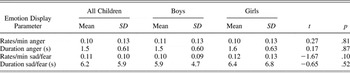
The mean rates per minute and durations of the superordinate child anger and sadness/fear display categories and their comparison by child sex are shown in Table 1. Child displays of anger and sadness/fear occurred at approximately the same rates during mother–child interaction, about once every 10 min. The mean duration of children's anger displays was typically brief, between 1 and 2 s. The mean duration of children's displays of sadness/fear was longer, about 6 s and showed much greater variability, suggesting differences in the downregulation of anger and of sadness/fear as indexed by duration. No significant sex differences were found in rates or durations of child displays of anger and of sadness/fear, with one exception: rates of girls' displays of sadness/fear were marginally higher than those of boys. Children's rates of anger and sadness/fear displays were reliably interrelated (r = .42, p < .001).
Rates and durations of observed child displays of anger and sadness/fear

Child angry given mother neutral and child sad/fear given mother neutral were chosen as target dyadic emotion display states for the lag sequential analyses based on the following rationale. Given the central focus on the relationship of exposure to maternal hostile and depressive moods to child emotion regulation, examination of the child's hazard rate (speed of downregulation) of anger and sadness/fear in relation to such exposure could be most clearly examined when the immediate maternal behavior toward the child during ongoing interaction was neutral and when the previous cumulative aversive behavior of mothers was statistically controlled. The aim was to specifically assess the association of children's exposure to maternal hostile and depressive moods with child emotion downregulation while accounting for the immediate and cumulative evocative and shaping influence of maternal aversive behaviors directed to the child on that downregulation. The analyses address the following question: given a concurrent neutral maternal behavior and accounting for cumulative influence of aversive maternal behavior toward the child, how is the time needed by a child to downregulate a negative emotion display associated with exposure to maternal hostile and depressive moods?
Child adjustment
Maternal reports of child adjustment were derived from the Child Behavior Checklist (CBCL; Achenbach & Edelbrock, Reference Achenbach and Edelbrock1983). The CBCL consists of 112 items describing a range of problem behaviors. For each item the parent indicates whether the problem was not true (0), somewhat or sometimes true (1), or very or often true (2) of the child over the previous 6 months. Three CBCL scales were used: aggressive behavior (subsequently labeled overt conduct problems; 18 items, e.g., fights, teases, is mean), rule-breaking behavior (subsequently labeled covert conduct problems; 14 item, e.g., steals, swears, lies), and withdrawn-depressed behavior (subsequently labeled depressive behavior; 8 items, e.g., sad, withdrawn, lacks energy). Extensive psychometric research indicates that CBCL scales have good temporal stability over 1 year (>0.70), good interparental agreement (>0.70), stable factor structure over many samples, good construct validity in relation to comparable scales from established instruments (rs > .50), and good criterion validity, discriminating between referred and nonreferred children (Achenbach, Reference Achenbach1991).
Results
Estimation of the model parameters was carried out using a Markov chain Monte Carlo algorithm (Gilks et al., Reference Gilks, Richardson and Spiegelhalter1996) in WinBUGS 1.4 (Spiegelhalter, Thomas, & Best, Reference Spiegelhalter, Thomas and Best2000). Convergence with a three-chain run was achieved after 25,000 iterations as judged by the scale reduction factor between 0.8 and 1.2 (Gelman & Rubin, Reference Gelman and Rubin1992). Posterior estimates of the Weibull parameters were computed based on subsequent 20,000 iterations after convergence, and are given in Table 2 and Table 3. In a Bayesian inference, a 95% or 90% credible interval is used to judge the strength of evidence for effects of covariates. If an interval does not contain zero, it then implies that there is significant association between the covariate of interest and the outcome variable.
Association of speed of child downregulation of emotion displays with parent negative moods

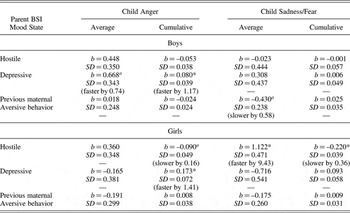
Note: BSI, Brief Symptom Inventory; b, the estimated coefficient for the model parameter function of parent mood state on the hazard rate. Positive coefficients indicate a higher hazard rate or faster downregulation, and negative coefficients indicate a lower hazard or slower downregulation. The “faster” and “slower” terms are derived from the exponentiation of the coefficient, indicating the amount of change in the hazard rate for every two-unit increase in parent self-reported hostile or depressive mood that relative to the sample mean on the BSI covers the difference between z scores of −1 and +1.
aOutside the 90% credible interval (two tailed).
*p < .05 outside the 95% credible interval (two tailed).
Association of speed of child downregulation of emotion displays with child maladjustment

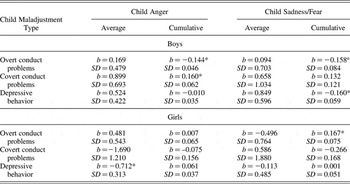
Note: b, the estimated coefficient for the model parameter function of child adjustment on the hazard rate. Positive coefficients indicate a higher hazard or faster downregulation, and negative coefficients indicate a lower hazard or slower downregulation.
aOutside the 90% credible interval (equivalent to p < .10 in a traditional test).
*p < .05 outside the 95% credible interval (two tailed).
Time dynamics of children's downregulation of anger and sadness/fear
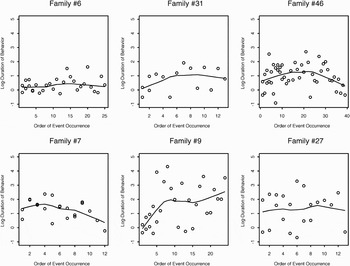
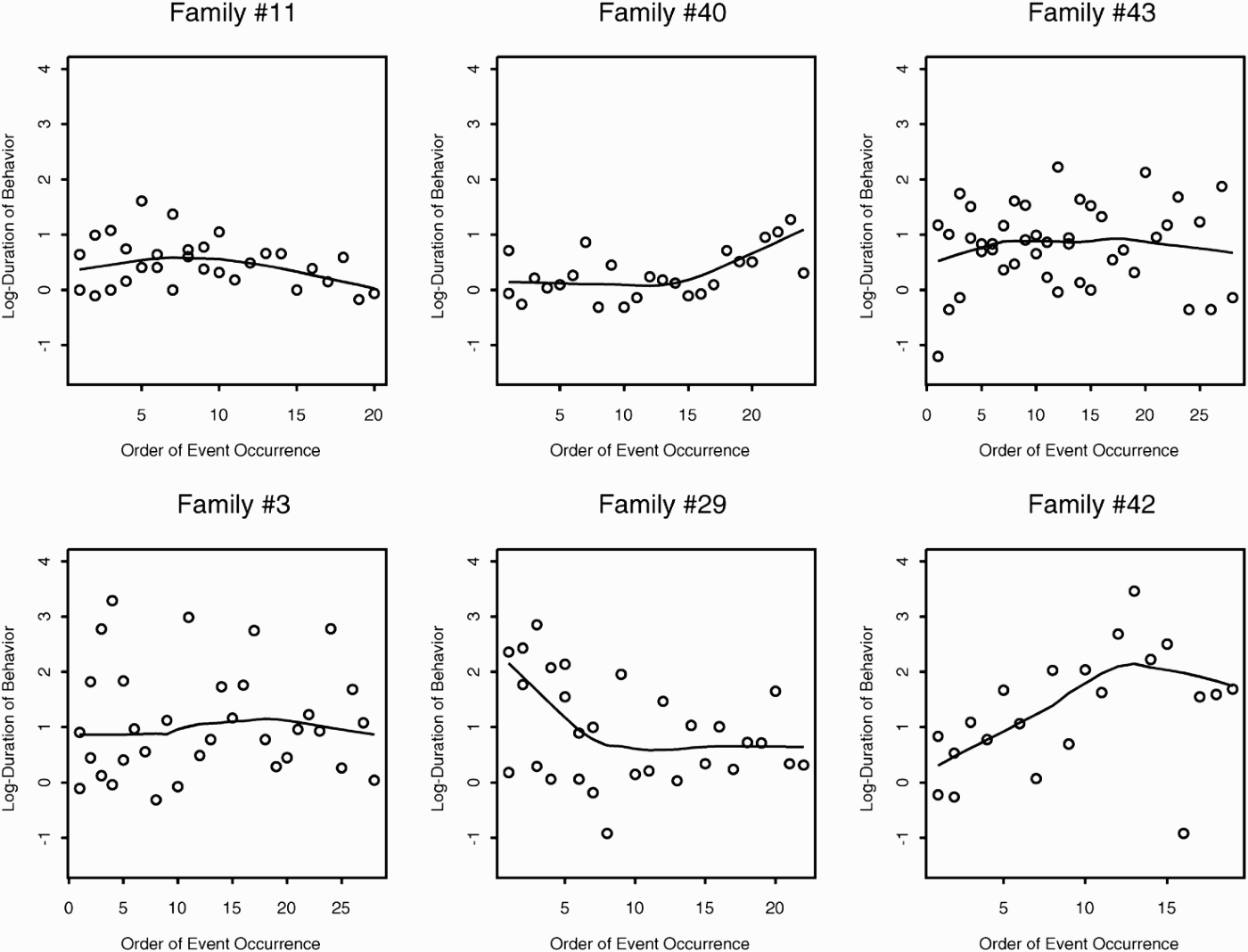
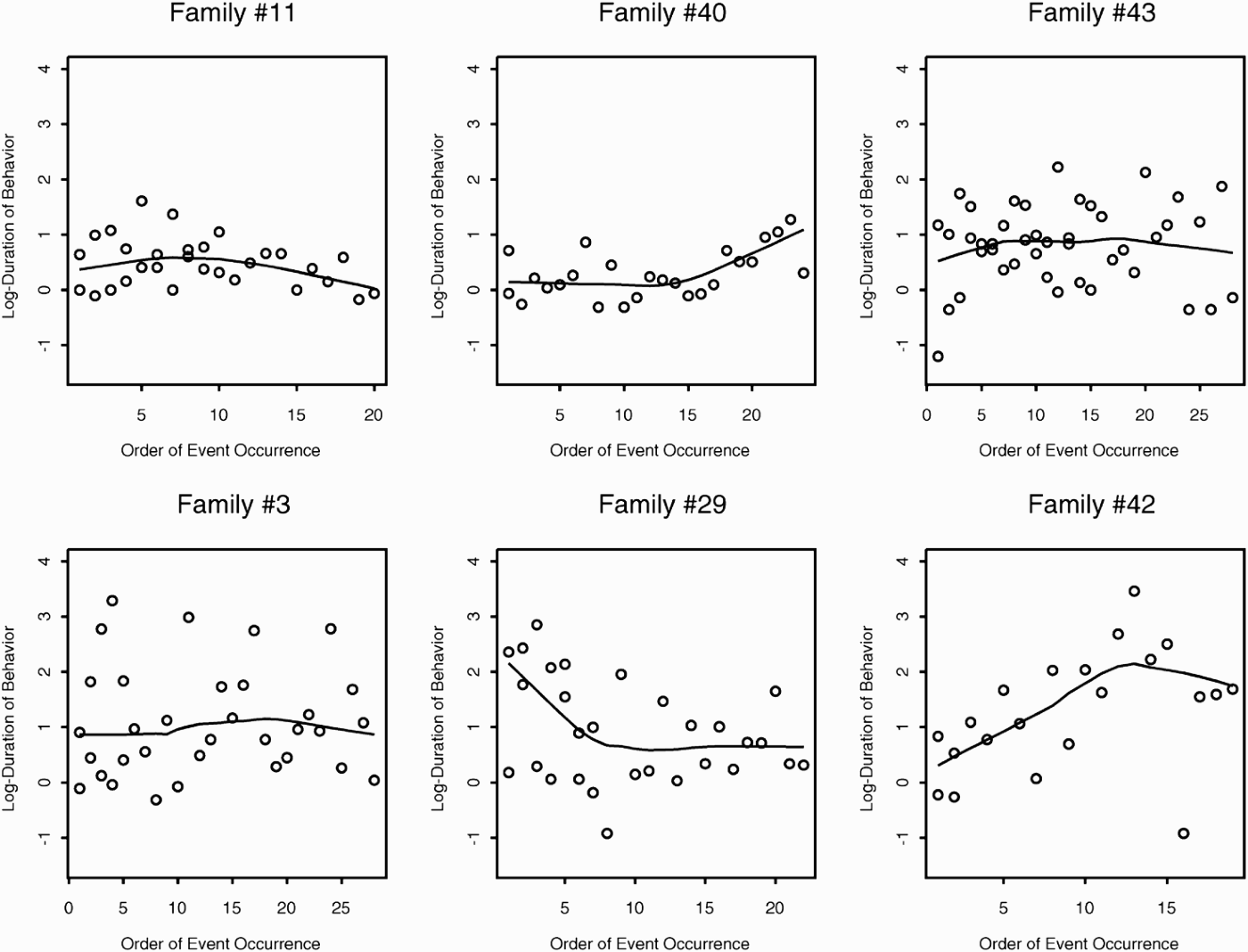
Prior to estimating the covariation of maternal moods and child adjustment with children's downregulation of negative emotions, we examined the degree to which the speed of children's downregulation of anger and sadness/fear was systematically associated with the repeating, cumulative display of those emotions during ongoing interaction. In other words, we assessed whether the speed of downregulation increased or decreased with repeated displays, and whether systematic individual differences were apparent in changes in the speed of downregulation with repeated displays. The locally weighted scatterplot smoothing (lowess) curve plotting logarithms (Cleveland, Reference Cleveland1979) of the duration of child unprovoked anger and child unprovoked sadness/fear against the cumulative count of emotional displays for child anger and sadness/fear during observed parent–child interaction were fit to the data separately for each child. Exemplars of these plots for anger (top row) and for sadness/fear (bottom row) are shown for a random selection of boys (Figure 2) and girls (Figure 3). These lowess curves indicate meaningful individual differences in how the speed of children's downregulation of anger and of sadness/fear changed with repeated expressions of those emotions during ongoing social interaction. For example, the plots in the bottom row of Figure 2 show that for some boys, downregulation of sadness/fear took progressively longer as sadness/fear displays accumulated over time (left-hand plot). For other boys the time to downregulate sadness/fear got progressively shorter as their displays of sadness/fear accumulated over time (middle plot). Inspection of lowess plots for all boys and girls suggested individual differences in direction and degree to which time to downregulate negative emotions were associated with cumulative displays of those emotions. A parameter for this systematic change in downregulation time with accumulating displays was incorporated into the subsequent Bayesian analyses and is termed cumulative in this report.
The locally weighted scatterplot smoothing (lowess) plots for the duration of boys' downregulation of anger (top row) and sadness/fear (bottom row) in relation to their cumulative display during an hour of parent–child interaction.

The locally weighted scatterplot smoothing (lowess) plots for the duration of girls' downregulation of anger (top row) and sadness/fear (bottom row) in relation to their cumulative display during an hour of parent–child interaction.
The association of children's downregulation of emotion displays with maternal mood states
The results of the Bayesian analysis of the relationship of maternal hostile and depressive moods to children's downregulation of anger and sadness/fear displays are shown in Table 2, after simultaneously estimating the cumulative effect of recurring maternal aversive behavior (see rows in Table 2 labeled “previous maternal aversive behavior”) and the effects of children's conduct problems and depressive symptoms (see Table 3). The top of Table 2 provides the results for boys' downregulation of anger (left portion) and sadness/fear (right portion), and the bottom of the table provides comparable results for girls. The columns labeled average describe the association of maternal moods with the child's average time to downregulate a specific negative emotion. The columns labeled cumulative describe how the association of maternal moods with the time for a child to downregulate specific negative emotions changes with each cumulative display of that emotion. For both average and cumulative effects, a positive coefficient (b) indicates frequent exposure to the maternal mood is associated with faster downregulation, and a negative coefficient indicates frequent exposure to the maternal mood is associated with slower downregulation of the emotional display by the child. The standard deviation is an estimate of a parameter. The “faster by” and “slower by” terms in Table 2 are exponentials of the estimated coefficients. These terms estimate the difference in the time for downregulation of anger and sadness/fear displays by children exposed to maternal depressive or hostile mood at z score values of −1 and +1 in the distribution observed in this sample.
Exposure to maternal hostile mood and child downregulation of emotion displays
Taking the two left facets of the top row of Table 2 for the relation of boys' downregulation of anger to their exposure to maternal hostile mood, the value of the b coefficient (0.448) for the column labeled average is positive and its 95% confidence interval contains zero. That is, maternal self-reported hostile mood was not reliably associated with their sons' downregulation of unprovoked anger during observed social interaction (after also accounting for cumulative maternal aversive behavior and the sons' adjustment problems, which are a set of controls that are applicable to the other analyses reported in Table 2). The b coefficient of −0.053 in the second column labeled “cumulative” indicates maternal hostile mood was also not reliably associated with changes in boys' downregulation of unprovoked anger displays as those displays accumulated over time in mother–child interaction. Similarly, there was no reliable association between maternal hostile mood and girls' downregulation of unprovoked anger (b = 0.360) as an average effect or as their anger displays accumulated (b = −0.090) during ongoing interaction (see upper left quadrant in the lower portion of Table 2).
The b coefficient of −0.023 in the third column and the b coefficient of 0.001 in the fourth column of the top portion of Table 2 indicate boys' downregulation of sadness/fear was not reliably associated with maternal hostile mood either as average or as cumulative effects, respectively. In contrast, greater exposure to hostile maternal mood was associated with girls' faster average downregulation of unprovoked sadness/fear displays (b = 1.122, p < .05), but with their slower downregulation of sadness/fear displays as those displays accumulated (b = −0.220, p < .05) during interaction (see the third and fourth columns in the upper right quadrant of the bottom half of Table 2). Compared to downregulation of unprovoked sadness/fear by girls whose mothers' self-reported hostile mood was 1 SD below the sample mean (z = −1), girls whose mothers' hostile mood was 1 standard deviation above the sample mean (z = 1) were 9.43 times (exp[1.122 × 2] = 9.43) faster on average to downregulate their unprovoked sad/fear displays. This association of maternal hostile mood with girls' average speed of downregulation of sadness/fear displays was very large. Girls exposed to maternal hostile mood at z = +1 downregulated their sadness/fear displays over nine times faster than girls exposed to maternal hostile mood at z = −1. However, the speed of girls' downregulation of sadness/fear displays diminished by 36% (exp[−0.220 × 2] = 0.36) with each occurrence of displays for girls who were exposed to maternal hostile mood at z = +1 compared to those exposed to maternal hostile mood at z = −1. The relation of exposure to maternal hostile mood to children's regulation of emotion displays during mother–child interaction had reliable effects on the downregulation of unprovoked sad/fear displays by girls but not on the downregulation of displays of either anger or sadness/fear by boys.
Exposure to maternal depressive mood and child downregulation of emotion displays
The relation of maternal depressive mood to boys' downregulation of anger and sadness/fear displays is shown in the second horizontal section in the top half of Table 2. Given increasing exposure to maternal depressive mood, boys were marginally faster on average to downregulate their unprovoked anger displays (b = 0.668, p < .10), and became increasingly faster in their downregulation of anger displays as those displays accumulated during interaction (b = 0.080, p < .05). Relative to a boy whose mother's depressive mood was z = −1, the anger downregulation of a boy whose mother's depressive mood was z = +1 became 1.17 times faster each time the boy displayed anger during ongoing interaction. Maternal depressive mood was not reliably associated with boys' downregulation of fear and sadness.
The relation of maternal depressive mood to girls' downregulation of anger and sadness/fear displays is shown in the lower section of the bottom portion of Table 2. Given increasing exposure to maternal depressive mood, girls were faster to downregulate their unprovoked anger displays as those displays accumulated during interaction (b = 0.173, p < .05). Relative to a girl whose mother's depressive mood was z = −1, the anger downregulation of a girl whose mother's depressive mood was z = +1 became nearly 1.5 times faster each time the girl displayed anger during ongoing interaction. Girls' average time to downregulate their unprovoked displays of sadness/fear (b = −0.716), and changes in their time to downregulate displays of sadness/fear with accumulation those displays (b = 0.093) were not reliably associated with maternal depressive mood. Exposure to maternal depressive mood was similarly related to increasing reductions in the time needed to downregulate anger displays as they accumulated during social interaction for boys and girls. However, exposure to maternal depressive mood was not associated with the time to downregulate sadness/fear by boys or girls.
Association of children's downregulation of anger and sadness/fear with child adjustment
Estimates of the association of children's downregulation of negative emotions with their overt and covert conduct problems and with depressive behavior were simultaneously incorporated into the Weibull hazard model analyses. The results are shown in Table 3. The top of the table provides the results for boys' regulation of anger (left portion) and sadness/fear (right portion) separately in relation to overt (top row) and covert (second row) conduct problems and depressive behavior (third row). The bottom half of the table provides comparable results for girls. The columns labeled average and cumulative provide results comparable to those described in Table 2, but now in relation to child adjustment. The b coefficients describe the association of child adjustment with the speed of the child's downregulation of each negative emotion (controlling for maternal mood and cumulative maternal aversive behavior). Positive b coefficients indicate an association of child maladjustment with faster downregulation and negative b coefficients indicate slower downregulation. The standard deviation refers to the hazard coefficients.
As shown in Table 3, children's downregulation of negative emotions given maternal neutral behavior was more consistently associated with boys' than girls' adjustment. Boys reported by parents to be higher on overt conduct problems were slower (b = −0.144, p < .05; top row, second column) and boys reported by parents to be higher on covert conduct problems were faster to downregulate their anger (b = 0.160, p < .05; second row, second column) as they repeatedly displayed anger during mother–child interaction. Boys reported by parents as showing more depressive behavior were observed to take longer to downregulate their sadness/fear displays (b = −0.160, p < .05; third row, fourth column) as those displays accumulated during interaction.
Girls reported by parents to be high on overt conduct problems were faster to downregulate their displays of sadness/fear (b = 0.167; p < .05; fourth row, fourth column) as those displays recurred during ongoing mother–daughter interaction. Girls reported by parents to be high on depressive behavior were slower on average to downregulate anger displays (b = −0.712, p < .05).
Discussion
The first goal of this research was to examine the covariation of prevailing maternal moods and children's capacity for downregulation of displays of anger and sadness/fear. Attempts were made to isolate variation in children's capacity for emotion downregulation because of to exposure to maternal moods from other sources of variation. These sources were controlled by simultaneously modeling variance because of to cumulative maternal aversive behavior toward the child during ongoing interaction and to child adjustment. The data suggest exposure to maternal hostile and depressive moods is reliably associated with children's downregulation of displays of anger and sadness/fear during interaction with their mothers. However, these associations were complexly differentiated according to the type of maternal mood, the type of child emotion display, the chronometric parameter used to define downregulation, and child gender.
A second goal of this research was to use the best available measurement methods to precisely capture the temporal durations of recurring emotion displays during ongoing social interaction, and to apply sophisticated analytic tools to adequately model individual differences in children's emotion displays from a time-dynamic perspective. Using Bayesian event history analyses, two chronometric parameters were derived from detailed observation of the real time onset and offset of children's separate displays of anger and of sadness/fear during social interaction with their mothers. There were reliable individual differences in each parameter. The first parameter was the duration of each type of child emotion display averaged over all display occasions during 2 hr of mother–child interaction. The second parameter reflected systematic change in the duration of each type of child emotion display as those displays accumulated over time during mother–child interaction.
Exposure to maternal hostile and depressive moods was related in different ways to children's downregulation of (unprovoked) anger and sadness/fear, and to average and cumulative parameters of their downregulation. Mothers' hostile mood was reliably associated with their daughters' faster downregulation of displays of sadness and fear, although such rapid downregulation became increasingly difficult as those displays accumulated during interaction. In contrast, mothers' depressed mood was reliably associated with increasingly faster downregulation of anger displays by both boys and girls as those displays accumulated during interaction. These relationships between maternal mood and children's downregulation of emotion displays did not reflect simple contagion or imitation of isomorphic emotions. In isomorphic contagion or imitation, extended exposure to maternal depressive mood would be associated with longer duration expressions of sadness/fear as indexed by both average and cumulative downregulation parameters, and extended exposure to maternal hostile mood would be associated with longer duration expressions of anger as indexed by both average and cumulative downregulation parameters. Frequent exposure to parental hostile and depressive moods instead appeared to be associated with shifts in children's downregulation of different, complementary negative emotion displays: maternal hostile mood with child downregulation of sadness/fear, and maternal depressive mood with child downregulation of anger.
Some explanation other than contagion or imitation is needed to account for the complementary relationship patterns between maternal moods and children's capacity to downregulate emotion displays. One possible explanation is that these patterns reflect the functional properties of different child emotion displays in relation to prevailing maternal moods. Based on past social experiences with their mothers, children's displays of anger and sadness/fear and the speed with which such displays are downregulated may have been more or less useful in engaging and coping with mothers whose moods are predominantly hostile or depressed. From this perspective, children's faster downregulation of fear and sadness may provide the means to avoid becoming the target of maternal hostility (Thompson & Meyer, Reference Thompson, Meyer and Gross2007) even though this tactic is hard to maintain during ongoing interaction. Maternal hostile mood is likely to be experienced as a salient aversive stimulus by children. Children's acquiescence as signaled by short-lived expressions sadness or fear may be quite functional in mitigating the effects of her mood on the child during ongoing interaction.
Children's long duration anger displays may exacerbate maternal depressive responses during ongoing mother–child interaction, whereas briefer displays may diminish those responses. As a consequence, children's faster downregulation of anger displays may be shaped by reductions in maternal expressions of depressive mood and behavior: persistent child anger does not engender positive maternal attention but rather may generate continuing maternal sadness, withdrawal, and helplessness. Functionally, maternal depressive mood is likely to be experienced as a salient aversive stimulus by their children. Long duration anger displays may exacerbate maternal depressive responses during ongoing mother–child interaction, whereas briefer displays may diminish those responses (Davis et al., Reference Davis, Sheeber, Hops, Reid, Patterson and Snyder2002).
The relationship patterns between downregulation of sadness/fear and exposure to maternal hostile and depressive moods was similar for boys and girls, with the exception that boys' downregulation of fear and sadness was not associated with maternal hostile mood. More generally, girls' downregulation of sadness and fear was more often affected by maternal mood than that of boys. These patterns are consistent with previous research on gender specific expression of sadness/fear, indicating girls relative to boys are socialized to respond to others' distress with empathy and acquiescence (Brody, Reference Brody1999; Garside & Klimes-Dougan, Reference Garside and Klimes-Dougan2002). The gender-specific patterns of downregulation of sadness/fear are also consistent with previous research indicating boys are more often reinforced for utilizing a more instrumental approach and girls for utilizing a more relationship-focused approach to social transactions (Zahn-Waxler et al., Reference Zahn-Waxler, Klimes-Dougan and Slattery2000; Zahn-Waxler, Race, & Dugal, Reference Zahn-Waxler, Race, Dugal, Bell, Foster and Mash2005)
The ascertainment of individual differences in the duration parameters of child negative emotions extends previous time-dynamic analyses that focused on the time it takes for children to move from neutral affect to displays of anger (Snyder et al., Reference Snyder, Stoolmiller, Wilson and Yamamoto2003) and to sadness (Stoolmiller & Snyder, Reference Stoolmiller and Snyder2006) in response to mothers' displays of anger during ongoing social interaction. Collectively, the current study along with previous studies suggest children's regulation of emotion displays during social interaction entail two time-sensitive processes, the propensity to display the emotion (reactivity) in response to some event, and the duration of the emotion once it is displayed (downregulation). Individual differences in each of these processes seem to occur at two levels. Reactivity is captured by the average rate at which a child displays a specific emotion over time (average effect) and by systematic changes in the time (either faster or slower) to return to the display of an emotion as the emotion is repeatedly expressed during ongoing interaction (cumulative effect). Downregulation can be captured by the average duration of displays of specific emotions over time and by systematic changes in the display duration (either longer or shorter) of an emotion as the emotion is repeatedly expressed during ongoing interaction (cumulative effect). The current analyses on display duration indicate the relation of maternal moods to children's average time to downregulate anger (and sadness/fear) was different than the relation of those moods to changes in the duration of child anger (and sadness/fear) displays as those displays accumulated during ongoing social interaction.
The linkage between emotion regulation and child adjustment has received considerable theoretical and empirical attention. Given nearly concurrent measurement of downregulation of emotion and child adjustment in this report, the analyses reported here do not provide strong causal tests of this linkage. With this caveat in mind, two intriguing findings merit further empirical attention. First, a strong version of a functional continuity model was not consistently supported. A functional continuity model assumes that high rate, intense and long duration experience and expression of specific negative emotions become increasingly organized over time into rigid patterns that increase risk for topographically similar problems: that is, anger with externalizing or conduct problems, and sadness/fear with depressive and anxiety problems (Izard, Reference Izard1977; Zahn-Waxler et al., Reference Zahn-Waxler, Race, Dugal, Bell, Foster and Mash2005). A functional continuity model fit the data better for boys than girls. For boys, overt conduct problems were associated with difficulty in downregulating anger, and depressive problems with slower downregulation of sadness/fear. For girls, overt conduct problems were associated with faster downregulation of sadness/fear, and depressive behavior with slower downregulation of anger.
Second, for boys only, overt conduct problems were associated with slower downregulation of anger and covert conduct problems with faster downregulation of anger. This is consistent with extant theory and research (Frick & Morris, Reference Frick and Morris2004; Snyder et al., 2010) suggesting an integral aspect of covert conduct problems is the ability to cover emotional expression. Suppressing the overt expression of anger may facilitate successful performance of norm-violating behavior by reducing the child affective cues needed by adults to effectively track and provide consequences for that behavior.
Interpretation of the findings in this report needs to be contextualized by a number of methodological limitations. The data were derived from a cross-sectional, correlational design. As such, causality cannot be inferred, and the direction of the relationships among the variables is not clear. Child conduct and depressive problems were derived solely from parent report. The assumption that direct effects of parent evocation of child emotion displays were successfully controlled by examining the duration of children's negative emotion displays in the absence of immediate maternal provocation and by controlling for cumulative maternal aversive behavior toward children during ongoing interaction cannot be definitively asserted in the absence of experimental manipulation. The data were derived from a community sample from one geographic location and school, limiting the degree to which generalization to other samples can be inferred.
Conclusions
The analyses and data in this report have several implications. First, empirical progress in the study of child emotion regulation may be facilitated by taking an increasingly differentiated view of the phenomenology of emotions. Anger and fear/sadness seem to have potentially different functions, are responsive to different environmental contexts, and their relative dysregulation may pose different risks. Second, observation of the time-dynamic expression of emotions provides a useful methodological and theoretical complement to more traitlike, temperamental approaches to emotional reactivity and regulation. Third, sophisticated repeated-events time series statistical tools are now available to successfully address a number of very challenging analytic issues that have limited the clear interpretation of the real-time expression and function of emotions in previous research (Dagne et al., Reference Dagne, Brown and Howe2003; Stoolmiller & Snyder, Reference Stoolmiller and Snyder2006).