Religion remains a key driving force in the political world (Gill Reference Gill2001; Norris and Inglehart Reference Norris and Inglehart2004). It affects a wide range of phenomena such as voter behavior (Esmer and Pettersson Reference Esmer, Pettersson, Dalton and Klingemann2007; Green Reference Green2007), political participation (Driskell, Embry, and Lyon Reference Driskell, Embry and Lyon2008; Omelicheva Reference Omelicheva2018), economic preferences for redistribution (Stegmueller Reference Stegmueller2013; Jordan Reference Jordan2014), and the welfare state (Gill and Lundsgaarde Reference Gill and Lundsgaarde2004), as well as attitudes toward various social policies that lie at the heart of global culture wars (Inglehart and Baker Reference Inglehart and Baker2000; Layman Reference Layman2001). As a result, it's important to understand the determinants of religious behavior. In this research note, we reexamine the relationship between religion and human development.
Historically, secularization theory has been the dominant paradigm in studies of religion. Secularization theory focuses on the “demand” for religion and predicts that religion will decline as societies develop. Over the past 20 years, though, secularization theory has come under sustained criticism for lacking empirical support and a clear causal story (Greeley Reference Greeley1989; Finke and Stark Reference Finke and Stark1992; Stark and Finke Reference Stark and Finke2000). One scholar describes it as little more than “a hodgepodge of loosely employed ideas” (Hadden Reference Hadden1987, 598). Responding to these criticisms, scholars have developed alternative models of religion, most notably the religious markets model. The religious markets model focuses on the “supply” of religion and predicts that religion will flourish in countries where the state abstains from intervening in the religious marketplace and religious organizations are free to compete for adherents (Finke Reference Finke1990; Iannaccone Reference Iannaccone1991; Chaves and Cann Reference Chaves and Cann1992; Finke and Iannaccone Reference Finke and Iannaccone1993; Stark and Iannaccone Reference Stark and Iannaccone1994; Finke and Stark Reference Finke and Stark1998). In many ways, the religious markets model has come to dominate the contemporary study of religion.
Two recent studies, though, suggest that we may have been too quick to discard secularization theory (Gaskins, Golder, and Siegel Reference Gaskins, Golder and Siegel2013a; Reference Gaskins, Golder and Siegel2013b). Importantly, these studies provide a formal model that lays out a clear causal pathway by which human development affects religion. The core insight in the Gaskins, Golder, and Siegel (GGS) model, which incorporates both demand-side and supply-side explanations of religion, is that religious and secular benefits are often substitutes for one another. This means that the desire to secure religious goods declines with the ability to earn secular goods. Since the ability to earn secular goods increases with human development, religion will, as secularization theory predicts, decline as societies develop. Empirical studies critical of secularization theory have typically examined religion in the context of wealthy countries. This is problematic because these analyses lack sufficient variation in human development to appropriately evaluate secularization theory's predictions. In their recent studies, GGS evaluate their theoretical claims using a wide range of countries that exhibit significant variation in societal development. In line with secularization theory, they find a strong negative relationship between religion and human development.
Secularization theorists differ over what they mean by the demise of religion. Specifically, they differ over whether it entails the decline of religious attendance, religious belief, or religion's role in the public sphere. GGS focus on religious attendance because the causal mechanism they propose for secularization theory rests on the substitutability of religious and secular goods. Their focus on religious attendance makes sense as it captures the intuition that being religious entails certain costs and that the benefits from being religious are often restricted to those who actively engage in religious activities. More time, effort, and money spent securing religious goods necessarily means receiving fewer secular goods, and vice versa. Not all religious goods, though, have secular substitutes. For example, it's not clear there are secular substitutes for all of the psychic benefits derived from religious belief. More importantly, there are no costs incurred in terms of foregone secular benefits if one simply believes in God. As a result, the GGS model provides no reason to expect that religious belief will decline with human development.
In this research note, we contribute to the existing literature by explicitly contrasting how human development affects religious attendance and religious belief. Our empirical analyses employ a significantly larger and more diverse dataset than previous studies. Consistent with the idea that the primary causal mechanism underlying secularization theory has to do with the substitutability of secular and religious goods, we find that human development has a negative effect on religious attendance but little effect on religious belief. Human development is a multifaceted concept. In the GGS model, it captures anything that increases the ability to obtain secular goods. In our analyses, human development is a composite measure that takes account of a country's level of education, health, and standard of living (UNDP 2016). In order to see exactly what is driving the relationship between societal development and religion, we disaggregate our measure of human development. We find that none of the disaggregated factors have any effect on religious belief, and that the negative relationship between religious attendance and human development is driven primarily by a country's level of education and health. There is no evidence that supply-side features of the religious marketplace have an effect on either religious attendance or religious belief.
THEORY
In the GGS model, individuals derive utility from both the secular and religious worlds. This utility can result from the consumption of material goods, such as cars or bequeathed alms, or from more psychic benefits, such as those that come from having a job or participating in group prayer. An individual's secular utility is determined by her net income—the more income she has, the more secular goods she can obtain. The ability to earn income varies across individuals depending on things like their level of education and health. As countries develop, populations typically become more educated and healthier, and, as a result, one's ability to earn secular income increases. While the GGS model incorporates several factors that affect an individual's religious utility, two are of particular relevance here. The first is an individual's level of religious participation, which comprises the time, effort, and money devoted to religious practice. Religious goods and benefits are increasing in participation. The second is the level of pressure exerted by the state on religious participation. Some states repress and regulate religion, whereas others impose “blue laws” designed to enforce religious standards and limit secular activities.
Individuals in the GGS model make two choices. First, they choose a level of doctrinal strictness, which may be zero, by affiliating with a particular denomination in the religious marketplace. Next, they choose a level of religious participation, which may also be zero. Individuals make these choices to maximize their expected utility from secular and religious goods. When choosing how much to participate in religious activities, individuals face a tradeoff “between the material and psychic goods …they can obtain via religious participation and the degree to which lost time, money, and effort devoted to religious participation detract from leisure time and the pursuit and enjoyment of secular goods” (Gaskins, Golder, and Siegel Reference Gaskins, Golder and Siegel2013b, 1128). The tradeoff exists because religious participation is viewed as a substitute for secular income. This tradeoff is conditioned by the way that states regulate religion. States that regulate religion raise the costs of religious participation, thereby increasing the relative benefits of seeking secular income. In contrast, states that encourage religious activity and allow competition in the religious marketplace lower the costs of religious participation, thereby decreasing the relative benefits of seeking secular income.
It follows from the substitutability of secular and religious goods that religious participation will be lower among those who have a high ability to earn secular income. Since the ability to earn secular income increases with human development, it also follows that religious participation should decline as societies develop. Religious participation should decrease with state regulations that suppress religious practice, but increase with state regulations that suppress secular practice. Each of these individual-level predictions apply at the aggregate level. In particular, human development should lead to less religious participation in a country because it leads to more individuals who earn high levels of secular income, each of whom has a greater incentive to reduce her religious participation. The predictions of the GGS model are, thus, in line with the basic claim of secularization theory that religion will decline as societies develop.Footnote 1
The underlying causal mechanism proposed by GGS has to do with the substitutability of religious and secular goods. However, it isn't the case that the pursuit of religious goods always takes away from one's ability to pursue secular goods. Religion provides a wide range of benefits, including social insurance, afterlife, socialization, and doctrinal benefits. Social insurance benefits comprise psychic benefits, such as a sense of belonging and hope, as well as more material benefits, such as money, food, and other social services, in times of need. Afterlife benefits are benefits, such as going to Heaven, that religious believers expect to consume after they die. Socialization benefits include things like holding the same beliefs and engaging in the same religious activities as family and friends. Doctrinal benefits are those individuals receive from truly believing and acting in accordance with the doctrines of a religious faith. Some of these benefits can only be obtained by participating in religious activities, such as attending religious services. Pursuing these benefits necessarily takes away from one's ability to procure secular goods. Other benefits, though, such as doctrinal benefits or the psychic benefits derived from a sense of belonging and hope, can often be obtained through religious belief alone. These benefits can be obtained without forgoing the pursuit of secular goods—individuals can believe in God and engage in secular activity at the same time. This suggests that human development should have different effects on religious attendance and religious belief. Specifically, human development should lower religious attendance but have no effect on religious belief.Footnote 2
Human Development Hypothesis (Religious Attendance): Religious attendance declines with human development.
Human Development Hypothesis (Religious Belief): To the extent that the secularization process is driven solely by the substitutability of secular and religious goods, there will be no relationship between religious belief and human development.
It's important to recognize that secularization theorists have proposed other, albeit loose, arguments for why religion will decline as societies develop. In particular, some scholars have argued that the rise of a rational worldview and the development of science cause people to lose faith in the superstitious dogma of religion (Berger Reference Berger1967; Martin Reference Martin1978). If these alternative causal mechanisms are at work, we may see both religious attendance and religious belief decline with human development.
In terms of the supply side, state regulations on religion should reduce religious attendance due to the substitutability of secular and religious goods, and the fact that regulations on religious activity increase the relative benefits of secular activity. There's no necessary tradeoff between religious belief and secular activity, though. Individuals can seek secular goods without reducing their religious belief. Moreover, states can't enforce regulations on private religious belief in the same way that they can enforce regulations on public religious practice. Thus, we wouldn't expect religious belief to decline with religious regulations.
Regulation of Religion Hypothesis (Religious Attendance): Religious attendance declines with regulations on religion.
Regulation of Religion Hypothesis (Religious Belief): To the extent that the secularization process is driven solely by the substitutability of secular and religious goods, there will be no relationship between religious belief and regulations on religion.
EMPIRICAL ANALYSIS
To test our hypotheses, we created two dependent variables.Footnote 3 Religious Attendance is the average level of religious attendance in a country and is measured on a 1–8 scale, with 1 meaning that citizens practically never attend religious services and 8 meaning they attend more than once a week. Religious Belief is measured on a 0–1 scale and captures the proportion of individuals in a country who believe in God. Data come from the integrated 1981–2014 World and European Values Surveys (EVS 2015; WVS 2015).
On the demand side, our primary independent variable is the Human Development Index (HDI), which is a composite index capturing three underlying dimensions: health, education, and standard of living (UNDP 2016). The three dimensions are combined to produce a country's HDI score on a 0–1 scale, with higher numbers indicating greater human development. We use the natural log of HDI to capture the idea, which comes directly from the GGS model, that religious attendance declines with societal development, but at a declining rate. HDI captures a broad notion of societal development. This is important as the relevant variable in the GGS model, which depends on human development, captures anything that affects individual income, including things like health and education. As our analyses indicate, our inferences hold even if we use the narrower measure of GDP per capita (Feenstra, Inklaar, and Timmer Reference Feenstra, Inklaar and Timmer2015).
On the supply side, we use two variables from the International Religious Freedom dataset to capture aspects of the religious market place and evaluate our hypotheses about religious regulations (Grim and Finke Reference Grim and Finke2006). Government regulation is a 0–10 index measuring the restrictions placed on religion by state actors, while Social Regulation is a 0–10 index measuring the restrictions placed on religion by non-state actors such as religious groups or the culture at large.
In line with Gaskins, Golder, and Siegel (Reference Gaskins, Golder and Siegel2013a; Reference Gaskins, Golder and Siegel2013b), we also include several variables to control for other factors thought to affect religion. Income Inequality measures the Gini index of income inequality (Solt Reference Solt2016).Footnote 4 According to deprivation theory, inequality promotes religion by exacerbating existential security threats, thereby encouraging the poor to seek comfort in religion (Norris and Inglehart Reference Norris and Inglehart2004; Karakoç and Baskan Reference Karakoç and Baskan2012). According to relative power theory, inequality promotes religion by exacerbating social tensions, thereby encouraging the rich to use religion as a means of social control (Solt, Habel, and Grant Reference Solt, Habel and Grant2011). In contrast to these theories, the GGS model does not make a firm prediction about the impact of inequality on religion. The model recognizes that inequality may act as a threat that increases the fundamental desire for religious comfort. However, it also recognizes that increasing inequality can influence religion by changing a country's income distribution. The generality of the model's assumptions don't allow us to make a firm prediction about this second causal pathway as it's possible to construct special cases in which inequality increases or decreases religious activity.
Communist is a dichotomous variable indicating whether a country is communist. Although there's variation in the extent to which communist regimes suppress religion, the generally hostile stance of communist authorities toward religion should raise the cost of acting religiously. Moreover, it's well-documented that many communist countries use their education system to socialize their citizens into holding more secular beliefs (Van den Bercken Reference Van den Bercken1985; Ramet Reference Ramet1998; Froese Reference Froese2004). Thus, we'd expect both religious attendance and religious belief to be lower in communist countries. Postcommunist is a dichotomous variable indicating whether a country has ever been communist. This variable captures the possibility that communism continues to have a negative effect on religion even after countries have transitioned to democracy. One reason for this is that religious institutions are less likely to have developed into key social institutions and will be less valuable as social networks. Percent Catholic, Percent Protestant, and Percent Muslim measure the population percentages that identify as Catholic, Protestant, and Muslim. The intuition here is that some religions place greater emphasis on religious adherence than others. Individuals who grow up in countries where these religions predominate are likely to be socialized into having greater religious sentiment.
To maximize comparability, we replicate the estimation strategy and model specification adopted by Gaskins, Golder, and Siegel (Reference Gaskins, Golder and Siegel2013b). Our models are estimated using ordinary least squares (OLS) regression.Footnote 5 We don't employ country fixed effects for two reasons. First, almost a quarter of our countries are “singletons” and would be dropped with the inclusion of country fixed effects. Second, our religious regulation (and other) variables are time invariant. As a result, including country fixed effects would result in the estimation of a demand-side only model of religion, which would be problematic. Country random effects are also problematic due to the very small number of observations per country (Clarke and Wheaton Reference Clarke and Wheaton2007). We include UN-specified regional fixed effects to capture unobserved heterogeneity across regions, as well as dichotomous variables to capture common wave effects in the WVS-EVS surveys. Finally, we also employ cluster-robust standard errors to deal with any heteroskedasticity and the non-independence of observations from the same country.
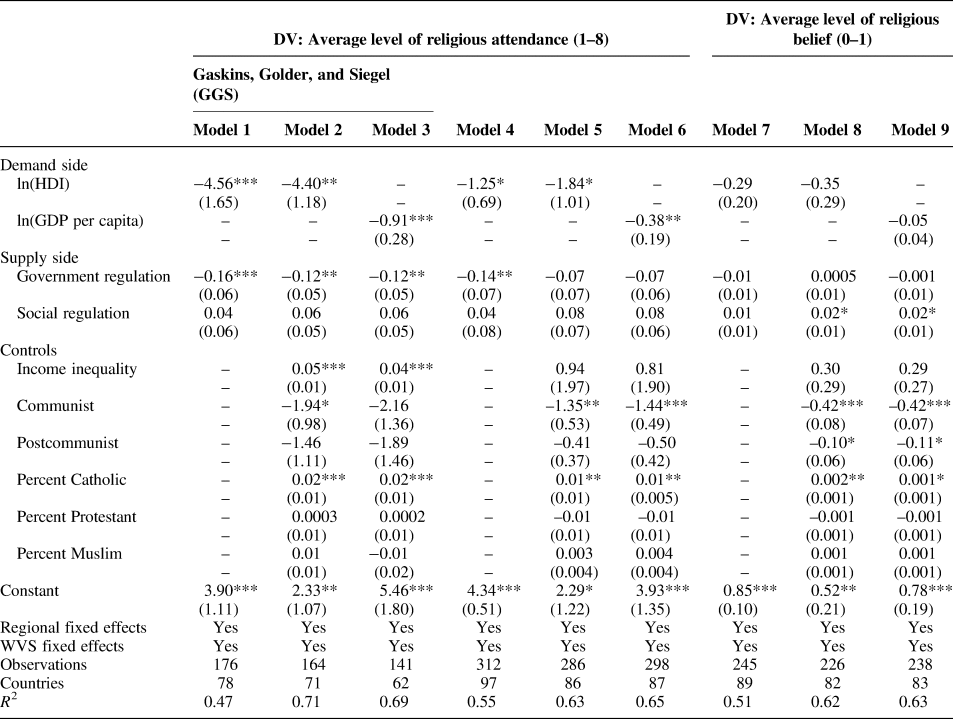
In Table 1, we report the results from two sets of models, one focusing on religious attendance and the other on religious belief. To provide some context for our results on religious attendance, we first show the equivalent results reported by Gaskins, Golder, and Siegel (Reference Gaskins, Golder and Siegel2013b, 1132). Our sample is significantly larger and more diverse than that used by GGS. Due to our longer time frame, our sample has almost 80% more country-surveys and 25% more countries. As a reminder, the principal difference when it comes to the measurement of the covariates between our models and the GGS models is that we explicitly incorporate the measurement uncertainty in Income Inequality into our model estimations (see footnote 4). In three models, we employ GDP per capita rather than HDI as our measure of societal development.
Determinants of aggregate religious attendance and belief

Notes: Cells show coefficients with robust standard errors clustered by country in parentheses. Models 1–3 replicate the results shown in Gaskins, Golder, and Siegel (Reference Gaskins, Golder and Siegel2013b, 1132). While our results are based on data from the 1981–2014 period, the results from GGS are based on data from the 1980–2004 period; HDI stands for the Human Development Index.
*p < 0.10; **p < 0.05; ***p < 0.01 (two-tailed).
As predicted, there is strong evidence that religious attendance declines with human development. This is evident from the negative and statistically significant coefficients on our two measures of societal development in all six religious attendance models. Also as predicted, there is little evidence that religious belief declines with human development. Although the coefficients on our measures of societal development are negative in the religious belief models, they do not reach conventional levels of statistical significance. Together, these results suggest that support for secularization theory writ large depends on whether we are considering religious attendance or religious belief. While religious attendance declines with human development, this doesn't necessarily seem to be the case for religious belief. Importantly, these results are consistent with the central theoretical claim in the GGS model that a key driving force in the secularization process has to do with the substitutability of secular and religious goods.
Supply-side explanations of religion receive little support from our analyses. While the GGS results suggest that government regulations reduce religious attendance, this inference is not consistently supported by our larger and more diverse sample. Although the coefficients on Government Regulation remain negative, they are no longer statistically significant once the control variables are included. There is no evidence that government regulations ever have an effect on religious belief. The results with respect to Social Regulation are even weaker. There is no evidence, for example, that religious regulations imposed by non-state actors ever have a negative effect on religious attendance or religious belief. Indeed, the positive and statistically significant coefficients on Social Regulation in Models 8 and 9 suggest that, if anything, social regulations on religion may actually increase religious belief.
In terms of the control variables, there's strong evidence that religious attendance and religious belief are significantly lower in communist countries—the coefficients on Communist are always negative and are significant in five of the six models that include controls. Only the negative effect of communism on belief persists into the postcommunist period. While the coefficients on Postcommunist are negative, they're only significant in the belief models. These particular results suggest that attempts by communist countries to socialize their citizens into holding more secular beliefs can have a long-lasting effect on religion. Recent research has focused on the impact of inequality on religion. While the GGS results suggest that inequality increases religious attendance, our analyses indicate that this result doesn't hold in our larger and more diverse dataset once we take account of the measurement uncertainty that exists in the inequality scores.Footnote 6 We also find no evidence that inequality ever has an effect on religious belief. Finally, our results indicate that countries with large Catholic populations tend to have higher levels of religious attendance and belief.
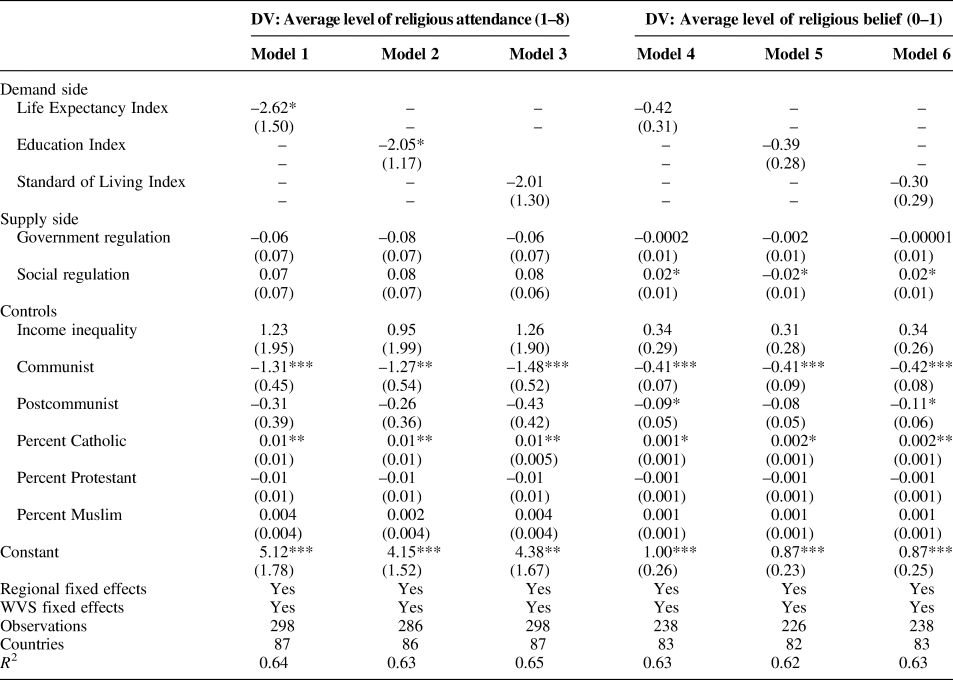
HDI is a composite measure capturing a country's level of education, health, and standard of living. In Table 2, we present results from models where we disaggregate the individual components of the HDI measure. The results show that the negative relationship between human development and religious attendance is driven primarily by a country's level of education and health. This is indicated by the negative and significant coefficients on Education Index and Health Index in Models 1 and 2, and the insignificant coefficient on Standard of Living Index in Model 3. Consistent with the results in Table 1 and the idea that a key driving force in the secularization process has to do with the substitutability of secular and religious goods, we find little evidence that the individual HDI components influence religious belief. Although the coefficients on the HDI components are negative in the belief models, they do not reach conventional levels of statistical significance.
Individual components of the Human Development Index and religion

Note: Cells show coefficients with robust standard errors clustered by country in parentheses. Models 1–3 show results with respect to religious attendance, while models 4–6 show results with respect to religious belief.
*p < 0.10; **p < 0.05; ***p < 0.01 (two-tailed).
CONCLUSION
Secularization theory focuses on the “demand” for religion and predicts that religion will decline as societies develop. Over the past 20 years, though, secularization theory has come under sustained criticism. This criticism has led to the development of alternative models of religion that focus on supply-side features of the religious marketplace. Two recent studies, though, suggest we may have been too quick to discard secularization theory. Incorporating both demand-side and supply-side explanations, Gaskins, Golder, and Siegel (Reference Gaskins, Golder and Siegel2013a; Reference Gaskins, Golder and Siegel2013b) lay out a clear causal pathway by which religion declines with human development. The causal mechanism they propose rests on the assumption that secular and religious goods are often substitutes. As societies develop, the ability to secure secular goods increases and, as a result, people will shift away from seeking religious goods toward seeking secular goods.
However, it is not the case that the pursuit of religious goods always requires a reduction in secular activity. Religious benefits that can be obtained only through religious attendance lower the ability to produce secular goods, but religious benefits that can be obtained through religious belief do not. Thus, we should see a difference in how societal development affects religious attendance and religious belief. Specifically, and to the extent that the secularization process is driven solely by the substitutability of secular and religious goods, we should find that religious attendance, but not religious belief, declines with human development. Using a larger and more diverse dataset than previous studies, this is precisely what we find. Our results indicate that as societies develop, we should not be surprised if religious belief remains high even as religious attendance declines.Footnote 7 These results are consistent with recent studies in the United States showing that the proportion of religious “nones” is increasing even while the proportion of those professing religious belief remains high (Putnam and Campbell Reference Putnam and Campbell2010; Chaves Reference Chaves2011). To see exactly what's driving our results, we disaggregate our human development measure into its three component parts. We find that none of these component parts have any effect on religious belief, and that the negative relationship between religious attendance and human development is driven primarily by a country's level of education and health. Our analyses suggest that it's important to think carefully about what one's theoretical model of the secularization process implies for different aspects of religion. Depending on one's purported causal mechanism, we should expect only some aspects of religion to decline with human development.
Supplementary material
To view supplementary material for this article, please visit https://doi.org/10.1017/S1755048319000464.