Introduction
Technological changes and the COVID-19 pandemic have recently affected the world’s significant economies, leading to a deteriorating employment situation and a worsening labour market (Frey & Osborne, Reference Frey and Osborne2017; Lemieux et al., Reference Lemieux, Milligan, Schirle and Skuterud2020). China’s labour force participation and employment rates have declined (Wu & Chen, Reference Ge, Chen, Tang and Cong2021). At the end of 2021, China’s surveyed urban unemployment rate was 5.1 per cent Footnote 1 and remained at 5.5 per cent until 2022 Footnote 2 . Mainly due to the impact of the COVID-19 pandemic, the risk of unemployment in China’s labour market will remain high for some time (Che et al., Reference Che, Du and Chan2020).
In this context, promoting employment has become a top issue in many countries in terms of politics, economy, and livelihoods. To increase labour force participation, many countries have started to strengthen the function of public employment service (PES) agencies and explore the paths of labour service cooperation with PES-jobseeker-employer tripartite participation (Ansell & Gash, Reference Ansell and Gash2008; van der Aa & van Berkel, Reference van der Aa and van Berkel2014; van Gestel et al., Reference van Gestel, Oomens and Buwalda2019). Following this trend, the Chinese Ministry of Human Resources and Social Security and the Poverty Alleviation Office of the State Council piloted a labour service cooperation policy in 2016, taking Guangdong Province, Hunan Province, and Hubei Province as pilot provinces. In this way, the Chinese PES agencies introduced the labour service cooperation policy, emphasising the multi-factor engagement of employers, employees, and public agencies to reduce unemployment.
Labour service cooperation policy has attracted the attention of countries as a practice that uses partnerships to deliver employment services (Ingold & Valizade, Reference Ingold and Valizade2017; van Gestel et al., Reference van Gestel, Oomens and Buwalda2019). By examining the collective recruitment and direct job placement approaches of labour service cooperation, studies showed how the cooperation process engages both PES agencies and the labour demand and supply sides (Holmlund & Linden, Reference Holmlund and Linden1993; van Berkel & van der Aa, Reference van Berkel and van der Aa2012) and discussed the effectiveness of this policy (Ingold & Stuart, Reference Ingold and Stuart2015; Bredgaard, Reference Bredgaard2018; Ingold, Reference Ingold2018; Raspanti & Saruis, Reference Raspanti and Saruis2021). The Chinese government is considering implementing this approach in all provinces. A topic of public concern is whether labour service cooperation, as an essential policy tool, can play a role in promoting employment. If the policy effectively encourages labour participation, what are its underlying mechanisms? Which provinces would benefit the most? However, there has not been much in-depth research on the labour service cooperation policy, and the effects and mechanisms of the policy have yet to be fully discussed in the Chinese context. Additionally, the impact of employment-promoting policies has been the subject of recent empirical investigations using frameworks such as quasi-experimental designs and meta-analyses (Vooren et al., Reference Vooren, Haelermans, Groot and Maassen van den Brink2019). However, as a new approach to employment-promoting policies, there is limited empirical evidence on the effect of the labour service cooperation policy.
This article explores the causal relationship between implementing the labour service cooperation policy and decreasing registered unemployment in policy pilot provinces. Furthermore, it optimises the implementation path for the labour service cooperation policy. Since the difference-in-differences (DID) method provides a way to control for unobserved factors with the same employment-promoting effect, and there were panel data covering an extended period that offered province-level employment information, this study used a DID framework with provincial panel data to evaluate the employment-promoting effect of the labour service cooperation policy. The analysis also aimed to establish whether there are transferable lessons that other labour markets or countries could replicate.
Literature review and hypotheses
Public employment services and the labour service cooperation policy
Since its emergence in the 1950s, PESs have been dedicated to addressing the asymmetry of information between supply and demand in the labour market. As a result, policies have focused on providing job seekers with recruitment information. Later, there was a new trend in active labour market policies towards ‘work first’ (Peck & Theodore, Reference Peck and Theodore2000; Weishaupt, Reference Weishaupt2010), and the focus of PESs shifted to human capital enhancement, typically in the form of vocational training (Hudson & Kühner, Reference Hudson and Kühner2009; Lee, Reference Lee and Autor2009). Since the early 1990s, the focus of PESs has shifted from the supply side of the labour force to the demand side, encouraging employer participation in the reemployment process and emphasising job supply and creation (Ingold & Stuart, Reference Ingold and Stuart2015; Bredgaard, Reference Bredgaard2018). PESs then accumulated more cooperative experience with employers and jobseekers.
Recently, collaborative governance, which emphasises multifactor engagement and brings multiple stakeholders together with public agencies to make decisions, has been introduced into labour market policy (Ansell & Gash, Reference Ansell and Gash2008; Hartley et al., Reference Hartley, Sørensen and Torfing2013). Studies have discussed collaborative governance in the labour market, especially private collaboration models such as labour market inclusion services and demand-side-oriented policies (Rieucau & Salognon, Reference Rieucau and Salognon2014; Lindsay et al., Reference Lindsay, Pearson, Batty, Cullen and Eadson2021; van der Aa & van Berkel, Reference van der Aa and van Berkel2014). Since public–private networks have been proven to improve public policy implementation (Lundin, Reference Lundin2007; van Gestel et al., Reference van Gestel, Oomens and Buwalda2019), as typical examples of public–private collaboration in the labour market, the labour service cooperation policy has gained more attention.
Following Thuy et al. (Reference Thuy, Hansen and Price2001), labour service cooperation in this study refers to a networked way to deliver employment services through partnerships among employers, job seekers, and PES agencies. From a policy process perspective, the labour service cooperation policy can be defined as a collective decision-making process that combines the experience and resources of both public and private agencies. Compared to other PES policies – whose mission is to empower job seekers and increase their competitiveness by facilitating access to labour market information and offering career-related training and guidance services – the labour service cooperation policy tries to create a network between the public and private sectors and build a direct cooperative relationship between both sides of labour demand and supply.
The labour service cooperation policy has two approaches: collective recruitment and direct job placement. Collective recruitment, taking job fairs as an example, is a practical approach featuring large-scale attendance, intensive contact, and face-to-face interviews between stakeholders (Beam, Reference Beam2016). The critical factors of successful job fair cooperation are employer engagement and the coordinating role of PESs (Martin & Swank, Reference Martin and Swank2012; van Berkel & van der Aa, Reference van Berkel and van der Aa2012). Direct job placement is another approach because one of the core functions of a PES agency is to provide appropriate candidates for registered job vacancies (Holmlund & Linden, Reference Holmlund and Linden1993; Autor, Reference Autor2009). PES agencies create and update job listings in a timely fashion by establishing relationships with and periodically interacting with employers. Simultaneously, based on the specific job requirements, PES agencies provide an initial screening of candidates and send them directly to the workplace. For example, the Danish job centre Aarhus has contact with 3,000–5,000 companies yearly to obtain adequate labour demand information and link them to well-prepared job applicants (Marklund & Rollnik-Sadowska, Reference Marklund and Rollnik-Sadowska2016). These two approaches show that the public–private networks built for employment cooperation aim to integrate all partners’ interests with high collaborative willingness and positive coordinating mechanisms.
Debates on the labour service cooperation policy
So far, many studies have examined the function and impact of the labour service cooperation policy. Some studies have found negative policy effects. Bonet et al. (Reference Bonet, Cappelli and Hamori2013) developed a taxonomy of labour market intermediaries, classifying them as information providers, matchmakers, and administrators. Following this framework, studies focused on the role of PES agencies and found that, compared to acting as matchmakers, PES agencies still act as information providers in a triangular relationship with employers and employees due to their lack of in-depth engagement (Ingold & Stuart, Reference Ingold and Stuart2015; Ingold & Valizade, Reference Ingold and Valizade2017; Jones et al., Reference Jones, Scullion, Hynes and Martin2022). Regarding the employers’ engagement in public employment services, van Gestel et al. (Reference van Gestel, Oomens and Buwalda2019) found that employers viewed most services as public sector responsibilities, and PES agencies were less keen to expand their partner role. Hence, the engagement of both the public and private partners is limited. Although employers maintain a positive attitude towards activation policies, only a few collaborate with PES agencies (Bredgaard, Reference Bredgaard2018).
In addition, since PES agencies cannot change employers’ selection criteria for employees and avoid selective hiring problems, employers are generally sceptical of PES-referred jobseekers, so employment collaboration between PES agencies and the private sector lacks a foundation (Bonoli & Hinrichs, Reference Bonoli and Hinrichs2012). Moreover, PES agencies must prioritise helping firms with labour shortages regardless of the working conditions or pay packages they offer (Larsen & Vesan, Reference Larsen and Vesan2012). Thus, the agencies may introduce unemployed people to junk occupations (Peck & Theodore, Reference Peck and Theodore2000). Therefore, the labour service cooperation policy leads to suboptimal job matches and has a limited impact on employers’ recruitment of disadvantaged groups.
However, many studies have found that the labour service cooperation policy is useful for promoting employment. Researchers found that PES agencies act as intermediaries that interface with employers continuously, stay abreast of job vacancies, and screen job seekers who meet job requirements based on a comprehensive grasp of job seeker information. They are effective in job placement and achieve higher efficiency and success rates in re-employment (Holmlund & Linden, Reference Holmlund and Linden1993; Sheldon, Reference Sheldon2003; Raspanti & Saruis, Reference Raspanti and Saruis2021). Aksnes (Reference Aksnes2019) found that job agents act as knowledge brokers when negotiating with employers, advising candidates, and arranging workshops to bridge the gap between these stakeholders and promote labour service cooperation policy implementation.
In addition, studies focusing on public–private sector networks have examined partnerships among job seekers, employers, and PES agencies. According to van Gestel et al. (Reference van Gestel, Oomens and Buwalda2019), public–private networks encourage employers to reconsider their ‘co-producer’ roles for job creation. Employers are willing to review the formal job qualifications of disadvantaged groups (Rieucau & Salognon, Reference Rieucau and Salognon2014). Ingold (Reference Ingold2018) discussed in detail how cooperation between PES agencies and employers is possible and mentioned that trust relationships among PES frontline advisers, unemployed clients, and potential employers are essential.
Chinese policy background
Since the Chinese government introduced the re-employment project to solve the massive lay-off problem of ‘Xiagang’ in the 1990s, government-sponsored and nationwide Re-employment Service Centres (RSCs) were set up (Wong & Ngok, Reference Wong and Ngok2006). However, the RSCs are thought to have failed to help unemployed workers retrain and find new jobs, although they did deliver basic living allowances (Solinger, Reference Solinger2002; Wong & Ngok, Reference Wong and Ngok2006). Given these shortfalls, the Chinese government ceased setting up new RSCs in 2001 and put forward an active employment policy with the development of the Chinese labour market (Qian et al., Reference Qian, Bian and Liu2022). At the end of 2000, the Labor Market Regulations of China were promulgated, which mentioned Chinese public employment services for the first time. According to the regulations, Chinese PES refers to public employment services provided by labour and social security departments, including employment introduction, vocational guidance, employment training, community employment development services, and other services (Zhang, Reference Zhang2019). Subsequently, in 2007, the Employment Promotion Law of China proposed the establishment of PES agencies at the county level. These agencies have been under the management of the Ministry of Human Resources and Social Security since 2009. Currently, the total number of PES agencies in China is 8,010 Footnote 3 . Data from the China Labour Statistical Yearbook show that all PES agencies’ job seekers and registered job vacancies numbered thirty six, 135, 413, and sixty seven, 279, 374, respectively, by the end of 2021.
In the context of China’s labour market, many studies have argued that PES agencies positively contribute to the employment of laborers, especially in terms of reducing job-searching expenses, enhancing working skills, meeting the recruitment needs of sectors experiencing labour shortages, and facilitating the flow of labour force resources (Lai et al., Reference Lai, Meng, Li and Tian2011; Zeng, Reference Zeng2009; Wu & Wang, Reference Wu and Wang2012; Wang, Reference Wang2019). However, some studies have questioned the effects of the Chinese PES. For example, Betcherman & Blunch (Reference Betcherman and Blunch2008) showed that more than just job training and matching services provided by PES agencies are needed to cope with economic crises and changing labour market challenges. Although PES agencies increased recruitment opportunities, vulnerable groups were excluded from training programs and job vacancies, indicating that the cream-skimming phenomenon exists in the Chinese labour market (Wang, Reference Wang2016; Zhu & Xie, Reference Zhu and Xie2019; Ge et al., Reference Ge, Chen, Tang and Cong2021). Also, as a part of the Active Labour Market Policies, PES agencies pay more attention to the supply side than the demand side of the labour market (Kong et al., Reference Kong, Kang and Jin2022).
After public–private partnerships were introduced in the field of public services in 2014 (Wang et al., Reference Wang, Xiong, Wu and Zhu2018), China witnessed the appearance of public–private cooperation in PES delivery. In 2016, the Ministry of Human Resources and Social Security and the Poverty Alleviation Office of the State Council decided to promote a labour service cooperation policy in Hunan, Hubei, and Guangdong provinces, which have massive workforces. This policy aimed to create a new approach by combining all stakeholders, such as job seekers, employers, and PES agencies, to facilitate job creation, mitigate labour market mismatches, and promote re-employment. Specifically, the local PES agencies in the pilot areas connected with a large number of companies or enterprises across the province, selected those experiencing labour shortages, and offered decent working conditions and reasonable wages. By making job listings, PES agencies keep abreast of candidate employers’ job vacancies and match registered eligible job seekers. Compared with traditional supply-side employment services, this process makes PES agencies and potential employers co-producers of job opportunities. In addition to establishing relationships and providing initial matching of candidates, PES agencies also negotiate with employers for work treatment, organise intensive interviews between jobseekers and candidate employers, and send employees who pass the interviews directly to the workplace to complete the job placement.
Theory and hypotheses
As the central part of the Chinese Labor and Employment bureaucratic system, Chinese PES agencies play the stewardship role of not only setting reemployment policy goals, but also mobilising resources to achieve them. Under this situation, although private cooperation in Chinese PES delivery involves PES agencies, job seekers, and employers, cooperation practices are dominated by PES agencies or the government. In the Chinese context, the dominant role of the local government makes labour service cooperation possible and helps improve the employment prospects of unemployed individuals in two ways.
On the one hand, with central coordination by the government, all stakeholders, including PES agencies, job seekers, and employers, have a solid motivation to cooperate. For the PES agencies driven directly by the local government, since the agency officials’ political promotion depends more on their economic performance, they need to improve local employment in the early stage of the promotion cycle to meet the macroeconomic objectives of the superior government (Gong et al., Reference Gong, He and Zhang2021), so they show a solid will to sustain labour service cooperation. Studies have analysed the labour shortage problems faced by some Chinese enterprises, especially those in eastern China’s export-oriented manufacturing belt (Chan, Reference Chan2010; Wang, Reference Wang2014). The results showed that the lack of social security for migrant workers and the hukou system still constrain the mobility of the labour force. Thus, Chinese employers are willing to cooperate with PES agencies and participate in labour service cooperation practices to solve the labour shortages they encounter. Job seekers desire to join the cooperative program to save on job-seeking costs because PES agencies charge little or no fees to job seekers. In addition, PES agencies can provide collective bargaining power to disadvantaged job-seekers (Wang et al., Reference Wang, Jincun and Changrui2020). Additionally, jobseekers believe that collective recruitment or direct job placement by the government will offer them more job opportunities.
On the other hand, the local government’s depth of participation can increase the quality of cooperative practices, leading to a better policy effect. On the employer side, to prevent job seekers from facing a precarious re-employment situation (Gamble, Reference Gamble2006; Greer, Reference Greer2016), PES agencies regularly obtain a list of companies or enterprises from local governments and rule out those that may lead to chronic income insecurity and weak in-work benefits statuses before making invitation lists for collective recruitment. In addition, PES agencies negotiate with employers during the direct job placement process to improve work conditions and actively bargain to increase wages, especially for disadvantaged job seekers. All these efforts make jobs on the recommendation list more attractive to the unemployed and may increase labour market participation. On the jobseeker side, by offering financial inputs for vocational training, local governments pay more attention to individual skill development to help jobseekers meet the recruitment requirements of potential employers. To remove reemployment obstacles such as long commutes and family care burdens, the local government offers commuter cars and social care services for job seekers. Thus, the participation of the local government in cooperation practices not only helps the de-commodification of labour but also makes the job-matching process more sustainable in the long run. Therefore, this study formulated the following hypothesis:
Hypothesis H1a: Implementing a labour service cooperation policy in China reduces the number of unemployed people.
In addition, some studies have suggested that evaluations of the effects of public employment policies should consider the temporal dimension. An investigation into the impact of PES on the duration of unemployment revealed that the effect of PES reforms on promoting employment is more substantial for short-term unemployment than for long-term unemployment (Launov & Wälde, Reference Launov and Wälde2016). From the policy cycle perspective, the effects of public employment policies extend beyond the present moment, endure after the implementation of the policies, and even require a medium to long period before unleashing the effect of promoting employment (Fitzenberger et al., Reference Fitzenberger, Osikominu and Völter2008; Bollens & Cockx, Reference Bollens and Cockx2017). This article argues that current observations and judgements of the labour service cooperation policy are made within a relatively short period; however, the effects of the policy are likely to be persistent and delayed. Therefore, the observation period should be extended to capture long-term policy effects. Considering that the labour service cooperation policy is a systematised project involving multiple parties, and that the impact of the policy needs to be transmitted across several links and subjects, this study set the following hypothesis:
Hypothesis H1b: There is a lagged effect on the implementation of the labour service cooperation policy, resulting in a delay in the impact of the policy.
In addition, many studies have found that labour markets are highly heterogeneous at different locations, and that the labour force participation of workers and the provision of PESs often vary according to socioeconomic factors such as demographics and industry structure (Angrist & Evans, Reference Angrist and Evans1998; Lundborg et al., Reference Lundborg, Plug and Rasmussen2017; Clark et al., Reference Clark, Kabiru, Laszlo and Muthuri2019). Therefore, the policy of labour service cooperation may receive differentiated policy feedback in various contexts. In China, while many regions are promoting industrial structure upgrades in which the GDP shares of agriculture, industry, and services are constantly adjusted, regional unemployment disparities have been observed in previous studies (Wu, Reference Wu2003; Marukawa, Reference Marukawa2017). On the one hand, regions with a strong agricultural foundation and advanced modern service industries differ widely in terms of employment opportunities, employment channels, and even employment barriers due to differences in the ability of different sectors to absorb the labour force, the basis of labour market development, and the degrees of marketisation and differentiation. On the other hand, the laid-off workers of state-owned enterprises have placed a heavy historical burden on regions such as northeastern China (Jiang et al., Reference Jiang, Zhang, Zhang and Zhi2014; Feng & Guo, Reference Feng and Guo2021). With these heavy burdens, regions with higher long-term unemployment rates need to make more efforts to create jobs. Given the above discussion, this study examined the moderating effects of industrial structure and unemployment burden separately and established the following hypothesis:
Hypothesis H2: Heterogeneity exists in the effect of the labour service cooperation policy on labour force participation in provinces (autonomous regions and municipalities directly under the central government) with different industrial structures and unemployment burdens.
Data and method
Data collection
The National Bureau of Statistics of China systematically surveys national economic and social development. It publishes annual statistical yearbooks with an excellent reputation for high quality. The data used in this study were extracted from the China Labour Statistical Yearbook, China Population and Employment Statistical Yearbook, and China Statistical Yearbook, the most comprehensive sources of official data in China. These yearbooks provide annual data covering thirty-one province-level regions across the country. They contain information regarding demography, the economy, and public services, which are closely related to the main topic of this article. Provincial panel data can avoid biased estimates caused by neglected variables and can be used to evaluate the long-term effects of social policies (Wooldridge, Reference Wooldridge2010; Hao et al., Reference Hao, Chen and Zhang2016).
Since the labour service cooperation policy was introduced in China in 2016, the data panel needed to cover observations before and after 2016. Considering that the Chinese equal employment services policy was implemented nationwide in 2011 (Lai et al., Reference Lai, Li and Zhang2019; Ministry of Human Resources and Social Security of the People’s Republic of China, 2021), this study covered the year 2011. In addition, due to the outbreak of COVID-19, employment and PES data after 2019 deviated from the actual situation; therefore, data after 2019 were dropped. Finally, this study built a panel dataset which covered 2011 to 2019 and collected 279 observations.
Identification strategy and model setting
In this study, the causal relationship between the implementation of the labour service cooperation policy and the decreasing number of registered unemployed in policy pilot provinces was identified using the DID model. DID is a widely used method for evaluating employment-promoting policy effects (e.g. Albanese et al., Reference Albanese, Picchio and Ghirelli2020; Weskott, Reference Weskott2020). The identification strategy compared changes in the outcome variables before and after the policy in the treated and control groups. Based on provincial panel data, this study set the pilot provinces (Guangdong, Hunan, and Hubei) in 2016 as the treatment group and the other provinces as the control group. In addition, this study constructed a two-way fixed effects model as the baseline regression model to test the effect of the labour service cooperation policy on individual labour force participation, as labour service cooperation is exogenous to individual workers.
 $$\ln unemp\_nu{m_{it}} = {\beta _0} + {\beta _1}Polic{y_{it}} + {\beta _2}{X_i} + {\beta _3}{\mu _i} + {\beta _4}{\varphi _t} + {\varepsilon _{it}}$$
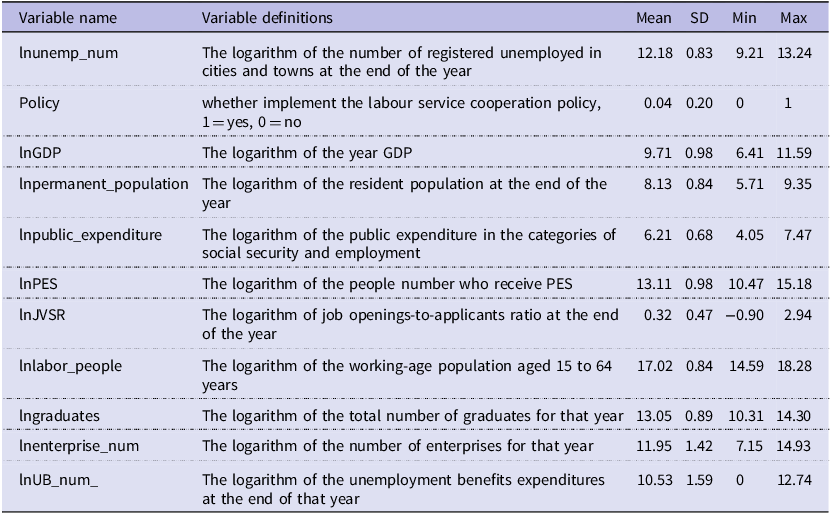
In formula (1), the subscript i represents provinces (i=1, 2, …, 31), and t represents the year (t=2011, 2012, …, 2019). lnunemp_num it represents the logarithm of the number of registered urban unemployed people in province i at the end of year t, which was the explanatory variable in this study. Policy it =Treat i *After t is an interactive item that is a crucial variable for measuring policy effects. Treat i is a dummy variable that describes the differences between groups: one represents the pilot provinces implementing the labour cooperation policy, and zero represents the non-pilot provinces. After t is also a dummy variable used to describe the time difference: one represents the sample after the implementation of the policy in 2016, and zero represents the sample before 2016. X i refers to a series of control variables that may affect the number of unemployed, including macroeconomic and demographic factors, and labour market supply and demand factors. The definitions and basic statistics of the variables are shown in Table 1.
Variable definitions and descriptive statistics (N = 279)

Results
Effect of the labour service cooperation policy on employment
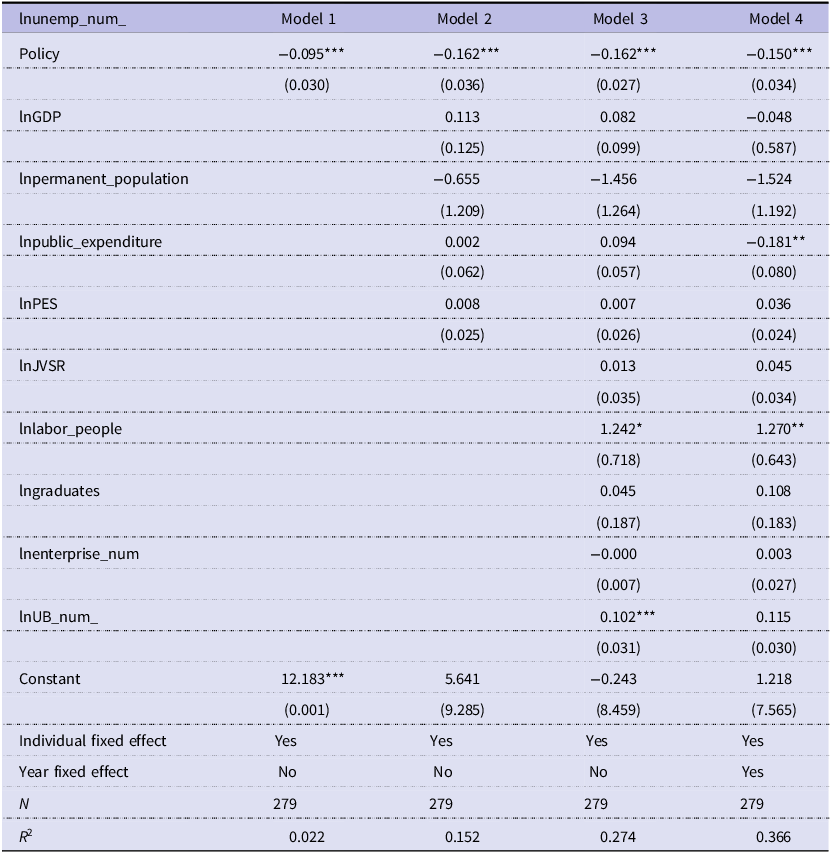
In Table 2, Models 1 to 4 show the coefficients of the models with control variables added individually to estimate the individual fixed effects and year fixed effects, respectively. The coefficient of the core variable, policy, remained negative and significant. Model 1 controlled for individual fixed effects only, and the coefficient of −0.095 was negative at the 1 per cent significance level. After adding the control variables in models 2 and 3, the coefficient was minus zero point one six two and remained negative at the 1 per cent significance level. Model 4 controlled for individual and time effects; the coefficient was minus zero point one five, remaining negative at the 1 per cent significance level. The results indicated that in the Chinese context, the labour service cooperation policy was closely correlated with the unemployment rate, and the implementation of the policy helped reduce the number of unemployed people and effectively relieved the employment pressure on pilot provinces. Therefore, H1a was confirmed.
The impact of labour cooperation policy on the number of unemployed

Notes: The data in parentheses are the robustness standard errors.
Significance level: *p < 0.1, **p < 0.05, ***p < 0.01.
Robustness tests
Parallel trends test
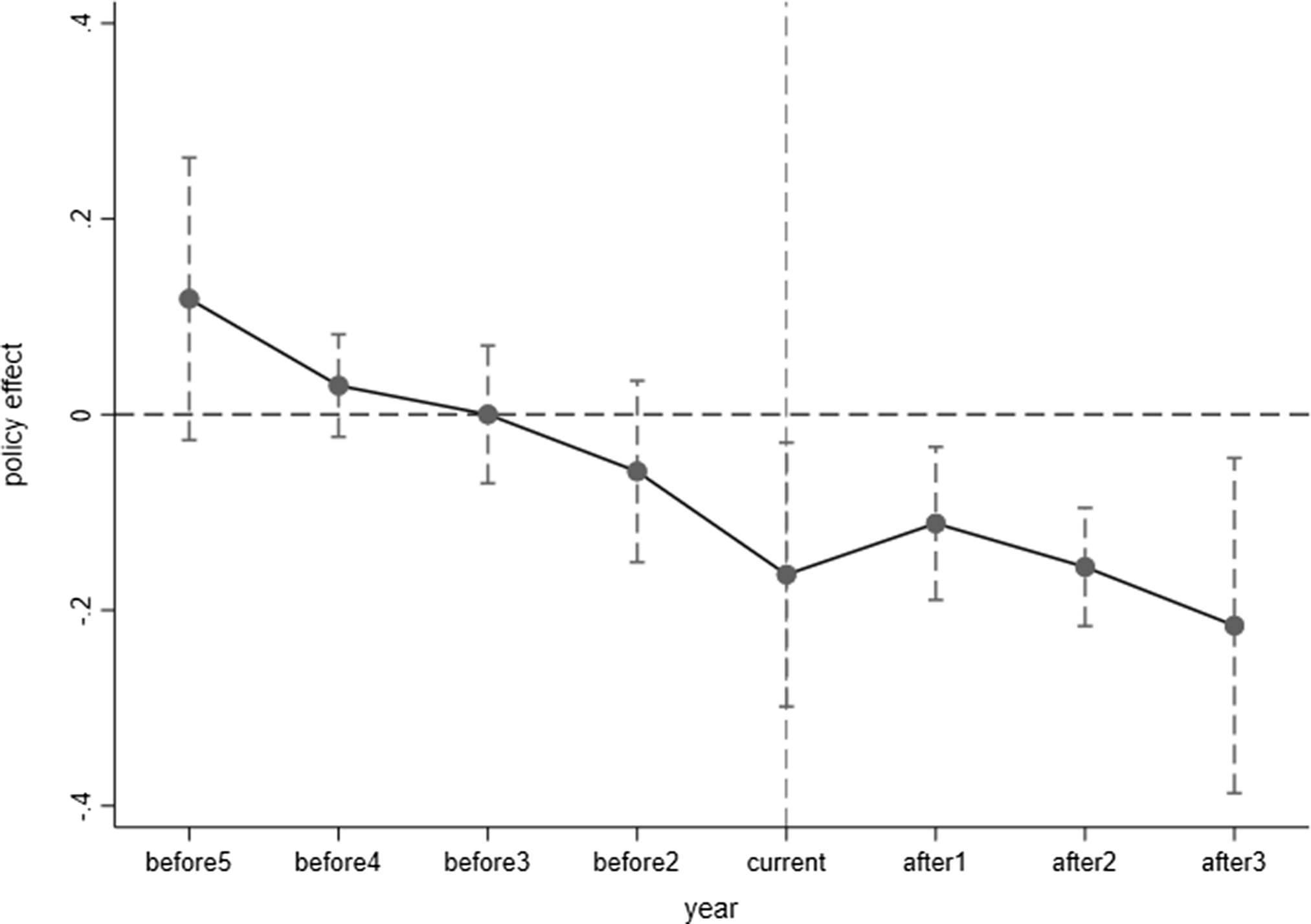
The basic premise of using the DID method is that the treatment and control groups have the same developmental trends before implementing the policy. Otherwise, the coefficient of the interaction term includes the difference between the treatment and control groups, which does not reflect the natural policy effect. After generating the interaction items between the virtual variables of the year and those of the processing group, it was found that the coefficients of the above interaction items were insignificant before implementing the labour cooperation policy. Figure 1 shows the results of this parallel trend. It can be seen that the 95 per cent confidence interval of the interactive term coefficient before the implementation of the labour cooperation policy in 2016 contained a value of zero, which means that there was no significant difference between the provinces in the treatment group and those in the control group, which meets the parallel trend hypothesis. Therefore, the interactive term coefficient in the benchmark model reflected the real policy effects.
Parallel trends test.
Notes: Horizontal bars represent the policy time; the vertical segments represent the 90 per cent confidence intervals.

Placebo test
This study conducted a placebo test. The specific method involved randomly selecting three of the thirty-one provinces as the pilot provinces for the labour cooperation policy. Then, this random process was repeated 1,000 times to obtain a series of ‘pseudo policy’ interaction term coefficients after regression according to the fictitious pilot provinces. Figure 2 shows the distribution of the estimated coefficient and p-values of ‘pseudo policy’ obtained by 1,000 randomly fictitious pilot provinces participating in the regression. The curves and dots represent the p-values corresponding to the kernel density of the estimated coefficient. It can be seen that the estimated coefficient of ‘pseudo policy’ is concentrated around the zero point, and most of the p-values are greater than zero point one, which is in line with the expectation that the coefficient would not be significant; in contrast, the estimated coefficient (vertical dotted line in the figure) of the real pilot province deviates from zero, and the p-value is less than zero point one, indicating that the policy effect of the real pilot province was not caused by coincidence, nor was it affected by other policies or random factors. Hence, the benchmark regression results were reliable.
Placebo test.
Notes: Horizontal bars represent the coefficients; the vertical segments represent the p values.

Replacement of response variables
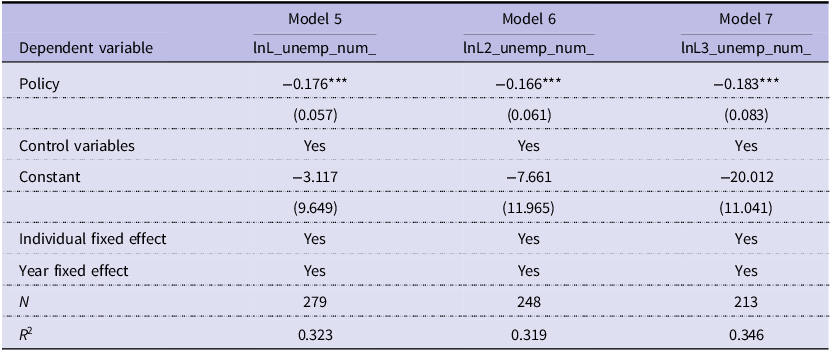
In the baseline regression model, the response variable was the logarithm of the number of registered urban unemployed people at the end of the year, which was used to measure whether the labour service cooperation policy can address unemployment through collective job placement. However, previous studies on unemployment have generally found that most employment promotion policies have a lagged effect (Bollens & Cockx, Reference Bollens and Cockx2017) because it takes time for macroscopic policies to function after their implementation. Therefore, the years after the implementation of the policy are equally good window periods for observing the effects of the policy. Based on this, we generated variables with one, two, and three lags based on the response variable lnunemp_num_, representing the logarithm of the number of registered urban unemployed people at the end of the second, third, and fourth years, respectively. After replacing the response variables, these lagged variables were tested in the respective models to observe the effects of the policy over an extended period. Model 5 in Table 3 shows that the labour service cooperation policy also significantly negatively impacted the logarithm of the number of unemployed people in the lagged periods, with a coefficient of minus zero point one seven six at the 1 per cent significance level. This indicates that the labour service cooperation policy implemented in 2016 reduced the number of unemployed people in 2017. In addition, the coefficients of models 6 and 7 were also negative at the 1 per cent significance level, again demonstrating that the labour service cooperation policy affected the promotion of employment and indicating, to some extent, that the baseline regression in this study was robust.
Robustness test: replacement of response variables

Notes: The data in parentheses are the robustness standard errors.
Significance level: ***p < 0.01.
Comparing the coefficients of the baseline regression model (minus zero point one five) and the lagged regression models (minus one point seven six, minus zero point one six six, minus zero point one eight three), this study found that the effect of the labour service cooperation policy was not only persistent, but also effective over a relatively long period, implying that this policy will continue to exert an influence after its implementation for more than three years. Furthermore, the changes in the magnitude of the coefficients of the models over successive windows suggested that the impact of the policy was gradually amplified, implying that the effects of large-scale job placement became broader and stronger over time. Therefore, H1b was verified.
Further analysis
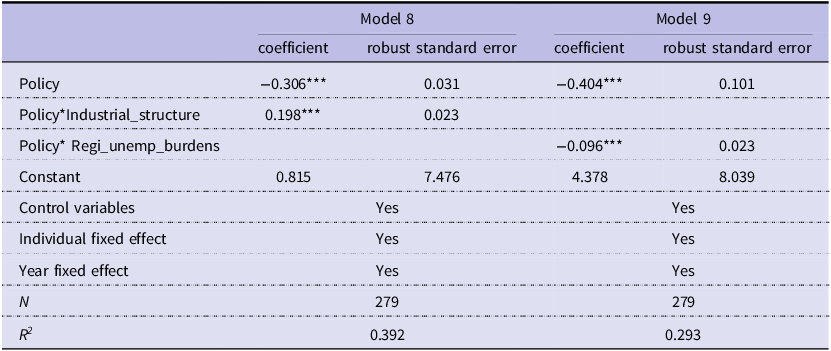
Studies have pointed out that the effect of employment-promoting policies often varies depending on many factors (Kluve et al., Reference Kluve, Puerto, Robalino, Romero, Rother, Stöterau, Weidenkaff and Witte2019; Qian et al., Reference Qian, Bian and Liu2022). This article separately explored the moderating effects of the industrial structure and unemployment burdens on the baseline regression model.
To measure the moderating variable of industrial structure, we referred to the GDP share of the three major sectors in each province (autonomous regions and municipalities directly under the central government). The variable Industrial_structure was set, with zero indicating the manufacturing industry as the primary sector and one indicating the service industry as the primary sector. The moderating variable was then zero-centred with the explanatory variable policy to generate the interaction term, which was included in the regression to obtain Model 8 in Table 4. The coefficient of the interaction term, zero point one nine eight, was positive at the 1 per cent significance level, indicating that the industrial structure significantly influenced the effect of the labour service cooperation policy.
Regression with the moderating variable

Note: Significance level: ***p < 0.01.
Regional unemployment burden factors may also influence the effect of the labour service cooperation policy on promoting employment. To delineate the historical baggage and long-term burden faced by provinces, this study used the provincial long-term unemployment rate, which was the logarithm of the share of long-term unemployment among the unemployed. By including the zero-centred unemployment burden variable and its interaction term with the core explanatory variable in the regression, we found that the coefficient of the interaction term in Model 9, zero one point zero nine six, was negatively significant, which indicated that the heavier the provincial unemployment burden, the stronger the effect of the labour service cooperation policy on promoting employment. Thus, H2 was verified.
Conclusions
While debates on the effectiveness of the labour service cooperation policy are in full swing in Western countries, this topic still needs to be discussed in the Chinese context. Drawing on the DID identification framework and provincial panel data to estimate the employment-promoting effects of the labour service cooperation policy conducted in pilot provinces in China, this study showed that the implementation of the labour service cooperation policy assisted in reducing the number of unemployed people. This demonstrates that following the public–private partnerships trend, public–private cooperation in Chinese PES delivery creates a new approach by combining all stakeholders, such as job seekers, employers, and PES agencies, to promote reemployment.
China offers several instructive lessons. First, our findings verified the effectiveness of the labour service cooperation policy in the Chinese labour market. Similar to some research results from Western countries (Aksnes, Reference Aksnes2019; Raspanti & Saruis, Reference Raspanti and Saruis2021), the private networks proved to be useful for PES agencies, employers, and job seekers to be involved in the policy implementation process and better equipped to address their needs. The partnerships also made the three stakeholders co-producers in the recruiting, interviewing, and hiring processes, contributing to achieving the re-employment promotion goal. Second, this article provided a counterpoint to Bredgaard (Reference Bredgaard2018), Ingold & Stuart (Reference Ingold and Stuart2015), and van Gestel et al. (Reference van Gestel, Oomens and Buwalda2019)’s opinion that PES agencies and employers lack in-depth engagement in public–private partnerships. Chinese practice shows that the desire of PES agency officials to get a political promotion, the intention of employers to solve their labour shortages, and the desire of the unemployed to save job-seeking costs and get more job opportunities give all stakeholders a solid motivation to participate in labour service cooperation. Third, the dominant role of the government in public–private partnerships are essential. With coordination by the local government, PES agencies help with the decommodification of labour by choosing eligible employers and conducting negotiations for welfare entitlements in workplaces. It seems that local governments’ in-depth participation could avoid the suboptimal employment referral problems mentioned in previous studies (Peck & Theodore, Reference Peck and Theodore2000; Larsen & Vesan, Reference Larsen and Vesan2012). In addition, local governments offer resources to the unemployed to meet the recruitment requirements by investing in vocational training and removing reemployment obstacles, indicating that political will and commitment to human capital investment make labour service cooperation more sustainable in the long run.
This study also observed a lagged policy effect, which is consistent with other studies’ conclusions (Fitzenberger et al., Reference Fitzenberger, Osikominu and Völter2008; Bollens & Cockx, Reference Bollens and Cockx2017). It found that the impact of the labour service cooperation policy on promoting employment was persistent and constantly amplified, with a lagged effect. China’s experience shows that policymakers should pay more attention to lagged unemployment or the re-employment rate when evaluating the effectiveness of this policy. In addition, it is essential to lengthen the policy implementation cycle to improve the building of the policy system and provide a relatively long period for unleashing the policy effects.
Regarding policy applicability, Chinese practice shows that the labour service cooperation policy is more effective when implemented in regions where the manufacturing industry is the primary sector. This may be because, compared with the service sector, which has a more fragmented availability of job opportunities and more diverse job demands, the traditional industrial model built on operations with assembly lines is more suitable for large-scale recruitment and collective employment and, therefore, can absorb more unemployed people through labour service cooperation. Therefore, PES agencies should channel candidates to employers who can accommodate large numbers of employees to maximise the effects of the labour service cooperation policy. At the same time, PES agencies in provinces with solid manufacturing industries may be more familiar with the skills needed for jobs in this industry; better understand the cycle and scale of employment in industrial enterprises; and fully grasp the actual labour conditions, packages, and benefits provided by enterprises through the feedback provided by employees. These agencies also have more experience in communication and negotiations, and thus are better at organising targeted labour exports, ensuring that the labour service cooperation policy is implemented in an orderly and efficient manner. Given the unemployment burdens, this study found that the labour service cooperation policy had a better effect on provinces with heavier unemployment burdens. This may be because places with a heavy historical burden of laid-off workers from state-owned enterprises have already accumulated employment-promoting experiences, such as building relationships with the labour demand side.
Overall, the Chinese labour service cooperation policy matters in significant ways when it comes to promoting reemployment. Although the Chinese labour market differs from those of other countries, this study provided empirical evidence of the effect of the labour service cooperation policy. In future research, comparative studies between China and other countries would be beneficial to deeply understand the functions of the labour service cooperation policy in employment promotion.
Acknowledgements
I would like to thank the anonymous peer reviewers and editors of Social Policy and Society for their helpful comments and suggestions.
Funding
This research has received funding form the National Social Science Fund of China (Grant No.23BGL242).