Introduction
Recent intensive excavation of the lower Cambrian (Series 2, Stage 4) Emu Bay Shale (EBS) at Buck Quarry on the northeast coast of Kangaroo Island has significantly increased the known diversity of this Konservat-Lagerstätte to over 50 species (Paterson et al., Reference Paterson, García-Bellido, Jago, Gehling, Lee and Edgecombe2016). Like most Cambrian Konservat-Lagerstätten, the fauna is dominated by arthropods, both in diversity and, especially, abundance of individual animals (Ivantsov et al., Reference Ivantsov, Zhuravlev, Leguta, Krassilov, Melnikova and Ushatinskaya2005; Zhao et al., Reference Zhao, Caron, Bottjer, Hu, Yin and Zhu2014; Paterson et al., Reference Paterson, García-Bellido, Jago, Gehling, Lee and Edgecombe2016). Ongoing work at Buck Quarry continues to reveal new taxa; the diversity of nonarthropod fauna is also becoming better known (García-Bellido et al., Reference García-Bellido, Paterson and Edgecombe2013, Reference García-Bellido, Lee, Edgecombe, Jago, Gehling and Paterson2014; Paterson et al., Reference Paterson, García-Bellido, Jago, Gehling, Lee and Edgecombe2016). Many of these newly discovered taxa are enigmatic, and are often only represented by one or two specimens. One such group is the Eldonioidea Dzik, Reference Dzik1991, which includes disc-shaped organisms whose complex internal structure belies their superficially medusoid appearance. Anatomical features observed across the group include dorsal and ventral discs enclosing a distinctive coiled digestive system, with a ventrally located mouth and anus, two circumoral tentacles, and a suite of variously observed and interpreted radial structures and concentric rings. Only two eldonioid specimens are known from more than 5,500 specimens collected from Buck Quarry and registered in the South Australian Museum paleontology collection.
The affinity of eldonioids remains problematic, with suggestions ranging across the major metazoan groups, including cnidarians and lophophorate protostomes (Dzik, Reference Dzik1991; Zhao and Zhu, Reference Zhao and Zhu1994; Chen et al., Reference Chen, Zhu and Zhou1995; Dzik et al., Reference Dzik, Zhao and Zhu1997; Zhu et al., Reference Zhu, Zhao and Chen2002), as well as deuterostomes (Conway Morris, Reference Conway Morris1993a, Reference Conway Morris1993b, figs. 2, 4; Chen et al., Reference Chen, Zhu and Zhou1995; Chen, Reference Chen2012; Zhang et al., Reference Zhang2013), such as holothurian echinoderms (Durham, Reference Durham1974; Chen, Reference Chen2009) and other ambulacrarians (as part of the informal, unranked stem-group called the ‘cambroernids’ sensu Caron et al., Reference Caron, Conway Morris and Shu2010b; Conway Morris et al., Reference Conway Morris, Selden, Gunther, Jamison and Robison2015). A taxonomic review of the group is long overdue, but two families that include Cambrian taxa are recognized, the Eldoniidae Walcott, Reference Walcott1911a and the Rotadiscidae Dzik, Reference Dzik1991, with a third post-Cambrian group informally referred to as the paropsonemids.
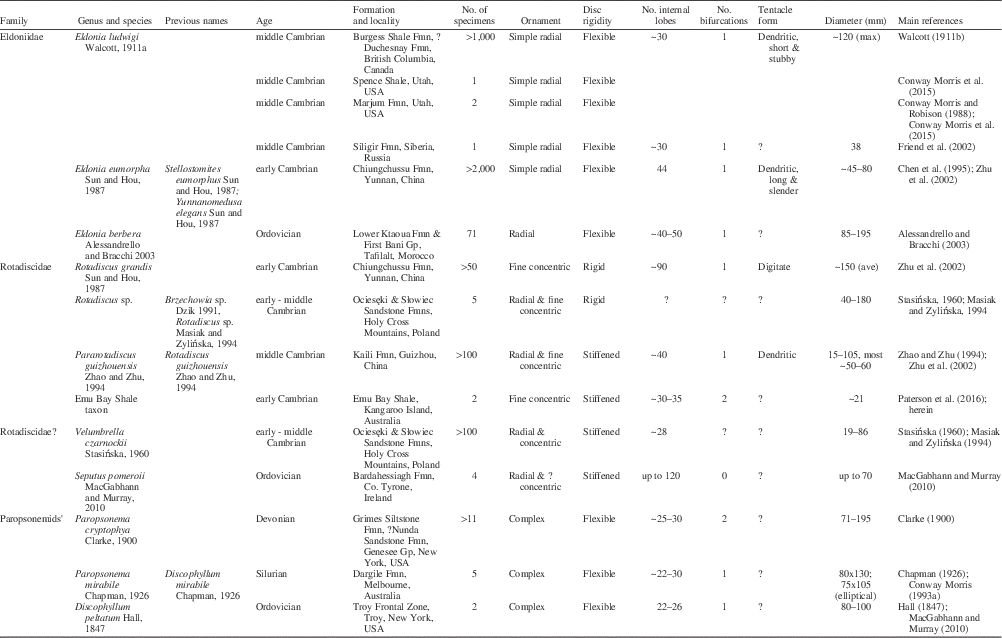
A summary of the geographic and stratigraphic distributions of eldonioids, along with some of their key morphological characteristics, is provided in Table 1.
Geographic and stratigraphic distribution of Paleozoic eldonioids and their key morphological characteristics.

Here we document a rare eldonioid from the EBS that displays similarities to Pararotadiscus guizhouensis from the middle Cambrian (Series 3, Stage 5) Kaili Biota of South China, including the presence of associated trace fossils on the discs of both forms. This adds support for close faunal affinities between the Konservat-Lagerstätten of South Australia and those of South China (Paterson et al., Reference Paterson, García-Bellido, Jago, Gehling, Lee and Edgecombe2016) and extends the known geographical range of Cambrian eldonioids to East Gondwana.
Materials and methods
Specimens were collected from the lower Cambrian (Series 2, Stage 4) Emu Bay Shale Konservat-Lagerstätte at Buck Quarry, Big Gully, Kangaroo Island, South Australia (for detailed locality information, see Gehling et al., Reference Gehling, Jago, Paterson, García‐Bellido and Edgecombe2011; Paterson et al., Reference Paterson, García-Bellido, Jago, Gehling, Lee and Edgecombe2016).
Photographs were taken with a Canon EOS 5D digital SLR camera with a Canon MP-E 65 mm 1–5x macro lens, using low-angled light from different directions to enhance the morphological detail of the fossils.
Repository and institutional abbreviation
Two specimens, SAM P45196 and P46361, are reposited in the South Australian Museum paleontology (SAM P) collection in Adelaide, South Australia.
Description
The specimens represent two incomplete, but clearly subcircular, nonbiomineralized discs. SAM P45196 (Fig. 1) has a diameter of 20.9 mm; SAM P46361 (Fig. 2) is too incomplete to be measured, but is of a similar size. Neither specimen shows evidence of a mouth, tentacles, or anus, which are located on the interpreted ventral side of other eldonioids. Consequently, we interpret the exposed surface of the EBS specimens as representing the dorsal disc, though its orientation in life is not certain.
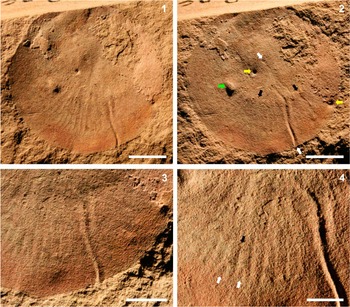
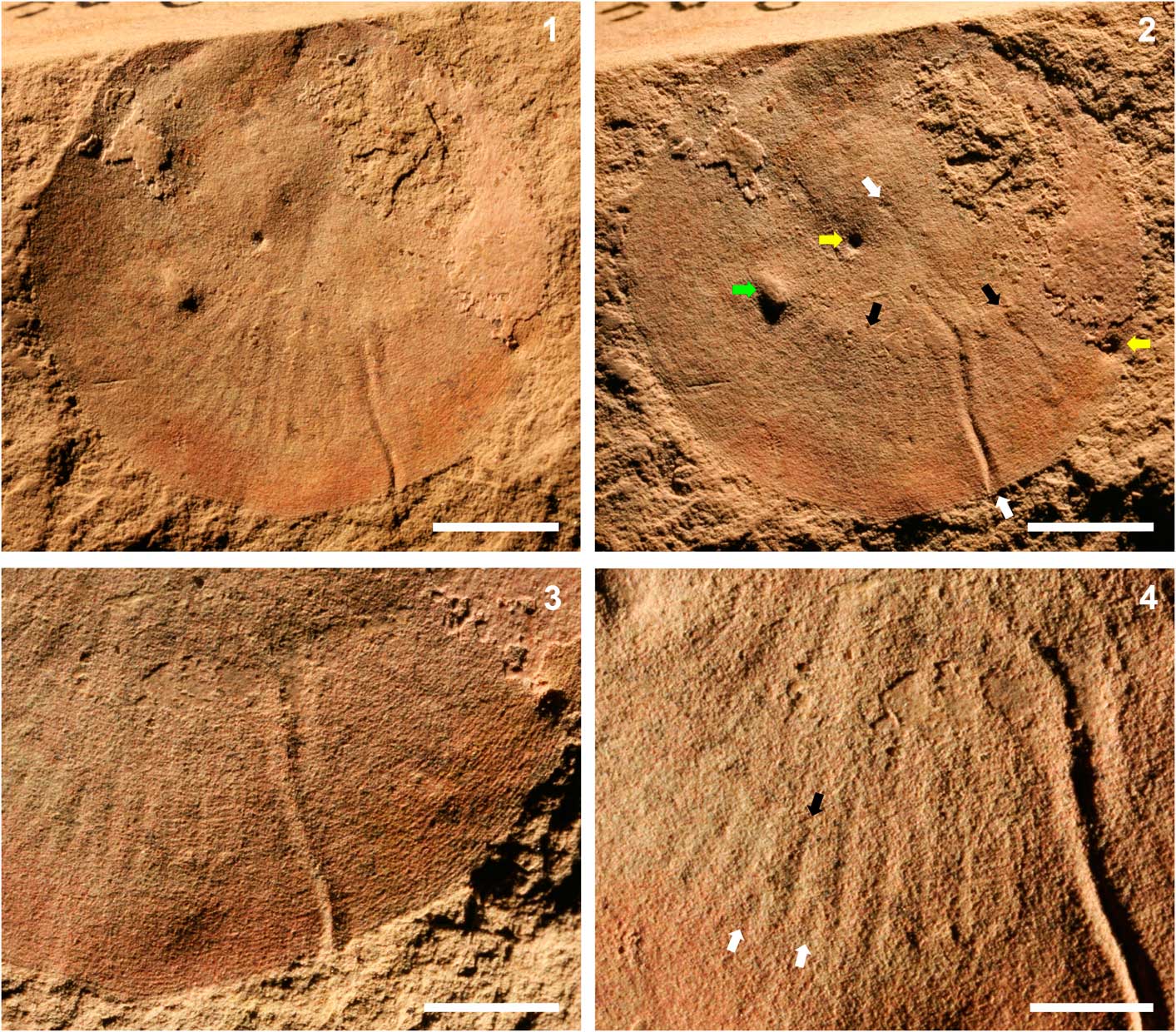
Eldonioid from the early Cambrian Emu Bay Shale, Kangaroo Island, South Australia, SAM P45196; previously illustrated by Paterson et al. (Reference Paterson, García-Bellido, Jago, Gehling, Lee and Edgecombe2016, fig. 6g). (1) Near complete specimen; lighting from top left. (2) Image taken with very low-angled light from top right to show surface relief and other features such as the associated traces (burrow [white arrows]; circular indentations [yellow arrows]; tubercular protuberance [green arrow]) and the bulge of the coiled sac near the center (black arrows). (3) Close-up showing detail of concentric corrugations; lighting from bottom right. (4) Close-up showing detail of internal lobes, including primary bifurcation (black arrow) and secondary bifurcations (white arrows); lighting from bottom right. (1, 2) Scale bar=5 mm; (3) scale bar=3 mm; (4) scale bar=2 mm.
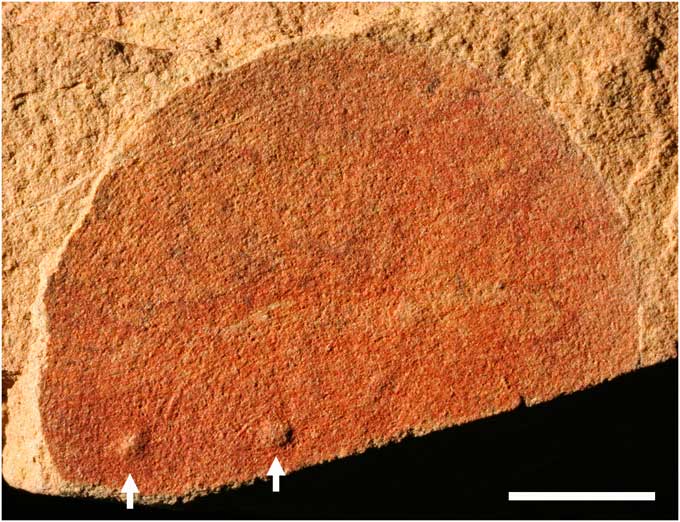
Eldonioid from the early Cambrian Emu Bay Shale, Kangaroo Island, South Australia, SAM P46361. Lighting from top left. White arrows indicate tubercular protuberances. Scale bar=4 mm.
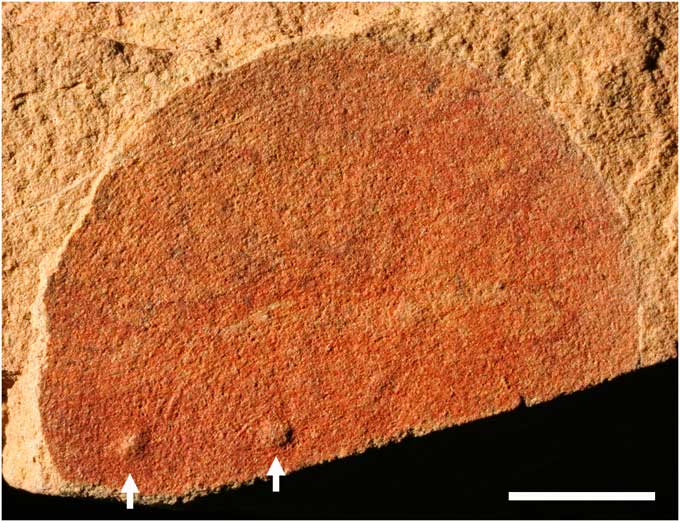
SAM P45196 is almost complete and provides the most morphological information for this description. About one-seventh of the disc margin is missing (Fig. 1.1, 1.2, top of specimen). SAM P46361 comprises about two-thirds of a disc (Fig. 2). Where preserved, the margins of both discs are sharply delineated, with no evidence of any structures protruding beyond the margins.
Eldonioids are characterized by a series of internal radial lobes, which extend in all directions from near the center of the disc toward its margin. In SAM P45196, the internal lobes appear as raised ridges on approximately one-quarter of the disc, imprinting through the integument (Fig. 1). They are indistinct near the center of the disc and terminate about 3 mm from the margin. Each lobe bifurcates twice, with the primary bifurcation situated near the marginal side of the coiled sac, and the secondary bifurcations occurring close to the distal end (Fig. 1.4). It is estimated that the whole disc bore approximately 30–35 lobes.
Another distinctive feature of eldonioids is the ‘coiled sac’ (sensu Zhu et al., Reference Zhu, Zhao and Chen2002, fig. 1) or stomach (sensu Caron et al., Reference Caron, Conway Morris and Shu2010b), generally considered to be the digestive organ overlying the internal lobes. This structure may be represented on SAM P45196 by a slightly convex ridge (shown by black arrows in Fig. 1.2) that is in a similar position to the ‘coiled sac’ in some eldonioid specimens from China (e.g., Chen et al., Reference Chen, Zhu and Zhou1995, fig. 4; Zhu et al., Reference Zhu, Zhao and Chen2002, fig. 4a), which also exhibit convex relief.
The external surface in both specimens consists of very fine, evenly and closely spaced concentric corrugations. This ornament is well preserved around the outer portion of the disc (Figs. 1.3, 2) but becomes gradually more indistinct toward the center. In SAM P45196, the concentric ornament clearly drapes over the ridges and valleys of the internal lobes without interruption (Fig. 1.3, 1.4). The internal lobes seem to have been resistant to compression, so the integument must have had some degree of flexibility.
Associated trace fossils
The EBS eldonioids also host distinctive trace fossils. SAM P45196 has a narrow, sinuous burrow running between the margin of the disc and its center (Fig. 1.2). It does not extend beyond the disc margin into the surrounding matrix. Near the disc margin, the trace on SAM P45196 is a clear, shallow groove about 1 mm across, flanked with low levees, but it becomes less distinct nearer the disc center. The fine concentric ornament on the disc surface also crosses the contours of the groove and levees of the trace without disruption, which indicates it was caused by activity just below, rather than at or above, the disc surface.
In situ orientation of the EBS specimens was not recorded, but most eldoniids and rotadiscids from China (Chen et al., Reference Chen, Zhu and Zhou1995; Zhu et al., Reference Zhu, Zhao and Chen2002) are found with the dorsal surface facing upward relative to the bedding plane. Such an orientation in the EBS specimens is supported by the lack of ventral structures (e.g., circumoral tentacles) and the presence of more robust structures visible through the disc, such as the internal lobes and probable coiled sac. Assuming this is the correct orientation for SAM P45196, burrowing activity beneath the disc is preserved in negative epirelief.
SAM P45196 also bears two circular indentations and a small, protruding, tubercle-like feature (Fig. 1.2), while SAM P46361 has two tubercles (Fig. 2). Similar protuberances (e.g., Wang et al., Reference Wang, Lin, Zhao and Orr2009, figs. 2E, 3D, 6A) and circular indentations (e.g., Wang et al., Reference Wang, Lin, Zhao and Orr2009, figs. 2A, 3C, 5B) can be seen on discs of Pararotadiscus guizhouensis.
Discussion
Taxonomic considerations
Despite there being only two EBS specimens, with imperfect preservation, the size of the discs, the number and structure of radial internal lobes, and the fine concentric dorsal ornament strongly support an eldonioid affinity. While the EBS discs have some superficial similarities to features of the brachiopod Heliomedusa orienta Sun and Hou, Reference Sun and Hou1987 from the Chengjiang Biota (see Jin and Wang, Reference Jin and Wang1992; Chen et al., Reference Chen, Huang and Chuang2007; Zhang et al., Reference Zhang, Li, Emig, Han, Holmer and Shu2009), an affinity can be easily dismissed. Apart from the EBS discs and valves of H. orienta being similar in size and possessing a fine concentric ornament, the EBS discs do not exhibit radial striae like H. orienta (e.g., Chen et al., Reference Chen, Huang and Chuang2007, fig. 4.5). The radial lobes of the EBS discs bear a faint resemblance to the lophophore of H. orienta, but the lophophore tentacles in H. orienta do not bifurcate (e.g., Zhang et al., Reference Zhang, Li, Emig, Han, Holmer and Shu2009, figs. 2, 3, 6). Other important features of H. orienta (that are absent in the EBS discs) include mantle setae that extend beyond the margins of both valves, a pseudointerarea, and a well-developed visceral cavity (Jin and Wang, Reference Jin and Wang1992; Chen et al., Reference Chen, Huang and Chuang2007; Zhang et al., Reference Zhang, Li, Emig, Han, Holmer and Shu2009).
At about 21 mm in diameter, the EBS specimens are among the smallest eldonioids known (Table 1). In their redescription of Pararotadiscus, Zhu et al. (Reference Zhu, Zhao and Chen2002) measured the diameter of 75 specimens, which ranged from ~12 to ~105 mm. They concluded that the disc becomes larger and increasingly sclerotized throughout ontogeny. In their smallest specimens, the disc margin is unclear and the disc easily deformed. Specimens greater than 20 mm in diameter, with a relatively stiff disc and clear disc margins, were considered to be adults. Using these criteria, the EBS specimens would appear to be adult animals, but whether they represent two young (similar-sized) individuals that could potentially have grown larger, or members of a miniature species, cannot yet be ascertained.
The number of internal lobes is fairly consistent for each of the well-known Cambrian eldonioid species (Table 1). Eldonia ludwigi Walcott, Reference Walcott1911a has a maximum of 30, E. eumorpha Sun and Hou, Reference Sun and Hou1987 has ~44, Rotadiscus grandis Sun and Hou, Reference Sun and Hou1987 has up to 88, and Pararotadiscus guizhouensis has ~40. The EBS specimens are estimated to have ~30–35 lobes, thus falling within the range observed in both eldoniids and rotadiscids. However, internal lobes that have primary and secondary bifurcations, as observed in SAM P45196, have not been documented in other Cambrian eldonioids.
The three families of eldonioids can be distinguished by the ornament on their dorsal surface. Simple concentric corrugations, as found on the EBS specimens, are characteristic of the Rotadiscidae. The post-Cambrian paropsonemids are also ornamented, but they have a far more complex pattern, and the ornament of the Eldoniidae is radial, not concentric (MacGabhann and Murray, Reference MacGabhann and Murray2010). The concentric corrugations observed in rotadiscids have been interpreted as lines of accretionary growth at the disc margin (Dzik, Reference Dzik1991; Chen et al., Reference Chen, Zhu and Zhou1995; Dzik et al., Reference Dzik, Zhao and Zhu1997; Chen Reference Chen2012). An alternative interpretation is that, at least in some instances, the concentric corrugations are taphonomic artefacts, due to compression of a dome- or bell-shaped (and variably sclerotized) body (Zhu et al., Reference Zhu, Zhao and Chen2002; Caron et al., Reference Caron, Conway Morris and Shu2010b). Given the small size of the EBS specimens, and the regularity and spacing of the fine concentric corrugations, it seems unlikely that the taphonomic interpretation applies in this instance.
Zhu et al. (Reference Zhu, Zhao and Chen2002) compared the degree of sclerotization of the dorsal disc in the three Chinese eldonioid taxa, using the frequency of specimens represented by folded or deformed discs as a proxy for disc stiffness or rigidity. Specimens of Eldonia eumorpha were most often folded or distorted, so were interpreted as being the most lightly sclerotized. Specimens referred to Pararotadiscus and Rotadiscus showed progressively lesser degrees of folding. Deformation of the dorsal disc to reveal the form of the underlying internal lobes is typical of Pararotadiscus, but does not occur in Rotadiscus (Zhu et al., Reference Zhu, Zhao and Chen2002). The EBS specimens show no sign of folding, but the internal lobes in SAM P45196 imprint through part of the dorsal surface, suggesting a stiff, but not completely rigid, disc, most similar to that of Pararotadiscus.
At present, lack of important morphological detail in the two EBS specimens precludes assignment to a new or existing genus and species. While their concentric ornament and stiffened dorsal disc would suggest placement of the EBS eldonioids within the family Rotadiscidae, the unknown condition of their circumoral tentacles prevents an assignment to either of the included genera. On comparison with other characteristics, Pararotadiscus seems the most similar, as both it and the EBS specimens have a stiff but not completely rigid disc and a similar number of internal lobes. However, internal lobes that show secondary bifurcations (as in the EBS specimens) would warrant designation to a separate species. Until further information regarding the precise number of internal lobes, the condition of the circumoral tentacles, and perhaps their size range becomes available, we consider the EBS specimens as being representative of the Rotadiscidae, but leave the genus and species under open nomenclature.
The eldonioid–trace fossil association
Examples of body and trace fossil associations can be found in the major Cambrian Konservat-Lagerstätten. For example, in the Burgess Shale, Chengjiang, Kaili, Sirius Passet, and Stanley Glacier assemblages, traces can be found on, or immediately below, body fossils, in the sediment surrounding them, or crossing between sediment and body fossil. These burrows and trails meander, intersect, or branch and occur on a variety of hosts (e.g., Zhang et al., Reference Zhang, Bergström, Bromley and Hou2007, Wang et al., Reference Wang, Lin, Zhao and Orr2009; Caron et al., Reference Caron, Gaines, Mángano, Streng and Daley2010a; Lin et al., Reference Lin, Zhao, Rahman, Xiao and Wang2010; Mángano, Reference Mángano2011; Mángano et al., Reference Mángano, Bromley, Harper, Nielsen, Smith and Vinther2012). In the Burgess Shale and Stanley Glacier assemblages, traces are found on and around various arthropod exoskeletons (such as Hurdia Walcott, Reference Walcott1912 and Tuzoia Walcott, Reference Walcott1912), and the vetulicolian Banffia Walcott, Reference Walcott1911b (Caron, Reference Caron2006; Caron et al., Reference Caron, Gaines, Mángano, Streng and Daley2010a; Mángano, Reference Mángano2011). In the Sirius Passet Lagerstätte, exoskeletons of the large, trilobite-like arthropod Arthroaspis Stein et al., Reference Stein, Budd, Peel and Harper2013 (see Mángano et al., Reference Mángano, Bromley, Harper, Nielsen, Smith and Vinther2012), and rarely the trilobite Buenellus Blaker, Reference Blaker1988 (see Babcock and Peel, Reference Babcock and Peel2007), host trace fossils. The Chengjiang Biota hosts include vetulicolians, the bivalved arthropods Isoxys Walcott, Reference Walcott1890 and Branchiocaris Resser, Reference Resser1929, and other nonbiomineralized arthropods (Zhang et al., Reference Zhang, Bergström, Bromley and Hou2007). In the Kaili Biota, typical hosts include arthropods such as Canadaspis Novozhilov, Reference Novozhilov1960, Naraoia Walcott, Reference Walcott1912, Skania Walcott, Reference Walcott1931, Tuzoia, and Waptia Walcott, Reference Walcott1912. One of the most common Kaili fossils, the rotadiscid Pararotadiscus, is also the most common trace fossil host (Wang et al., Reference Wang, Lin, Zhao and Orr2009; Lin et al., Reference Lin, Zhao, Rahman, Xiao and Wang2010).
Aside from large coprolites containing trilobite fragments (Nedin, Reference Nedin1999; Daley et al., Reference Daley, Paterson, Edgecombe, García‐Bellido and Jago2013), trilobite exoskeletons showing injuries (Conway Morris and Jenkins, Reference Conway Morris and Jenkins1985), and perhaps the ‘epibionts’ seen in some specimens of the EBS vetulicolian Nesonektris (cf. García-Bellido et al., Reference García-Bellido, Lee, Edgecombe, Jago, Gehling and Paterson2014, figs. 1B, C, 4A), trace fossils are notably scarce from the body-fossil-bearing layers of the EBS Lagerstätte interval (Paterson et al., Reference Paterson, García-Bellido, Jago, Gehling, Lee and Edgecombe2016). The near-complete absence of traces associated with EBS body fossils is clearly not due to a lack of suitable hosts—similar taxa to those listed, including Nesonektris García-Bellido et al., Reference García-Bellido, Lee, Edgecombe, Jago, Gehling and Paterson2014 and the bivalved arthropods Tuzoia and Isoxys (García-Bellido et al., Reference García‐Bellido, Paterson, Edgecombe, Jago, Gehling and Lee2009), are common to very abundant in the EBS. Therefore, the scarcity of EBS body–trace fossil associations most likely relates to specific (probably restrictive) paleoenvironmental conditions, particularly at the sediment-water interface (Paterson et al., Reference Paterson, García-Bellido, Jago, Gehling, Lee and Edgecombe2016).
The discovery of eldonioids with associated traces in the EBS is important, not only for expanding the ichnological diversity of this fossil deposit, but also for providing new paleoecological information on the biota. For example, the simple, sinuous burrow on one of the discs (SAM P45196; Fig. 1.2) may represent a feeding trace. The form of the trace, a groove with flanking levees, is typical of a burrow produced by sediment displacement (Carbone and Narbonne, Reference Carbone and Narbonne2014). Smooth, curved, unbranched burrows such as this suggest a single-use, nonselective feeding strategy (Mikuláš et al., Reference Mikuláš, Fatka and Szabad2012). Burrowing seems to have occurred just below the disc, perhaps to feed on bacteria or other nutrients situated beneath it (Mángano et al., Reference Mángano, Bromley, Harper, Nielsen, Smith and Vinther2012), with the disc subsequently draping over the burrow during (or possibly before) burial of the eldonioid. The simplicity and short length of the burrow may be due, in part, to the small size of the disc, but the presence of additional traces on SAM P45196 suggests a more complex situation than the form of the burrow implies (discussed in the following).
Tubercule-like features preserved on both EBS specimens have also been observed on eldonioid discs and arthropod exoskeletons from the Kaili Biota and from Cambrian sites in the Czech Republic. These have been interpreted as attempts at upward movement by the trace-maker, which was unable to pierce the sclerotized disc or exoskeleton (Wang et al., Reference Wang, Lin, Zhao and Orr2009; Mikuláš et al., Reference Mikuláš, Fatka and Szabad2012). Priapulids are proposed as possible contenders for the trace-makers at Kaili and other Lagerstätten (Wang et al., Reference Wang, Lin, Zhao and Orr2009). Interestingly, small palaeoscolecid worms with a body width (or diameter) similar to the observed burrow have been described from the EBS (García-Bellido et al., Reference García-Bellido, Paterson and Edgecombe2013), implicating them as suspected trace-makers.
The circular indentations on SAM P45196 (Fig. 1.2) are similar to those appearing with Gordia-like traces on some of the Kaili specimens illustrated, but not discussed, by Wang et al. (Reference Wang, Lin, Zhao and Orr2009, figs. 2A, D, 3C, 5). These may represent sites of epibiont attachment, or perhaps, contrary to Wang et al. (Reference Wang, Lin, Zhao and Orr2009), are the result of successful perforations of the disc surface by the trace-maker.
The presence of different trace forms on a single specimen (e.g., Fig. 1.2) suggests that either multiple trace-makers were present in the immediate vicinity of the individual and converged on it, or one trace-maker was able to produce several trace forms.
Mode of life and taphonomic considerations
Previous studies have suggested that eldonioids were either pelagic (Walcott, Reference Walcott1911a; Durham, Reference Durham1974; Sun and Hou, Reference Sun and Hou1987; Zhu et al., Reference Zhu, Zhao and Chen2002; Hu et al., Reference Hu, Steiner, Zhu, Erdtmann, Luo, Chen and Weber2007; Chen, Reference Chen2009, Reference Chen2012), nektobenthic (Caron et al., Reference Caron, Conway Morris and Shu2010b), or benthic (Dzik et al., Reference Dzik, Zhao and Zhu1997; MacGabhann and Murray, Reference MacGabhann and Murray2010). Taxa envisaged as living at or near the seafloor have been portrayed as vagile, oriented with the disc facing convex side upward and the tentacles combing the substrate (Caron et al., Reference Caron, Conway Morris and Shu2010b), or sessile, with tentacles facing upward and the convex side of the disc lying passively on or within the sediment (Dzik et al., Reference Dzik, Zhao and Zhu1997). Eldonioids were also a common, and occasionally abundant, element of the early to middle Paleozoic fauna, with some taxa known from hundreds or thousands of specimens (see Table 1).
The two EBS eldonioid specimens represent isolated individuals, found in different stratigraphic levels within Buck Quarry, separated by about 1.5 m. Both specimens are undistorted, with the discs preserved parallel to laminations within mudstone beds. This suggests that these individuals were buried under relatively calm conditions, as opposed to being swept up by the intermittent sediment gravity flows that captured other faunal elements (including benthic and nektobenthic taxa) of the EBS biota prior to rapid burial (Gehling et al., Reference Gehling, Jago, Paterson, García‐Bellido and Edgecombe2011; García-Bellido et al., Reference García-Bellido, Lee, Edgecombe, Jago, Gehling and Paterson2014; Paterson et al., Reference Paterson, García-Bellido, Jago, Gehling, Lee and Edgecombe2016).
Unfortunately, there is limited taphonomic (and certainly no morphologic) evidence to elucidate the lifestyle of the EBS eldonioid. The paucity of specimens in the EBS—coupled with the otherwise depauperate diversity of the autochthonous benthic fauna in the exaerobic zone (see Paterson et al., Reference Paterson, García-Bellido, Jago, Gehling, Lee and Edgecombe2016)—would indicate that a sessile life mode is unlikely, unless individuals were infrequently relocated from their original habitat. Moreover, the style of preservation of the EBS specimens neither supports nor contradicts a mobile benthic, nektic, or pelagic habit, but their rarity suggests that these individuals either were transported or settled into the ‘preservational trap,’ as represented by the Konservat-Lagerstätte interval. Irrespective of lifestyle, the associated trace fossil evidence suggests that the EBS eldonioids were exposed on the substrate for a short period before burial, allowing organisms to exploit these particular carcasses before the entombing sediment became truly anoxic (Hall et al., Reference Hall, McKirdy, Halverson, Jago and Gehling2011; McKirdy et al., Reference McKirdy, Hall, Nedin, Halverson, Michaelsen, Jago, Gehling and Jenkins2011; Mángano et al., Reference Mángano, Bromley, Harper, Nielsen, Smith and Vinther2012; Gaines, Reference Gaines2014; Paterson et al., Reference Paterson, García-Bellido, Jago, Gehling, Lee and Edgecombe2016).
Acknowledgments
This research was supported by grants from the Australian Research Council (FT120100770 to JRP) and National Geographic (#8991-11), with additional financial assistance from Beach Energy Ltd. and the South Australian Museum, and logistical support from SeaLink. We are grateful to the Buck family for access to the field area, and to our regular EBS collaborators G. Edgecombe, D. García-Bellido, J. Gehling, J. Jago, and M. Lee. We thank R. Atkinson, M.-A. Binnie, A. Camens, A. Daley, R. Gaines, M. Gemmell, J. Holmes, K. Kenny, P. Kruse, J. Laurie, B. McHenry, M. Mills, L. Reid, D. Rice, E. Thomson, and members of the South Australian Museum Waterhouse Club for assistance in the field and lab, and for discussions. Thanks also to the two anonymous referees for their helpful reviews of the manuscript.