Introduction
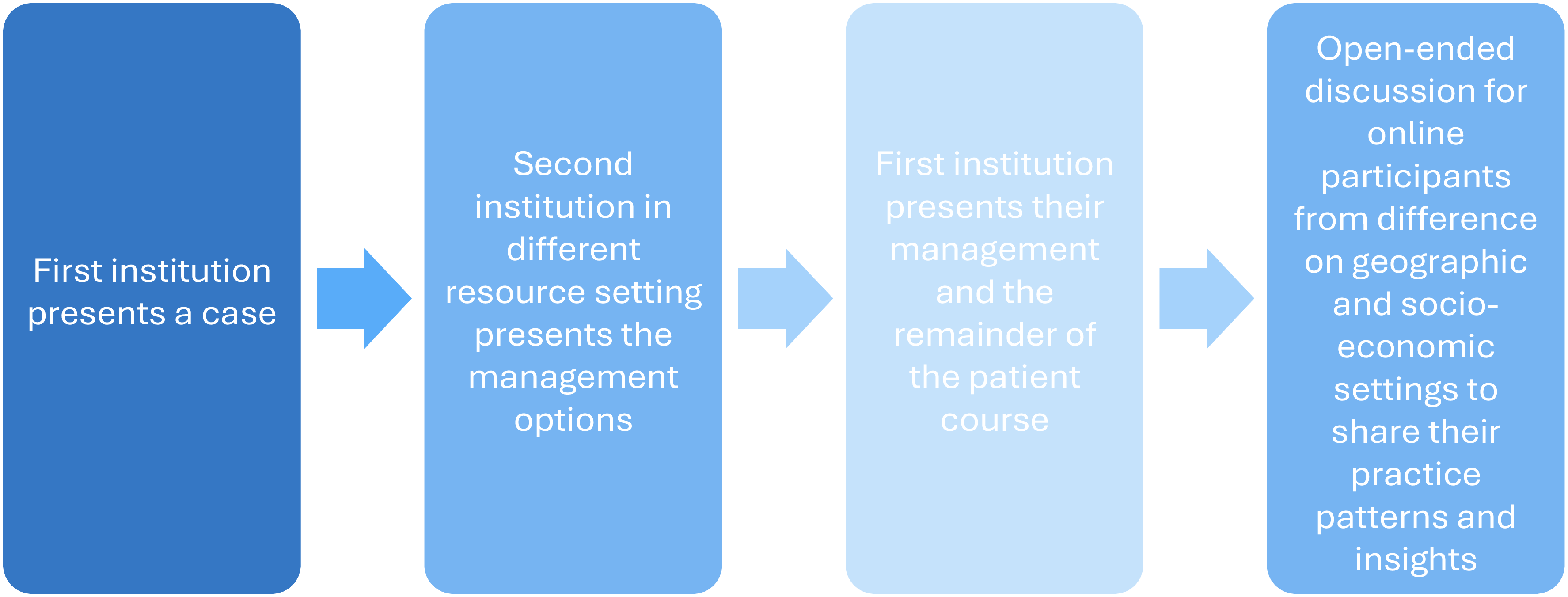
Paediatric cardiology fellowship training varies depending on the socio-economic setting and geographic location of the training, resulting in potential knowledge gaps. Reference Ross, Brook and Koenig1,Reference Subramanyan2 “Cardiology Across Continents” is an interactive, case-based webinar series hosted by Heart University that seeks to narrow educational differences between geographically diverse centres. Each session is jointly presented by fellowship programmes in a resource-limited and non-resource-limited setting with a focus on the differing diagnostic evaluation and management options available within each (Figure 1). Reference Peck, Neal and Redington3 We present the 12th instalment of the Cardiology Across Continents series, entitled “Acute Decompensated Heart Failure,” highlighting the key lessons learned from this intercontinental discussion of a challenging patient presentation.
General format of Heart University’s case-based learning series, “Cardiology Across Continents.” Each sixty-minute session involves two institutions from differently resourced settings and geographic locations.

Case report
Initial Presentation of Patient in a non-Resource-Limited Setting (Cincinnati Children’s Hospital Medical Center, Ohio, USA)
A previously healthy 17-year-old female presented to the emergency department with three days of cough, rhinorrhea, sore throat, fever of 39°C, and loss of appetite. She was positive for influenza A. She was ill-appearing with tachycardia, hypotension, and an elevated lactate of 5 mmol/L. Administration of 1.6 litres of isotonic fluids led to worsening tachycardia. Limited bedside ultrasound was concerning for diminished biventricular systolic function. In the setting of likely cardiogenic shock, the patient was admitted to the cardiac intensive care unit, intubated, and initiated on inotropic support (milrinone and low-dose epinephrine). The echocardiogram confirmed moderate to severe left ventricle systolic dysfunction, mild right ventricular dysfunction, and a moderate pericardial effusion, with worsening systolic function over the course of the examination. Despite escalation of inotropic support, she remained hypotensive with a rising lactate (12 mmol/L).
Proposed management of patient in resource-limited setting (Amrita Hospital, Kerala, India)
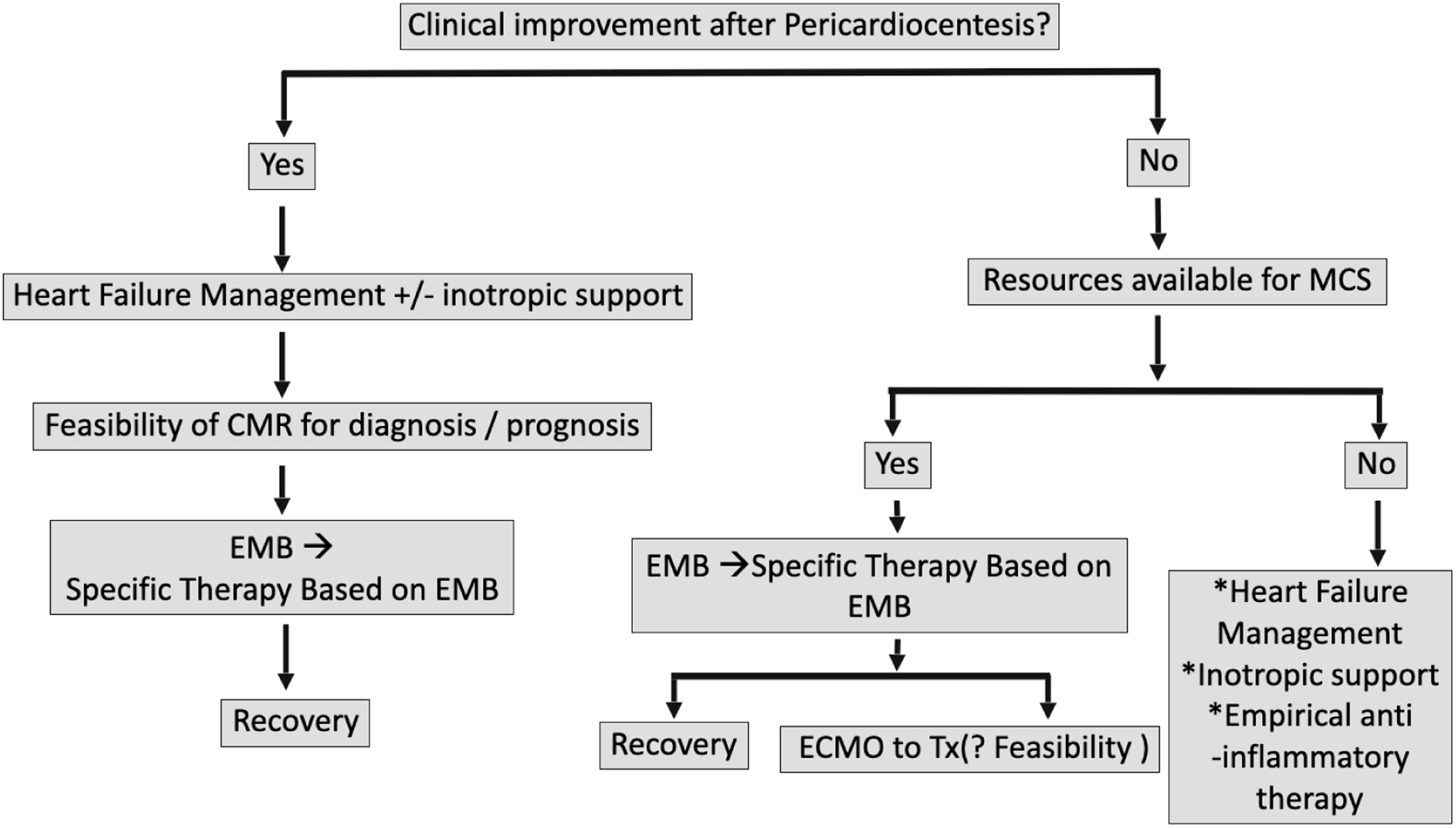
The presentation was felt to be typical of fulminant myocarditis with a high likelihood of requiring mechanical circulatory support. Echocardiographic findings of right atrial systolic collapse, right ventricular diastolic collapse, and significant respiratory variation in mitral inflow velocity were suggestive of cardiac tamponade. Emergency bedside pericardial drainage was proposed as the initial management strategy. This could potentially improve the patient condition to facilitate initiation of standard heart failure therapies. More invasive initial management options (e.g. extracorporeal membrane oxygenation) would not be preferred given resource constraints (Figure 2). Endomyocardial biopsy early in the course was also proposed to further evaluate the aetiology and likelihood of recovery. If pericardiocentesis did not improve the patient’s clinical status, the major determinant of Amrita’s initial management would have been resource availability. In India, ventricular assist device has limited availability compared to extracorporeal membrane oxygenation, and thus, the latter would have been preferred. A short extracorporeal membrane oxygenation course could be considered if the patient’s myocardial function was deemed to be reversible.
Proposed management plan from resource-limited setting. CMR = cardiac magnetic resonance; EMB = endomyocardial biopsy; MCS = mechanical circulatory support; ECMO = extra corporeal membrane oxygenation.

Further management would be dictated by the financial means of the family or the availability of funding from non-governmental organisations. The alternate funding mechanisms do not cover extracorporeal membrane oxygenation, ventricular assist device, or transplant. The cost of extracorporeal membrane oxygenation initiation alone is 150,000 Indian Rupees which is equivalent to 1,800 United States dollars, while the per week extracorporeal membrane oxygenation cost is 200,000 Indian Rupees (2,400 United States dollars). The cost of a ventricular assist device is approximately 5–10 million Indian Rupees (120,000 United States dollars) per month. Additionally, heart transplant in India is limited by the few number of states that have paediatric-specific programmes. While heart transplantation is offered at Amrita for older children, the family would also need to consider the additional cost for medications and follow-up after the transplant, as well as the challenges posed by prevalent infections. Ultimately, an honest discussion between the family and providers would be recommended, taking into consideration any resource and/or financial limitations, as well as the long-term modest outlook associated with heart transplantation in India before deciding on the best course forward for this patient.
Continued course of patient in non-resource-limited setting (Cincinnati Children’s Hospital Medical Center, Ohio, USA)
The patient was emergently placed on venoarterial extracorporeal membrane oxygenation due to persistent haemodynamic instability and rising lactate despite up-titration of ionotropic agents (epinephrine and vasopressin). Following cannula placement, the patient had concerns for venous congestion and low extracorporeal membrane oxygenation flows. Chest X-ray demonstrated low venous cannula position, and a repeat echocardiogram revealed ongoing severe left ventricle dysfunction and an increase in size of the pericardial effusion. She was taken to the cath laboratory for emergent balloon atrial septostomy, drainage of the pericardial effusion, and venous cannula repositioning. The following day, an echocardiogram revealed a very large thrombus encompassing the entire left ventricle and atrium despite bivalirudin anticoagulation, so the patient underwent placement of a 50 mL SynCardia total artificial heart. Pathology confirmed the diagnosis of fulminant myocarditis. The patient subsequently received an orthotopic heart transplant, after 26 days of total artificial heart support. Three months after transplant, she was discharged from the hospital. At the last follow-up two years later, she was clinically well.
Discussion
We present the case of a teenager with acute decompensated heart failure in the setting of fulminant myocarditis who required mechanical circulatory support and ultimately heart transplantation to survive. This interactive, intercontinental discussion highlighted a few key points.
While cost considerations did not impact decision-making in the non-resource-limited setting where a ventricular assist device was placed as a bridge to transplant, it was a large factor in the proposed management plan in the resource-limited setting. The average cost of an open-heart surgery in India is equivalent to the average annual family income of affected patients. Reference Raj, Paul and Sudhakar4 Most paediatric cardiac procedures are supported by parents out-of-pocket or by funding from non-governmental organisations. Reference Faisal, Handa and Ramakrishnan5 Neither of these funding options nor governmental insurance is adequate to cover the high cost of advanced procedures such as extracorporeal membrane oxygenation, ventricular assist device, or heart transplant.
Participants from the resource-limited setting also highlighted additional challenges with heart transplantation. As opposed to the wide availability of paediatric heart transplantation in the United States, there are currently very few heart transplant programmes in India. For instance, in 2018, the number of total heart transplants in India increased to>200, however, paediatric heart transplants remained uncommon. Reference Vaidya6 This contrasts with the nearly 3500 heart transplants in the USA in 2018, with 473 occurring in paediatric patients. Reference Colvin, Smith and Hadley7 Ultimately, given the personal cost of advanced care with limited funding options as well as limited centres, most families consider the cost-benefit ratio to be unfavourable in the context of modest long-term outcomes.
Conclusion
Cardiology Across Continents provides an effective platform for global cardiology trainee discourse and learning to address knowledge gaps associated with geographic and socio-economic training limitations. Additionally, this case specifically highlighted unique considerations relevant to paediatric heart transplantation in resource-limited settings.
Financial support
None
Competing interests
None