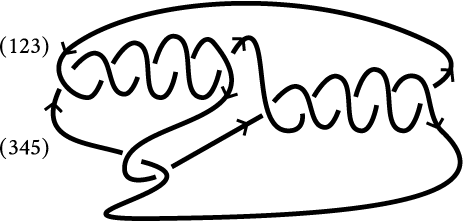
1 Introduction
In the classical setting, the bridge number
 $\beta (K)$
is a fundamental measure of complexity for a knot K in
 $S^3$
. The bridge number provides a comprehensive exhaustion of all knots; indeed, 2-bridge knots are the simplest of knots in many ways, and their classification by Schubert was a triumph of early knot theory [Reference Schubert18]. Cappell and Shaneson’s meridional rank conjecture posits that
 $\beta (K)$
is equal to the meridional rank
 $\mu (K)$
, the minimal number of meridians needed to generate
 $\pi _1(S^3\backslash K)$
. Tools such as knot contact homology and Coxeter quotients have been used to verify that the conjecture holds for several families of knots (see [Reference Baader, Blair and Kjuchukova2] and the references therein) but no counterexamples have been discovered. In this paper, we study the bridge numbers and meridional ranks of knotted spheres in
 $S^4$
.
The bridge number of a knotted sphere is completely analogous to the classical case: it is the minimal number of local minima of the surface taken over all Morse embeddings in
 $S^4$
with respect to the standard height function. However, unlike the classical case, not much is known about the bridge number of knotted spheres. Scharlemann showed that a sphere in
 $S^4$
with four critical points is standard [Reference Scharlemann17], but it is conceivable that a nontrivial sphere could have a single minimum and three or more maxima. Such a sphere would have group
 $\mathbb {Z}$
, so by work of Freedman, it would be topologically unknotted [Reference Freedman8]. Hence, it is not known if
 $\beta (K)=1$
implies that K is the unknot.
Twist-spinning is an operation introduced by Zeeman [Reference Zeeman22] which produces a knotted sphere
 $\tau ^m K$
from a classical knot
 $K\subseteq S^3$
and an integer m, called the twist index. By construction,
 $\beta (\tau ^m K)\leq \beta (K)$
. Similarly,
 $\mu (\tau ^m K)\leq \mu (K)$
, because the group of a twist-spun knot is a quotient of the classical knot group. Note that
 $m=\pm 1$
always yields an unknotted sphere.
Question 1.1 Given
 $K\subseteq S^3$
, does there exist
 $m\neq \pm 1$
such that
 $\mu (\tau ^m K)<\mu (K)$
, or
 $\beta (\tau ^m K)<\beta (K)$
?
In Theorem 1.2, we find conditions on K and m so that the equality of
 $\mu (K)$
and
 $\beta (K)$
ensure the equality of all four of these values. To do so, we need to find quotients of knot groups which are compatible with the quotient maps
 $\pi _1(S^3\setminus K) \rightarrow \pi _1(S^4\setminus \tau ^m K)$
. In the case that m is even, Coxeter quotients are sufficient, and we make use of large families of examples for which the MRC is known, due to Baader, Blair, and Kjuchukova in [Reference Baader, Blair and Kjuchukova2], and these authors and Misev in [Reference Baader, Blair, Kjuchukova and Misev3].
Definition 1.1 We will refer to the arborescent knots and twisted knots admitting Coxeter quotients found in [Reference Baader, Blair and Kjuchukova2, Reference Baader, Blair, Kjuchukova and Misev3] as BBKM knots.
These knots can be represented using special diagrams, which we call BBKM knot diagrams, formed by piecing rational tangles together in an organized way (see Sections 2.3 and 2.3 for more details).
For odd-twist spinning, we adapt the construction of Brunner [Reference Brunner6], utilized in [Reference Baader, Blair and Kjuchukova2], to find quotients of classical knot groups sending meridians to p-cycles of any finite order p. This may be of independent interest, as it works in situations where Coxeter quotients, the Alexander module, and Kei colorings all fail. When applicable, we will mention how these techniques allow us to compute the meridional rank for more general deform-spun knots. We summarize these results in the following theorem. The knots referenced in the theorem can be found in Construction 3.4.
Theorem 1.2 Let
 $m,n\in \mathbb {Z}$
with
 $|m|\neq 1, n\geq 2$
. Then there exist infinitely many classical knots
 $K\subseteq S^3$
such that
 $\mu (\tau ^m K) = \beta (\tau ^m K) = n$
.
Twist-spun knots can be used to exhibit interesting behaviors. It is an open question whether the meridional rank is
 $(-1)$
-additive under connected sum of classical knots, whereas Schubert proved that the bridge number is
 $(-1)$
-additive for classical knots. On the other hand, both
 $\mu (S)$
and
 $\beta (S)$
fail to be
 $(-1)$
-additive for connected sum of knotted surfaces if we do not require that S is orientable. Although he was working in the context of abstract knot groups, Maeda proved in [Reference Maeda15] that there exist knotted surfaces
 $S_1$
and
 $S_2$
of genus one such that
 $\mu (S_1) = \mu (S_2)=2$
and
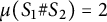 $\mu (S_1\# S_2) =2$
. For the bridge number, there is an example due to Viro in [Reference Viro20] of a knotted sphere F with
 $\beta (F)=2$
, such that connected sum with a standard projective plane
 $\mathbb {R} P^2$
is again a standard projective plane. Hence,
 $\beta (F\# \mathbb {R} P^2) = \beta (\mathbb {R} P^2)=1$
. The
 $({-1})$
-additivity of bridge number appears to remain open in the case of orientable knotted surfaces. However, using examples first studied by Kanenobu [Reference Kanenobu12], we show that the meridional rank of a connected sum of spheres can achieve any value in between the theoretical limits. So, either the meridional rank conjecture fails for knotted spheres, or bridge number also fails to be
 $(-1)$
-additive.
Theorem 1.3 Let
 $p_1,\dots ,p_n,q\geq 1$
such that
 $\max\{ p_i\} \leq q \leq \sum p_i -(n-1)$
. Then there exist 2-knots
 $K_1,\dots ,K_n$
, with
 $\mu (K_i)=p_i$
for all i and such that
 ${\mu (K_1\#\cdots \# K_n)=q}$
.
Corollary 1.4 Either bridge number fails to be
 $(-1)$
-additive on 2-knots, or there exist 2-knots K with
 $\mu (K)<\beta (K)$
.
We conclude by finding a lower bound on the meridional rank of a connected sum of twist-spun 2-knots. This is in contrast to the previous theorem, and shows that if the twist-indices of a family are bounded, the meridional rank of increasingly long connected sums grows without bound.
Theorem 1.5 Let
 $\{K_i\}_{i=1}^\infty $
be a collection of twist-spun 2-knots:
 $K_i=\tau ^{m_i} k_i$
for nontrivial classical knots
 $k_i$
, with
 $|m_i|\geq 2$
. If
 $\{m_i\}_{i=1}^\infty $
is bounded, then
 $\displaystyle {\lim _{n\to \infty }\mu (K_1\#\cdots \# K_n)=\infty }$
.
Weidmann proved that if
 $k_1,\dots ,k_n$
are nontrivial classical knots, then
 $\mu (k_1\#\cdots \# k_n)\geq n+1$
[Reference Weidmann21]. A corollary of Theorem 1.5 is the following statement, providing an analogous bound for the m-twist spin of a connected sum.
Corollary 1.6 Let
 $k_1,\dots ,k_n$
be nontrivial classical knots and
 $|m|\geq 2$
. Then
 $$\begin{align*}1+n/m\leq \mu(\tau^m(k_1\#\cdots\# k_n))\leq \mu(k_1\#\cdots\#k_n). \end{align*}$$
1.1 Organization
This paper is organized as follows: In Section 2, we define bridge number and meridional rank of classical knots and review some families of knots for which the MRC is known. In Section 3, we develop a construction to build knots which can be labeled by p-cycles. We use this technique in Section 4 to establish the MRC for a large family of 2-knots in Theorem 1.2. We then investigate the additivity of meridional rank under connected sum of 2-knots in Section 4.3, and prove Theorems 1.3 and 1.5.
2 Preliminaries
2.1 Meridional rank and bridge number of knots in
 $S^3$

Here, we define the quantities in the classical meridional rank conjecture.
Definition 2.1 Let
 $K:S^1\rightarrow S^3$
be a knot, and let
 $N(K)$
be a tubular neighborhood of K. A fiber of
 $N(K)$
is a meridional disk
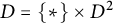 $D=\{*\}\times D^2$
with
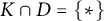 $K\cap D=\{*\}$
. A meridian of K is an element of
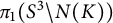 $\pi _1(S^3\setminus N(K))$
which is freely homotopic to
 $\partial D$
for some point
 $*$
on K. The meridional rank of K is the minimal number of meridians which generate
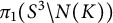 $\pi _1(S^3\setminus N(K))$
.
Of course, the rank of the knot group is a lower bound for the meridional rank, and a lower bound for the rank is (one plus) the minimal number of generators of the Alexander module. More subtle lower bounds are achieved by finding a quotient G of
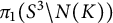 $\pi _1(S^3\setminus N(K))$
which sends the meridians of K to a specified conjugacy class of G. The minimal number of elements of this conjugacy class needed to generate G is then a lower bound for
 $\mu (K)$
. For example, although the rank of the symmetric group
 $S_n$
is two, the number of transpositions needed to generate is
 $n-1$
. See [Reference Livingston14] for more examples and background.
There are multiple equivalent ways to define the bridge number. Each perspective has its own advantage, but the following formulation is the most suitable for this paper.
Definition 2.2 The bridge number of K, denoted
 $\beta (K)$
, is the minimal number of local minima of K, taken over all Morse embeddings in
 $S^3$
with respect to the standard height function.
2.2 Coxeter groups
The Coxeter group
 $C(\Delta )$
associated with a finite simple graph
 $\Delta $
with weighted edges is defined as follows: (1) Each vertex of
 $\Delta $
corresponds to a generator of
 $C(\Delta )$
. (2) If s is a generator of
 $C(\Delta ),$
the
 $s^2 = 1.$
(3) If s and t are vertices that are connected by an edge of weight
 $k,$
then
 $(st)^k = 1.$
An element conjugate to any of the generators is called a reflection and the number of vertices of
 $\Delta $
is the reflection rank of
 $C(\Delta )$
. In particular, a generator is itself a reflection. The following proposition, which was observed in [Reference Baader, Blair and Kjuchukova2], will be very useful in computing the meridional rank.
Proposition 2.1 Suppose that there is a surjective map from
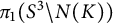 $\pi _1(S^3\setminus N(K))$
to
 $C(\Delta )$
sending meridians to reflections, where the weight on each edge of
 $\Delta $
is at least two. Then, the meridional rank of K is bounded below by the reflection rank of
 $C(\Delta )$
.
2.3 BBKM knots
In [Reference Baader, Blair and Kjuchukova2, Reference Baader, Blair, Kjuchukova and Misev3], many explicit surjections from classical knot groups to Coxeter groups are realized, with specified conjugacy classes for the meridians to map to, thus providing lower bounds for meridional rank. In these examples, they show that the classical Wirtinger number also equals the Coxeter group rank thus proving the meridional rank conjecture for these knots. We begin by giving brief descriptions of these BBKM knots introduced earlier in the paper.
For our applications, we need the fact that these knots are constructed by piecing together simple pieces. For the twisted knot case, the building blocks are twist regions and each twist region is associated with two meridians. For the arborescent case, the building blocks are rational tangles, where each rational tangle is associated with either a single Coxeter generator or two distinct Coxeter generators.
2.3.1 Classical twisted knots
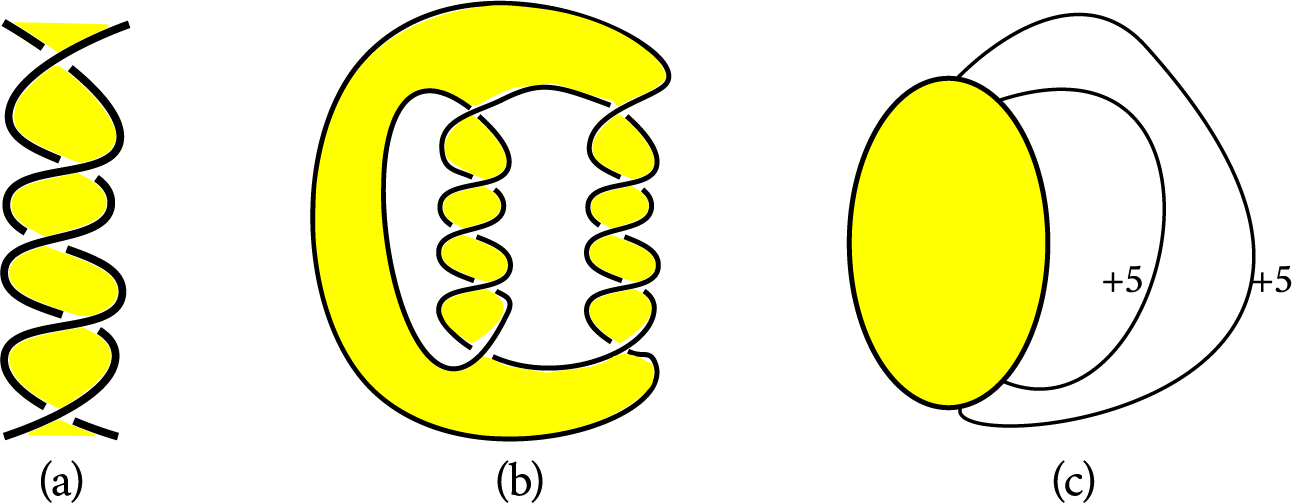
Consider a classical knot diagram D that is reduced so that it does not admit simplifications via Reidemeister I and II moves. It is well-known that D can be checkerboard colored. There are two associated checkerboard surfaces each of which can be thought of as a union of disks and twisted bands, where a band is an alternating sequence of disks and half-twists shown in Figure 1a. One can construct a graph
 $\Gamma $
from this surface, with one vertex for each disk and one edge for each band, weighted according to the number of signed half-twists in the band. If a classical knot K admits a diagram with a checkerboard surface (see Figure 1b) such that the edge weights of the induced graph (see Figure 1c)
 $\Gamma $
are all at least two in absolute value, and such that the plane dual graph
 $\Gamma ^*$
has no multiple edges, then K is called a twisted knot [Reference Baader, Blair and Kjuchukova2].
(a) A band. (b) A reduced checkerboard colored diagram. (c) After collapsing the bands into thin lines, we get the associated graph
 $\Gamma $
. Here, we treat the disk as a fat vertex.

2.3.2 Classical arborescent knots
Each classical arborescent knot can be encoded with a weighted tree. Each vertex in this weighted tree is an annulus where the weight corresponds to the number of twists. An edge connecting two vertices corresponds to a plumbing of the two annuli. The arborescent knots that are BBKM knots can be further broken into two sub-families: arborescent knots associated with bipartite trees with even weights [Reference Baader, Blair and Kjuchukova2], and arborescent knots associated with plane trees whose branching points carry a straight branch to at least three leaves [Reference Baader, Blair, Kjuchukova and Misev3].
3 Labeling knots with p-cycles
In this section, we develop a procedure to obtain knots colorable by p-cycles. We will often use the following terminology, which also appeared in the work of Annin and Maglione [Reference Annin and Maglione1].
Definition 3.1 A k-cycle
 $\sigma $
in the symmetric group
 $S_n$
is called a step k-cycle (or simply a step cycle) if
 $\sigma $
can be written in the form
 $\sigma =(a_0,a_1,a_2,\dots ,a_{k-1})$
such that
 $a_i \in \mathbb {Z}/n\mathbb {Z}$
and
 $a_i=a_0+i$
in
 $\mathbb {Z}/n\mathbb {Z}$
for all
 $i=0,1,2,\dots , k-1$
.
When we label knot diagrams with elements of order greater than two, orientations become important. We begin by showing that twist regions can be consistently labeled by p-cycles. More specifically, in the following lemma, we refer to the four endpoints of the arcs on the boundary of a tangle diagram as NE, NW, SW, SE. By a consistent labeling, we require that the label of the NE arc (resp. NW arc) is the same as the label of the SE arc (resp. SW arc).
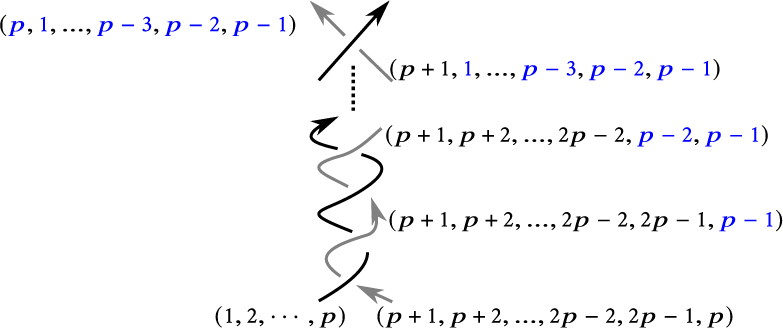
Lemma 3.1 The oriented classical two braid with
 $2p-1$
crossings pictured in Figure 2 can be labeled with step p-cycles
 $(1,2,\dots , p)$
and
 $(p,p+1,\dots ,2p-1)$
.
Labeling a twist region with
 $2p-1$
crossings by overlapping step p-cycles.

Proof The tangle has two components (colored black and gray in Figure 2). Starting at the bottom right label
 $(p+1,p+2,\dots ,2p-2,2p-1,p)$
, this component will go under the other component p times and the sequence of labelings that will appear in order after the bottom left label is
 $(p+1,p+2,\dots ,2p-2,2p-1,p-1) \rightarrow (p+1,p+2,\dots ,2p-2,p-2,p-1) \rightarrow (p+2,p+3,\dots ,p-3,p-2,p-1) \rightarrow \dots $
and will emerge on the top left as
 $(p,1\dots ,p-1)$
.
Similarly, starting at the bottom left label
 $(1,2,\dots ,p)$
, this component will go under the other component
 $p-1$
times and emerges on the top left as
 $(p+1,\dots ,2p-2,2p-1,p)$
.
If the labels
 $(1,2,\dots ,p)$
and
 $(p, p+1, \dots , 2p-1)$
are permuted, a similar calculation shows that the top left labeling will agree with bottom left, and top right labeling with the bottom right.
We now introduce a subset of the set of p-cycles which we will use to create more complicated knots with labelings. For convenience, we define
 $G_{p,n}$
as the symmetric group
 $S_{np-(n-1)}$
when p is even, and as the alternating group
 $A_{np-(n-1)}$
when p is odd.
Definition 3.2 A step p-cycle is a p-cycle of the form
 $(a,a+1,a+2,\dots ,a+p-1)$
. Given integers
 $p,n$
, with
 $p\geq 3,n\geq 2$
, we will refer to the set of once-overlapping step p-cycles
 $O_{p,n}=\lbrace (1,\dots ,p),(p,\dots ,2p-1),\dots ,\ ((n-1)p-(n-2),\dots ,np-(n-1))\rbrace \subset G_{p,n}$
.
Note that if x and y are in
 $O_{p,n}$
, then they are either once-overlapping, or they permute disjoint elements and therefore commute:
 $xy=yx$
. Note also that if they are once-overlapping, their product is a
 $(2p-1)$
-cycle, e.g.,
 $(1,2,3)(3,4,5)=(1,2,3,4,5)$
.
With the intention of applying the following result of Annin and Maglione, we also would like to make sure that the elements of
 $O_{p,n}$
generate
 $G_{p,n}$
.
Theorem 3.2 [Reference Annin and Maglione1, Theorem 3.1]
Let m and r be positive integers with
 $m \geq r \geq 2$
such that
 $(m, r) \neq (2, 2)$
and
 $(m, r) \neq (3, 3)$
. If r is odd (respectively, even), then the minimum number of r-cycles needed to generate
 $A_m$
(respectively,
 $S_m$
) is
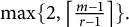 $\max \lbrace 2, \left \lceil {\frac {m-1}{r-1}} \right \rceil \rbrace .$
If
 $m= np-(n-1)=n(p-1)+1$
, then
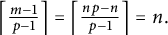 $ \left \lceil {\frac {m-1}{p-1}} \right \rceil = \left \lceil {\frac {np-n}{p-1}} \right \rceil = n.$
Note that knots in
 $\mathcal {K}_{p,n}$
can be labeled by
 $n\ p$
-cycles from
 $G_{p,n}$
. We still need to show that these overlapping step cycles generate.
Lemma 3.3 The collection of n overlapping step p-cycles
 $O_{p,n}=\lbrace (1,\dots ,p),(p,\dots ,2p-1),(2p-1,\dots .,3p-2),\dots ,\ ((n-1)p-(n-2),\dots ,np-(n-1))\rbrace $
generates
 $A_{np-(n-1)}$
(respectively,
 $S_{np-(n-1)}$
), when p is odd (respectively, even).
Proof By Corollary 2.4 of [Reference Annin and Maglione1], the set of all step cycles of length p generates
 $A_{np-(n-1)}$
for p odd (resp.
 $S_{np-(n-1)}$
for p even), so we need only show that
 $O_{p,n}$
generates the set of all step p-cycles. Note that the (ordered) product of the elements of
 $O_{p,n}$
is
 $(1,\dots ,p)(p,\dots ,2p-1)\cdots ((n-1)p-(n-2),\dots ,np-(n-1)) = (1,2,\dots ,np-(n-1))$
, an
 $(np-(n-1))$
-cycle: we denote this element by
 $\tau $
. Now, we will show that any step p-cycle is generated by
 $\tau $
and
 $(1,2,\dots ,p)$
. Let a be an integer in
 $\{1,2,\dots ,np-(n-1)\}$
. Observe that the step cycle of length p starting at a can be written as
 $$ \begin{align*} \tau^{a-1}(1,2,\dots,p)\tau^{-(a-1)} = (\tau^{a-1}(1),\tau^{a-1}(2), \dots, \tau^{a-1}(p)) = (a,a+1,\dots,a+p-1). \end{align*} $$
Brunner described a method to construct a link in
 $S^3$
from a weighted simple planar graph, which admits a surjection to an Artin group whose presentation can be read off from the graph. Now, we adapt his construction to the more subtle case of labeling by step p-cycles as opposed to just order two elements. The following construction builds links in
 $S^3$
which can be labeled by overlapping p-cycles, yielding a surjection of the link group to
 $G_{p,n}$
which detects the meridional rank.
Construction 3.4 Let
 $\Gamma $
be a simple planar graph, and form its dual
 $\Gamma ^*$
. Label the edges of
 $\Gamma ^*$
with elements from the set
 $\{0,1\}$
. As in [Reference Brunner6], blow up the vertices of
 $\Gamma ^*$
to disks, and the edges to twisted bands. At this stage, the number of half-twists in each band is only determined up to parity: an even number of half-twists if that edge was labeled with 0, and an odd number if labeled with 1. This labeling determines the connectivity of the resulting link diagram. Choose an orientation on each component. Let
 $n=|V(\Gamma )|$
. As shown in [Reference Baader, Blair and Kjuchukova2], there is a choice of n meridians, one for each region of
 $\mathbb {R}^2 - \Gamma ^*$
, which will generate the group of the complement of the resulting link. The following claim summarizes a strategy to choose the number of half-twists in each box so that the resulting link L will be colorable by step p-cycles.
Claim. If a generating set of n meridians on the resulting link diagram from Construction 3.4 can be labeled by the n elements of
 ${O_{p,n}}$
, subject to the following rules, then the labeling corresponds to a surjection
 $\pi _1(S^3\setminus L) \rightarrow G_{p,n}$
, sending meridians to step p-cycles.
Rule 1. If the labels at the bottom of a twist box are the same or permute disjoint cycles, then any number of half-twists may be chosen (respecting the parity choice already made).
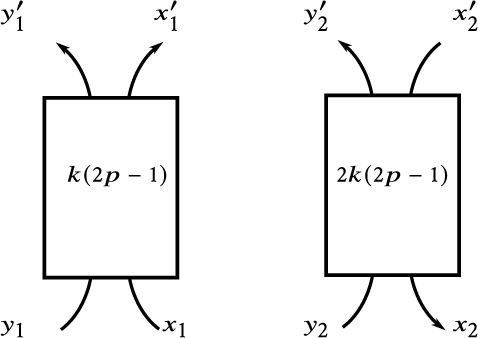
Rule 2. If the labels at the bottom of a twist box are once-overlapping, then the number of half-twists can be chosen as follows (see Figure 3):
The allowable twist regions in Construction 3.4. The relations
 $x_i=x_i^\prime $
and
 $y_i=y_i^\prime $
are guaranteed whenever
 $x_i$
and
 $y_i$
are chosen from
 $O_{p,n}$
.

Case I. If both strands travel upward, then any multiple of
 $2p-1$
half-twists may be chosen (respecting the parity choice already made).
Case II. If one strand travels up and one down, then any even multiple of
 $2p-1$
half-twists may be chosen (note this necessitates having an even twist box to begin with).
We now prove that the rules above yield a valid labeling of the diagram, which amounts to showing that the labels at the bottoms of the twist boxes agree with the corresponding labels at the top. We prove the case
 $k=1$
, which implies the statement for all positive k. The proof is similar for negative k, and trivial when
 $k=0$
.
Let
 $x,y \in O_{p,n}$
. If x and y do not overlap, then they commute, and the Wirtinger relations become trivial. Similarly, if
 $x=y$
the relations are trivial. Otherwise, x and y are once-overlapping, so
 $xy$
and
 $\overline {x}y$
are
 $(2p-1)$
-cycles.
First consider Case I, the left-hand picture of Figure 3. The calculation in Figure 2 shows that the top-left label is
 $(1,\dots ,p)$
and the top-right label is
 $(p,\dots ,2p-1)$
. In terms of
 $x_1$
and
 $y_1$
, this says that
 $x_1^\prime =({x_1}y_1)^{-(p-1)}y_1({x_1}y_1)^{p-1}=x_1$
, and
 $y_1^\prime =({x_1}y_1)^{-p}x_1({x_1}y_1)^{p}=y_1$
(in fact, the first equation implies the second, since
 $({x_1}y_1)^{2p-1}$
is trivial). As noted in the proof of Lemma 3.1, the desired conclusion holds if these labels are permuted.
Now, consider Case II, the right-hand picture of Figure 3. The Wirtinger relations from the crossings in the twist-box imply that
 $x_2^\prime =(\overline {x_2}y_2)^{-(2p-1)}x_2(\overline {x_2}y_2)^{2p-1}$
. Since
 $\overline {x_2}y_2$
is a
 $(2p-1)$
-cycle, we have
 $x_2^\prime =x_2$
. Similarly,
 $y_2^\prime =(\overline {x_2}y_2)^{-(2p-1)} y_2(\overline {x_2}y_2)^{2p-1}=y_2$
.
Definition 3.3 Let
 $p,n\in \mathbb {Z}$
with
 $p,n\geq 2$
. We define
 $\mathcal {K}_{p,n}$
to be the set of knots resulting from the above construction.
Example 3.5
 $\mathcal {K}_{2,2}$
is the set of 2-bridge twisted knots with a surjection to
 $S_3$
, the third symmetric (and dihedral) group. It is straightforward to check that when
 $|V(\Gamma )|=2$
, any knot resulting from Construction 3.4 will be of the form
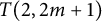 $T(2,2m+1)$
. Thus,
 $\mathcal {K}_{2,2}=\{T(2,6k+3):k\in \mathbb {Z}\}$
, the 2-bridge torus knots which admit a tricoloring.
Example 3.6 The torus knot
 $T(2,2p-1)$
is in
 $\mathcal {K}_{p,2}$
, and therefore admits a surjection to
 $G_{p,2}$
, sending meridians to p-cycles. The n-fold connected sum of
 $T(2,2p-1)$
is in
 $\mathcal {K}_{p,n+1}$
.
Remark 3.7 Note that Construction 3.4 shows that a single knot may admit arbitrarily many surjections to symmetric or alternating groups of different orders, sending meridians to cycles of different lengths. For example, consider the torus knot
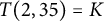 $T(2,35)=K$
. Since
 $35 = 2*18-1$
, K may be labeled by 18-cycles in
 $G_{18,2}=S_{35}$
. Since
 $35=7*5=7(2*3-1)=5(2*4-1)$
, K may also be labeled by 3-cycles in
 $G_{3,2}=A_5$
, and by 4-cycles in
 $G_{4,2}=S_7$
.
Example 3.8 Recall that the generalized pretzel knot is a knot that admits a diagram formed by joining two components of a planar unlink with parallel twisted bands. The generalized (
 $q_1,q_2,q_3,\dots ,q_n)$
-pretzel knot where
 $q_i=2p-1$
for
 $i\neq n$
and
 $q_n$
is even is in
 $\mathcal {K}_{p,n}$
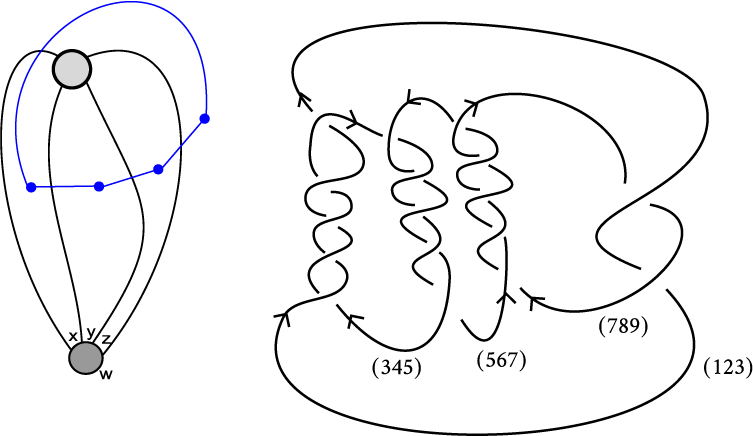
. Figure 4 depicts a specific case where our knot J is the
 $(5,5,5,2)$
-pretzel knot, an element of
 $\mathcal {K}_{3,4}$
.
At left, the cycle graph
 $\Gamma $
and its dual
 $\Gamma ^*$
are shown. The vertices of
 $\Gamma ^*$
are fattened into disks and edges into twisted bands, forming the generalized pretzel knot
 $K \in \mathcal {K}_{3,4}$
(right).

Remark 3.9 Instead of using just twist regions in the construction of
 $\mathcal {K}_{p,n}$
, one may use non-integer rational tangles by making sure that the end result is a knot and the orientations are compatible (see Figure 5).
The closure of a rational tangle in
 $\mathcal {K}_{p,2}$
. Each rectangle represents a horizontal twist region containing a multiple of
 $2p-1$
crossings (one odd and one even).

The preceding discussion proves that for any knot K in
 $\mathcal {K}_{p,n}$
, the meridional rank of K is equal to n. The same techniques utilizing the Wirtinger number as in [Reference Blair, Kjuchukova, Velazquez and Villanueva5] show that their bridge number is also n. While the values of bridge numbers and meridional ranks for these knots can also be found by methods of [Reference Baader, Blair and Kjuchukova2], the existence of knot group epimorphisms is interesting in its own right [Reference Silver and Whitten19].
Corollary 3.10 If
 $K\in \mathcal {K}_{p,n}$
, then
 $\mu (K)=\beta (K)=n$
.
Proposition 3.11 This construction is well-suited for connected sums of knots. If
 ${K_1\in \mathcal {K}_{p,n_1}}$
and
 $K_2\in \mathcal {K}_{p,n_2}$
, then
 $K_1 \# K_2 \in \mathcal {K}_{p,n_1+n_2-1}$
.
Proof Since the connected sum operation is well-defined, we may performed the connected sum operation in any location on the knot diagram. Since
 $K_i\in \mathcal {K}_{p,n_i}$
for
 $i=1,2$
, there is an arc of
 $K_1$
with label
 $(1,2,3,\dots ,p)$
and also an arc of
 $K_2$
with label
 $(1,2,3,\dots ,p)$
. Performing the connecting sum operation on these two arcs describe a desired surjection to an alternating group that needs at least
 $n_1+n_2-1$
p-cycles to generate the group.
4 Meridional rank and bridge number of 2-knots
In this section, we define the meridional rank and bridge number of knotted spheres in
 $S^4$
, and use the labelings from the previous section to prove Theorem 1.2, verifying that meridional rank and bridge number coincide for families of twist-spun 2-knots with any possible twist indices. We then investigate the additivity of meridional rank under connected sum of 2-knots and prove Theorems 1.3 and 1.5.
4.1 2-knots in
$S^4$

A 2-knot
 $K:S^2\rightarrow S^4$
is a smoothly embedded sphere in
 $S^4$
. We assume our embeddings are in Morse position with respect to the standard height function
 $S^4\rightarrow \mathbb {R}$
, and therefore have finitely many critical points.
The bridge number and meridional rank of a 2-knot are defined exactly analogously as in the case of knots in
 $S^3$
: the bridge number is the minimal number of minima over all Morse embeddings, and the meridional rank is the minimal number of meridians needed to generate the knot group,
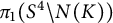 $\pi _1(S^4\setminus N(K))$
. A meridian is an element of
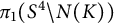 $\pi _1(S^4\setminus N(K))$
which can be represented by a simple closed curve bounding a disk in
 $S^4$
that transversely intersects the sphere in a single point. As in the case of classical knots, the meridional rank of a 2-knot is a natural lower bound for its bridge number.
Proposition 4.1 Let K be a 2-knot. Then
 $\mu (K)\leq \beta (K)$
.
Proof Consider an embedding K with
 $\beta (K)=n$
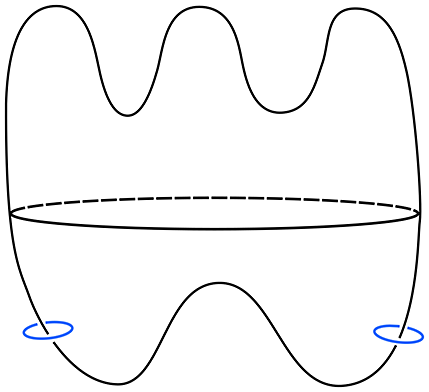
minima. As suggested in Figure 6, taking a meridian to each of these minima yields a generating set for
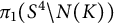 $\pi _1(S^4\setminus N(K))$
, since the index 0 critical points of K correspond to the 1-handles in a handle decomposition of
 $S^4\setminus N(K)$
[Reference Gompf and Stipsicz9].
An embedded sphere in Morse position with two minima. Meridians near the minima (shown in blue) generate the knot group.

Sometimes, we will write
 $\pi K$
as an abbreviation for
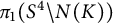 $\pi _1(S^4\setminus N(K))$
. Also note that any meridians drawn as simple loops are joined by paths to the basepoint of
 $S^4\setminus N(K)$
.
4.1.1 Twist-spun knots
Let
 $K\subseteq S^3$
be a knot. Delete a small neighborhood of a point on K to obtain a tangle
 $(B^3,K^\circ )$
. Let
 $(B^4,D)$
denote the trace of the identity isotopy of
 $K^\circ $
in
 $B^3$
, i.e.,
 $(B^4,D)=(B^3,K^\circ )\times I$
and D is the standard half-spun disk for
 $K\# {-K}$
. Let
 $(B^4,D_m)$
denote the trace of the isotopy that rotates
 $K^\circ $
about the polar axis relative to
 $B^3\ m$
-times, for some
 $m\in \mathbb {Z}$
. The m-twist spin of K is defined to be the 2-knot
 $(S^4,\tau ^m K) = (B^4,D) \cup (B^4,D_m)$
.
Twist-spun knots were introduced by Sir Christopher Zeeman [Reference Zeeman22], who proved the amazing fibering theorem below.
Theorem 4.2 (Zeeman [Reference Zeeman22])
Let
 $\Sigma _m k$
be the
 $|m|$
-fold cyclic cover of
 $S^3$
branched over the knot k. If
 $m\neq 0$
, then the twist-spun knot
 $\tau ^{m} k$
is fibered by a punctured copy of
 $\Sigma _m k$
.
Note this implies that
 $\tau ^{\pm 1}K$
is always unknotted. Another implication of this theorem we make use of in Theorem 1.5 is that the commutator subgroup of
 $\pi (\tau ^m k)$
is isomorphic to
 $\pi _1(\Sigma _m k)$
(since the infinite cyclic cover is
 $\Sigma _m k \times \mathbb {R}$
). Moreover, the group of
 $\tau ^m K$
is a quotient of
 $\pi K$
, obtained by centralizing the
 $m{\text {th}}$
power of a meridian.
More generally, we can consider a general ambient isotopy
 $f=\{f_t \ | \ t\in [0,1]\}$
of the tangle, where
 $f|_{\partial B^3}=id, f_1(K^\circ )=K^\circ $
, as in [Reference Litherland13]. The isotopy f is called a deformation and
 $fK$
is called a deform-spin of K.
Proposition 4.3 Let K be a knot in
 $S^3$
. Then,
 $\beta (f K) \leq \beta (K)$
and
 $\mu (f K) \leq \mu (K)$
.
Proof The deform-spun knot
 $fK$
can be thought of as only doing the deformation in the top half, i.e., we glue together the deform-spun disk on top and the standard half-spun ribbon disk for
 $K\# -K$
on bottom. By starting with K in minimal bridge position, and removing a small 3-ball centered on a maximum of K, the half-spun disk will have
 $\beta (K)$
minima. The top half has no minima, as it is a ribbon disk for
 $K\# -K$
. Thus,
 $\beta ( fK)\leq \beta (K)$
.
The group
 $\pi (f K)$
is obtained from
 $\pi K$
by identifying
 $f_1(x)$
with x, for each meridian x of
 $\pi K$
[Reference Litherland13]. Thus, there is a quotient map
 $\pi K \to \pi (f K)$
, which sends meridians to meridians because meridional curves of the punctured K are meridional curves of
 $f K$
. This shows the second inequality.
4.2 Proof of Theorem 1.2
Before proving the theorem, we prove a lemma demonstrating how the techniques of Section 3 can be useful for measuring the meridional rank of twist-spun 2-knots for any possible twist indices.
Lemma 4.4 If a knot
 $K\in \mathcal {K}_{m,n}$
, then for any integer p,
 $\tau ^{pm}K$
also has a surjection to
 $G_{m,n}$
, sending meridians to step m-cycles.
Proof Let
 $K\in \mathcal {K}_{m,n}$
. By definition, there is a surjection
 $\phi :\pi K \to G_{m,n}$
, sending meridians
 $x_1,\dots ,x_n$
of K to a set of n step m-cycles which generate
 $G_{m,n}$
. Let
 $\tau $
denote the quotient map
 $\tau : \pi K \to \pi (\tau ^{pm} K)$
. As explained in Section 4.1, this quotient map is induced by centralizing the
 $(pm)\text {th}$
power of a meridian, say x, in
 $\pi K$
. Therefore, the kernel of
 $\tau $
is the normal closure of
 $\{[x^{pm},g]:g\in \pi K\}$
, where
 $[g,h]=g^{-1}h^{-1}gh$
denotes the usual commutator. The kernel of
 $\phi $
contains
 $x^m$
, so it contains all elements of the form
 $[x^{pm},g]$
as well. Thus,
 $\phi $
factors through
 $\tau $
, and there is a unique homomorphism
 $\psi :\pi (\tau ^{pm} K)\to G_{m,n}$
such that
 $\psi \circ \tau =\phi $
. Then
 $\psi (\tau (x_i))=\phi (x_i)$
for
 $1\leq i \leq n$
, that is the meridians
 $\tau (x_1),\dots ,\tau (x_n)$
of
 $\tau ^{pm}K$
are sent by
 $\psi $
to the same generating set of step m-cycles as the original meridians of K under
 $\phi $
.
We are now prepared to prove Theorem 1.2. The condition
 $|m|\neq 1$
is necessary, as it guarantees by [Reference Zeeman22] that the resulting m-twist spun 2-knots are not unknotted.
Theorem 1.2 Let
 $m,n\in \mathbb {Z}$
with
 $|m|\neq 1, n\geq 2$
. Then there exist infinitely many classical knots
 $K\subseteq S^3$
such that
 $\mu (\tau ^m K) = \beta (\tau ^m K) = n$
.
Proof of Theorem 1.2
As in Lemma 4.4, we take K from the family
 $\mathcal {K}_{m,n}$
, defined in Section 3. It is evident from Construction 3.4 and the ensuing examples that each of the sets
 $\mathcal {K}_{m,n}$
in question is infinite. These knots have surjections to
 $G_{m,n}$
, sending meridians to step m-cycles. Lemma 4.4 shows that
 $\tau ^m K$
also has a surjection to
 $G_{m,n}$
, sending a generating set of meridians of
 $\tau ^m K$
to step m-cycles. As shown in Section 3,
 $n\ m$
-cycles are needed to generate
 $G_{m,n}$
, so
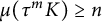 $\mu (\tau ^m K) \geq n$
.
The bridge number of
 $\tau ^m K$
is at most
 $\beta (K)=n$
, by Proposition 4.3. Thus,
 $\mu (\tau ^m K) = \beta (\tau ^m K) = n$
.
Remark 4.5 If we combine Theorem 1.2 with the observation in Remark 3.7, we can actually show that for any
 $n\geq 2$
and vector
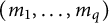 $(m_1,\dots ,m_q)$
with
 $|m_i| \neq 1$
, there exist infinitely many knots
 $K\subset S^3$
such that
 $\mu (\tau ^{m_i} K) = \beta (\tau ^{m_i} K) = n$
for all i. For example, for odd
 $j \geq 1,$
let
 $K_j$
be the n-fold connect sum of
 $T(2,jM)$
, where
 $M=(2m_1 - 1)(2m_2 - 1)\dots (2m_q-1)$
.
We remark that Coxeter quotients, where images of meridians have order two, are sufficient to prove the theorem for all even twist indices. Thus, any BBKM knot will suffice when m is even. This observation was the starting point of our efforts to find compatible quotients for any m-twist-spun knot.
We remark that the technique used in Theorem 1.2 can be used for other motions that affect the fundamental group of K by centralizing powers of a certain element
 $\gamma $
of
 $\pi K$
. To elaborate, we remind the reader of the proof of Proposition 4.3. Given a meridional presentation
 $\langle x_1,\dots ,x_n \;\ | \;\ R\rangle $
of K, we get a meridional presentation
 $\langle x_1,\dots ,x_n \;\ | \;\ R,f_1(x_i) = x_i \;\ (i=1,\dots ,n)\rangle $
for the deform spin of K with motion f. Note that
 $\gamma $
is a meridian when the motion is m-twist-spinning and
 $f_1(x_i)=x^{-m}x_ix^m$
for a meridian x. When the motion is Litherland’s m-roll spinning [Reference Litherland13], the element
 $\gamma $
is the Seifert longitude
 $\lambda $
and
 $f_1(x_i)=\lambda ^{-m}x_i\lambda ^m$
.
Proposition 4.6 Take
 $K \in \mathcal {K}_{p,n}$
. Using the notations in the previous paragraph, suppose that
 $f_1(x_i) = \gamma ^{-1}x_i\gamma $
. Then,
 $\mu (K) = \mu (f^m K)= \beta (f^m K) = n$
, where
 $m = |G_{p,n}| = \frac {1}{2}(np-(n-1))!$
when p is odd and
 $(np-(n-1))!$
when p is even.
Proof Recall that
 $K \in \mathcal {K}_{p,n}$
has a surjection to
 $G_{p,n}$
. Call that surjection
 $\phi $
. We obtain a surjective homomorphism from
 $\pi (f^{m}K) = \langle x_1,\dots ,x_n \;\ | \;\ R,\gamma ^{-m}x_i\gamma ^{m} = x_i \;\ (i=1,\dots ,n)\rangle $
to
 $G_{p,n}$
as well because
 $\phi (\gamma )$
raised to the order of
 $G_{p,n}$
is trivial.
Example 4.7 Baader and Kjuchukova proved the meridional rank conjecture for some of the knots they referred to as
 $\binom {n}{2}$
-colorable knots [Reference Baader and Kjuchukova4]. This means that for each of these knots, there exists a surjective homomorphism from the knot group onto the symmetric group, mapping meridians to transpositions. Consider the fundamental group of the complement of the dth roll spun
 $\rho ^dK$
of K in
 $S^4$
, which can be obtained from the knot group of K by making the dth power of the longitude central. It is known that the longitude is an element of the second commutator subgroup of the knot group (see Proposition 3.12 of [Reference Burde and Zieschang7], for example). The second commutator subgroup of
 $S_n$
is
 $A_n,$
and
 $|A_n|=\frac {n!}{2}$
. By Proposition 4.6, the surface
 $\rho ^{n!/2}K$
satisfies the property that the meridional rank equals the bridge number.
4.3 Behavior of meridional rank under connected sum
In this section, we study how the meridional rank of 2-knots (knotted spheres in
 $S^4$
), changes under connected sum. Note that if the meridional rank conjecture for classical knots is true then their meridional ranks must be
 $(-1)$
-additive, since the bridge number is known to have this property. One elementary bound for the meridional rank of a connected sum is the following.
Proposition 4.8 Let
 $K_1$
and
 $K_2$
be 2-knots. Then
 $$\begin{align*}\max\{\mu (K_1), \mu (K_2)\} \leq \mu (K_1\# K_2) \leq \mu (K_1) + \mu (K_2) - 1. \end{align*}$$
Proof The group of
 $K_1\# K_2$
surjects onto the group of
 $K_i$
by abelianizing the other factor. So if
 $x_1,\dots ,x_n$
are meridians which generate
 $\pi (K_1\# K_2)$
, then their images under this quotient map are meridians which generate
 $\pi (K_i)$
. This proves the first inequality. The second is proved by taking the obvious presentation for
 $\pi (K_1\# K_2)$
: a minimal set of meridional generators for each factor, and then identifying a meridian of
 $K_1$
with one of
 $K_2$
to form the amalgamated product.
Theorem 1.3 is the main theorem of this section and proves that the meridional rank of a connected sum of 2-knots is not, in general,
 $(-1)$
-additive. Indeed, it can achieve any value in between the theoretical bounds given by Proposition 4.8. Thus, either the bridge number also fails to be
 $(-1)$
-additive for these examples, or the meridional ranks of these knotted spheres are strictly less than their bridge numbers.
Theorem 1.3 Let
 $p_1,\dots ,p_n,q\geq 1$
such that
 $\max\{ p_i\} \leq q \leq \sum p_i -(n-1)$
. Then there exist 2-knots
 $K_1,\dots ,K_n$
, with
 $\mu (K_i)=p_i$
for all i and such that
 ${\mu (K_1\#\cdots \# K_n)=q}$
.
Corollary 1.4 Either bridge number fails to be
 $(-1)$
-additive on 2-knots, or there exist 2-knots K with
 $\mu (K)<\beta (K)$
.
The lemma below is one of the more striking special cases of the theorem, from which the other cases are obtained by taking connected sums wisely (see Figure 7 for a schematic).
Lemma 4.9 Let
 $n, m_1,\dots ,m_n\in \mathbb {N}$
such that
 $m_i\geq 2$
are relatively prime. Let
 $k_1,\dots ,k_n$
be 2-bridge knots, and let
 $K_i = \tau ^{m_i} k_i$
. Then
 $\mu (K_i)=2=\mu (K_1\#\cdots \# K_n)$
.
Proof Let
 $\langle x_i, y_i | r_i \rangle $
be a Wirtinger presentation for
 $\pi k_i$
, where
 $x_i$
and
 $y_i$
are meridians of
 $k_i$
. Then a presentation for
 $K_i$
is obtained by adding the relation
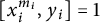 $[x_i^{m_i},y_i]=1$
. Note that this relation is equivalent to the relation
 $x_i^{m_i}=y_i^{m_i}$
. This is because the Wirtinger relation
 $r_i$
tells us that
 $x_i$
and
 $y_i$
are conjugate:
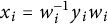 $x_i = w_i^{-1} y_i w_i$
for some
 $w_i\in \pi k_i$
. After adding the twist-spinning relation
 $x_i^{m_i}$
and
 $y_i^{m_i}$
are both conjugate and central, so they must be equal in the group of
 $\tau ^{m_i} k_i$
. In the other direction, we show that
 $x_i^{m_i}=y_i^{m_i}$
implies
 $x_i^{m_i}y_i = y_ix_i^{m_i}$
. We have
 $x_i^{m_i}y_i = y_i^{m_i}y_i = y_i y_i^{m_i} = y_ix_i^{m_i}$
.
It is convenient to think of the group of the connected sum
 $K_1\# \cdots \# K_n$
as being amalgamated in a “zig-zag” fashion from the groups of the summands
 $K_i$
: for i odd we amalgamate
 $x_i$
with
 $x_{i+1}$
, and for i even we amalgamate
 $y_i$
with
 $y_{i+1}$
. Then a presentation for the group of the connected sum is
 $\langle x_1, y_1, \dots , x_n, y_n | r_1, \dots , r_n, x_1^{m_1}=y_1^{m_1},\dots ,x_n^{m_n}=y_n^{m_n}, x_1=x_2, y_2=y_3, \dots , z_{n-1}=z_n\rangle $
, where the symbol z stands for x if n is even and y if n is odd (Figure 7).
Now, we prove by induction that for n even, the meridians
 $y_1$
and
 $y_n$
generate the group of
 $K=K_1\#\cdots \# K_n$
, and that for n odd,
 $y_1$
and
 $x_n$
generate the group of K. Since each of the groups
 $\pi K_i$
inject into the group of K,
 $\pi K$
is not cyclic, so we will conclude that
 $\mu (K)=2$
.
Specifically, we will show that for n even,
 $x_n=x_{n-1}$
is in the subgroup generated by
 $y_1$
and
 $y_n$
, and for n odd,
 $y_n=y_{n-1}$
is in the subgroup generated by
 $y_1$
and
 $x_n$
. Then, by induction, the stated pairs of elements generate the group of K.
When
 $n=1$
, the group of
 $K=K_1$
is generated by
 $x_1$
and
 $y_1$
by assumption. Now, assume the claim is true for less than or equal to
 $n-1$
summands, and consider the case of
 $K=K_1\#\cdots \# K_n$
.
Let n be even,
 $M=m_1 m_2 \dots m_{n-1}$
, and note that the twist-spinning relations imply that
 $y_1^M=x_{n-1}^M=x_n^M$
. Since M is relatively prime to
 $m_n$
, there exist integers a and b so that
 $aM+bm_n=1$
. Then
 $y_1^{aM}y_n^{bm_n}=x_n^{aM}x_n^{bm_n}=x_n=x_{n-1}$
, so this element is in
 $\langle y_1,y_n\rangle $
.
Now, let n be odd and consider
 $M,a,b$
as before. Then
 $y_1^M=y_{n-1}^M=y_n^M$
, and
 $y_1^{aM}x_n^{bm_n}=y_n^{aM}y_n^{bm_n}=y_n=y_{n-1}$
. Thus,
 $y_1$
and
 $x_n$
generate
 $y_n=y_{n-1}$
, as claimed.
A schematic for Lemma 4.9 with five summands. Amalgamated meridians have matching colors; the orange and pink meridians (
 $y_1$
and
 $x_5$
, respectively) generate the knot group.

We will use the examples created in [Reference Kanenobu12] for a different purpose to show that meridional rank is not necessarily
 $(-1)$
-additive for 2-knots. In that paper, Kanenobu defined a family of 2-knots in order to prove an analogous statement to Theorem 1.3 regarding the weak unknotting number of a 2-knot, the fewest number of meridian-identifying relations which abelianize the knot group.
For the lower bound in Theorem 1.3, we will again make use of Construction 3.4. Recall that this construction is
 $(-1)$
-additive under connected sum (Proposition 3.11). For a 2-knot K, let
 $\alpha J$
denote the connected sum of
 $\alpha $
copies of J. The definition below is essentially due to Kanenobu, however, we expand the number of usable examples by using our p-cycle labelings from Section 3.
Definition 4.1 Let
 $p_1,\dots ,p_n,q\geq 1$
such that
 $\max\{ p_i\} \leq q \leq \sum p_i$
and
 $p_1\geq p_2 \geq \dots \geq p_n$
, and choose j such that
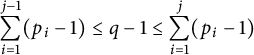 $\displaystyle {\sum _{i=1}^{j-1} (p_i - 1) \leq q - 1 \leq \sum _{i=1}^{j} (p_i - 1)}$
. Let
 $m_1,\dots ,m_n$
be relatively prime integers with
 $|m_i|\geq 2$
, and let
 $T_i=\tau ^{m_i} k_i$
, where
 $k_i\in \mathcal {K}_{m_i,2}$
, e.g.,
 $k_i=T(2,2m_i-1)$
. Now, define
 $$\begin{align*}K_i=\begin{cases} (p_i - 1) T_1, & i< j, \\ \left(q + j - 2 -(p_1+\cdots+ p_{j-1}) \right)T_1 \# (p_j - 1) T_j, & i=j, \\ (p_i - 1) T_i, & i>j, \end{cases} \end{align*}$$
and let
 $K=K_1\#\cdots \# K_n$
.
4.3.1 Proof of Theorem 1.3
Proof Given
 $p_1,\dots ,p_n,q$
as in the statement of Theorem 1.3, choose a family
 $K_1, \dots , K_n$
as in Definition 4.1.
Note that each
 $T_i$
has meridional rank at least 2, since
 $\pi (\tau ^{m_i} k_i)$
has a surjection to
 $G_{m_i,2}$
. Each
 $T_i$
also has meridional rank at most 2 due to the upper bound in terms of the bridge number stated in Proposition 4.3. Regrouping so that
 $T_1$
’s are together, we see that there are
 $(\sum _{i=1}^{j-1}p_i-(j-1)+q+j-2-(\sum _{i=1}^{j-1}p_i))= q-1$
copies of
 $T_1$
:
 $$ \begin{align*} K = (q-1) T_1 \# (p_j - 1) T_j \# \cdots \# (p_n - 1) T_n. \end{align*} $$
In particular,
 $\mu (K)\geq \mu ((q-1) T_1) = q.$
Here, we are using the
 $(-1)$
-additivity of
 $\mu $
for knots in
 $\mathcal {K}_{p,n}$
(Proposition 3.11):
 $k_1\in \mathcal {K}_{m_1,2}$
, so
 $(q-1)k_1 \in \mathcal {K}_{m_1,q}$
. Note that K has a connected summand
 $$ \begin{align*} J = (q-1)\tau^{m_1}k_1 = \tau^{m_1} (q-1)k_1, \end{align*} $$
so K has a surjection to
 $G_{m_1,q}$
as well, sending meridians to
 $m_1$
-cycles.
Following Kanenobu, we can also regroup the summands of K as
 $$ \begin{align*} (q-p_j)T_1 &\# (p_j-p_{j+1})(T_1\# T_j) \# (p_{j+1}-p_{j+2})(T_1 \# T_j \# T_{j+1}) \# \cdots \\ &\# (p_{n-1}-p_n)(T_1 \# T_j\#\cdots \# T_{n-1}) \# (p_n-1)(T_1\#T_j\#\cdots\# T_n). \end{align*} $$
Each of the 2-knots
 $T_1\#T_j\#\cdots \# T_{j+i}$
has meridional rank 2 by Lemma 4.9. Hence,
 $\alpha (T_1\#T_j\#\cdots \# T_{j+i})$
has meridional rank at most
 $\alpha +1$
. Then K is a connected sum of
 $q-1$
2-knots, each of meridional rank 2, so
 $\mu (K)$
is at most q, by repeated application of Proposition 4.8.
Due to the abundance of notation in the proof above, we elaborate Theorem 1.3 and its proof with a specific example for clarity.
Example 4.10 Let
 $p_1=2, p_2=3, p_3 = 5, p_4 = 5, q = 7.$
Proceeding along the statement of Definition 4.1, we next have to choose j. If
 $j=3,$
then
 $\sum _{i=1}^2 (p_i-1) = 1+2 = 3 \leq q-1 = 6 \leq \sum _{i=1}^3 (p_i-1) = 1+2+4 = 7.$
We are now ready to define our summands
 $K_1,K_2,K_3$
, and
 $K_4$
. We have that for
 $i<j$
,
 $K_1 = (p_1-1)T_1 = T_1, K_2 = (p_2-1)T_1 = T_1\#T_1$
. Note that each factor is
 $T_1$
when
 $i<j.$
Next, for
 $i=j=3,$
the 2-knot
 $K_3$
is
 $(7+3-2-(p_1+p_2))T_1 \# (p_3-1)T_3 = 3T_1 \# 4T_3$
. Finally,
 $K_4 = (p_4-1)T_4 = 4T_4.$
In conclusion,
 $K=T_1\#(2T_1)\#(3T_1 \# 4T_3)\# 4T_4$
, which can be factored as
 $6T_1 \# 4T_3 \# 4T_4$
, or as
 $4(T_1 \# T_3 \# T_4) \# 2T_1$
. The former factorization allows us to verify that
 $\mu (K)$
is at least
 $\mu (6T_1)=7$
, and the latter shows that it is at most
 $\mu (4(T_1 \# T_3 \# T_4)) + \mu (2T_1) - 1 = 5+3-1=7$
, hence,
 $\mu (K)=7$
as desired.
Remark 4.11 The weak unknotting number studied by Kanenobu in [Reference Kanenobu12] is a natural lower bound for the stabilization number, the minimal number of 1-handle stabilizations needed to produce an unknotted surface. In [Reference Joseph, Klug, Ruppik and Schwartz10], a theorem analogous to Kanenobu’s theorem and Theorem 1.3 is proved for the (algebraic) Casson-Whitney number of a 2-knot, a measure of complexity regarding regular homotopies to the unknot, using the same examples. Theorem 1.3 implies both of these theorems, since
 $\mu (K)-1$
is an upper bound for these algebraic unknotting numbers.
Remark 4.12 If one starts with a connected sum as in Lemma 4.9 with at least two factors and performs a stabilization to affect Kanenobu’s relation, a torus S with group
 $\mathbb {Z}$
is obtained; Kanenobu asks if this torus is smoothly unknotted [Reference Kanenobu12]. In [Reference Joseph, Klug, Ruppik and Schwartz10], it is shown that
 $S\#T = T\# T$
, where T is an unknotted torus. If S is smoothly knotted, and if
 $\beta (S)>1$
, then
 $\beta (S)>\beta (S\# T)$
, and this would be an example of bridge number collapsing. This is purely conjectural, as current tools have not been able to identify any smoothly knotted torus (or any orientable surface) with group
 $\mathbb {Z}$
, and if one was identified it is also not obvious how to show that its bridge number is at least 2.
Question 4.13 Let K be as in Theorem 1.3, with
 $\mu (K)=q<\sum p_i - (n-1)$
. Does K have a Wirtinger presentation with q meridional generators?
Conjecture 4.14 The examples in Theorem 1.3 (with
 $q < \sum p_i -(n-1)$
) are counterexamples to the MRC for knotted spheres.
4.4 A lower bound from the rank of the commutator subgroup
As proven in the previous section, meridional rank can behave erratically under connected sum, even staying bounded in a connected sum with arbitrarily many summands. In contrast, here we find a lower bound for the meridional rank of a connected sum of twist-spun knots, which shows that if the twist indices in a family are bounded, the meridional rank of increasingly long connected sums must increase asymptotically. The proof is inspired by the well-known argument that
 $\mu (K)-1$
elements always generate the Alexander module (see, e.g., [Reference Rolfsen16]).
Theorem 1.5 Let
 $\{K_i\}_{i=1}^\infty $
be a collection of twist-spun 2-knots:
 $K_i=\tau ^{m_i} k_i$
for nontrivial classical knots
 $k_i$
, with
 $|m_i|\geq 2$
. If
 $\{m_i\}_{i=1}^\infty $
is bounded, then
 $\displaystyle {\lim _{n\to \infty }\mu (K_1\#\cdots \# K_n)=\infty }$
.
The lower bound comes from the rank of the commutator subgroup of the group of an m twist-spun knot, and the property that conjugation by a meridian has order at most m. Recall Theorem 1.5 [Reference Zeeman22], which implies that the commutator subgroup of the knot group of the m-twist spin of a knot k is isomorphic to the fundamental group of the m-fold cyclic branched cover of k.
Lemma 4.15 Let
 $\{K_i\}_{i=1}^\infty $
be a collection of twist-spun 2-knots:
 $K_i=\tau ^{m_i} k_i$
for nontrivial classical knots
 $k_i$
, with
 $|m_i|\geq 2$
,
 $n\geq 1$
. Let
 $K=K_1\#\cdots \# K_n$
,
 $M=\mathrm {lcm}(m_1,\dots ,m_n)$
, and
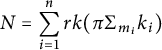 $\displaystyle {N=\sum _{i=1}^n rk(\pi \Sigma _{m_i} k_i)} $
. Then
 $\mu (K)\geq 1+N/M$
.
Proof For clarity, we first prove the statement in the case that the number of summands n is equal to
 $1$
, i.e., that
 $K=\tau ^m k$
and
 $\mu (K)\geq 1 + \frac {rk(\pi _1(\Sigma _m k))}{m}$
.
Suppose that meridians
 $x_1,\dots ,x_p$
generate
 $G = \pi _1(S^4\backslash K)$
. Denote by C the commutator subgroup of
 $\pi _1(S^4\backslash K)$
. Since
 $\tau ^m k$
is fibered by
 $\Sigma _m k$
,
 $C\cong \pi _1(\Sigma _m k)$
. Recall that for any orientable surface knot group G with commutator subgroup C, the abelianization short exact sequence
 $1\rightarrow C \rightarrow G \rightarrow \mathbb {Z} \rightarrow 1$
is split-exact: a splitting is provided by sending
 $1\in \mathbb {Z}$
to a meridian of G. So we can regard G as a semidirect product:
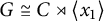 $G\cong C \rtimes \langle x_1 \rangle $
. Then each
 $x_i=x_1 c_i$
, for some
 $c_i\in C$
.
Now, letting x denote
 $x_1$
, we have
 $G=\langle x, xc_2, \dots , xc_r\rangle = \langle x, c_2, \dots , c_r\rangle $
. Let
 ${c\in C}$
. Then
 $c=w(x,c_2,\dots ,c_r)$
, i.e., c can be written as a word in these generators. Notice that this word must have an exponent sum of zero for all of its x terms, since otherwise it is nontrivial in the abelianization. This means that
 $c=w^\prime (x^{-j}c_ix^j: -\infty \leq j \leq \infty , 2\leq i\leq r)$
, however, since
 $x^m$
is central in G, we need only consider
 ${0\leq j \leq m-1}$
. Therefore,
 $C=\langle x^{-j}c_ix^j:0\leq j\leq m-1, 2\leq i \leq r \rangle $
, and
 $rk(C)\leq m(r-1)$
. Taking r to be minimal and rearranging, we get the desired inequality.
For the general case, the adaptation is to replace m with
 $M=\mathrm {lcm}\{m_1,\dots ,m_n\}$
. Note that the commutator subgroup of the knot group of a connected sum is the free product of the individual commutator subgroups. Therefore,
 $C\cong C_1*\cdots * C_n$
, where
 $C_i\cong \pi _1 (\Sigma _{m_i}k_i)$
is the commutator subgroup of
 $K_i=\tau ^{m_i}k_i$
. If
 $c\in C$
is nontrivial, then c can be written as a product
 $c=z_1\dots z_\ell $
, where each
 $z_j$
is nontrivial and in exactly one of the
 $C_i$
’s. Then
 $x^{-M}cx^M = c$
, because
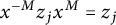 $x^{-M}z_j x^M =z_j$
for each j. Following the previous argument,
 $C=\langle x^{-j}c_ix^j:0\leq j\leq M-1, 2\leq i \leq r \rangle $
, and
 $rk(C)= rk(C_1)+\dots +rk(C_n)=N\leq M(r-1)$
. As before, the inequality
 $\mu (K)\geq 1+N/M$
follows by taking r to be minimal.
The proof of the theorem then follows by noticing that
 $N\geq n$
, since
 $\pi _1(\Sigma _{m_i} k_i)\ncong 1$
and therefore
 $rk(C_i)\geq 1$
for each i. The lower bound
 $1+n/M$
approaches infinity with n when, e.g., M is finite. This proves that to exhibit the extreme behavior in Lemma 4.9, it was necessary for the twist-indices to become arbitrarily large.
Weidmann proved that for a connected sum of n nontrivial classical knots, the rank of the knot group, and therefore the meridional rank, is at least
 $n+1$
[Reference Weidmann21]. Applying Theorem 1.5 to
 $\tau ^m(k_1\#\cdots \# k_n)=\tau ^mk_1\#\cdots \# \tau ^m k_n$
yields the following corollary, which gives an analogous version for the m-twist spin of a connected sum.
Corollary 1.6 Let
 $k_1,\dots ,k_n$
be nontrivial classical knots and
 $|m|\geq 2$
. Then
 $$\begin{align*}1+n/m\leq \mu(\tau^m(k_1\#\cdots\# k_n))\leq \mu(k_1\#\cdots\#k_n). \end{align*}$$
Remark 4.16 Although Theorem 1.5 and the above corollary are stated in terms of meridional rank, these statements are true when meridional rank is replaced with rank. The only change needed to the proof of Lemma 4.15 is the following: if
 $\{z_1,\dots ,z_n\}$
is any generating set for G, we can write
 $z_i = x^{p_i}c_i$
. Using a clever trick from [Reference Kadokami and Yang11] (during the proof of Theorem 1.1), we may assume that each
 $p_i=1$
, and proceed with the rest of the proof unchanged.
Acknowledgments
We would like to thank Ryan Blair, Micah Chrisman, and Alexandra Kjuchukova for helpful conversations and encouragement. We would also like to thank the referee on an earlier draft of this paper for many careful comments and suggestions.