INTRODUCTION
The Pacific invasive cheilostome bryozoan Tricellaria inopinata d'Hondt & Occhipinti-Ambrogi, Reference d'Hondt and Occhipinti-Ambrogi1985 was first recorded in 1982 in the Lagoon of Venice (d'Hondt & Occhipinti-Ambrogi, Reference d'Hondt and Occhipinti-Ambrogi1985), near the city centre, and during the last decade of the 20th Century the lagoon was the site of a remarkable invasion by T. inopinata. It was also found in the Grado Marano lagoon, 70 km north-east of the Lagoon of Venice (Occhipinti-Ambrogi, Reference Occhipinti-Ambrogi2000). In 1998 substantial populations of T. inopinata were discovered in Poole Harbour, on the central southern coast of England (Dyrynda et al., Reference Dyrynda, Fairall, Occhipinti-Ambrogi and d'Hondt2000). This represented the first Atlantic record and probably the initial stage of a range expansion of the species along the Atlantic coasts. Tricellaria inopinata has been detected in other Atlantic ports in Spain (Fernández-Pulpeiro et al., Reference Fernández-Pulpeiro, César-Aldariz and Reverter-Gil2001), on the south-west coast of France and along the French coast of the Channel, in The Netherlands and Belgium along the North Sea coast (De Blauwe & Faasse, Reference De Blauwe and Faasse2001; Breton & d'Hondt, Reference Breton and d'Hondt2005) and along the south coast of England, from East Sussex to Cornwall (Arenas et al., Reference Arenas, Bishop, Carlton, Dyrynda, Farnham, Gonzalez, Jacobs, Lambert, Lambert, Nielsen, Pederson, Porter, Ward and Wood2006). In 2004 it was also recorded in the Ria de Aveiro, Portugal (Marchini et al., Reference Marchini, Cunha and Occhipinti-Ambrogi2007). In 2005, during surveys conducted in the Lagoon of Tunis, the harbour of Radès and the nearby sea (Gulf of Tunis), massive colonies of T. inopinata were collected by Ben Souissi et al. (Reference Ben Souissi, Ben Salem and Zaouali2006). The species was found in 2006 and 2007 in a few marinas along the eastern and southern coast of Ireland (Dan Minchin, personal communication), in 2008 and 2009 along the south-western coast of Scotland (Elizabeth J. Cook, personal communication) and in 2009 and 2010 along the German North Sea coast (ICES, 2010). In 2010 it was also detected in Eel Pond, Woods Hole, Massachusetts (USA) (ICES, 2011). The finding of T. inopinata in the Italian commercial harbours of La Spezia and Olbia represents the first record of the species in the Ligurian and in the western-central Tyrrhenian Sea, respectively. Furthermore, the presence of this alien species will be critically discussed in relation to the most likely vectors of introduction into the western Mediterranean Basin.
MATERIALS AND METHODS
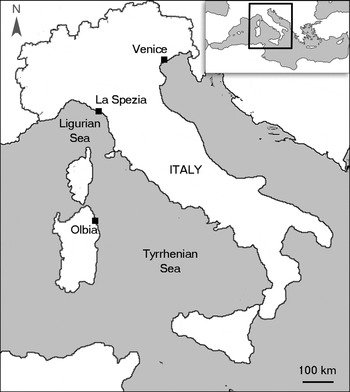
In summer 2010 a systematic survey was carried out in La Spezia and Olbia harbours (Figure 1) with the aim of studying alien species in Italian commercial harbours. La Spezia and Olbia are two commercial harbours both characterized by international trade shipping and aquaculture activities (mainly mariculture of the bivalves Mytilus galloprovincialis Lamarck, 1819 and Ruditapes philippinarum Adams & Reeve, 1850). La Spezia is located on the eastern coast of the Ligurian Sea, between Genoa and Leghorn, while Olbia is located on the north-eastern coast of Sardinia and faces the western-central Tyrrhenian Sea. In each harbour, sampling sites were selected depending on the exposure to ship traffic so that they encompass the mooring (two replicates identified by the code ‘P') and the transit area (three replicates identified by the code ‘TR'). The biological sampling consisted in scraping the artificial hard substratum (the concrete dock walls) just under the low tide level, with a handheld rigid net (1 mm of mesh size, surface 25 cm × 20 cm) using a semi-quantitative methodology, standardized for hard bottom macrobenthos collections (Occhipinti-Ambrogi, Reference Occhipinti-Ambrogi2000; Marchini et al., Reference Marchini, Gauzer and Occhipinti-Ambrogi2004; Savini et al., Reference Savini, Marchini, Forni and Castellazzi2006a; Minchin, Reference Minchin2007a). For each sampling site, five replicates were collected on two separate occasions: at the end of spring/beginning of summer, when Mediterranean benthic communities are known to exhibit their maximum demographic potential, and at the end of the summer, just before the winter crisis (Sardà et al., Reference Sardà, Pinedo and Martin1999). Water temperature and salinity were recorded in the water column (1 m below the low water mark) using a multi-parameter probe (Quanta Hydrolab) at the same time that sampling for the mooring and the transit area was carried out. Samples were preserved in plastic jars (70% alcohol) and transferred to the laboratory where organisms were identified to species level. Because of the colonial nature of most components of the benthic fauna, the fouling community was evaluated by a semi-quantitative methodology, using a four-class abundance scale, which indicates the coverage (Occhipinti-Ambrogi, Reference Occhipinti-Ambrogi1991): +, presence of isolated colonies; ++, a few small colonies; +++, large well-established colonies; and ++++, overwhelming abundance. This approach, already tested in other studies on the artificial hard-bottom communities (Marchini et al., Reference Marchini, Gauzer and Occhipinti-Ambrogi2004; Savini et al., Reference Savini, Marchini, Forni and Castellazzi2006a), allows us to compare the vagile and sessile components of the benthic fauna whose quantitative estimation is not possible by enumeration of individuals. The specimens of Tricellaria inopinata were identified by morphological comparisons with Adriatic material collected in the past by our research group in Venice. Zooid measurements were taken on a sample of 30 individuals for each of the five replicates, using the Software Digital Microscope Suite 2.0 for image analysis (accuracy 0.01 mm).
Location of the two investigated harbours, La Spezia and Olbia as well as the Lagoon of Venice, the first Mediterranean site where Tricellaria inopinata was recorded.

RESULTS
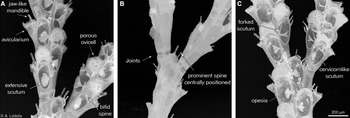
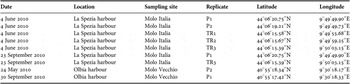
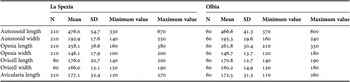
Luxuriant and bushy colonies of Tricellaria inopinata, bearing ovicells, were found in samples collected in the summer of 2010 in La Spezia and Olbia harbours (Figure 1): they were discovered in 7 (La Spezia) and 2 (Olbia) out of the 10 samples collected in each harbour. Table 1 summarizes the details of sample collection, reporting dates, locations, sites and replicates, and geographical coordinates of sites where T. inopinata was found. Morphological comparisons with Adriatic material confirm the identification of T. inopinata as previously described from the Lagoon of Venice (d'Hondt & Occhipinti-Ambrogi, Reference d'Hondt and Occhipinti-Ambrogi1985). All of the T. inopinata specimens examined shared the following diagnostic features as reported by d'Hondt & Occhipinti-Ambrogi (Reference d'Hondt and Occhipinti-Ambrogi1985) and Dyrynda et al. (Reference Dyrynda, Fairall, Occhipinti-Ambrogi and d'Hondt2000) (Figure 2): colonies are arborescent in form and composed of unilaminar branches, each made up of biserial autozooids whose number varies greatly between branch bifurcations; joints at the bases of the rami are characteristic (Figure 2B). All autozooids typically have a scutum whose shape and size varies enormously within an individual colony (Figure 2), from a slender projection, sometimes forked (Figure 2C), to an extensive structure with an irregular margin (Figure 2A), often cervicornlike (Figure 2C). All autozooids have marginal spines around the rim of the opesia; usually there are three lateral spines on the outer flank of the autozooid, the most proximal of which is often bifid (Figure 2A), and only two lateral spines on the inner side. Furthermore, one large prominent spine is centrally positioned within branch axis (Figure 2B). Autozooids generally bear avicularia, variable in size and with a characteristic jaw-like mandible (Figure 2A, C), but lack frontal avicularia and vibracularia. The ovicells are sub-globular, usually equal in length and width, and have three or more rows of pores on the surface (Figure 2A, C). Mean, minimum and maximum values for autozooids, opesia and ovicells length and width and for avicularia length of T. inopinata specimens from the harbours of La Spezia and Olbia are reported in Table 2. They are to a large degree in accordance with those previously recorded for T. inopinata material from the Lagoon of Venice (d'Hondt & Occhipinti-Ambrogi, Reference d'Hondt and Occhipinti-Ambrogi1985).
Stereomicroscope photograph of Tricellaria inopinata specimens from the harbours of La Spezia (A, B) and Olbia (C). Arrows indicate details of colonies and diagnostic features.

Details of sample collection where Tricellaria inopinata was found.

Autozooids, opesia, ovicell and avicularia dimensions (μm) of Tricellaria inopinata specimens from the harbours of La Spezia and Olbia.

N, number of individuals; SD, standard deviation.
Water temperature and salinity for the mooring and the transit area where T. inopinata was found in the harbours of La Spezia and Olbia are given in Table 3.
Water temperature and salinity values of the mooring and the transit area in the harbours of La Spezia and Olbia where Tricellaria inopinata was found.

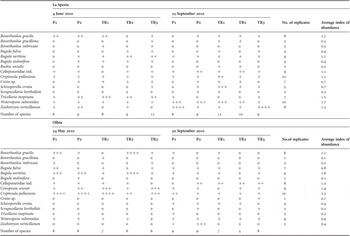
Tricellaria inopinata is well-represented within the fouling community, colonizing anthropogenic substrata within the two investigated harbours. It mainly occurs on biotic substrata offered by Mytilus galloprovincialis, which is the dominant species of the fouling assemblages. Tricellaria inopinata colonies are fastened to both shell surface and more often to the byssal threads of mussels. Apart from mussels, other organisms were found to provide substrates for T. inopinata colonies such as: the polychaete Sabella spallanzanii (Gmelin, 1791), the ascidian Styela plicata (Lesueur, 1823), the barnacle Balanus perforatus Bruguière, 1789 and the bryozoans Watersipora subovoidea (d'Orbigny, 1852) and Zoobotryon verticillatum (Delle Chiaje, 1828). Tricellaria inopinata was also accompanied by other bryozoans such as Bowerbankia gracilis Leidy, 1855, Bugula neritina (Linnaeus, 1758), Cryptosula pallasiana (Moll, 1803), Watersipora subovoidea and Zoobotryon verticillatum, which were the most common and abundant species in both La Spezia and Olbia harbours (Table 4). As regards La Spezia (Table 4), the abundance indices showed that when T. inopinata was present with high abundance (abundance index = 2 or 3), Watersipora subovoidea and Zoobotryon verticillatum were less abundant (abundance index = 1) and vice versa. Furthermore, T. inopinata prevailed in samples collected at the beginning of the summer season while it was present to a lesser extent, in samples collected at the end of September. As far as Olbia harbour is concerned (Table 4), the most common assemblage of bryozoans included Cryptosula pallasiana, Bugula neritina and Conopeum seurati (Canu, 1928) together with T. inopinata, which occurred in 2 out of 10 samples and with lower abundance (abundance index = 1).
List of bryozoan species found in the 10 replicates collected in summer 2010 from both the harbours of La Spezia and Olbia, with indication of abundance, total number of replicates with presence of the species and average abundance index (sum of indices/10 replicates).

+, presence of isolated colonies; ++, a few small colonies; +++, large well-established colonies; ++++, overwhelming abundance.
DISCUSSION
Most of the Tricellaria inopinata colonies found in our samples were dense and had ovicells, confirming that the species is now acclimated and reproducing also in the western Mediterranean Sea. Occhipinti-Ambrogi (Reference Occhipinti-Ambrogi1991) reported that, before the arrival and spread of T. inopinata, the most common bryozoan species in the Lagoon of Venice were Bugula neritina, Bugula stolonifera Ryland, 1960, Conopeum seurati, Cryptosula pallasiana and Bowerbankia gracilis. A similar assemblage of species also occurs in the harbours of La Spezia and Olbia. However, the lack of information on the bryozoan community of the two harbours prevents us from comparing our species list with former data. Tricellaria inopinata dispersal throughout the lagoon has been well documented since it was first discovered (Occhipinti-Ambrogi, Reference Occhipinti-Ambrogi1991, Reference Occhipinti-Ambrogi2000; Occhipinti-Ambrogi & d'Hondt, Reference Occhipinti-Ambrogi, d'Hondt, Hayward, Ryland and Taylor1994). Initially it was confined to the intertidal level near the centre of the city but within a few years it had gradually radiated out to most of the lagoon basin, reaching its maximum abundance and geographical spread in the late 1980s. The spectacular invasion of T. inopinata and the subsequent decline of the native bryozoan species were a major event in the Lagoon of Venice bryozoan association during the 1980s and 1990s (Occhipinti-Ambrogi, Reference Occhipinti-Ambrogi2000). Occhipinti-Ambrogi (Reference Occhipinti-Ambrogi1991) observed that B. stolonifera abundance varied substantially after the introduction of T. inopinata and similarly De Blauwe & Faasse (Reference De Blauwe and Faasse2001) no longer found B. stolonifera in places where it used to be abundant, as it had been replaced by T. inopinata. These two anascan bryozoans occurred together also in the harbours of La Spezia and Olbia. In La Spezia harbour B. stolonifera did not reach high abundance, being outnumbered by T. inopinata; conversely in Olbia harbour, both B. stolonifera and T. inopinata were present in low abundance, while B. neritina was the dominant species. Due to the lack of data on the baseline conditions of the bryozoan community prior to the introduction of T. inopinata, we were unable to follow a precise chronology of invasion in these two harbours, therefore data are still too limited to be able to evaluate the effect of T. inopinata colonization on the native bryozoan community in La Spezia and Olbia harbours. On the other hand, our results would justify the setting up of a monitoring programme in these two harbours in order to assess colonization process and impact of T. inopinata on the local fouling community.
Occhipinti-Ambrogi (Reference Occhipinti-Ambrogi2000) hypothesized that T. inopinata might belong to a species-complex, including Tricellaria occidentalis (Trask, 1857) and Tricellaria porteri (MacGillivray, Reference MacGillivray1898–1899), known to be invasive in New Zealand (Gordon & Mawatari, Reference Gordon and Mawatari1992) and cryptogenic (sensu Carlton, Reference Carlton1996) in the northern American Pacific (Robertson, Reference Robertson1905; Osburn, Reference Osburn1950), Japan (Yanagi & Okada, Reference Yanagi and Okada1918; Mawatari, Reference Mawatari1951) and Australia (MacGillivray, Reference MacGillivray1898–1899; Bock, Reference Bock, Shepherd and Thomas1982; Brock, Reference Brock, Nielsen and Larwood1985). An appraisal of samples from various global regions conducted by Dyrynda et al. (Reference Dyrynda, Fairall, Occhipinti-Ambrogi and d'Hondt2000) has morphologically distinguished the European T. inopinata form, T. occidentalis and T. porteri, and has also confirmed its Pacific origins. The Lagoon of Venice is the first location of introduction of T. inopinata in Europe and the bryozoan's possible pathways of introduction are ship traffic from the Pacific via the Suez Canal or the association with imported stocks of live oysters (Occhipinti-Ambrogi, Reference Occhipinti-Ambrogi2000). The presence of T. inopinata in harbours along the Atlantic coast highlights the likelihood of shipping as the main vector of introduction, which facilitated its long-distance and regional anthropogenic secondary dispersal from the Lagoon of Venice (Dyrynda et al., Reference Dyrynda, Fairall, Occhipinti-Ambrogi and d'Hondt2000). De Blauwe & Faasse (Reference De Blauwe and Faasse2001) suggest recreational shipping as a likely vector of T. inopinata introduction along the coasts of Belgium and The Netherlands, since the bryozoan has not been found in harbours in these countries but rather in marinas regularly frequented by British yachts. Similarly, Marchini et al. (Reference Marchini, Cunha and Occhipinti-Ambrogi2007) observed that in the Ria de Aveiro, T. inopinata was more abundant in samples collected in marinas, although the Ria is home to a well-developed mussel culture. As stated by Ashton et al. (Reference Ashton, Boos, Shucksmith and Cook2006), Minchin et al. (Reference Minchin, Floerl, Savini, Occhipinti-Ambrogi, Davenport and Davenport2006) and Savini et al. (Reference Savini, Marchini, Forni and Castellazzi2006a, Reference Savini, Occhipinti-Ambrogi, Minchin and Floerlb) recreational boating can play an important role in secondary diffusion of alien species: larvae released by colonies on floats in marinas are likely to settle on suitable surfaces on yacht hulls and vice versa; thus, tourist harbours could represent an important source of alien species. This is not the case for T. inopinata introduction in the harbours of La Spezia and Olbia as they are two important commercial ports of the western Mediterranean Sea, both characterized by international shipping and aquaculture and to a lesser extent by pleasure boating. While it is unlikely that T. inopinata was directly introduced to the two investigated harbours as larvae in ship ballast waters, given that T. inopinata larva is short-lived lecitotrophic with a very low dispersal potential (Occhipinti-Ambrogi & d'Hondt, Reference Occhipinti-Ambrogi, d'Hondt, Hayward, Ryland and Taylor1994), the introduction by transport of mature colonies as ship fouling cannot be excluded since many cheilostome bryozoans are known to be easily dispersed as fouling organisms to non-native regions (Watts et al., Reference Watts, Thorpe and Taylor1998). Notwithstanding this, the most likely vector of T. inopinata introduction in the harbours of La Spezia and Olbia could be the transfer from the northern Adriatic with mussels, which are reared in the numerous farms near the harbour entrance. Moreover, interviews with local mussel farmers in Olbia confirmed that the majority of mussel seeds are imported from the northern Adriatic lagoons, where T. inopinata have formed stable populations since the end of the last century. It is generally assumed that aquaculture practices are one of the main means of alien species introduction into aquatic ecosystems, and is an important vector of marine bioinvasions (Carlton, Reference Carlton, Rosenfield and Mann1992; Reise et al., Reference Reise, Gollasch and Wolff1999; Naylor et al., Reference Naylor, Williams and Strong2001; Bax et al., Reference Bax, Williamson, Aguero, Gonzalez and Geeves2003; Weigle et al., Reference Weigle, Smith, Carlton and Pederson2005; Minchin, Reference Minchin2007b; Molnar et al., Reference Molnar, Gamboa, Revenga and Spalding2008). Furthermore, the same vector was suggested to be the most likely one also for other alien species recorded in these two harbours: the polychaete Ophryotrocha japonica Paxton & Åkesson, 2010 (Simonini, Reference Simonini2002) in La Spezia harbour and the bivalves Musculista senhousia (Benson in Cantor, 1842) (Campani et al., Reference Campani, Coppini, Cuneo and Margelli2004), Ruditapes philippinarum (Cannas et al., Reference Cannas, Trentadue, Manca, Mura and Fois2009) and Anadara transversa (Say, 1822) (Lodola et al., Reference Lodola, Savini, Mazziotti and Occhipinti-Ambrogi2011) in Olbia harbour. There are several reasons for the success of T. inopinata as an invader of harbour environments: it is a generalist, able to grow on every kind of substrate and to thrive in low salinity and silty conditions; furthermore, it can tolerate changes in water velocity and eutrophication level (Occhipinti-Ambrogi, Reference Occhipinti-Ambrogi1991; Dyrynda et al., Reference Dyrynda, Fairall, Occhipinti-Ambrogi and d'Hondt2000; De Blauwe & Faasse, Reference De Blauwe and Faasse2001; Jamila Ben Soussi, personal communication). Tricellaria inopinata is a robust opportunistic taxon capable of enduring a broad spectrum of temperate zone water temperatures, as it is able to survive temperature conditions ranging from the Atlantic coasts of Europe as far as the Mediterranean Sea (Occhipinti-Ambrogi, Reference Occhipinti-Ambrogi1991; Dyrynda et al., Reference Dyrynda, Fairall, Occhipinti-Ambrogi and d'Hondt2000; De Blauwe & Faasse, Reference De Blauwe and Faasse2001). Apart from temperature, salinity is recognized as a major physical factor affecting the distribution patterns of bryozoans (Occhipinti-Ambrogi, Reference Occhipinti-Ambrogi, Nielsen and Larwood1985). Occhipinti-Ambrogi (Reference Occhipinti-Ambrogi1991) did not find T. inopinata in the innermost sections of the Lagoon of Venice, in proximity of freshwater discharge, where salinity was lower than 25 psu, suggesting that its settlement and spread in other water bodies depend on salinity conditions. Although in La Spezia and Olbia harbours salinity data were only taken during the sampling and do not reflect the entire range of variation, salinity conditions are in agreement with the maximum salinity range (26–35 psu) reported for T. inopinata from the Lagoon of Venice (Occhipinti-Ambrogi, Reference Occhipinti-Ambrogi1991). As far as the tidal exchange is concerned, the tidal magnitude in the northern Adriatic (80–100 cm) is unique to the Mediterranean Sea, and the continental inflows from the large hydrographic basin create estuarine gradients in the lagoon environment (Sconfietti, Reference Sconfietti1989). Occhipinti-Ambrogi (Reference Occhipinti-Ambrogi1991) never found T. inopinata deeper than the lowest water spring tide; nor did they find it in the inner parts of the lagoon where salinity is lower than 18 psu. These considerations would suggest that the tidal exchange is one of the ecological requirements for the settlement and spread of T. inopinata in the Lagoon of Venice. However, this is not the case for La Spezia and Olbia harbours where tidal range does not exceed 30–40 cm, suggesting that the presence of tidal excursion is not a fundamental requirement for the establishment and acclimation of T. inopinata. This consideration is confirmed by the luxuriant colonies found in the Lagoon of Tunis, where no significant tidal excursions are present (Jamila Ben Souissi, personal communication). Since the fouling fauna in Italian harbours is not investigated on a regular basis, the invasion history of T. inopinata in the western Mediterranean Sea cannot be assessed. Tricellaria inopinata was found to be widespread and abundant in the harbours of La Spezia and Olbia in 2010, therefore suggesting that its acclimation in these areas can be backdated. Although further spreading and future developments of T. inopinata in the Mediterranean Sea are hard to predict, these new records highlight the importance of studying the fouling community of Italian harbours and their role as a sink of alien species as well as the need to enforce strict controls on the transfers of aquaculture products also within national localities, in order to avoid the unintentional spread of alien species.
ACKNOWLEDGEMENTS
The research was carried out within the European Community's Seventh Framework Programme (FP7/2007-2013) under Grant Agreement No. 266445 for the project Vectors of Change in Ocean and Sea Marine Life, Impact on Economic Sectors (VECTORS). We thank Dr Jamila Ben Soussi for helpful information on the ecological conditions of the Lagoon of Tunis. We also thank the Association For-Mare for supporting this research.