Introduction
A steadily increasing number of older adults will require the support of unpaid, often family carers, so that they can remain living in the community. Nineteen percent of Australians aged over 65 years are carers (Australian Bureau of Statistics, 2012). Their important role is becoming recognized, not only in terms of the assistance they provide, but also in terms of the financial savings that would have otherwise been spent on residential care and formal services. Older carers are at high risk of poor mental health, including increased levels of depression (Dahlberg et al., Reference Dahlberg, Demack and Bambra2007), anxiety (Neri et al., Reference Neri2012), and burden (Helmes et al., Reference Helmes, Green and Almeida2005). Poor physical health is an additional risk for older carers, and can lead to depression (Pinquart and Sorensen, Reference Pinquart and Sorensen2007).
Thus there has been renewed interest in what contributes to good mental health in this vulnerable group. Attitudes to aging encompass attitudes towards older people in general, and the aging process. Examples of prevailing negative attitudes in western societies would include that older people are helpless, boring, and weak (Levy, Reference Levy2003; Laidlaw et al., Reference Laidlaw, Power and Schmidt2007b). Attitudes to aging in older people include internalized attitudes to aging, which are the attitudes older people endorse in regards to themselves as an older person (rather than attitudes to aging about older people in general). These attitudes can have powerful effects, with previous studies demonstrating relationships between more positive attitudes to aging with improved outcomes from rehabilitation, improved cardiovascular health (Levy et al., Reference Levy, Hausdorff, Hencke and Wei2000), and better memory (Levy et al., Reference Levy, Hausdorff, Hencke and Wei2000). Conversely, more negative attitudes to aging have been linked to poorer outcomes (Levy, Reference Levy2003). Older adults who endorse more positive attitudes to aging appear to be more motivated to engage in healthier lifestyles such as having a more nutritious diet (Huy et al., Reference Huy, Schneider and Thiel2010) and engaging in physical activity (PA) (Levy and Myers, Reference Levy and Myers2004). With regard to attitudes to aging and mental health, cross-sectional studies have identified that more positive attitudes to aging are linked to less depression (Bryant et al., Reference Bryant2012), and this is evident even in subsyndromal depressive symptoms (Chachamovich et al., Reference Chachamovich, Fleck, Laidlaw and Power2008). The risk of older people believing that being depressed is a normal part of aging (Law et al., Reference Law, Laidlaw and Peck2010) has significant implications in that they may be less likely to seek help for their symptoms, leading to increased morbidity and impaired functioning. Older carers often do not seek treatment for their physical and mental health due to lack of time and prioritizing the care-recipient (CR) (Pinquart and Sorensen, Reference Pinquart and Sorensen2007), and if they have negative attitudes to aging, they may be even less inclined to seek help. As well as adverse carer outcomes, suboptimal care provision and institutionalization of the CR may occur (Clyburn et al., Reference Clyburn, Stones, Hadjistavropoulos and Tuokko2000).
Carer personality traits may have an important link with both attitudes to aging and depression. Personality traits have a role in how carers manage difficult situations, which may put them at risk of depression. Previous research demonstrates that neuroticism (N), in particular, has been associated with adverse carer outcomes, such as increased burden (Reis et al., Reference Reis, Gold, Andres and Markiewicz1994), and perceptions of poorer quality of social support (Reis et al., Reference Reis, Gold, Andres and Markiewicz1994). A relationship between various personality traits and attitudes to aging has also been found in two recent studies with older samples, using the Philadelphia Geriatric Morale Scale, PGMS, as the attitudinal measure (Jang et al., Reference Jang, Kim and Chiriboga2006; Moor et al., Reference Moor, Zimprich, Schmitt and Kliegel2006). These two studies both found that high levels of N correlated with more negative attitudes to aging. However, the PGMS only contains five items and has been critiqued for not providing a comprehensive assessment of attitudes to aging (Shenkin et al., Reference Shenkin2014). Shenkin et al. (Reference Shenkin2014) studied older Scottish adults using the AAQ instead. The authors found that the major five personality traits, N, extraversion (E), openness to experience (O), agreeableness (A), and conscientiousness (C) were significantly associated with the subscales of the AAQ in the regression analyses. Participant mental and physical health were also significantly associated. The results of the study demonstrated that the major predictors of attitudes to aging were personality traits, and optimizing physical health and mood may improve attitudes.
There has been scarce literature exploring attitudes to aging in older carers, with one paper suggesting that older carers have more negative attitudes to aging compared to non-caring counterparts (Lucas-Carrasco et al., Reference Lucas-Carrasco, Laidlaw, Gomez-Benito and Power2013). In contrast, Courts et al. (Reference Courts, Barba and Tesh2001) studied carers of people with dementia (PWD), after the person they cared for entered residential care. The majority of these carers were aged over 65 years, and expressed generally positive attitudes to aging. They did not “dread the future”, nor the changes in appearance associated with aging, and endorsed that older adults have much knowledge and are valued in the community. Laidlaw and Baikie (Reference Laidlaw and Baikie2007a) suggested a stress–diathesis model whereby older people may be vulnerable to developing negative attitudes to aging due to the surrounding negative stereotypes of being older. These latent negative attitudes may be activated by an experience or stressor, such as being the carer of someone who is “demonstrating” these negative aspects of getting older. These might include memory loss, increasing frailty, and visual deterioration, which lead to dependence on others. Thus for some older adults, caring may lead to more negative attitudes to aging, with worse outcomes, but for others, they may actually become, or remain positive. It remains unclear what are the factors that are associated with attitudes to aging in carers. Since attitudes to aging are closely related to physical and mental health, and help-seeking, further knowledge about attitudes to aging in carers may provide some guidance in how to improve attitudes, which may help them remain well while they are caring.
To our knowledge, investigating attitudes to aging in older carers, has not previously being reported. This paper describes a cross-sectional study of older carers living in Australia and their attitudes to aging. The major objectives are to: (1) describe their attitudes to aging; (2) determine factors associated with attitudes to aging, including demographic factors (age, gender, level of education achieved), physical health, depression, and personality traits.
Methods
Participants
For this study, we obtained data from potential participants recruited for the Improving Mood through Physical Activity in Carers and Care-recipient Trial (IMPACCT). Briefly, this larger project aimed to use a PA program to improve depression in carers who lived with the person they provided care for (Dow et al., Reference Dow2013). From April 2012 to April 2014, carer support agencies, general practitioners (GPs), specialists (such as neurologists and geriatricians), and geriatric health services, in rural and metropolitan Victoria, Australia were targeted for recruitment. The inclusion criteria for the older carers were that: (1) they were aged 55 years and older; (2) they lived with the person they provided support for, the CR, who was aged 60 years or older.
Interested carers contacted the research team by telephone and were administered the Geriatric Depression Scale (GDS-15). If they scored ≥5 on the GDS, they were eligible for participation in IMPACCT. Carers who scored <5, were invited to participate in a substudy investigating attitudes to aging in older carers. Hence, the data obtained included the baseline data of IMPACCT carers, as well as the substudy, so that carers with a range of depression scores, and their respective data were included in this paper.
Ethical approval was granted by Melbourne Health and St Vincent's Hospital Research Ethics Committees, and all participants provided written, informed consent. Any participant who scored ≥12 on the GDS, indicating severe depression, would be referred to a specialist old age psychiatrist for a more thorough assessment of their depression.
Measures
Depression was assessed using the GDS-15 (Yesavage et al., Reference Yesavage1983), which was specifically developed to measure depression in older adults. A cut-off score of 5 has specificity and sensitivity of 65.2% and 92.7%, respectively for identifying clinical depression according to the ICD-10 (Almeida et al., 1999).
Personality traits were assessed using the NEO-Five Factor Inventory, NEO-FFI (Costa and McCrae, Reference Costa and McCrae2010). N is defined as the propensity to experience negative affect, such as sadness, fear, and guilt. People who are high in Extraversion (E) are sociable, and enjoy excitement and stimulation. Those high in Openness to Experience (O), are open-minded and like to experience new and novel situations. People high in Agreeableness (A), are sympathetic and like to help people. Finally, Conscientiousness (C) refers to people who are disciplined, organized and have good self-control (Costa and McCrae, Reference Costa and McCrae2010).
Attitudes to aging were assessed using the AAQ (Laidlaw et al., Reference Laidlaw, Power and Schmidt2007b), which was developed specifically for older people, to measure the multidimensional aspects of aging. It has 24 statements with three subscales, measuring psychological growth (Growth), for example: “my life has made a difference”; physical change (Physical); “I don't feel old,” and psychosocial loss (Loss); “I feel excluded because of my age.” Participants rate these statements on a 5-point Likert scale, with 1 being “Not at all true,” to 5, “Extremely true.” Higher scores in Growth and Physical indicate more positive attitudes to aging, whereas the Loss statements are negatively worded so that higher scores indicate more negative attitudes to aging. Consistent with Bryant et al. (Reference Bryant2012), scores ≥24 on Growth and Physical, and scores ≤24 on the Loss subscales, were defined as being in the positive range. The cut-off of 24 indicates an average score of “3” (neutral) in each subscale. In this study, the Cronbach's α for the Growth, Physical, and Loss subscales were 0.738, 0.767, and 0.834, respectively.
The ZBI (Zarit et al., Reference Zarit, Reever and Bach-Peterson1980) was used to measure the stress of caring. This contains 18 questions asking about carer difficulties such as their health and well-being. There is a 5-point Likert scale for responses, ranging from 0 “never” to 4, “nearly always.” Higher scores indicate increased levels of burden, with scores of 0–21 indicating little or no burden, scores of 21–40 indicating mild-to-moderate burden, scores of 41–60 indicating moderate-to-severe burden, and scores ≥61 indicate severe burden (Hebert et al., Reference Hebert, Bravo and Preville2000). Cronbach's α was calculated as 0.915.
Physical health was assessed using the proxy measure of the number of medications prescribed, excluding vitamins, and over-the-counter medications. This objective indicator of physical health has been used previously (Baumgarten et al., Reference Baumgarten1992).
In addition, carer demographic information such as age, gender, and highest education level achieved, and the principle reason for care provision, i.e. CR diagnosis, were collected.
Statistical analyses
Analyses were performed using Statistical Package for Social Sciences, version 22.0 (SPSS Inc., Chicago, IL). Descriptive statistics were performed using mean and standard deviations (SD) for normally distributed variables (age, ZBI, Growth, Physical and personality), and median and interquartile range (IQR) for skewed variables (GDS, AAQ Loss). Percentages and counts were used for categorical variables. Spearman correlations were performed to evaluate relationships between AAQ subscales and other variables, using a p value of p < 0.003, considering Bonferroni adjustment for multiple comparisons. To compare attitudes to aging between different groups (that is, male vs. female carers, and spouses vs. non-spousal carers), t-tests and Mann–Whitney U tests were used for parametric and non-parametric data, respectively. Skewed data was transformed using natural log transformation. Multivariate hierarchical linear regression was performed using each of the three AAQ domains as dependent variables, using variables found to be significant in the correlation analysis. The independent variables were entered into blocks, with Model 1 including demographic variables (age, gender, highest education level); Model 2 added number of medications, depression, and burden scores, and Model 3 added personality scores. For the regression analysis, the significance level was set as p < 0.05.
Results
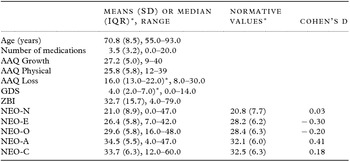
Please see Table 1 for demographics and means (or medians) of the variables.
Demographic information of participants

AAQ = attitudes to aging questionnaire; GDS-15 = Geriatric Depression Score-15; ZBI = Zarit Burden Inventory; NEO-N = Neuroticism; NEO-E = Extraversion; NEO-O = Openness to experience; NEO-A = Agreeableness; NEO-C = Conscientiousness.
*Normative values taken from Costa and McCrae (Reference Costa and McCrae2010).
Demographic information
There were 202 carers who participated in this study. The majority of participants were women (74.3%), and were retired (82.2%). Approximately half (54.4%) had achieved tertiary level of education. Almost 85% of carers were spouses of the CR and they spent an average of 79.6 hours a week caring (SD 52.8). The CRs were mostly men (66.5%), and the most common diagnosis necessitating care was dementia (42.1%). Table 2 shows the other CR diagnoses.
Care-recipient (CR) diagnoses

Depression and burden
The median depression score was 4.0 (IQR 2.0–7.0), ranging from 0 to 14. There were 43% of carers who were clinically depressed (scored ≥5 on the GDS). The mean ZBI score was 32.69 (SD 15.7), indicating that these carers had mild to moderate burden. A quarter of the carers (25.4%) reported moderate to severe burden (score ≥ 41).
Personality
Table 1 shows the mean personality scores for the participants and their normative values (Costa and McCrae, Reference Costa and McCrae2010). Analyzing for differences between these carers and normative values (Costa and McCrae, Reference Costa and McCrae2010) using effect sizes found that the personality traits of E and A had medium effect size differences of d = −0.30 and 0.41, respectively (Cohen, Reference Cohen1992), with the carers in this sample being less extraverted and more agreeable than normative values.
Attitudes to aging
Attitudes to aging in all three subscales were generally positive (Table 1 shows the mean and median scores). The three subscales were significantly intercorrelated: Growth with Physical (r = 0.425, p < 0.001), and with Loss (r = −0.309, p < 0.001), and Physical with Loss (r = −0.403, p < 0.001).
There were no significant differences in subscale scores for female and male carers (Growth: T (196) = 1.061, p = 0.290, CI −0.730 to 2.431; Physical T (197) = −0.464, p = 0.643, CI −2.297 to 1.423; Loss MWU 3775.5, z = −0.130, p = 0.896); or spouses and non-spousal carers (Growth T(196) = −0.786, p = 0.422, CI −2.680 to 1.153; Physical T(197) = 1.032, p = 0.309, CI −2.680 to 1.153; Loss MWU 2598.0, z = −0.020, p = 0.984).
Correlational analysis
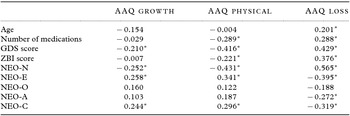
Table 3 shows the variables and their correlations with each of the AAQ subscale scores. Higher Growth subscale scores correlated with: lower depression scores, lower N, and higher E and C. Higher Physical subscale scores correlated with less number of medications prescribed, lower depression and burden, lower N, and higher E and C. More positive attitudes to aging in the Loss subscale correlated with younger age, lower depression and burden, less medications prescribed, lower N, and higher E, A and C. The stronger correlations were between Loss and depression (r = 0.429), Loss and N (r = 0.545), Physical and N (r = −0.431), and Physical and depression (r = −0.416) (Hinkle et al., Reference Hinkle, Wiersma and Jurs2003). The personality trait of O was not correlated with any of the AAQ subscales.
Spearman correlations with attitudes to aging

AAQ = attitudes to aging questionnaire; GDS-15 = Geriatric Depression Score-15; ZBI = Zarit Burden Inventory; NEO-N = Neuroticism; NEO-E = Extraversion; NEO-O = Openness to experience; NEO-A = Agreeableness; NEO-C = Conscientiousness.
*significant at p < 0.006.
Multivariate regression analysis
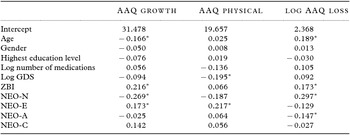
Multiple regression models in which independent variables were entered in successive blocks were used to determine the independent influence of demographics, carer factors (number of medications, carer depression, and burden), and personality (Table 4). Table 5 shows the adjusted effects of the independent variables on the final model.
Results of hierarchical regression analyses predicting attitudes to aging

Model 1: demographics (age, gender, highest education level achieved); Model 2 add physical health, depression and burden (number of medications prescribed, GDS-15, ZBI); Model 3 add personality (NEO-N, NEO-E, NEO-A, NEO-C).
AAQ = attitudes to aging questionnaire; GDS-15 = Geriatric Depression Score-15; ZBI = Zarit Burden Inventory; NEO-N = Neuroticism; NEO-E = Extraversion; NEO-O = Openness to experience; NEO-A = Agreeableness; NEO-C = Conscientiousness.
Results of multiple regression analyses (standardized beta) showing adjusted effects of the independent variables on the final model

AAQ = attitudes to aging questionnaire; GDS-15 = Geriatric Depression Score-15; ZBI = Zarit Burden Inventory; NEO-N = Neuroticism; NEO-E = Extraversion; NEO-O = Openness to experience; NEO-A = Agreeableness; NEO-C = Conscientiousness.
*significant at p < 0.05.
Significant factors associated with more positive attitudes to aging in terms of Growth were younger age, increased burden and lower N and increased E. Together, all the variables entered accounted for 21.9% of the variance in Growth. Model 2, which included demographic and carer factors, accounted for 10.4% of the variance, and Model 1, which did not include carer factors, accounted for 3.7% of the variance. The majority of the variance (11.5%) was contributed by carer personality.
Significant factors associated with more positive attitudes to aging in terms of Physical were less depression, and increased E. Lower burden and C, and high N (approached significance, p = 0.064), which were significantly correlated did not contribute to the regression model. All the variables entered accounted for 29.9% of the variance. Model 2, which included demographic and carer factors, accounted for 20.4% of the variance, while Model 1, which only included demographics, accounted for 0.9% of the variance in Physical. The majority of the variance (19.5%) was contributed by carer factors.
Significant independent factors associated with Loss were increasing age, increased burden and N, and lower A. All the variables accounted for 44.3% of the variance. Increasing medications prescribed and increasing depression which were significantly correlated did not contribute to the regression model. Model 2, which included demographic and carer factors accounted for 33% of the variance. Model 1, which only included demographics accounted for 3.7% of the variance in Loss. The majority of the variance (29.3%) was contributed by carer factors.
Discussion
This cross-sectional study of carers, aged 70 years old, living with their CR, who had mild-to-moderate burden, and moderate depression, is one of the first to investigate older carers and their attitudes to aging. These carers were a self-selected group who volunteered to participate; they were relatively well-educated, were in reasonable health (indicated by being prescribed on average less than four medications), with only mild-to-moderate levels of burden. Overall, their attitudes to aging were positive, and similar to previous studies. Bryant et al. (Reference Bryant2012) studied rural Australian older adults and obtained very similar average scores (Growth = 28.5, Physical = 26.1, and Loss = 16.4). The scores obtained by Shenkin et al. (Reference Shenkin2014), who investigated attitudes to aging in an older Scottish longitudinal cohort, were slightly more positive in terms of the Physical (score = 28.0) and Loss (score = 15.2) subscales. Considering that the sample may not be entirely representative of the general older caring population, these results suggest that inspite of being a carer, spending substantial time caring, and reporting moderate depressive symptoms, attitudes to aging in carers remained positive, and had similar scores to non-carers’ attitudes to aging. While the literature has focused more on the negative aspects of caring, carers have also reported satisfaction (Andren and Elmstahl, Reference Andren and Elmstahl2005), and thus it remains unclear from this study, whether being a carer activates negative attitudes to aging.
Depression in carers was significantly correlated with attitudes to aging in this study, which is consistent with previous studies (Bryant et al., Reference Bryant2012; Shenkin et al., Reference Shenkin2014), and those which suggest that negative attitudes to aging are dependent on the person's mood-state. In the current study, depression was a significant factor associated with Physical only, in the regression analysis, which suggests that attitudes to aging in terms of Growth and Loss may be more strongly influenced by personality, and burden, respectively. Physical health, as measured by the number of prescribed medications approached significance (p = 0.062), of being an independent factor associated with Physical. That depression has a stronger influence on Physical attitudes to aging, then the objective measure of health also is consistent with attitudes to aging being mood-dependent. Using the number of prescribed medications as a proxy, however, may not be a true representation of physical health in carers. Carers may not make their own health a priority, or have the time to visit their family doctor for their physical symptoms so may not be prescribed medications which are required (Pinquart and Sorensen, Reference Pinquart and Sorensen2007).
Increased carer burden was a significant factor associated with Loss in the regression analysis. An unexpected result was that higher burden was also a predictor for more positive attitudes to aging in terms of Growth. Possibly, carers who endorsed more carer burden may have perceived this as part of further maturation and psychological growth. They may become more resilient, and have the ability to learn new skills. Again, this demonstrates that being a carer does not always lead to negative outcomes, and many carers report both moderate satisfaction and burden (Andren and Elmstahl, Reference Andren and Elmstahl2005), which attitudes to aging might reflect. Because increased E was another independent predictor for Growth, these carers may be more likely to have a positive outlook and feel more confident to advocate for themselves and their CR. These carers may also be more likely to be help-seeking and obtain support, whether this is practical (such as assistance with household chores, or personal care), or emotional (such as counseling, or attending support groups).
Personality traits of N, E, and A were significant independent predictors of attitudes to aging. This accords with previous research which found that all five personality traits were significant predictors with Growth, Physical, and Loss, in the expected direction (Shenkin et al., Reference Shenkin2014). A longitudinal study of predictors of attitudes to aging also found different personality traits were significant predictors in the three subscales (Bryant et al., Reference Bryant2014). Bryant et al. (Reference Bryant2014) reported that for Growth, significant personality traits were lower N and C, and increased E, for Physical, significant traits were increased O, and for Loss, significant traits were lower E and A. Longitudinal studies of carers, their personality traits and attitudes to aging may clarify these relationships.
Burden and depression were both correlated with Physical and Loss, but only depression was associated with Physical, and only burden was associated with Loss. Depression was correlated with Growth, but burden was a predictor for Growth. The reasons behind these contrasting results remain unclear. Because the ZBI measures subjective burden, perhaps this is more related to the “psychological” aspects of attitudes to aging, i.e. the Growth and Loss subscales. Carer burden and depression are related but distinct caring concepts, with suggestions that burden may precede depression, and depression can worsen burden (Gallagher et al., Reference Gallagher2011). This study provides evidence that burden and depression are separate concepts and contribute to different aspects of attitudes to aging.
These contrasting relationships, such as high levels of burden, but positive attitudes in Growth, may be an example of the aging paradox. This theory suggests that older adults report high levels of well-being at a time which is generally thought to be one of decline (Kunzmann et al., Reference Kunzmann, Little and Smith2000). Both Shenkin et al. (Reference Shenkin2014) and Bryant et al. (Reference Bryant2012) reported these findings. The older carers in this study had moderate depression scores and were spending almost 80 hours a week caring, yet their attitudes to aging remained positive. Thus, this study provides further evidence of the importance of attitudes to aging, that one can remain positive about aging, despite objective evidence. Rather than the caring process activating negative attitudes to aging, carers may compare themselves to the CR who is less fortunate than themselves, and this may actually lead to more positive attitudes.
The limitations of this study include the convenience sample of older carers who reported mild-to-moderate levels of burden and depression, who were in relative good health, well-educated, and predominantly spoke English. This limits generalizability to carers who have been impacted more severely by caring, as well as more culturally and ethnically diverse carers. Longitudinal studies of predictors of attitudes to aging may further clarify the role of personality, mental and physical health of carers. Investigating the role of carer satisfaction, and comparing carers and non-carers’ attitudes to aging might also clarify whether or not being a carer leads to more negative attitudes. Nevertheless, the strengths of this study include a relatively large sample of older carers, with the inclusion of a number of carer factors and personality, which enabled exploration of their attitudes to aging. This is the first study that we know of in this area and provides important information about their role in caring and the aging process.
In conclusion, while personality did contribute to the variance in attitudes to aging, carer factors of burden, and depression accounted for more of the variance, particularly in the Physical and Loss subscales. This has important implications in the improvement of attitudes to aging in carers. It is more achievable to decrease burden and depression, rather than “change” personality, as this represents long-standing patterns of beliefs and behaviors. This study provides evidence that ongoing good mental health, and the benefits associated with caring have a significant relationship with positive attitudes to aging in carers, which may help them stay well while they are caring.
Conflict of interest
None.
Description of authors’ roles
B Dow, K Moore, M Russell, K Hill, E Cyarto, S Malta, D Ames and NT Lautenschlager contributed to the conceptualization of IMPACCT, and preparation of the paper. SM Loi, B Dow, K Moore and S Malta contributed to the data collection. SM Loi, B Dow, D Ames and NT Lautenschlager designed the study. SM Loi contributed to the data analysis, developed and completed the paper. All authors contributed to the review of, and approved the submitted version of the paper.
Acknowledgments
The authors would like to thank the other researchers involved in the assessments of the participants, and thank the participants for their time.
The Improving Mood through Physical Activity in Carers and Care-Recipient Trial (IMPACCT) was funded by the National Health and Medical Research Council (NHMRC 1033828). SM Loi was supported by an NHMRC Postgraduate scholarship (NHMRC 1055234).