Language learning requires understanding words both as referential symbols and as conventional forms. These essential features of words are what underscore their communicative value for individuals and communities of speakers (Koenig & Woodward, Reference Koenig, Woodward and Gaskell2007). As discussed by many, part of understanding words as symbols is recognizing that the intentions of a speaker determine a symbol's content (Bloom & Markson, Reference Bloom and Markson1998; DeLoache & Burns, Reference DeLoache, Burns, Pratt and Garton1993) and one part of understanding conventionality in language is recognizing that words convey information by virtue of shared knowledge about their relation to things in the world (Clark, Reference Clark1993; Reference Clark, Kalish and Sabbagh2007). The current manuscript investigates infants' aged 2 ; 0 appeal to both of these features when learning words in a foreign language.
There is a great deal of evidence that infants have tools to understand words as referential symbols from the very start of word learning. By age 0 ; 9 to 1 ; 0, infants begin to show a number of social behaviors such as gaze-following, pointing, social referencing, holding up objects for show, imitation of actions on objects, and so on (Tomasello, Reference Tomasello, Moore and Durham1995; Tomasello, Carpenter, Call, Behne & Moll, Reference Tomasello, Carpenter, Call, Behne and Moll2005). In Baldwin's research, when an experimenter waited until children were focused on a novel object, toddlers aged 1 ; 3 and 1 ; 6 looked up to at the experimenter's eyes as soon as they heard her utter a novel word (Baldwin, Reference Baldwin1991; Baldwin, Markman, Bill, Desjardins, Irwin & Tidball, Reference Baldwin, Markman, Bill, Desjardins, Irwin and Tidball1996). Several studies have shown that infants as young as 1 ; 0 to 1 ; 2 interpret new words and emotional expressions based on information about the speaker's attention and apparent intention (Baldwin & Moses, Reference Baldwin and Moses2001; Campbell & Namy, Reference Campbell and Namy2003; Moses, Baldwin, Rosicky & Tidball, Reference Moses, Baldwin, Rosicky and Tidball2001; Woodward, Reference Woodward and Waxman2004). In work by Woodward (Reference Woodward and Waxman2004), infants aged 1 ; 1 readily accepted a novel word as the name for an object when the speaker indicated the object with relevant pointing and eye-gaze. When the speaker's gaze was elsewhere, infants did not form a word–object mapping in spite of the temporal co-occurrence of word and object.
An understanding of conventionality goes beyond an understanding of shared word meanings (for recent discussions, see Kalish & Sabbagh, Reference Kalish and Sabbagh2007; Diesendruck & Markson, Reference Diesendruck and Markson2011). Conventions in language (and elsewhere) are intrinsically social, typically arbitrary, both stable and flexible in use, bound to a specific community of speakers and carry prescriptive force (Lewis, Reference Lewis1969). Early in development, there is evidence that infants understand certain aspects of conventionality but these studies have primarily investigated infants' understanding of the shared nature of words (Au & Glusman, Reference Au and Glusman1990; Diesendruck, Reference Diesendruck2005; Graham, Stock & Henderson, Reference Graham, Stock and Henderson2006; Henderson & Graham, Reference Henderson and Graham2005; Buresh & Woodward, Reference Buresh and Woodward2007) and the priority they give to conventional forms over incorrect ones (Koenig & Echols, Reference Koenig and Echols2003). For example, infants aged 1 ; 7 expect two speakers to use the same name to refer to an object (Graham, Stock & Henderson, Reference Graham, Stock and Henderson2006) and infants aged 1 ; 1 are surprised when two speakers use the same name for two different referents (Buresh & Woodward, Reference Buresh and Woodward2007). Although older children show some sensitivity to the boundaries that mark different conventional systems (Au & Glusman, Reference Au and Glusman1990; Diesendruck, Reference Diesendruck2005), a focus on the shared nature of conventions leaves open questions concerning infants' understanding that different conventional systems can exist.
This is a complex issue to study in infancy, but consider a situation in which an infant hears words in a language with which she is not familiar. In this situation, in which a foreign speaker connects with an infant in an engaging interaction, there is good evidence that linguistic symbols are being used, and strong pragmatic cues to their meanings, but the word forms and naming frames are not from the infant's conventional system. How might infants begin to grapple with this situation?
One possibility is that they will resist learning foreign words. Infants' well-documented preferences for the sounds of their native language (Mehler, Jusczyk, Lambertz, Halsted, Bertoncini & Amiel-Tison, Reference Mehler, Jusczyk, Lambertz, Halsted, Bertoncini and Amiel-Tison1988) might interfere with their ability to attend to foreign speech. Further, the perceptual novelty of foreign speech may make it difficult to segment and extract the appropriate word forms. Moreover, even if children could successfully identify the appropriate word-level units, they may filter out information that is not likely to be relevant in their community (Kinzler, Dupoux & Spelke, Reference Kinzler, Dupoux and Spelke2007). Starting at around age 1 ; 6–1 ; 8, a narrowing expectation for specifically verbal forms emerges among hearing infants, grows increasingly stronger (Namy & Waxman, Reference Namy and Waxman1998; Woodward & Hoyne, Reference Woodward and Hoyne1999), and by age 2 ; 2 interferes with children's ability to learn arbitrary gestures. While the precise scope of this type of expectation is unknown, it may lead two-year-olds to restrict their lens to English-like forms only. In sum, there are several factors that may hinder children's propensity to learn new words from foreign speakers.
A second possibility is that, these factors aside, infants can learn words from foreign speakers. As mentioned above, a large number of studies have found that infants in their second year readily acquire new word–object mappings in episodes of joint attention (Baldwin, Reference Baldwin1993; Baldwin & Moses, Reference Baldwin and Moses1996; Bloom, Reference Bloom2000; Tomasello & Farrar, Reference Tomasello and Farrar1986; Woodward, Markman & Fitzsimmons, Reference Woodward, Markman and Fitzsimmons1994; for reviews, see Baldwin & Moses, Reference Baldwin and Moses2001). Bates and colleagues (Bates, Benigni, Bretherton, Camaioni and Volterra, Reference Bates, Benigni, Bretherton, Camaioni and Volterra1979) observed that as early as age 0 ; 9 to 1 ; 1, infants' non-verbal communicative behaviors often become consistent, abbreviated actions directed at communication. This suggests that at the very start of word learning, children aim for and attend to shared symbols in communication, if only in the local context of communicating with a parent. Gaze following is known to be a significant predictor of receptive vocabulary (Baldwin, Reference Baldwin, Moore and Dunham1995; Brooks & Meltzoff, Reference Brooks and Meltzoff2005; Mundy & Gomes, Reference Mundy and Gomes1998), and could help children make sense of foreign speech (Kuhl, Reference Kuhl2004). Indeed, if the intentional use of language is a critical factor in children's learning of cultural forms, including words, these intentional cues could potentially help children identify word forms when actively engaging with a foreign speaker in a meaningful and shared interaction. Based on these considerations, we investigated the possibility that, in the context of a brief, contingent and engaging interaction with a native speaker of Dutch, even monolingual, English-speaking two-year-olds can learn novel word–object mappings when embedded in a fluent stream of Dutch.
Further support for the possibility that toddlers can learn words when embedded in foreign speech comes from research by Namy and Waxman (Reference Namy and Waxman2000) who examined infants' aged 1 ; 5 acquisition of symbols presented in a series of different naming frames. In the first study, which compared infants' acquisition of gestures and words, infants learned novel words only when they were presented in a familiar naming frame (i.e. “Look at this blicket!”) and not when presented in isolation (i.e. “Look! Blicket!”). In Experiment 3, to examine the flexibility of infants' expectations, infants interacted with someone who used a nonsense carrier phrase to label common objects (e.g. “Look! Shaylem bosher key!” and “See here? Shaylem bosher bottle!”). Infants were then trained on a new category term using the same phrase “Shaylem bosher blicket!” and in response, infants systematically selected target objects when their comprehension was tested. Taken together, these two studies show that infants develop expectations for how objects are named based on long-term regularities in the input, but that they can also adapt their expectations when given transient and unfamiliar cues as to how a particular speaker labels objects. Based on these findings, we expect that (1) two-year-olds will be better able to acquire novel meanings for words presented in the familiar naming frames of English over the unfamiliar frames of Dutch, but also (2) that two-year-olds may be able to extract terms from the unfamiliar frames used by the Dutch speaker and expect them to function as object names.
In the current study, we approached these questions by presenting one group of children with a speaker who consistently used English to name familiar objects and another group with a native speaker of Dutch who consistently named the same objects in fluent Dutch. The speakers trained and tested children on two new word–referent mappings using naming frames appropriate to Dutch or English. The measure of learning was a comprehension test: toddlers were asked to choose the target from a tray containing the previously labeled target object and a distracter object that was given an equal amount of verbal attention from the experimenter. We also measured the productive vocabulary of each child to examine the possibility that word learning in one's native language may contribute to or reflect a child's ability to identify word–object mappings in a foreign language.
If children can learn foreign terms that are embedded in a foreign stream of speech, then an interesting question arises regarding the longevity of their representation and the extent to which they will generalize the words they have learned to speakers other than the original speaker. Broad generalization to other speakers may indicate that infants have accepted the word, formed a relatively robust representation but have not demarcated the boundaries of their own system versus the novel language. Narrow generalization – generalizing English but not foreign terms to users of your own language – may suggest that infants have begun to appreciate that different systems can exist.
To investigate whether children's generalizations are made broadly or narrowly, after training one group of children with novel terms in English and another group on those same terms in Dutch, children's comprehension was subsequently tested by a second speaker of English. If children expect new words to generalize broadly across speakers, then children in both the Dutch and English conditions may select the target when the same term is used by the second English speaker. On the other hand, children may generalize word knowledge only when the second speaker shares a language with the first speaker (as in the English condition), and not when the two speakers do not share a language (as in the Dutch condition).
METHOD
Participants
Participants were fifty two-year-old children (age: M=24 months, 2 days; range=22 ; 26 to 26 ; 0) from the Chicago area. Twenty-five children participated in the English condition (10 boys) and twenty-five children (12 boys) participated in the Dutch condition. All participants came from predominantly English-speaking families (i.e. exposed to English at least 80% of the time). Nine additional children participated but were excluded due to fussiness (3), experimenter error (2), side bias (1) or failure to comprehend words for one or more of the familiarization items, based on parental report (3). The sample of infants was 64% Caucasion, 22% African American, 8% Hispanic and 6% Asian.
Parents completed the short-form version of the MacArthur Vocabulary Checklist, Level II (Fenson, Pethick, Renda, Cox, Dale & Reznick, Reference Fenson, Pethick, Renda, Cox, Dale and Reznick2000), a 100-item measure for assessing the productive language of children aged 1 ; 4 to 2 ; 6. The vocabulary levels of infants in the Dutch condition (M=49·3 (28·3), range: 8–92) and the English condition (M=53·6 (24·4), range: 10–83) did not differ (t(48)=0·68, n.s.).
Stimuli
Six familiar items were labeled serially by an English speaker in the English condition and by a native Dutch speaker in the Dutch condition. Familiar items and their Dutch equivalents are as follows: frog=kikker; duck=eend; spoon=lepel; car=auto, horse=paard, dog=hond.
Dutch was selected as the experimental language because of its structural and prosodic similarities to English (Nazzi, Bertoncini & Mehler, Reference Nazzi, Bertoncini and Mehler1998). Objects are typically labeled in final position with similar pitch contours in both English and Dutch. Infants were presented with two pairs of test items. One pair of test objects was novel (a colorful, woven object and a black, rubber object) and one pair was familiar (a cup and shoe) (see Figure 1). Children spontaneously produced labels for the familiar objects (e.g. cup, shoe) but not for the novel objects, providing indirect evidence that the novel target objects were indeed unfamiliar to them. Two nonsense words, sep (/sɛp/) and kippel (/kʰipəl/), were constructed using phonemes which respected the phonology of both Dutch and English and were judged to be equally compatible with both languages by native speakers. A colorful cardboard chute was used to make the labeling game more engaging and to facilitate the exchange of objects between the experimenter and child.
Test stimuli: photographs of novel and familiar test object pairs that were given novel labels in the Dutch and English conditions.

Design and procedure
A between-subjects design was employed with two crossed factors. The first factor was the language spoken by the first speaker (Dutch vs. English) and the second factor was the level of the child's English vocabulary knowledge. Participants were divided into two vocabulary groups based on median split. For simplicity, we will refer to these groups as ‘high vocabulary’ (M=69·1 (12·3), range: 52–96) and ‘low vocabulary’ (M=33·8 (14·7), range: 8–51). We hypothesized that vocabulary knowledge, which varies considerably at this age, would be associated with a greater sensitivity or tolerance toward alternative conventions.
(i) Warm-up
While parents filled out the vocabulary checklist, the experimenter interacted with the child for five minutes of free play. In the Dutch condition, the Dutch speaker played with children while speaking in Dutch. In the English condition, the speaker spoke in English. The experimenter followed the child's lead and played with toys of interest. After the warm-up session, children were taken into a different room and the experimental procedure began.
(ii) Familiarization
Children sat on a parent's lap at a table across from the experimenter. The experimenter began by labeling a series of three familiar objects using child-directed speech. In the Dutch condition, after placing a toy frog (pronounced ‘kíkayr’ in Dutch) on the table, the speaker pointed to it, touched it and alternated her gaze between the object and child saying, “Kijk (child's name)! Het is een kikker! Wao, een kikker! Oooh, het is een kikker. Stop de kikker hierheen.” Equivalent constructions were produced in the English condition: “See this, (child's name)? It's a frog. Wow, a frog! Ooohh, that's a frog. Can you put the frog down the chute for me?” In both conditions, all children complied with the experimenter's request to put objects down the chute.
(iii) Novel label training
After three familiarization trials, the experimenter presented a novel word–object pairing. In the English condition, the speaker said, “Look! That's a sep. See? A sep! This is a sep. Can you put the sep down the chute for me?” The experimenter also gave an equal amount of non-labeling attention to a distracter object: “Look! See this one? Wow! It's a nice one. I like this one! Can you put it down the chute for me?” In the Dutch condition, the target was labeled in Dutch: “Kijk (child's name)! Een sep! Wao, een sep! Oooh, het is een sep. Stop de sep hierheen (‘Put the sep here!’).” Equal attention was drawn to the distracter object, “Kijk! Zie je dit? (‘Look, do you see?’) Oooooh. Hmmm. Wow! Stop het hierin (‘Put it here!’).”
(iv) First speaker tests
Immediately after novel label training, children's comprehension was tested. The target and the distracter were placed on either side of an oval tray, out of children's reach. While looking at the child, the experimenter requested one of the objects. In the English condition, the speaker said, “Where is the sep? Can you show me the sep? Can you put the sep down the chute for me?” and pushed the tray toward the child. In the Dutch condition, the speaker said, “Waar is de sep? Waar is de sep? Stop de sep heirheen!” After the infant made a selection, the experimenter said “Thank you!” or “Goed zo! Dank u veel!” and administered a second comprehension test with objects in new positions on the tray.
The procedure described above was repeated in a second block of trials that again included familiarization, novel label training and test, with three new familiar objects and two new test objects. The order of trial blocks and whether the first set of test objects was novel or familiar was counterbalanced across participants. The identity of the target object, the novel label it was given and the order in which the target and distracter objects were presented was counterbalanced across participants in each condition.
(v) Second speaker tests
After the last comprehension trial, the experimenter left the room. In both conditions, a second speaker of English entered, sat at the table and addressed the child in English. She brought out each pair of test objects and asked in English, “Where is the sep/kippel? Can you show me the sep/kippel? Can you put the sep/kippel down the chute for me?” Each child completed four comprehension tests (two for each test pair) with the first and the second speaker.
Coding and reliability
Sessions were videotaped and coded off-line. Children's responses were coded in terms of which object was selected first in response to the speaker's request. Selection was credited to whichever object infants touched, grabbed, sent down the chute or pointed to first, or, if asked to “show” (e.g. “Show me/Mommy/Daddy the blicket”), which object they first showed to either the parent or the experimenter. When infants picked up the two objects simultaneously, selection was credited to whichever object infants chose to put down the chute first. The test phases of fifteen randomly selected infants were coded independently by two coders blind to condition. They demonstrated 99% agreement.
RESULTS
Preliminary analyses revealed no effects or interactions involving gender, order of presentation (Block A vs. Block B first) or test trial order (target labeled first vs. second); subsequent analyses collapsed across these factors. In our first analysis, we calculated a repeated measures ANOVA with condition (Dutch vs. English) and vocabulary knowledge (High vs. Low) as between-subject variables and Experimenter (First vs. Second Experimenter) and Target Label Type (First vs. Second labels) as the within-subjects variables. This ANOVA revealed a main effect of condition (F(1, 46)=16·49, p<0·001, d=1·24) and a significant three-way interaction of Experimenter×Condition×Vocabulary Knowledge (F(1, 46)=4·75, p=0·034). The effect of condition results from children's greater overall accuracy in response to a speaker of English (M=0·78, SD=0·18) than to a speaker of Dutch (M=0·53, SD=0·22). A main effect for vocabulary knowledge was also found (F(1, 46)=4·26, p=0·045, d=0·25); children with high vocabularies (M=0·68, SD=0·25) performed more accurately overall than children with low vocabularies (M=0·62, SD=0·23). In spite of demonstrated effects of mutual exclusivity at this age and younger (Markman, Wasow & Hansen, Reference Markman, Wasow and Hansen2003), we found no effects for Target Label type (F(1, 46)=0·21, p=0·886). That is, under these conditions, children performed similarly when their comprehension of both first and second labels was tested (see Liittschwager & Markman, Reference Liittschwager and Markman1994).
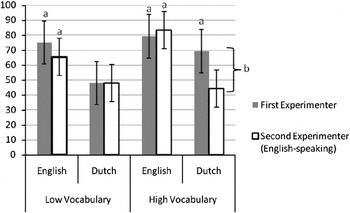
To further examine the three-way interaction, two-way ANOVAS (with condition as the between-subject variable and experimenter as the within-subject variable) were conducted for each of the two vocabulary groups. First, we found that children with high vocabularies responded differently to the first and second experimenters depending on condition, as reflected in a condition×experimenter interaction (F(1, 23)=6·58, p<0·02 (see Figure 2)). In the Dutch condition, children with high vocabulary scores responded differently to the Dutch speaker (M=0·69, SD=0·29) as compared to the second English speaker (M=0·44, SD=0·30; t(12)=2·55, p<0·05, d=0·85), whereas children in the English condition responded systematically to the first (M=0·79, SD=0·20) and second (M=0·83, SD=0·19) English speakers (t(11)=−0·80, n.s.). Children with low vocabulary scores responded similarly to the first and second speakers in the Dutch condition (First speaker: M=0·48, SD=0·33; Second speaker: M=0·48, SD=0·25; t(11)=0·00, n.s.) as well as in the English condition (First speaker: M=0·75, SD=0·20; Second speaker: M=0·65, SD=0·26; t(12)=1·33, n.s.).
Proportion correct in response to the first and second experimenter by children with high and low native vocabularies. a=indicates values greater than chance, p<0·05. b=indicates significant condition difference, p<0·05.

Next we compared the proportion of correct choices to chance (50%). Overall, children with low vocabularies responded at above chance rates to both speakers in the English condition (ts ⩾2·13, ps <0·05), but responded randomly to both speakers in the Dutch condition (ts ⩽−0·24, n.s.). Children with high native vocabularies also indicated the target at above chance rates to both speakers in the English condition (ts ⩾4·81, ps ⩽0·01). In the Dutch condition, however, children with high vocabularies performed above chance in response to the Dutch speaker (t(12)=2·38, p<0·04), but not to the second speaker of English (t(12)=−0·67, n.s.) (see Figure 2).
DISCUSSION
We investigated whether young monolingual children could learn words from a speaker of another language and whether a child's native vocabulary knowledge might play a role in this ability. Indeed, we found that although children performed better in the English than in the Dutch condition overall, children with high English vocabularies successfully learned new words presented by a fluent speaker of Dutch. Second, we were also interested in how broadly they might generalize such terms and were intrigued to find that children with high vocabularies responded randomly when their comprehension of the same words was subsequently tested by an English speaker. This pattern stands in contrast to the cross-speaker generalization found among children who learned new words from an English speaker. These findings suggest that (a) proficient monolingual English learners can learn words from foreign speakers and (b) such children, upon learning a foreign term, do not broadly extend knowledge of that word to all speakers.
When presented with a foreign and a native speaker, infants and young children demonstrate social preferences for the speaker of their native language (Kinzler et al., Reference Kinzler, Dupoux and Spelke2007; Kinzler, Shutts, DeJesus & Spelke, Reference Kinzler, Shutts, DeJesus and Spelke2009). For example, infants look longer at native speakers and speakers with native accents, prefer the toys they offer and older children choose such speakers as friends. The presence of two alternative speakers makes it unclear as to whether infants are displaying a bias to favor the familiar native speaker or an initial disfavoring of the non-native speaker or some combination of both. Whatever the nature of this social preference, current data suggests that it is not strong enough to block learning from a non-native speaker who is presented alone. Thus, in spite of early preferences for their native language (Bosch & Sebastián-Gallés, Reference Bosch and Sebastián-Gallés1997; Dehaene-Lambertz & Houston, Reference Dehaene-Lambertz and Houston1998) and for the speakers who use it (Kinzler et al., Reference Kinzler, Dupoux and Spelke2007), such native language preferences among monolingual toddlers do not preclude them from learning from foreign speakers.
The ability to learn words from a Dutch speaker was found squarely among children with high native vocabularies. Such a result may reflect a general competence that ‘good word learners’ bring to the task of word learning across contexts and across languages. A strong word-learning capacity may include some combination of the ability to segment speech, attend to social cues, establish a word–object link and retain this information over time (Stoel-Gammon, Reference Stoel-Gammon, Hoff and Shatz1998; Walley, Reference Walley1993). Another possibility is that learning words in one's own language may have the paradoxical effect of helping one learn words for the same objects and events in a foreign language. Vocabulary growth in one's native language may accelerate or promote word learning in a foreign language. Internationally adopted preschoolers were found to have expressive vocabularies after three months in the US that were similar in size and composition to monolingual two-year-olds who had been building a productive vocabulary for over a year (Snedeker, Geren & Shafto, Reference Snedeker, Geren and Shafto2007). As stated by the authors, “whereas infants initially learn words quite slowly, the adoptees hit the ground running, going through the same stages as infants but more quickly” (p. 85). One way to begin disentangling these various possibilities would be to experimentally investigate in a training study whether words first learned in one's native language are later learned more easily in a second language by children, regardless of their vocabulary level.
Children in the low vocabulary group showed a different pattern: they generalized terms learned in English but responded randomly to both speakers in the Dutch condition. There are both high- and low-level explanations for why these different patterns may have emerged, raising a number of important questions for future research.
Children with low vocabularies may appreciate the shared nature of specifically English words but reject, ignore or fail to identify foreign terms. Such children might require more exposures to link a word to an object, or they may be less likely to encode the input correctly and retain it. Learning the sounds of new words is known to be mediated by a child's phonological short-term memory and their native vocabulary knowledge (Baddeley, Gathercole & Papagno, Reference Baddeley, Gathercole and Papagno1998; Gathercole, Hitch, Service & Martin, Reference Gathercole, Hitch, Service and Martin1997; Stoel-Gammon, Reference Stoel-Gammon, Hoff and Shatz1998; Walley, Reference Walley1993). Children with smaller vocabularies may be ‘slow-tuners’ to the phonetic repertoire of their native language, making irrelevant discriminations for longer periods when compared with children with higher vocabularies (Tsao, Liu & Kuhl, Reference Kuhl2004). Lastly, although the Dutch speaker presented novel terms in a rich, interactive context, children with lower vocabulary levels may not exploit such referential cues to their full potential (Baldwin, Reference Baldwin, Moore and Dunham1995; Brooks & Meltzoff, Reference Brooks and Meltzoff2005). As a result, they may have failed to recognize and identify the referential intentions of an individual speaking a foreign language. All told, at least three kinds of developments – conventional, phonological and pragmatic – could have contributed to the vocabulary differences found here.
Upon indicating their comprehension to the Dutch speaker, why did high-vocabulary children not subsequently do so in response to an English speaker? One possibility is that as soon as children are able to learn a non-native term (a challenging task), they appropriately restrict its use. Children may have encoded the Dutch word–object pairing, formed a lasting semantic memory for it, but limited its application in response to a speaker who spoke a language different from the first speaker. If true, this would suggest that the idea of alternative conventions may be present very early and may not depend on extensive experience with multiple linguistic systems. In accord with this possibility, bilingual children in the one- and early two-word stages use their languages differentially with parents who speak different languages to them (Nicoladis & Genesee, Reference Nicoladis and Genesee1996). More importantly, they demonstrate such competence when interacting with strangers to whom they have had no prior exposure (Genesee, Boivin & Nicoladis, Reference Genesee, Boivin and Nicoladis1996; Comeau, Genesee & Mendelson, Reference Comeau, Genesee and Mendelson2007). Thus, the ability to use and learn language selectively may not depend on extensive experience with two languages (see Genesee & Nicoladis, Reference Genesee, Nicoladis, Hoff and Shatz2007).
The second possibility is that children encoded the Dutch word–object pairing sufficiently well to support the initial interaction with the Dutch speaker but failed to form a lasting semantic memory for it that would prove robust to a change in context. In other words, children may have formed a weak or temporary representation for terms presented in another language, a short-term representation that did not survive to support subsequent interactions. Akin to what may be toddlers' approach to learning from inaccurate or ignorant speakers (Koenig & Woodward, Reference Koenig and Woodward2010; Sabbagh & Shafman, Reference Sabbagh and Shafman2009), monolingual children may fail to form long-term semantic links from speakers who speak a different language. Although children may promptly adapt their expectations when adults name things using a foreign language, such shifts may last only as long as the input supports them (Namy & Waxman, Reference Namy and Waxman2000). In future work, it will be interesting to explore the longevity of this expectation and the extent to which foreign word–object representations can be sustained when tested by two Dutch speakers.
One might wonder if children even extracted a target word from the Dutch speaker's input. Perhaps children represented a phrase, an utterance or several utterances as a signal to point to the target object. However, children's spontaneous productions during the experiment help mitigate this possibility. Out of the thirteen children with high vocabularies in the Dutch condition, five of them produced a Dutch word: one of them repeated the appropriate target word sep, two children repeated kippel and two others repeated a Dutch word used during familiarization: kikker (‘frog’). Although few in number, this at least renders it less plausible that children treated entire utterances as referential forms. It also bears repeating that Dutch labels occurred in salient sentence-final positions (as in English) and the only invariant form across four training utterances was the target word. Furthermore, the utterances used to introduce the Dutch terms (“Kijk! Dit is een kippel. Het is een kippel. Stop de kippel heirin.”) were not the utterances used to test comprehension (“Waar is de kippel? Waar is de kippel? Stop de kippel heirin.”), making it impossible for training utterances to serve as potential signals during test trials.
A final possibility is that children formed rigid or inflexible phonological representations for terms learned in Dutch. Akin to a ‘first-impression’ bias found in speech processing among adults, properties of the speech that are present during the first encounter with a speaker may be learned, and treated as characteristic for that speaker (Kraljic, Samuel & Brennan, Reference Kraljic, Samuel and Brennan2008). Perhaps children attended to the invariant aspects of the Dutch speaker's pronunciation, learned the word forms she presented, but formed inflexible phonological representations for these terms. If children learned from the Dutch speaker but formed rigid phonological representations for sep and kippel, they may have failed to recognize these terms when they were spoken by a subsequent speaker of English. A task that began by asking children to learn an English term that was subsequently used by a foreign speaker would allow us to bypass the foreign word learning and see whether children would sequester terms presented across a conventional language boundary.
In sum, our findings demonstrate that after hearing a word–object link offered in fluent Dutch, two-year-olds with high native vocabularies accurately indicated the target when it was requested by the Dutch speaker. Despite the difficulty of this task, children acquiring sizable native vocabularies successfully extracted a novel word form from a stream of foreign speech and linked the term to its intended referent. Those children who learned Dutch terms did not indicate their comprehension when subsequently tested by a speaker of English. While the precise mechanisms remains unclear, these findings suggest that young monolingual children with proficiency in their own language can learn foreign terms from fluent speech and do not promiscuously extend knowledge of newly learned foreign words to speakers of their native language.