





Introduction
Mortar dating is an important tool in the absolute chronology of historic buildings, challenging due to contamination risks (Baxter and Walton Reference Baxter and Walton1970; Folk and Valastro Reference Folk and Valastro1976; Hajdas et al. Reference Hajdas, Lindroos, Heinemeier, Ringbom, Marzaioli, Terrasi, Passariello, Capano, Artioli, Addis, Secco, Michalska, Czernik, Goslar, Hayen, Van Strydonck, Fontaine, Boudin, Maspero, Panzeri, Galli, Urbanova and Guibert2017; Labeyrie and Delibrias Reference Labeyrie and Delibrias1964; Lindroos et al. Reference Lindroos, Heinemeier, Ringbom, Braskén and Sveinbjörnsdóttir2007; Nawrocka et al. Reference Nawrocka, Michniewicz, Pawlyta and Pazdur2005). A particular challenge involves binders with high-magnesium lime, which is obtained by burning dolomite. Unlike Ca-based lime, this material does not undergo a complete cycle: the magnesium hydroxide (brucite, Mg(OH)₂) present in the binder slowly forms carbonates, and under certain conditions it may not carbonate at all. Furthermore, dolomite does not reform at the end of the setting process. Instead, secondary deterioration products such as hydromagnesite and/or nesqueonite may form. Consequently, the mineral systems present in these types of mortar are extremely heterogeneous and exhibit varying solubilities, which complicates radiocarbon dating (Caroselli et al. Reference Caroselli, Hajdas and Cassitti2020, Reference Caroselli, Hajdas and Cassitti2023). This study combines sample characterization with AMS radiocarbon dating of mortar binder. Characterization of samples allow to identify the composition and state of preservation of the binder, and selection of carbonates binder fractions for dating (Barrett et al. Reference Barrett, Keaveney, Lindroos, Donnelly, Daugbjerg, Ringbom, Olse and Reimer2021; Caroselli et al. Reference Caroselli, Hajdas and Cassitti2020, Reference Caroselli, Hajdas and Cassitti2023; Hajdas et al. Reference Hajdas, Lindroos, Heinemeier, Ringbom, Marzaioli, Terrasi, Passariello, Capano, Artioli, Addis, Secco, Michalska, Czernik, Goslar, Hayen, Van Strydonck, Fontaine, Boudin, Maspero, Panzeri, Galli, Urbanova and Guibert2017; Lindroos et al. Reference Lindroos, Heinemeier, Ringbom, Braskén and Sveinbjörnsdóttir2007; Michalska Reference Michalska2019; Michalska et. al. Reference Michalska, Czernik and Goslar2017).
The analyzed samples: MR14, MR24 and PL07 from Nahla Valey represent carbonaceous mortars and plasters from ancient village Dūré. If the amount of mortar allowed, two subsamples were selected for measurement, a suspension and a grain fraction.
The ancient village named Dūré is located on a natural hill west of perennial stream providing water for fields and gardens on artificial terraces covering the bottom and slopes of the valley (Figure 1). The ancient settlement is nearly entirely overbuilt by houses of modern village Dvrĩ, the only extant ancient structure being the church of Bnê Shmunĩ (NCH 07-Nahla Church, Figure 2).
Location of research area; photo of the Church of Bnê Shmunĩ, façade seen from the south (photo by X. Kolińska).

Church of Bnê Shmunĩ in Dêvrĩ village. Location of mortars and plaster selected for 14C measurement; plan by X. Kolińska.

The church is presently facing a terrace ca. 5 m wide and 15 m long, with stone walls marking its eastern and southern limit, although the date of this structure is not clear. The church itself is the oldest building in the entire Nahla Valley (Koliński Reference Koliński2025). While the ancient settlement seems to be a small one, there is a number of off-site features that must have been used together with the site, namely three stone water mills, an extensive network of irrigation channels and cultivation terraces.
Materials
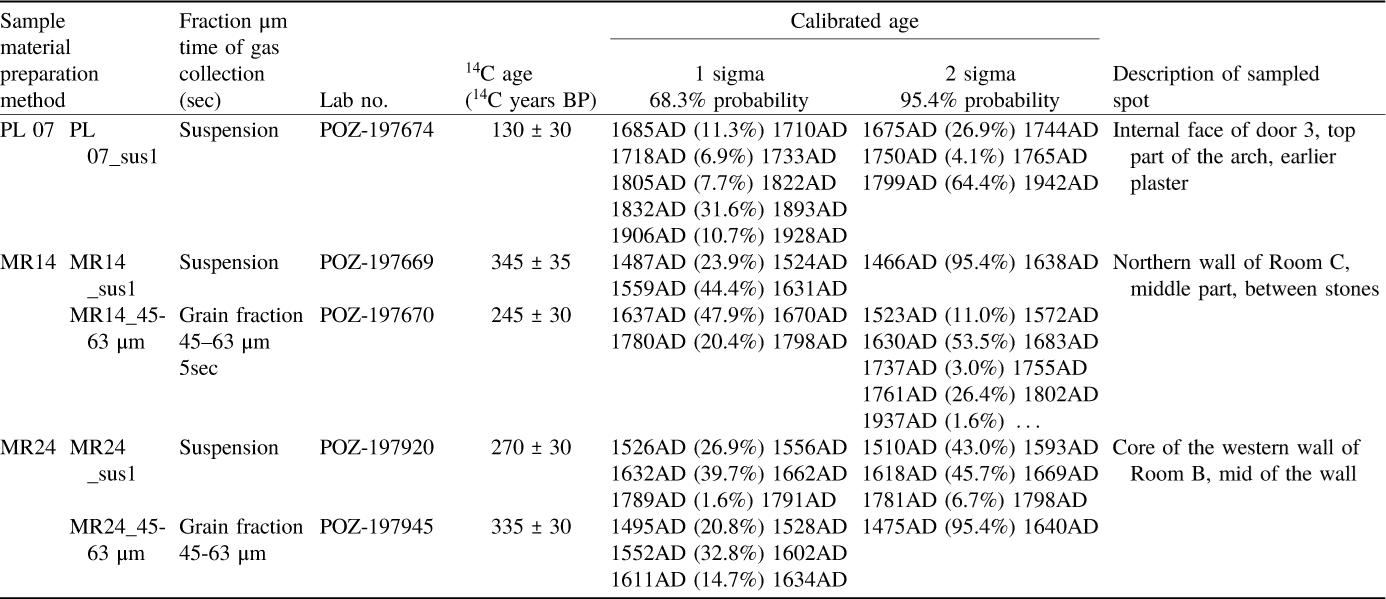
The samples were collected carefully, however due to the limited amount of material, samples were taken from various accessible locations, including those with visible signs of weathering. A list of the samples collected is provided in Table 1 and shown on plan of Church of Bnê Shmunĩ in Dêvrĩ village (Figure 2).
Results of 14C measurements of mortars binders. The calibration was made with the OxCal software (OxCal v4.4.4 Bronk Ramsey (Reference Bronk Ramsey2021); Atmospheric data from Reimer et al (Reference Reimer, Austin, Bard, Bayliss, Blackwell, Bronk Ramsey, Butzin, Cheng, Edwards, Friedrich, Grootes, Guilderson, Hajdas, Heaton, Hogg, Hughen, Kromer, Manning, Muscheler, Palmer, Pearson, van der Plicht, Reimer, Richards, Scott, Southon, Turney, Wacker, Adolphi, Büntgen, Capano, Fahrni, Fogtmann-Schulz, Friedrich, Köhler, Kudsk, Miyake, Olsen, Reinig, Sakamoto, Sookdeo and Talamo2020).

Table 1. Long description
The table presents radiocarbon dating results of mortar samples collected from different locations. It includes details such as sample material preparation method, fraction size, time of gas collection, lab number, 14C age in years before present (BP), calibrated age with 1 and 2 sigma probabilities, and a description of the sampled spot. The table has 10 rows and 8 columns. Column headers are Sample material preparation method, Fraction µm, time of gas collection (sec), Lab no., 14C age (14C years BP), Calibrated age 1 sigma 68.3% probability, Calibrated age 2 sigma 95.4% probability, and Description of sampled spot. Row 1: PL 07 PL 07_sus1 Suspension, 130 ± 30, POZ-197674, 16850 (11.3%), 16754 (26.9%), Internal face of door 3, top part of the arch, earlier plaster. Row 2: MR14 MR14_sus1 Suspension, 345 ± 35, POZ-197669, 14874 (23.9%), 14664 (95.4%), Northern wall of Room C, middle part, between stones. Row 3: MR14_45-63 µm MR14_45-63 µm Grain fraction 45–63 µm, 245 ± 30, POZ-197670, 16374 (47.9%), 15234 (11.0%), 5sec. Row 4: MR24 MR24_sus1 Suspension, 270 ± 30, POZ-197920, 15264 (26.9%), 15104 (43.0%), Core of the western wall of Room B, mid of the wall. Row 5: MR24_45-63 µm MR24_45-63 µm Grain fraction 45–63 µm, 335 ± 30, POZ-197945, 14954 (20.8%), 14754 (95.4%), 5sec.
EDS analyses indicated the carbonate, dolomitic nature of the binder of the selected mortars and plasters (Figure 3A). In some of the samples from the church, the presence of hydromagnesite within pores was detected (Figure 3B).
Results of EDS analyses: (A) the dolomitic nature of binder observed in mortars, including MR13, MR14, MR24, PL 07; (B) spectrum of hydromagnesite, identified in samples PL 06 and MR24.

Methods
The binder-enriched fraction of the samples was extracted by dry sieving. After freezing in liquid nitrogen and thawing, the samples were gently crushed to induce spontaneous disintegration at the binder-aggregate contact. The crushed material was dry sieved. The fine-grained fraction with a particle size of 45–63 μm was subjected to further testing. For sequential dissolution, 50–100 mg of the mortar powder fraction was treated with concentrated phosphoric acid (85% H3PO4). This process involved measuring the reaction time of carbonate decomposition in the acid and then freezing the purified CO2 in liquid nitrogen. The first gas portions from the leaching reaction of the selected grain fractions were collected within the first 3–5 seconds. The carbon content of each collected fraction was captured and graphitized (0.2–1.0 mg C) and 14C measured in Poznań Radiocarbon Laboratory, equipped with the 1.5 SDH-Pelletron Model (produced by the National Electrostatics Corporation, Middleton, USA). Calendar ages of mortars were determined using OxCal v.4.4.4 online calibration software (Bronk Ramsey Reference Bronk Ramsey2009, Reference Bronk Ramsey2021) with the INTCAL20 calibration data set (Reimer et al. Reference Reimer, Austin, Bard, Bayliss, Blackwell, Bronk Ramsey, Butzin, Cheng, Edwards, Friedrich, Grootes, Guilderson, Hajdas, Heaton, Hogg, Hughen, Kromer, Manning, Muscheler, Palmer, Pearson, van der Plicht, Reimer, Richards, Scott, Southon, Turney, Wacker, Adolphi, Büntgen, Capano, Fahrni, Fogtmann-Schulz, Friedrich, Köhler, Kudsk, Miyake, Olsen, Reinig, Sakamoto, Sookdeo and Talamo2020).
Results
The first results of the radiocarbon dating of mortars binders from the ancient village Dūré (Iraqi Kurdistan in Nahla Valley), are summarized in Table 1 and Figure 4.
Calibration of 14C results of Dūré mortars in graphical form (OxCal v4.4.4 Bronk Ramsey (Reference Bronk Ramsey2021); Atmospheric data from Reimer et al (Reference Reimer, Austin, Bard, Bayliss, Blackwell, Bronk Ramsey, Butzin, Cheng, Edwards, Friedrich, Grootes, Guilderson, Hajdas, Heaton, Hogg, Hughen, Kromer, Manning, Muscheler, Palmer, Pearson, van der Plicht, Reimer, Richards, Scott, Southon, Turney, Wacker, Adolphi, Büntgen, Capano, Fahrni, Fogtmann-Schulz, Friedrich, Köhler, Kudsk, Miyake, Olsen, Reinig, Sakamoto, Sookdeo and Talamo2020).

Discussion
The first results obtained (Table 1; Figure 3 and Figure 4) for mortars from Dūré indicate the complexity of the characterization and dating process of these anthropogenic carbonates, which, combined with the relative chronology, shed light on the history of the Church of Bnê Shmunĩt.
The plaster sample PL 07_sus1 yielded a calibrated date range of 1675–1942 calAD (95.4% probability), providing a terminus ante quem for the interior plaster layer of Door 3 in the Church of Bnê Shmunĩ.
For sample MR14, the discrepancy between the suspension date (345 ± 35 BP, 1466–1638 calAD) and the grain fraction (245 ± 30 BP, 1523–1950 calAD with complex probability distribution) highlights the importance of multi-fraction analysis. The composition of this mortar, absence of recrystallization indicators in this sample, together with relative chronology suggests that the younger grain fraction results may more accurately represent the true age of the northern wall of Room C, while the older suspension probably incorporates carbon from incompletely burnt limestone fragments - a common source of contamination in mortar dating.
The detection of hydromagnesite within pores in sample MR24 (Figure 3B) provides direct evidence of secondary carbonate recrystallization, which is reflected in the inconsistent dates between the suspension (270 ± 30 BP) and grain fraction (335 ± 30 BP).
Measurement of other samples from the same wall or charcoal inclusions from the same mortar samples, where available, would provide independent verification of the binder dates.
Conclusions
The first radiocarbon results for mortars from the ancient village of Dūré in Nahla Valley, Iraq, open a new window into the history of this landscape, while also contributing to the broader methodological discourse on dating anthropogenic carbonates.
This relatively modern date of sample PL 07 contrasts with the older ages obtained from the mortar samples, suggesting multiple construction or renovation phases within the structure.
Further investigation in the Nahla Valley of Iraqi Kurdistan, incorporating additional mortars samples and independent dating materials e.g., charcoal, promises to refine our understanding of the history of this region.
Dating anthropogenic carbonate from mortars from the Nahla Valley has allowed us to obtain the first dates for the Church of Bnê Shmunĩ, the valley’s oldest standing structure. A subsequent set of samples, comprising both mortars and charcoals from this church as well as from other features and structures in the valley, has already been collected. Dating a larger sample set from multiple structures within the valley would enable comparison between relative chronological sequences and absolute radiocarbon dating results, potentially revealing patterns of construction, abandonment, and reuse across the landscape
Acknowledgments
Many thanks to Prof. Rafał Koliński and Xenia Kolińska for archaeological background and samples collections financed by National Science Centre Poland, project NAHLA, no. 2022/45/B/HS3/03501. The mortars characterization and methodological context of radiocarbon dating of anthropogenic carbonates was supported by the “Initiative of Excellence - Research University” at Adam Mickiewicz University in Poznań, project no. 173/02/UAM/0045




 Open access

