Since the 1970s, the gender gap in attitudes about war and the use of force has been a mainstay in U.S. public opinion (Brooks and Valentino Reference Brooks and Valentino2011; Conover and Sapiro Reference Conover and Sapiro1993; Eichenberg Reference Eichenberg2003, Reference Eichenberg2016; Gallagher Reference Gallagher, Howes and Stevenson1993; Goldstein Reference Goldstein2001; Shapiro and Mahajan Reference Shapiro and Mahajan1986). By the 1980s, gender had become one of the most important predictors of these attitudes, with women being consistently less likely than men to support war and the use of force (Fite, Genest, and Wilcox Reference Fite, Genest and Wilcox1990; Togeby Reference Togeby1994). These patterns continue today and are visible among members of the general public and political elites such as members of Congress (Bendix and Jeong Reference Bendix and Jeong2020: Nincic and Nincic Reference Nincic and Nincic2002). Yet, while a clear gender gap exists in opinion on the use of force, the typical focus on differences between women and men obscures differences among women. Recent work by Barnes and Cassese (Reference Barnes and Cassese2017) reminds us that women are not a monolithic block who simply take positions in opposition to men. Instead, we need to recognize the ways in which other important political influences shape the beliefs of women (and men) in ways that create diversity among women.
In the current polarized U.S. political climate, one of the most central influences on public opinion is partisanship. As partisanship has become more tightly connected to political attitudes, we should take stock of Americans’ attitudes about the use of force to update our understanding of this important concept. This approach allows us to examine several aspects of these attitudes—the overall gap between women and men, gaps among women, and gender gaps within political parties. By examining the impact of gender and partisanship in this way, we are also able to determine whether certain people experience cross-pressures along gender and partisan identities.
A second reason for an updated examination of gendered attitudes about the use of force is the reality that the United States has been continuously engaged in wars in Iraq and Afghanistan for the past 17 years. This persistent wartime context presents a unique opportunity to examine the extent to which the realities of war have an influence on the gender gap in women's and men's attitudes about the use of force. While previous research has often focused on attitudes toward a range of possible military and diplomatic scenarios, recent surveys have also asked people for their reactions to the use of force in the ongoing conflicts in these countries. Using data from the Cooperative Congressional Election Study (CCES), we analyze the gender gap in attitudes toward the use of force from 2006 to 2016. This investigation allows for a more detailed look into the circumstances in which gender and partisanship shape attitudes about U.S. military involvement around the world in times of contemporary conflict.
Our analysis demonstrates that the gender gap in attitudes on the use of force remains a consistent feature of public opinion in the United States. At the same time, we find that gender gaps exist within the Democratic and Republican parties, with women taking more dovish positions in each party. The intraparty gender gap is smaller among Republicans than it is among Democrats. The data also support the idea that there is diversity among women and among men, with partisanship exerting an influence. Here, the gap is smaller among men, with Democratic men sitting closer to Republican men and women of the two parties maintaining a wider gap in opinion. The results show that Republican women and Democratic men experience cross-pressures from gender and partisanship that influence their positions on these issues.
THE IMPACT OF GENDER AND PARTISANSHIP ON ATTITUDES TOWARD THE USE OF FORCE
As demonstrated by a significant literature, the use of force is one of the most consistent and long-standing areas of disagreement between women and men. Across time and context, women are less likely to support the use of force than men. This gender gap has existed in response to conflicts from World War II to the present-day wars in Iraq and Afghanistan (Brandes Reference Brandes1992; Conover and Sapiro Reference Conover and Sapiro1993; Eichenberg Reference Eichenberg2003; Feinstein Reference Feinstein2017; Shapiro and Mahajan Reference Shapiro and Mahajan1986). Beyond reaction to specific conflicts, women and men also have different perspectives on tactical approaches to military interventions, such as the use of ground troops or air strikes, and women have a lower tolerance for the costs of war as measured by battle casualties than men (Eichenberg Reference Eichenberg2003; Gelpi, Feaver, and Reifler Reference Gelpi, Feaver and Reifler2006). Research finds that the widest gender gaps appear when combat troops are deployed or when the military objective is restraining a foreign aggressor or working to force political change (Eichenberg Reference Eichenberg2003, Reference Eichenberg2016). In terms of solutions to international problems, women are more likely to advocate for peacekeeping over escalation (Brooks and Valentino Reference Brooks and Valentino2011; Nincic and Nincic Reference Nincic and Nincic2002) and to support using the military for humanitarian aid and assisting the United Nations (Eichenberg Reference Eichenberg2003, Reference Eichenberg2016). Since 2001, as threats of terrorism have become more salient to Americans, there is evidence that women exhibit greater anxiety about terrorism and the potential for retaliatory actions against the United States than men (Huddy, Feldman, and Cassese Reference Huddy, Feldman, Cassese, Stritzke, Lewandowsky, Denamark, Clare and Morgan2009; Huddy et al. Reference Huddy, Feldman, Taber and Lahav2005), and they have lower levels of support for the use of torture as a tool in the war on terrorism (Lizotte Reference Lizotte2017; Wemlinger Reference Wemlinger2014). Taken together, this literature demonstrates that women take decidedly dovish positions on use-of-force issues, while men are consistenly more hawkish in their orientations.
At the same time, the literature most often takes a traditional approach to studying the gender gap, one that compares women's and men's attitudes on a range of use-of-force issues. This approach has two limitations. First, it does not offer us any sense of differences among women, which can lead to assumptions that “women” are an undifferentiated group and, as recent work suggests, ignores the existence of large numbers of conservative and Republican women (Barnes and Cassese Reference Barnes and Cassese2017; Deckman Reference Deckman2016). Second, work on the gender gap in attitudes about the use of force that does consider the impact of other political influences largely considers these factors alongside gender, not in interaction with it (Eichenberg Reference Eichenberg2003, Reference Eichenberg2016; Gelpi, Feaver, and Reifler 2005; Huddy et al. Reference Huddy, Feldman, Capelos and Provost2002; Lizotte Reference Lizotte2017; Nincic and Nincic Reference Nincic and Nincic2002). Much of this work is descriptive or focused on bivariate relationships, and even the work that considers the influence of other variables generally only does so by employing control variables in multivariate analyses. So while we know that women and men generally take different positions on issues of force, we know less about whether and how their attitudes are shaped by other central political considerations.
In the contemporary U.S. context, one of these central considerations is political party identification. With regard to the impact of partisanship on attitudes toward the use of force, research tends to find that Republicans are more likely than Democrats to consistently back military actions (Elder and Green Reference Elder and Greene2007; Fite, Genest, and Wilcox Reference Fite, Genest and Wilcox1990; Gelpi, Feaver, and Reifler 2005; Nincic and Nincic Reference Nincic and Nincic2002). However, despite the important role that partisanship plays in the formation of public opinion on the use of force in the United States (Berinsky Reference Berinsky2009), there is relatively little work that examines the degree to which partisanship shapes the gender gap in these attitudes. One notable exception is Conover and Sapiro (Reference Conover and Sapiro1993). Examining attitudes toward militarism during the Gulf War period, they find that men's attitudes on the use of force and isolationism are shaped by their partisan identity, but women's are not. They conclude by suggesting that women's attitudes about violence “are not available for politicization” in the way that men's attitudes are or that women's ties to political parties are weakening. Recent work by Feinstein (Reference Feinstein2017) takes a different perspective, pointing to the reliable differences in patterns of women's and men's party identification as a reason to consider how partisanship might enter the relationship between gender and attitudes toward the use of force. In examining U.S. public opinion toward conflicts since the 1980s, Feinstein argues that partisan considerations intersect with traditional gender gaps to move women and men partisans in somewhat different directions in response to specific use-of-force circumstances.
GENDER, PARTISANSHIP, AND CROSS-PRESSURES
Given the increasingly important influence of partisanship on public opinion in the United States, the contemporary period is an excellent one in which to expand our understanding of the gender gap in attitudes on the use of force and to acknowledge the complexity of these issues beyond a simple “women versus men” dichotomy. Though partisanship has long been an important force in shaping behavior, recent years have seen this influence strengthen dramatically and become more closely entwined with individual-level issue positions (Bartels Reference Bartels2000; Carsey and Layman Reference Carsey and Layman2006; Jacobson Reference Jacobson2013; Layman and Carsey Reference Layman and Carsey2002). At the same time, partisanship has become more closely intertwined with social identity, creating an environment in which affective polarization thrives, creating opposing “teams” of partisans (Mason Reference Mason2015; Miller and Conover Reference Miller and Conover2015). Thus, while the gender politics literature would suggest that the gender gap between women and men on issues is motivated by social roles and life experiences (Hansen and Goenaga Reference Hansen and Goenaga2019), we need to update our understanding to examine how party sorting is driving positions on issues, which may drive differences between women and men, as well as differences among women and among men (Barnes and Cassese Reference Barnes and Cassese2017; Deckman Reference Deckman2016; Hansen and Dolan Reference Hansen and Dolan2020).
In thinking about the impact of partisanship and gender on attitudes toward the use of force, there are two things to consider. First, a desire to examine differences among women requires that we acknowledge their diverse party attachments. For many years, women have been more likely to identify as Democrats than Republicans, which has been one of the primary narratives driving discussion of the gender gap (Box-Steffensmeier, De Boef, and Lin Reference Box-Steffensmeier, Boef and Lin2004; Kaufmann and Petrocik Reference Kaufmann and Petrocik1999). However, recent surveys demonstrate that the percentage of women who identify as Republicans ranges from 25% for those who self-identify to 37% when we combine Republicans and Republican leaners (Pew Research Center 2018). This means that a focus on women as Democrats makes the political leanings of many American women less visible (Barnes and Cassese Reference Barnes and Cassese2017; Deckman Reference Deckman2016). The same reality exists for men, of course, although the differences are smaller, with 48% of men identifying as or leaning toward Republicans and 44% identifying as or leaning toward Democrats (Pew Research Center 2018).
Second, a focus on the interaction of partisan identity and gender allows us to acknowledge the possibility of cross-pressures. For some individuals, social and partisan identities may not align, which can create crosscutting identities. This is particularly relevant for partisanship and gender in contemporary U.S. politics. Beliefs about the attitudes and competences of women and men are well documented to fall along feminine and masculine dimensions (Alexander and Andersen Reference Alexander and Andersen1993; Huddy and Terkildsen Reference Huddy and Terkildsen1993). At the same time, considerable work outlines the feminine and masculine elements of partisan identity. Winter's (Reference Winter2010) work on “masculine Republicans” and “feminine Democrats” details the process by which the parties have become identified with gendered traits, partly through the idea of issue ownership. In the same way that women are thought to be more interested in and connected to issues such as education, health care, poverty, and promoting peace, Democrats have come to be seen as having ownership of these issues. Republicans are perceived to “own” the more masculine issues of economics, defense, military, crime, and terrorism (Petrocik Reference Petrocik1996). There is evidence that as a result of these shifts in the views of the parties, these views influence people's political perceptions and behaviors (Dolan Reference Dolan2014; Hayes Reference Hayes2011; Winter Reference Winter2010).
The potential for gender and partisanship to cross-pressure some individuals flows from this overlap of feminine/Democratic and masculine/Republican dimensions. As currently constructed, Democratic women and Republican men experience consistent signals from their gender and partisan identities. Republican women and Democratic men, however, receive conflicting signals, and they are the people who should be most challenged by cross-pressures (Dolan Reference Dolan2014; Hayes Reference Hayes2011). One key here is the degree to which one identity can be more important to attitudes than another. With regard to gender and partisanship and attitudes toward the use of force, studies find a relationship between support for gender egalitarian attitudes, which are most widely embraced by Democrats, and decreased support for the use of force to achieve traditional security objectives, even among men (Fite, Genest, and Wilcox Reference Fite, Genest and Wilcox1990; Togeby Reference Togeby1994; Wood and Ramirez Reference Wood and Ramirez2018). At the same time, some of this work points to a greater impact for partisanship than for gendered attitudes (Fite, Genest, and Wilcox Reference Fite, Genest and Wilcox1990; Holsti Reference Holsti1992; Togeby Reference Togeby1994).
Other work suggests that gender is sometimes less central than other influences on women's attitudes and behaviors and that beliefs about traditional gender roles and sexism can influence women's positions in ways that override the impact of their sex alone (Cassese and Holman 2017; Deckman Reference Deckman2016). One of the key factors that might contribute to cross-pressures is the lack of a strong sense of gender consciousness among women. In general, women do not exhibit a strong sense that they share commonalities with other women based on sex and gender-based experiences (Cassese and Barnes Reference Cassese and Barnes2019; Cassese and Holman Reference Cassese and Holman2016; Huddy Reference Huddy, Sears, Huddy and Jervis2003), which can leave the door open for some women, particularly white women and Republicans, to be more influenced by their partisan identity (Cassese and Barnes Reference Cassese and Barnes2019; Dolan and Hansen Reference Dolan and Hansen2018; Sanbonmatsu and Dolan Reference Sanbonmatsu and Dolan2009).
Given the evidence that partisan identity can sometimes outweigh gender considerations, we might expect Republican women to experience cross-pressures in a way that pulls them in a more hawkish direction. At least since the Reagan years, Republicans have positioned themselves as the party of national security and international affairs, which may cause Republican women to align more closely with their party's positions on the use of force (Hayes Reference Hayes2011; Winter Reference Winter2010). In the reverse, Democratic men, whose gender identity might signal more traditionally masculine views about the use of force, find themselves in the party of peace and international cooperation, which could cause them to take a somewhat more moderate position on these issues.
HYPOTHESES
Our goal is to examine the gender gap in attitudes on the use of force across a range of military objectives and with regard to the recent conflicts in Iraq and Afghanistan. To do this, we compare the attitudes of women and men across a range of scenarios and conflicts. Since we also seek to assess the impact of partisanship on the gender gap in these attitudes, we examine the gender gap within the Democratic and Republican parties as well as the party gap among women and among men. In doing so, we will see whether some respondents, namely, Republican women and Democratic men, demonstrate evidence of being cross-pressured by their gender and partisanship.
We test three hypotheses. First, we examine the gender gap between women and men. Second, we test whether gender gaps exist within each party. Third, we observe differences among women and among men.
H1: Women will be less likely than men to support the use of military force across a range of scenarios and in the conflicts in Iraq and Afghanistan.
H2: Women in each party will be less likely than their copartisan men to support the use of military force in general and across specific conflicts. Because of cross-pressures on Republican women, we expect the gender gap to be smaller among Republicans than among Democrats.
H3: Democratic women will be less likely than Republican women to support the use of military force in general and across specific conflicts, and Democratic men will be less likely to support the use of force than Republican men. Because of cross-pressures on Democratic men, we expect the party gap among men to be smaller than the party gap among women.
DATA AND METHOD
To test our hypotheses about the relative impact of gender and partisanship on the use of force, we specify models for a series of dependent variables that measure attitudes toward a range of general force and military scenarios and three that measure attitudes toward the conflicts in Iraq and Afghanistan. To do this, we employ data from the 2006–16 CCES, a series of national stratified sample surveys administered by YouGov/Polimetrix. In each year, the survey consists of a 20-minute pre-election wave and a 10-minute post-election wave. We conduct our analysis using survey weights for all descriptive statistics and for the estimation of our multivariate models. The yearly data sets are pooled, and one logistic regression model is estimated for each dependent variable. We then estimate predicted probabilities while holding all other variables at their survey-weighted means.Footnote 1 We chose this approach because pooled models permit an ease of interpretation and comparison that enables a more direct discusson of substantive differences. Because of the large number of observations, statistical significance alone does not convey enough important information about the relationships under investigation. By pooling data, we are able to present our results in terms of the substantive impact of variables, rather than just the significance of a coefficient.
Dependent Variables: General Attitudes toward the Use of Force
We begin our analysis by examining a series of general situations in which troops might be deployed. The CCES asks respondents about their willingness to support the use of U.S. troops abroad. The question asks, “Would you approve the use of U.S. military troops in order to …?” Respondents are provided with six scenarios: (1) ensure the supply of oil, (2) destroy a terrorist camp, (3) intervene in a region where there is genocide or civil war, (4) assist the spread of democracy, (5) protect American allies under attack by foreign nations, (6) help the United Nations (UN) uphold international law. If respondents do not think the use of troops is justifiable in any of the scenarios, they are offered the option of selecting “none of the above.” All of the general attitudes on the use of force are measured as binary variables (0 = does not support the use of troops or strategy, or 1 = supports the use of troops or strategy). See Appendix A in the supplementary materials online for all variable coding.
Dependent Variables: Conflict-Specific Attitudes
In addition to asking about general attitudes toward the use of troops, the CCES includes questions that ask specifically about attitudes toward conflicts that the United States is either actively engaged in or that are/were relevant to the United States at the time of the survey. These questions focus on two conflicts: the Iraq War and the war in Afghanistan. The questions were asked in different years based on the status of U.S. involvement or the emergence of the conflict. In 2006 and 2008, respondents were asked whether they would pull U.S. troops out of Iraq. From 2006 to 2014, respondents were asked whether it was a mistake for the United States to invade Iraq. From 2010 to 2012, respondents were asked whether it was a mistake for the United States to invade Afghanistan.
All of the conflict-specific attitudes are measured as binary variables. When the respondent is asked whether they would pull troops out of Iraq, the responses are coded as 0 = should not pull troops out of Iraq or 1 = should pull troops out of Iraq. For the items that ask whether it was a mistake to invade Iraq and Afghanistan, responses are coded as 0 = invasion was not a mistake or 1 = invasion was a mistake. Again, we pool all of the relevant years for each question for presentation purposes and clarity of findings. Then, we calculate and present predicted probabilities for the variables of interest so that we could demonstrate the precise gaps in the probability of supporting action or inaction in the specific conflicts.
Independent Variables
In the multivariate analyses, we include relevant independent/control variables that are typically related to political attitudes in general and attitudes toward the use of force in particular. The sociodemographic variables included in the models are respondent age, gender, education, income, and race. Further, we include a series of variables that are key influences on these attitudes: respondent party identification, political ideology, political knowledge, and political interest. Since previous work has found that military service can influence attitudes about the use of force (Pew Research Center 2011), we include a variable that measures whether respondents have served in the military. Previous work has also focused on the potential impact of parenthood, so we include a measure of the number of children a respondent has.Footnote 2 Finally, yearly dummy variables are included to account for variance by year.
To recap our hypotheses, we first seek to examine the gender gap in attitudes on the use of force by exploring women's and men's reactions across a range of general scenarios and specific conflicts. We then investigate whether partisan identification influences these attitudes in two ways. First, we look at whether a gender gap exists among partisans. To do this, we split the samples by party identification of the respondent to determine whether women and men copartisans differ in their attitudes. Second, we examine partisan differences among women as a group and men as a group. Here, we split the samples by sex of the respondent and estimate models to determine whether there are significant partisan differences in attitudes among women and among men.
ANALYSIS OF THE GENDER GAP IN ATTITUDES
With regard to the gender gap in attitudes toward the use of force, our results support historical trends indicating that women are significantly less likely than men, across all years, to support the use of troops to ensure the supply of oil, destroy a terrorist camp, intervene in genocide or civil war, assist the spread of democracy, and protect American allies under attack, and they are more likely than men to say they would not support the use of troops in any scenario (Eichenberg Reference Eichenberg2003, Reference Eichenberg2016; Feinstein Reference Feinstein2017). Also consistent with previous trends is women's greater likelihood of supporting the use of troops to help the UN uphold international law (Brooks and Valentino Reference Brooks and Valentino2011). The same general patterns are evident on attitudes toward the specific conflicts in which the United States has recently been involved. Women are more likely than men to say they would pull troops out of Iraq and that U.S. involvement in Iraq and Afghanistan was a mistake.Footnote 3
While bivariate analysis indicates the presence of a consistent and significant gender gap in general attitudes on the use of force, the most appropriate analysis considers these relationships in the context of other relevant influences. Therefore, we conduct multiple logistic regression analysis on several dependent variables. Since this analysis includes the estimation of 35 pooled models and 16 conflict-specific models (more than 300 yearly models), to simplify presentation, we present and discuss the predicted probabilities for the variables of interest in the models.Footnote 4
Gender Gap in General Attitudes on the Use of Force
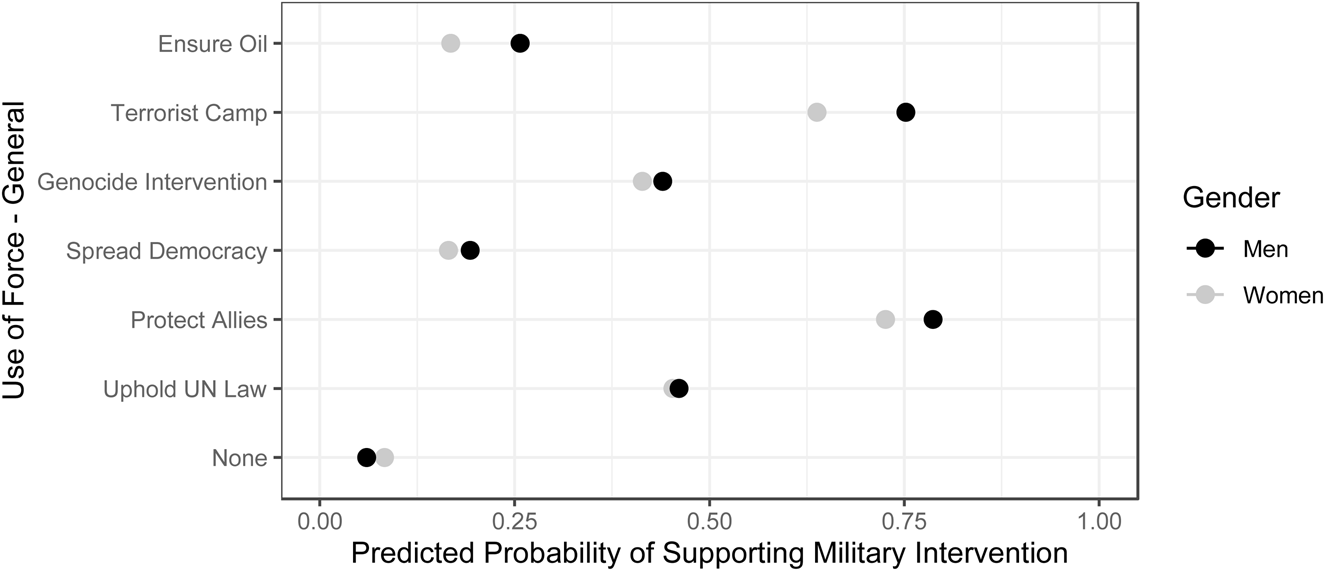
Figure 1 displays the predicted probabilities for respondent sex in the pooled models estimating attitudes on the various scenarios of force from 2006 to 2016. These results demonstrate a clear and sustained gender gap in general attitudes toward the use of force across a range of scenarios, even after accounting for the influence of other central political variables. Over the 10-year period, women are significantly less likely than men to support the use of troops to ensure the supply of oil, destroy a terrorist camp, intervent in a genocide, spread democracy, and protect American allies under attack. The gender gaps range from 2 percentage points (spread democracy) to 11 percentage points (destroy a terrorist camp) in the probability of support for the use of troops in these scenarios. Women are also significantly more likely than men to say that none of the scenarios are justifiable reasons for the use of force, although the substantive gap is quite small. These results provide clear evidence that women are less willing than men to use U.S. troops across a range of military, political, or economic situations.
Predicted probabilities of support for general use-of-force scenarios by gender.

Gender Gap in Attitudes on Specific Conflicts
We find a clear gender gap in general attitudes on the use of force, but hypothetical scenarios might not be the best way to gauge how women and men react to questions of military force. Given that the United States has been almost continuously engaged in two significant conflicts since 2003, we capitalize on questions in the CCES that allow us to tap into reactions to real-world circumstances. It is certainly possible that the attitudes of women and men toward the use of force in specific conflicts could be shaped by what the United States has experienced while fighting these conflicts over an extended period of time.
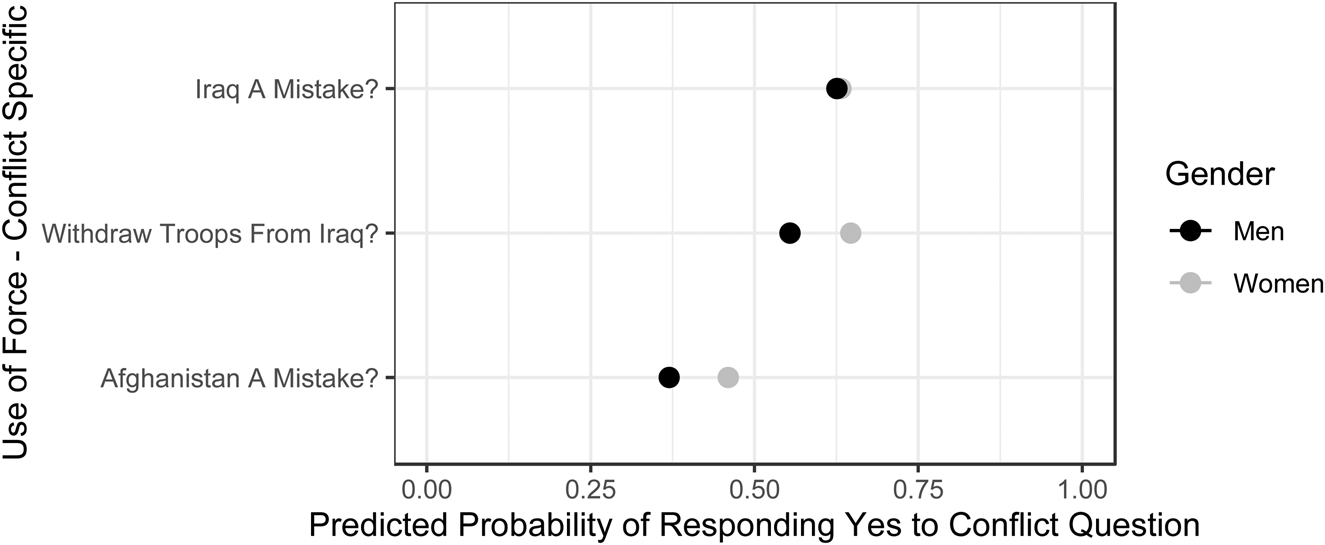
Figure 2 presents the predicted probabilities for respondent gender from multivariate models that estimate the gender gap in attitudes toward the use of force in Iraq and Afghanistan. Consistent with the results in Figure 1, we find a clear gender gap in attitudes toward the conflicts in Iraq and Afghanistan. Women are 10 percentage points more likely than men to call for the withdrawal of troops from Iraq. However, there is no gender difference in evaluating the invasion of Iraq as a mistake. Additionally, women are 8 percentage points more likely than men to identify invading Afghanistan as a mistake.
Predicted probabilities of support for specific conflict scenarios by gender.

IS THERE A PARTISAN GENDER GAP?
To this point, the analysis of attitudes about both general and conflict-specific use of force has consistently demonstrated that women are less likely than men to support the use of force. However, given the centrality of partisanship, we next examine the degree to which there are gender gaps among Democrats and among Republicans. Given the long-standing findings on the gender gap here, we hypothesize that women in each party will be less likely than their copartisan men to support the use of military force in general and across specific conflicts. Because of cross-pressures on Republican women, we expect the gender gap to be smaller among Republicans than among Democrats.
Gender Differences among Democrats and among Republicans
To examine possible gender gaps in the two parties, we conduct an analysis by splitting the sample by respondent party identification and reestimating all of the models for each sample and calculating predicted probabilities.
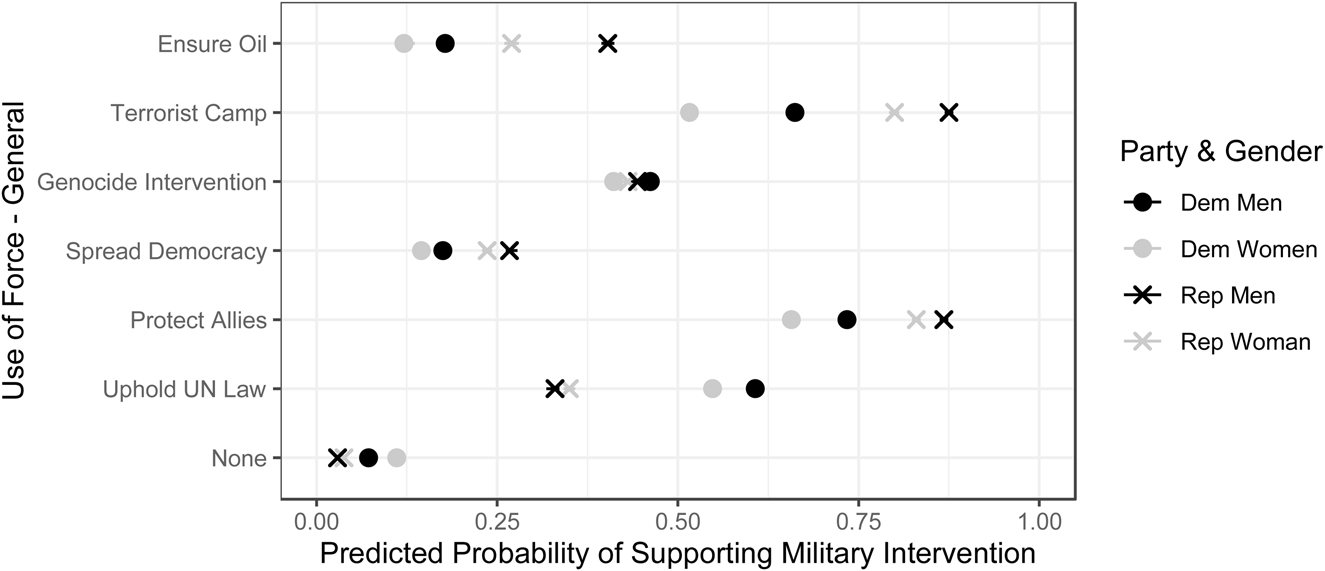
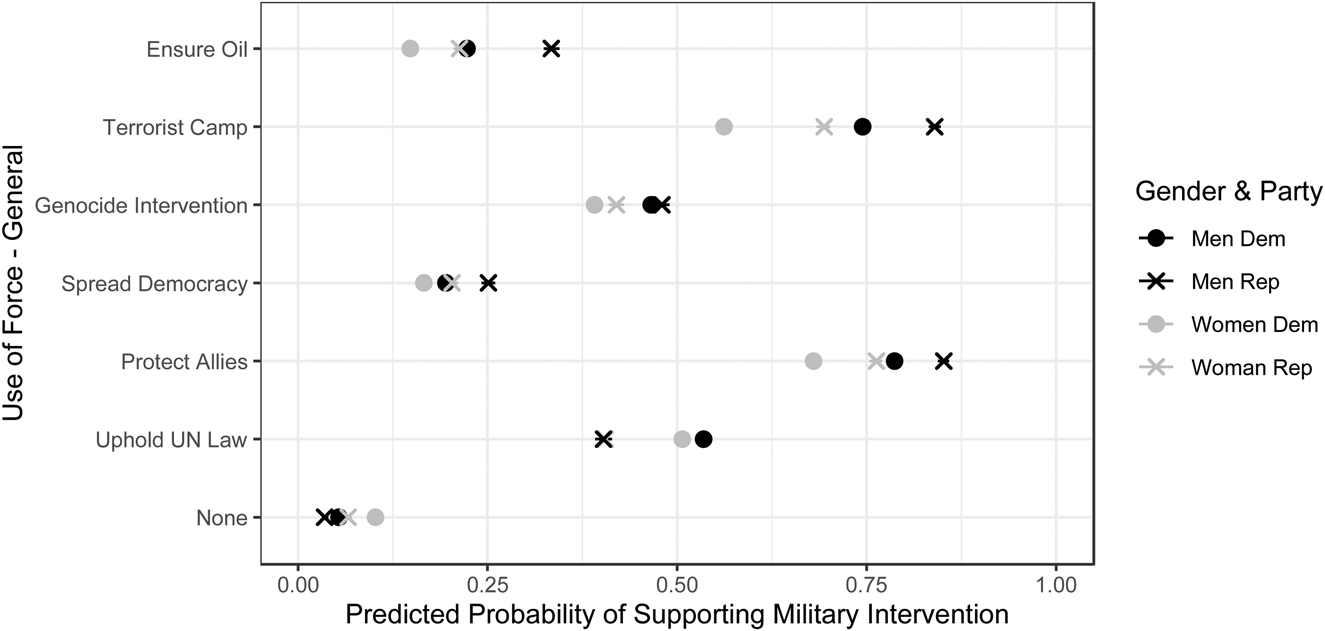
Figure 3 presents the predicted probabilities for the coefficients for four groups—Democratic women, Democratic men, Republican women, and Republican men—in the pooled general use-of-force models. In general, we see patterns that are consistent with what we know about partisan positions on force: Republicans (stars) have higher probabilities of supporting the use of force in the five scenarios that are most militaristic and confrontational, while Democrats (dots) have a higher likelihood of supporting the two that are less conflict focused.
Predicted probabilities of support for general use-of-force scenarios by gender (samples split by party ID).

Next, we look at whether there is support for our hypothesis about gender gaps in each party. Taking Democrats first, we see that Democratic women take significantly different positions than Democratic men on all seven items. Women are less likely to support the use of troops to ensure oil supplies, destroy a terrorist camp, intervene in genocide, spread democracy, protect allies, and uphold UN law, and they are more likely to believe that troops should not be used in any of these situations. The difference in probability of women and men supporting the use of force in these situations ranges from 3 percentage points (to spread democracy) to 15 percentage points (destroy a terrorist camp). Across all seven items, the largest substantive differences are on deployment of troops to destroy a terrorist camp, for protection of American allies under attack, and to help the UN uphold international law.
Among Republicans, Republican women's attitudes are significantly different from Republican men's on six items. Republican women are less likely than their copartisan men to support the use of troops in all scenarios except to uphold UN law. Republican women are also more likely than Republican men to indicate that they do not support the use of troops in any of the scenarios. There is no significant difference on attitudes toward using troops to intervene in a genocide. However, with the exception of attitudes toward using troops to endure the supply of oil, on which there is a 13 percentage point difference, the substantive differences between Republican women and men are extremely small and range from 0.02 percentage point (uphold UN law) to 3 percentage points (to spread democracy). There are essentially no differences on intervening in a genocide, attacking a terrorist camp, protecting allies, and upholding UN law.
Indeed, when we examine the average distance between partisan groups of women and men, we see that the results in Figure 3 suggest that partisanship plays a more prominent role in the preferences of Republican women than does gender. For Democrats, the average difference in probability across all items is 5.42 percentage points and 3.80 percentage points if we eliminate the extreme value on attacking terrorist camps. For Republicans, the average difference is 2.44 percentage points and 0.68 percentage points without the extreme value on using troops to ensure oil supplies. This clearly supports the hypothesis that Republican women are more likely to experience the cross-pressures of a more dovish gender identity and a more hawkish partisan identity.
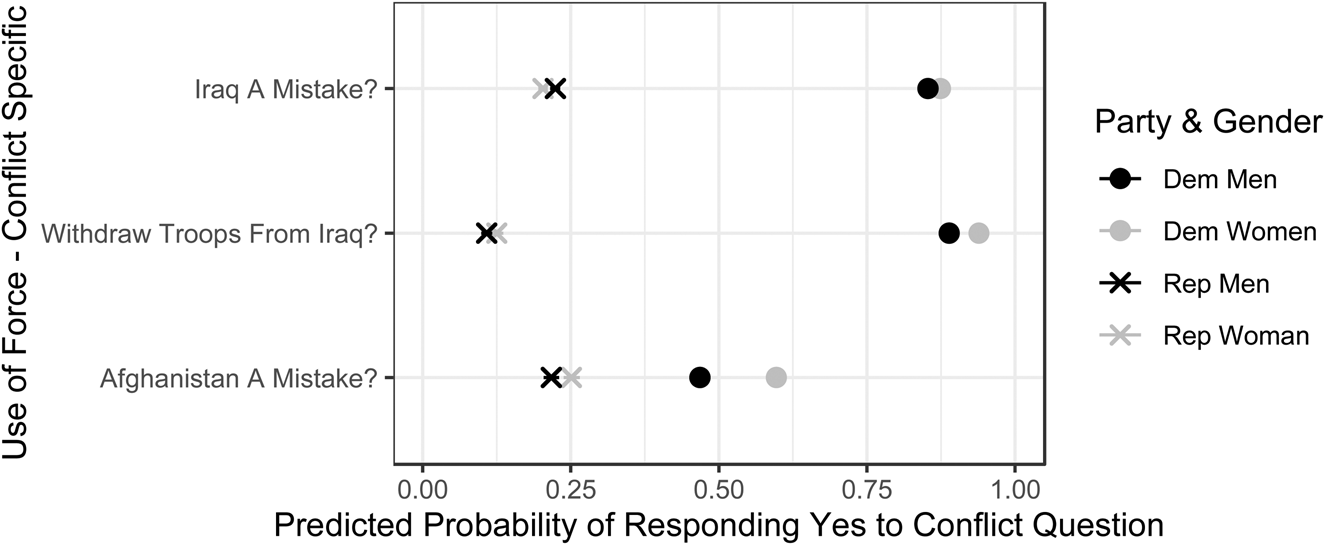
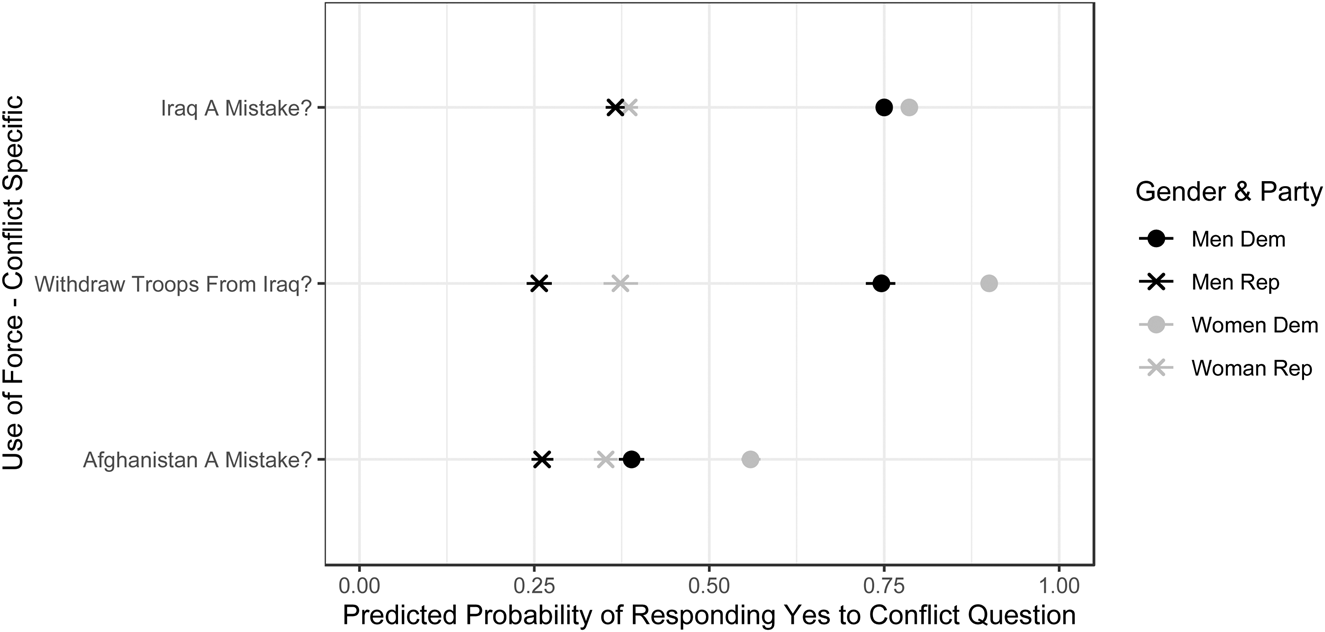
Significant differences persist among Democratic women and men when we examine the recent specific conflicts in which the United States has been engaged (Figure 4). Democratic women are significantly different from men on all three items, being more likely than Democratic men to support withdrawing troops from Iraq and seeing both the Iraq and Afghanistan conflicts as a mistake. The differences range from 3 percentage points on seeing Iraq as a mistake to 13 percentage points on considering Afghanistan a mistake.
Predicted probabilities of support for specific conflict scenarios by gender (samples split by party ID).

Republican women continue to exhibit similar attitudes to Republican men. As we saw with the items in Figure 3, Republican women's and men's attitudes on Iraq and Afghanistan are significantly different, with women being more critical than men. But the substantive difference remains neligible, with the difference on each of the three items standing at 2 percentage points. This supports the evidence from the analysis of the items on general use of force that the gender gap among Republicans is much smaller than the gender gap among Democrats because cross-pressures on Republican women move them closer to their copartisan men.
Partisan Differences among Women and among Men
The final step in our analysis seeks to account for partisan diversity among women and among men by examining the degree to which Democratic women and Republican women differ from each other in their attitudes on the use of force. We conduct the same analysis for Democratic and Republican men, hypothesizing that Democratic women will be less likely than Republican women to support the use of military force in general and across specific conflicts and that Democratic men will be less likely to support the use of force than Republican men. Because of cross-pressures on Democratic men, we expect the party gap among men to be smaller than the party gap among women.
To investigate the role of partisan identification on attitudes, we split the sample by gender of the respondent and re-estimate our models for the women-only and men-only samples. Figures 5 provides the predicted probabilities for the partisanship variable (Democratic versus Republican) for each sample for the models with each of the general use-of-force scenarios as the dependent variables.Footnote 5
Predicted probabilities of support for general use-of-force scenarios by party ID (samples split by gender).

Taking women first, we see consistent and significant differences in attitudes among women based on their partisan identity across all seven general force scenarios. Democratic women are less likely than Republican women to support using troops to ensure oil supply, attack a terrorist camp, intervene in genocide, spread democracy, and protect allies. They are more likely to support using troops to uphold UN law and to say that troops should not be used in any of these situations than Republican women. The largest differences are on attacking a terrorist camp (13 percentage points) and upholding UN law (10 percentage points). Across all items, there is an average distance of 7.8 percentage points on these force items, with Republican women consistently supporting the use of force and Democratic women supporting the more peaceful items.
The argument that partisanship works to distinguish among women is mirrored in the results for men. Republican men are more likely than Democratic men to support the use of force to ensure supplies of oil, destroy terrorist camps, intervene in genocide, spread democracy, and protect allies. Democratic men are more likely than Republican men to support troops helping to uphold UN law and not using troops in any situation. These findings are in line with the findings on differences among Democratic and Republican women. However, the average difference between Democratic and Republican men's positions is smaller, at 7.1 percentage points, than the differences among women. As Figure 5 illustrates, Democratic men actually sit closer to Republican women, and, to a lesser degree, to Republican men, than they do to Democratic women on most items. Here again, we see the evidence of gender and partisan identities applying cross-pressure to some individuals. Democratic men, who sit in the more dovish party but have a gender identity that is generally more masculine, are closer to their Republican male colleagues than Democratic women are to Republican women.
Finally, with regard to attitudes toward the specific conflicts in Iraq and Afghanistan, we again see difference among women and among men based on partisanship. Figure 6 demonstrates that Republican women are significantly more supportive of the U.S. involvement in Iraq and Afghanistan than are Democratic women by large margins. Republican women are 53 percentage points less likely than Democratic women to want troops withdrawn from Iraq, 40 percentage points less likely to say that the invasion of Iraq was a mistake, and 20 percentage points less likely to think that Afghanistan was a mistake. Among men, we see the same pattern of Republican men being significantly different from Democratic men on all three items, but the differences are slightly smaller. Republican men are 50 percentage points less likely than Democratic men to want to withdraw troops from Iraq, 38 percentage points less likely to think that Iraq was a mistake, and 13 percentage points less likely to think Afghanistan was a mistake. Here again we see that average differences in probabilities are bigger among women (38 percentage points) than among men (33 percentage points), with Democratic men being closer to Republicans than are Democratic women. The results provide additional evidence of men feeling the cross-pressures of gender and partisan identity.
Predicted probabilities of support for specific conflict scenarios by party ID (samples split by gender)

In total, this analysis of attitudes about a wide range of issues regarding the use of force produces three findings. First, the traditional gender gap on these attitudes remains, with women taking significantly more dovish positions than men consistently across scenarios and conflicts. Second, in line with recent work by Barnes and Cassese (Reference Barnes and Cassese2017), we find gender gaps within both the Democratic and Republican parties. Here we see Democratic women being more dovish than Democratic men and Republican women being more similar to Republican men than different. We see this as evidence of the cross-pressures between gender and partisan identity that Republican women feel. Third, we find evidence that there is diversity of attitudes among women and among men driven by their partisan attachments. Democratic women take strongly more dovish positions than do Republican women. Democratic men take more dovish positions than do Republican men, but these differences, while still large, are a bit smaller than the differences among women. Here it is Democratic men who feel the cross-pressure of multiple identities. In both circumstances of cross-presure, for Republican women and for Democratic men, it is partisanship that exerts the greatest pull. Republican women are more hawkish, and Democratic men more dovish, than their gender identities would suggest.
CONCLUSION
While differences in the attitudes that women and men take on questions of the use of force are a long-standing finding in the public opinion literature, there is more diversity among women and men than our current understanding acknowledges. In this project, we extend that understanding by considering the importance of partisanship and by documenting the gender gaps within political parties and among women and among men. While we find that the traditional gender gap in attitudes remains, we also find important gender gaps in the Democratic and Republican parties as well as differences among women and among men that are driven by partisan identities. In the aggregate, women continue to support the use of force at significantly lower rates than do men, whether in general military scenarios or with regard to the conflicts in Iraq and Afghanistan. But we also find that gender identity shapes positions among copartisans, as we see Democratic women and Republican women taking more dovish positions than their male colleagues. That the gender gap in the Republican Party is much smaller than the gap in the Democratic Party indicates that Republican women feel a particular pressure from their partisan identity, which is clearly one associated with support for military issues (Winter Reference Winter2010). Finally, when we examine attitudes among women and among men, we see the diversity within each group that is often invisible when we take a “women versus men” approach to public opinion. We find there is partisan diversity among women and among men on issues of force, although the differences among men are smaller than those among women. Here it is Democratic men who experience the cross-pressures of multiple identities.
By introducing an examination of the conditions under which individuals are cross-pressured by their gender and partisan identities, we acknowledge the ways in which multiple identities pull some individuals in different directions. In our analysis, it is clear that Republican women, who sit in a hawkish party, are more supportive of the use of force than their gender would predict. The same is true for Democratic men, who are slightly more hawkish than their partisan identity would predict. Identifying the ways in which individuals are the product of multiple influences recognizes the diversity within these groups (Cassese Reference Cassese2020). Future work on the gender gap in public opinion should continue to examine the concept of cross-pressures and the potential impact of other relevant political considerations, such as race, religiosity, age, and social class, particularly as these influences might differ across issue domains. Another important focus will be to examine the influence these attitudinal cross-pressures might have on voting and other political activities (Davis and Mason Reference Davis and Mason2016). As partisan and social sorting continues to take place, these types of investigations will become increasingly important to our understanding of public opinion and elections in the United States.
SUPPLEMENTARY MATERIAL
To view supplementary material for this article, please visit https://doi.org/10.1017/S1743923X20000690