Introduction
Chronic fatigue syndrome (CFS) is a debilitating condition lasting over 6 months. Symptoms include fatigue, pain, sleep problems and poor concentration and memory (Sharpe et al. Reference Sharpe, Archard, Banatvala, Borysiewicz, Clare, David, Edwards, Hawton, Lambert and Lane1991; Fukuda et al. Reference Fukuda, Straus, Hickie, Sharpe, Dobbins and Komaroff1994). No single somatic cause has been identified. Although a virus or work stress may trigger the condition, cognitive, behavioural, affective and physiological factors are thought to perpetuate symptoms and disability (Surawy et al. Reference Surawy, Hackmann, Hawton and Sharpe1995; Burgess et al. Reference Burgess, Andiappan and Chalder2012; Moss-Morris et al. Reference Moss-Morris, Deary and Castell2013). Self-report studies have found that negative illness representations, symptom interpretations and heightened symptom focusing contribute to the maintenance of CFS (White et al. Reference White, Thomas, Amess, Grover, Kangro and Clare1995; Knoop et al. Reference Knoop, Prins, Moss-Morris and Bleijenberg2010; Moss-Morris et al. Reference Moss-Morris, Spence and Hou2011). Changing such cognitions, in particular fear avoidance beliefs and catastrophizing, have been found to mediate treatment response (Moss-Morris et al. Reference Moss-Morris, Sharon, Tobin and Baldi2005; White et al. Reference White, Goldsmith, Johnson, Potts, Walwyn, DeCesare, Baber, Burgess, Clark and Cox2011; Wiborg et al. Reference Wiborg, Knoop, Prins and Bleijenberg2011; Wearden & Emsley, Reference Wearden and Emsley2013; Stahl et al. Reference Stahl, Rimes and Chalder2014; Chalder et al. Reference Chalder, Goldsmith, White, Sharpe and Pickles2015).
Whilst self-report studies have identified certain cognitions as perpetuating factors, little is understood about the cognitive processes underlying these beliefs. Deary et al. (Reference Deary, Chalder and Sharpe2007) have suggested habitual processes, such as attention and misinterpretation, may play a role. For example, selectively attending to somatic information and habitually interpreting ambiguous information as health threatening may precede and perpetuate unhelpful cognitive and behavioural responses, such as fear avoidance beliefs, symptom monitoring and avoidance of activity. If so, targeting these cognitive processes in existing or adjunct treatments may optimize outcomes.
Little experimental research has been conducted in this area. A recent review of cognitive processing biases in CFS found a small number of published studies (n = 5), many with methodological limitations including small sample sizes and poorly defined populations (Hughes et al. Reference Hughes, Hirsch, Chalder and Moss-Morris2016a ). Results were often conflicting. Studies using a modified Stroop task found threatening content did not interfere with information processing in CFS (Moss-Morris & Petrie, Reference Moss-Morris and Petrie2003). However, studies using visual probe tasks indicate that selective attention towards health-threatening stimuli occurs when stimuli are presented for longer durations (e.g. >500 ms; Creswell & Chalder, Reference Creswell and Chalder2002; Hou et al. Reference Hou, Moss-Morris, Bradley, Peveler and Mogg2008; Hou et al. Reference Hou, Moss-Morris, Risdale, Lynch, Jeevaratnam, Bradley and Mogg2014) but not when presented briefly (e.g. 100 ms; Martin & Alexeeva, Reference Martin and Alexeeva2010). This may indicate that people with CFS have difficulties with attentional processes of disengagement, rather than the initial orientation of attention. Similarly, studies of interpretation biases using on-line tasks, which require participants to make an immediate and spontaneous interpretation of ambiguous information, have not found biases in CFS (Martin & Alexeeva, Reference Martin and Alexeeva2010). Studies that have used off-line interpretative bias tasks which allow participants time to form an interpretation have found biases in CFS (Moss-Morris & Petrie, Reference Moss-Morris and Petrie2003). This may indicate that people with CFS interpret ambiguous information in a somatic way when they have time to reflect on the material (i.e. off-line tasks) but not when the material is first encountered (i.e. on-line tasks). These findings suggest that threat-related processing in CFS occurs at later, elaborative stages of processing.
Furthermore, one study has shown a correlation between increased somatic interpretations of ambiguous information and self-reported somatic focus (Moss-Morris & Petrie, Reference Moss-Morris and Petrie2003), supporting the hypothesized role for cognitive processing in perpetuating maladaptive beliefs and behaviours. However, these conclusions are deduced from a small body of evidence, employing different paradigms and subtle methodological variations, tapping into different cognitive content and mechanisms. Further research is needed to establish whether cognitive processing biases are a reliable phenomenon in CFS, the nature of such biases and how they relate to other self-reported cognitive and behavioural factors operationalized in the cognitive–behavioural model of CFS.
Most of the previous experimental CFS studies used generic health-threatening stimuli, which arguably are not integral to CFS. Some studies recruited participants from support groups, who may have different salient concerns from clinical CFS populations. Given the large heterogeneity in CFS (Cella et al. Reference Cella, Chalder and White2011a ), experimental research would benefit from exploratory work to first identify the salient illness-related concerns before assessing threat-related processing. Content-specific processing is evident in depression and anxiety disorders (Fritzsche et al. Reference Fritzsche, Dahme, Gotlib, Joormann, Magnussen, Watz, Nutzinger and von Leupoldt2010; Pergamin-Hight et al. Reference Pergamin-Hight, Naim, Bakermans-Kranenburg, van IJzendoorn and Bar-Haim2015). Given the high prevalence of co-morbid mood disorders in CFS (Cella et al. Reference Cella, White, Sharpe and Chalder2013), it may be that cognitive biases are a function of depression and/or anxiety in the CFS population, rather than their CFS per se. However, recent research in CFS indicates that these biases are independent of mood and affect (Hughes et al. Reference Hughes, Hirsch, Chalder and Moss-Morris2016a ). These biases are associated with health-related rather than mood-related stimuli, suggesting that biases occur for themes central to the disorder. This is in keeping with cognition and emotion research (Mathews & MacLeod, Reference Mathews and MacLeod1994; Hirsch, et al. Reference Hirsch, Meeten, Krahé and Reeder2016).
Some theories suggest that threat-related processing is a result of difficulty in regulation and allocation of attention, sometimes known as attentional control (Eysenck et al. Reference Eysenck, Derakshan, Santos and Calvo2007). Support for this idea comes from studies in anxiety and pain, which have found that people with poorer attentional control show greater attentional (Heathcote et al. Reference Heathcote, Vervoort, Eccleston, Fox, Jacobs, Van Ryckeghem and Lau2015) and interpretation biases for threat-relevant stimuli (Salemink & Wiers, Reference Salemink and Wiers2012). There is also evidence from both self-report and neuropsychological studies that people with CFS have difficulties with general attentional control (Cockshell & Mathias, Reference Cockshell and Mathias2010; Togo et al. Reference Togo, Lange, Natelson and Quigley2015). One small study (n = 14) (Hou et al. Reference Hou, Moss-Morris, Risdale, Lynch, Jeevaratnam, Bradley and Mogg2014) found that only a subset of CFS participants with poor attentional control had an increased attentional bias towards health threat when compared with healthy individuals. This suggests that there may be a subgroup of CFS patients with particularly poor attentional control who are more prone to develop biases in cognitive processing. A larger study is needed to confirm these findings and to date no CFS studies have looked at attention control in relation to interpretive bias. If confirmed, training programmes to improve attentional control may be clinically relevant (Sharpe et al. Reference Sharpe, Ianiello, Dear, Perry, Refshauge and Nicholas2012, Reference Sharpe, Johnson and Dear2015; Schoth et al. Reference Schoth, Georgalli and Liossi2013; Jones & Sharpe, Reference Jones and Sharpe2014).
Finally, research to date has not established whether there is a relationship between illness duration or severity and cognitive biases in CFS (Hughes et al. Reference Hughes, Hirsch, Chalder and Moss-Morris2016a ). It may be that people who have been living with the ongoing uncertainty of a disabling and poorly explained condition for some time could reasonably become preoccupied with their illness. Over time this may result in biases in how information is attended to and processed. There is some evidence from the chronic pain literature that attentional biases are associated with poorer outcomes over time (Lautenbacher et al. Reference Lautenbacher, Huber, Schöfer, Kunz, Parthum, Weber and Sittl2010; Todd et al. Reference Todd, Sharpe, Colagiuri and Khatibi2016) and greater chronicity (Sharpe et al. Reference Sharpe, Haggman, Nicholas, Dear and Refshauge2014) but this has not been addressed in CFS studies.
The current study is the largest to date in this area and addresses many of the methodological limitations and gaps in the research mentioned above. Stimuli were developed with CFS patients and clinicians to ensure that the tasks were tapping into CFS-specific concerns and validated paradigms were selected to assess attention and interpretation biases. The main hypotheses are as follows: (1a) CFS participants, when compared with healthy controls, will have an attentional bias towards fatigue-specific, somatic and disability-related information presented for 500 ms and an interpretive bias towards somatic rather than positive information; (1b) this difference between groups will remain even when controlling for co-morbid mood disorders; (2) attention and interpretation biases in CFS will be associated with/moderated by deficits in attentional control; (3) attention and interpretation biases in CFS will be associated with self-reported fear avoidance beliefs, catastrophizing about symptoms, symptom focusing, fatigue, disability and increased illness duration.
Method
Participants
Participants were included if they were 18 years or older, fluent in English, with normal or corrected-to-normal vision and good manual dexterity. CFS participants were recruited from specialist CFS services in London, Oxford and Dorset. To be included, they had to meet either the Oxford (Sharpe et al. Reference Sharpe, Archard, Banatvala, Borysiewicz, Clare, David, Edwards, Hawton, Lambert and Lane1991) or US Centers for Disease Control (Fukuda et al. Reference Fukuda, Straus, Hickie, Sharpe, Dobbins and Komaroff1994) criteria for CFSFootnote 1 Footnote †, diagnosed by a consultant psychiatrist or experienced cognitive–behavioural therapist, and confirmed by self-report questions. CFS participants were excluded if undergoing concurrent cognitive–behavioural therapy or graded exercise therapy.
Healthy controls were recruited via online advertisements placed on public forums, such as Gumtree, and recruited on the basis that they had similar demographic characteristics of the CFS group. They were included if they had no previous or current diagnosis of CFS (Sharpe et al. Reference Sharpe, Archard, Banatvala, Borysiewicz, Clare, David, Edwards, Hawton, Lambert and Lane1991; Fukuda et al. Reference Fukuda, Straus, Hickie, Sharpe, Dobbins and Komaroff1994) ascertained through self-reported medical history and a current score of less than 4 on the Chalder Fatigue Scale (Chalder et al. Reference Chalder, Berelowitz, Pawlikowska, Watts, Wessely, Wright and Wallace1993). Participants were excluded if they reported other persistent physical symptoms which may be associated with CFS, including irritable bowel syndrome (IBS), fibromyalgia and chronic pain. All participants were paid £20 for taking part.
Sample size was determined by an a priori analysis using the G*Power analysis program (Erdfelder et al. Reference Erdfelder, Faul and Buchner1996). We set α at 0.05 with a corresponding power of 0.80 to detect a standard medium effect size of Cohen's f 0.25, resulting in a required sample size of 90 participants in total; 45 per group. This medium effect size was selected based on previous, similar studies, which found medium effect sizes between smaller groups of CFS and healthy controls in terms of attentional bias (Hou et al. Reference Hou, Moss-Morris, Bradley, Peveler and Mogg2008), interpretation bias (Moss-Morris & Petrie, Reference Moss-Morris and Petrie2003) and attentional control (Hou et al. Reference Hou, Moss-Morris, Risdale, Lynch, Jeevaratnam, Bradley and Mogg2014). We over-recruited by 15% to allow missing or extreme outliers in the data.
Procedure
The study was approved by Berkshire-B Research Ethics Committee (14/SC/0172). Following written informed consent, participants completed questionnaires at home and subsequently attended the laboratory to complete the computer tasks. Computer tasks were programmed using E-prime version 2.0 (Psychology Software Tools, Inc., USA). Experiments were conducted in a private room on a Toshiba Satellite-Pro Laptop (screen size 15.6 inches), which was attached to a stand and placed on a table to maintain a 4.0° visual angle for every task. Each task consisted of a practice and test trials which were completed in the absence of the experimenter. All participants completed the Visual Probe Task (VPT), followed by the Attention Network Task (ANT), Interpretative Bias (IB) Task and clinical interview.
Questionnaires
Chalder Fatigue Questionnaire (CFQ; Chalder et al. Reference Chalder, Berelowitz, Pawlikowska, Watts, Wessely, Wright and Wallace1993; Cella & Chalder, Reference Cella and Chalder2010)
The CFQ consists of 11 items measuring physical and mental fatigue on a four-point scale, ranging from ‘better than usual’ (0) to ‘much worse than usual’ (3). Items were scored using the continuous method (0, 1, 2, 3). Cronbach's α in the current study was 0.98.
Work and Social Adjustment Scale (WSAS; Mundt et al. Reference Mundt, Marks, Shear and Greist2002)
This five-item scale measures the extent to which fatigue interferes with people's ability to engage in activities of daily life including work and socializing, rated on a scale from 0 (‘not at all’) to 8 (‘very severely impaired’). The scale has strong psychometric properties and is a valid and reliable measure in CFS (Cella et al. Reference Cella, Sharpe and Chalder2011b ). Cronbach's α in the current study was 0.97.
Cognitive Behavioural Responses Questionnaire (CBRQ; Skerrett & Moss-Morris, Reference Skerrett and Moss-Morris2006)
The CBRQ consists of seven subscales. Five relate to cognitive responses to symptoms: catastrophizing, damage beliefs, symptom focusing, fear avoidance and embarrassment avoidance; rated on a five-point Likert scale ranging from 1 ‘strongly disagree’ to 5 ‘strongly agree’, with two items on the fear avoidance scale reverse coded. Two subscales measure behavioural responses to illness: avoidance behaviour and all-or-nothing behaviour, rated on a five-point scale from 1 (‘never’) to 5 (‘all the time’). Higher scores indicate proneness to maladaptive responses to symptoms. The CBRQ was included to assess the relationship between self-reported beliefs and behaviours and cognitive biases. Cronbach's α for the seven subscales ranged from 0.85 to 0.97.
Clinical Interview Schedule Revised (CIS-R; Lewis et al. Reference Lewis, Pelosi, Araya and Dunn1992)
The CIS-R is a standardized, highly structured, valid and reliable psychiatric interview which produces depression and anxiety diagnostic categories according to International Classification of Diseases-10 criteria, as well as a continuous total score of psychological distress. A computer version of the CIS-R was used excluding the fatigue item normally contained within the interview. Cronbach's α in the current study was 0.76.
Information processing tasks
Stimuli development for the VPT (MacLeod et al. Reference MacLeod, Mathews and Tata1986)
This computerized task measures reaction times to the threating illness-related words and neutral word pairs, matched for length and frequency of use. Faster reaction times to probes replacing (appearing in the location of) CFS-threatening words relative to probes replacing neutral words indicate an attentional bias towards threat. In order to ensure illness words were salient to the experience of CFS, we conducted preliminary interviews with six CFS patients and a workshop with six experienced cognitive–behavioural therapists specializing in CFS. The interviews and workshop explored the experience of CFS and elicited real-life examples which captured this experience. From this preliminary work we extracted 56 illness-related words which were subsequently rated for their saliency on an on-line survey by 58 CFS participants. Instructions were ‘Recalling a time when you were experiencing your worst symptoms, please rate these words in the degree to which they bring to mind an unpleasant or distressing emotion related to CFS’. Ratings were: ‘not at all distressing’; ‘neutral’; ‘moderately distressing’; ‘quite a bit distressing’; ‘extremely distressing’. Mean ratings were calculated per word, with higher scores reflecting a greater emotive threat valence. The 24 highest scoring words were selected for the VPT (see online Supplementary Table S1), which broadly related to symptom experience (e.g. ‘shattered’) and associated consequences (‘bedbound’).
VPT (MacLeod et al. Reference MacLeod, Mathews and Tata1986)
Threatening–neutral word pairs were presented in random order for 96 trials. Each trial started with a fixation cross (500 ms) followed by two words (Arial point 18), appearing above and below the fixation. After 500 ms the words disappeared and one of them was replaced by an arrow. Participants were seated approximately 60 cm from the screen and read the following instructions: ‘You will see a fixation cross (+) in the centre of the screen. Please use this fixation cross to focus your vision. Two words will appear, one above and one below the centre of the screen, for a short duration of time. An arrow will appear in either one of the two locations of the previously shown words.’ Participants pressed ‘c’ to indicate the arrow pointing to the left and ‘m’ for the arrow pointing to the right. After reading the instructions participants completed 16 practice trials of neutral–neutral word pairs, before starting the experiment. The inter-trial interval was 500 ms. Attentional bias scores were calculated as the standardized residual (i.e. difference score) of the mean reaction time to probes replacing the illness-related stimuli from the reaction time to probes replacing the neutral stimuli. To create the standardized residual score a regression analysis was conducted where reaction times to probes replacing neutral stimuli were entered as the dependent variable and reaction times to probes replacing illness-related stimuli were entered as the independent variables. Positive values demonstrate an attentional bias to CFS-threatening stimuli.
Stimuli development for the IB Task
Scenarios were conceived from the interviews and workshop described above and tested for saliency in a pilot survey. The survey consisted of 40 short ambiguous scenarios, with the last word left blank. Participants had to complete the last word, thus revealing an interpretation of the text (see online Supplementary Appendix S1). For example, ‘You have planned to clean the downstairs of your house today and found this easier and quicker than you expected. You think if you carry on you will feel… (possible completions: exhausted/pleased)’. In all, 26 CFS and 26 healthy participants completed the survey. The single word completions were rated by two independent researchers as either CFS-related, generally negative, neutral or positive. The scenarios which demonstrated the biggest difference between the CFS and control groups in terms of CFS-related interpretations were selected to be developed into full-text materials for the main IB Task described below. See Hughes et al. (Reference Hughes, Hirsch, Chalder and Moss-Morris2016b ) for further details on the development of these CFS-specific VPT and IB stimuli.
IB Task (Mathews & Mackintosh, Reference Mathews and Mackintosh2000)
This computerized task was adapted from Mathews & Mackintosh's (Reference Mathews and Mackintosh2000) task used in anxiety. The task comprised of two phases: the initial encoding phase followed by a recognition phase. During the encoding phase, 10 ambiguous descriptions of everyday situations, each headed with a short title, were presented. Participants read all 10 scenarios whilst imagining themselves as the central character. After each scenario participants rated its ‘pleasantness’ and answered a comprehension question. An example scenario and comprehension question follow.
‘Cleaning the house
“Last week you spent a day cleaning the house. You hoovered all the carpets in the house and mopped the kitchen floor. A week later you notice the carpets are dirty and need hoovering again. You think about how you felt after the last time you cleaned.”
Did you clean the windows?’
After reading all 10 scenarios participants are presented with a ‘recognition test’. The recognition phase was designed to test participants’ interpretations of the ambiguous scenarios made during the encoding phase. Participants were presented with the title of each scenario (e.g. ‘Cleaning the house’), followed by four sentences, presented individually, to be rated for recognition. For each scenario there were two ‘target’ interpretations, which were possible positive or somatic (negative) interpretations of the scenario; and two foil sentences, one positive and one negative, which were not possible interpretations of the text. Foils were included to assess a potential response bias for endorsing any positive or negative information. Below is an example of the recognition phase which corresponds to the above scenario ‘Cleaning the house’:
-
1. You felt pleased with how nice the house looked after cleaning. (positive target/interpretation)
-
2. You felt stiff and painful for days as you pushed your body too far. (somatic target/interpretation)
-
3. You completed the cleaning quicker than you had expected. (positive foil)
-
4. You were unable to clean last week as you hurt your back. (negative foil)
Participants were asked to rate independently how similar in meaning each sentence was from the original encoding description (‘how similar is this sentence to the original description you read?’), from 1 (very different in meaning) to 4 (very similar in meaning). The scenarios in the encoding and recognition phases were presented in the same order, but the four recognition sentences were randomized for each scenario. For the analyses, mean similarity ratings were calculated for the positive and negative interpretations (targets) and foils separately. To obtain an interpretive bias index, mean similarity scores of positive interpretations were subtracted from mean similarity scores from negative interpretations (higher scores indicate a stronger threat-related interpretive bias).
ANT (Fan et al. Reference Fan, McCandliss, Sommer, Raz and Posner2002, Reference Fan, McCandliss, Fossella, Flombaum and Posner2005)
The ANT measures three aspects of attention: altering, orientating and attentional control. As a previous study only found differences between CFS and healthy participants on attentional control (Hou et al. Reference Hou, Moss-Morris, Risdale, Lynch, Jeevaratnam, Bradley and Mogg2014), we only included attentional control in this study. The ANT consists of six demonstration trials, 12 practice trials and 72 experimental trials. Participants are presented with a string of five congruent (→→→→→) or incongruent (→→←→→) arrows and are required to determine the direction of the central arrow. Attentional control is calculated by subtracting the mean reaction time on congruent flanker trials from the mean reaction time on incongruent flanker trials. Higher scores indicate poorer attentional control.Footnote 2
Data preparation and analytical procedure
Reaction time data were excluded from trials with errors and outliers (<200, and >2000 ms) in the VPT and ANT. One CFS participant and two healthy controls were excluded from the VPT analysis due to excessive missing data (>3 s.d. above the group mean) consistent with other studies (Brown et al. Reference Brown, Eley, Broeren, MacLeod, Rinck, Hadwin and Lester2014; Hou et al. Reference Hou, Moss-Morris, Risdale, Lynch, Jeevaratnam, Bradley and Mogg2014). Analysis was performed using the Statistical Package for Social Sciences (SPSS) version 21 (USA).
The Kolmogorov–Smirnov test of normality indicated that the distributions of the ANT attention control scores and age were skewed; bootstrapping (set at 1000 resamples) was performed on attentional control data and a Mann-Whitney test was used to assess group differences in age. All other data met assumptions of normality. Gender, employment, education and symptom measures (CIS-R, WSAS and fatigue) were compared between groups using χ2 or t tests. Participants in the CFS group were significantly older than healthy controls so age was controlled for in subsequent analysis.Footnote 3 Separate analyses of covariance (ANCOVAs) were run for attentional bias and attentional control scores, with group as the between-subjects factor. The means of the IB Task were entered into a three-way mixed ANCOVA, with group as between-group factor, target type (target sentence v. foil sentence) and sentence valence (positive v. negative sentence) as within-subjects factors and age as covariate (hypothesis 1a). These ANCOVAs were rerun with total CIS-R scoresFootnote 4 entered as covariates to identify whether cognitive biases in CFS were independent of co-morbidity (i.e. hypothesis 1b). Post-hoc analyses of variance and t tests were used to clarify significant results. To determine if attentional control acted as a moderator of attention and interpretation biases in CFS, an interaction term was created between centred attentional control scores and group. The interaction term was entered as a criterion variable along with group in separate linear regressions with attentional bias scores and interpretation bias index as the predictor variables (hypothesis 2). Pearson correlations were also carried out between self-reported symptom measures and attention and interpretation bias scores, within the CFS group (hypothesis 3).
Results
A total of 80 people with CFS were invited to participate in the study; 56 agreed (response rate = 70%). After screening for eligibility the final sample consisted of 52 CFS participants and 51 healthy controls.
Clinical and demographic measures
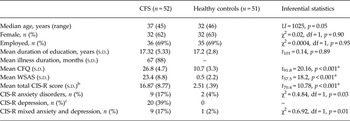
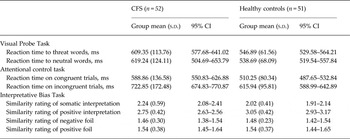
Group characteristics and clinical measures are presented in Table 1. CFS participants and controls did not differ with respect to gender, employment, or years in education; however, members of the CFS group were significantly older than healthy controls. As expected, the CFS group had significantly higher rates of co-morbid depression and anxiety (CIS-R), and significantly higher scores on all clinical measures compared with controls. Scores and reaction times for the experimental tasks are presented in Table 2.
Comparisons between CFS patients and controls on demographic and clinical variables

CFS, Chronic fatigue syndrome; df, degrees of freedom; s.d., standard deviation; CFQ, Chalder Fatigue Questionnaire; WSAS, Work and Social Adjustment Scale.; CIS-R, Clinical Interview Schedule Revised.
a Degrees of freedom were corrected after Lavene's test.
b All CIS-R scores excluded the fatigue scale contained in the interview.
c Statistics were not computed because all controls scored 0 on this scale.
Reaction times and scores on the information processing tasks

CFS, Chronic fatigue syndrome; s.d., standard deviation; CI, confidence interval.
VPT: attentional bias in CFS v. control groups
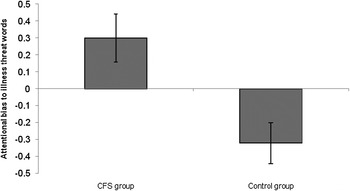
The CFS group had slower overall mean reaction time on the VPT than controls (614.99 v. 540.87 ms, t 98 = 3.97, p < 0.001). Fig. 1 illustrates the standardized attentional bias scores in both groups; positive scores indicate an attentional bias toward CFS stimuli. The ANCOVA showed a significant main effect of group when controlling for age (F 1,97 = 9.98; p = 0.002; η p 2 = 0.09); the CFS group had a significant attentional bias towards threat stimuli compared with healthy controls. This effect remained when controlling for CIS-R distress (F 1,96 = 4.24; p = 0.04; η p 2 = 0.04). Post-hoc contrasts of overall mean bias score against zero for each group showed a significant bias towards threat in the CFS group [one-sample t 50 = 2.13, p = 0.038, 95% confidence interval (CI) 0.62–21.33], while the healthy control group showed a significant bias towards neutral stimuli (t 48 = −3.7, p = 0.004, 95% CI −21.74 to −4.52).
Standardized attentional bias scores in chronic fatigue syndrome (CFS) and healthy control groups. Values are means, with standard deviations represented by vertical bars.

Recognition task: interpretative bias in CFS v. control groups
There was a significant group × target × valence interaction (F 1,100 = 20.94, p < 0.001, η p 2 = 0.17). To further explore this effect we conducted a mixed-model ANCOVA with group as the between-subjects factor, valence (somatic or positive target) as the within-subjects factor and age as covariate for targets and foils separately. The ANCOVA for targets demonstrated a significant group × valence interaction (F 1,100 = 25.83, p < 0.001, η p 2 = 0.21), which remained when controlling for co-morbid distress (F 1,99 = 4.38, p = 0.04, η p 2 = 0.10). Independent-samples t tests showed that the CFS group endorsed positive interpretations significantly less than healthy controls (t 101 = −3.8, p < 0.001), and somatic (negative) interpretations significantly more than healthy controls (t 91 = 2.13, p = 0.04). The ANCOVA for foils demonstrated no significant main effects (F 1,100 = 0.05, p = 0.82). Within-group analyses showed that both groups endorsed positive interpretations significantly more than somatic interpretations (CFS group: F 1,51 = 39.43, p < 0.001, η p 2 = 0.45; healthy control group: F 1,50 = 166.26, p < 0.001, η p 2 = 0.78).
Attention network test: attentional control in CFS v. control groups
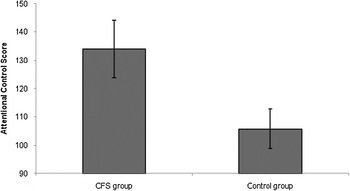
The CFS group had slower overall mean reaction time on the ANT compared with healthy controls (649.33 v. 556.63 ms) (t 101 = 3.88, p < 0.001). Fig. 2 illustrates the mean ANT attentional control scores of both groups. The CFS group had significantly poorer attentional control (i.e. higher ANT scores) than healthy participants, controlling for age (F 1,100 = 4.05; p = 0.05; η p 2 = 0.04).
Attentional control scores in chronic fatigue syndrome (CFS) and healthy control groups. Higher scores represent poorer attentional control. Values are means, with standard deviations represented by vertical bars.

Relationship between attentional control and attention bias
There was no significant correlation between attentional bias scores and attentional control in either the CFS group (r 51 = 0.08, p = 0.59) or the healthy control group (r 49 = 0.30, p = 0.12). To examine if attentional control acted as a moderator of attentional bias in CFS, an interaction term was created between group (CFS, healthy controls) and centred attentional control scores. The interaction term and group were entered as predictor variables in a linear regression with attentional bias as the criterion. There was no significant interaction between attentional bias scores and group (β = 0.25, t 97 = 1.45, p = 0.15, 95% CI −0.11 to 0.008).
Relationship between attentional control and interpretation bias
In order to assess the relationship between interpretation biases and attentional control an interpretation bias index was calculated by subtracting the mean similarity scores of the positive interpretations from the mean similarity scores of the negative interpretations from the recognition task. There was no significant correlation between interpretative bias index and attentional control in either the CFS group (r 52 = 0.12, p = 0.41) or the healthy control group (r 51 = 0.23, p = 0.10). To test the moderating role of attentional control on the relationship between group (CFS and healthy controls) and interpretative bias, a linear regression analysis was performed with the interpretative bias index as the dependent variable and group and the interaction term between group and centred attentional control as the predictors. Attentional control was not a significant moderator of the relationship between group and interpretation bias (β = 0.17, t 99 = 0.88, p = 0.38, 95% CI −0.002 to 0.006).
Relationship between cognitive biases and self-reported beliefs, behaviours, fatigue and disability
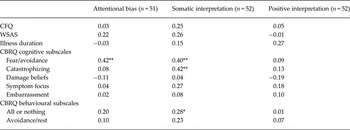
Table 3 shows correlations within the CFS group between self-reported symptoms, beliefs and behaviours, and cognitive biases (attention and interpretation biases). Attentional bias was significantly, positively correlated with fear/avoidance beliefs. Somatic interpretations were significantly positively correlated with all/nothing behaviours, fear/avoidance beliefs and catastrophizing. Positive interpretations were not correlated with any cognitive or behavioural illness responses (CBRQ). There were no significant correlations between self-reported fatigue (CFQ), disability (WSAS) or illness duration and either attentional biases or interpretation biases (positive or somatic).
Correlations between cognitive biases and self-report measures in the CFS group

CFS, Chronic fatigue syndrome; CFQ, Chalder Fatigue Questionnaire; WSAS, Work and Social Adjustment Scale.; CBRQ, Cognitive Behavioural Responses Questionnaire.
* p < 0.05, ** p < 0.01 (all two-tailed).
Discussion
This study investigated cognitive processing biases and attentional control, and their relationships with CFS. Our hypotheses, that CFS participants would have an attentional bias towards salient, illness-related information and an interpretive bias towards somatic rather than positive information, were supported. These effects were independent of co-morbid anxiety and depression. Although the CFS group had poorer attentional control than healthy participants, this was not related to cognitive processing biases. As hypothesized, somatic interpretations in the CFS group were significantly associated with self-reported fear/avoidance beliefs and catastrophizing, but not symptom focusing. There was also a significant relationship between somatic interpretations and all/nothing behaviours. Attentional bias scores only correlated with fear/avoidance beliefs. Neither bias was significantly associated with fatigue or disability although correlations were in the hypothesized direction.
The finding of an attentional bias for CFS-specific (somatic and disability-related) information presented for 500 ms adds credence to the somewhat ambiguous findings of previous, smaller studies in this area. These attentional biases may reflect a strategy to continually monitor, review and evaluate pertinent threats in the environment as opposed to an initial orientation or hypervigilance to threat (e.g. for stimuli presented for 100 ms), as seen in anxiety disorders (Pergamin-Hight et al. Reference Pergamin-Hight, Naim, Bakermans-Kranenburg, van IJzendoorn and Bar-Haim2015) and other persistent physical symptoms such as IBS (Chapman & Martin, Reference Chapman and Martin2011). This attentional strategy may have developed in order to evade further injury or relapse, as evidenced by the association between attentional bias and fear/avoidance beliefs within the CFS group. Or attentional bias may pre-empt such beliefs. These findings parallel similar findings in chronic pain (Crombez et al. Reference Crombez, Viane, Eccleston, Devulder and Goubert2013b ; Heathcote et al. Reference Heathcote, Vervoort, Eccleston, Fox, Jacobs, Van Ryckeghem and Lau2015).
Our CFS-specific off-line task found that people with CFS had a bias to interpret information in a more somatic and less positive way than healthy controls. An advantage of this paradigm is that it allows a broader range of illness-related material to be used than previous paradigms such as homophones, and it is grounded in everyday ambiguous situations, thus likely to reflect more ‘real-world’ interpretations (Hirsch et al. Reference Hirsch, Meeten, Krahé and Reeder2016; Hughes et al. Reference Hughes, Gordon, Chalder, Hirsch and Moss-Morris2016b ). The groups did not differ in their rejection of false interpretations (foils), thus ruling out the effects of a general threat-based response bias. These findings are consistent with previous off-line tasks (Moss-Morris & Petrie, Reference Moss-Morris and Petrie2003), suggesting that interpretation biases in CFS occur when there is opportunity for reflection, when the participant has time to draw upon their illness-related schemas.
In the CFS group, somatic interpretations were associated with maladaptive illness responses which have been identified as key mechanisms of change in behavioural treatments for CFS (Stahl et al. Reference Stahl, Rimes and Chalder2014; Chalder et al. Reference Chalder, Goldsmith, White, Sharpe and Pickles2015). The relationship between these beliefs/behaviours and cognitive biases highlights the role of implicit processing within the cognitive–behavioural model of CFS. This may be a reciprocal relationship. For example, believing that symptoms and activity have serious consequences may encourage biases in cognitive processes to develop. Equally, cognitive biases may encourage the person to maintain these beliefs alongside behavioural patterns, such as overdoing things when symptom free and needing to rest for prolonged periods in response to symptoms (all-or-nothing behaviour) (Moss-Morris & Petrie, Reference Moss-Morris and Petrie2003), thus contributing to the maintenance of fatigue (Chalder et al. Reference Chalder, Power and Wessely1996). The nature of these relationships should be further explored by studies employing longitudinal designs.
We were unable to replicate the finding that attentional bias in CFS is associated with poor attentional control (Hou et al. Reference Hou, Moss-Morris, Risdale, Lynch, Jeevaratnam, Bradley and Mogg2014). These contradictory findings may be methodological; our CFS and healthy control groups had poorer attentional control than Hou et al.’s (Reference Hou, Moss-Morris, Risdale, Lynch, Jeevaratnam, Bradley and Mogg2014) sample. This, coupled with the fact that people with CFS need more time to process information than healthy adults (Cockshell & Mathias, Reference Cockshell and Mathias2010), may mean that longer exposure conditions are required before effortful attentional control exerts its influence on attentional processing in CFS. A recent pain study showed that poorer levels of self-reported attentional control in a group of high-catastrophizing adolescents were associated with increased vigilance towards pain faces presented for 1250 ms, but not 100 ms (Heathcote et al. Reference Heathcote, Vervoort, Eccleston, Fox, Jacobs, Van Ryckeghem and Lau2015). Additionally, subjective self-report of attentional control may tap into a different construct to the objective and neutral measure (consisting of judging the direction of arrows in an array) of attentional control used in this study.
We were also unable to detect a relationship between interpretation bias and attentional control. Salemink & Wiers (Reference Salemink and Wiers2012) identified a moderating role of objectively measured attentional control in interpretation biases in anxiety, when psychological arousal is temporal and situational (state anxiety), but not when arousal is enduring and dispositional (trait anxiety) in the general population. It may be that objective, general attentional control (as measured here) moderates threat processing for some individuals when anxiety, pain, or in this case fatigue, is temporary and situational but not necessarily when symptoms are enduring, as is the case with CFS. Perhaps when symptoms are enduring, it is context-dependent attentional control that is key to how threatening information is processed. This corresponds to other accounts of threat processing which suggest that the threat evaluation process is idiosyncratic and dynamic, i.e. people preferentially process information which is salient to their current and specific concerns (Riemann & McNally, Reference Riemann and McNally1995; Van Damme et al. Reference Van Damme, Legrain, Vogt and Crombez2010; Mogg & Bradley, Reference Mogg and Bradley2016; Pool et al. Reference Pool, Brosch, Delplanque and Sander2016). Further measures of attentional control are needed which account for context-dependent factors, such as saliency of threat and the individual's current goals/priorities, to fully explore a dynamic relationship between attentional control and threat processing.
Correlations between cognitive biases and self-reported fatigue were not significant, though in the expected direction. There were no significant correlations between cognitive biases and illness duration, suggesting that cognitive biases in CFS are not necessarily related to chronicity. However, large prospective and longitudinal designs are needed to fully explore how cognitive biases develop and potentially change over time. Cognitive biases did correlate with maladaptive beliefs and behaviours, which other research has identified are proximal treatment outcomes (Chalder et al. Reference Chalder, Goldsmith, White, Sharpe and Pickles2015). The potentially maintaining role of these biases should be explored through bias modification studies and pre–post treatment designs. It may be that existing treatments for CFS modify these cognitive biases (Price et al. Reference Price, Tone and Anderson2011; Waters et al. Reference Waters, Mogg and Bradley2012), or it may be that processing mechanisms are less accessible through extant cognitive–behavioural techniques and treatment outcomes could be optimized by specifically targeting cognitive biases with computer-based cognitive bias modification (CBM) techniques.
CBM techniques aim to alter patterns of information processing by means of simple computerized training programmes. Attentional bias modification techniques, for instance, typically use a modified version of the dot-probe task whereby the probe consistently appears in the location of the neutral or positive information (MacLeod et al. Reference MacLeod, Mathews and Tata1986). Similarly, interpretative bias modification tasks reinforce positive or neutral interpretations of ambiguous information through repeated training towards positive/neutral resolutions of ambiguous information (for a recent review, see Hirsch et al. Reference Hirsch, Meeten, Krahé and Reeder2016). In this way, studies in anxiety have shown that an attentional bias towards threat can be reduced, with associated reductions in symptoms (MacLeod & Mathews, Reference MacLeod and Mathews2012).
Recently, CBM has been applied with pain patients; one study successfully modified interpretation biases in pain patients and found that those who were trained to interpret information in a threatening way hesitated for longer on a cold pressor task than those who were trained for benign interpretations (Jones & Sharpe, Reference Jones and Sharpe2014). Studies have also identified some potential in the application of attentional bias modification to pain conditions (Sharpe et al. Reference Sharpe, Ianiello, Dear, Perry, Refshauge and Nicholas2012). However, the mechanisms of change are still unclear. Further research is needed to understand the mediating and moderating variables for successful modification of biases that could lead to therapeutic benefits in the future. Similar CBM techniques could help elucidate the potential role of cognitive biases in maintaining key aspects of CFS, and may in time help ameliorate biases in CFS, with potential associated benefits of reduced fear avoidance and catastrophizing.
This study found that attention and interpretation biases in the CFS group remained when psychological co-morbidity was controlled for, suggesting that cognitive biases in CFS are not a function of negative mood or affect but rather intrinsic to the condition itself. These findings are consistent with studies in chronic pain (Crombez et al. Reference Crombez, Van Ryckeghem, Eccleston and Van Damme2013a ) and IBS (Chapman & Martin, Reference Chapman and Martin2011), suggesting that cognitive biases in persistent physical conditions depend on the relevance of the stimuli to the individual's illness concerns and beliefs, rather than anxiety or depression per se. Thus CBM techniques need to be tailored to tap into illness-specific concerns (Pergamin-Hight et al. Reference Chalder, Goldsmith, White, Sharpe and Pickles2015; Hughes et al. Reference Hughes, Gordon, Chalder, Hirsch and Moss-Morris2016b ) and may further benefit from exploring the within-person variability in the temporal expression of attention and interpretational biases (Hirsch & Mathews, Reference Hirsch and Mathews2000; Heeren et al. Reference Heeren, Philippot and Koster2015).
Although this study has several strengths, including the use of well-established diagnostic, symptom and cognitive processing measures, there are limitations. One limitation is the lack of a clinical control group, thus the obtained cognitive biases in CFS may reflect the chronicity of illness generally rather than a unique CFS effect, although the use of CFS-specific stimuli makes this unlikely. Second, the groups were not adequately matched in age. Age is associated with increased reaction times on cognitive tasks and less cognitive flexibility (Jurado & Rosselli, Reference Jurado and Rosselli2007); thus we controlled for age in all between-group analyses. Furthermore, the VPT used here provides a ‘snapshot’ of attention; we cannot determine whether attention is initially captured (e.g. 100 ms) and then maintained for 500 ms or whether this occurs later within the 500 ms window. Attentional bias may be better understood as a dynamic process in time rather than a static trait (Heeren et al. Reference Heeren, Philippot and Koster2015). Similarly, though we can conclude that interpretative biases occur at later stages of processing in CFS, interpretation biases may also occur at earlier stages than our off-line task can assess. Future research should also employ on-line interpretative bias tasks (Hirsch & Mathews, Reference Hirsch and Mathews2000) and utilize advances in eye-tracking technology, which offer more precise methods of measurement than reaction time alone (Armstrong & Olatunji, Reference Armstrong and Olatunji2012).
Conclusions
This is the largest study to date measuring cognitive processing biases in CFS and the first to use materials developed with CFS patients to tap into illness-specific concerns. The findings suggest that people with CFS have illness-specific biases in how information is attended to and interpreted, which are associated with specific illness beliefs and behaviours. Cognitive processing biases in CFS may independently play a part in maintaining symptoms by driving and reinforcing maladaptive illness beliefs and behaviours. Enhancing adaptive processing, such as positive interpretation biases and more flexible attention allocation, may provide beneficial intervention targets.
Supplementary material
The supplementary material for this article can be found at https://doi.org/10.1017/S0033291716002890
Acknowledgements
We would like to thank Dr Charlie Winward, Dr Daniel Zahl, Michelle Selby, Prof Selwyn Richards, Nelly Roell and Jennifer Robertson for their assistance with recruitment. We would also like to thank Sam Norton for assistance with data analysis. C.R.H. and T.C. receives salary support from the National Institute for Health Research (NIHR), Mental Health Biomedical Research Centre at South London and Maudsley NHS Foundation Trust and King's College London. The views expressed are those of the authors and not necessarily those of the National Health Service, or the NIHR.
Declaration of Interest
T.C. receives royalties for self-help books on chronic fatigue.