Outcomes for neonates and infants with CHD have improved dramatically in the last few decades. With increased sophistication in prenatal diagnostics, foetal–maternal medicine, and neonatal care, survival of even the most premature and fragile babies is expected, but it brings about a whole new set of challenges as well. Not only is management of a given CHD at stake, but also that of multiple non-cardiac malformations, prematurity, low birth weight, malnutrition, and genetic syndromes, further complicating the picture.Reference Jenkins, Gavreau and Newberger 1 , Reference O’Brien, Clarke and Jacobs 2 As such, patient-related co-morbidity may increase the risk of already complex congenital heart repairs to nearly prohibitive levels, making some babies poor surgical candidates and to a point of withdrawing care.
Our Children’s Hospital is the only one in the entire State of Mississippi, providing for a geographically stable, underserved, and poorer rural population of approximately three million. Since April, 2010, an emerging comprehensive and multi-disciplinary Children’s Heart Center has been launched, with the goal of treating all-comers regardless of disease complexity and avoiding transfer of patients outside the State as had been the practice for decades. We report our experience in all consecutive neonates and infants since the inception of the programme, with a focus on flexible alternative strategies in the highest-risk patients in an attempt to make them reasonable surgical candidates. The impact of non-cardiac co-morbidity on the outcomes and the way co-morbidity influenced surgical and interventional cardiologic decision-making algorithms for both cardiac and non-cardiac conditions were evaluated.
Materials and methods
From April, 2010 to November, 2013, 442 consecutive primary cardiac operations were performed on 142 neonates and 300 infants at the Children’s Heart Center of the University of Mississippi Medical Center in Jackson, Mississippi. Our Institutional Review Board granted permission to proceed with retrospective chart review, and parental consent was waived.
Patients with heart defects underwent palliation or complete repair for bi-ventricular physiology (n=312) or staged palliations for uni-ventricular physiology (n=130). A distinction was made between standard complete repair and staging for bi-ventricular hearts (n=293, SB=standard bi-ventricular) or alternative palliative strategies (n=19, AB=alternative bi-ventricular). Standard staging for bi-ventricular physiology included systemic-to-pulmonary artery shunts in case of cyanotic lesions and main pulmonary artery banding for defects with pulmonary over-circulation. Alternative palliative/hybrid strategies included bilateral pulmonary artery banding for truncus arteriosus with severe truncal valve insufficiency, patent ductus arteriosus stenting in severely cyanotic patients with right ventricular outflow obstruction, or right ventricular outflow resection with patching in cyanotic patients with diminutive pulmonary arteries deemed unfavourable for a standard systemic-to-pulmonary shunt. For the staged care of single ventricle lesions, standard palliations included either a systemic-to-pulmonary artery shunt, pulmonary artery banding, or a Norwood-type operation in the neonatal period, and a cavo-pulmonary anastomosis (Glenn operation) in infancy (n=96, SU=standard uni-ventricular). On the other hand, alternative palliations using hybrid techniques – combined surgical and interventional catheter procedures – were preferred for babies considered very poor surgical candidates, either due to the patient’s general condition or specific anatomical findings precluding the use of standard palliative operations (n=34, AU=alternative uni-ventricular). The decision-making for standard or alternative strategies was discussed prospectively on a case-by-case basis at a weekly combined surgical, cardiology, intensive care, and anaesthesiology conference: the presence of superimposed complicating cardiac anomalies or major patient-related non-cardiac co-morbidity placed the patients in the high-risk category. In those situations, flexible/alternative strategies were attempted with the goal of making the neonates and infants reasonable surgical candidates and avoiding withdrawal of care. Procedures were classified according to RACHS-1 and STAT Scores.Reference Jenkins, Gavreau and Newberger 1 , Reference O’Brien, Clarke and Jacobs 2
Patient demographic data included gender, race, gestational age, birth weight and weight at surgery, the presence or absence of genetic syndromes, significant non-cardiac co-morbidity, or malformations, which in turn required same-admission surgery for other major organ systems, surgical strategy according to treatment group as defined above, such as standard bi-ventricular, alternative bi-ventricular, standard uni-ventricular, or alternative uni-ventricular – and, finally, pre-operative risk factors including sepsis, immune deficiency, necrotising enterocolitis, seizures, intracranial haemorrhage, need for cardiopulmonary resuscitation, pre-operative extracorporeal membrane oxygenation, and pre-operative mechanical ventilation.
Values are expressed as median and range (minimum, maximum) or mean±standard deviations for continuous variables and N (%) for categorical variables. Continuous variables were compared using one-way analysis of variance, and categorical variables were compared using the χ 2 or Fisher’s exact tests, where appropriate. Total intubation time, ICU length of stay, and overall hospital length of stay were transformed using the natural log transformation and modelled using linear regression, whereas extracorporeal membrane oxygenation and mortality were modelled using logistic regression. Data were analysed using SAS software, version 9.4 (SAS Institute, Cary, North Carolina, United States of America).
Results
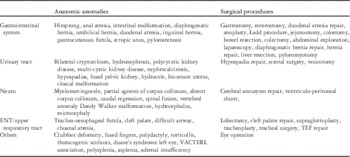
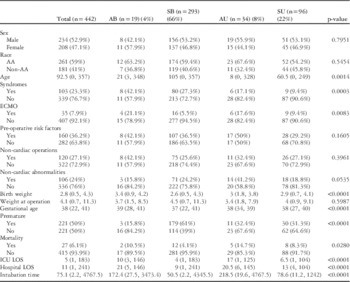
Mean age at surgery was 113.1±99.6 days, with significant variability between the four treatment groups, the youngest being in the hybrid uni-ventricular AU group (73.4±96.4 days; p=0.0014). Gender (53% male) and race (59% African-American) were similar among all treatment groups, as was weight at surgery (4.5±2.1 kg). There were significant differences among groups with regard to the presence or absence of genetic syndromes (23%), with the highest finding in those who underwent alternative hybrid palliation for bi-ventricular physiology (42%; p=0.0003). Furthermore, gestational age (mean 35.7±4.5 weeks), prematurity (defined as a gestational age <37 weeks, 50% of all patients), and low birth weight (mean 2.6±0.9 kg) were significantly different among treatment groups. The most premature (34.5 weeks of gestation, 61% prematurity) and smallest at birth (2.3±1 kg) were in the SB group. The smallest at the time of surgery were premature neonates with single ventricle physiology requiring hybrid strategies for palliation 4.1±1.8 kg. Major pre-operative risk factors including sepsis, immune deficiency, necrotising enterocolitis, malnourishment (n=35; 7.8%), seizures, intracranial haemorrhage, need for cardio-pulmonary resuscitation, pre-operative extracorporeal membrane oxygenation, and pre-operative mechanical ventilation were present in 36% of all patients and did not significantly differ among treatment groups. Major non-cardiac abnormalities (24% of all patients) requiring same-admission surgeries on other organ systems (27%) were similar among treatment groups and are listed in Table 1. Complete characterisation of patients can be seen in Table 2.
Major non-cardiac abnormalities and same-admission non-cardiac surgery.

Patient characteristics and outcomes.

AA=African-American; AB=alternative bi-ventricular; AU=alternative uni-ventricular; ECMO=extracorporeal membrane oxygenation; LOS=length of stay; SB=standard bi-ventricular; SU=standard uni-ventricular
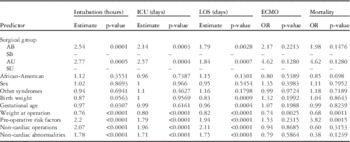
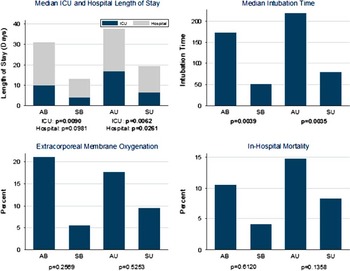
The unadjusted association of variables with end points is depicted in Table 3. End points included intubation time (median 75.3 hours (2.2, 4767.5)), ICU stay (5 days (1, 183)), hospital length of stay (11 days (1, 241)), need for extracorporeal membrane oxygenation (8%, n=35), and mortality (6%, n=27). Intubation, ICU stay, and hospital stay were significantly different between treatment groups, whereas no difference was detected for extracorporeal membrane oxygenation and mortality (Table 3; Fig 1). Not surprisingly, alternative palliative strategies for both bi-ventricular and uni-ventricular hearts resulted in significantly longer mechanical ventilation times (AB 172.4 hours (27.5, 3473.4) and AU 218.5 hours (19.6, 4767.5) compared with standard repairs or palliations (SB 50.5 hours (2.2, 4345.5) and SU 78.6 hours (11.2, 1242.0)) (p=0.0001 and 0.0005, respectively). Accordingly, with alternative strategies, significantly longer ICU stays were required for patients with both bi-ventricular and uni-ventricular hearts (AB 10 days (3, 146) and AU 17 days (1,125)) compared with standard care (SB 4 days (1,183) and SU 6.5 days (1,104)) (p=0.0003 and 0.0004, respectively). Longer length of hospital stay was required when alternative surgical strategies were attempted (AB 21 days (5, 146) and AU 20 days (6,145)) compared with standard care length of stay (SB 9 days (1,241) and SU 13 days (4, 104)) (p=0.007 and 0.0028, respectively).
Univariable associations.

AB=alternative bi-ventricular; AU=alternative uni-ventricular; ECMO=extracorporeal membrane oxygenation; LOS=length of stay; OR=odds ratio; SB=standard bi-ventricular; SU=standard uni-ventricular
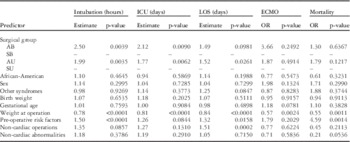
The adjusted association of variables with end points is depicted in Table 4. All models were adjusted for race, sex, genetic syndromes, birth weight, gestational age, weight at operation, other risk factors, other operations, and other cardiac abnormalities. When comparing patients with bi-ventricular and uni-ventricular hearts, surgical strategy affected the length of intubation (p=0.0039 and 0.0035, respectively), length of ICU stay (p=0.0090 and p=0.0062, respectively), and length of hospital stay. With respect to length of hospital stay, surgical strategy affected only patients with uni-ventricular hearts (p=0.0261). Despite the prolonged need for respiratory, intensive, and hospital care, as well as a positive trend in the need for extracorporeal membrane oxygenation and mortality, statistical significance was not reached. The impact of same-admission surgery for other major organ systems translated into a significantly longer hospital length of stay in the 27% of patients who needed it compared with those who did not (p=0.0025) (Table 4; Fig 1).
Multivariable associations.

AB=alternative bi-ventricular; AU=alternative uni-ventricular; ECMO=extracorporeal membrane oxygenation; LOS=length of stay; SB=standard bi-ventricular; SU=standard uni-ventricular
Discussion
Alternative palliative surgical and hybrid techniques were used to manage high-risk neonates and infants with complex CHD in our emerging programme, which helped buffer mortality and improve survival, although at the cost of prolonged need for mechanical ventilation, longer length of hospital stay, and increased trend in the need for extracorporeal membrane oxygenation. The primary reason to use unconventional palliative strategies involved a patient-tailored approach for babies with severe co-morbidities including prematurity, poor nutritional status, low birth weight and low weight at operation, and major non-cardiac congenital and genetic abnormalities in an effort to make them reasonable surgical candidates and avoid withdrawal of support. Practically, this often meant breaking down a more straightforward/standard but more aggressive procedure into two or more smaller procedures, judged to be potentially less traumatic. The second reason involved practical considerations pertaining to our newly assembled care team, sometimes with manpower leanness at all levels and particularly during night shifts with junior physicians and nursing staff. Combined with patient-related factors were initial operational logistics, building, and materials shortcomings, which led to flexibility in medical decision-making to accommodate for potential high-risk situations, even in standard-risk patients.
Lower weight at surgery influenced our treatment strategy, making us withdraw from more established surgical repairs and palliations and move towards alternative hybrid pathways. The algorithm seemed less aggressive for more fragile babies, involving less or no exposure to cardio-pulmonary bypass and/or potentially less post-operative haemodynamic instability, as may occur with systemic-pulmonary artery shunt-dependent palliations. In our study, the mean weight at birth was 2.6±0.9 kg and at surgery it was 4.5±2.1 kg among all groups, with the lowest findings among the AB and AU groups. Heavier weight was significantly associated with decreased length of intubation (p<0.0001), ICU stay (p<0.0001), and hospital length of stay (p<0.0001), as well as decreased mortality (p=0.0011) and extracorporeal membrane oxygenation need (p=0.0024). This is in accordance with other studies showing increased mortality in patients with low weight and poor nutritional status at the time of surgical repair.Reference Curzon, Milford-Beland and Li 3 , Reference Goff, Luan and Gerdes 4 Curzon et alReference Curzon, Milford-Beland and Li 3 found significantly higher mortality in infants weighing 1–2.5 kg compared with those weighing 2.5–4 kg for several surgical procedures. Lower weight remained strongly associated with mortality after adjustment by the RACHS categorisation and Aristotle complexity levels.Reference Goff, Luan and Gerdes 4 Wei et alReference Wei, Azen and Bhombal 5 found an increased risk for post-operative infections (p<0.0001) in patients with low weight at surgery, with a cut-off weight at 2.4 kg. Low weight at surgery has been associated with higher morbidity not only in neonates and infants but also in older children: in a study by Anderson et al,Reference Anderson, Kalkwarf and Kehl 6 weight-for-age Z score of <−2 at Fontan completion was associated with a higher rate of serious post-operative infections and longer length of hospital stay.
We found signs of malnourishment in 35 (7.8%) of our patients, without a significant difference among treatment strategies. The effect of pre-operative nutritional status on post-operative outcomes in children undergoing surgery for CHDs was assessed by Radman et al,Reference Radman, Mack and Barnoya 7 showing lower total body fat mass and acute and chronic malnourishment to be associated with worse clinical outcomes. They also reported an inverse correlation between total body fat and brain natriuretic peptide levels. The duration of inotropic support and brain natriuretic peptide increased concomitantly to decreasing nutritional status in their patients, supporting the hypothesis that malnourishment is associated with decreased myocardial function.Reference Radman, Mack and Barnoya 7 A clear association between poor nutritional status and adverse outcome has recently sparked efforts to streamline nutritional practices in inter-stage single ventricle patients. Keating et alReference Keating, Simsic and Kogon 8 examined the impact of early fundoplication or a gastrostomy tube on the mid-term outcomes of patients with single ventricle physiology. hypoplastic left heart syndrome anatomy (p=0.002) and those with a morphological right ventricle (p=0.003) were associated with the need for fundoplication or gastrostomy. Although neither of the cardiac morphology variables affected mid-term survival, the need for fundoplication or gastrostomy was significantly associated with poor outcomes (hazard ratio of 4.3; p=0.003).Reference Keating, Simsic and Kogon 8 In addition, recent studies indicate that exclusive oral feeding post-Norwood is associated with higher age-for-weight Z-score at the time of stage II palliation,Reference Lambert, Pike and Medoff-Cooper 9 and gastrostomy/fundoplication is associated with higher inter-stage mortality.Reference Hebson, Oster, Kirshbom, Clabby, Wulkan and Simsic 10 Some surmise that the need for inter-stage tube feeding is a marker of unmeasured co-morbidities. As such, efforts by the National Pediatric Cardiology Quality Improvement Collaborative have resulted in improved inter-stage growth in several programmes around the country.Reference Anderson, Beekman and Kugler 11 We hypothesise that the co-morbidities seen in our population likely represent some of the “unmeasured”. Despite these challenges, our hospital survival is satisfactory; however, as previously mentioned, expectations are changing and inter-stage and mid-term survival are increasingly important.
Prematurity was present in 50% of our patient population, known to adversely impact on clinical outcomes in newborns requiring congenital heart surgery.Reference Wei, Azen and Bhombal 5 , Reference Azakie, Johnson and Anagnostopoulos 12 Wei at alReference Wei, Azen and Bhombal 5 found lower gestational age at birth to be associated with home oxygen use, higher tracheostomy rates, and discharge with a gastrostomy tube, without influencing survival to discharge. Azakie et alReference Azakie, Johnson and Anagnostopoulos 12 found a slightly lower survival trend among patients born at <37 weeks of gestation at 83 versus 97% among patients born at 37 weeks of gestation or greater, without achieving statistical significance. Necrotising enterocolitis, seizures, need for supplemental oxygen, and gavage feeds at discharge were all more frequent among their late preterm infants.Reference Azakie, Johnson and Anagnostopoulos 12 The correlation between prematurity and outcomes was also examined by Costello et al,Reference Costello, Polito and Brown 13 comparing neonates who were delivered at 39–40 completed weeks of gestation with those born at 37–38 weeks, who had increased mortality (6.9 versus 2.6%; adjusted p=0.049), morbidity (49.7 versus 39.7%; adjusted p=0.02), and longer duration of mechanical ventilation (adjusted p=0.05). Patients born after 40 or before 37 weeks of gestation had increased morbidity rates and required more days of mechanical ventilation and intensive care. Based on their findings, they suggest that morbidity and mortality rates are lowest when delivery occurs or may safely be delayed to 39–40 weeks of gestation.Reference Costello, Polito and Brown 13 Based on these findings and in concert with our own experience, we have reached an understanding with our own and other referring foetal–maternal medical teams to allow a gestational age of at least 38 weeks, when it is safe for the expecting mother and the foetus.
We showed that pre-operative risk factors, present in more than a third of our patients, including necrotising enterocolitis, sepsis, seizures, immune deficiency, cardio-pulmonary resuscitation, intracranial haemorrhage, pre-operative extracorporeal membrane oxygenation, and need for mechanical ventilation, were associated with significant higher lengths of intubation (p=0.0001) and hospital stay (p=0.0158, respectively), as well as a higher mortality rate (p=0.0014). We found major non-cardiac abnormalities requiring same-admission surgeries, present in 27.1% of our patients, to be associated with significantly longer length of hospital stay (p=0.0025) among our treatment groups. Patel et al evaluated the impact of non-cardiac congenital and genetic abnormalities on outcomes in patient with hypoplastic left heart syndrome, based on two large multi-institutional data sets. They suggested that the presence of co-existing non-cardiac anomalies or genetic abnormalities confer an additional risk of death for infants undergoing staged palliation for hypoplastic left heart syndrome.Reference Patel, Hickey and Mavroudis 14 Stage 1 in-hospital mortality (26 versus 20%, p=0.04) and mean post-operative length of stay (42 versus 31 days, p<0.0001) were greater, and post-operative complications were significantly more prevalent in infants with non-cardiac genetic defects. Chromosomal defects (n=14) were highly unfavourable: the early risk of death was doubled (10 year survival 25±9 versus 54±2%, p=0.005). The presence of non-cardiac abnormalities and genetic syndromes was associated with significantly delayed post-operative recovery (post-operative length of hospital stay >14 days) at both stage 1 (76 versus 67%, p=0.02) and stage 2 (31 versus 18%, p=0.007), as well as reduced survival.Reference Patel, Hickey and Mavroudis 14 Aortic atresia (versus stenosis), low birth weight, and presence of a non-cardiac abnormality or genetic syndrome were all independent risk factors for increased early risk of death after Norwood stage I operation.Reference Patel, Hickey and Mavroudis 14
Prematurity and genetic co-morbidity are commonplace in our programme. In our study, genetic syndromes (n=23.3%), with the highest incidence among patients who underwent bi-ventricular alternative palliation (n=42.1%, p<0.0002), were not significantly associated with longer intubation time, length of ICU and hospital stay, extracorporeal membrane oxygenation need, or mortality. With the exception of 22q11.2 deletion syndrome, morbidity data on large a number of patients with specific genetic syndromes/chromosomal anomalies are scarce. Simsic et alReference Simsic, Coleman and Maher 15 studied the effect of genetic abnormalities on short-term outcomes following neonatal cardiac surgery, finding a higher risk of post-operative complications, longer hospital length of stay, but no increase in hospital mortality. McDonald et alReference McDonald, Dodgen and Goyal 16 showed that children with 22q11.2 deletion have a higher risk of post-operative complications after cardiac surgery, such as prolonged infections, need for dialysis, and unplanned non-cardiac surgeries such as gastrostomy and gastrostomy with fundoplication, with no difference in length of mechanical ventilation, ICU length of stay, hospital length of stay, or mortality.
Study limitations
The limitations of the manuscript are inherent to those of any retrospective database study. The analysis focusses on outcomes of the immediate initial hospital stay during which the first surgery was performed and does not address follow-up issues pertaining to the need for unplanned re-operations or interventional catheter procedures. In patients with single ventricle physiology, inter-stage mortality, suitability for stage II, the results of either cavo-pulmonary anastomosis or comprehensive stage I+II palliation, or further down the single ventricle pathway, are also not addressed and judged beyond the scope of the manuscript.
In conclusion, the initial 4 years of our experience as the sole emerging congenital heart programme in a State treating neonates and infants with complex cardiac disease with a higher than expected incidence of accompanying non-cardiac co-morbidity has been encouraging. Alternative surgical and hybrid palliative pathways for bi-ventricular and single ventricle physiology in our highest-risk patients buffered risk, allowed us to expand the number of reasonable surgical candidates who may have otherwise been denied care, and achieved excellent outcomes. The flexible algorithms were tailored not only according to patient-related cardiac and non-cardiac co-morbidity, but also took into consideration the manpower and logistical limitations during a team-building phase. As the programme matures with more established protocols in a current phase of sustainability, we shall re-assess the necessity of less conventional palliations in our continued quest of providing quality care and achieving excellent benchmark outcomes.
( a , top left): median ICU and hospital length of stay by treatment group. ( b , top right): median intubation times by treatment group. ( c , bottom left): need for extracorporeal membrane oxygenation by treatment group. ( d , bottom right): in-hospital mortality by treatment group. AB=alternative bi-ventricular; AU=alternative uni-ventricular; SB=standard bi-ventricular; SU=standard uni-ventricular.

Acknowledgement
None.
Financial Support
This research received no specific grant from any funding agency, commercial, or not-for-profit sectors.
Conflicts of Interest
None.