Introduction
Considerable attention has been paid to the effects of dietary fats in modulating lipid metabolism (Bortz et al., Reference Bortz, Abraham and Chaikoff1963; Allee et al., Reference Allee, Baker and Leveille1971). Pig de novo fat synthesis largely takes place in the adipose tissue (O’Hea and Leveille, Reference O’Hea and Leveille1969; Bergen and Mersmann, Reference Bergen and Mersmann2005). Deposition and mobilization of fat depots are regulated at several levels. As for other metabolites, fat oxidation and synthesis occur in different cellular compartments and these processes are directly controlled by the level and activity of the enzymes involved. Enzyme activity may be regulated at transcription, translational or post-translation level. During the last decade it has been recognized that specific dietary lipids have unique biological activities, which are due to their stimulatory/inhibitory effects on the transcription of genes encoding enzymes involved in fat metabolism (Jump, Reference Jump2002).
Regulation of fatty acid (FA) metabolism is done through changes in transcription, messenger ribonucleic acid (mRNA) processing, mRNA stability or activity of several transcription factors like the peroxisome proliferators-activated receptor (PPAR) family (involved in FA oxidation) (Lee et al., Reference Lee, Pineau, Drago, Lee, Owens, Kroetz, Fernandez Salguero, Westphal and Gonzalez1995; Kersten et al., Reference Kersten, Seydoux, Peters, Gonzalez, Desvergne and Wrahli1999) and sterol regulatory element-binding protein-1 (SREBP–1) (involved in FA synthesis) (Kim and Spiegelman, Reference Kim and Spiegelman1996; Yahagi et al., Reference Yahagi, Shimano, Hasty, Amemiya-Kudo, Okazaki, Tamura, Iizuka, Shiomoiri, Ohashi, Osuga, Harada, Gotoda, Nagai, Ishibashi and Yamada1999). These two transcription factors are central for the regulation of the expression of several key enzymes involved in pathways controlling fat metabolism (Jump, Reference Jump2002).
The main focus on effects of dietary FA on transcription of lipogenic genes has been at the hepatic level (Azain, Reference Azain2004) since the liver is the most important organ regulating FA metabolism in mouse and humans (Bergen and Mersmann, Reference Bergen and Mersmann2005). However, in pigs, adipose tissue is the most important organ in fat synthesis (O’Hea and Leveille, Reference O’Hea and Leveille1969). Little is known about the effects of dietary FA on regulating gene transcription in pigs, and existing studies have only been performed on liver (Theil and Lauridsen, Reference Theil and Lauridsen2007), muscle and adipose tissue of weaning pigs and porcine adipocytes (Hsu et al., Reference Hsu, Wang, Liu and Ding2004; Liu et al., Reference Liu, Kuo, Wang and Ding2005a). This study was therefore conducted to investigate the effect of diets with different FA composition on the transcription of genes involved in fat metabolism in adipose tissue, liver and semimembranousus muscle in growing pigs during the fattening period.
Material and methods
Animals and diets
Sixty-one crossbred female pigs (Duroc ♂ × Landrace ♀) were fed a barley–corn–soybean meal-based diet during a 4-week pre-experimental period. Five gilts were slaughtered at the beginning of the trial (null animals), whereas 56 gilts (61.8 ± 5.2 kg BW) were randomly selected and assigned to one of seven dietary treatments (eight animals per treatment). Treatments were assigned randomly by animal weight and litter. The experiment comprised three periods with three, three and two pigs per treatment, respectively. Pigs had access to feed and water ad libitum and feed consumption was measured individually. Gilts were slaughtered at an average BW of 99.8 ± 8.5 kg. Samples from liver, neck backfat (adipose tissue) and semimembranosus muscle were taken after slaughter and immediately frozen in liquid nitrogen and then stored at −75°C until analysis. Experimental procedures were approved by IRTA’s ethical committee.
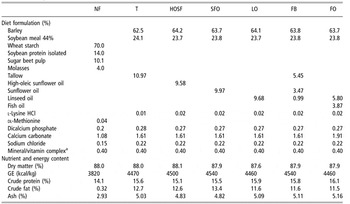
Seven diets were formulated to meet National Research Council (NRC) (1998) requirements (Table 1). Six fat-supplemented diets (containing 10% to 11% fat in total) were based on barley and soybean meal. Additionally, a semi-synthetic diet was formulated to contain no fat because traditional diets with no fat addition always contain around 2% of dietary fat. Fat was weighed and added into the mixer (1000 l capacity) and mixed with the rest of the feed for 5 min. Different fat sources were selected to obtain different FA composition of the diets: tallow (T), high-oleic sunflower oil (HOSF), sunflower oil (SFO), linseed oil (LO), blend (55% T, 35% SFO and 10% LO) (FB) and fish oil (FO) blend (40% fish oil and 60% LO). The T diet was designed to have a high content in saturated FA (SFA), the HOSF diet to have a high content in oleic acid, the SFO diet to have a high content in linoleic acid (FA from the n-6 series) and LO to have a high content in linolenic acid (FA from the n-3 series). The FB diet was planned to have a similar content in the main FA (palmitic, stearic, oleic, linoleic and linolenic acids) and the FO diet to have a high content in long polyunsaturated fatty acid (PUFA). Oils and fats were for food or feed-quality grade. The fat-supplemented diets were formulated in order to supply equal amounts of digestible fat based on previous measurements (Duran-Montgé et al., Reference Duran-Montgé, Lizardo, Torrallardona and Esteve-Garcia2007).
Diet composition and nutrient content

NF: no fat; T: tallow; SFHO: high-oleic sunflower oil; SFO: sunflower oil; LO: linseed oil; FB: fat blend (55% tallow, 35% sunflower oil and 15% linseed oil); FO: fish oil blend (40 fish oil and 60% linseed oil); GE = gross energy.
aOne kilogram of feed contains: vitamin A: 5000 IU; vitamin D3: 1000 IU; vitamin E: 15 mg; vitamin B1: 1.3 mg; vitamin B2: 3.5 mg; vitamin B12: 0.025 mg; vitamin B6: 1.5 mg; calcium pantothenate: 10 mg; nicotinic acid: 15 mg; biotin: 0.1 mg; folic acid: 0.6 mg; vitamin K3: 2 mg; Fe: 80 mg; Cu: 6 mg; Co: 0.75 mg; Zn: 60 mg; Mn: 30 mg; I: 0.75 mg; Se: 0.10 mg; ethoxiquin: 0.15 mg.
Chemical analyses
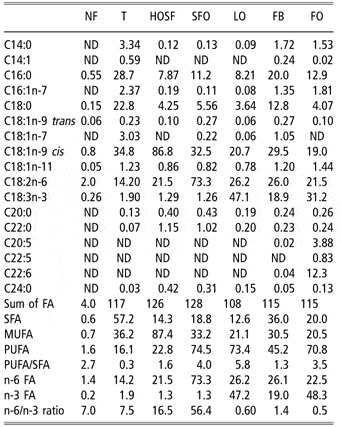
Diets were analyzed for dry matter (DM) content, crude protein, energy, ash and FA. The DM content, ash and energy were determined according to Association of Official Analytical Chemists (AOAC) (1990), and crude protein by Dumas (AOAC, 2000). For FA determination lipids were extracted by the Folch method (Folch et al., Reference Folch, Lees and Stanley1957) and then transmethylated with BF3 and methanolic KOH (Morrison and Smith, Reference Morrison and Smith1964). Diet composition and nutrient content are shown in Table 1 and FA profile of the seven diets in Table 2. FA contents were determined using an automated GC (Hewlett Packard 6890, USA) equipped with an automatic injector, using C19:0 as the internal standard.
Fatty acid content of experimental diets (mg/g)

NF: no fat; T: tallow; SFHO: high-oleic sunflower oil; SFO: sunflower oil; LO: linseed oil; FB: fat blend (55% tallow, 35% sunflower oil and 15% linseed oil); FO: fish oil blend (40 fish oil and 60% linseed oil); FA: fatty acids; SFA: saturated FA; MUFA: monounsaturated FA; PUFA: polyunsaturated FA; ND: not detected.
mRNA abundance
Approximately 30 mg of frozen liver or semimembranosus muscle tissues or 100 mg of backfat were homogenized in a tube containing TriReagent (Molecular Research Center, Cincinnati, OH, USA), and then 1-bromo-3-chloropropane (BCP) (Molecular Research Center, Cincinnati, OH, USA) was added in order to separate the upper phase containing the RNA upon centrifugation of the homogenate. RNA was precipitated in isopropanol and the precipitate was washed twice in ethanol 75%. Finally, the pellet was resuspended in 20 μl RNAse-free water (100 μl in liver samples).
Purified RNA was reverse-transcribed with oligo-dT and random primers using the Superscript III RNAse H reverse transcriptase kit (Invitrogen, Taastrup, Denmark) according to the manufacturer’s protocol.
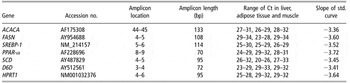
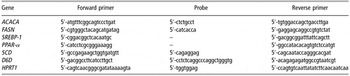
Reverse-transcribed material (1 μl) was amplified with TaqMan Universal PCR Master Mix (Applied Biosystems, Stockholm, Sweden) using primer pairs specific for each gene and signal was detected quantitatively by SYBR Green (SREBP-1 and PPAR-α), or probes labeled with carboxyfluorescein (FAM) on the 5′ end. Two different types of probes were used; locked nucleic acid probes (Human probe Library, Roche Applied Science, Denmark) were used to quantify acetyl CoA carboxylase (ACACA) (human probe #13), fatty acid synthase (FASN) (#9), stearoyl CoA desaturase (SCD) (#82) and hypoxanthine phosphoribosyltransferase (HPRT1) (#22), whereas delta 6 desaturase (D6D) was detected using a minor groove binding probe. Primers and probes were designed by using Primer Express Version 2.0 software, and HPRT1 was used as endogenous control (housekeeping gene). The design of primers for SREBP-1 did not allow discrimination between SREBP-1a and SREBP-1c. Details of primer/probe design and runs of real time (RT)-PCR are given in Table 3. No amplification was found in ribonuclease-free water and in samples containing genomic pig DNA. For RT-PCR, 40 cycles were used at 95°C for 15 s, and 60°C for 60 s. The response was quantified as the number of PCR cycles required to reach a certain threshold, and samples were analyzed in duplicates. The oligonucleotide sequences of forward primer, probe (in case it was used) and reverse primer for the studied genes are described in Table 4.
Accession numbers, amplicon location (span of exons), amplicon length, range of Ct values of different tissues and slope of standard curve of the analyzed genes

ACACA: acetyl CoA carboxylase; FASN: fatty acid synthase; SREBP-1: sterol regulatory element binding protein-1; PPAR-α: peroxisome proliferator activated receptor α; SCD: stearoyl CoA desaturase; D6D: Δ6-desaturase; HPRT1: hypoxanthine phosphoribosyltransferase.
Oligonucleotide sequences of forward primer, probe (in case it was used) and reverse primer for the studied genes

ACACA: acetyl CoA carboxylase; FASN: fatty acid synthase; SREBP-1: sterol regulatory element binding protein-1; PPAR-α: peroxisome proliferator activated receptor-α; SCD: stearoyl CoA desaturase; D6D: Δ6-desaturase; HPRT1: hypoxanthine phosphoribosyltransferase.
Calculations and statistics
Data to evaluate mRNA quantities were obtained as Ct values (the cycle number at which logarithmic plots cross a calculated threshold line) according to the manufacturer’s guidelines, and used to determine ΔCt values (ΔCt = Ct of the target gene − Ct of the housekeeping gene). The ΔCt data of each target gene were analyzed separately for each tissue using the MIXED procedure of SAS (Littell et al., Reference Littell, Milliken, Stroup and Wolfinger1996). Data were expressed relative to no fat (NF) diet by calculating ΔΔCt values (ΔCt of treatment − ΔCt of NF diet) and results were converted to expression levels according to Pfaffl (Reference Pfaffl2001) by taking into account the PCR efficiencies. The following statistical model was applied separately for each tissue:

where y is the observation (e.g. ΔCt values) in the jth period from the kth litter, μ is the overall mean, αi is a fixed treatment effect, βj is a fixed effect of period, χij is the interaction effect treatment × period, Ujk is the sow × period random effect and ε the residual errors. The treatment × period interaction was not significant for any of the variables, and therefore only main effects are reported. Significance levels of the correlate coefficients are based on Fisher (Reference Fisher1925).
Results
Fatty acids in diets and feeding regimens
The NF diet had a low content in all FA, whereas the fat-supplemented diets had high contents of specific FA; the T diet was characterized as having high contents of saturated FAs (palmitic and stearic FA), HOSF, SFO and LO diets were rich in oleic, linoleic and linolenic acids, respectively, the B diet had similar content of palmitic, stearic, linoleic and linolenic FA (Table 2) and the FO diet was rich in docosahexaenoic acid (DHA) and eicosapentaenoic acid (EPA).
Pigs fed NF showed higher feed : gain compared to FB (P = 0.059). No statistical differences were observed (P > 0.05) in average daily gain and final live weight of pigs among dietary treatments.
Gene expression related to treatments in the different tissues
Transcription of genes was analyzed separately for each type of tissue. Within a given tissue, the housekeeping gene (HPRT1) was not affected by treatment (liver P = 0.59, adipose tissue P = 0.88 and muscle P = 0.48). Hence, the HPRT1 was considered a suitable housekeeping gene.
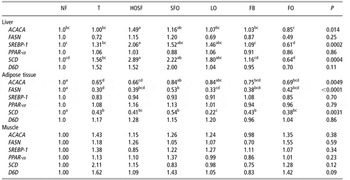
In the liver (Table 5) the dietary treatments affected the transcription of ACACA (P = 0.014), SREBP-1 (P < 0.001) and SCD (P < 0.001). For these three genes, hepatic transcription was higher (all P ⩽ 0.03) in pigs fed HOSF than in those fed FO, NF, FB and T. The lowest mRNA abundance was observed in pigs fed FO.
Liver, adipose tissue and muscle mRNA abundancesFootnote 1

ACACA: acetyl CoA carboxylase; FASN: fatty acid synthase; SREBP-1: sterol regulatory element binding protein-1; PPAR-α: peroxisome proliferator activated receptor-α; SCD: stearoyl CoA desaturase; D6D: Δ6-desaturase of pigs fed either a diet with no fat (NF) or a diet with 10% of fat from different sources: tallow (T), high oleic sunflower oil (HOSF), sunflower oil (SFO), linseed oil (LO), blend (55% tallow, 35% sunflower oil and 10% linseed oil) (FB) or fish oil blend (40% fish oil and 60% linseed oil) (FO). The mRNA’s abundances are expressed relative to the NF diet.
1 Means within are row with different letter are significantly different (P < 0.05).
In adipose tissue (Table 5) ACACA, FASN and SCD were affected by dietary treatment (P < 0.01, < 0.0001 and < 0.01, respectively). The mRNA abundance of the FASN and SCD was much higher for the NF diet when compared to the other diets, and ACACA mRNA abundance was also higher for the NF diet compared to the T, HOSF, FB and FO diets. For ACACA and FASN the lowest mRNA abundances were observed in T, whereas for SCD the lowest mRNA abundance was observed in pigs fed LO. None of the selected target genes were affected by dietary fat source in the semimembranosus muscle (Table 5) (all P > 0.05).
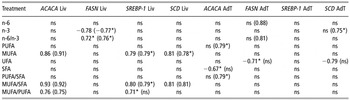
Correlation analyses of hepatic gene expression and dietary FA composition (Table 6) showed that the dietary monounsaturated FA (MUFA) content correlated positively (P < 0.05) with ACACA, SREBP-1 and SCD in the liver, and n-3 content correlated negatively with SCD (P < 0.1). When the NF diet was included in the data analyses, negative correlations between dietary unsaturated FA and SCD (P < 0.05), and FASN (P < 0.1) were observed, and dietary SFA correlated negatively with ACACA (P < 0.1) in adipose tissue. When the NF diet was not included in the data analyses, other correlations were observed in the adipose tissue, e.g. the dietary n-6 content and n-6/n-3 ratio correlated positively with the expression of FASN (P < 0.05) in adipose tissue (Table 6).
Correlation coefficients (r) between diet FA composition and gene expression of genes that were affected by treatments in the liver (Liv) and adipose tissue (AdT)

ACACA: acetyl CoA carboxylase; FASN: fatty acid synthase; SREBP-1: sterol regulatory element binding protein-1; SCD: stearoyl CoA desaturase.
Significant values were P < 0.05 (*when P < 0.1). ns: not significant.
In brackets, data when NF diet was excluded from comparisons.
Discussion
mRNA abundance in the liver
Fats and especially PUFA are inhibitors of hepatic lipogenesis in rats (Wilson et al., Reference Wilson, Hays and Clarke1986). Different studies (Brown and Goldstein, Reference Brown and Goldstein1997; Xu et al., Reference Xu, Nakamura, Cho and Clarke1999) suggest that SREBP-1c regulates the expression of several lipogenic genes involved in the synthesis of FA. In vivo experiments with different species such as rats (Xu et al., Reference Xu, Cho, O’Malley, Park and Clarke2002) and pigs (Hsu et al., Reference Hsu, Wang, Liu and Ding2004; Liu et al., Reference Liu, Wang, Kuo, Cheng, Shen and Ding2005b) have shown that dietary FO, rich in long PUFA, lowered SREBP-1 expression in the liver, similarly to the results of the present experiment in which pigs fed the FO diet with the highest contents in very long PUFA clearly showed the lowest SREBP-1 expression. In the present experiment, pigs fed FO diet also tended to show the lowest ACACA and SCD mRNA abundances in the liver possibly caused by inhibition of lipogenic genes by the low SREBP-1 expression. In contrast, pigs fed the HOSF diet showed the highest expression of SREBP-1, ACACA and SCD in the liver, suggesting that the high-oleic acid content of this diet indeed stimulated the expression of SREBP-1, as observed in rats (Xu et al., Reference Xu, Nakamura, Cho and Clarke1999). Pigs fed the NF diet received a higher fraction of energy from carbohydrate, but this did not increase the expression of genes related to lipogenesis as SREBP-1, ACACA or SCD genes in liver. Experiments with other species have shown the influence of PUFA on the expression of SREBP-1c (Blake and Clarke, Reference Blake and Clarke1990; Mater et al., Reference Mater, Thelen, Pan and Jump1999; Xu et al., Reference Xu, Nakamura, Cho and Clarke1999) brought about by a decrease in the mature form of SREBP-1 and consequently a decreased expression of lipogenic genes (Xu et al., Reference Xu, Nakamura, Cho and Clarke1999). In our study, pigs fed the diets rich in n-6 (SFO) and n-3 (LO) FA did not show low expression of lipogenic genes in the liver when compared to pigs fed the T diet. Our results are similar to those of Theil and Lauridsen (Reference Theil and Lauridsen2007) in which pigs of 56 days of age fed with a diet rich in n-6 FA had similar expression levels of lipogenic genes as pigs fed a diet rich in SFA. The SCD, involved in the transformation of stearic acid into oleic acid, and its mRNA is reduced in rat liver by PUFA (Lochsen et al., Reference Lochsen, Ormstad, Braud, Brodal, Christiansen and Osmundsen1997), but not by stearic and oleic acids. These findings suggest that FA desaturation is not inhibited by its reaction products as shown by the fact that the diet rich in oleic acid (HOSF diet) did not reduce SCD expression. In contrast to SREBP-1, no changes are reported in PPAR-α expression caused exclusively by dietary FA (Pegorier et al., Reference Pegorier, Le May and Girard2004; Jump et al., Reference Jump, Botolin, Wang, Xu, Christian and Demeure2005). We did not observe changes in PPAR-α mRNA abundance in response to dietary treatments either in the liver or in adipose or muscle tissues. Different studies (Lee et al., Reference Lee, Pineau, Drago, Lee, Owens, Kroetz, Fernandez Salguero, Westphal and Gonzalez1995; Leone et al., Reference Leone, Weinheimer and Kelly1999) report that the increase in lipid oxidation due to FA is mediated by PPAR-α since FA bind to PPAR-α and act as a transcription promoter, which lead to changes in expression of genes involved in lipid metabolism and storage.
Animals fed with very long PUFA (FO diet) tended to have a lower expression (P = 0.11) of D6D and SFO pigs have a higher expression of this gene. Tang et al. (Reference Tang, Cho, Nakamura and Clarke2003), in rats, found that FO decreased D6D expression; in contrast, the results observed with SFO show an opposite trend to that observed by Tang et al. (Reference Tang, Cho, Nakamura and Clarke2003) using sunflower oil, which is also high in n-6 PUFA.
mRNA abundance in adipose tissue
In previous reports, the effects of different FA types were tested to investigate their effects on lipogenesis; Allee et al. (Reference Allee, Baker and Leveille1971) demonstrated that 10% of corn oil or beef T added to diets had the same effects on suppressing lipogenesis in porcine adipose tissue. Smith et al. (Reference Smith, Knabe and Smith1996) tested in vitro lipogenesis in cultured adipocytes from piglets previously fed with different dietary treatments differing in their FA source. They observed that the C18:0-enriched diet resulted in lower lipogenesis compared to a C18:2-enriched diet and attributed this finding to the lower absorption of C18:0. Under most circumstances fat is deposited in fat depots without modifications of the FAs because growing pigs in commercial conditions are in a positive energy balance and diets contain large amounts of carbohydrates in the form of starch, which are used for de novo synthesis of lipids. In species like chickens, rodents or human, liver is the main organ for de novo synthesis, whereas in pigs this mainly takes place in adipose tissue (O’Hea and Leveille, Reference O’Hea and Leveille1969). In contrast to the liver, pigs fed with the no fat-added diet (NF diet) showed the highest mRNA abundance in adipose tissue of genes involved in the synthesis of palmitic acid (ACACA and FASN) and also a gene involved in FA desaturation (SCD). These results agree with the higher lipogenic rate observed by Smith et al. (Reference Smith, Knabe and Smith1996) in cultured adipocytes isolated from pigs fed a cornstarch diet as compared to pigs fed a 10% fat-added diet, and also agrees with the findings of Mersmann et al. (Reference Mersmann, Pond and Yen1984) who measured adipose tissue lipogenesis comparing carbohydrate and fat as energy source. In the present study, the higher SCD mRNA abundance in adipose tissue with the NF diet showed a different response pattern to what was observed in the liver. In addition, pigs fed the HOSF diet did not show the highest SCD expression as observed in the liver. In rodents (Blake and Clarke, Reference Blake and Clarke1990; Iritani et al., Reference Iritani, Komiya, Fukuda and Sugimoto1998) diets containing high levels of PUFA result in lower lipogenesis than those fed diets containing high levels of saturated or MUFA and in broilers SFO (a PUFA-rich diet) lowers FA synthesis (Sanz et al., Reference Sanz, Lopez-Bote, Menoyo and Bautista2000). Different studies with pigs report higher lipogenic rates in animals fed unsaturated FA than SFA (Waterman et al., Reference Waterman, Romsos, Tsai, Miller and Leveille1975; Freire et al., Reference Freire, Mourot, Cunha, Almeida and Aumaitre1998; Kouba and Mourot, Reference Kouba and Mourot1998; Kouba et al., Reference Kouba, Bonneau and Noblet1999). According to Chilliard (Reference Chilliard1993) and Azain (Reference Azain2004), in species like rodents and poultry where the liver is the primary site of lipogenesis, unsaturated FA are more inhibitory on FA synthesis than saturated FA. Results of the present experiment suggest that in pigs where adipose tissue is the primary site of lipogenesis, SFA are equivalent (or more potent) inhibitors of lipogenesis than unsaturated FA as animals fed the diet with the highest contents in SFA (T diet) tended to decrease the mRNA abundance of FASN, ACACA and SCD relative to other diets. In contrast to the abundance of liver SREBP-1 mRNA, adipose tissue showed no differences between treatments, suggesting that fat synthesis in pig adipose tissue could be regulated in a different manner than in the liver. This is consistent with findings by Kouba and Mourot (Reference Kouba and Mourot1998) and Waterman et al. (Reference Waterman, Romsos, Tsai, Miller and Leveille1975). Pigs fed the T diet, which had a high content of SFA, showed the lowest ACACA and FASN mRNA abundance and pigs fed the SFO diet, rich in linoleic acid, showed the highest expression of these genes among fat-added diets, suggesting that SFA inhibit the expression of these genes; other unsaturated fats resulted in intermediate values. In contrast, Hsu et al. (Reference Hsu, Wang, Liu and Ding2004) found no differences in mRNA contents of FASN either in adipose tissue or in the liver in weaned pigs fed 2% of T or DHA oil in diet. Correlation analyses of hepatic gene expression and dietary FA composition (Table 6) showed that the dietary MUFA content correlated positively (P < 0.05) with ACACA, SREBP-1 and SCD in the liver, and the n-3 content correlated negatively with SCD (P < 0.1). When the NF diet was included in the data analyses, negative correlations between dietary unsaturated FA and SCD (P < 0.05), and FASN (P < 0.1) were observed, and dietary SFA correlated negatively with ACACA (P < 0.1) in adipose tissue. When the NF diet was not included in the data analyses, other correlations were observed in the adipose tissue, e.g. the dietary n-6 content and n-6/n-3 ratio correlated positively with the expression of FASN (P < 0.05) in adipose tissue (Table 6). Still, both studies showed lower SREBP-1 mRNA abundances in liver of pigs fed DHA than in those fed T. The different mRNA abundance of SREBP-1 observed in liver but not in adipose tissue agrees with the work of Ding et al. (Reference Ding, Lapillone, Heird and Mersmann2003). Liu et al. (Reference Liu, Wang, Kuo, Cheng, Shen and Ding2005b) also found differences in the liver but not in adipose tissue when feeding pigs with 10% algal DHA for 2 days and they suggested that it was due to the inability to increase DHA content in adipose tissue in that short period of time.
In contrast to other tissues, semimembranosus muscle was not affected by any of the selected target genes. It is possible that this was related to the secondary role of muscles as lipid reservoir depots.
Fat level was higher than when used in practical pig production, but we would expect similar actions of specific FA at lower concentrations. Further research is needed to evaluate how the responses on gene expression are affected by the FA level.
In the liver, FASN expression was reduced by dietary n-3 FA as shown by correlation results, meaning that although FASN was not affected by dietary treatments, the presence of linolenic acid or long-chain n-3 PUFA in the diets could exert an effect on FASN liver expression. Correlations showed that MUFA (or absence of other metabolically active FA) could exert an effect on liver gene expression, relative to lipogenic genes. In liver these correlations were significant irrespective of the inclusion of the NF treatment, but in adipose tissue correlations differed when this diet was included. This suggests that dietary effects on liver gene expression are due to FA composition, while in adipose tissue effects may also depend on the fat level. In adipose tissue the correlation coefficient between FASN expression and n-6 dietary content (as well as the dietary n-6/n-3 ratio) suggests that linoleic acid in the diet could exert a positive action on adipose FA synthesis.
Conclusions
Results of the present study show that the dietary FA profile modifies mRNA abundances of genes encoding lipogenic enzymes and that these dietary effects are tissue specific. Adipose tissue is the main organ for FA synthesis and our results suggest that the effects of the different FA on this tissue are different from those found in the liver and in semimembranousus muscle. In liver, FO diet rich in long-chain n-3 PUFA decreased mRNA of lipogenic genes, whereas in adipose tissue, the main reductions in lipogenic enzyme mRNAs were observed in pigs fed T, which is rich in SFA. None of the selected target genes was affected by dietary fat source in semimembranousus muscle.
Acknowledgments
This project was supported by Instituto Nacional de Investigación Agraria, of Spanish Government (INIA). Project no. RTA03-060-C2-1. Also the support of Selecció Batallé S.A. in providing semen for production of the animals used in the experiment is appreciated.