Introduction
The management of chronic suppurative otitis media (CSOM) mucosal disease in children has undergone a paradigm shift. There is now a considerable acceptance of paediatric tympanoplasty worldwide, with numerous studies reporting a success rate comparable to adult tympanoplasty. However, the minimum age for paediatric tympanoplasty is still a subject of debate, with no consensus among otologists to date.
The English-language medical literature cites some compelling reasons for early tympanoplasty. Firstly, a longer duration of CSOM and repeated bouts of a discharging ear increases the potential risk of cholesteatoma formation. Secondly, as children have excellent cochlear reserves, they are ideal candidates for tympanoplasty.Reference Umapathy and Dekker1–Reference Sarkar, Roychoudhury and Roychoudhury5 Moreover, the protracted course of CSOM also increases the potential risk of ossicular chain necrosis leading to deafness. Hearing loss in children leads to poor language development and peer acceptance. This undermines academic achievement and affects the overall personality profile of the child.Reference Riberio, Rui, Netercia, Jose and Antonio6–Reference Emir, Ceylan, Kizilkaya, Gocmen, Uzunkulaoglu and Samim9
With this background, we carried out a prospective study with the central aim of evaluating the success rate of tympanoplasty type I in patients aged five to eight years. To the best of our knowledge, this is the first cohort study on paediatric tympanoplasty, conducted using a control group, that has been carried out exclusively in school-going children aged five to eight years.
Materials and methods
A prospective comparative study was carried out at the ENT department, Lady Hardinge Medical College and Associated Hospitals, New Delhi, India, during the period 2011–2013. The study was approved by the Medical Division of the University Board of Studies, University of Delhi, New Delhi.
The cohort study sample comprised 60 patients of either sex who were suffering from CSOM mucosal disease. The patients were divided into 2 groups of 30 each. Group A comprised paediatric patients aged 5–8 years and group B comprised patients aged over 14 years.
The following inclusion criteria were adopted in this study: informed consent was mandatory, all patients had CSOM mucosal disease (both unilateral and bilateral); and all patients had a perforation in the pars tensa for a minimum period of six months and a dry ear for a period of four weeks.
Excluded from the study were patients requiring ossiculoplasty and those with: cholesteatoma in the ear, granulation tissue in the ear, a previously operated ear, only one hearing ear, or any congenital anomalies such as cleft lip, cleft palate and syndromal diagnosis.
All patients underwent a clinical evaluation and detailed ear examination. Once the requisite investigations and pure tone audiometry had been conducted, the patients underwent tympanoplasty type I; this involved a post-auricular inlay technique using a temporalis fascia graft. Patients attended regular (on a monthly basis) follow-up sessions in the ENT out-patients department for six months post-operatively.
An intact graft and a minimum of 10 dB hearing improvement in two consecutive frequencies at six months post-operation were considered evidence of graft and audiological success.Reference Umapathy and Dekker1, Reference Singh, Sidhu, Sharma and Singh2, 10 Residual perforations were regarded as treatment failure.
All data were recorded in a proforma. As the sample sizes were small, the data were analysed for significant differences using: the Mantel–Haenszel (chi-square) test and the Fisher exact test for confirmation (where applicable). Epi Info™ version 7 software was used to carry out these statistical tests.
Results
Group A (paediatric patients aged 5–8 years) comprised 15 males and 15 females, and group B (patients aged over 14 years) consisted of 17 males and 13 females.
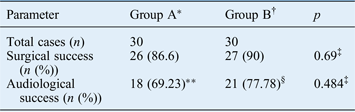
With regard to graft acceptance, the overall success rate was 86.6 per cent in group A and 90 per cent in group B (Table I). When the data were statistically analysed using Mantel–Haenszel and Fisher exact tests, p was found to be more than 0.05, clearly indicating that the difference was not significant. Hence, it is evident that age did not influence the outcome of tympanoplasty type I.
Overall success of tympanoplasty type I

*Paediatric patients aged 5–8 years; †patients aged over 14 years. ‡p > 0.05 (i.e. not significant). **Eighteen of 26 cases of surgical success had audiological improvement; §21 of 27 cases of surgical success had audiological improvement
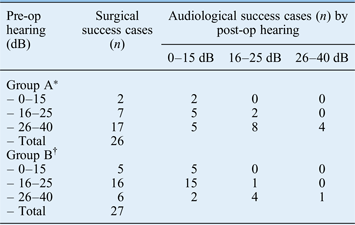
Of the 26 successfully operated cases in group A, audiological improvement of 10 dB in 2 consecutive frequencies was observed in 18 patients. Similarly, a definitive improvement in hearing was recorded in 21 of the 27 successfully operated cases in group B (Tables I and II). Statistical evaluation of the data did not reveal a significant p-value, implying that both groups had comparable audiological improvement.
Detailed audiological success data
Eighteen of 26 cases of surgical success had audiological improvement; 21 of 27 cases of surgical success had audiological improvement. *Paediatric patients aged 5–8 years; †patients aged over 14 years. Pre-op = pre-operative; post-op = post-operative
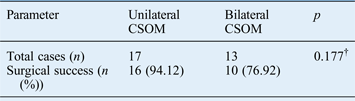
In our study, the status of the contralateral ear was taken as a measure of eustachian tube function.Reference Knapik and Saliba3, Reference Collins, Telischi, Balkany and Buchman11–Reference Bluestone, Cantekin and Douglas14 In group A (the study group), out of a total of 30 patients, 13 had contralateral ear pathology. The patients with an intact tympanic membrane were also screened for secretory otitis media by impedance audiometry, but no case of secretory otitis media was recorded in this study. Of these 13 patients, 10 had a successful graft uptake with hearing improvement. In the remaining 17 patients with unilateral pathology, 16 had a successful outcome. When these data were statistically analysed, a p-value of 0.177 was obtained, which is not significant (Table III). The findings indicate that eustachian tube function did not influence the outcome of tympanoplasty in paediatric patients aged five to eight years in our study.
Our results would be incomplete without addressing the issue of complications. There were no complications of underlay tympanoplasty (i.e. intra-operative bleeding, facial nerve palsy, chorda tympani nerve injury, wound haematoma, infection, perichondritis, epithelial pearl formation, granulation tissue formation at the tympanomeatal flap or sensorineural hearing loss) for any of the patients in our study. Moreover, no complications related to general anaesthesia were observed in our paediatric patients aged five to eight years. In addition, no case of secretory otitis was seen in any of the operated ears of patients in either group at six months post-operation.
Influence of contralateral ear in group A*
* As a measure of eustachian tube function, in paediatric patients aged five to eight years.
†p > 0.05 (i.e. not significant). CSOM = chronic suppurative otitis media
Discussion
There exists a strong bias against paediatric tympanoplasty. In general, most otologists tend to delay the closure of perforation in a child. It is reasoned that in view of unpredictable eustachian tube function, high frequency of otitis media and upper respiratory tract infections, and technical difficulties in the operation as a result of a narrow ear canal, this operation is best deferred in a child to as late as possible.Reference Tos and Lau15–Reference Kessler, Potsic and Marsh17
In this study, we recorded a surgical success rate of 87 per cent in group A (paediatric patients aged five to eight years) (Table I). This compares well with the success rates of 35–92 per cent reported in the medical literature for paediatric tympanoplasty.Reference Singh, Sidhu, Sharma and Singh2, Reference MacDonald, Lusk and Muntz8, Reference Koch, Friedman, McGill and Healy18, Reference Pignataro, Grillo, Cappacio and Zaghis19 Our audiological success rate of 70 per cent (Tables I and II) in this age group also compares well with the hearing improvement rates of 60–100 per cent reported in the medical literature for paediatric tympanoplasty.Reference Umapathy and Dekker1, Reference Singh, Sidhu, Sharma and Singh2, Reference Sarkar, Roychoudhury and Roychoudhury5, Reference Boronat-Echeverría, Reyes-García, Sevilla-Delgado, Aguirre-Mariscal and Mejía-Aranguré7, Reference Koch, Friedman, McGill and Healy18 However, it is interesting that despite performing tympanoplasty type I in a select group with no ossicular damage, hearing improvement was not recorded in all cases. This may be a result of scar tissue that prevented total hearing restoration with grafting. In addition, a laterally placed graft (which is thick) may thin over time, with anticipated hearing improvement Reference Singh, Sidhu, Sharma and Singh2, Reference Todd20
Our study adds to the literature showing no relationship between age and paediatric tympanoplasty. Various studies by Kessler et al.Reference Kessler, Potsic and Marsh17, François et al.,Reference François, Juvanon, Contencin, Bobin, Manac'h and Narcy21 Lau and Tos,Reference Lau and Tos22 Ophir et al.,Reference Ophir, Porat and Marshak23 and Gersdorff et al.Reference Gersdorff, Garin, Decat and Juantegui24 have found no impact of age on paediatric tympanoplasty. Similarly, studies carried out by Albera et al.,Reference Albera, Ferrero, Lacilla and Canale25 Yung et al.,Reference Yung, Neumann and Vowler26 Umapathy and Dekker,Reference Umapathy and Dekker1 and Merenda et al.Reference Merenda, Koike, Shafiei and Ramadan12 have reported excellent results for paediatric tympanoplasty, and have failed to find any correlation between age and tympanoplasty success. In another prospective study (conducted by the principal investigator of this study), Singh et al. found age to be a redundant factor in patients aged 8–14 years.Reference Singh, Sidhu, Sharma and Singh2 Recent studies by Boronat-Echeverría et al.,Reference Boronat-Echeverría, Reyes-García, Sevilla-Delgado, Aguirre-Mariscal and Mejía-Aranguré7 and Knapik and Saliba,Reference Knapik and Saliba3 have also advocated early myringoplasty in children, preferably above the age of six years.
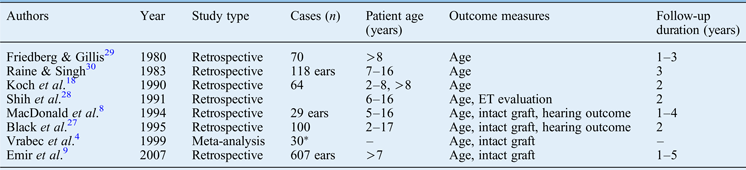
However, studies by Black et al.Reference Black, Hickey and Wormald27 and MacDonald et al.Reference MacDonald, Lusk and Muntz8 found patient age of less than eight years to be a poor prognostic factor for tympanoplasty. A landmark study conducted by Koch et al. in 1990 recommended a minimum age of eight years.Reference Koch, Friedman, McGill and Healy18 Similarly, a meta-analysis by Vrabec et al. found age to be a significant factor for tympanoplasty and concluded that tympanoplasty should not be performed in children below 10 years of age.Reference Vrabec, Deskin and Grady4 However, of the 30 studies cited in this meta-analysis, 25 independently reported that age was not a significant factor for paediatric tympanoplasty. A more recent study by Emir et al. also found that the success of tympanoplasty was correlated with age.Reference Emir, Ceylan, Kizilkaya, Gocmen, Uzunkulaoglu and Samim9 This postponement of tympanoplasty until 8–12 years of age has additionally been endorsed by Shih et al.,Reference Shih, de Tar and Crabtree28 Friedberg and Gillis,Reference Friedberg and Gillis29 and Raine and Singh,Reference Raine and Singh30 in their respective studies.
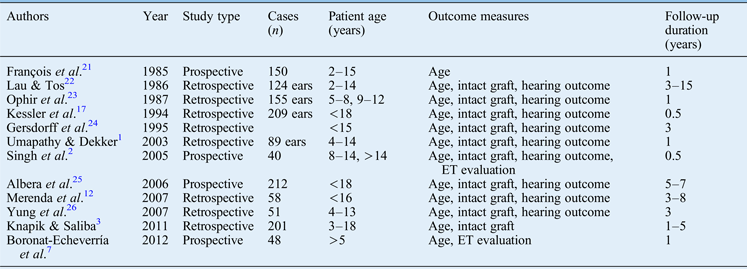
A judicious analysis of these studies revealed that most of those conducted in the twentieth century highlighted the importance of age as a significant factor that might influence the outcome of paediatric tympanoplasty (Tables IV and V). These studies cite the importance of eustachian tube function. The idea of delaying tympanoplasty until the patient is eight years of age is based on eustachian tube maturity. It is believed that at this age there is an increase in the cartilaginous portion of the tube and tensor palatini mass, which aids ventilatory function.Reference Singh, Sidhu, Sharma and Singh2 Hence, the effect of eustachian tube function on paediatric tympanoplasty was examined in this study.
Summary of studies in favour of paediatric tympanoplasty
ET = eustachian tube
Summary of studies against paediatric tympanoplasty
*Number of studies included in meta-analysis. ET = eustachian tube
In our study, the status of the contralateral ear was used as a measure of eustachian tube function.Reference Knapik and Saliba3, Reference Collins, Telischi, Balkany and Buchman11, Reference Merenda, Koike, Shafiei and Ramadan12 Eustachian tube function is usually symmetrical in children; thus, a contralateral ear with an intact tympanic membrane may be a good indicator of expected eustachian tube function of the operated ear.Reference Megerian13, Reference Bluestone, Cantekin and Douglas14 The statistical analysis of our data clearly indicates that eustachian tube function is not an important factor and does not influence the outcome of the said surgery (Table III).
There are conflicting views regarding the role of the eustachian tube. Many authors, such as Merenda et al.,Reference Merenda, Koike, Shafiei and Ramadan12 Collins et al.Reference Collins, Telischi, Balkany and Buchman11 and Uyar et al.,Reference Uyar, Keleş, Koç, Oztürk and Arbağ31 have found a strong association between contralateral ear status and tympanoplasty success rate in children, thereby highlighting the importance of eustachian tube function. In contrast, studies by Albera et al.,Reference Albera, Ferrero, Lacilla and Canale25 Vartiainen,Reference Vartiainen32 Pignataro et al.,Reference Pignataro, Grillo, Cappacio and Zaghis19 Singh et al.,Reference Singh, Sidhu, Sharma and Singh2 and Knapik and SalibaReference Knapik and Saliba3 have failed to elucidate any relationship between eustachian tube function and graft uptake in children.
The role of the eustachian tube in middle-ear pathology is questionable today. No definitive test exists to support evidence-based medicine in the measurement of eustachian tube function, and the pathophysiology of various ear diseases is now explained in accordance with the recent ‘gas diffusion theory’, rather than eustachian tube dysfunction.Reference Todd20, Reference Sade, Ar, Ludman and Wright33 The perforation alters the physiological function of the middle ear. As the normal anatomy is restored by tympanoplasty, the proper physiological function of the middle ear is regained, and thus the patency of the blocked eustachian tube is reversed. This also leads to proper aeration of the middle-ear cleft on a long-term basis.Reference Manning, Cantekin, Kenna and Bluestone34 Hence, in view of the aforementioned new theory, otologists' acceptance of tympanoplasty in a younger age group is increasing in the modern era. The review of the medical literature revealed that tympanoplasties have been successfully carried out in children as young as two and three years of age.Reference Collins, Telischi, Balkany and Buchman11
It would also be prudent to note that CSOM mucosal disease is not immune to complications, and there is no concept of a safe ear.Reference Browning, Merchant, Kelly, Swan, Canter, McKerrow and Gleeson35 Any type of CSOM has the potential to cause intracranial and extracranial complications, and thus all perforations should be surgically closed at the earliest opportunity.
Furthermore, as deafness has a detrimental impact on speech, it is important for all health personnel to note that at five years of age children are initiated into education. This lays down the foundation for future academic achievements, making a strong case for early perforation closure in children.
• The age at which tympanoplasty should be performed in paediatric patients is a controversial subject
• Medical texts report a minimum age of eight years, in view of eustachian tube maturity
• This study evaluated tympanoplasty in paediatric patients aged five to eight years
• In this age group, success rates for graft uptake and audiological success were 87 and 70 per cent respectively, comparable to older individuals
• Eustachian tube function had no significant influence on paediatric tympanoplasty outcome in this age group
Some limitations should be considered when interpreting our results. This study was not randomised and the results were not ascertained blindly. As data from a single tertiary healthcare centre were used, potential bias (e.g. selection bias) and confounding factors may have crept in. The study did not take into account the discharge history (we could not analyse this factor because of inconsistencies in the patients' histories reported by illiterate parents and the absence of previous medical records). Some critics may contend that our sample size was small and the follow-up period short (which may preclude the detection of otitis media effusion).
Nevertheless, the major strength of this study lies in its prospective nature and use of a control group, which allowed for the accurate assessment of data without depending upon recalled information. The true value of this study in the context of existing literature is the evaluation of tympanoplasty type I exclusively in children aged five to eight years, hitherto unreported in the medical literature. The study amalgamates the realities of clinical practice with the rigours of scientific data analysis in accordance with the principle of evidence-based medicine, and thus may invite a hypothesis for future prospective, randomised trials.
Conclusion
Based on our findings, we conclude that tympanoplasty has a definitive role in paediatric patients aged five to eight years.