The judge and polymath William Jones (1746–94) and the adventurer and politician John Macpherson (c. 1745–1821) have enjoyed sharply contrasting reputations among historians of early British rule in India. Whereas Jones has long been sanctified for exposing Europe to Indian civilization, Macpherson, when remembered at all, has been demonized for indulging in corruption and intrigues. Whereas Jones has been seen to personify a fleeting current of imperial Indophilia, Macpherson has been seen to illustrate the baser tendencies that ostensibly opposed it. Such disparate treatment, however, belies the close relations between the two men. Overlapping in the East India Company's Bengal administration from 1783 to 1786, Jones and Macpherson collaborated on a range of official and intellectual pursuits. Their close association calls into question a historiography that has celebrated the one and dismissed the other. It suggests that, in the eighteenth-century British empire in India, Enlightened scholarship and patronage politics were interdependent spheres.
The correspondence presented here sheds light on the Jones–Macpherson connection as well as on its broader implications. Of the three letters, two have never been published and the third has been published only in part. None of the manuscripts, it appears, have been noticed by modern scholars. To some extent, the letters’ long oblivion can be explained by the scholarly neglect of Macpherson, among whose papers they reside. A further explanation, however, is that Macpherson's papers were long inaccessible. In the 1920s, his descendants loaned many of them to the historian H. H. Dodwell for the publication Warren Hastings’ letters to Sir John Macpherson (1927). The collection evidently remained in Dodwell's possession. Upon his death in 1946, it was appropriated by C. H. Philips, his successor as director of the School of Oriental and African Studies in London. That same year marked the bicentenary of Jones's birth and the beginning of a renewal in scholarly interest that culminated in Garland Cannon's edition of Jones's correspondence (1970). Yet not only did Cannon obtain no documents from Philips for that work, but he obtained no more than a single reference from him for a subsequent bibliography.Footnote 1
Cannon was not the only scholar who seems to have been shut out. Around the same time, Hugh Trevor-Roper complained that ‘Sir Cyril Philips evidently treats the [Macpherson] papers as his private property; and he has refused to allow me to see them.’ According to Trevor-Roper's posthumous editor, only in 1981 was Philips ‘finally forced by mounting academic, family, and ultimately legal pressure, to disgorge what was left of the collection of Macpherson papers which he had guarded illegitimately, jealously, and incompetently for thirty-five years’. Over 200 items from the hoard were placed on permanent loan at the India Office Library (now part of the British Library). And with this development, ‘A long-running academic scandal, damaging to historical scholarship, had finally come to an end.’Footnote 2 Even so, use of the Macpherson collection was restricted for another two decades. Thus, the most recent printed catalogue of European-language manuscripts in the India Office Records describes the collection as ‘closed to public access’ and gives no further information.Footnote 3 Only since 2002 have the letters been available to researchers, at the reference MSS Eur F291/202.
The three letters date to mid-1785, a decisive period for the intellectual exploration of India that would come to define Jones's legacy. Jones was serving as a judge on the Calcutta Supreme Court, a position he had travelled east to take up two years earlier. It was now that he began to study Sanskrit, initially to check the influence of the court pandits (elite Hindu scholars) who interpreted Hindu laws for British judges. Beginning to compare Sanskrit with Western classical languages, however, Jones laid the groundwork for his ‘Third Anniversary Discourse’, which he would deliver before the Asiatic Society of Bengal in February 1786. Jones's thesis on this occasion – that Sanskrit, Greek, and Latin shared a common ancestor – would be profoundly influential in his own time and long thereafter. No less an achievement, perhaps, was his founding in 1784 of the Asiatic Society, which provided a stimulus to the growing number of Europeans engaged in researches in Asia. Jones initially offered the role of president of the society to then-Governor-General Warren Hastings, whose patronage had done much to nourish the present crop of Company scholar-administrators. But Hastings convinced Jones to lead the society himself, apparently recognizing his advantageous standing. Hastings was a controversial figure, who had made numerous enemies since taking office, and who already had some forewarning of the rancorous impeachment that awaited him back in Britain.Footnote 4 Jones, by contrast, was seemingly sheltered from the winds of India politics by his crown appointment and subsequent knighthood, by his financial security as a judge, and by his established reputation as a scholar. It is a question, then, why such a respectable figure should have associated with the likes of Macpherson.
At first glance, Macpherson would seem to have led a very different existence from Jones. Several studies have detailed the machinations that marked his early career, including dealings with the Nawab of Arcot that saw him banned temporarily from the Company's service.Footnote 5 In assessing Macpherson's later tenure as a member of the Supreme Council (1781–5) and then as acting governor-general (1785–6), historians have largely accepted the judgements of better-remembered rivals. One such rival accused Macpherson of ‘mean jobbing and peculation,…duplicity and low intrigues’; another reported that ‘I have not heard one person speak of his public conduct without contempt and indignation.’Footnote 6 Thus, modern scholars have dismissed Macpherson as corrupt and incompetent, and typically devoted to him no more than a passing reference.Footnote 7 When Dodwell, the editor of Hastings's correspondence with Macpherson, suggested that the latter had ‘been somewhat hardly dealt with by the historians’, a reviewer chided him for ‘yielding rather to his kindness of heart than to his critical judgment’.Footnote 8 Yet Dodwell was one of only a few scholars who had access to Macpherson's papers before 2002, and he was probably better informed than his critic. A recent biographer of the Macpherson family – one of the few writers to cite these papers since 2002 – has likewise painted a more complex portrait of the man.Footnote 9
There was indeed another side to Macpherson that is difficult to reconcile with his long-standing reputation, but which helps explain his close connection with Jones. Educated at the University of Edinburgh and steeped in the Scottish Enlightenment, Macpherson expounded a commercial vision of empire that eschewed conquest for the pacific exchange of goods and ideas.Footnote 10 It was not for nothing that Jones dubbed Macpherson ‘the statesman and the scholar’, whose ‘mind can grasp the whole field of literature and criticism, as well as that of politics’.Footnote 11 One vehicle for advancing a synthesis of scholarship and politics was the Asiatic Society, of which Macpherson served as an honorary patron. He boasted to his friend and former tutor Adam Ferguson of the global commerce in knowledge that ‘the researches of Sir William Jones and others’ would stimulate with his assistance.Footnote 12 As the letters below indicate, Macpherson forged numerous links with the society, often blurring the distinction between official and personal auspices. He involved the society in the management of state institutions, like the Calcutta Madrasa, but also rendered informal aid to members, like Jones, and to Indian collaborators, like Zain-ud-Din ‘Ishqi and Ramalocana Kanthavarna. The evidence of such activities in the letters complicates the received portrait of Macpherson as a venal operator for whom ideas and theories were merely instrumental.
Conversely, it complicates the received portrait of Jones as a pure thinker who ‘resisted any political aspects of scholarship’.Footnote 13 Jones's biographers have long insisted that he cultivated patronage reluctantly in Britain and foreswore it upon obtaining a lucrative post in India.Footnote 14 Jones himself probably sought to give this impression.Footnote 15 His effusive flattery of Macpherson and repeated applications for sponsorship, however, suggest that acting independently was not a viable, or at least an attractive, option. While Macpherson's views were capable of taking in the sublime heights of philosophy, Jones's were capable of taking in the grubby depths of patronage politics.
The general proposition that knowledge and politics have historically gone hand in hand has been well aired, especially since Edward Said and the post-colonial turn. If Jones has proved uncommonly difficult to place at the nexus of knowledge and politics, it is because this nexus has almost invariably been located on cultural terrain.Footnote 16 In the numerous studies of British or European ‘representations’ of India, the older sense of ‘Orientalism’ as a love of the East has not yielded entirely to its newer sense as a project of control.Footnote 17 Accordingly, scholars have continued to parse Jones's comments for evidence of his and his generation's ‘cultural attitudes’.
The new letters serve to indicate the limitations of this long-standing research agenda. Despite some qualifications, the conventional portrait of Jones remains as a standard-bearer of British Indophilia.Footnote 18 A recent commentator, for instance, has contrasted the ‘Indophilia’ of Jones with the ‘Indophobia’ of his colleague and eulogist John Shore (later Lord Teignmouth). According to this commentator, Shore's view of India as ‘“wholly void of public virtue”’ was ‘anathema’ to Jones; any attempt to ‘associate such sentiments with Jones's name’ would be ‘little short of libellous’.Footnote 19 Unfortunately for this claim, Jones now turns out to have made a statement nearly identical to Shore's on the anomaly of ‘a virtuous Hindu’. The point to be made here is not that Jones has been assigned to the wrong camp – that he was an Indophobe (or ‘Anglicist’) instead of an Indophile. Rather, it is that these categories are reductive and ahistorical. Aspersions on Indian morality and affirmations of imperial despotism may shock modern liberal sensibilities, but they were commonplace among eighteenth- and nineteenth-century Europeans, and compatible with a wide range of political and philosophical orientations. A focus on largely illusory clashes of cultural attitudes has obscured other arenas of Indo-European interaction that generated greater debate and more profoundly stimulated the forces of historical change.
The most prominent such arena on display in these letters is scholarly patronage. Macpherson's nineteen-month governor-generalship, though little examined by historians, represented a momentous hinge between those of Hastings and Charles Cornwallis. As the letters attest, scholarly patronage was a key feature of Macpherson's administration: he corresponded with Jones on intellectual pursuits, took an active interest in the Asiatic Society and the Calcutta Madrasa, and treated with Indian scholars like Zain-ud-Din and Ramalocana. The reputation to be gained in Britain from such pursuits was politically advantageous. Macpherson and his supporters would trot out Jones's scholar-and-statesman endorsement for decades to come.Footnote 20 Nor were the political implications of scholarly patronage confined to the metropolitan context. Zain-ud-Din's address (attached to Letter 1) suggests the ways in which the East India Company and its governors-general used ideas about knowledge to buttress their precarious authority among Indian rulers and elites. The period following 1785 was a pivotal one for the Company, witnessing the impeachment of Hastings in Britain and the reforms of Cornwallis in India. It is to be hoped that the following letters will prove a spur to research not only on Jones, but also on the understudied figure of Macpherson; not on cultural attitudes, but rather on the politics of scholarly patronage.
Letter 1
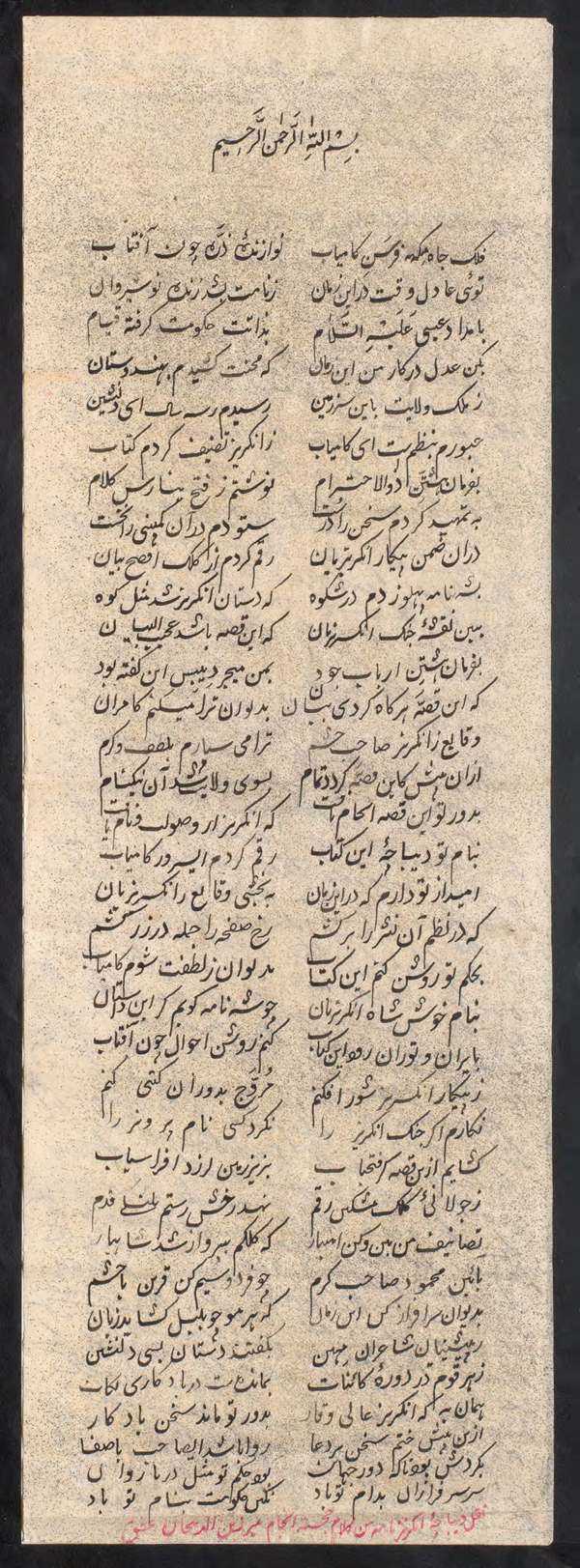
The first letter, dated 22 May 1785, was partly (and inaccurately) printed by Jones's early biographer Lord Teignmouth; the same version was later reprinted by Garland Cannon.Footnote 21 The original document reveals several new details, including the persistence of Jones's poor health and the first steps taken at Macpherson's behest to reform the Calcutta Madrasa. The middle paragraph refers to enclosed verses from the poet Zain-ud-Din ‘Ishqi. This paragraph and Jones's reasonably full translation of the verses comprise the portion of the letter that has already been published. The verses in their original Persian are reproduced here for the first time (Figure 1), and provide an example of Indian court literature adapted to suit the tastes of new British patrons.
Persian verses by Zain-ud-Din ‘Ishqi. British Library, Mss Eur F291/202. © British Library Board.

RussapuglaFootnote 22
22 May 1785
My dear Sir,
I passed Surman's bridgeFootnote 23 last night in my way to your garden, but was taken with such a sickness and headach from obstructed bile, that I was obliged to return.
It was my intention to present to you in the Author's name, the book which I now send. The poet Zainu'ddein was recommended to me, soon after I came to India, as a worthy ingenious old man. I enclose his verses to you with a hasty translation, on the back of the paper, of the best couplets. The smaller volume contains part of the Epick poem, which is written with enthusiasm, and the other volume is filled with pleasing Odes and Elegies, all in the old man's handwriting. He is married to immortal verse, and his highest ambition is to be an atom in one of your sunbeams.Footnote 24
The members of our SocietyFootnote 25 who met on Thursday highly approved your proposal concerning the Medresah,Footnote 26 and Mr. ChambersFootnote 27 readily undertook to visit it: the HeadFootnote 28 of the College was to show him the Charter yesterday, from which it will appear whether the original rules of the institution have been observed.
I am rather better to day, but some company, who are just come and will stay late, prevent my waiting on you. I am, with great regard,
my dear Sir,
your faithful and affect[ionat]e Serv[an]t
W. Jones
The Opening of an Epick Poem in Persian on the Military Transactions of the English in India by Meírzá Zaínu'ddein.
MACPHERSON, exalted as the sky, prosperous in thy undertakings, who, like the Sun, receivest even atoms in thy beams! Thou art the Just One of this age, and in thy name that of Núshireván Footnote 29 revives. With the aid of Jesus (blessed be his name!) the Government acquires its stability from thy mind. I have composed a Poem in words of Truth, beginning with a panegyrick on the Company. It contains a recital of the Wars of the English, described with an animated pen. By the command of Hastings, entitled to reverence, I began, a book on the Victory at Benares;Footnote 30 but, before the completion of my task, that honourable man returned to his country. In thy government has my work been completed; and with thy name have I adorned its opening; in hope that thou wilt send me fresh materials, to decorate with golden verses the cheeks of my book. If I compose a Sháhnámeh Footnote 31 on the glorious name of the King of England, the book will fly over Iran and Túrán,Footnote 32 & the deeds of this nation will blaze like the Sun; if I sing the Achievements of the English, the name of Parveíz Footnote 33 will no more be mentioned. If I open a chapter of their Conquests Afrasyáb Footnote 34 will tremble under the earth; the rapid motions of my dark reed will make Rustem Footnote 35 halt and droop. Hear my strains with discernment and my pen shall soar with the wings of a falcon. Favour me, as Sultan Mahhmúd Footnote 36 showed kindness to Firdaúsy; that we may be a pair of tuneful nightingales. The actions of all nations are commemorated; let those of the English be celebrated under thy auspices. May thy orders be resistless as the sea, the head of the contumacious be in thy power, and the seal of Government bear thy name!
Letter 2
The second letter, dated 5 June 1785, concerns Jones's efforts to formulate and promulgate binding oaths for Hindus and Muslims who appeared in British-administered courts in India. Like other of his correspondence on the subject, it evinces a suspicion of brahman pandits. Noteworthy, however, is Jones's plan to check their legal interpretations through Persian translations rather than Sanskrit originals. This indicates that Jones had not yet made up his mind to learn Sanskrit himself, a project on which he would embark by the following September.Footnote 37
Sunday Morning.
5 June [1785]Footnote 38
My dear Sir,
I have the pleasure to send you two copies of the Mohammedan Oaths: the plate will not be finished, till the 10th but the writing is, I believe, correct. It will be more difficult to settle the Hindu oath, from the reserve of the Brahmans: the great object will be, to prevent them from giving absolution to perjured men; and I will discover this secret by the help of the Persian translations, which I have caused to be made from the Sangscrit. I am, dear Sir,
your faithful &
affect[ionat]e Serv[an]t
W. Jones.
Letter 3
The third letter is undated, but must have been written in or shortly after October 1785, when Jones returned to Calcutta from the venerable Hindu ‘university’ at Nadia, and informed Macpherson that he had brought Ramalocana Kanthavarna with him.Footnote 39 Here Jones does not offer a rationale for introducing the two men. His description of the vaidya scholar as ‘a perfect Grammarian and an excellent moralist’, however, may suggest the range of subjects he expected them to discuss. Elsewhere, Jones described Ramalocana as ‘a pleasant old man’, who, as a member of the vaidya caste, lacked the ‘priestly pride’ of his brahman pupils at Nadia.Footnote 40 Jones's stated reason for beginning to study Sanskrit was to prevent brahman pandits from distorting Hindu law through wilful mistranslation. He was apt to distrust not only this community, but Hindus in general, describing them at one point as ‘incapable of civil liberty’ and under the necessity of being ‘ruled by an absolute power’.Footnote 41 The present letter contains an even stronger instance of such rhetoric, presenting ‘a virtuous Hindu’ as an almost unexampled ‘curiosity’. Macpherson's later acquaintance Sir Thomas Strange evidently saw or heard of this remark, for he paraphrased it in the margin of a book.Footnote 42
Court House
9 o'clock
Wedn[esda]y Morn[in]g
My dear Sir,
I beg leave to present to you a greater Asiatick curiosity than the rarest production of nature or the oldest manuscript – a virtuous Hindu. His name is Rámlóchan Cantabern, a physician, and teacher of Sanscrit at Nediyā. He is a perfect Grammarian and an excellent moralist. I would have waited on you with him, but am forced to go into Court, and am, dear Sir,
ever affect[ionate]ly yours,
W. Jones.