Introduction
Population prevalence estimates of lifetime posttraumatic stress disorder (PTSD) in American adults range from 6.4–6.8%.Reference Kessler, Chiu, Demler and Walters1, Reference Pietrzak, Goldstein, Southwick and Grant2 A number of mental disorders and physical consequences commonly occur comorbidly with PTSD, including major depressive disorder (MDD), alcohol and drug abuse/dependence,Reference Friedman and Yehuda3–Reference Tucker, Pfefferbaum and Doughty5 suicidal ideation and suicide attempts,Reference Oquendo, Friend and Halberstam6 sleep disruption,Reference Kobayashi, Boarts and Delahanty7, Reference Caldwell and Redeker8 and a host of medical conditions.Reference Boscarino9 Given negative psychological sequelae of trauma exposure, research into the effectiveness of early intervention is necessary to determine whether the symptoms of PTSD after a traumatic event can be prevented or reduced. Early psychological interventions have been shown to be relatively ineffective and, in some cases, detrimental,Reference Mayou, Ehlers and Hobbs10, Reference Rose, Brewin and Andrews11 leading researchers to examine the efficacy of early pharmacologic approaches to preventing the development of PTSD.
During the initial period of memory consolidation following a traumatic event, repetitive retrieval, reliving, and re-encoding of the event may lead to that memory becoming “overconsolidated.”Reference Larkin12, Reference Pitman13 Endogenous hypercortisolemia and exogenous glucocorticoid administration has been found to impair retrieval and declarative memory performance,Reference de Quervain, Henke and Aerni14–Reference Martignoni, Costa and Sinforiani21 raising the possibility that therapeutic disruption of retrieval mechanisms soon after a traumatic event might protect against the development of PTSD symptoms.Reference deQuervain, Aerni, Schelling and Roozendaal22
Earlier research has suggested that administering hydrocortisone during septic shock or cardiac surgery leads to a decrease in the incidence of subsequent PTSD.Reference Schelling, Stoll and Kapfhammer23–Reference Schelling, Kilger and Roozendaal25 However, these findings have been reported in patients in whom the cortisol may directly decrease the clinical disease, and thereby the stressfulness of the ongoing traumatic event. Recently, Zohar etal. Reference Zohar, Yahalom and Kozlovsky26 conducted a small randomized trial of the efficacy of a single high-dose (100–140 mg based on weight) bolus of hydrocortisone at preventing PTSD in mildly injured emergency department patients with acute stress symptoms. Hydrocortisone recipients (n = 8–10) reported significantly fewer PTSD symptoms than did placebo control patients (n = 7–9) at 2-week and 1- and 3-month follow-ups, suggesting the efficacy of early high-dose hydrocortisone treatment as a secondary prevention for PTSD. Given concerns of higher hydrocortisone doses impacting immune functioning and healing in injured trauma patients, we aimed to examine the efficacy of a low-dose (20 mg, twice daily: bid) 10-day course of cortisol treatment in preventing or reducing PTSD symptoms in a larger sample of more seriously injured adult traumatic injury victims. It was hypothesized that those patients receiving cortisol would be less likely to meet PTSD diagnostic criteria and would report fewer symptoms of PTSD at 1- and 3-month follow-ups than participants receiving the placebo treatment. Further, given consistent relationships between PTSD and depressionReference Breslau, Davis, Peterson and Schultz27, Reference Campbell, Felker and Liu28 and between PTSD and lower quality of life (QOL),Reference Clark and Kirisci29–Reference Zatzick, Marmur and Weiss32 it was hypothesized that hydrocortisone recipients would report fewer depressive symptoms and higher health-related QOL than placebo recipients. Finally, as the link between prior psychopathology and PTSD following a subsequent trauma is well-established,Reference Blanchard, Hickling and Taylor33–Reference Ursano, Fullerton and Epstein39 we also assessed the role of prior mental health treatment as a moderator.
Methods
Subjects
Participants consisted of 64 (34% female, 84% Caucasian, 14% African American, 2% Native American) injury victims, ranging in age from 18–56 (mean = 30.6 ± 10.7) who were admitted as trauma inpatients at a Midwestern Level-1 trauma unit. Exclusionary criteria included: Glasgow Coma Scale (GCS)Reference Teasdale and Jennett40 score of less than 14; exposure to a traumatic event that occurred more than 12 h before initial medication dose could be given or inability to initiate first medication dose within 12 h of event; allergy to cortisol or medical/medicinal contraindications to cortisol administration; pregnant or breastfeeding; exposure to a trauma of a potentially ongoing nature (e.g., domestic violence); presence of injuries requiring delayed operative procedures; patient reported corticosteroid use in the previous 6 months; and/or patient had injuries that required treatment with steroids.
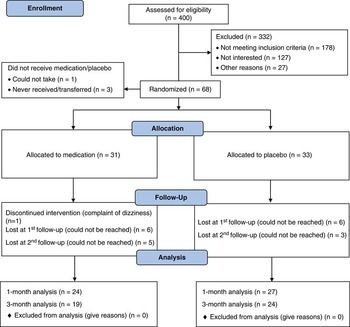
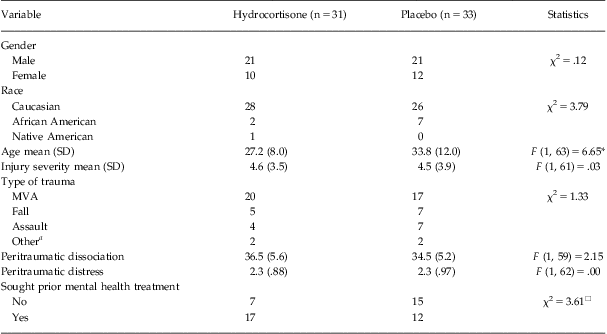
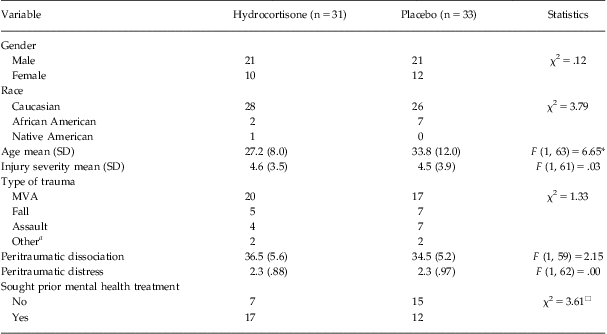
Participants were randomized to either the hydrocortisone (n = 31: 21 males, 10 females) or placebo (n = 33: 21 males, 12 females) groups. Figure 1 details participant flow through the protocol. Fifty-one participants (78%) were retained at the 1-month follow-up, and 42 (65%) were retained at the 3-month follow-up. There was no differential drop out between the hydrocortisone and placebo groups. At 1 month posttrauma, 6 participants had dropped from the placebo group and 7 had dropped from the hydrocortisone group, while at 3 months a total of 9 had dropped from the placebo group and 12 had dropped from the hydrocortisone group. Of the 13 participants who dropped between randomization and the 1-month follow-up, one complained of dizziness and asked to discontinue participation (from the hydrocortisone group), and the remaining 12 could not be contacted after numerous attempts at varying times during the day and night for at least 7 days. Drop-outs between the 1- and 3- month time points were all due to inability to reach participants after repeated attempts. There were no differences between drop-outs and participants who were retained through the protocol on any study variable. Demographic and baseline clinical data are presented in Table 1.
Consort flow diagram of participants through the protocol.

Frequency of demographic and study variables by group at baseline
Note. MVA = motor vehicle accident.
aOther = pedestrian vs. car.
□p < .10, *p < .05.
Procedure
The human subjects review boards of Kent State University and Summa Health System approved the following procedures.
In-hospital recruitment
All non-amnestic participants who met criterion A for exposure to a traumatic event, satisfied the inclusion criteria, and were deemed at high-risk for developing PTSD were eligible. Based on meta-analytic determination that the strongest predictor of PTSD following trauma was the presence of peritraumatic dissociation (weighted r = .35)Reference Ozer, Best, Lipsey and Weiss41 scores on the 10-item Peritraumatic Dissociative Experiences Questionnaire Self-Report Version (PDEQ)Reference Marmar, Weiss and Metzler42 were used to determine risk for PTSD. In previous studies, the PDEQ has been administered to trauma victims within 24 h of a traumatic event, and patients who were subsequently diagnosed with PTSD were found to have higher PDEQ scores (means scores = 3.1 ± 0.9 and 3.0 ± 0.9) than patients who did not develop PTSD (mean scores = 2.3 ± 0.6 and 2.3 ± 0.7).Reference Birmes, Brunet and Carreras43, Reference Birmes, Carreras and Charlet44 In order to target patients at high risk for PTSD, eligible participants were required to score at least a total of 27 (mean score of 2.7 per item) on the PDEQ. Following eligibility determination, participants were consented in-hospital and randomly assigned, in double-blind fashion, to either a 10-day course (plus a 6-day taper period) of hydrocortisone or placebo.
Medication
Following consent, the nurse administered the first oral dose [20 mg hydrocortisone (Cortef, Pharmacia) or placebo capsules] within 12 h of hospital admission. Following the protocol of Pitman etal.,Reference Pitman, Sanders and Zusman45 participants continued to take either the 20 mg hydrocortisone or placebo capsules every 12 h (bid) for 10 days, followed by a 6-day taper period to avoid any potential adrenal suppression. The medication regimen was tapered by halving the dose every 2 days. The 20 mg bid dose was chosen, as it reliably interferes with memory retrievalReference de Quervain, Roozendaal, Nitsch, McGaugh and Hock46, Reference Kirschbaum, Wolf, May, Wippich and Hellhammer47 while having no obvious effect on wound healing or of increasing risk of infection in trauma victims.Reference DiPasquale and Steinetz48–Reference Anstead50 Higher doses of cortisol have resulted in increased infection and delayed wound healing.Reference Anstead50 Patient adherence to study medication was measured by diary self-reports and pill counts.
1-Month and 3-month post-injury assessments
The 1-month and 3-month follow-up assessments were identical and took place in participants’ homes. Participants were administered the Clinician-Administered PTSD Scale (CAPS)Reference Blake, Weathers and Nagy51 to assess incidence of PTSD and PTSD symptoms, and were asked whether they had ever previously received help from a mental health professional. Participants were left a packet of self-report measures and a stamped envelope in which to return completed forms. Self-report measures included the Center for Epidemiological Studies—Depression ScaleReference Radloff52 to assess depressive symptoms and the SF-36 to assess health-related quality of life.Reference Ware and Sherbourne53 At the 1-month follow-up, 33 participants (16 hydrocortisone, 17 placebo) returned the self-report instruments, while 25 participants (12 hydrocortisone, 13 placebo) returned the self-report instruments at the 3-month follow-up. There were no significant differences between participants who did and did not return self-report packets on any demographics, in-hospital assessments, or outcome variables assessed at any time point.
Measures
Peritraumatic dissociation
As mentioned, the PDEQReference Marmar, Weiss and Metzler42 was used as a screener to identify individuals at high risk for developing PTSD. The PDEQ is a 10-item questionnaire designed to measure retrospective reports of derealization, depersonalization, disorientation, and altered time and body perception on 5-point scales ranging from 1 (Not at all true) to 5 (Extremely true). The PDEQ has demonstrated reliability and validity.Reference Marmar, Weiss and Metzler42 However, due to truncating the range of scores by requiring a minimum score of 27 to be eligible to participate, Cronbach's alpha for the present sample was .45.
Peritraumatic distress
Peritraumatic distress was assessed via the Peritraumatic Distress Inventory (PDI)Reference Brunet, Weiss and Metzler54 in order to determine whether randomization of groups was equal with regard to initial emotional responses to the trauma. The PDI demonstrated good internal consistency (alpha = 0.85) for the present study.
PTSD symptoms
PTSD severity at each follow-up was assessed with the CAPS.Reference Blake, Weathers and Nagy51 The CAPS is a structured clinical interview that provides both a dichotomous measure of PTSD incidence and a continuous measure of PTSD severity. The intensity and frequency of individual symptoms are rated on a 0 (never, not at all) to 4 (daily or almost daily, extreme) scale. Coefficient alphas were .87 and .89 at 1- and 3-month follow-ups, respectively.
Depression
The Center for Epidemiological Studies—Depression Scale (CES-D),Reference Radloff52 a reliable and valid 20-item measure assessing cognitive, affective, and vegetative aspects of depression, was used to assess severity of depressive symptoms at each follow-up time point. Coefficient alphas were .82 and .77 at 1- and 3-month follow-ups, respectively.
Health-related quality of life
Health-related QOL was measured with the RAND SF-36, a standard and widely accepted measure developed in the Medical Outcomes Study (MOS).Reference Radloff52 The SF-36 consists of 8 subscales; the focus of the present study was on general health. Coefficient alphas were .75 and .84 for the 1- and 3-month follow-ups, respectively.
Prior mental health treatment
Participants self-reported whether they had “ever received help from a mental health professional” at the baseline assessment.
Data Analysis
All analyses were conducted with the Statistics Package for the Social Sciences Version 19 (SPSS 2010). An alpha level of .05 (two-tailed) was used to determine significance in all analyses. Preliminary analyses were conducted to determine normality of distributions of predictor and outcome variables. To determine potential covariates, simple differences between groups on continuous variables were evaluated using one-way analysis of variance (ANOVA), and differences between groups on categorical variables were examined with Fisher's exact tests. Next, Pearson chi-square analyses were conducted to examine group difference in PTSD diagnostic status. A series of repeated measures, or analyses of covariance (ANCOVAs), were conducted on participants who completed the entire study protocol (completer analyses) to determine whether groups differed on PTSD, depression, or QOL scores at 1 and 3 months posttrauma. Finally, two separate ANCOVAs were conducted to determine the moderating impact of previously receiving mental health treatment at 1 and 3 months, respectively. Dividing the already small sample size by whether or not participants received prior mental health treatment provided cells with insufficient numbers of participants, so separate ANCOVAs were conducted for each follow-up assessment.
Findings
Initial analyses revealed that hydrocortisone and placebo groups did not differ in race, gender, type of trauma, injury severity scores, or peritraumatic dissociation or distress (see Table 1). However, there was a significant drug group difference for age (33.8 ± 12.0 versus 27.2 ± 8.0, for the placebo versus hydrocortisone group, respectively). Age was also significantly correlated (r = −.30, p < .05) with 1-month PTSD symptoms and was used as a covariate in subsequent analyses. Groups also marginally differed in the number of participants who had received prior mental health treatment (χ2 = 3.61, p = .06), with a higher percentage of participants in the hydrocortisone group receiving prior mental health treatment.
At 1 month posttrauma, 2 (8%) of the hydrocortisone recipients and 3 (11%) of the placebo recipients met full PTSD diagnostic criteria, χ2 (1) = .11, p = .75; at 3 months, no (0%) hydrocortisone recipients and 3 (14%) placebo recipients met full PTSD diagnostic criteria, χ2 (1) = 2.93, p = .09.
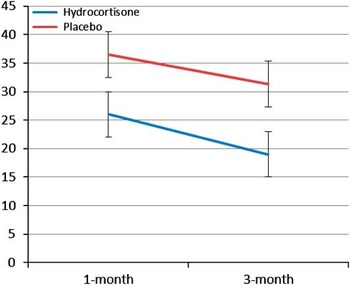
A repeated measures ANCOVA on CAPS total scores at 1 and 3 months post-trauma, covarying for age, revealed a significant main effect of time, F(1,36) = 6.9, p = .01; partial η2 = .16, and a significant main effect of drug group, F(1,36) = 4.0, p = .05; partial η2 = .10 (see Figure 2). PTSD symptoms decreased over time for both groups, and hydrocortisone recipients reported fewer PTSD symptoms at follow-up assessments than did placebo recipients (estimated marginal means = 26.0 ± 4.0 vs. 36.5 ± 3.9 and 19.4 ± 4 vs. 31.3 ± 3.9 at 1- and 3-month follow-ups, respectively). The drug group × time interaction was nonsignificant, F(1,36) = 0.1, p = .74.
Adjusted mean CAPS total PTSD symptom scores (± std. error) for the placebo and hydrocortisone groups at 1 and 3 months posttrauma.

In order to examine whether participants receiving prior mental health treatment (prior treatment) moderated the impact of medication group, we conducted two additional 2 × 2 factorial ANCOVAs with drug group and prior treatment as between subject factors, controlling for age. Results for 1 month posttrauma revealed significant main effects of drug (F(1,46) = 7.2, p = .01; partial η2 = .14) and prior treatment groups (F(1,46) = 6.7, p = .01; partial η2 = .13) that were qualified by a drug × prior treatment interaction, F(1,46) = 4.2, p = .05; partial η2 = .08. Therefore, we divided participants into those who had previously received mental health treatment (n = 17 hydrocortisone and 12 placebo recipients) and those who had not (n = 7 hydrocortisone and 15 placebo). Post hoc ANOVAs revealed no differences in PTSD scores between drug groups in those who had previously received treatment for mental health issues. However, in participants who had not previously received mental health treatment, hydrocortisone recipients reported significantly fewer PTSD symptoms than placebo recipients (15.1 versus 33.9, respectively; F(1,20) = 4.80, p < .05; see Table 2).
Differences in CAPS total PTSD symptom scores between placebo and hydrocortisone groups divided as to whether participants had previously sought help from a mental health professional or not

aMeans are significant at p < .05.
A similar 2 × 2 factorial ANCOVA was conducted on 3-month PTSD symptoms with drug group and whether the participant had received prior mental health treatment (n = 13 hydrocortisone and 9 placebo recipients who received prior treatment versus n = 6 hydrocortisone and 11 placebo who had not received prior treatment) as between subject factors, controlling for age. Results revealed a significant main effect of drug group, F(1,34) = 4.6, p = .04; partial η2 = .12, but no main effect of prior help, F(1,34) = 0.7, p = .40, or interaction effect, F(1,34) = 1.3, p = .26. This suggested that, regardless of prior mental health treatment, the hydrocortisone group (adjusted mean PTSD symptoms =18.0) reported fewer PTSD symptoms 3 months posttrauma than the placebo group (adjusted mean = 31.0). The lack of a significant interaction effect may have reflected decreased power due to the smaller sample size at the 3-month time point.
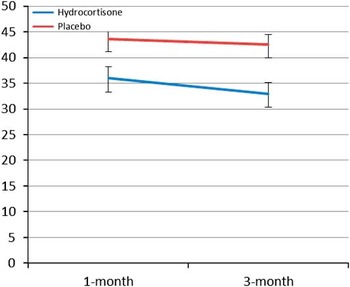
An additional repeated measures ANCOVA on depression scores (CESD) at 1 and 3 months posttrauma, covarying for age, also revealed a significant main effect of drug group, F(1,18) = 7.7, p = .01; partial η2 = .30 (see Figure 3), demonstrating that the hydrocortisone group reported significantly lower depression symptoms at follow-up assessments (estimated marginal means = 36.0 ± 2.2 vs. 43.6 ± 2.0 and 32.7 ± 2.7 vs. 42.5 ± 2.5 at 1- and 3-month follow-ups, respectively). Finally, an identical analysis on quality of life (SF-36) general health scores between medication groups revealed a significant drug group by time interaction, F(1,18) = 5.3, p = .03; partial η2 = .23, suggesting that quality of life improved over time in the hydrocortisone group (from 32.6 ± 6.6 to 48.0 ± 7.7) relative to the placebo group (from 30.8 ± 6.3 to 28.3 ± 7.3).
CESD depression scores (estimated marginal means) for the placebo and hydrocortisone groups at 1 and 3 months posttrauma.

The smaller sample sizes of participants returning self-report assessments precluded any ability to test the moderating impact of prior mental health treatment on depression and quality of life variables.
Discussion
The present study pilot tested the efficacy of a 10-day course of low-dose hydrocortisone (with 6-day taper) at preventing/buffering the development of acute posttraumatic symptoms. Hydrocortisone recipients reported fewer PTSD and depression symptoms and had greater improvements in health-related quality of life during the first 3 months posttrauma than did placebo recipients, suggesting that low-dose hydrocortisone may serve as a secondary intervention for PTSD in adult trauma victims.
Differences in levels of PTSD symptoms reported by the hydrocortisone and placebo groups were statistically significantly different; however, as Schnurr etal. Reference Schnurr, Friedman and Foy55 have suggested that a 10-point difference on the CAPS is a clinically meaningful difference, the difference in CAPS symptom reporting is arguably clinically significant also. Interestingly, hydrocortisone recipients who had never received prior mental health treatment had the lowest CAPS scores, suggesting that hydrocortisone might be most efficacious in reducing PTSD symptoms in adults without significant prior psychopathology and with less complex cases of PTSD.
Despite these promising pilot findings, there are a number of limitations that suggest that the present study should be viewed with caution. Perhaps most strikingly, the present study highlights the difficulty inherent in identifying high-risk PTSD patients. Prior research has used a variety of ways of detecting individuals at increased risk for developing PTSD following trauma: initial heart rate levels,Reference Pitman, Sanders and Zusman45 a variety of questionnaires,Reference Winston, Kassam-Adams, Garcia-Espana, Ittenbach and Cnaan56 and initial PTSD symptoms.Reference Zohar, Yahalom and Kozlovsky26 None of these screeners was particularly effective at identifying individuals who were likely to develop PTSD. The present study used initial PDEQ score cut-offs that had previously been shown to identify individuals likely to develop PTSD. However, the present results may not be generalizable to individuals who did not have significant peritraumatic dissociative responses. Further, our inability to reliably detect high-risk individuals underscores another major limitation to the current literature. It is difficult to demonstrate the efficacy of any early intervention if a significant percentage of participants does not develop the disorder that is meant to be intervened upon. Future research into determining reliable ways in which to identify trauma victims at risk for PTSD will lead to the targeting of limited intervention resources, as well as allow for better testing of early secondary interventions.
The present study also had a relatively small sample size with significant attrition, which is typical in recruiting traumatic injury victims. Despite the time- and labor-intensive nature of the present protocol, recruiting participants is oftentimes not difficult while they remain in the hospital. However, once participants have left the hospital and have returned to busy lives, retaining participants for follow-up assessments upon discharge poses challenges. We were fortunate in that there was no differential dropout between treatment groups, and that dropouts did not differ from retained participants on any study variable of interest at any time point.
Given the anti-inflammatory properties of hydrocortisone, an additional limitation to the current study was the failure to examine posttraumatic reports of pain as a possible mechanism accounting for the efficacy of hydrocortisone treatment. Future research should assess pain and pain medication use as potential mechanisms/moderators of the early hydrocortisone treatment.
Conclusion
Despite limitations, the present results from a randomized double-blind trial suggest that early low-dose hydrocortisone treatment may be efficacious in the prevention of PTSD in heterogeneous traumatic injury victims. This is especially promising, as the current dose was significantly lower than hydrocortisone doses examined in prior studies.Reference Schelling, Stoll and Kapfhammer23–Reference Zohar, Yahalom and Kozlovsky26 Although future research should further examine the extent to which dose and duration alterations may improve the efficacy of hydrocortisone treatment, the present study suggests that a dose of hydrocortisone that has not been shown to impact healing may prevent posttraumatic distress in traumatic injury victims.
Disclosures
Douglas L. Delahanty, Crystal Gabert-Quillen, Sarah A. Ostrowski, Nicole R. Nugent, Adam Morris, Roger K. Pitman, and William Fallon, Jr. do not have anything to disclose. John Bon has the following disclosures: The Medicine Company, speaker's bureau, honoraria; Merck & Co., speaker's bureau, honoraria.