INTRODUCTION
The history of Mesoamerican cultures is mainly investigated by archaeologists, because most of the indigenous documents were destroyed. Archaeologists get information from the chronology, stratigraphy, spatial distribution and architecture of pre-Columbian sites, and through the study of codices, ceramics, and other remains.
The Mezquital Valley, located in Central Mexico, at about 250 km northeast of Mexico City, was a settlement of several cultures that were controlled by the Aztecs during the Late Postclassic Period (1350–1521 AD) (Ortiz and Aguilar Reference Ortiz and Aguilar2014). Their main city was Tenochtitlan, near present-day Mexico City. The way the Aztecs dominated other people was through the simultaneous establishment of a government system that generally comprised two twin cities, known as Altepetl. At the beginning of the 16th century, there were more than 300 Altepetl systems in Central Mexico (Fernández-Christlieb Reference Fernández-Christlieb2015).
In this dual-headed system, one part belonged to the Aztec government and the other to the local government. In the case we studied, the autonomous government from the Altepetl was El Maye, while Ixmiquilpan was the head of the Altepetl (López Aguilar Reference López Aguilar2005, Reference López Aguilar2009; López Aguilar and Márquez Lago Reference López Aguilar and Márquez Lago2007).
In this paper, the chronology of El Maye site is studied through radiocarbon accelerator mass spectrometry (14C AMS) dating of some selected samples. Our aim in this study was to provide new data on the foundation and development of El Maye which could also imply the construction time frame of its sister city Ixmiquilpan, under the Aztec regime.
El Maye Site
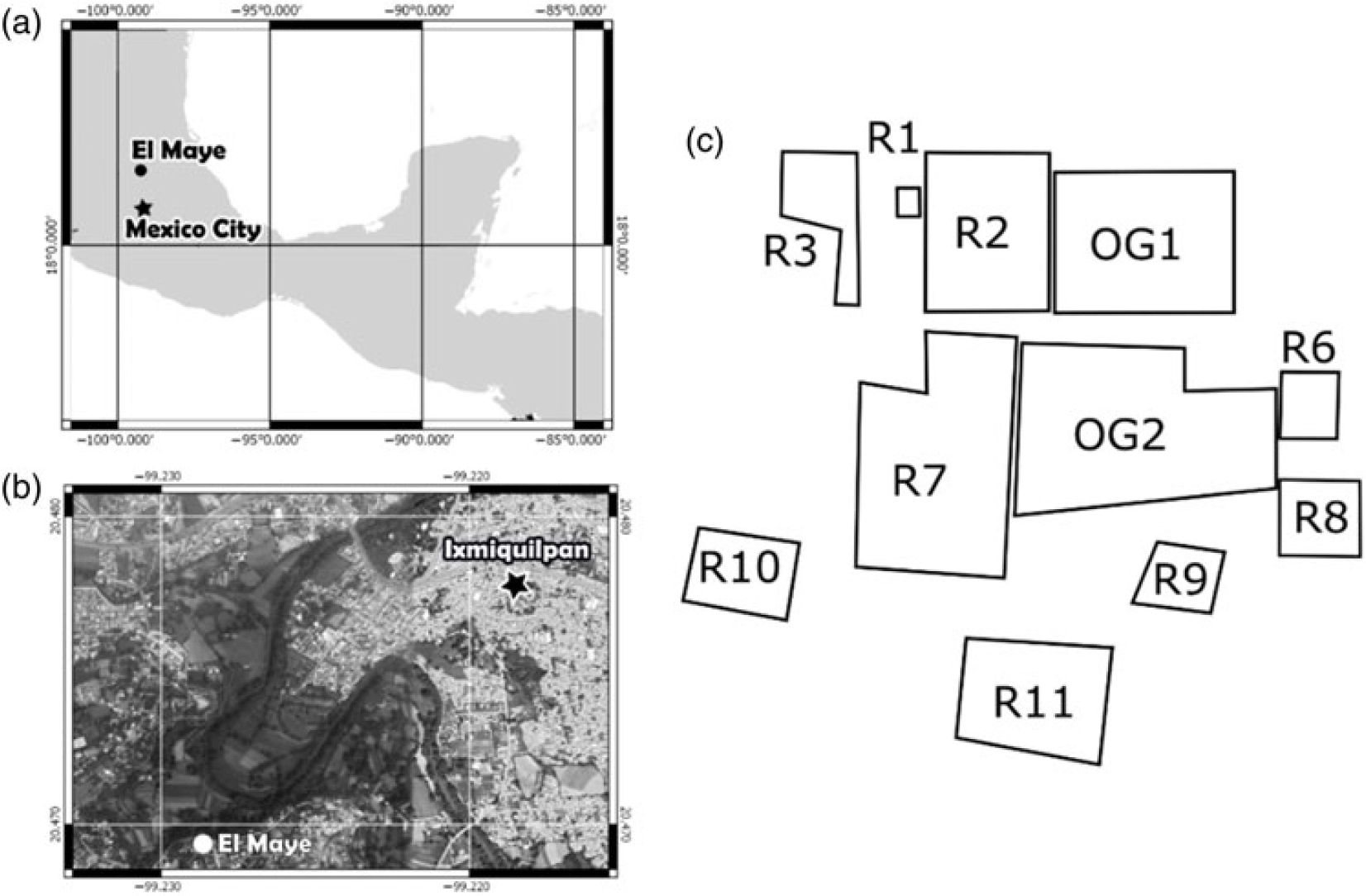
El Maye is a site located at Lat. 20°28'N, Long. 99°13'W, and 1719 m ASL in the Mezquital Valley (Figure 1a, 1b). It belongs to the Eranfri district of Ixmiquilpan Municipality, Hidalgo State, in Central Mexico. The site consists of an agricultural terrace of approximately 30 × 12 m, with a modern house at the southeast corner. Some remains of pre-Hispanic construction (walls and floors) were discovered in the area, thanks to the destruction caused by road expansion. (López Aguilar and Vilanova Reference López Aguilar and Vilanova2009).
(a) Simplified map of Mexico showing the study site, El Maye, and the reference location of Mexico City. (b) Location of the archaeological site in the Mezquital Valley (Lat. 20°28'N, Long. 99°13'W) and the reference location of Ixmiquilpan City. The Tula river crosses between both points. (c) Simplified map showing the distribution of rooms (R) and outdoor grounds (OG) where the samples were recovered (for more details of the rooms see Figure 2).

During four excavation seasons in the residential units, from 2008 to 2015, six different occupational phases were identified, which seem to comprise a period between 1300 and 1570 AD (Ortiz and Aguilar Reference Ortiz and Aguilar2014). The first date corresponds to the foundation time of the city, and the last one to the abandonment of the site and congregation of the people from the villages in the environs of an Augustinian convent, made by the Spaniards in the 16th century (Ortiz and Aguilar Reference Ortiz and Aguilar2014).
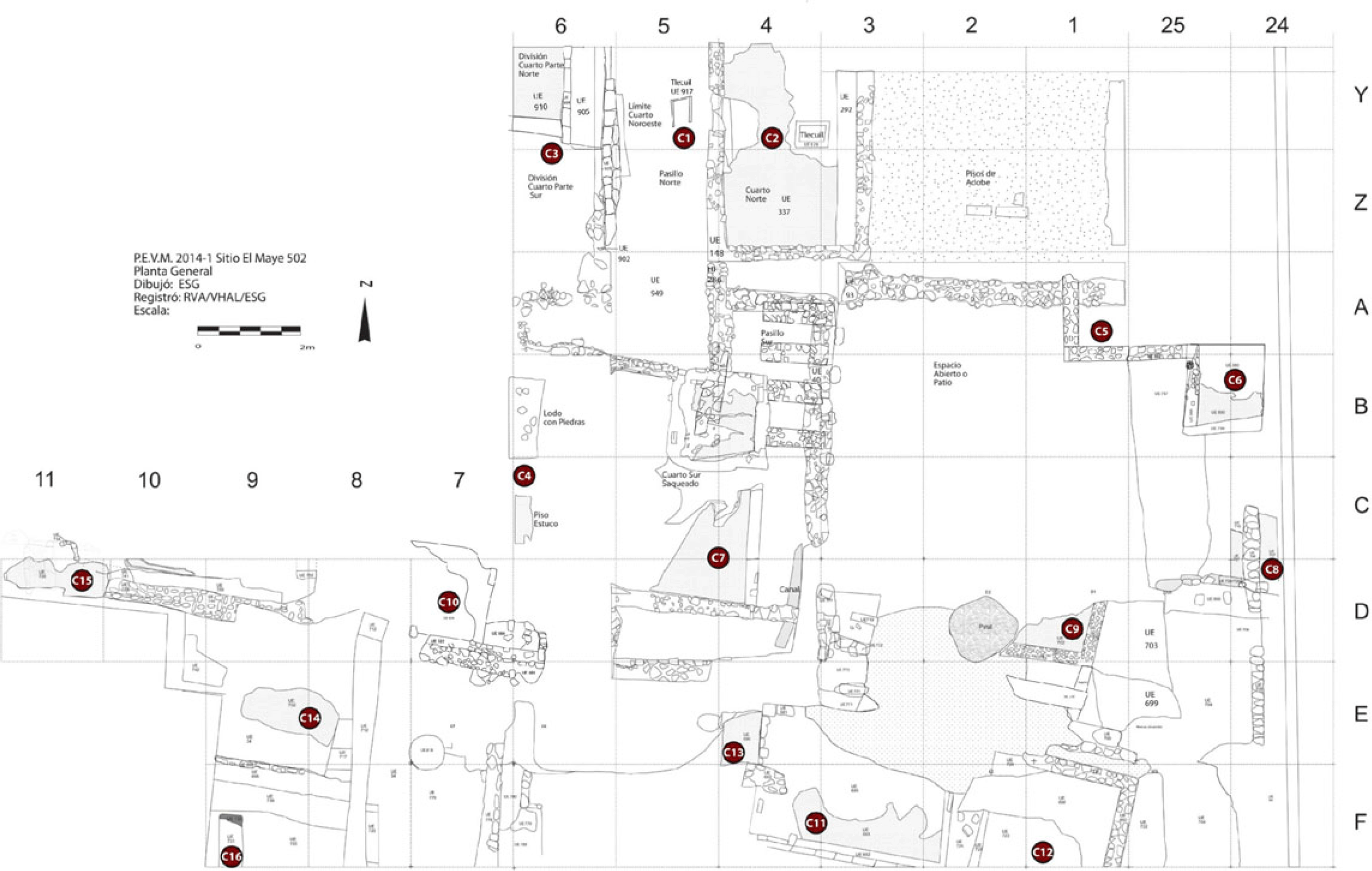
The site consists of 16 rooms (Figures 1c and 2), 15 with plaster stucco in walls and floors, terraces and two outdoor grounds, whose construction took place at six different occupational phases (López Aguilar et al. Reference López Aguilar and Vilanova2015). The constructive system consisted, initially, of leveling the bedrock tamping with caliche; then the area was recovered with mud. Next, multiple terraces were built over the mud, and finally rooms made of volcanic rock were built. So far, the chronology of El Maye site has been established by the classification of different ceramic types, from 1300 to 1570 AD (Ortiz and Aguilar Reference Ortiz and Aguilar2014).
Cartogram of El Maye site. The rooms are identified with a letter C.

SAMPLES AND METHODS
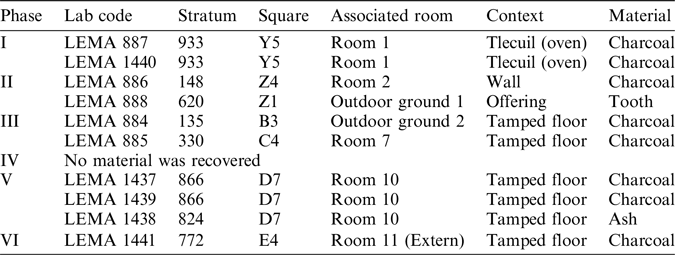
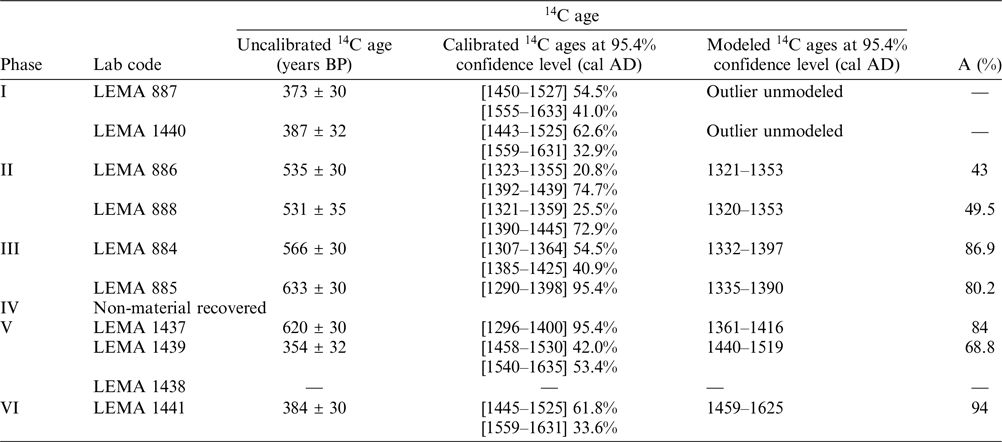
The samples collected from six different stratigraphic phases are described in Table 1. The association between charcoal samples and their respective archaeological context was based on the constructive method employed in the site. We know that the construction method consisted of lifting the walls, tamping the ground, and covering with stucco; once the process was finished, the room unit was ready to be used.
Samples for 14C dating from El Maye.

In the first construction phase, charcoal samples (LEMA 887 and its replicate LEMA 1440) were collected from room 1, on the base of a Tlecuil—an oven or brazier made of adobe— which allows us to infer that it was a residential area. This room is the oldest one according to the stratigraphy.
Regarding the samples found in Phase II, a charcoal sample (LEMA 886) was collected from a wall of room 2, which could be considered as part of the filling. However, dates from filling materials must be taken with caution, since they may appear older than the phase from the same archaeological context. In the same Phase II, an offering was found which was identified from the stratigraphic relationships. Small parts of canid bones were also recovered, among which some teeth stand out. The size of the offering was small, and the bones belonged to a 2-month-old specimen identified as Canis familiaris species. According to the stratigraphy, the offering must mark the beginning of the occupation of the open space of room 2.
In Phase III, charcoal samples LEMA 884 and LEMA 885 were recovered from the top of a tamped floor. In Phase IV there was no organic material, therefore it was not possible to date this phase. Samples LEMA 1437, LEMA1438, and LEMA1439 were taken in Phase V, from what appeared to be filling materials, since they were collected from beneath the floor of room 10. The sample LEMA1438 could not be dated given that the material was completely dissolved during the chemical cleaning procedure. For the last Phase VI, sample LEMA 1441 was found outside of room 11.
A total of 10 charcoal samples were cleaned using an acid-base-acid (ABA) protocol, designed to eliminate carbonates and organic contaminants (Goh and Molloy Reference Goh and Molloy1972). All charcoal samples came from charred wood, some samples came from filling materials, while others came from a fire area. The canid canine tooth was cleaned using the same ABA protocol since it was very small, and it was not possible to extract collagen from it.
Graphite was obtained from these samples, using an automatic graphitization equipment AGE III (Ion Plus) (Wacker et al. Reference Wacker, Nemec and Bourquin2010). One-milligram carbon samples were pressed in aluminum cathodes and analyzed in the LEMA-AMS system from the Institute of Physics of the National Autonomous University of Mexico (UNAM) in Mexico City, based on a 1MV Tandetron (High Voltage Engineering Europa) following protocols in Solís et al. (Reference Solís, Chávez-Lomelí, Ortiz, Huerta, Andrade and Barrios2014).
NIST SRM4990C Oxalic Acid II (OXAII) was used as a primary standard for normalization, while Phthalic Acid (C8H6O4) was used as a blank, for the background correction. International Atomic Energy Agency (IAEA) reference materials, C3 (cellulose), C5 (wood), and C7 (oxalic acid), with known ages, were graphitized and measured together with the samples as secondary standards, in order to assess the accuracy of our measurements.
The measured 14C/12C isotopic ratios were corrected for isotopic fractionation using the 13C/12C isotopic ratios measured in the AMS system. 14C ages calculation were performed as described in Solis et al. (Reference Solís, Chávez-Lomelí, Ortiz, Huerta, Andrade and Barrios2014), using a computer code developed at LEMA.
RESULTS AND DISCUSSION
14C dates were converted to calendar ages with the OxCal 4.4 program (Bronk Ramsey Reference Bronk Ramsey2009) using the calibration curve IntCal 20 (Reimer et al. Reference Reimer, Austin, Bard, Bayliss, Blackwell, Ramsey, Butzin, Cheng, Edwards, Friedrich, Grootes, Guilderson, Hajdas, Heaton, Hogg, Hughen, Kromer, Manning, Muscheler, Palmer, Pearson, van der Plicht, Reimer, Richards, Scott, Southon, Turney, Wacker, Adolphi, Büntgen, Capano, Fahrni, Fogtmann-Schulz, Friedrich, Köhler, Kudsk, Miyake, Olsen, Reinig, Sakamoto, Sookdeo and Talamo2020). Ages were estimated with 95.4% confidence level.
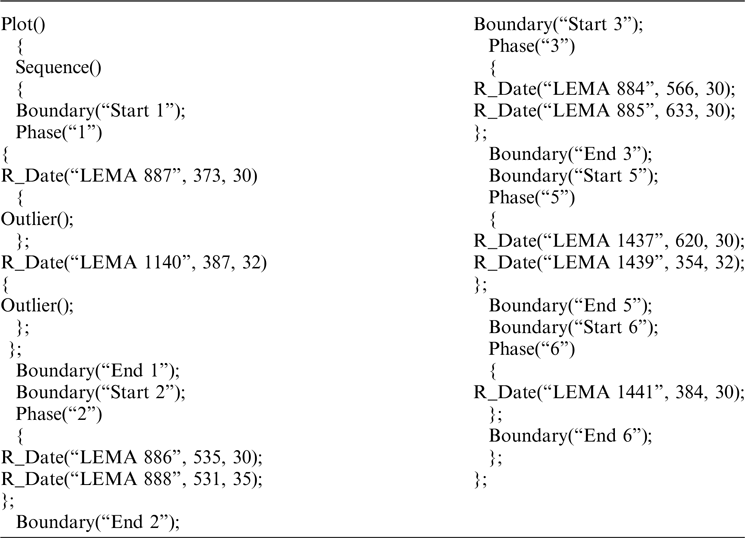
Obtained results correspond to the expected relative temporality of the site (1300–1521 AD) (Ortiz and Aguilar Reference Ortiz and Aguilar2014), except for the Phase 1 samples, which were considered to be outliers. 14C dates were included into a Bayesian model, using the OxCal 4.4 program. We constructed a sequential model with 4 phases, each one representing an occupation phase. The OxCal code is shown in Table 2.
OxCal code for Bayesian age model.

Since no appropriate material to be dated was recovered from Phase IV, it was not included in the Bayesian model.
Samples LEMA 887 and 1440, from Phase I, are replicates of the same charcoal sample, and were considered outliers when they were compared to the entire group of dates. According to stratigraphy, room 1 where they were taken from, should be the oldest one, and the first occupation level of the site (Table 3). The outlier result may be due to the fact that the area where the samples were recovered, is part of a farm field and a drainage canal of the Tula River, contaminated with wastewater.
Results of 14C dating from El Maye settlement.

A = agreement index values (in %) of modeled dates.
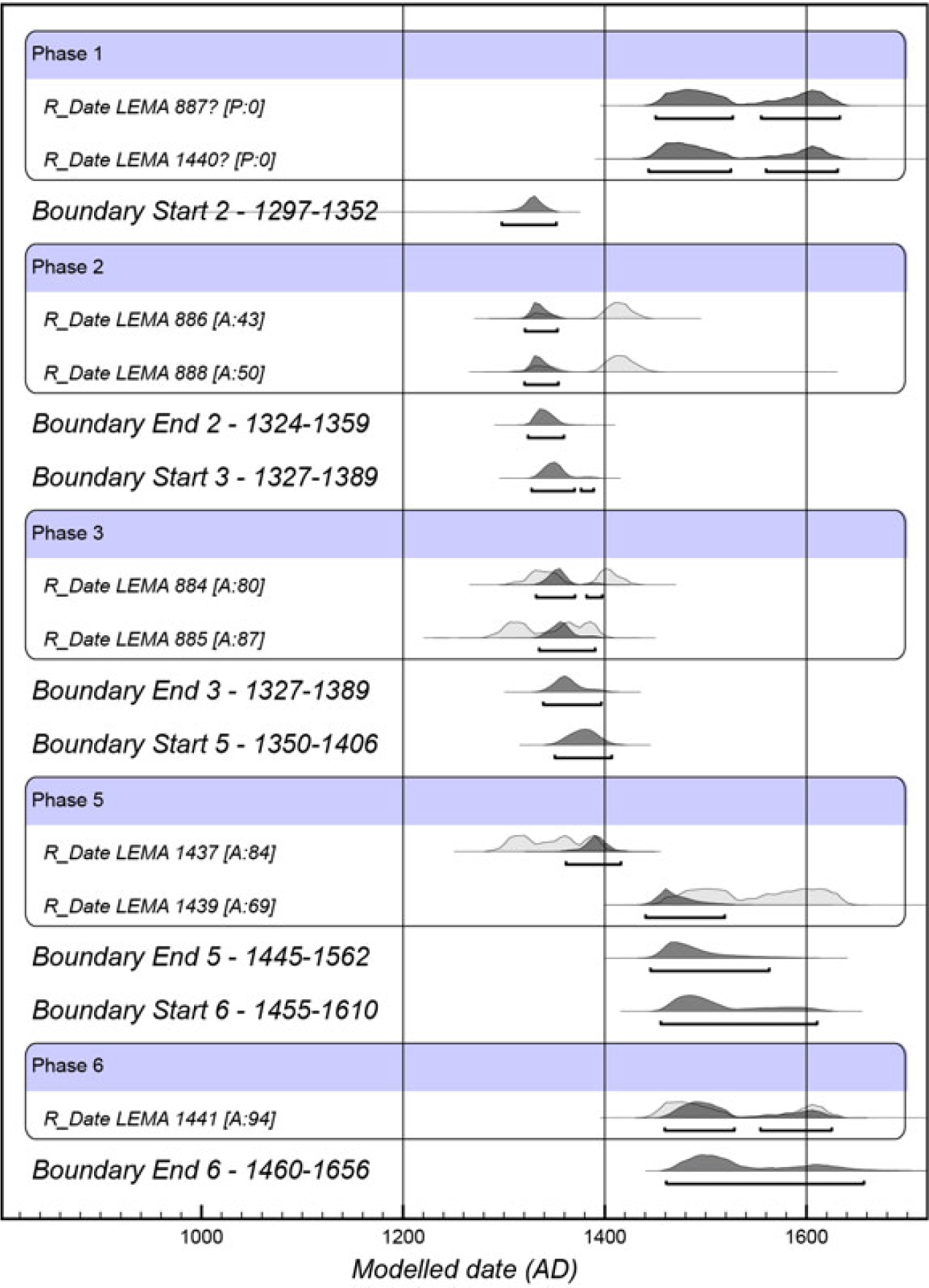
According to the data generated by the Bayesian model, despite not having an extensive number of samples, the timing of each phase of the site could be delimited. Dates obtained for the charcoal and the tooth recovered from Phase II are similar, indicating that the effect of “old wood” is not a problem for the whole site. According to the Boundary Start and Boundary End from the MCMC analysis, Phase II ranges from 1320 to 1353 cal AD, Phase III from 1332 to 1397 cal AD, Phase V from 1361 to 1519 cal AD, and Phase VI from 1459 to 1625 cal AD (Figure 3).
OxCal Bayesian model.

The lack of samples from Phase IV forces the model to give a very extensive Phase V, which is limited by the boundaries of Phases III and VI. On the other hand, as Phase VI has a single sample for 14C dating, the resulting date frame results in a large uncertainty (1459–1625 cal AD) (Figure 3). Nevertheless, our results not only match the expected time frame of the site (1320–1625 cal AD modeled dates), but also show the differences between each phase as expected from stratigraphy.
CONCLUSION
This study provides new 14C data that allowed the identification of the settlement time frame for six occupational phases into the Postclassic period of the El Maye site. These results confirm the expected temporality of the occupation of El Maye (1320–1625 cal AD). The use of 14C and Bayesian models, show that there are temporary differences in each of the stages of occupation, and that despite the difficulties of dealing with a small number of samples and uncertainties arising from archaeological contexts, this method proves once again that its standardized use can yield reliable data. Further research with larger datasets from other sites may help to complement the occupation periods of the Mezquital Valley.
ACKNOWLEDGMENTS
The authors thank Arcadio Huerta for the maintenance and operation of the AMS system, and Sergio Martinez for laboratory AMS assistance. This project was financed by DGAPA-UNAM IG100619 and Conacyt.