Civil–military relationships (CMRs) have been governed by a series of international agreements and guidelines dating back to the first Geneva Convention in 1864. 1 This focused on the responsibilities and protections applicable to all medical facilities and staff, whether military or civilian, requiring them to act neutrally and impartially for the sake of humanity. Since then, the roles of military and humanitarian medical actors have diverged, and interaction has become fraught, especially around aid to civilians. Securitization of aid, either pursuing military goals or for political ends, is seen as particularly problematic. While these uses of medical support go back a hundred years (health services were used to legitimize the Philippines government in the 1900sReference Gates 2 ), they were generally considered separate from humanitarian efforts.Reference Egnell 3
Loss of this distinction rose to prominence during the 1990s Balkans conflict, where co-location of military and humanitarian facilities suggested increasing association, eroding the visible neutrality, impartiality, and independence of aid workers.Reference Studer 4 These are fundamental principles of humanitarian action, and relief organizations rely on them to ensure their safety and access to vulnerable populations. 5 This “blurring of lines” between military and humanitarian actors increased in the Iraq and Afghanistan conflicts, with the United Kingdom (UK) cross-governmental Comprehensive Approach linking security, relief, and development in a coherent strategy to stabilize fragile states.Reference Ferreiro 6 , 7 Many Western governments adopted similar approaches. Concerns among nongovernmental organizations (NGOs) that they were being co-opted for domestic security purposes were reinforced by overt political statements, for example, United States Secretary of State Powell’s description of NGOs as “a force multiplier for us ... an important part of our combat team.”Reference Powell 8
Humanitarians responded by seeking clear separation between the sectors, and a series of guidelines followed. In 2003, the Inter-Agency Standing Committee (IASC) published the Civil–Military Relationship in Complex Emergencies, 9 focusing on Distinction: Militaries should not appear to be humanitarian or undertake tasks better suited to humanitarians. The United Nations Office for the Coordination of Humanitarian Affairs (OCHA) guidelines 10 on the use of foreign military and civil defense assets in disaster relief followed, requiring that military support be unique in terms of the capability or timeliness of response, critical to the humanitarian effort and only ever a last resort. OCHA describe the “essential dialogue and interaction between civilian and military actors in humanitarian emergencies ... to protect and promote humanitarian principles, avoid competition, minimize inconsistency and ... pursue common goals” as Civil–Military Coordination (CMCoord). 11
With many governments and some humanitarian organizations viewing humanitarian aid, development, and peace as a “triple-nexus” of interdependent components,Reference Slim 12 use of foreign militaries in complex emergencies is likely to continue, if not increase. Many concerns remain about how this will impact on the humanitarian space. Western militaries, subservient to their governments, have limited influence on how they will be used; advising their political masters as to what they can do well, and how to minimize the negative impacts of their presence. In turn, humanitarians can adapt their ways of working, or advocate to governments to influence how militaries are deployed. These activities require insight and mutual understanding to be effective.
In 2017, Operation TRENTON saw a UK military contribute an engineering task force, supported by a hospital, to the United Nations Mission in South Sudan (UNMISS). This necessitated a degree of contact with humanitarians; it would treat personnel from United Nations (UN) agencies and NGOs and was closely co-located with them.
Aims of the Study
This deployment allowed prospective assessment of attitudes to the CMR in a complex humanitarian emergency, including the military perspective. The aim of the study was to understand the perceptions of CMRs, from a military and civilian perspective, and to identify themes and factors that shape these views.
METHODS
Ethics
Approval was granted by the UK MOD Research Ethics Committee (Reference 782MODREC16).
Questions
Questions were based on a previous study,Reference Bollettino 13 adapted to the context and for military participants. The 26 questions comprised 8 concerning role and experience within their organization, 6 on CMCoord knowledge and training, and 12 on the anticipated impact of the military presence on the humanitarian effort and the relationship in general. The questionnaire allowed free text comments to expand answers at every stage. Four-point Likert scales (Strongly Agree to Strongly Disagree, with a Don’t Know option) were used. The questions were evaluated by independent members of the Conflict and Health Research Group at King’s College London for validity and objectivity.
Recruitment
From April to October 2017, military participants were recruited by means of predeployment briefings and advertisements during the deployment. The eligible military population was approximately 220. Civilian participants were invited through their leaders during Health Cluster meetings or when they visited the facility (with a potential study population of around 50).
Data Collection and Analysis
A questionnaire was hosted on smartsurvey.co.uk. Group codes were used for epidemiological data. Data were plotted graphically using MS EXCEL. Free text was extracted linked only to participant number and thematically analyzed using a 4-stage process. An initial set of codes was generated deductively using anticipated arguments and observations from the literature. Additional codes were generated inductively, where possible using language from the statements. Once the statements were coded, broad themes were identified, which captured the codes but also linked to the underlying research questions.
RESULTS
After removal of duplicates and blank entries, 67 participants completed questionnaires: 82% (55) were military, 18% (12) were civilian.
Civilian Respondents
Nine (75%) civilian respondents identified as with an NGO, 1 “another humanitarian organization,” and 2 “other” (World Health Organization [WHO] and an UNMISS civilian). NGOs named were World Relief South Sudan (1); Médecins Sans Frontières (MSF, Doctors Without Borders) (4); Relief International, Premier Urgence International (1); and unspecified (3). Roles were health care worker (50%), managerial/operations (33%), logistics 16%, and other (8%).
Three civilians had previously served with a military organization. A total of 50% had worked with UN troops before, 16% with local national troops, and 1 had worked alongside the UK Armed Forces. The majority had worked for their organization for 1–5 years (66.6%), and only 1 was deploying for the first time. Fifty percent had deployed 4 or more times. Previous deployments included South Sudan, Afghanistan, Yemen, Chad, Syria, Democratic Republic of Congo, Uganda, Iraq, and Jordan. Fifty-eight percent (7) believed they would not interact with the UK unit in South Sudan, including all of the MSF workers who replied. Three NGOs anticipated interacting with the UK military.
Seventy-five percent had received no training in civil–military interactions, and were unaware of the Oslo or IASC guidelines. Only 1 had received training involving military personnel and felt adequately prepared for interactions with the military. Seventy-five percent stated that their organization had no standard procedures to guide interaction, or that they did not know if such existed (1 of them having done some training). Seventy-five percent said that their organization had no one trained for liaison. UNMISS and the WHO both had dedicated trained personnel.
Only 16% stated that CMCoord issues were communicated by their organization, the rest stating that they had never received any.
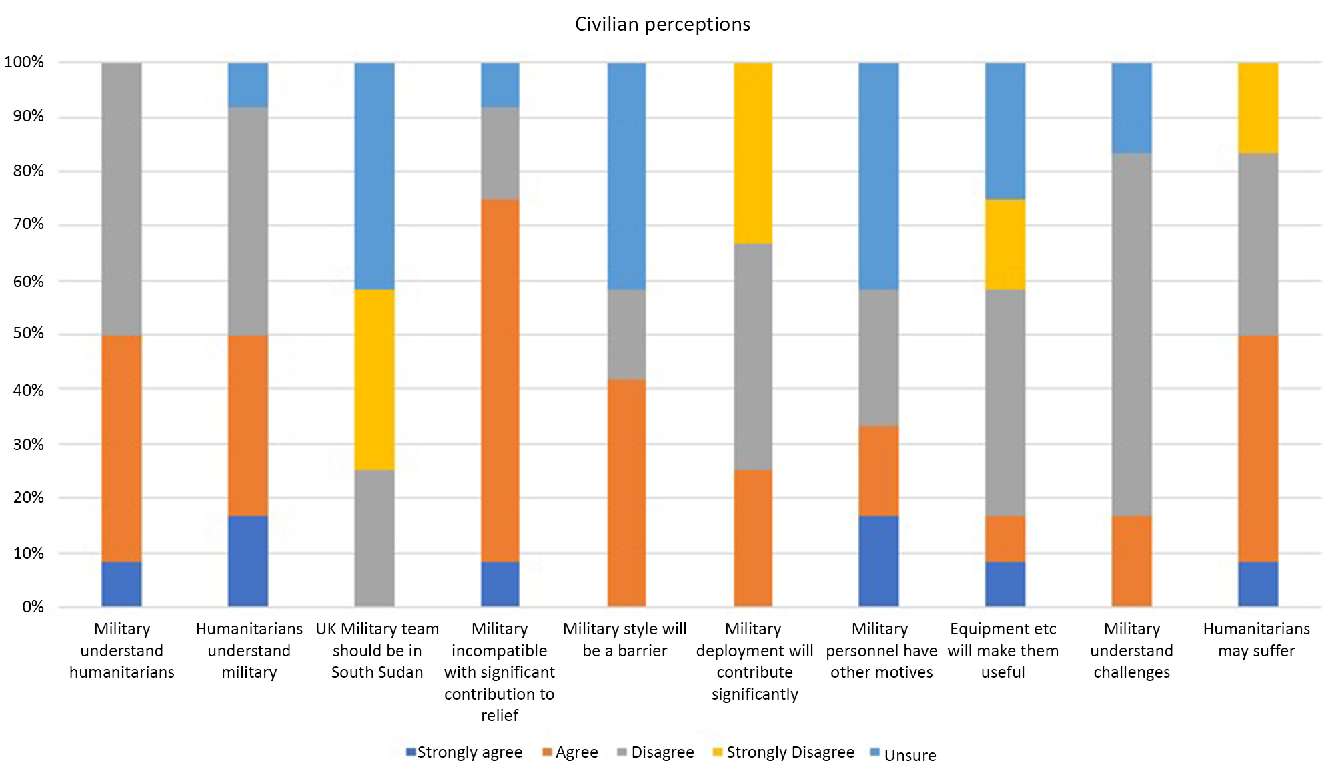
The civilian replies to the statements are given in Figure 1. Those that reached consensus (>70%) were: (i) “Being in the UK military is incompatible with making a significant contribution to the relief effort in South Sudan”: 75% agreed (9), 17% disagreed (2). (ii) “The military medical deployment will contribute significantly to the efforts to relieve the humanitarian crisis in South Sudan”: 25% agreed (3), 75% disagreed (9).
Civilian Perceptions.

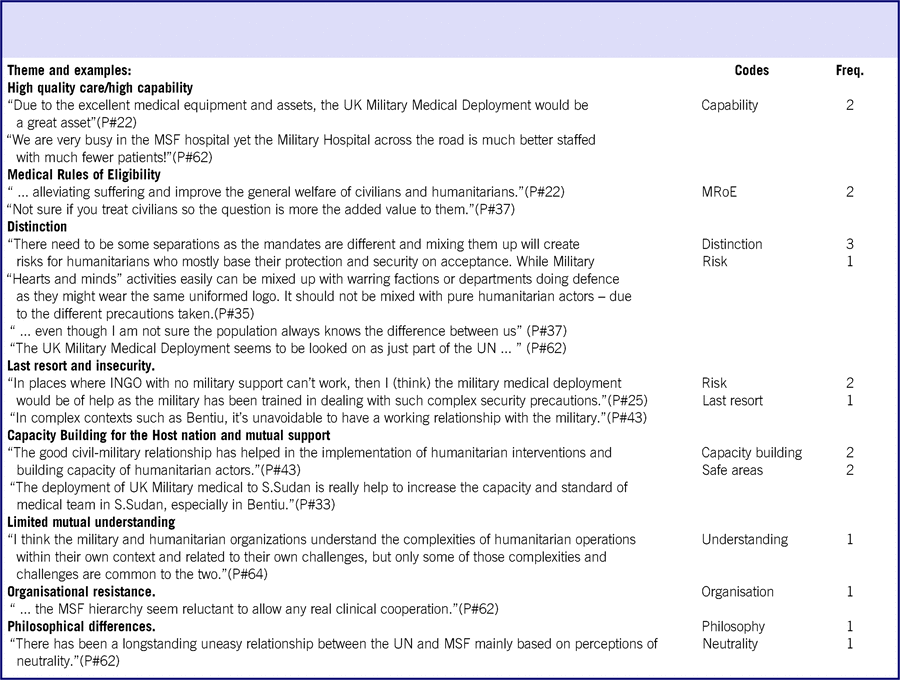
All 6 who believed there were risks to humanitarians from perceived association with the military believed it undermined their ethical stance, 1 believed it reduced their political influence, and 1 that it impacted funding streams. Another believed it did not harm as such but noted in free text that funding streams might be affected. Two believed it put them at physical risk, although 1 said “I am not sure the population always knows the difference between us” (P#37).
The civilian comments were grouped into 8 themes: medical rules of eligibility (MRoE), quality and capability of care, distinction, risks to humanitarians, organizational resistance, organizational capacity building, host-nation support, and mutual understanding (Table 1).
Themes (with example statements and participant study numbers) from the civilian respondents, with the subordinate codes and frequency of mentions

Military Respondents
Fifty-five respondents were part of the UK Military Medical Group. Of those, 87% (47) identified as clinical/allied health professionals, 3.6% as medical support officers or commanders (2), 3.6% operations staff (2), and 5.5% logisticians (3).
Eighty-seven percent (47) of participants had served more than 5 years, 5.5% (2) for 1-5 years, and 1 had left basic training 3 months before. A total of 18.5% were deploying for the first time, with 24% deployed 2-3 times, and 57.4% (31) deployed 4 or more times. Previous deployments included: Northern Ireland, Bosnia, Iraq, Afghanistan, Oman, Jordan, Albania, Germany, Cyprus, Gibraltar, Sierra Leone, Kosovo, Kuwait, Pakistan, and the Philippines.
Fifty-one percent had received some CMCoord training, with 93% recalling a humanitarian being involved. Most cited the predeployment training, but also previous operations, the Advanced Staff and Command course or other staff training. None mentioned attending the Medical Humanitarian Support Operations course, the UK Defence Medical Services’ specific training for these operations. Seventy percent believed that they had been prepared adequately.
Fifty percent knew that the unit had guidance regarding CMCoord, whereas 3.6% (2) believed it did not (the rest did not know). Communication of CMCoord issues through the chain of command (CoC) was described as Never by 35%, Rare by 16%, and Occasional/Frequent by 3.8%. Only 28.8% (15) knew about the Oslo/IASC guidelines, all describing themselves as only slightly familiar. Forty percent (21) knew that there was a nominated liaison officer, while 13.5% believed there was not.
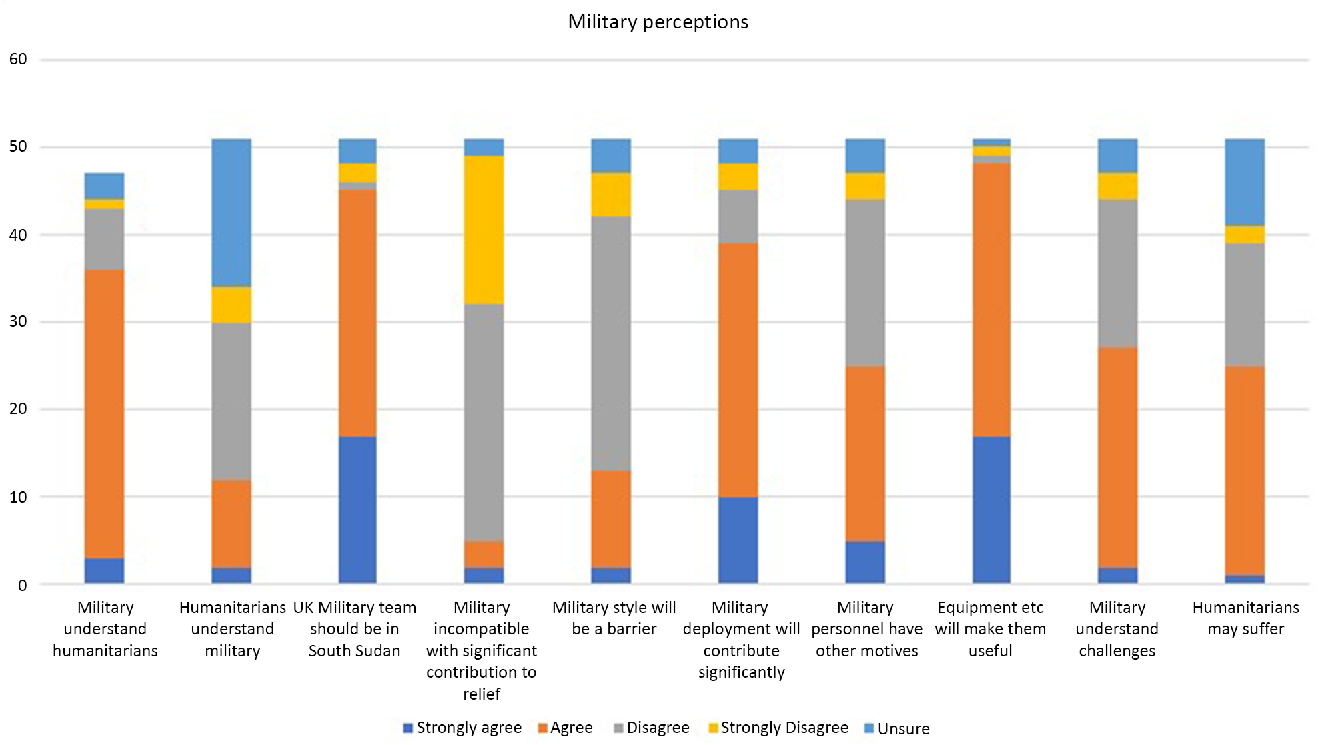
Military respondents’ replies to the statements are given in Figure 2. Four questions achieved consensus. Eighty-one percent believed that the UK military medical unit should be in South Sudan, and 85% believed the equipment and training of the military personnel would be make them valuable. Seventy percent believed that the deployment would significantly help efforts to relieve the humanitarian crisis in South Sudan, and 80% believed that being military was not incompatible with making a significant contribution to the relief effort in South Sudan.
Military Perceptions.

Of those expressing concerns about the impact of a perceived association between the military and humanitarians, 88% believed it would undermine their ethical stance, 26.5% their political influence, 35.3% that it would pose physical risk, 79.4% believed it would restrict their access, and 20.6% their funding.
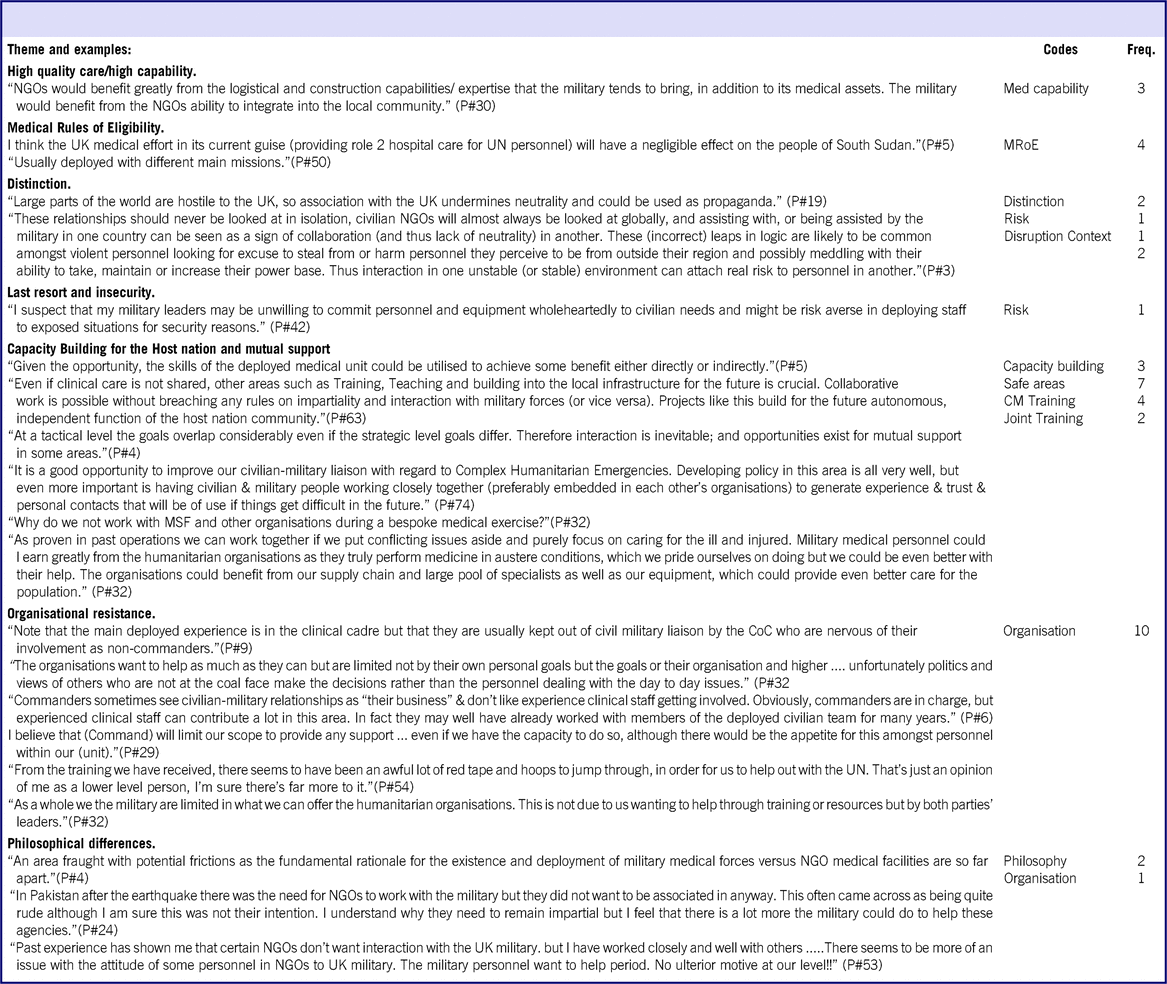
All comments fell into 7 of the 8 thematic groups identified for the civilians (Table 2). Lack of mutual understanding did not appear as a theme in the military responses.
Themes (with example statements and participant study numbers) from the military respondents, with the subordinate codes and frequency of mentions

DISCUSSION
This study is the first to examine attitudes of both military and civilians to the CMR in a complex humanitarian emergency. No published literature studies the relationship with regard to medical teams. One study examined the perceptions of the relationship in general after Typhoon Haiyan in 2013.Reference Bollettino 13 Sixty-four humanitarians completed an 80-point questionnaire describing the training they had received and whether they believed the relationship was beneficial to the overall response. The group was very experienced (62% serving with their organization for over 5 years), and nearly 50% considered themselves to be involved in a CMCoord role for their organization. Despite this, few had received formal CMCoord training or described themselves as familiar with the Oslo or IASC guidelines. The civilians in this study followed a similar pattern. The military team was equally experienced. Four locations were deployments-in-common between the 2 groups (Iraq, Afghanistan, Jordan, and S Sudan), and least 6 others potentially involved CMCoord (Bosnia, Albania, Sierra Leone, Kosovo, Kuwait, Pakistan, and the Philippines).
Despite their experience, few civilians had CMCoord training, with only 1 confident to engage in the field. Trained personnel were mainly used by the UN or WHO in co-ordination roles, suggesting that the wider community remains untrained. Half the military respondents recalled training, but in theory, all personnel attended it; either a number missed that section, forgot about it, or did not recognize it for what it was, suggesting it was ineffective. Better is that 93% of those recalling training stated that humanitarians had been involved in it, suggesting that humanitarians are engaged in that part of the package, although it is disappointing that none of the respondents had attended the course specifically designed for interactions with the humanitarian sector.Reference Bricknell and Sullivan 14 Organizational communication of CMCoord issues was infrequently described by either group. This finding suggests that such information, being most relevant to leaders, does not reach to the grassroots of the organization.
Civilian expectations regarding working with the UK military were mixed. This might reflect lack of understanding of the UK role, or variation in their own organization’s self-reliance in terms of medical care and evacuation routes. While all organizations were supposed to ensure that they had adequate intrinsic medical care for their staff, many smaller or less experienced groups may have been less sure of their capabilities. A few responses suggested confusion about the UK mission and the MRoE for treatment at the facility, but neither group believed that the MRoE were actually a problem for the relationship. Some clearly understood them: “I’m not sure if you even treat civilians” while others believed the deployment would “(alleviate the) suffering and improve the general welfare of civilians and humanitarians.” The military personnel still believed that they would contribute to the relief of the humanitarian crisis (70% agreeing), despite the MRoE. This suggests that they understood the wider implications of an improving security situation facilitating the activities of the humanitarian organizations. This statement reached consensus for the civilians too, but in the opposite direction, suggesting they were more focused on immediate aid delivery.
The other statement that reached consensus in the civilian group was that “Being in the UK military is incompatible with making a significant contribution to the relief effort in South Sudan.” Again, the military group came to the opposite conclusion. The free text comments suggest 2 reasons for this. First, a more strategic organizational awareness from previous deployments where the military has provided logistics, communications, and reconnaissance support to disasters. Second, a longer-term focus on building capacity rather than the immediate delivery of service or resources: “Even if clinical care is not shared, other areas such as training, teaching, and building into the local infrastructure for the future is crucial. Collaborative work is possible without breaching any rules on impartiality and interaction with military forces.”
The military agreed on 2 other statements: The first, that the UK military medical unit should be in South Sudan, suggests that the unit believed in the mission, in military terms part of the “moral component,” building morale, cohesion, and teamwork. The second referenced specialist equipment and training. The unit capability was unique outside the capital including a computed tomography scanner, a polymerase chain reaction diagnostic suite, and experience in tropical medicine, infectious diseases, and trauma. Despite knowing that these would not be used to treat civilians, they still believed they would contribute to the relief effort. While this may simply represent the aforementioned impact on security (it was hoped local UN peacekeepers could be even more proactive given closer medical support), the free text suggests the potential for capacity building was also a consideration: “The organisations could benefit from our ... large pool of specialists ... which could provide even better care for the population,” “building into the local infrastructure for the future is crucial ... Projects like this build for the future autonomous, independent function of the host nation community” and “given the opportunity, the skills of the deployed medical unit could be utilised to achieve some benefit ... indirectly.”
The security context was important, with statements suggesting the relationship would need to be flexible taken into account. However, no one believed it was too dangerous for a relationship to exist. In both groups, half were concerned about the risks to humanitarians, especially the effect on their principled position. The military group was more concerned than the civilians about additional practical risks, access to the population, physical risk, and funding. Despite this, many participants (especially military) believed that a more productive relationship could easily be achieved without compromising distinction. Suggested activities included training, improving standards and building capacity for both humanitarians and military. Joint exercising has been recommended in WHO special reports,Reference Gunnarsson, Hyer and Hufstader 15 and guidelines issued in South Sudan by the Humanitarian Country Team and UNMISS states that “training, engendering mutual respect, provides the foundation for effective dialogue ... is a vital part of increasing an understanding of respective mandates, ways of working and professional cultures.” It recommends that “actors co-ordinate closely on specialized trainings in areas of common interest ... ”. 16 Opportunities to build capacity within the host-nation medical services were also frequently referred to by both groups.
Organizational resistance to civil–military activities was a consistent theme. Much was made of similarity of purpose (notwithstanding different MRoE so potentially in terms of wider professional obligations) at a tactical level, alluding to professional and moral healthcare worker obligations. The organizational hierarchy was seen as preventing more effective relationships; philosophical differences in terms of fundamental principles and institutional antipathy and suspicion were cited frequently by both groups as possible reasons. Limited mutual understanding was apparently an issue in both directions.
Limitations of the Study
While the study recruited a significant number of military personnel (25% of the eligible population), civilian enrollment was limited for several reasons. First, organizations approached to support the study before the deployment were generally cautious about engaging (perhaps supporting the findings about organizational resistance) and so instead of being advertised through organizations’ own communications channels, contacts were made ad hoc after arrival. Recruitment depended on support from program managers; no organization allowed direct approaches to potential participants. Second, technical limitations impaired access; bandwidth was far more limited than anticipated and several attempted responses failed. Only 7 paper-copy questionnaires were returned. Given the dispersed nature of humanitarian operations, these access constraints significantly impacted participation.
The military cohort may have demonstrated bias because of the hierarchical structure and fear of ramifications if replies were made public. The study design minimized any sense of pressure or attributability. The frank nature of the free text suggests it was effective in this aim.
The nature of the relationship is not expressed in terms that allow statistical comparison. Instead, the study seeks to describe some aspects of the relationship through the experiences and beliefs of those taking part. The findings may be highly context specific and person specific.
CONCLUSIONS
This is the first study evaluating the CMR from both civilian and military perspectives during a humanitarian operation. It echoes previous findings in the civilian sector, and demonstrates a high level of training in and understanding of relevant issues among military participants. Both believed that opportunities for joint activities, particularly organizational and host-nation capacity building, are being missed. Current guidance does not recognize that medical actors across the civil–military divide have more in common than nonmedical components and may be professionally and ethically required to engage differently. Further work should be undertaken to delineate if and how medical humanitarians and military personnel could safely work more closely together.
Declarations
Ethics approval and consent to participate: Approval was granted by the UK MOD Research Ethics Committee (Reference 782MODREC16).
Consent for publication: All participants consented to participate as per the ethics application above, through voluntary access to the data collection webpage (where all information about the study was available. All gave consent on the first page of the questionnaire. Consent included consent to publish and for anonymous quotation.
Availability of data and material: Given the nature of employment of the majority of participants, raw data are not made available. Selected data are available as an EXCEL spreadsheet that can be made available on reasonable request.
Authors’ Contributions
Dr Horne and Prof Sullivan designed the study. Dr Horne, Dr Gurney, and Prof Smith recruited the participants. All authors were involved in writing the paper.
Funding
This publication is funded through the UK Research and Innovation GCRF RESEARCH FOR HEALTH IN CONFLICT (R4HC-MENA); developing capability, partnerships and research in the Middle and Near East (MENA) ES/P010962/1.