INTRODUCTION
Triggered in large part by the work of Stouffer ([1955] Reference Stouffer1992), political tolerance has received a great deal of scholarly attention. Considerable thought has been devoted to uncovering the antecedents, consequences, and trends over time of tolerance and intolerance (e.g., Cutler and Kaufman Reference Cutler and Kaufman1975; Davis Reference Davis1975; Nunn, Crockett, and Williams Reference Nunn, Crockett and Williams1978; Sullivan, Piereson, and Marcus Reference Sullivan, Piereson and Marcus1979; Reference Sullivan, Piereson and Marcus1982; Mondak and Sanders Reference Mondak and Sanders2003). Much of this research has demonstrated a link between religion and an unwillingness to grant civil liberties as well as a link between psychological security and political tolerance (Stouffer [1955] Reference Stouffer1992; Nunn, Crockett and Williams Reference Nunn, Crockett and Williams1978; Sullivan, Piereson and Marcus Reference Sullivan, Piereson and Marcus1982; Marcus et al. Reference Marcus, Sullivan, Theiss-Morse and Wood1995; Sullivan and Transue Reference Sullivan and Transue1999; Gibson Reference Gibson2006; Eisenstein Reference Eisenstein2006). In fact, psychological security is identified as one of the three primary determinants of political tolerance (Gibson Reference Gibson2006).
Although the effects of psychological security on tolerance are well-known, there have been few attempts to distinguish, simultaneously, the independent effects of the components that comprise the psychological security construct (typically measured by dogmatism,Footnote 1 self-esteem,Footnote 2 and social trustFootnote 3 ) on political tolerance. Thus, it is not known whether the separate component parts of psychological security exert comparable influence on political tolerance or whether using the multi-item security index masks important differences in the independent effects of dogmatism, self-esteem, and social trust. Lacking relative/comparative influences of these various components is a deficiency in the literature.
Likewise, although previous research assessed the influence of religion on psychological security, that research has not examined the influence of religion on the component parts of psychological security (dogmatism, self-esteem, and social trust) or the mediating influence of these three traits in the religion-psychological security-political tolerance linkage. This is problematic since it is believed that certain religious beliefs, practices, and/or affiliations contribute differentially to the particular components of psychological security that are linked with differences in tolerance orientations (Welch, Sikkink, Sartain, and Bond Reference Welch, Sikkink, Sartain and Bond2004; Smidt Reference Smidt1999; Smith Reference Smith1997; Bahr and Martin Reference Bahr and Martin1983; Schoenfeld Reference Schoenfeld1978). Thus, there is reason to question if the religion relationship is the same across all sub-components or if the negative effect of religion on psychological security (Eisenstein Reference Eisenstein2006) may be conditioned by a particular religious experience and a specific security item that is masked using the combined psychological security measure. At the same time, there is theoretical speculation (although empirical evidence is in short supply) that the negative effect of religion vis-à-vis political tolerance results from the mediation of psychological security (see, for example, Canetti-Nisim Reference Canetti-Nisim2004).
While both religion and psychological insecurity have been associated with intolerance, the aim of the present study is to explore the independent role of the separate traits of psychological security as both a mediating force and direct influence on political tolerance, which the extant literature does not address in a systematic manner. We argue that there is sufficient reason to believe that the effect of religion on tolerance may be indirect — through its influence on psychological security — and that the contributions of the separate components of psychological security on tolerance may operate in countervailing directions. For this reason, studies that have relied on the composite measure of psychological security are likely masking theoretically important connections for uncovering the sources of political tolerance.
RELIGION, PSYCHOLOGICAL SECURITY, AND TOLERANCE
Political tolerance, usually defined as the willingness to permit groups that one dislikes to engage in acts of free expression, has been found to be negatively related to religion (Stouffer [1955] Reference Stouffer1992; Smidt and Penning Reference Smidt and Penning1982; Nunn, Crockett, and Williams Reference Nunn, Crockett and Williams1978; McCloskey and Brill Reference McClosky and Brill1983; Wilcox and Jelen Reference Wilcox and Jelen1990; Green et al. Reference Green, Guth, Kellstedt and Smidt1994). Beginning with Stouffer ([1955] Reference Stouffer1992), religion has been identified as an obstacle to the development of democratic values and support for civil liberties. The overwhelming evidence confirmed that the absence of religion or “secular detachment” is an important source of tolerance (Stouffer [1955] Reference Stouffer1992; Nunn et al. Reference Nunn, Crockett and Williams1978; Sullivan et al. Reference Sullivan, Piereson and Marcus1982). In addition, there are substantial denominational differences with members of conservative religious traditions (evangelicals, fundamentalists etc.) more intolerant than members of other Christian traditions (Stouffer [1955] Reference Stouffer1992; Nunn, Crockett, and Williams Reference Nunn, Crockett and Williams1978; Beatty and Walter Reference Beatty and Walter1984; Wilcox and Jelen Reference Wilcox and Jelen1990; Green et al. Reference Green, Guth, Kellstedt and Smidt1994); that specific theological beliefs such as biblical literalism or biblical inerrancy lead to greater intolerance (Wilcox and Jelen Reference Wilcox and Jelen1990; Green et al. Reference Green, Guth, Kellstedt and Smidt1994); that the strong, negative correlation between religious beliefs and tolerance may vary with the nature of religious convictions (Nunn et al. Reference Nunn, Crockett and Williams1978; Gibson Reference Gibson, Wolfe and Katznelson2010)Footnote 4 ; and that those who report higher levels of religious salience or commitment have less support for political tolerance than other groups of Americans (Beatty and Walter Reference Beatty and Walter1984; Wilcox and Jelen Reference Wilcox and Jelen1990; Jelen and Wilcox Reference Jelen and Wilcox1991).Footnote 5
In spite of these findings, there are reasons to question the direct relationship between religion and predicted intolerance. Although religious involvement is often correlated with intolerance at the bivariate level, this tie often disappears when other variables are taken into account (Sullivan, Piereson, and Marcus Reference Sullivan, Piereson and Marcus1982). Moreover, Eisenstein (Reference Eisenstein2006) shows that although religious commitment is considerably influenced by doctrinal orthodoxy, increased commitment (as measured by church attendance, prayer, and religious guidance) does not directly lead to decreased tolerance; neither does doctrinal orthodoxy. Instead, the results showed that religious commitment had a direct influence on psychological security while doctrinal orthodoxy had a direct influence on threat perception. Thus, both religious commitment and doctrinal beliefs were merely associated with variations in the political and psychological predictors of political tolerance.
A second concern with previous research is that church attendance and affiliation are seldom examined in tandem. The problem is two-fold. First, attendance may have a differential effect on tolerance by denomination. Second, attendance varies widely by denomination. Beatty and Walter (Reference Beatty and Walter1984) show that tolerance differences are related to both frequency and denomination. The issues raised in the earlier study are confirmed in the work of Wilcox and Jelen (Reference Wilcox and Jelen1990) who report that part of the difference between evangelicals and other Americans is due to their higher levels of church attendance. While there is substantial evidence that tolerance may vary with the nature of religious convictions, practice, and denomination, nonetheless, a variety of studies have found that when other factors are controlled, religion is either unrelated to, or actually fosters support for, civil liberties (Gaddy Reference Gaddy, McConkey and Lawler2003; Canetti-Nisim Reference Canetti-Nisim2004; Eisenstein Reference Eisenstein2006). Such variations have led some scholars to suggest that some intervening factor, such as psychological security, may serve as a trigger for intolerant ideas. This is what we turn to next.
Psychological security is among one of the most important predictors of political tolerance (Sullivan et al. Reference Sullivan, Marcus, Feldman and Piereson1981; Reference Sullivan, Piereson and Marcus1982; Gibson Reference Gibson2006). The most common way in which psychological security is operationalized consists of multiple measurement scales such as dogmatism, self-esteem, and trust where these items are combined into a single construct (for example, Sullivan, Piereson, and Marcus Reference Sullivan, Marcus, Feldman and Piereson1981; Reference Sullivan, Piereson and Marcus1982; Marcus et al. Reference Marcus, Sullivan, Theiss-Morse and Wood1995; Eisenstein Reference Eisenstein2006). While the existing evidence indicates that the role of psychological security is such that those respondents who are psychologically insecure are less tolerant, the separate and independent effects of the tripartite components of psychological security have not been examined in tandem. This is the task we undertake as the evidence suggests these items do not unequivocally tap into a single underlying dimensionFootnote 6 and a close examination of the literature supports that greater caution in measurement strategy may be needed to ensure confidence in the expected relationships.
A number of studies also emphasize the connection between psychological security and the correlates of religion. Religion is one of the factors identified as influencing psychological security and these results persist after controls for alternative explanations have been introduced (Sullivan, Piereson, and Marcus Reference Sullivan, Piereson and Marcus1982; Canetti-Nisim Reference Canetti-Nisim2004; Eisenstein Reference Eisenstein2006). Among the hypothesized relationships, religious attachment as compared to secularism was found to have a negative “minor direct impact” on one's level of psychological security (Sullivan et al. Reference Sullivan, Piereson and Marcus1982, 222). Canetti-Nisim (Reference Canetti-Nisim2004) demonstrates that religion precedes authoritarianism (a component part of psychological security per Sullivan et al. Reference Sullivan, Piereson and Marcus1982), which in turn influences support for democratic values. Eisenstein (Reference Eisenstein2006) shows that religious commitment has a negative influence on psychological security, which in turn impacts political tolerance. Notwithstanding the contributions of these studies, the precise nature of the link between religion (belief, belonging, and/or behavior) and the separate components of psychology security is as yet undetermined. In particular, the existing evidence indicates that psychologically insecure individuals are intolerant but it is unclear “if” and “how” each component part of the psychological security index independently influence tolerance orientations as well as foster the association between the various dimensions of religion and tolerance.
Dogmatism has routinely been associated with political intolerance (Sullivan et al. Reference Sullivan, Marcus, Feldman and Piereson1981; Reference Sullivan, Piereson and Marcus1982; Gibson Reference Gibson1987). The direct, negative influence of dogmatism is hardly surprising. In terms of the religion-dogmatism-political tolerance link, it is generally understood that certain religious beliefs and practices tend to occasion a dogmatic cognitive style (Jelen and Wilcox Reference Jelen and Wilcox1991, 35) that is incompatible with freedom of expression and alternative lifestyles. In particular, it has been suggested that evangelical Christian doctrine itself is a source of dogmatism, which is linked with greater political intolerance (Wilcox and Jelen Reference Wilcox and Jelen1990; Green et al. Reference Green, Guth, Kellstedt and Smidt1994). While both Wilcox and Jelen (Reference Wilcox and Jelen1990) and Green et al. (Reference Green, Guth, Kellstedt and Smidt1994) argue that religious beliefs and/or practices contribute to dogmatism leading to less political tolerance, neither subjected that assumption to an empirical test. By contrast, Hunsberger (Reference Hunsberger1995) argues that it is not religious fundamentalism that explains variation in intolerance, but rather the authoritarian components of the construct. Recent formulations suggest that controlling for authoritarian personality traits may account for the finding that fundamentalist groups are intolerant (Laythe et al. Reference Laythe, Finkel, Bringle and Kirkpatrick2002; Canetti-Nisim Reference Canetti-Nisim2004). Similarly, Gibson (Reference Gibson, Wolfe and Katznelson2010, 167) found that, in addition to a direct effect on tolerance, religious traditionalism influences intolerance via dogmatism. In short, it is understood that religious commitment, belief, and affiliation, contribute to dogmatism — which in turn, lowers political tolerance. However, uncertainty remains as to the separate effects of the religious dimensions to dogmatism as well as the link to political tolerance, while accounting for the separate effects of the remaining items — self-esteem and trust — used to measure psychological security.
Self-esteem is a common psychological factor that has been found to be positively related to political tolerance (Sniderman Reference Sniderman1975; Sullivan et al. Reference Sullivan, Piereson and Marcus1982; McCloskey and Brill Reference McClosky and Brill1983). Persons high in self-esteem tend to be more tolerant and, religious commitment and religious belief have been linked to greater self-esteem (Keonig, McCullough, and Larson Reference Keonig, McCullough and Larson2001; Ellison Reference Ellison1993) as well as general well-being (Keonig, McCullough, and Larson Reference Keonig, McCullough and Larson2001). Religious commitment and affiliation have also been associated with increased life satisfaction (Ellison, Gay, and Glass Reference Ellison, Gay and Glass1989). In short, greater self-esteem leads to more political tolerance; likewise, strong religious beliefs and increased commitment also, arguably, lead to greater self-esteem with its concomitant positive influence on tolerance. Religion then has countervailing influences on constructs commonly used in the tolerance literature to measure psychological security: it promotes dogmatism, which leads to decreased tolerance while at the same time religion promotes self-esteem which is associated with higher tolerance.
Finally, there is the role of social trust. According to Sullivan et al. (Reference Sullivan, Piereson and Marcus1982, 155), “respondents who lack trust in other people are slightly less tolerant than trustful respondents.” The trust-tolerance result was upheld by other research (Gibson Reference Gibson1987; Bobo and Licari Reference Bobo and Licari1989). That greater interpersonal trust is correlated with a willingness to concede tolerance is expected given that individuals with a stronger sense of trust in others may be less anxious about the possible risk posed by disliked groups. However, the evidence on the relationship between religion and trust is mixed. On the one hand, research has shown that individuals who claim a religious affiliation tend to be more trusting than those who do not (Rotter Reference Rotter1967; Alesina and La Ferrara 2002). Putnam (Reference Putnam2000) finds that people who report frequent attendance of a religious service participate in activities that are associated with greater trust such as giving both time and money, spending time with friends, and participating in volunteer associations. Uslaner (Reference Uslaner2000) shows that individuals who are considered religious have a higher level of trust and civic participation than those who do not.
Yet other research suggests that hierarchical religion, particularly Catholicism, impedes trust (Putnam Reference Putnam1993); that religion oftentimes results in “particularized” trust wherein you trust those within your religious worldview but not those outside of it (Uslaner Reference Uslaner2000-2001; Yamagishi and Yamagishi Reference Yamagishi and Yamagishi1994); and religion “consumes” but does not “produce” trust (Uslaner Reference Uslaner2000–2001). Religious values may lead people to insulate themselves from nonbelievers or people outside of their inner circle. In other words, there is greater trust of those within the individual's religious network at the expense of trust of others in society in general. Daniels and von der Ruhr (Reference Daniels and von der Ruhr2008) show that individuals who do not claim a religious affiliation trust others more. However, this same study suggests that religion fosters trust wherein trust is positively influenced by church attendance but negatively influenced by evangelical or conservative affiliations (Daniels and von der Ruhr Reference Daniels and von der Ruhr2008). In short, there are countermanding expectations regarding the impact of religion on trust; at the same time, the influence of religion on dogmatism and self-esteem cuts in opposite directions (increasing political tolerance via self-esteem but decreasing political tolerance via dogmatism). This necessitates disaggregating the psychological security variable. In sum, then, there is sufficient reason to believe that the effect of religion on tolerance may be indirect — via psychological security — and that the contributions of the separate components of psychological security on tolerance may differ.
Of course, given existing disagreements, the causal ordering between religion and psychological security remains a concern.Footnote 7 Although it seems very likely that religion and personality are to some extent reciprocally related, and acknowledging continued disagreements regarding the causal ordering of religion vis-à-vis psychological security, we model religious activity, affiliation, and doctrine causally prior to psychological security (see Peffley and Sigelman Reference Peffley and Sigelman1990; Jelen and Wilcox Reference Jelen and Wilcox1991; Canetti-Nisim Reference Canetti-Nisim2004). We do so based on the existing political tolerance scholarship (such as Sullivan, Piereson, and Marcus Reference Sullivan, Marcus, Feldman and Piereson1981; Reference Sullivan, Piereson and Marcus1982; Peffley and Sigelman Reference Peffley and Sigelman1990; Eisenstein Reference Eisenstein2006), and we also draw on the work of Canetti-Nisim (Reference Canetti-Nisim2004, 384–387). Canetti-Nisim (Reference Canetti-Nisim2004) empirically tested causal models of religion preceding psychology, and vice versa, and suggested a framework that modeled religion preceding psychology.
DATA, MEASUREMENTS, AND DESIGN
In order to conduct this research, we utilize James Gibson's Reference Gibson1987 Freedom and Tolerance survey and merge it with the General Social Survey (GSS) conducted in the same year. The Freedom and Tolerance survey was a re-interview of the 1987 GSS respondents. The GSS study was conducted in the spring, and the Freedom and Tolerance study was conducted in June and July. Of the 1,459 subjects eligible for re-interview, interviews were completed for 1,267 respondents (approximately 87% of those eligible). The 1987 GSS survey also included an oversample of 353 black respondents beyond the 191 blacks in the main sample (for a total of 544); 436 black respondents (approximately 80%) were re-interviewed in the summer survey.
The use of the Freedom and Tolerance survey, merged with the 1987 GSS, enables the use of a national sample that brings together a least-liked measure of political tolerance, all the predictor variables as it relates to political tolerance, measures of dogmatism, self-esteem, and trust, as well as measures of religious belief (doctrinal orthodoxy), religious behavior (level of religious commitment), and a sophisticated coding scheme as it relates to religious belonging (e.g., the coding scheme for religious affiliation outlined in Steensland et al. Reference Steensland, Park, Regnerus, Robinson, Wilcox and Woodberry2000). Arguably, a survey from 1987 is not ideal. However, it is the only national sample currently available that allows for the use of the least-liked tolerance measure comprised of groups along the ideological spectrum, the multi-dimensionality of religion (belief, belonging, and behavior), as well as the psychological and political determinants of political tolerance. Datasets tend to either provide good measures of political tolerance or measures of religion, but typically not both. For example, the standard GSS does not include measures for the most important psychological and political predictors of political tolerance; however, it does adequately measure religion. The Freedom and Tolerance survey does provide measures of the psychological and political predictors of political tolerance (as well as a least-liked measure of political tolerance) but it fails to include measures for the assessment of religion. Thus, the standard GSS alone and the Freedom and Tolerance survey by itself cannot accommodate a study of religion and political tolerance. This is emblematic and symbolic of problems with datasets for conducting research at the intersection of religion and political tolerance. In contrast, by merging the GSS and Freedom and Tolerance studies, we have a dataset inclusive of all pertinent measures.
Still, one may question if in the years since this data became available if the relationships between the variables of interest have changed. Of particular concern, should we expect these variables to relate to each other in the same way in a pre- and post-September 11, 2001 world? While public support for civil liberties has undergone important changes since the terrorist attacks, a review of the important works in the political tolerance literature preceding (including but not limited to, Nunn et al. Reference Nunn, Crockett and Williams1978; Sullivan et al. Reference Sullivan, Piereson and Marcus1982; McCloskey and Brill Reference McClosky and Brill1983; Marcus et al. Reference Marcus, Sullivan, Theiss-Morse and Wood1995) and following the tragic event (including but not limited to Davis and Silver Reference Davis and Silver2004; Eisenstein Reference Eisenstein2006; and Gibson Reference Gibson, Wolfe and Katznelson2010) reveal little evidence to suggest that the attitudinal and demographic variables have changed in their relationship to political tolerance. That is, across these studies the important role played by individual characteristics — such as psychological security and the various dimensions of religion — has remained constant.Footnote 8 So while we may expect the selection of target groups to be different today than in the past, the relationships of the key predictors to tolerance are not expected to have changed. Sullivan and Hendriks (Reference Sullivan and Hendriks2009, 382) argue that although the focus of the debate may have shifted, including scholarly attention to previously understudied variables such as political trust, the individual and contextual variables that explain citizens' support for civil liberties have not changed dramatically.
In addition, this dataset allows for a comparison with results from some of the seminal studies of political tolerance, such as Sullivan et al. (Reference Sullivan, Piereson and Marcus1982) and McCloskey and Brill (1983). The importance of this should not go unappreciated. Sullivan et al. (Reference Sullivan, Piereson and Marcus1982) relied solely on a crude measure of affiliation — failing to include any measures of belief or behavior — comprised of three response options: Baptist, other religion, or no religion. Furthermore, their religion variable was modeled exclusively as an indirect social demographic variable. The McCloskey and Brill (1983) findings are also limited since religious affiliation and the belief measures were imprecise; they ignored religious behavior altogether; and they relied on bivariate analyses (rather than a more sophisticated modeling strategy) that may not provide stable estimates of the influence of religion on political tolerance. As stated previously, although religion has been found to be correlated with intolerance at the bivariate level, this association often disappears when other variables are taken into account.
Following Sullivan et al. (Reference Sullivan, Piereson and Marcus1982) and their conclusion that religion had no independent influence on political tolerance, greater attention and focus was devoted to better conceptualization and measurement of the three most important predictors of political tolerance: psychological security, democratic norm support and threat perception (Marcus et al. Reference Marcus, Sullivan, Theiss-Morse and Wood1995; Peffley et al. Reference Peffley, Knigge and Hurwitz2001; Hurwitz and Mondak Reference Hurwitz and Mondak2002; Mondak and Sanders Reference Mondak and Sanders2003; Davis and Silver Reference Davis and Silver2004); but the exclusion of religion became routine. Some work has attempted to join the multi-dimensionality of religion and political tolerance but most relied on special samples that raise questions of generalizability (e.g., Eisenstein Reference Eisenstein2006) and as such must be viewed cautiously. The failure to bring together a national sample for the study of religion and political tolerance is a deficiency in the literature that we address.Footnote 9
Measurements
Political Tolerance
The Freedom and Tolerance study measured tolerance by the least-liked approach that allows respondents to identify their most disliked group from among a list of groups that represent the left-right continuum. Each of the statements has a five point scale ranging from agree strongly to disagree strongly. All responses were coded so that one corresponds to low tolerance and five corresponds to high tolerance. Please see Appendix A for a list of all items associated with the measurement for all variables discussed in this section.Footnote 10
Psychological Security
Psychological security is measured by three distinct traits: dogmatism, self-esteem, and trust (Sullivan et al. Reference Sullivan, Marcus, Feldman and Piereson1981; Sullivan, Piereson, and Marcus Reference Sullivan, Piereson and Marcus1982; Davis Reference Davis1995; Marcus et al. Reference Marcus, Sullivan, Theiss-Morse and Wood1995; Peffley, Knigge, and Hurwitz Reference Peffley, Knigge and Hurwitz2001). Dogmatism is measured by six items and each item has five response categories ranging from agree strongly to disagree strongly. All responses are coded so that 1 corresponds to low dogmatism and 5 corresponds to high dogmatism. Self-esteem is measured by five items and each item has five response categories ranging from agree strongly to disagree strongly. All responses are coded so that 1 corresponds to low self-esteem and 5 corresponds to high self-esteem. Trust is measured by three items and each item has three response categories and is coded so that 1 corresponds with low trust and 3 corresponds with high trust.
Religion
Religion is a multi-dimensional variable and each dimension must be measured separately. Within the traditional religion and politics literature, religion is conceptualized as having three distinct, yet interrelated dimensions: religious belief, religious belonging, and religious behavior (Jelen Reference Jelen1991; Layman and Green Reference Layman and Green1998; Kellstedt et al. Reference Kellstedt, Green, Guth, Smidt, Green, Guth, Smidt and Kellstedt1996; Carwardine 1993; Wuthnow 1988; Kellstedt Reference Kellstedt, Leege and Kellstedt1993). These are measured by doctrinal, sociological, and external behavior variables. Please see Appendix B for a discussion of the multi-dimensionality of religion.Footnote 11
Religious commitment (e.g., religious behavior) is measured by frequency of attendance (at a religious institution), frequency of personal prayer, and religious salience (Kellstedt et al. Reference Kellstedt, Green, Guth, Smidt, Green, Guth, Smidt and Kellstedt1996; Layman and Green Reference Layman and Green1998). All questions are coded so that lower numbers indicate less religious commitment. Doctrinal orthodoxy (e.g., religious belief) is measured by biblical literalism and biblical inerrancy. Both questions are coded so that higher numbers corresponds to a strong belief in doctrinal orthodoxy. Religious tradition (e.g., religious belonging) has (minimally) six religious traditions: evangelical Protestant, mainline Protestant, Black Protestant, Roman Catholic, Jewish, and Seculars (or the non-religious). Religious tradition is categorized using the Steensland et al. (Reference Steensland, Park, Regnerus, Robinson, Wilcox and Woodberry2000) coding scheme for GSS data.Footnote 12
THE MODEL
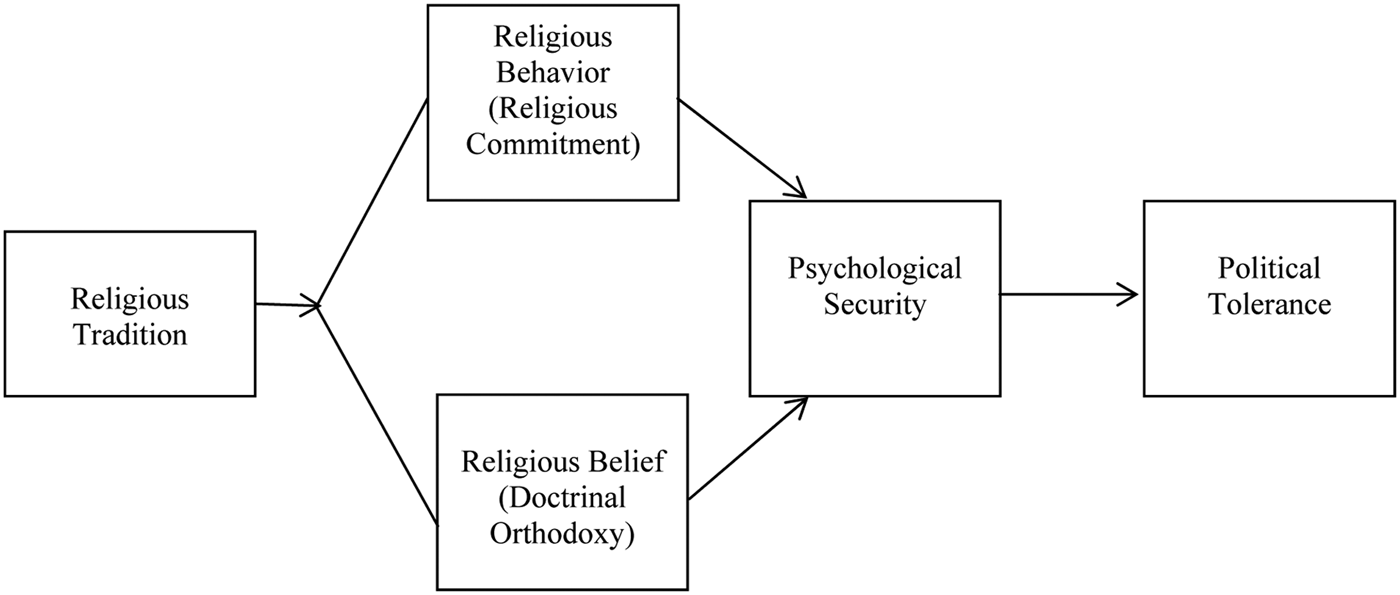
The theoretical model in Figure 1 summarizes the expected nature of the linkages between religion,Footnote 13 psychological security, and political tolerance. We estimate the model using structural equation modeling (SEM), which relies on maximum likelihood estimation.Footnote 14 Structural equation modeling allows for a series of regression equations, in a model with causal ordering, to be tested simultaneously. Visually, our model may look like a path analysis, but it is not. Path analyses use single indicator variables; in contrast, structural equation modeling allows for latent variables that are measured by multiple indicators. The specific focus, in terms of the results, is two-fold: (1) the relationship between religion and political tolerance as mediated by psychological security, considering the distinct impact of the separate components of dogmatism, self-esteem, and trust; and (2) the direct relationship between psychological security on political tolerance, considering the distinct impact of the separate components of dogmatism, self-esteem and trust. While we expect an indirect relationship between religion and political tolerance mediated by psychological security, we will test for a direct relationship although we do not expect that relationship to manifest (on this point see Peffley and Sigelman Reference Peffley and Sigelman1990; Gaddy Reference Gaddy, McConkey and Lawler2003; Eisenstein Reference Eisenstein2006).
Religion-psychological security-political tolerance connections. Note: Theoretical expectations concerning the relationship between religion, psychological security, and political tolerance. For space reasons, a number of social, psychological and political attitudes known to influence whether individuals want to extend political tolerance are not shown.

RESULTS
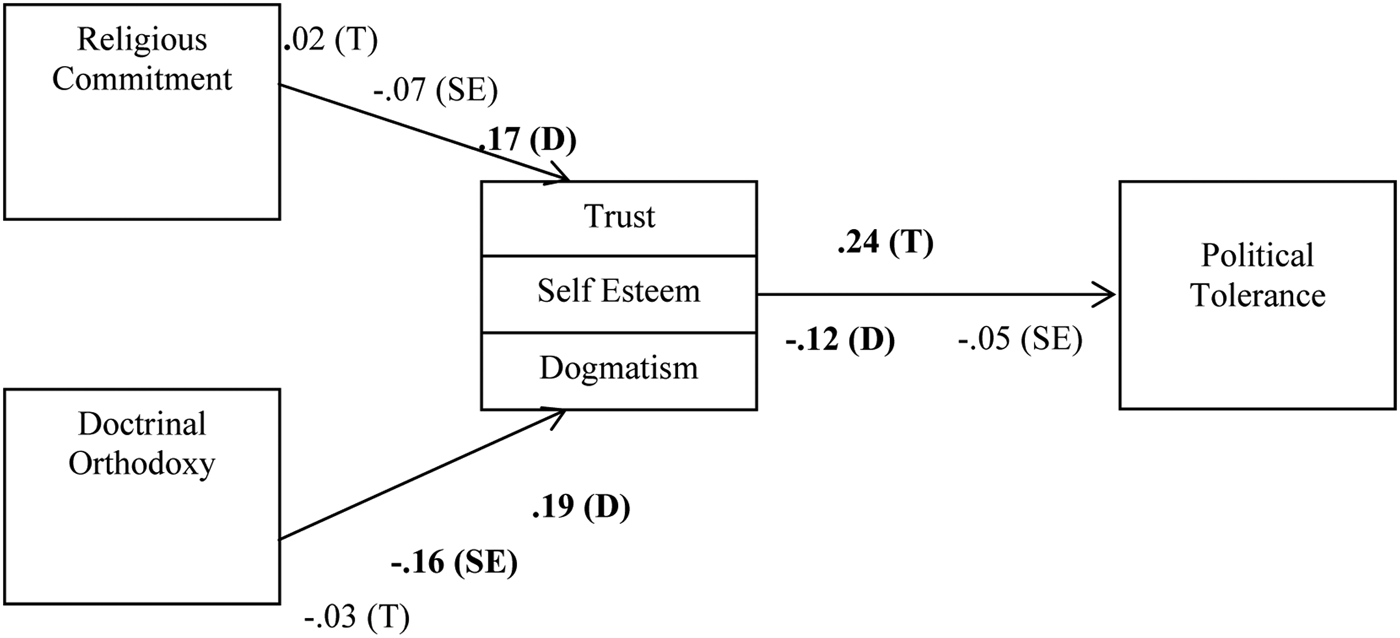
The results shown in Figure 2 are for the religion-psychological security-political tolerance linkage for all respondents without distinction between religious traditions.Footnote 15 All path coefficients that are bold indicate significance at 0.05 level or better and all estimates are the standardized estimates.
Religion-psychological security-political tolerance results by all respondents. Note: Empirical estimates of the relationship between religious commitment and doctrinal orthodoxy, psychological security (trust, self-esteem, and dogmatism), and political tolerance, controlling for other variables.

As can be seen in Figure 2, doctrinal orthodoxy exerts a moderate influence on two of the psychological security traits. In particular, dogmatic tendencies (0.19) are associated with an increase in doctrinal orthodoxy whereas self-esteem (−0.16) decreases with an inerrant or literal view of scripture. While the coefficient is in the predicted direction, there is no substantive or statistically significant influence of doctrinal orthodoxy on trust. Likewise, religious commitment has no influence on trust or self-esteem. However, a higher level of religious commitment (or religious behavior) influences dogmatism so that higher rates of service attendance, prayer frequency, and religious saliency are reflected in a moderate increase in dogmatism (0.17). These results call into question scholarship that posits a relationship between religious commitment and doctrinal orthodoxy with trust. As Alesina and La Ferrara (2002) and Welch et al. (Reference Welch, Sikkink, Sartain and Bond2004) contend, our findings confirm that religious commitment and beliefs are largely inconsequential to trust or not to trust.
Finally, we find that neither doctrinal orthodoxy nor religious commitments are directly linked to political tolerance (results not shown, available upon request). For both doctrinal orthodoxy and religious commitment, the direct relationship to political tolerance resulted in an insignificant coefficient of −0.06. Considering these findings, it appears that after controlling for both attitudinal and demographic factors that are associated with support for civil liberties, religious commitment and doctrinal orthodoxy are not especially strong determinants of political tolerance.
Now we assess the separate contributions of the three psychological security dimensions to political tolerance. We find that the direct influence of dogmatism on political tolerance while hardly impressive (the path coefficient is a weak −0.12, but it is statistically significant) is not unexpected given the extant literature. Counter to expectations, self-esteem has no substantive or statistical influence on political tolerance. Nevertheless, the coefficient suggests a negative relationship so that a healthy self-esteem undermines tolerance. Others have argued that low self-esteem is typically associated with intolerance in part because individuals with low self-esteem do not interact with others enough to learn the dominant social norm of tolerance and because they are more likely to perceive threats from others (Sniderman Reference Sniderman1975; McClosky and Brill Reference McClosky and Brill1983; Gibson Reference Gibson1987). The results here suggest that the relationship may not be as straightforward as previously suggested. In particular, the negative association may in fact be the result of differences in religious tradition — a point we return to later.
Trust, on the other hand, manifests the expected (direct) relationship whereby greater trust in others has an extremely convincing and positive influence on political tolerance (0.24). In fact, trust is by far the most important tolerance predictor among the tripartite psychological security components considered. This is rather unexpected and somewhat surprising given the well-established influence of dogmatism in the tolerance literature. Moreover, given the importance of dogmatism in the religion-psychological security linkage, we expected that among the various indicators of psychological security, the direct influence of dogmatism to political tolerance would be preeminent. In sum, once the dimensions of psychological security are considered separately, religious belief and commitment are moderately important with dogmatism constituting a bridge between religion and tolerance. Neither religious beliefs nor commitment directly explains variations in tolerance. Rather, the dominant direct influence on political tolerance is produced by trust — a component that has no connection to either religious dimension.Footnote 16
Finally, the associations found in Figure 2 confirm our concerns about the common usage of the psychological security index comprised of dogmatism, trust, and self-esteem as a predictor of tolerance. Our results show that self-esteem is unrelated to political tolerance whereas a sense of trust in others and to a lesser extent dogmatic tendencies are both important but these dimensions cut in opposite directions suggesting that greater caution may be needed in estimating the effects of psychological security on tolerance; e.g., the opposing influences of trust and dogmatism, are likely “washed out” using the composite psychological security index. In short, the analyses make clear that unless trust, self-esteem, and dogmatism are considered separately, we fail to appreciate the underlying association between religion, psychological security, and tolerance.
RELIGIOUS TRADITIONS
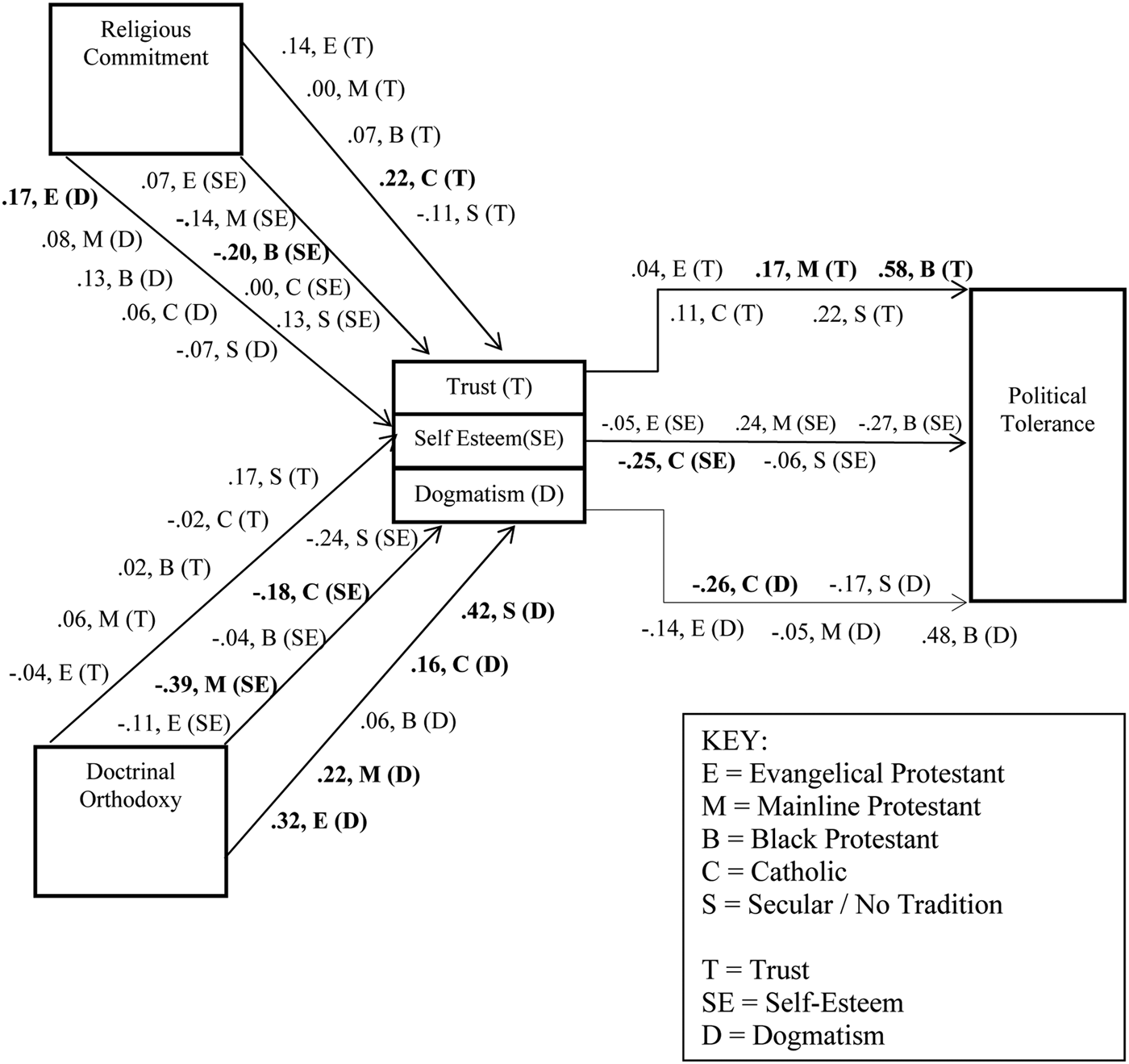
The results so far have focused on all respondents without distinction between the various religious traditions. Now we will present results for each religious tradition separately.Footnote 17 Figure 3 contains the path coefficients for the five religious traditions considered: evangelical Protestants, mainline Protestants, black Protestants, Catholics, and Seculars. All the estimates are standardized and coefficients in bold indicate significance at 0.05 or better. To delineate the estimates for each tradition, E is for evangelical Protestant, M is for mainline Protestant, B is for black Protestant, C is for Catholic, and S is for Secular.
Religion-psychological security-political tolerance results by religious tradition.

Consistent with earlier findings, religious commitment has little influence on any of the component parts of psychological security but, the impact varies by tradition. The only significant influence in the relationship between religious commitment and dogmatism is for evangelical Protestants (0.17). In fact, the evangelical effect appears to account entirely for the association between commitment and dogmatism (without religious tradition distinction) seen in Figure 2. This supports our expectation that the more religiously conservative tradition, evangelical Protestants, would be more likely to be dogmatic.
While earlier results without religious tradition distinction showed that higher rates of religious commitment do not translate into more social trust or high self-esteem (see Fig. 2), we find that the influence of religious commitment is contingent upon denominational membership. On this point, with the exception of Catholics (0.22), there is no linkage between religious commitment and trust; and likewise, with the exception of black Protestants (−0.20), there is no relationship between religious commitment and self-esteem. Although the religious commitment-trust link among Catholics is in the expected direction, the religious commitment to self-esteem link is negative for black Protestants. This finding suggests that for black Protestants higher rates of service attendance, prayer frequency, and religious saliency weaken self-esteem (a point we discuss further below). On the whole, the evidence suggests that religious commitment by tradition exerts minimal influence on any of the psychological security traits.
Doctrinal orthodoxy within religious tradition, on the other hand, has a more dominant influence on dogmatism and self-esteem. The only religious tradition that did not demonstrate a relationship between doctrinal orthodoxy and dogmatism is black Protestants. In contrast, seculars (0.42), evangelical Protestants (0.32), mainline Protestants (0.22), and Catholics (0.16) all demonstrate a substantive relationship whereby strong orthodox beliefs lead to increased dogmatism. Contrary to expectation, however, we find that the doctrinal orthodoxy-dogmatism relationship is not considerably different for evangelical Protestants (a more conservative tradition) than for the other religious traditions. It appears that an inerrant or literal view of scripture triggers a similar dogmatic reaction unrelated to denominational preference. This finding is in line with tolerance formulations that argue certain religious beliefs contribute to dogmatism — independent of other religious orientations (Jelen and Wilcox Reference Jelen and Wilcox1991; Green et al. Reference Green, Guth, Kellstedt and Smidt1994).
The results for the relationship between doctrinal orthodoxy and self-esteem are mixed and once again indicate that denominational preference matters. The only statistically significant coefficient's are for mainline Protestants (−0.39) and Catholics (−0.18). Nevertheless, all the coefficients are in the same direction indicating that doctrinal orthodoxy fosters low self-esteem. This negative association, again, is somewhat unexpected given previous studies that have argued religious commitment and affiliation (Ellison Reference Ellison1993; Keonig, McCullough and Larson Reference Keonig, McCullough and Larson2001) as well as doctrinal orthodoxy (Keonig, McCullough, and Larson Reference Keonig, McCullough and Larson2001) enhance self-esteem. Finally, doctrinal orthodoxy again proves unimportant to the creation of trust. Thus, while some have argued in favor of a religion-trust link wherein trust is positively influenced by church attendance but negatively influenced by Evangelical or fundamentalist affiliations (Welch et al. Reference Welch, Sikkink, Sartain and Bond2004; Bahr and Martin Reference Bahr and Martin1983; Smith Reference Smith1997; Schoenfeld Reference Schoenfeld1978) we find little evidence of either effect.
The relationship of trust, self-esteem, and dogmatism to political tolerance demonstrate the importance of taking account of the various religious dimensions as well as considering the psychological security items separately. The results in Figure 3 are quite different from those found in Figure 2 without distinction between religious traditions. For the direct relationship between dogmatism and political tolerance, only among Catholics (−0.26) do we find a statistically significant relationship. Hence, it seems that the negative influence of dogmatism to tolerance reported in Figure 2 manifests entirely from a Catholic orientation — in part, a product of their strongly held orthodox beliefs — indicating that unless denominational preference is taken into account the religion connection to tolerance will be obscured.
Once again, the negative influence of self-esteem on political tolerance is contrary to expectations; the only path coefficient that is statistically significant is for Catholics at −0.25, which suggests high self-esteem is associated with intolerance. These results indicate that the unexpected negative influence of self-esteem on tolerance is primarily driven by a Catholic influence that presumably reflects a “correct” way of thinking and living. After all, Catholic catechism and social teaching aims to develop a coherent and all-encompassing moral framework. As such Catholicism weaves together domestic and social issues (for example, opposition to abortion and the death penalty) not found in other religious traditions. It seems natural to suggest that among Catholics with high self-esteem, they are more confident or secure in the values and standards that serve as a basis for what is right or wrong in society and are thus, less willing to put up with nonconformity or deviation from these familiar standards.
The results for trust are similar to those found for all respondents. Here we find a very strong positive influence of trust on political tolerance among black Protestants (0.58) and to a much lesser extent mainline Protestants (0.17). Moreover, while religious commitment and trust are positively linked, among Catholics the lack of self-esteem and sense of dogmatism (as a consequence of their strict doctrinal beliefs) work against the effects of trust rendering these individuals less likely to be tolerant. In short, with few exceptions, there is little support for the link between trust and political tolerance. The evidence suggests that the direct positive effect of trust on tolerance presented for all respondents illustrated in Figure 2 is largely driven by the trusting attitudes among mainline and black Protestants.
As we did with the model for all respondents, we examined the direct relationship between religious commitment and doctrinal orthodoxy for the different denominations with political tolerance. Once again, religious commitment is inconsequential to understanding the sources of political tolerance regardless of religious tradition. None of the path coefficients are statistically significant and they are all negligible in size with the largest finding of -0.10 for both Seculars and black Protestants. For the direct relationship between doctrinal orthodoxy and political tolerance, the sole statistically significant finding is for Catholics (−0.14).
CONCLUSION
The purpose of this article was to provide new insight into the forces driving tolerance and intolerance by focusing on issues not systematically addressed in the extant literature: the independent role of the separate traits of psychological security as both a mediating force in the religion-political tolerance connection and as a direct influence on political tolerance. Since psychological security is a primary determinant of political tolerance, we consider the lack of understanding as to the precise nature of the component parts of trust, self-esteem, and dogmatism to tolerance a major omission in the research. We believe our findings raise troubling implications for the psychological security linkage estimated in prior studies.
In general, our results confirm that there is little evidence in support of a direct influence of religion (irrespective of doctrinal orthodoxy, religious commitment, or religious tradition) on political tolerance (Eisenstein Reference Eisenstein2006; Gaddy Reference Gaddy, McConkey and Lawler2003; Canetti-Nisim Reference Canetti-Nisim2004). While this is contrary to the assertions of Gibson (Reference Gibson, Wolfe and Katznelson2010) that religion has an independent direct influence on political tolerance, we believe the disagreement may, in part, stem from differences in the measurement of religion. Indeed, there are many ways in which tolerance scholars have conceptualized religion and despite substantial evidence that tolerance may vary with the manner of convictions, practice, and denomination, seldom are these religious dimensions examined in tandem. In the present study, we incorporate these three distinct religious dimensions and as discussed in more detail below, the outcome suggests the utility of this modeling framework for understanding the religion-psychological security-tolerance connection.
Although largely inconsequential through a direct linkage with tolerance, we find religion influences tolerance indirectly through its impact on psychological security. Even so, while the various religious dimensions directly affect trust, self-esteem, and/or dogmatism, the mitigating contribution of these psychological security traits is only marginally important for tolerance and is contingent upon both the particular psychological security predictor and religious dimension. For the religion-psychological security connection, after adjusting for the effects of demographic factors, the overall results (in Fig. 2) show that doctrinal orthodoxy reduces self-esteem whereas there is relatively little difference in the association of doctrinal orthodoxy and religious commitment to dogmatism; both promote higher levels of dogmatism. Still, the effects vary dependent on the denominational preference of the respondent. Namely, the link between religious commitment and dogmatism stems entirely from evangelical Protestants which indicate the relationship is contingent upon one's religious affiliation. Moreover, while self-esteem and trust were found unimportant in models without religious affiliation distinction, there is evidence that commitment reduces self-esteem among black Protestants as well as fosters trust for Catholics. Likewise, the association between strong doctrinal beliefs and the psychological security predictors vary with religious tradition. It is Catholics and mainline Protestants with strong doctrinal beliefs that lack self-esteem.
Equally important, there is evidence that the psychological security components mediate the relationship between religion and tolerance, but only elusively so. Put differently, while our account finds significant variations in trust, self-esteem, and dogmatism stemming from religious belonging, beliefs, and behavior, the mediating influence of the psychological security items is not, except among Catholics, important for enhancing or impeding tolerance. On this point, higher levels of dogmatism as a consequence of their doctrinal beliefs, is also a consideration in their willingness to tolerate. As far as Catholics are concerned then, the findings support claims that individuals tend to be intolerant, not because their religion makes them so, but because the same traits (such as dogmatic tendencies) that motivate them to engage with religion also leads them to oppose the endorsement of tolerant values (Allport and Ross, Reference Allport and Ross1967). We consider this finding to be a significant contribution of this study.
The literature has generally demonstrated a negative association between the various components of religion and levels of political tolerance. At the same time, an impressive body of evidence emphasizes a connection between religion and psychological security. With this in mind, we believe that by establishing which dimensions of religion and which dimensions of psychological security are most important our study makes a unique contribution to the tolerance literature. We find that religious commitment and doctrinal orthodoxy play different roles in the propensity to trust, possess self-esteem, and hold dogmatic tendencies for members of different religious groups. More importantly, except among Catholics, the connections between religion (doctrinal orthodoxy, religious commitment, and denomination) and trust, self-esteem, and dogmatism do not account for differences in political tolerance. In sum, there is little evidence to suggest that religious people are any less tolerant because of their religion nor because their religious orientations motivate traits that are inconsistent with tolerance.
Thus, while both commitment and doctrinal orthodoxy promote dogmatism, dogmatism does not demonstrate a substantial direct influence on political tolerance. Rather, among the three psychological security components, trust — a trait that seemingly has no connection to religious beliefs and commitment — has the dominant direct influence on political tolerance. Moreover, while neither religious commitment nor beliefs contribute to trust, there are denominational trust differences that reinforce tolerance among mainline and particularly black Protestants. These results are consistent with our supposition that the traditional usage of the composite psychological security measure does not capture the complex nature of the religion-psychological security-tolerance linkage. The results demonstrate that unless the individual measures of trust, self-esteem, and dogmatism are considered separately, we fail to capture the unique and disparate contributions of religion to psychological security as well as from psychological security to tolerance.
In light of these findings, we introduce several points that have important implications for modeling and estimating a commitment to political tolerance. First, there is the matter of the appropriateness of the trust dimension as part of the psychological security measure. According to Sullivan, Piereson, and Marcus (Reference Sullivan, Marcus, Feldman and Piereson1981; Reference Sullivan, Piereson and Marcus1982), faith-in-people — or trust — is an effective, if simple, measure of authoritarianism. To this point, a number of studies have demonstrated a strong negative relationship between religion and authoritarianism (e.g.. Adorno et al. Reference Adorno, Frenkel-Brunswik, Levinson and Sanford1950; Laythe et al. Reference Laythe, Finkel, Bringle and Kirkpatrick2002; Canetti-Nisim Reference Canetti-Nisim2004; Canetti-Nisim and Beit-Hallahmi Reference Daphna and Beit-Hallahmi2007). Our results provide little evidence that religious people are any more/less trusting than the non-religious. Thus, we must reconsider common assumptions about the meaning and measurement of trust as a proxy measure for the authoritarian personality. The fact that neither religious commitment (aside from the connection for Catholics) nor doctrinal orthodoxy explains variations in trust indicates that the designation of trust as an indicator of authoritarianism is not well understood. At a minimum, this research draws into question the efficacy of trust as a reliable component of the psychological insecurity indicator. Future research might consider whether our understanding of the sources of tolerance is the result of measurement issues associated with the psychological insecurity variable and in particular, the trust dimension.
In addition, this means we must consider what, if anything, the positive relationship between trust and political tolerance really means. While there are studies that link religion and trust, the extant literature does not address (in any systematic way) a connection between trust and political tolerance. For now, it is sufficient to note that it makes intuitive sense that trust is closely correlated with tolerance given the importance of trust to a functioning democracy and the conjecture that individuals with a stronger sense of trust in others may be less anxious about the possible risk posed by disliked groups. Given the magnitude of the trust effect relative to the other psychological security components, these findings indicate that more theoretical and empirical work is needed for developing and understanding the link between trust and political tolerance. Similarly, given that the influence of trust on political tolerance varies by religious tradition, further research into the source of these differences is also warranted.
Finally, while the causal relationships between the three dimensions of religion are hard to disentangle, failing to incorporate the so-called “three B's” makes it impossible to measure precisely the impact of religion. The model estimated here demonstrates that the conclusions reached largely hinge on a conceptualization of religion that adequately captures all three different dimensions. In this way, we identify connections between religious tradition and psychological security and tolerance that are largely hidden when the analyses is confined to religious commitment and/or doctrinal orthodoxy. So, for example, religious commitment is unimportant to shaping trust in others or self-esteem overall (Fig. 2 results). However, once controls for religious tradition are incorporated into the model (Fig. 3 results), we find religious commitment does matter and in some cases works in a contradictory direction that is dependent upon religious group membership. Thus, the results reported here suggest the necessity of including measures that tap into all three religious dimensions.
Therefore, the results presented here correspond with studies that model religious affiliation as an important form of social identity. According to the ethno-religious model,Footnote 18 religion is first and foremost a social group phenomenon. From this perspective, religious belonging is intertwined with cultural attributes (e.g., race, ethnicity, and region) and with religious behavior and belief that work to create distinctions between rather than within religious traditions. Ergo, the differences in the religious commitment-psychological security linkages can be attributed to the profound, lasting and continuing differences in the historical development and evolution of the various religious traditions. This is consistent with early studies of political behavior that argue identification with primary social groups have an enduring influence on people (Berelson, Lazarsfeld, and McPhee Reference Berelson, Lazarsfeld and McPhee1954). Religious traditions, according to this perspective, are similar to labor unions, racial or ethnic groups, or class distinctions so that identity with or group membership influences attitudes and behaviors. Moreover, the influence of religion interacts with other associational attachments and individual attributes.Footnote 19 For example, while mainline Protestant denominations have focused on accommodating modernity as it relates to social issues and cultural changes, evangelical Protestants have not. In a sense, mainline Protestants have given preference to highlighting commonalities between the community of faith and the broader culture while evangelical Protestants have given preference to highlighting the division between their values and the values of the broader culture. Consequently, it is not surprising to see that increased religious commitment portends greater dogmatism for evangelicals but not for mainline Protestants (or the other religious traditions).
Or, take for example, the relationship between religious commitment and self-esteem for black Protestants. It is difficult to imagine how an institution (the Black Church) that is central to the African-American community (Lincoln and Mamiya 1990) engenders a lack of self-esteem. We think this result is indicative of other factors, which also reinforce an ethno-religious model of religion. Namely, as a consequence of historic discrimination against the African-American community, the relationship between religious commitment and self-esteem may indicate other cultural factors such as the likelihood of African-Americans to view their community in terms of “winners” or “losers” in the broader social-economic milieu. That is, religious commitment does not create but reflects the lack of self-esteem within the African-American community as a consequence of strongly held and multi-generational beliefs about their ability to succeed in American society.Footnote 20
In conclusion, the evidence presented in this study suggests that, collectively, religious variables do a modest job of producing variation in psychological security as a source of political tolerance. In each model, the results suggest that the psychological security components are influenced by religion but neither relationship (religion to psychological security — or psychological security to political tolerance) offers a complete explanation for understanding lower levels of tolerance. Indeed, the results suggest that all things being equal, the religion-political tolerance nexus cannot fully be understood without accounting for the cultural and historical differences between the various religious traditions.
APPENDIX A
Least-Liked Political Tolerance Items
-
1. Members of the (subject selected least-liked group) should be banned from running for public office.
-
2. Members of the (least-liked group) should be allowed to teach in public schools.
-
3. The (least-liked group) should be outlawed.
-
4. Members of the (least-liked group) should be allowed to make a speech in this city.
-
5. The (least-liked group) should have their phones tapped by our government.
-
6. The (least-liked group) should be allowed to hold public rallies in this city.
Gibson's approach varied from Sullivan, Piereson, and Marcus (Reference Sullivan, Piereson and Marcus1982). Gibson asked tolerance items on each respondent's four most disliked groups (although for the 3rd and 4th most disliked group, only four in lieu of six activities were asked about). In measuring political tolerance, we use solely the responses to each respondents 1st most disliked group. We summed the responses to both the 1st most disliked group and the 2nd most disliked group and the correlation between the two separate indices is 0.97. According to Gibson (Reference Gibson1992, 563), the correlation between his six item indices and his four item indices (e.g., the indices on political tolerance created from respondents answers to four instead of six items) was 0.96. Therefore, using each respondents 1st most disliked group is an effective measure of political tolerance.
Dogmatism Items
-
1. Of all the different philosophies that exist in the world there is probably only one that is correct.
-
2. To compromise with our political opponents is dangerous because it usually leads to the betrayal of our side.
-
3. A group which tolerates too many differences of opinion among its own members cannot exist for long.
-
4. In the long run the best way to live is to pick friends and associates whose tastes and beliefs are the same as one's own.
-
5. There are two kinds of people in this world: those who are for the truth and those who are against it.
-
6. Most of the ideas that get printed nowadays aren't worth the paper they are printed on.
Self-Esteem Items
-
1. I never try to do more than I can for fear of failure.
-
2. I think that in some ways I am really an unworthy person.
-
3. When I look back on it, I guess I really haven't gotten as much out of life as I had once hoped.
-
4. I often feel I have done something wrong or evil.
-
5. People today have forgotten how to feel properly ashamed of themselves.
Trust (Or Faith-In-People) Items
-
1. Generally speaking, would you say that most people can be trusted or that you can't be too careful in dealing with people?
-
2. Would you say that most of the time people try to be helpful, or that they are mostly just looking out for themselves?
-
3. Do you think most people would try to take advantage of you if they got a chance, or would they try to be fair?
Religious Commitment Items
Frequency of Attendance is measured by asking: How often do you attend religious services?
-
1. Less than once a year.
-
2. Once a year.
-
3. Several times a year.
-
4. Once a month.
-
5. 2–3 times a month.
-
6. Nearly every week.
-
7. Every week.
-
8. More than once a week.
Frequency of Personal Prayer is measured by asking: About how often do you pray?
-
1. Less than once a week.
-
2. Once a week.
-
3. Several Times a week.
-
4. Once a day.
-
5. Several times a day.
Religious Salience is measured by asking: “Would you call yourself a strong [religious preference] or not a very strong [religious preference]?
-
1. No Religion
-
2. Not Very Strong
-
3. Somewhat Strong
-
4. Strong
In the empirical measurement of religious commitment, scholars typically include the subjective salience of religion question (e.g., the NES question regarding the amount of guidance religion provides). The GSS does not have this item; therefore, consistent with Gaddy (Reference Gaddy, McConkey and Lawler2003), we substitute the GSS item most analogous to it, which is a question about religious intensity.
Doctrinal Orthodoxy Items
The Biblical literalism question asked respondents: Which of these statements comes closest to describing your feelings about the Bible?
-
1. The Bible is an ancient book of fables, legends, history, and moral precepts.
-
2. The Bible is the word of God but not everything in it should be taken literally, word for word.
-
3. The Bible is the actual word of God and is to be taken literally, word for word.
The Biblical inerrancy question asked respondents: Here are four statements about the Bible, and I'd like you to tell me which is closest to your own view.
-
1. The Bible was written by men who lived so long ago that it is worth very little today.
-
2. The Bible is a good book because it was written by wise men, but God had nothing to do with it.
-
3. The Bible was written by men inspired by God, but it contains some human errors.
-
4. The Bible is God's word and all it says is true.
APPENDIX B
Within the traditional religion and politics literature, religion is conceptualized as having three distinct, yet interrelated dimensions: religious belief, religious belonging, and religious behavior (Jelen Reference Jelen1991; Layman and Green Reference Layman and Green1998; Kellstedt et al. Reference Kellstedt, Green, Guth, Smidt, Green, Guth, Smidt and Kellstedt1996; Carwardine 1993; Wuthnow 1988; Kellstedt Reference Kellstedt, Leege and Kellstedt1993). These are measured by doctrinal, sociological, and external behavior variables. Commonly utilized measures are: Church attendance, frequency of prayer, denominational affiliation, religious salience, doctrinal beliefs (doctrinal orthodoxy), religious self-identification, and religious experience (such as a born-again experience). Thus, by knowing how often someone attends church, their level of religious salience, frequency of prayer, and/or adherence to doctrinal statements — all measures of external behavior — an individual's religious behavior (or religious commitment) could be gauged. This is how religion and politics scholars have typically measured commitment, which is a measure focused on behavior.
Denominational affiliation and religious traditions are meant to operationalize the concept of belonging. 1 When analyzing and exploring the relationship of religious belonging to the political landscape, some type of order needs to be placed on the staggering number of religious group memberships in the United States. Denominational affiliation and religious tradition are the most frequently used categories for imposing this necessary order. Denomination refers to a specific organizational affiliation such as Catholic, Baptist, Lutheran, Episcopalian, Methodist, etc. For example, someone who is formally associated with the local Episcopalian church in Muncie Indiana, belongs to a local congregation. However, that local congregation is also part of a larger denomination called the Episcopalian Church, USA.
Religious tradition is distinctly different and broader conceptually from denominational affiliation because it cuts across denomination. Thus, that same individual who is a member of a local Episcopalian congregation, and part of the larger Episcopalian Church, USA denomination can also be categorized with individuals from other denominations into what is called a religious tradition. Denominations categorized within the same religious tradition tend to share common histories, a particular belief set regarding theology, ritual and eschatology, and even distinct racial or ethnic compositions (Steensland et al. Reference Steensland, Park, Regnerus, Robinson, Wilcox and Woodberry2000; Layman and Green Reference Layman and Green1998; Kellstedt and Green Reference Kellstedt, Green, Leege and Kellstedt1993; Roof and McKinney 1987; Greeley 1972).
Finally, the most common way of conceptualizing believing is through doctrinal orthodoxy. However, believing is also conceptualized by (i.e., trying to capture) the relationship between the individual and the divine by asking questions about religious experience(s). The most commonly used question asks whether or not an individual has had a “born-again” experience. Doctrinal orthodoxy, typically measured by questioning individual beliefs regarding the literalism and/or the inerrancy of the Bible, is meant to capture the worldview and basic values of religious individuals (Layman and Green Reference Layman and Green1998; Leege and Kellstedt Reference Kellstedt, Leege and Kellstedt1993; Wilcox Reference Wilcox1986). 2
NOTES FOR APPENDIX
-
1. Self-identification can also be utilized to measure religious belonging/affiliation, but it is used much less frequently. Self-identification refers to self-selected descriptive labels — as applied by the individual to describe either themselves or their church —such as charismatic, evangelical or fundamentalist. Fundamentalist, evangelical, charismatic, liberal, and conservative are the typical religious self-identification labels (Wilcox, Jelen, and Leege Reference Wilcox, Jelen, Leege, Leege and Kellstedt1993).
-
2. Scholars within this area of study argue believing is the central motivation for belonging and behavior (Layman and Green Reference Layman and Green1998; Layman Reference Layman1997; Leege and Kellstedt 1996; Kellstedt and Smidt Reference Kellstedt, Smidt, Leege and Kellstedt1993); thus, although belief, belonging, and behavior are conceptually and theoretically distinct religious dimensions, they are nonetheless related.