INTRODUCTION
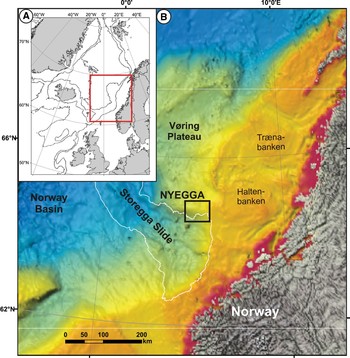
Hydrocarbon seeps are a common feature on the Norwegian continental slope. One of the regions where they occur is Nyegga. This region is located on the northern flank of the Storegga slide (Figure 1), at the border between two large oil/gas prone sedimentary basins, the Møre Basin to the south and the Vøring Basin to the north (Bunz et al., Reference Bunz, Mienert and Berndt2003). Seepage features, such as pockmarks, are widespread at the seabed in Nyegga. Through the European Community funded HERMES programme gas hydrates were recovered from this area (Ivanov et al., Reference Ivanov, Blinova, Kozlova, Westbrook, Mazzini, Minshull and Nouzé2007). Methane release from the Storegga and the south-western area of Nyegga was assessed by Paull et al. (Reference Paull, Ussler and Holbrook2007). Very general information on chemosynthetic fauna of Nyegga including bacteria, siboglinids and bivalves was reported by Kenyon et al. (Reference Kenyon, Ivanov and Akhmetzhanov1999), Mazzini et al. (Reference Mazzini, Aloisi, Akhmanov, Parnell, Cronin and Murphy2005), Vanreusel et al. (Reference Vanreusel, Andersen, Boetius, Connelly, Cunha, Decker, Hilario, Kormas, Maignien, Olu, Pachiadaki, Ritt, Rodrigues, Sarrazin, Tyler, Van Gaever and Vanneste2009) and Ivanov et al. (Reference Ivanov, Mazzini, Blinova, Kozlova, Laberg, Matveeva, Taviani and Kaskov2010). Among bivalves were mentioned Acharax sp., thyasirids and vesicomyid cf. Calyptogena sp. (Ivanov et al., Reference Ivanov, Mazzini, Blinova, Kozlova, Laberg, Matveeva, Taviani and Kaskov2010). For the first time vesicomyids were observed and collected at the Storegga and Nyegga pockmarks during the UNESCO–IOC Training Through Research cruise with RV ‘Professor Logachev’ (Kenyon et al., Reference Kenyon, Ivanov and Akhmetzhanov1999; Ivanov et al., Reference Ivanov, Mazzini, Blinova, Kozlova, Laberg, Matveeva, Taviani and Kaskov2010), and later during the Viking cruise in 2006 with ‘Pourquois pas?’ (Vanreusel et al., Reference Vanreusel, Andersen, Boetius, Connelly, Cunha, Decker, Hilario, Kormas, Maignien, Olu, Pachiadaki, Ritt, Rodrigues, Sarrazin, Tyler, Van Gaever and Vanneste2009).
Location of the Storegga Slide and the Nyegga study area. Area in frame in part (A) is enlarged in part (B). Area in frame in part (B) is shown in detail on Figure 2.

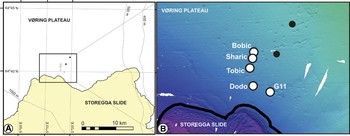
Material for our study was obtained during a marine geological survey of the Vøring Plateau (Nyegga and Vigrid areas) carried out by researchers from the University of Bergen in July–August 2008 on the RV ‘G.O. Sars’, cruise GS-08-155 (Haflidason et al., Reference Haflidason, Hjelstuen, Monsen, Ekerhovd, Skaug, Alvheim, Vaular, Chen, Steen, Daae, Hocking, Todt, Cid and Portnova2008). This cruise was a scientific contribution to the Petromaks research project ‘Gas Hydrates on the Norway–Barents Sea–Svalbard margin’ (GANS). Among the main aims of the cruise was detailed mapping (at the sub-metre scale) of the topography of one of the largest diapirs in the Vigrid area and of active seeps/pockmarks at Nyegga using an ROV, and an ROV video survey of the seafloor and sampling inside the Nyegga active seep area (Figure 2).
Methane seep sites in the Nyegga area. Area in frame in part (A) is enlarged in part (B). White circles correspond to pockmarks surveyed with ROV and sampled. Black circles, only sampled. Vesicomyid shells were discovered at seeps G11 and Tobic.

During the ROV survey several sites with dead shells of pliocardiin bivalves (Vesicomyidae) on the seafloor, some of them surrounded by bacterial mats and populations of siboglinids, were discovered at two active seep areas in the Nyegga region: G11 and Tobic (Figures 3B, 4A), at depths of 710–740 m. Descriptions of these sites were given by Hovland & Svensen (Reference Hovland and Svensen2006) and Ivanov et al. (Reference Ivanov, Blinova, Kozlova, Westbrook, Mazzini, Minshull and Nouzé2007, Reference Ivanov, Mazzini, Blinova, Kozlova, Laberg, Matveeva, Taviani and Kaskov2010). Pliocardiinae is a highly specialized subfamily of the family Vesicomyidae containing sulphide-oxidizing bacteria in their gills (Fisher, Reference Fisher1990). Pliocardiins are a consistent component of communities in reducing environments with a worldwide distribution (Krylova & Sahling, Reference Krylova and Sahling2010). In the Atlantic Ocean they occur in sulphide-rich habitats along both oceanic margins (Cosel & Olu, Reference Cosel and Olu2008, Reference Cosel and Olu2009) and also at the Mid-Atlantic Ridge (Gebruk et al., Reference Gebruk, Chevaldonne, Shank, Lutz and Vrijenhoek2000; Krylova et al., Reference Krylova, Sahling and Janssen2010; Lartaud et al., Reference Lartaud, de Rafelis, Oliver, Krylova, Dyment, Ildefonse, Thibaud, Gente, Hoise, Meistertzheim, Fouquet, Gaill and Le Bris2010). In the West Atlantic the northernmost locality, where pliocardiins have been recorded, was the Laurentian Fan (43°35′N 55°38′W, 3800 m) (Mayer et al., Reference Mayer, Shor, Clarke and Hughes Piper1988). The Nyegga seeps are located much further north, at about 64°N, representing the northernmost record of Recent vesicomyids. In samples taken by the ‘G.O. Sars’ expedition at Nyegga in 2008 as well as during the previous expeditions only dead shells were present. Examination of these shells revealed that they belong to a new species of the genus Isorropodon. They are identical to those which were referred to as cf. Calyptogena sp. (Ivanov et al., Reference Ivanov, Mazzini, Blinova, Kozlova, Laberg, Matveeva, Taviani and Kaskov2010). Here, we describe this species, discuss the distribution of the genus, and give some details on methane seep communities at Nyegga, the northernmost active examples known so far.
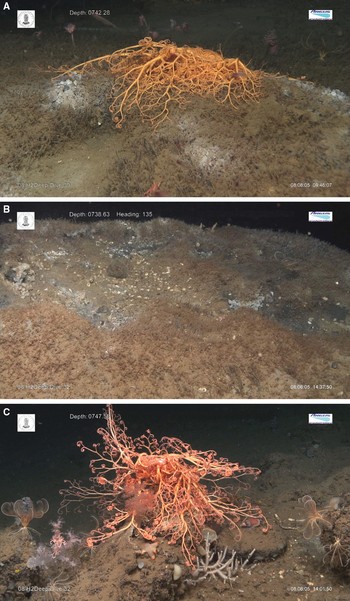
Seafloor images from the G11 seep site at Nyegga. (A) Population of siboglinids around spots of bacterial mats, Gorgonocephalus cf. eucnemis, solitary hydroids Corymorpha groenlandica in the background; (B) patch of Isorropodon shells surrounded by population of siboglinids; (C) rich fauna on and around carbonate blocks: Gorgonocephalus cf. eucnemis, crinoids Heliometra glacialis, stylasterid corals, soft corals Gersemia sp., sea star Pteraster sp. and a buccinid gastropod.

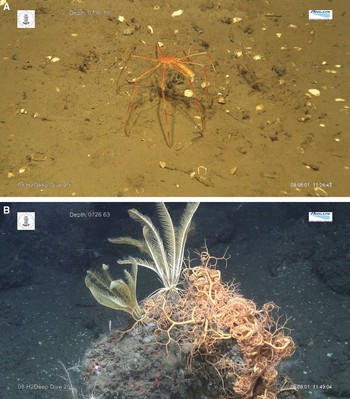
Sea-floor images from the Tobic seep site at Nyegga. (A) The pycnogonid Colossendeis proboscidea on a patch of Isorropodon shells; (B) Heliometra glacialis, Gorgonocephalus cf. eucnemis and red ophiuroids on a carbonate block, Isorropodon shells in the background.

MATERIALS AND METHODS
Vesicomyid shells were observed and sampled at the G11 and Tobic seep sites. Seafloor observations and in part sampling were conducted using the ROV ‘Bathysaurus’ XL; equipment included a colour 12 × zoom CCD camera, a SIT camera, a Digital Video Camera (Panasonic AW-E600 including SDI module), stills camera facilities, Sonar MS1000, a paired laser for scaling, a 5 function manipulator and sensor package for providing heading, depth, altitude and position. At G11 observations with the ROV were made on five dives (ROV Stations 29, 30, 31A, 31B and 32) and at Tobic on four dives (ROV Stations 4, 5, 6 and 8).
Samples of shells were taken at four stations, at one of them using the ROV ‘Bathysaurus’ XL (ROV Station 8) and at three others with a box corer (BC Stations 10, 19 and 22). Station 22 was taken at the G11 seep, the other three stations were at the Tobic seep. Material collected included 4 paired valves, 3 pairs of conjoined valves and 12 separate valves.
For morphological descriptions the following standard valve measurements were used: length, height, width, length of the fibrous part of the ligament (as the distance from the beak to the end of nymph), length of the posterior lamellar part of the ligament (as the distance from the beak to the end of the ligament groove) (Krylova & Sahling, Reference Krylova and Sahling2006). Position of the umbo was defined as the distance of the umbo from the anterior margin relative to the shell length. All measurements were made with calipers (±0.1 mm).
The type material is deposited in the Museum of Zoology, University of Bergen, Bergen, Norway (ZMBN) and in the Zoological Museum of Moscow State University, Moscow (ZMMU).
Abbreviations used in the text: IORAN, P.P. Shirshov Institute of Oceanology, Moscow, Russia; MNHN, Muséum National d'Histoire Naturelle, Paris, France; NSMT, National Science Museum, Tokyo, Japan; ZMBN, Museum of Zoology, University of Bergen, Bergen, Norway; ZMMU, Zoological Museum of Moscow State University, Moscow, Russia; BC, box corer; ROV, remotely operated vehicle; RV, research vessel; spm(s), specimen(s) live-collected; v(s), valve(s).
RESULTS
Description of seep sites
SEEP G11
This seep is related to a pockmark structure about 150 m in diameter, at 732 m depth and in a temperature regime around –0.7oC (Hovland & Svensen, Reference Hovland and Svensen2006). The topography inside the pockmark was rough, with numerous mounds and carbonate blocks of different size. Seep areas were marked by dark sediment with spots of whitish bacterial mats and carbonate crusts and blocks. Some areas with dark sediment were surrounded by patches of dead bivalve shells and populations of siboglinids Oligobrachia sp. and Archeolinum sp. (formerly referred to the genus Sclerolinum, see Smirnov (Reference Smirnov2008)) (Figure 3A, B). The soft corals Gersemia sp. and large solitary hydroids Corymorpha groenlandica (Allman, 1876) were abundant. The pycnogonid Colossendeis proboscidea (Sabine, 1824) was common at patches with bivalve shells and siboglinids. Also common were the sea stars Pteraster sp. and buccinid gastropods.
The carbonate formations were heavily populated by the comatulid crinoid Heliometra glacialis (Owen, 1833), ophiuroids (including Gorgonocephalus cf. eucnemis), glass sponges (Rossellidae) and stylasterids resembling Errina and Stylaster (Figure 3C).
In close vicinity of G11, large polychaete tubes (~10 cm in length) resembling Nothria sp. were observed at the seafloor in high densities (about 20 m−2). Several species of fish were recorded in the area of G11, including Macrourus berglax Lacépède, 1801, Cottunculus cf. sadko and the ray Amblyraja cf. hyperborea.
TOBIC SEEP
This site is located at a depth of 710 to 725 m. The topography here was even, with small sediment mounds and small carbonate blocks. Compared to the G11 seep, there were much fewer carbonate structures present; carbonate structures and areas of soft sediment covered with populations of siboglinids and vesicomyid shells were smaller. In general the fauna documented for Tobic was similar to that of the G11 seep (Figure 4A, B). Some faunistic differences included the presence of sea pens (Umbellula sp.) and sea stars of the genus Crossaster at Tobic, and the absence of buccinid gastropods that were very common at G11.
Isorropodon Sturany, 1896: 17.
Isorropodon, Cosel & Salas, Reference Cosel and Salas2001: 343.
TYPE SPECIES
Isorropodon perplexum Sturany, 1896 (by monotypy).
TYPE LOCALITY
Isorropodon perplexum is found north of Alexandria, Egypt, eastern Mediterranean at 2420 m.
DIAGNOSIS
Shell from small to medium-sized, length to 70 mm, thin-walled, ovate to elliptical in outline, with prosogyrate beaks. Escutcheon present and lunular incision indistinct or missing. Pallial sinus is absent. Anterior pedal retractor scar shallow. Anterior lamellar layer does not excavate subumbonal pit. Hinge with three dental elements in each valve. Ctenidia comprise inner demibranchs only with descending and ascending lamellae. Inner vulva of inhalant siphon without processes. For more details see Cosel & Salas (Reference Cosel and Salas2001) p. 343.
COMPOSITION
Isorropodon bigoti Cosel & Salas, Reference Cosel and Salas2001, I. curtum Cosel & Salas, Reference Cosel and Salas2001, I. elongatum (Allen, Reference Allen2001), I. fossajaponicum (Okutani, Fujikura & Kojima, Reference Okutani, Fujikura and Kojima2000) (tentatively), I. nyeggaensis sp. nov., I. perplexum Sturany, 1896 and I. striatum (Thiele & Jaeckel, Reference Thiele and Jaeckel1931).
DISTRIBUTION
Western Atlantic: the North America, Guyana and Argentina Basins; Eastern Atlantic: from off Namibia to off Mauritania; Mediterranean; Arctic: Norwegian Sea; Pacific Ocean: Japan Trench, Aleutian Trench; 150–6809 m.
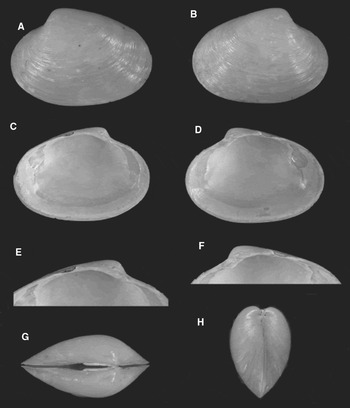
Isorropodon nyeggaensis sp. nov, RV ‘G.O. Sars’, Cruise GS-08-155, Station 10, BC, holotype, ZMBN 86309, length = 12.7 mm. (A) Exterior of left valve; (B) exterior of right valve; (C) interior of left valve; (D) interior of right valve; (E) left hinge plate; (F) right hinge plate; (G) dorsal view; (H) anterior view.

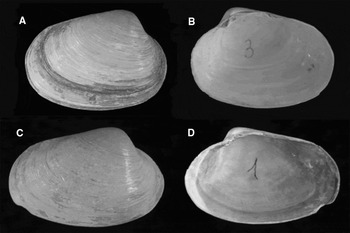
Isorropodon nyeggaensis sp. nov., RV ‘G.O. Sars’, Cruise GS-08-155, Station 10, BC. A, B, length = 15.3 mm. (A) Exterior of right valve; (B) interior of right valve. C, D, length = 17.5 mm. (C) Exterior of right valve; (D) interior of right valve.

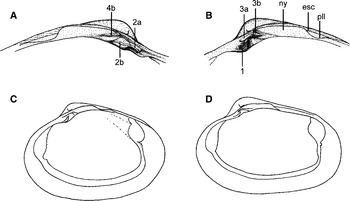
Isorropodon nyeggaensis sp. nov., RV ‘G.O. Sars’, Cruise GS-08-155, Station 10, BC. A–C, holotype. (A) Hinge margin of left valve; (B) hinge margin of right valve; (C) diagrammatic views of interior. (D) L = 15.8 mm. Diagrammatic views of interior. 1, ventral cardinal tooth; 2a, anterior ramus of subumbonal cardinal tooth; 2b, posterior ramus of subumbonal cardinal tooth; 3a, anterior ramus of subumbonal cardinal tooth 3b, posterior ramus of subumbonal cardinal; 4b, posterodorsal cardinal tooth; esc, escutcheon; ny, nymph; pll, trace of attachment of posterior lamellar ligament layer.

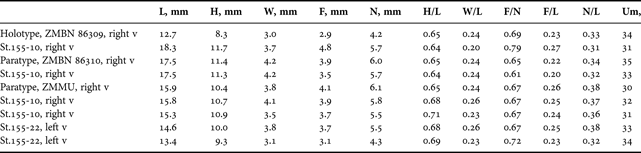
Measurements of shells of Isorropodon nyeggaensis sp nov.
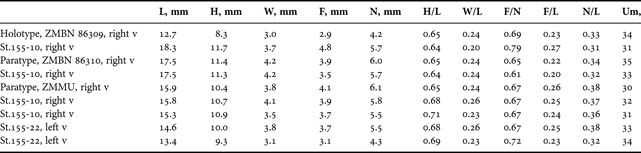
L, length; H, height; W, width; F, length of the fibrous part of the ligament; N, length of the posterior lamellar part of the ligament; Um, position of the umbo; St., station, v, valve.
TYPE MATERIAL
Holotype: two paired vs (RV ‘G.O. Sars’, Cruise GS-08-155, Station 10, BC, 64°40.826′N 05°15.710′E, 720 m, 1 August 2008) (ZMBN 86309).
Paratypes: right valve (the same station) (ZMBN 86310); one left and one right unpaired valve (the same station) (ZMMU Ld-3027).
ADDITIONAL MATERIAL EXAMINED
Three pairs of conjoined vs, 1 right v (RV ‘G.O. Sars’, Cruise GS-08-155, Station 08, ROV, Tobic seep, 64°40.860′N 05°15.772′E, 720 m, 1 August 2008 (IORAN); 4 right vs (Station 10, BC, Tobic seep, 64°40.826′N 05°15.710′E, 720 m, 1 August 2008 (IORAN); 2 paired vs (Station 19, BC, Tobic seep, 64°41.068′N 05°15.857′E, 715 m, 3 August 2008 (IORAN); 3 left vs, 1 right v (Station 22, BC, G11 seep, 64°39.812′N 05°17.340′E, 732 m, 3 August 2008) (IORAN).
COMPARATIVE MATERIAL EXAMINED
Isorropodon bigoti Cosel & Salas, Reference Cosel and Salas2001. Holotype: 1 spm in alcohol, MNHN, Eastern Atlantic, off Pointe-Noire, Congo (Brazzaville), N'Kossa oilfield (5°53.54′S 11°38.79′E, 150 m); 1 spm in alcohol from the same locality (IORAN).
Calyptogena (Ectenagena) fossajaponica Okutani, Fujikura & Kojima, Reference Okutani, Fujikura and Kojima2000. Holotype: 2 paired vs, NSMT-Mo 71494, Western Pacific, Japan Trench, middle Sanriku Escarpment (40°06.40′N 144°11.22′E, 6329 m); 2 spms in alcohol, eastern Pacific, Aleutian Trench (RV ‘Sonne’, Cruise 110, Station 49/1, TV box corer, 54°18.05′N 157°12.11′W, 4809 m, 8 August 1996) (IORAN).
TYPE LOCALITY
Arctic, Norwegian Sea, Vøring Plateau, Storrega Slide, Nyegga seep area (64°40.826′N 05°15.710′E), 720 m.
DIAGNOSIS
Isorropodon: species with length to 21 mm, thin, elongate–elliptical, height/length = 0.64–0.71, width/length = 0.20–0.26, ventral margin with nearly straight its middle part, glossy transparent light brown periostracum, shallow escutcheon, slight lunular incision, umbo situated in anterior 30–35% of valve, prosogyrate beaks, stout nymph, fibrous layer of ligament occupying 20–27% of valve length and 61–79% of posterior lamellar layer.
DESCRIPTION OF HOLOTYPE
Shell small-sized, length = 12.7 mm, thin-shelled, elongate-elliptical in outline, height/length = 0.65, nearly equivalve. Periostracum thin, transparent, glossy, light brown.
Sculpture consisting of concentric threads. Escutcheon narrow and weak, limited by rounded ridge, which is a little bit sharper in the left valve; lunule ovate, delimited by pairs of faint incisions, the first one, proximal, more distinct than the second incision. Inequilateral, umbo situated in anterior 34% of valve. Umbones rather inflated; beaks prosogyrate, not touching each other. Anterior–dorsal margin short, nearly straight; anterior margin rounded; ventral margin nearly straight in its middle part; posterior margin broadly rounded, posterior–dorsal margin slightly convex.
Internal shell surface is white, with faint radial striation. Pallial line somewhat broad, especially just below the anterior adductor scar, not impressed. Pallial sinus absent, but pallial line has a very shallow irregular deflection below the posterior adductor scar. Anterior adductor scar elongated ovately–conical, somewhat impressed to rear. Posterior adductor scar larger, subcircular. Anterior pedal retractor scar slightly impressed, located above anterior adductor scar, fused with it. Posterior pedal retractor not impressed, fused to posterior adductor scar. Nymph moderately developed, with steep posterior end. Fibrous layer of ligament occupies 23% of valve length and 69% of posterior lamellar layer. Anterior lamellar ligament forms a very shallow deflection in proximal part of nymph.
Arrangement of teeth is more or less parallel to the dorsal margin. Dentition of right valve: ventral cardinal (1) and subumbonal cardinal, consisting of anterior ramus (3a) and posterior ramus (3b). Tooth 1 the strongest in the right valve, wedge-shaped. 3a short, thin, distally fused with thicker 3b. Dentition of left valve: subumbonal cardinal tooth with two rami (2a and 2b) and posterodorsal cardinal tooth (4b). 2b-ramus is stout, fused with thinner and shorter 2a-ramus; 4b is thin, lamellar, shorter than a half of nymph.
VARIATION
Variations can be seen in the shape of teeth, shell shape and relative lengths of fibrous and lamellar parts of ligament (Table 1). Teeth can vary from thin and parallel to the dorsal margin to somewhat stout and slightly radiating. Shell shape can be more or less elongated, ratio height/length varies from 0.64 to 0.71.
RELATIONSHIPS
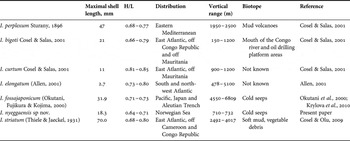
From all six already described representatives of Isorropodon the new species differs by relatively more elongated shell shape and nearly straight middle part of shell ventral margin. In shell size and general shell shape the new species is most closely related to I. bigoti (Table 2), from which it differs by not truncated, evenly rounded both anterior and posterior shell margins, less inflated umbo and nearly straight ventral margin. In I. bigoti the ventral margin is markedly convex with highest part of shell located ‘well behind the beaks’ (Cosel & Salas, Reference Cosel and Salas2001, p. 346). In the new species maximal height of shells is always at the level of umbo.
Main characteristics and distribution of Recent Isorropodon species.

DISTRIBUTION
Arctic, Norwegian Sea, Storrega Slide, Nyegga, 710–732 m.
BIOTOPE
Methane seeps.
ETYMOLOGY
Named after the Nyegga seep area, which is the type locality of the species.
DISCUSSION
Hydrocarbon seeps are widely distributed in the Norwegian Sea basin, but information on macrofauna related to the sulphide-rich reducing environments is scanty. The most studied community associated with hydrocarbon seeps in the Norwegian Sea is that of the Håkon Mosby mud volcano (Gebruk et al., Reference Gebruk, Krylova, Lein, Vinogradov, Anderson, Pimenov, Cherkashev and Crane2003; Soltwedel et al., Reference Soltwedel, Portnova, Kolar, Mokievsky and Schewe2005). The total diversity of benthic macrofauna collected at this site so far is 46 species. Among specialized organisms harbouring symbiotic bacteria there were two siboglinid species: Oligobrachia sp. and Archeolinum contortum Smirnov, Reference Smirnov2000 (Smirnov, Reference Smirnov2000, Reference Smirnov2008), and two bivalve species: Thyasira (Parathyasira) dunbari Lubinsky, 1976 and Thyasira (Parathyasira) sp. Both species of siboglinids and T. dunbari dominate the community (Gebruk et al., Reference Gebruk, Krylova, Lein, Vinogradov, Anderson, Pimenov, Cherkashev and Crane2003). The sites at Nyegga, in which vesicomyid valves have been recorded, were also dominated by siboglinids of the same genera as at the Håkon Mosby mud volcano.
In spite of that only empty shells of vesicomyids were sampled at Nyegga; their state and condition suggest that live specimens might occur deeper in the sediment and could be found with more targeted sampling effort.
Previously the genus Isorropodon, Sturany 1896 was tentatively placed in the family Trapezidae (Keen, Reference Keen and Moore1969). As a member of the family Vesicomyidae it was recognized quite recently (Cosel & Salas, Reference Cosel and Salas2001). Krylova & Sahling (Reference Krylova and Sahling2010) divided the family Vesicomyidae into two subfamilies—Vesicomyinae and Pliocardiinae. The subfamily Pliocardiinae currently contains about 15 genera including Isorropodon, which are highly specialized for sulphide-rich reducing environments. For a long time Isorropodon has been known only by the type species, I. perplexum Sturany, 1896, recorded in the Mediterranean Sea. Cosel & Salas (Reference Cosel and Salas2001) studying the fauna of vesicomyids of the Eastern Atlantic described two more new species of the genus, I. bigoti and I. curtum, and also transferred two already known species to Isorropodon, Vesicomya striata Thiele & Jaeckel, Reference Thiele and Jaeckel1931 and Kelliella elongata Allen, Reference Allen2001. In addition we tentatively suggest here that Calyptogena (Ectenagena) fossajaponica Okutani, Fujikura & Kojima, Reference Okutani, Fujikura and Kojima2000 from the Western and North Pacific could be assigned to the genus Isorropodon. Like the type species of the genus I. perplexum, C. (E.) fossajaponica has oval small-sized thin shell without pallial sinus, with three narrow dental elements in each valve, only one inner demibranch and midgut posteriorly curving upward before entering the pericardial cavity. One more species described in the Eastern Atlantic as Isorropodon, I. atalantae Cosel & Olu, Reference Cosel and Olu2009, quite probably should be excluded from Isorropodon. Isorropodon atalantae has very similar to ‘real’ Isorropodon a narrow hinge plate with all teeth arranged in a line, but there is a difference in the musculature of the siphons. In I. atalantae intersiphonal septal retractor attaches to the shell separately from the posterior adductor and there is a separate scar of the retractor on the inner surface of the shell like in the other vesicomyid genus, Pliocardia. In Isorropodon there is not a separate scar of the intersiphonal septal retractor. In addition to Recent species, one fossil species of Isorropodon—I. frankfortensis Amano & Kiel, Reference Amano and Kiel2007, has been described from the early Miocene of Washington State (USA, North Pacific region) (Amano & Kiel, Reference Amano and Kiel2007).
Thus, to date, there are seven Recent species (Table 2) and one fossil species known in the genus. With the exception of I. elongatum and I. curtum, for which there is no information, Isorropodon species are known from reducing habitats. Available data on the anatomy of I. perplexum and I. bigoti suggest that these species harbour bacteria in their thick, large gills (Cosel & Salas, Reference Cosel and Salas2001), but direct evidence is absent. Direct evidence for symbiotic chemosynthetic bacteria in the gills is known for I. fossajaponicum from the Japan Trench, which has numerous sulphide-oxidizing endosymbionts in the epithelial cells of the gills (Fujiwara et al., Reference Fujiwara, Kojima, Mizota, Maki and Fujikura2000).
Recent species of Isorropodon were previously known from the following areas: Eastern Atlantic Ocean along the west coast of Africa from Namibia to Mauritania (3 species), southern and north-western Atlantic basins (1 species), the Mediterranean Sea (1 species) and the Japan and Aleutian Trenches (1 species). In the Mediterranean Sea, I. perplexum is the only Recent representative of vesicomyids. The occurrence of I. nyeggaensis sp. nov. substantially extends the geographical range of the genus Isorropodon and the family Vesicomyidae as a whole. It is the first description of vesicomyids from the Norwegian Sea and the second record in the Arctic basin. To date only Laubiericoncha sp. was known from the Arctic (Sirenko et al., Reference Sirenko, Petryashov, Rachor and Hinz1995; Krylova & Sahling, Reference Krylova and Sahling2010). It was discovered at the Gakkel Ridge (77°46′N 126°07′E, 1992–2054 m) and represented only by fossil valves with an age 15.7 kyr (late Pleistocene) (Sirenko et al., Reference Sirenko, Petryashov, Rachor and Hinz1995).
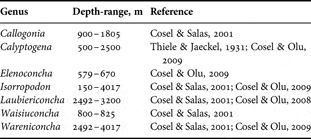
The vertical range of Isorropodon is very broad, extending from 150 m to 6809 m. Such an extensive range is exceptional for the pliocardiins; the majority of pliocardiin genera are stenobathic, restricted to a single bathymetric zone, bathyal or abyssal (Krylova & Sahling, Reference Krylova and Sahling2010). In the Eastern Atlantic the depth-range of Isorropodon (150–4017 m) exceeds the vertical ranges of all other pliocardiin genera from this region (Table 3). The upper vertical limit is among the shallowest in the family.
Depth-range of pliocardiin genera in the East Atlantic.

Isorropodon is known from very different geological settings in a wide range of biotopes—from mud volcanoes to plant debris. Species of Isorropodon are among the small-sized vesicomyids. Perhaps this adaptation facilitates the inhabiting of biotopes with a broad span of environmental conditions in an extensive range of depths. Adaptation for a wide range of environmental conditions could have promoted penetration of this genus to the Arctic basin. It can be suggested that Isorropodon invaded the Norwegian Sea from the Atlantic along the African–European continental margin, where the majority of Isorropodon species are distributed. Further investigations of the methane seep fauna on the Norwegian continental slope and of the fauna of recently discovered hydrothermal vents on ridges in the Norwegian Sea (Schander et al., Reference Schander, Rapp, Bakken, Berge, Cochrane, Kongsrud, Oug, Byrkjedal, Cedhagen, Fosshagen, Larsen, Obst, Pleijel, Stöhr, Todt, Warén, Hadler-Jacobsen, Keuning, Mikkelsen, Petersen, Torseth and Pedersen2010) will clarify pathways of distribution of chemosynthetic fauna into the Arctic basin.
ACKNOWLEDGEMENTS
We are obliged to the captain and the crew of the RV ‘G.O. Sars’ and to the pilots of the ROV ‘Bathysaurus’ for their support in collecting samples. We thank the following experts for help with identification of benthic fauna from the seafloor images: A. Dilman (Asteroidea), K. Tabachnik (Porifera), N. Budaeva and J. Kongsrud (Polychaeta), A. Orlov and N. Chernova (Pisces). We owe thanks to Y. Fujiwara and H. Saito (NSMT, Japan), R. von Cosel and V. Heros (MNHN, France) for the loan of type material. We are also grateful to R. von Cosel for providing specimens of Isorropodon bigoti. We acknowledge H. Sahling (MARUM, Germany) for help with photography of Isorropodon valves. Also we would like to thank C. Little (University of Leeds, UK) for constructive comments that significantly improved the manuscript. We are grateful to M. Ivanov (Moscow State University, Russia) and M. Taviani (CNR–Instituto di Scienze Marine, Italy) for advice. Funding was partly provided by the Russian Foundation for Basic Research (project number 08-05-00470). We would like to thank the GANS project (‘Gas hydrates on the Norway-Barents Sea and Svalbard margin’, Contract No. 175969/S30), which is supported by the Norwegian Research Council and the joint industry Norwegian Deepwater Programme–SEABED III consortium.