Case 1
A 98-year-old lady presented with a 4-month history of a rapidly growing 8×5·5 cm Merkel cell carcinoma (MCC) above her left eyebrow extending on to her upper eyelid causing mechanical obstruction of her vision. When seen in the clinic, the lesion was 8×5·5 cm and she had no palpable lymphadenopathy. Staging computed tomography (CT) scan showed no bony involvement or invasion into orbital contents. There was however cervical lymphadenopathy on the left side, particularly affecting level 3 nodes. Due to her performance status (PS) of 4 and other co-morbidities, we offered her the split-course palliative hypofractionated radiotherapy regime.
Phase 1 included the primary tumour with a 1·5-cm margin for planning target volume. A dose of 20 Gray (Gy) in 5 fractions using 15 MeV electrons was delivered. Following phase 1 the primary tumour had markedly reduced in size to 5×3 cm and she was able to fully open her eye and see clearly. However, her cervical lymphadenopathy had worsened with her left cervical lymph node increasing in size to 5 cm. Phase 2 of 20 Gy in 5 fractions to a reduced volume was commenced after 2 weeks, this time to both the MCC lesion and the left cervical lymph node. Radiation Therapy Oncology Group (RTOG) grade 1 skin toxicity was noted during treatment. This resulted in an excellent response with complete resolution of the primary MCC and the lymph node was no longer clinically palpable (see Figure 1). There were no reported side effects.
Case 1 pre- and post-treatment photographs.

At a subsequent 6-month follow-up clinic the treated site still had a complete response but she had a new MCC lesion on her right cheek. However, she deteriorated before she could have any further palliative radiotherapy and died secondary to complications from her end-stage renal disease.
Case 2
A 92-year-old lady presented with a biopsy confirmed 5×5-cm rapidly enlarging MCC on her left cheek. Following multidisciplinary meeting discussions and considering her multiple co-morbidities (PS 3), it was decided to manage the lesion palliatively with radiotherapy. She underwent split-course hypofractionated radiotherapy consisting initially of 20 Gy in 5 fractions using 6-MV photons with bolus to the skin. The lesion responded with complete flattening and minimal scarring. After a 2-week break, she went on to have phase 2 treatment of a further 20 Gy in 5 fractions of superficial radiotherapy. There was minimal RTOG grade 1 skin toxicity during treatment.
The patient was reviewed 1 month after treatment and had achieved complete resolution of the primary lesion. She developed a new lesion on the left angle of the jaw measuring 3×2·5 cm, which was another biopsy-proven MCC. A CT staging scan showed no definitive evidence of nodal or distant metastases. She underwent a repeat phase 1 treatment of 20 Gy in 5 fractions however, given her progressive frailty and co-morbidities she did not have a phase 2 treatment. Radiotherapy to the new lesion resulted in significant reduction in size by more than 50%, which achieved good local control. She is currently under 2 monthly follow-up sessions with further treatment dictated by symptoms.
Case 3
An 80-year-old gentleman had been diagnosed by Maxillofacial surgeons with an ~4-cm MCC on the right angle of the mandible invading the parotid. He had a staging CT that showed no lymphadenopathy or distant disease. He underwent a superficial right parotidectomy including skin excision. Histology showed intravascular invasion and extension into the parotid gland. The tumour focally reached the circumferential margin. Clinically within a few weeks of his operation he developed a locally recurrent suspicious nodule measuring 2 cm in the postoperative bed. It was arranged for him to undergo postoperative radiotherapy to the tumour bed and ipsilateral neck.
Due to his multiple co-morbidities and a PS 2 he underwent split-course hypofractionated radiotherapy with 20 Gy in 5 fractions using 6-MV photons. He tolerated both phases of treatments well with minimal side effects (RTOG grade 1 skin toxicity) and no clinical evidence of recurrence during his follow-up. He died 2 years later from an infective exacerbation of chronic obstructive pulmonary disease.
Case 4
A 93-year-old gentleman was referred with a 5×5-cm skin lesion on the left anterior scalp. This was confirmed to be a MCC on skin biopsy with subcutis and perineural invasion. Due to his significant co-morbidities and a PS of 4 it was planned for him to have palliative radiotherapy alone for local control and thus no staging scans were arranged.
He had 20 Gy in 5 fractions over 5 days using superficial radiotherapy to which the tumour achieved a partial response. He died 2 months later due to urosepsis on a background of chronic kidney disease.
Introduction
The aim of this case series was to provide evidence on the efficacy of the split-course hypofractionated palliative regime used in the cases presented above and to review the literature on the palliative management of MCC. This will add to the evidence base as currently there is limited evidence on the optimal palliative management of MCC. The methods used for the literature search included PubMed searches with the keywords merkel cell carcinoma, radiotherapy and palliative.
MCC is a rare primary cutaneous neuroendocrine carcinoma with a propensity to spread to regional lymph nodes and distant sites. It was first described in 1972 by Toker.Reference Toker1 It frequently affects elderly Caucasian patients with a preference for the head and neck.Reference Suarez, Rodrigo, Ferlito, Devaney and Rinaldo2 Risk factors for MCC include sun exposure, immunosuppression and organ transplantation.Reference Suarez, Rodrigo, Ferlito, Devaney and Rinaldo2
The cells of origin is thought to be the merkel cell which are believed to be the slow-acting mechanoreceptors in the basal layer of the epidermis. Clinical appearance of a MCC typically appears as a red, violaceous (violet) nodule with a shiny surface, with overlying telangiectasia. Most lesions are <20 mm in diameter. MCC can spread through the dermal lymphatics system, resulting in the development of multiple satellite lesions.Reference Poulsen3
On histology, MCC cells are usually ovoid and up to 15 µm in diameter with scanty cytoplasm. Typically, MCC will express both neuroendocrine and cytokeratin markers.Reference Poulsen3 In 2008, an association between MCC and Merkel cell polyomaviruses (double-stranded circular DNA viruses) was described.Reference Feng, Shuda, Chang and Moore4
Between 1999 and 2008, the incidence rate of MCC in England rose from 0·1 to 0·2 per 100,000 persons.5 The annual incidence of MCC is 0·6 per 100,000 persons and is increasing (~1,600 new cases per year in the United States).Reference Hughes, Hardee, Cornelius, Hutchins, Bercker and Gao6 The rising incidence is partly due to increased awareness and the introduction of cytokeratin 20 immunostaining. According to the National Cancer Database, the majority of MCCs present with localised disease (66%) followed by nodal disease (27%) and metastatic disease (7%).Reference Hughes, Hardee, Cornelius, Hutchins, Bercker and Gao6
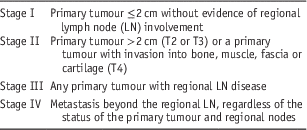
Tumour, node and metastases staging classification of MCC is tabulated in Table 1.Reference Edge, Byrd and Compton7 Along with lymph nodes, common sites of metastases include in transit skin, lungs, central nervous system, bone and liver.Reference Bichakijan, Lowe and Lao8
Tumour, node and metastases staging classification supported by AJCC and UICCReference Edge, Byrd and Compton7
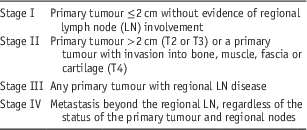
AJCC=American Joint Committee on Cancer; UICC=Union for International Cancer Control.
Prognosis
Patients with local disease had a 64% relative survival at 5 years, compared with 39% in regional nodal disease.Reference Paulson, Iyer, Byrd and Nghiem9 Although ~70% of patients with MCC present with stage one or two disease,Reference Allen, Bowne, Jaques, Brennan, Busam and Coit10 the low 5-year survival rates are attributed to high rates of loco-regional and distant recurrence.Reference Gillenwater, Hessel and Morrison11 Time to recurrence is most often reported to occur at around a median of 8 months.Reference Allen, Bowne, Jaques, Brennan, Busam and Coit10–Reference Eng, Naguib, Fuller, Jones and Herman12
Treatment
The aim of treatment is to achieve local control in the primary site and the nodes. This is because uncontrolled loco-regional disease has a significant impact on quality of life and increases risk of distant metastasis.Reference Poulsen3 Treatment for MCC is primarily surgery. Wide local excision with a 2–3-cm margin is recommended, except for the head and neck region where narrow margins may be acceptable.Reference Hughes, Hardee, Cornelius, Hutchins, Bercker and Gao6 The use of adjuvant radiotherapy is becoming more prevalent as data show that radiotherapy improves both loco-regional control and survival.Reference Mojica, Smith and Ellenhorn13, Reference Lewis, Weinstock, Weaver and Otley14
In areas where resection is not possible because of the proximity of critical structures or the patient is medically unfit for surgery, or where surgery is refused, radical radiotherapy alone may be offered. Though data regarding radiotherapy alone are limited, high rates of local control have been reported.Reference McAfee, Morris, Mendenhall, Werning, Mendenhall and Mendenhall15, Reference Mortier, Mirabel, Fournier, Piette and Lartigau16 The radical doses used in treating MCC have ranged between 45 to 60 Gy, with higher doses being applied to bulky disease.Reference Poulsen3
A research report published in 2009 identified 19 relevant studies between 1981 and 2008 where the literature on definitive radiotherapy of MCC was reviewed.Reference Koh and Veness17 The studies reported outcome on 65 MCC patients treated with radiotherapy alone. Of the 63 patients who underwent definitive radiotherapy (2 patients had lower-dose schedules) only 9 (14%) were documented to have loco-regional recurrence. The 2 patients who received lower-dose schedules (20 Gy in 5 fractions, 30 Gy in 10 fractions) also achieved complete tumour regression. These studies report high rates of in-field loco-regional control following radiotherapy alone. This in turn supporting a recommendation of moderate-dose radiotherapy alone in select patients unsuitable for surgery and lower-dose palliative dose fractionation schedules to be considered in patients with very poor PS to improve quality of life.
For clinically node-negative patients, sentinel lymph node biopsy (SLNB) is becoming a standard practice. For patients with a negative SLNB, a study showed that 97% (39/40) had no recurrence with the omission of radiotherapy.Reference Mehrany, Otley, Weening, Phillips, Roenigk and Nguyen18 Clinically node-positive patients go on to have node dissection, and regional control was improved two-fold by the addition of radiotherapy (37 versus 18%).Reference Veness, Perera and McCourt19 In non-resectable nodal disease, radiotherapy doses up to 60 Gy are recommended.Reference Veness, Palme and Morgan20 In the United States, Fang et al.Reference Fang, Lemos, Douglas, Iyer and Nghiem21 prospectively collected data from patients with MCC over a 22-year period, which included data from patients who received radiotherapy alone for positive nodes. Regional control for patients with microscopically involved nodes was 100% regardless of treatment modality. Patients with clinically positive lymph nodes had 2-year regional recurrence-free survival rate of 78 and 73% in the definitive lymph node irradiation (n=9) and completion lymphadenectomy±radiotherapy (n=15) groups, respectively (p=0·8) with a median follow-up of 16 months. The authors concluded that radiotherapy alone provided similar rates of control as completion lymphadenectomy with or without additional radiotherapy.Reference Fang, Lemos, Douglas, Iyer and Nghiem21
Systemic failure remains a big challenge in MCC, with distant failure as the most common site of first disease recurrence.Reference Fang, Lemos, Douglas, Iyer and Nghiem21 Chemotherapy has been explored with disappointing results.Reference Poulsen, Rischin and Porter22
Palliative Radiotherapy
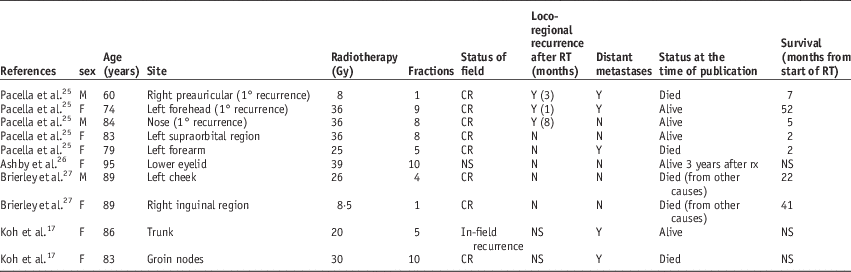
Due to the rarity of MCC, there are no randomised controlled trials that address the optimal therapy,Reference Poulsen and Harvey23 and most data on optimal treatment in the literature are supported by retrospective studies or case series. Furthermore there is even more scarcity of data to guide optimal palliative management of MCC.Reference Khan and Barnes24 Following a PubMed search, some of the palliative regimes used in the literature for MCC have been tabulated (Table 2).Reference Koh and Veness17, Reference Pacella, Asby, Ainslie and Minty25, Reference Ashby, Jones, Tasker and Blackshaw26, Reference Brierley, Stockdale and Rostom27 Kilovoltage X-rays, photons and electrons were used in the five cases described by Pacella et al.Reference Pacella, Asby, Ainslie and Minty25. The fractionation schedules used included an 8-Gy single fraction, 36 Gy in 9 fractions, 36 Gy in 8 fractions and 25 Gy in 5 fractions. Ashby et al.Reference Ashby, Jones, Tasker and Blackshaw26 describes a case using 39 Gy in 10 fractions using kilovoltage X-rays to a small volume using a lead cut-out. Brierley et al.Reference Brierley, Stockdale and Rostom27 describes two cases, one was treated with kilovoltage X-rays, a schedule of 26 Gy in 4 fractions (weekly) using lead cut-out, and the other was treated with photons where a single fraction of 8·5-Gy applied dose with a bolus was given. Koh and VenessReference Koh and Veness17 describes two cases with a fractionation schedule of 20 Gy in 5 fractions and 30 Gy in 10 fractions using either a single large electron or an orthovoltage photon field. Some regimes have reported good loco-regional control (complete response post treatment, no loco-regional or distant metastasis) others not so effective. However, this establishes the wide variety of palliative dose fractionation regimes used with limited data on outcomes.
Palliative radiotherapy regimes used in the literatureReference Koh and Veness17, Reference Pacella, Asby, Ainslie and Minty25–Reference Brierley, Stockdale and Rostom27
Abbreviations: Gy, Gray; RT, radiotherapy; CR, complete response; Y, yes; N, no; NS, not specified.
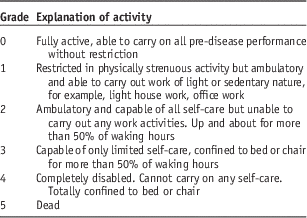
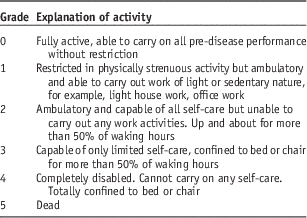
A split-course hypofractionated regimen has been used palliatively in squamous cell cancer (SCC) of head and neck patients in whom the tumour stage, PS and co-morbidity makes radical treatment unsuitable.Reference Kancherla, Oksuz and Prestwich28 The schedule comprises of an initial 20 Gy in 5 fractions over 1 week followed by a 2-week gap, and then a further 20 Gy in 5 fractions over 1 week if the patient is able to tolerate the treatment. The radiation field encompassed the gross tumour volume with a 1–2-cm margin, using 6-MV photons and a surface bolus in cases of skin infiltration. Out of the 33 patients treated, 26 (79%) reported symptomatic improvement at the 4–6-week follow-up, 13 (39%) patients had complete tumour response and 11 (33%) had a partial response as assessed clinically and in some cases radiologically. The median overall survival was 9 months (range 3–43 months). Progression-free survival at 1 and 2 years was 35 and 25%, respectively. Treatment was well tolerated, and admission for nasogastric feeding and/or supportive management was required in only six patients. The above retrospective analysis showed that split-course hypofractionated radiotherapy is an effective palliative regimen for head and neck SCC with acceptable toxicity. The same split-course hypofractionated regime used by Kancherla et al.Reference Kancherla, Oksuz and Prestwich28 has been adopted for MCCs treated at the North Middlesex University Hospital with palliative intent. Most patients were elderly and had multiple co-morbidities with a World Health Organization PS score of 2 and above (Table 3).Reference Oken, Creech and Tormey29 Although the numbers treated with this regime are small, good local control was seen in all the patients treated at this centre and are presented in this case series.
World Health Organization performance statusReference Oken, Creech and Tormey29
Conclusion
MCC is a rare, aggressive, radiosensitive tumour with a high propensity for loco-regional and distant metastasis. There is a lack of randomised controlled trials that address the optimal therapy, particularly palliative management. A review of the literature revealed varying palliative regimes with varying outcomes. The split-course hypofractionated regime of 20 Gy in 5 fractions, a 2-week gap and then a further 20 Gy in 5 fractions (if tolerated) was used in North Middlesex University Hospital. The aim of this case series was to present further evidence on this schedule in the palliative setting of MCC. The outcome of the case series demonstrates that these aims were met as the regime was well tolerated and achieved excellent local control. This is especially important in a select group of frail patients with MCC, who without treatment can potentially become very symptomatic from this disease. Further accrual of patients treated with the above regime in North Middlesex University Hospital will add to the evidence base and strengthen the case for this dose and fractionation.
Acknowledgements
None.