Implications
The stimulation of the immune system can interfere with production functions, such as growth and protein accretion because of depressed feed intake and modifications of nutrient metabolism. We have shown before that inflammation modifies tryptophan (Trp) metabolism suggesting a competition between growth and the animal’s defence system for Trp utilisation. Data reported in this experiment show that moderate inflammation induced by a deterioration of the sanitary status can be considered as a factor decreasing the availability of Trp for growth. This research generates new knowledge on the metabolic basis of nutrient requirements. This provides opportunities for nutritional interventions to sustain growth and the animal’s defence system.
Introduction
Tryptophan (Trp) is an indispensable amino acid (AA), implying that an adequate Trp dietary supply is crucial to sustain functions involving this AA. Unlike lysine, which is mainly used for body protein accretion associated with growth, Trp is involved in many other biological functions such as the control of feed intake and stress response, vitamin and glucose metabolism and immune and inflammatory responses (Le Floc’h and Sève, Reference Le Floc’h and Sève2007). We have previously shown that an experimental lung inflammation caused important modifications in Trp metabolism (Melchior et al., Reference Melchior, Sève and Le Floc’h2004) involving a decrease in plasma Trp concentrations and an increase in Trp catabolism into kynurenine through the indoleamine 2,3-dioxygenase pathway (Melchior et al., Reference Melchior, Mézière, Sève and Le Floc’h2005; Le Floc’h et al., Reference Le Floc’h, Melchior and Sève2008). We hypothesised that these modifications of Trp metabolism caused by inflammation may decrease the amount of Trp available for protein accretion and pig growth, leading to a modification of the Trp requirement associated with immune functions and maintenance of health status.
To evaluate the consequence of an inflammation on the growth response to dietary Trp, we have developed a model of moderate inflammation based on the deterioration of post-weaning housing conditions of pigs. Such a moderate inflammatory response was efficient in decreasing growth performance and plasma Trp concentrations (Le Floc’h et al., Reference Le Floc’h, LeBellego, Matte, Melchior and Sève2009) when a moderate feed restriction was used to standardise feed intake. In doing so, modifications of growth rate associated with moderate inflammation could be solely attributed to changes in nutrient metabolism and utilisation for growth. In this initial study (Le Floc’h et al., Reference Le Floc’h, LeBellego, Matte, Melchior and Sève2009), two diets were used in which the Trp content of the diets was well below or slightly above the recommendations made by Sève (Reference Sève1994). In both poor and good housing conditions, growth rate was higher in pigs fed the control Trp diet compared with those fed the deficient diet. Moreover, additional Trp did not prevent the reduction of growth rate observed in pigs housed in poor sanitary conditions.
This experiment aimed at comparing the responses of pigs fed diets differing in Trp contents and suffering or not from a moderate inflammation induced by poor housing conditions and control pigs housed in good housing conditions. In this study, we used a wider range of dietary Trp contents than those used by Le Floc’h et al. (Reference Le Floc’h, LeBellego, Matte, Melchior and Sève2009) because we hypothesised that a Trp supply above the current recommendations may be required to prevent the decrease in plasma Trp concentration and to maximise growth of pigs suffering from a moderate inflammation. The plasma concentrations of Trp, as well as those of two of Trp metabolites, kynurenine and nicotinamide produced through the catabolism of Trp in inflammatory states, were used as indicators of changes in Trp metabolism and availability for growth. Because both inflammation and Trp deficiency are known to reduce voluntary feed intake, this experiment was performed in pigs having ad libitum access to feed, a situation reflecting what occurs in practical conditions.
Material and methods
Animals and allotment
The experiment was conducted under the guidelines of the French Ministry of Agriculture for animal research. In this experiment, 160 Piétrain × (French Landrace × large white) piglets from the INRA herd were used. Piglets were weaned at 4 weeks of age. Forty blocks of 4 littermate piglets each were selected according to their body weight. The average initial weight was 8.4 ± 0.9 kg. Within each block, four diets differing in Trp contents were randomly assigned to one of the piglets. In 20 of these blocks, the animals were subjected to a moderate inflammatory challenge consisting in housing the piglets in poor sanitary conditions without antibiotic supplement. Pigs of the other 20 blocks were housed in good sanitary conditions and also received antibiotics (see below). Therefore, all piglets of the same block were assigned to the same housing conditions but received each one of the four tested dietary Trp contents.
Experimental diets
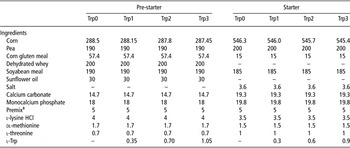
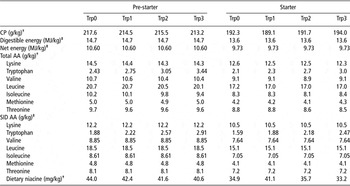
Four pre-starter and four starter diets were prepared in the INRA facilities at Saint Gilles, France (Table 1). These diets were based on corn, corn gluten meal, peas, soybean meal and whey for the pre-starter diets. The basal pre-starter and starter diets (Trp0) were formulated to meet the AA requirements per unit of net energy (Sève, Reference Sève1994) except for Trp, which was maintained at a low concentration. The pre-starter and starter diets provided 14.7 and 13.6 MJ/kg of digestible energy and 12.2 and 10.5 g/kg of standardised ileal digestible (SID) lysine respectively. Free l-trp was added at increasing levels to create the three other diets. The expected SID Trp : Lys ratios were 15%, 18%, 21% and 24% for Trp0, Trp1, Trp2 and Trp3, respectively. These ratios were the same for the pre-starter and starter diets (Table 2).
Composition of the prestarter and starter experimental dietsFootnote †

Trp = tryptophan.
† Expressed as g/kg of fresh feed. Pre-starter diets were delivered during period 1 and starter diets were delivered during periods 2 and 3.
‡ Supplied per kg (as fed basis) of pre-starter diets: providing the following amount of vitamins and minerals (per kg diet): vitamin A, 30 000 UI; vitamin D3, 6000 UI; vitamin E, 80 UI; vitamin B1, 4 mg; vitamin B2, 20 mg; panthotenic acid, 30 mg; vitamin B6, 20 mg; vitamin B12, 0.1 mg; vitamin PP, 60 mg; folic acid, 4 mg; vitamin K3, 4 mg; biotin, 0.4 mg; choline, 1600 mg; vitamin C, 200 mg; Fe, 200 mg; Cu, 40 mg; Zn, 200 mg; Mn, 80 mg; Co, 4 mg; Se 0.6 mg; I, 2 mg. For starter diets: vitamin A, 10 000 IU; vitamin D2, 2000 IU; vitamin E, 20 mg; vitamin K3 (menadione), 2 mg; vitamin B1 thiamin, 2 mg; vitamin B2 riboflavin, 5 mg; vitamin B3 niacin, 20 mg; vitamin B5 panthotenic acid, 10 mg; vitamin B6 pyridoxine, 5 mg; vitamin B8 biotin, 0.2 mg; vitamin B9 folic acid, 1 mg; vitamin B12 cyanocobolamine, 0.03 mg; choline, 500 mg; vitamin C ascorbic acid, 40 mg; Fe as iron sulfate, 100 mg; Cu as copper sulfate, 20 mg; Zn as zinc oxide, 100 mg; Mn as manganese oxide, 40 mg; I as calcium iodate, 0.6 mg; Se as sodium selenium, 0.3 mg; Co as carbonate cobalt, 1 mg.
Nutritional composition of the pre-starter and starter experimental diets

Trp = tryptophan; AA = amino acids; SID = standardised ileal digestible.
†Measured values. Pre-starter diets were delivered during period 1 and starter diets were delivered during periods 2 and 3.
‡Values predicted by formulation. Net energy content was calculated according to Noblet et al. (Reference Noblet, Fortune, Shi and Dubois1994).
Experimental procedure
The experimental period lasted 7 weeks and was divided into three periods. The first period (period 1) corresponded to the first 3 weeks, during which the piglets received the pre-starter diets. The second period (period 2) corresponded to the next 2 weeks during which the piglets received the starter diets. The last period (period 3) corresponded to 2 weeks during which the piglets were moved to a growing unit while they were assigned to the same Trp and housing condition treatments as in periods 1 and 2. During period 3, the pigs continued to receive the starter diets.
From the day of weaning, the piglets were housed individually. The different housing conditions were obtained as described by Le Floc’h et al. (Reference Le Floc’h, Jondreville, Matte and Sève2006 and Reference Le Floc’h, LeBellego, Matte, Melchior and Sève2009) and were maintained throughout the three experimental periods. Briefly, control pigs subjected to the good housing conditions were housed in regularly cleaned and disinfected rooms throughout the experimental period, that is, from weaning to the end of period 3. They received the antibiotic, avilamycine at 2 g/kg of diet during the post-weaning period (periods 1 and 2), and oxytetracycline at 0.2 g/kg of diet during period 3. Oxytetracycline was used to prevent Haemophillus infection. For each pig at each day, a dose of antibiotic was prepared and top-dressed on the feed when the feed was delivered in the individual feeder. The prophylactic use of antibiotics was used to indirectly reinforce the quality of good sanitary conditions in the experimental model (Le Floc’h et al., Reference Le Floc’h, LeBellego, Matte, Melchior and Sève2009) aiming at modulating the inflammatory status of the pigs (Niewold, Reference Niewold2007). The pigs raised in poor housing conditions were housed in rooms that were not disinfected or cleaned after previous occupation by pigs from the same herd. They did not receive any antibiotic supplementation. The poor housing conditions were applied throughout the experiment (i.e. from weaning until the end of period 3). For the remainder of the paper, the term ‘inflammation’ or ‘inflammatory status’ will be used in reference to housing and antibiotic-supplementation treatment.
For each pig, three blood samples were taken by jugular puncture after an overnight fast at 13 (period 1), 36 (period 2) and 43 (period 3) days after weaning. Blood was collected in Vacutainer tubes coated with heparin (BD Vacutainer Systems, Oxford, Oxfordshire, UK), kept on ice and centrifuged (15 min, 4°C, 5000 r.p.m). An aliquot sample of plasma was taken and kept at −20°C until analysis.
Measurements and analysis
Diets were analysed as described earlier (Le Floc’h et al., Reference Le Floc’h, Melchior and Sève2008). Pigs were weighed at the end of each period after an overnight fast. Individual feed intake was calculated for each period from the difference between allocated feed and refusals. Plasma concentrations of Trp, kynurenine and haptoglobin were determined as described earlier (Le Floc’h et al., Reference Le Floc’h, Melchior and Sève2008). Nicotinamide plasma concentrations were measured by HPLC according to the method described by Santschi et al. (Reference Santschi, Berthiaume, Matte, Mustafa and Girard2005).
Statistical analysis
The experiment was arranged according to a split-plot design in which the inflammation levels were assigned to litters or blocks as the main plots, while dietary Trp content was assigned to littermates as subplots. Analysis of variance was performed using the Mixed Models procedure of the Statistical Analysis System (SAS, 2008). Except for average daily gain (ADG), average daily feed intake (ADFI) and feed/growth calculated for the overall experiment, data were analysed as repeated measures. Model selection was based on the minimisation of the Akaike and Bayesian information criteria. The initial model included period, inflammation, dietary Trp content, and their interactions as fixed factors and animals as random factor. The results of this analysis were not presented in the tables but commented in the Results section. Subsequently, data were analysed and presented as least-square means per period because the three experimental periods differed in the way the experimental treatments, housing conditions causing inflammation and dietary Trp, were applied. The experimental diets were different from period 1 to periods 2 and 3 (pre-starter and starter, respectively) implying that different Trp contents were tested. Additionally, during period 3, pigs were transferred to another building in which both housing conditions were maintained but avilamycine was replaced by oxytetracycline. In addition, ADG was analysed with a linear plateau model. It was initially assumed that each block could have a different plateau value, while within each inflammatory status, the breakpoint and slope of the response would be the same. The model was then simplified assuming a common slope and breakpoint for both inflammatory statuses, that is, control pigs and those subjected to moderate inflammatory challenge. This model reduction was tested using the extra sum-of-square principle (Ratkowsky, Reference Ratkowsky1983). Through this test it was possible to decide whether the inflammation affected the slope and breakpoint of the response curve. A similar test was applied to determine whether or not the inflammation affected the plateau values.
Results
During this trial, transitory diarrhoea was observed in some pigs and these animals were then treated with colistine to avoid contamination of other pigs. Out of 160 selected piglets, 10 died or lost too much weight, eight of them being housed in poor sanitary conditions. The interaction between Trp and inflammation and between period, Trp and inflammation were not significant for any of the outcome variables. Accordingly, the results are presented as least-square means calculated at each period for each of the four dietary Trp supplies, irrespective of inflammatory status, and for each inflammatory status, irrespective of dietary Trp supply.
Effects of inflammation and dietary Trp level on growth and feed intake
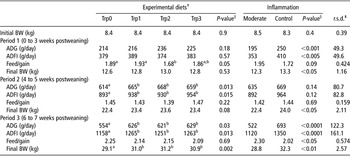
Performance results are given for each of the three experimental periods in Table 3 and for the combination of periods 1, 2 and 3, in Table 4. The effect of inflammation differed between the experimental periods (period * inflammation, P < 0.05 for ADG, ADFI and feed/gain) whereas the interaction between period and dietary Trp was not significant.
Effects of moderate inflammation and dietary Trp levels on growth performance calculated during periods 1, 2 and 3

Trp = tryptophan; ADG = average daily gain; ADFI = average daily feed intake; SID = standardised ileal digestible.
Values are least-square means. Within a row, least-square means with different letters in superscript differ (P < 0.05).
†Trp0: 15% SID Trp : Lys; Trp1: 18% SID Trp : Lys; Trp2: 21% SID Trp : Lys; Trp3: 24% SID Trp : Lys.
‡r.s.d.=r.s.d. is the root mean square of the error that applies to the statistical model.
§Values for probabilities, inflammation or housing conditions and dietary Trp, were obtained from the mixed procedure of SAS applied to each period. The interaction between inflammation and dietary Trp was not significant.
Effects of moderate inflammation and dietary Trp on growth performance and feed intake from initiation of period 1 to end of period 3

Trp = tryptophan; ADG = average daily gain; ADFI = average daily feed intake; SID = standardised ileal digestible.
Values are least-square means. Within a row, least-square means with different letters in superscript differ (P < 0.05).
†Trp0: 15% SID Trp : Lys; Trp1: 18% SID Trp : Lys; Trp2: 21% SID Trp : Lys; Trp3: 24% SID Trp : Lys.
‡r.s.d. = r.s.d. is the root mean square of the error that applies to the statistical model.
§Values for probabilities, inflammation and dietary Trp, were obtained from the mixed procedure of SAS applied to each period. The interaction between Inflammation and dietary Trp was not significant.
Inflammation decreased the ADG and the ADFI during period 1 (P < 0.001 and P < 0.01, respectively) and period 3 (P < 0.0001) and for the overall trial (P < 0.001). The feed/gain ratio was increased by inflammation during period 3 (P < 0.05) and for the overall trial (P < 0.05), whereas a trend was observed for period 1 (P = 0.09). Inflammation did not influence ADG, ADFI and feed/gain ratio during period 2.
At the end of period 2, the piglets subjected to moderate inflammatory challenge were lighter (P < 0.05) than control pigs. At the end of the trial, inflammation resulted in a 3.5 kg weight difference compared with the control pigs (28.8 kg v. 32.3 kg; P < 0.001).
During period 1, increasing the dietary Trp content did not influence ADFI and ADG (Table 3), and feed/gain tended to be decreased (P = 0.054). During periods 2 and 3, ADG and ADFI increased with dietary Trp (P < 0.05): ADG and ADFI calculated for pigs fed the Trp0 diet were lower than for pigs fed the other diets. The feed/gain ratio was not modified by dietary Trp during periods 2 and 3. The final BW increased with dietary Trp (P < 0.01). For the overall trial (Table 4), increasing the Trp content in the diet resulted in an increase in ADG (P < 0.001) and ADFI (P < 0.05) and a decrease in the feed/gain ratio (P < 0.01). Pigs fed the Trp0 diet ate and grew less than pigs fed the other diets, whereas the feed/gain ratio was the lowest for pigs fed the Trp2 diet.
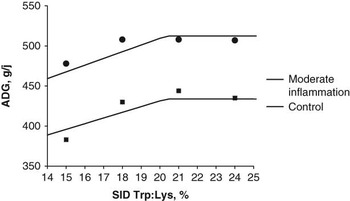
The linear plateau model demonstrated that the plateau for ADG was affected by the inflammatory status (P < 0.05, 434 v. 512 g/day), while neither the slope, nor the breakpoint (SID Trp : Lys 20.3%) differed (Figure 1).
Effect of increasing the SID Trp : Lys on ADG of control piglets and piglets suffering from moderate inflammation. Using a linear plateau relationship between Trp and ADG, inflammatroy status did not affect the slope and the breakpoint of the relationship. The plateau was lower in piglets housed in poor conditions (P < 0.05). ●: means for Controls; ▪: means for Moderate inflammation. SID, standardised ileal digestible; ADG, average daily gain.

Effects of inflammation and dietary Trp level on plasma concentrations of Trp and its metabolites
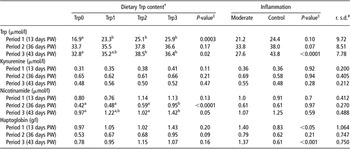
Plasma Trp concentrations are shown in Table 5. These concentrations were lower during period 1 than during periods 2 and 3 (P < 0.0001). Plasma concentrations of Trp were the lowest in piglets suffering from moderate inflammation (P < 0.0001). This difference was significant during period 3, while a trend was observed at the other 2 periods (inflammation × period, P < 0.0001). The period × Trp interaction tended to be significant (P = 0.09). Increasing the dietary Trp content resulted in an increase in the plasma Trp during periods 1 and 3 (P < 0.001 and P < 0.05, respectively) but not during period 2. Plasma Trp concentrations were the lowest in piglets fed diet Trp0 during periods 1 and 3.
Effects of dietary Trp and moderate inflammation on plasma Trp, kynurenine, nicotinamide and haptoglobin concentrations measured 13, 36 and 43 days post-weaning (PW)

Trp = tryptophan; ADG = average daily gain; ADFI = average daily feed intake; SID = standardised ileal digestible.
Values are least-square means. Within a row, least-square means with different letters in superscript differ (P < 0.05). Nutrients and haptoglobin concentrations have been measured at fasted state.
†Trp0: SID Trp/Lys 15%; Trp1: SID Trp/Lys 18%; Trp2: SID Trp/Lys 21%; Trp3: SID Trp/Lys 24%.
‡r.s.d. = r.s.d. is the root mean square of the error that applies to the statistical model.
§Values for probabilities, Inflammation and dietary Trp, were obtained from the mixed procedure of SAS applied to each period. The interaction between Inflammation and dietary Trp was not significant.
Plasma kynurenine concentrations were not affected by the interactions of Trp or inflammation by period but were higher at period 3 compared with periods 1 and 2 (P < 0.0001). Whatever the period, there was no effect of inflammation or dietary Trp on plasma kynurenine concentrations.
Plasma nicotinamide concentrations were not affected by the interactions of Trp or inflammation and period. Plasma nicotinamide concentrations were the lowest during period 2 (P < 0.0001). Inflammation had no effect on the plasma nicotinamide concentrations. Increasing the dietary Trp content resulted in an increase in the plasma nicotinamide concentration during period 2 (P < 0.0001) and 3 (P = 0.05) in which the highest nicotinamide concentrations were measured in piglets fed diets containing the highest levels of Trp (Trp3).
Effects of inflammation and dietary Trp on haptoglobin plasma concentrations
Inflammation, period and the inflammation × period interaction had a significant impact on plasma haptoglobin concentrations (P < 0.0001, P < 0.0001 and P < 0.05, respectively). Plasma haptoglobin concentrations were increased by inflammation, (P < 0.0001) and was not modified by dietary Trp content. During periods 1 and 3, plasma haptoglobin concentrations were higher in piglets experiencing the moderate inflammation challenge compared with control pigs (P < 0.05 and P < 0.001, respectively; Table 5). For these two periods, respectively, 63 (19/30) and 90% (17/19) of pigs with haptoglobin concentrations higher than 2 g/l had been subjected to the moderate inflammation challenge.
Discussion
Antibiotics were included in the feed offered to the control pigs to reinforce their health status. Consequently, the effect of antibiotics cannot be dissociated from the effects of moderate inflammation due to housing conditions and should be considered as a part of the model used to modulate the inflammatory status. Antibiotics may act through modulating the gut microflora and preventing the proliferation of pathogenic bacteria, thereby reducing the subclinical infection that may affect metabolism and the immune response. Antibiotics may also have an anti-inflammatory effect (Niewold, Reference Niewold2007), which can partly explain the lower plasma haptoglobin concentrations in control pigs. Haptoglobin is a major inflammatory protein in pigs (Eckersall et al., Reference Eckersall, Saini and McComb1996), synthesised in the liver through the activation by inflammatory cytokines such as interleukine-6. Plasma haptoglobin concentrations have been used as an indicator of immune system stimulation and of deterioration of pig health and sanitary status of the pig farm (Harding et al., Reference Harding, Baarsch and Murtaugh1997; Lipperheide et al., Reference Lipperheide, Rabe, Knura and Petersen2000). Thus, these results confirmed earlier observations (Le Floc’h et al., Reference Le Floc’h, Jondreville, Matte and Sève2006 and Reference Le Floc’h, LeBellego, Matte, Melchior and Sève2009) showing that variation in housing and antibiotic-supplementation provides a reliable moderate inflammation model to impair growth. Accordingly, as reported earlier (Le Floc’h et al., Reference Le Floc’h, Jondreville, Matte and Sève2006 and Reference Le Floc’h, LeBellego, Matte, Melchior and Sève2009), the impact of housing conditions on plasma haptoglobin concentrations and performance were actually observed during periods 1 and 3 directly following changes in the environment. In those studies (Le Floc’h et al., Reference Le Floc’h, Jondreville, Matte and Sève2006 and Reference Le Floc’h, LeBellego, Matte, Melchior and Sève2009), no difference between the two inflammatory statuses, that is, between control pigs and pigs subjected to the moderate inflammatory challenge, was observed during period 2, indicating that pigs were probably adapted to the environment in the weaning building.
This experiment, due to ad libitum feeding and major effect of inflammation on feed intake, it was not possible to determine whether the reduction in growth rate was due to a decrease in feed intake or to metabolic changes caused by inflammation. Nevertheless, when growth rate was corrected using feed intake as a covariable, the effect of moderate inflammation was still significant for period 3 (597 v. 644 g/day, P < 0.05) and the overall experimental period (460 v. 475 g/day; P < 0.05) but not for period 1 (214 v. 231 g/day; P = 0.36). Therefore, during this first period, the decreased growth rate may be ascribed to the reduced feed intake. However, considering the period 3 and the overall experimental period, it is likely that both metabolic changes altering partitioning of nutrients and reduced feed intake were involved in the decrease in growth rate. This is consistent with earlier experiments (Le Floc’h et al., Reference Le Floc’h, Jondreville, Matte and Sève2006 and Reference Le Floc’h, LeBellego, Matte, Melchior and Sève2009) in which we observed a difference in growth rate between control pigs maintained at the same level of feed intake than those subjected to moderate inflammatory challenge.
Plasma Trp concentrations increased with increasing dietary Trp supply but no further increase was observed for Trp : Lys ratios greater than 21% (Trp2 treatment). Yet, plasma concentrations of Trp and most essential AA increase when supplied above the requirement for protein accretion (Lewis et al., Reference Lewis, Peo, Cunningham and Moser1977; Rosell and Zimmerman, Reference Rosell and Zimmerman1985; Lewis and Peo, Reference Lewis and Peo1986). The response of Trp may be explained by an increase in its degradation, thereby limiting the increase in plasma Trp concentration when the requirement for growth is met. Indeed, in situations of dietary Trp excess, Trp can activate the hepatic enzyme Trp dioxygenase (TDO; EC 1.13.11.11) (Knox and Mehler, Reference Knox and Mehler1951) and increase Trp degradation to kynurenine. In inflammatory states, a second enzyme is involved in the catabolism of Trp into kynurenine (Widner et al., Reference Widner, Ledochowski and Fuchs2000). The enzyme, indoleamine 2,3-dioxygenase (IDO; EC 1.13.11.52), is mainly found in immune cells and is activated by the cytokine interferon γ (Takikawa et al., Reference Takikawa, Kuroiwa, Yamazaki and Kido1998). In pigs suffering from experimental lung inflammation, the induction of IDO activity has been associated with decreased plasma Trp concentrations (Melchior et al., Reference Melchior, Sève and Le Floc’h2004; Le Floc’h et al., Reference Le Floc’h, Melchior and Sève2008). The decrease in plasma Trp induced by the inflammatory response could limit Trp availability for growth and other functions in which Trp is involved (Le Floc’h and Sève, Reference Le Floc’h and Sève2007). Accordingly, this result showed that plasma Trp concentrations were lower in pigs suffering from moderate inflammation compared with control pigs. Those low plasma Trp concentrations are likely a consequence of a reduced feed intake and increased Trp catabolism through IDO pathway caused by moderate inflammation. Indeed, just like ADG, when the response of plasma Trp was corrected by ADFI, we confirmed that plasma Trp measured during periods 1 and 3 was reduced by moderate inflammation (data not shown: P = 0.02 and P = 0.0001, respectively). This experiment showed that the plasma concentrations of kynurenine were not modified despite the moderate inflammatory status associated with the deterioration of housing conditions. This may appear contradictory with the above-described ‘IDO’ hypothesis. In fact, we previously reported that the change in plasma kynurenine concentrations was not a reliable indicator of increased IDO activity in pigs suffering from inflammation because the induction of IDO activity did not result in an increase in kynurenine plasma concentrations (Melchior et al., Reference Melchior, Mézière, Sève and Le Floc’h2005; Le Floc’h et al., Reference Le Floc’h, Melchior and Sève2008). This can be explained by the fact that kynurenine produced through the catabolism of Trp by IDO, and TDO, is the first intermediary metabolite of a complex metabolic pathway resulting in the production of several other molecules including nicotinamide, picolinic, and kynurenic acids. As for kynurenine, plasma concentrations of nicotinamide, produced from kynurenine, were not modified by moderate inflammation. However, as reported earlier by Matte et al. (Reference Matte, Giguère, Melchior and Le Floc’h2008), nicotinamide plasma concentrations increased with increasing dietary Trp. In this experiment, the effect of Trp was significant only during period 2, a period during which the inflammatory response was less pronounced. This may reflect a different regulation of kynurenine and nicotinamide metabolism by dietary Trp content and by inflammation.
In pigs, the effects of Trp on growth have been related to effects on feed intake (Sève, Reference Sève1999). For instance, Trp addition to a Trp deficient diet increased feed intake in young piglets (Sève et al., Reference Sève, Meunier-Salaün, Monnier, Colléaux and Henry1991) and in growing pigs (Henry et al., Reference Henry, Colléaux, Ganier, Saligaut and Jégo1992). In this experiment, a Trp supply above that provided by Trp0, that is, Trp1, resulted in an increase in feed intake, confirming that the level Trp0 was inadequate. The lack of depressive effect on feed intake at higher Trp supplies, namely with SID Trp : Lys of 24% ruled out any possible adverse effect associated with an excess of Trp.
Increasing the Trp supply did not allow the pigs subjected to an inflammatory challenge to match the growth rate of control pigs. This was confirmed by the analysis of the response of ADG to total Trp supply with a linear plateau model indicating that the plateau for ADG was affected by the inflammatory status, while neither the slope, nor the breakpoint were different. This indicates that dietary Trp requirement, that is, the amount of Trp per kg of diet required to maximise ADG, was not modified by our experimental conditions. This may be explained by the difference in feed intake observed between the two inflammatory statuses, resulting in a difference in total Trp intake. The major effect on feed intake induced by the moderate inflammation challenge may have prevented the total daily amount of ingested Trp to cope with the impaired growth and Trp availability to peripheral tissues, reflected in the decrease in plasma Trp concentrations, due to metabolic changes.
Conclusion
This study confirmed that the deterioration of housing conditions induced moderate inflammation and decreased growth rate and feed intake in weaned piglets. The lower growth rate was associated with higher haptoglobin plasma concentrations. A Trp supply above the recommendations did not prevent the reduction in growth rate observed in pigs kept in poor sanitary conditions. Taking into account the responses of growth and plasma Trp to inflammatory challenge and Trp treatment, further studies are needed to better evaluate the relative availability of Trp for growth and metabolism according to the inflammatory statuses and the quality of the environment in which piglets are housed after weaning.
Acknowledgements
The authors acknowledge the staff from INRA-SENAH, Michelle Guillette from AAC, and Marcelle Eudaimon from Ajinomoto Eurolysine (Amiens).