


August was always hot, even by the lakefront. The hats were necessary—for modesty, of course, but also for protection from the sun's afternoon rays. The summer people—a smattering of men, vastly outnumbered by women and children—hurried down the steps and assembled for the celebration, forming two straight lines that would weave a path through the grounds so familiar that few participants needed direction. Friends lined up together. Boys and girls dressed in white and blue received ribbons and medals while their mothers looked on. Everyone knew it would be a shame to be late, forced to find space at the back of the grove or near the tennis court, where it was difficult to see the activities taking place at the pines along the water's edge.
They outdid themselves each year—the women who volunteered to plan the “lawn fete” and arranged for the banners and floral arrangements; the speakers on the program and the clergy who offered prayers; and the devoted crowd: some in attendance for the first time, others “old-timers” who marveled at the growing numbers of visitors each year arriving up north by train and trolley. While the religious services were offered by men, local papers routinely noted that “it was the common labor of every woman” to organize the social events for the afternoon and evening on this summer day, “Lady Day,” honoring Catholic womanhood.Footnote 1
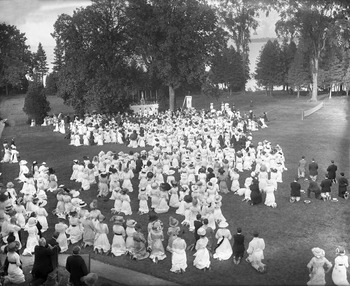
Lady Day was no ordinary day at the beach. (See Figure 1.) Observed each year on August 15, and better known across the Catholic world as the Feast of the Assumption of Mary, it was also the biggest day of the season at the Catholic Summer School of America (CSSA), located in Plattsburgh, New York, on the western shores of Lake Champlain. Most years, “Lady Day” included a slate of morning masses, followed by the afternoon procession outdoors. A festival with games and refreshments rewarded patient children in the early evening hours before the adults returned to their cottages to eat, drink, dance, and mingle on the porches and in the ballrooms. More lavish with each passing year, the day grew from a few hundred participants in the 1890s to more than fifteen hundred by the 1910s. “The fete was a unique one in many ways,” marveled a local reporter from the Plattsburgh Daily Press in 1904. “Its social nature was so mixed with the religious element as to give tone and dignity to the whole affair.”Footnote 2
Catholic Summer School of America visitors celebrate the Feast of the Assumption of Mary (ca. 1910). From the collections of the Clinton County Historical Association.

Mixing the social with the religious was not just reserved for Lady Day—it was the defining element of the CSSA, founded in 1892. That Lady Day was both sacred obligation and summer party should draw our attention to the dynamics of religion, class, and the diversity of U.S. Catholic culture at this place modeled on the Chautauqua Institution, and imitated by other, shorter-lived Catholic summer and winter schools in the South and West. Summer School vacationers who “knelt on the warm green earth” to honor the Blessed Virgin on her August feast day were not making an arduous religious pilgrimage or participating in a noisy street festa—sites out-of-doors more commonly associated with Roman Catholicism, past and present.Footnote 3 Instead, visitors were taking part in a movement that took pains to model a kind of white Catholic respectability—what the Daily Press reporter clearly implied when he remarked on the event's “tone and dignity.” And at the center of the Summer School movement—as in the center of the photograph—were Catholic laywomen.
These summer Catholics on the tennis lawn and by the lakeshore deserve more than just a passing glance. Long relegated to the footnotes of book history and American Catholic studies, the CSSA and its reading circle antecedents are here reclaimed for the study of women and American religion.Footnote 4 As a Catholic institution, the Summer School was directed by clergy and laymen; men's names fill the published histories of the site as a religious retreat. But the CSSA largely functioned as a women's space, where laywomen's daily labors were devoted to creating and maintaining a vision of white, middle-class respectability. Based on close readings of the traces that Summer School visitors left in print—including photographs, postcards, local newspaper reports, and previously overlooked fiction and nonfiction by Catholic women writers—I explore the resort during its first two decades as a critical site for studying an upwardly mobile white Catholic leisure class concerned with its social and cultural reproduction.
To grapple with twentieth-century U.S. Catholic history, we must acknowledge not only lived religion but social reproduction—the routines by which white Catholic laypeople asserted their class and racial status. In what follows, I locate one kind of routine and respectability discourse in the Catholic Reading Circle movement of the late nineteenth century, from which the Summer School emerged; I further explore the Summer School's origin as a “Catholic Chautauqua” that both borrowed from the more prominent Protestant retreat but also took pains to code its upstate New York space as an especially Catholic one. Finally, I offer a new reading of the Summer School's first decades as women's history, following Catholic laywomen's investment in the resort as a place of association, friendship, and even romance, all in the service of an aspirational, ascendant, recognizable, and exclusively white, middle-class, U.S. Catholic “style.” In doing so, I contend that the CSSA deserves our attention as a place that disrupts commonly held assumptions about U.S. Catholic culture in the era of “the immigrant church”—a historiography that emphasizes assimilation of new ethnic groups but often serves to obscure efforts by clergy and laypeople who distanced themselves from newcomers and explained themselves as the better and best Catholics, consolidating their claims to whiteness.Footnote 5 Laywomen contributed to those claims: they filled the CSSA with their favorite books, their families, and their flirtations, contributing to the intellectual and social atmosphere; they made it comfortable and formed, in the words of one writer, a “delightful social communion” intended to be reproduced at home long after the summer season was over.Footnote 6
Reading Catholic Respectability
Laywomen usually enter the historiography of U.S. Catholicism at the turn of the twentieth century. They begin to pursue higher education and take on aspects of Progressive-era uplift in new charitable works often married to existing parish organizing.Footnote 7 But it is in their leisure pursuits that we might consider forms of association life that bolstered lay Catholics’ middle-class status. Indeed, the idea for a Catholic summer school first emerged from the intersection of popular nineteenth-century literary societies and study clubs with American Catholic discourses on the benefits of “good reading” and a Catholic education.Footnote 8 Books and reading served as a sign of the good taste and fine upbringing of young, white, Catholic women, as it did for so many other nineteenth-century American girls taking part in female literary societies with the twin purposes of intellectual and moral self-improvement.Footnote 9 Single-sex study clubs proliferated during the second half of the nineteenth century. Some focused on political goals; some aimed at harnessing the energies of new immigrants and working populations (such as the study courses run by Chicago's Hull House); and others had a religious bent, including the Adult Bible Class movement of the late nineteenth and early twentieth centuries.Footnote 10 For these readers, prescriptive literature introduced the notion of “self-culture”—cultivating a broad knowledge of the world by learning to observe and think for oneself, to seek beauty, and to take advantage of opportunities for travel and reading.Footnote 11 By the late 1880s, a Catholic reading circle movement—linked by a national journal and study programs organized by the Paulist Fathers in New York and Warren Mosher's Catholic Educational Union out of Youngstown, Ohio—embraced self-culture as a Catholic endeavor, and encouraged laypeople to organize around reading for pleasure and edification.Footnote 12
Reading circle organizers grew their movement on the enthusiasm and support of young women recently graduated from Catholic convent academies. They paid lip service to working-class Catholics who would likely be shut out from the opportunity to connect to the reading circles on account of “enjoying less leisure,” as one Catholic reading booster put it.Footnote 13 Instead, young women's groups paired reading and respectability. Many of the most active Catholic reading circles started in the elite boarding schools run by orders of women religious, and convent school alumnae often continued their associations after graduation. In the early 1890s, for example, the Academy of Mount Saint Joseph in Chestnut Hill, Philadelphia, was home to at least three different reading circles for current students as well as graduates. Members chose readings, discussed them together, wrote and read their own lectures in line with the movement's guidelines, and were frequent correspondents with the movement's journal, Mosher's Catholic Reading Circle Review.Footnote 14
Reading circle women were central figures in middle-class Catholic association life at the turn of the century. When the Irish-American journalist and editor Katherine E. Conway—a founding member of Boston's John Boyle O'Reilly Reading Circle—spoke at the 1893 Columbian Catholic Congress in Chicago, she was careful to make the case for women's involvement in the reading circles as appropriate to their sphere. The aim of reading together, she explained, was:
not to raise a crop of women publicists, disputants, and debaters, but simply to increase the good influence which we can exercise on the normal womanly lines by making us more numerously able to write, at need, a plain statement of fact or opinion; increasing our resources for dull and lonely days, making us more tolerant and reasonable and therefore more companionable in our home and social life.
Conway linked “womanly” usefulness not with the convent, career aspirations, or political objectives but with building a good home and the right social circle (she was a fervent antisuffragist, after all). This would be, she argued, part of a larger strategy of influence to make America Catholic. “We shall do it,” she declared, “mainly by making ourselves better Catholics—more intellectual, more refined, more prosperous, united and public spirited Catholics.”Footnote 15
Conway's 1893 remarks are a reminder, as the historian William S. Cossen has argued, that “assertive” Catholic laywomen “had key roles to play in shaping public Catholicity and Catholics’ ideas about their own community of faith.”Footnote 16 But as a mission statement, Conway's words did more than simply describe reading circles as places for young women to practice sharing an opinion or become better conversation partners. She suggested a role for laywomen as thoughtful companions and gracious cover girls for a cultivated, successful, and outward-facing Roman Catholic Church in America. To her audience of mostly white, middle-class Catholics at the Columbian Exposition, Conway offered a glossary of Catholic respectability discourse: “intellectual,” “refined,” and “prosperous”—the “better” and best Catholics in her line of sight. Circles of women, Conway suggested, would be critical to the maintenance of such prosperity. They would create, in the words of another reading circle supporter, the Reverend J. L. O'Neill, “an atmosphere that is fragrant of intelligent Catholicity.”Footnote 17 To extend that atmosphere—one of Catholic success, not Catholic charity—the reading circle movement embraced travel and tourism, modeling an exclusive new retreat on a successful nineteenth-century American experiment, the Chautauqua movement.
A “Catholic Chautauqua”
The Reverend Thomas McMillan, a member of the Paulist Fathers order in New York, and Ohio layman Warren Mosher organized the first Catholic Summer School gathering in 1892, seeking, in McMillan's words, “a valuable collective experience.” McMillan leaned on New York Archbishop Michael Corrigan to support the venture, emphasizing the value such an experience would have for young Catholics. “A large number of our young people especially,” McMillan wrote Corrigan, espousing the self-culture ethos, “eagerly desire to improve themselves by the counsel and assistance of those who have the perfection of intellectual culture in harmony with true faith.” The Catholic for a new century, he implied, would be pious and book smart, seeking out venues to continue her education in the company of other like-minded people.Footnote 18 McMillan, Mosher, and their supporters dreamed of expanding this summer event into an annual retreat where Catholics from around the nation could mingle on the grounds of a co-ed resort.
Catholic leaders had a clear model in mind for their experiment: the Chautauqua assemblies, which originated in western New York in 1874. As an adult education movement founded by Methodist minister John Heyl Vincent, Chautauqua's lecture circuit and summer camp outside of Buffalo offered visitors weeks of “vacation learning.” The Chautauqua mission grew to encompass a home reading program, soon claiming a quarter-million subscribers, while the annual summer gatherings provided music, art, recreation, and lectures on academic subjects—all under the umbrella of a nondenominational Protestantism.Footnote 19 Catholic leaders grudgingly admired Chautauqua as a place of uplift. University of Notre Dame professor Maurice Francis Egan once sniffed, “I have long admired the bold stroke by which the Methodists have raised themselves from their position as the most illiterate of denominations by means of the Chautauqua movement.”Footnote 20 But where Egan poked fun, other Catholics took inspiration. By early 1893, CSSA backers had found a permanent site for their cause, settling on 450 acres of land at Cliff Haven, on Lake Champlain, three miles south of upstate Plattsburgh, New York. The news of the CSSA was reported in Catholic and secular papers from Boston to Bismarck, with breathless accounts announcing the formation of a site that would “rival Chautauqua.”Footnote 21
Historians often draw attention to Theodore Roosevelt's oft-repeated observation that Chautauqua was “the most American thing in America” to insinuate that U.S. Catholics copied Chautauqua as a show of patriotic fervor. Andrew Rieser, in The Chautauqua Moment, for example, argues that the “Catholic Chautauqua” was one way for an “out group” to assert successful assimilation and fidelity to the nation state. By “appropriating” the Chautauqua model, Rieser writes, American Catholics “declared their intent to converge with the mainstream.”Footnote 22 But a close reading of CSSA writings suggests otherwise. Instead of convergence, CSSA founders and visitors to the site articulated how a separate Catholic world could be, in fact, entirely American. It was a space used to consolidate Catholic clout; to mimic Chautauqua was, if anything, an assertion of Catholic whiteness as much as it was a show of Catholic patriotism. And it was a resort for leisure travelers—limiting the summer demographics to clergy and laypeople who could afford to be away from home for a week, or two, or eight.
In choosing upstate New York, CSSA leaders like Father Thomas McMillan, an amateur naturalist who spent most of his days ministering to the faithful at St. Paul's Church in Manhattan, saw in the Adirondacks an opportunity to bring Catholics into touch with the sublime.Footnote 23 While late-nineteenth-century writers celebrated the “curative potential” and accessibility of the mountains and forests of the Adirondack Park just south and west of the CSSA site, and while Gilded Age industrialists and businessmen built sprawling “Great Camps” in the region to escape the city, the Summer School founders were attracted to the area because they understood the Adirondack region to be theirs, as Catholics and Americans. During a century of recurrent anti-Catholic sentiment, CSSA leaders proudly asserted both facets of their identity in their choice of name and in their choice of location.Footnote 24 They made claims on upstate New York as symbolically important, “made sacred by the blood of Jesuit martyrs, and of patriots,” a none-too-subtle reference to the seventeenth-century North American martyrs and the eighteenth-century Revolutionary War soldiers at the Battle of Saratoga.Footnote 25 Thus, their turn-of-the-century Catholic retreat would not be an invasion by an isolated, outsider culture, but, instead, an American Catholic homecoming to “hallowed lands.” This was not just flowery rhetoric for the lecture hall—CSSA founders and visitors understood themselves as a people with multiple generations of ties back to the land on which they now made into a middle-class retreat.Footnote 26
In future years, Catholic Summer Schools on a smaller scale were organized in the Midwest and on the West Coast; a Catholic winter school brought the lecture program to New Orleans later in the decade. But the best-attended, longest-running effort was the one in upstate New York.Footnote 27 Beginning in 1893, the grounds were generally open from June 15 to September 15, with a full syllabus of weekly lectures published each spring and advertisements placed in The Catholic World magazine and newspapers like the Irish American Weekly.Footnote 28 The lectures—on topics ranging from history and literature to science and religion—were only one element of a summer way of life that combined education and leisure with the gendered norms of Roman Catholicism and turn-of-the-century American culture. A “Recreation Committee” arranged daily activities including walking, running, bowling, tennis, archery, and golf, as well as croquet and cycling—with the caveat that “some events are tempered to apply to women and youth.”Footnote 29 A camp for boys was added in the early 1900s. Formal dances were scheduled during the season and noted in the social columns of local newspapers.Footnote 30
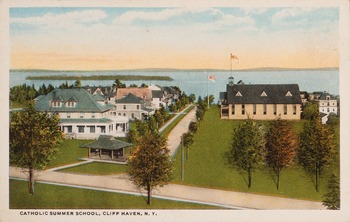
By the end of its first decade, the Summer School looked like a little village. (See Figure 2.) Visitors arrived by train and trolley directly on site, and proceeded to their cottages, the largest offering forty to fifty rooms, shared bathrooms, parlors, dining rooms, and other social areas. Named for Catholic cities and dioceses from which visitors came—the Marquette, the Philadelphia, the Boston—most cottages had a paid hostess and a private chef. Elsewhere on the grounds, the main auditorium hosted daily lectures and evening entertainments; a dining room seated eight hundred; and a simple wooden chapel, Our Lady of the Lake, allowed CSSA guests the option of staying on site for Sunday mass instead of going off site to church in Plattsburgh.Footnote 31 It was a place apart—one Plattsburgh newspaper called it “the magic city” springing into existence on the lake. Footnote 32 Much of that magic, as frequent CSSA lecturer Helena Goessmann wrote, came from getting “a taste of Catholic society life” outside of the “urban vortex.” Here, she described, was a “simplified, elevated,” atmosphere for the visiting laywoman arriving at “our little Eden.”Footnote 33
CSSA grounds facing east, C. T. American Art Postcard Co. (ca. 1906). Collection of the author.

Women Are to Take Part
Local history buffs have long noted the significance of thousands of Catholic visitors arriving on the western shores of Lake Champlain each summer from 1893 through 1941.Footnote 34 Who were those visitors and what did they do on vacation? Much of Adirondacks historiography focuses on the region's appeal to businessmen in an era of industrialization and urbanization—a historiography that runs parallel to religious historians’ focus on an emergent Christian manliness, or “muscular Christianity,” of the same era.Footnote 35 Largely without comment, however, other scholars have estimated that three-quarters of the Catholic Summer School attendees were female—despite the overwhelmingly male leadership of the site.Footnote 36
At the first Connecticut meeting of the Summer School in 1892, CSSA founders were encouraged by the attendance of reading circle women, representing eighteen states, the District of Columbia, and Nova Scotia.Footnote 37 In preparations for the first summer at their permanent New York site, Warren Mosher and Father McMillan asked Catholic women to “devote one [reading circle] meeting to a talk about the coming session at Plattsburgh, and to secure the attendance of at least one representative” to the Summer School's 1893 session.Footnote 38 The men planned an annual “Reading Circle Day” when leaders of the women's groups would meet together to announce their goals for the coming year, and they appointed a committee of five women “to provide more adequately” for their sex. This first CSSA women's auxiliary represented Northeastern centers of Catholic activity and the largely Irish-American makeup of an American Catholic middle class: reading circle boosters K. G. Broderick and A. T. Horgan of New York City; writer and translator Ella McMahon of Boston; singer, writer, and teacher Elizabeth Cronyn of Buffalo; and Emily Gaffney, who founded Rochester's second reading circle with seventy women in 1889. As an auxiliary committee, their first duty was to write a detailed report for the CSSA's all-male Board of Studies on “all matters calculated to protect women's interests at the Summer-School.”Footnote 39
If those reports survived, they would likely have documented the fact that women speakers provided only a fraction of the school's programming. Katherine Conway lectured the first year on literature and returned each summer with members of her Boston reading circle.Footnote 40 The New York Times observed that humorist Agnes Repplier and novelist Anna T. Sadlier were scheduled to speak in 1893, although they were far outnumbered by laymen and clergy on the lecture program.Footnote 41 Conway and the German-American Catholic writer Helena Goessmann of Amherst, Massachusetts, would soon count among the Summer School's most popular speakers. In 1893, the largest audience of the summer season gathered to hear Goessmann's talk on “America's Indebtedness to Isabella, the Catholic,” timed to coincide with the World's Columbian Exposition. Goessmann's prominence demonstrated that CSSA leaders were not opposed to women taking on serious topics (and they frequently justified it by mentioning her advanced degrees) but few other women gained a spot on the Catholic lecture circuit.Footnote 42 In its first decade, the CSSA featured just twenty-nine lectures by women among the hundreds of yearly offerings.Footnote 43
When a New York Herald headline declared “Women Are to Take Part” in the 1894 Summer School session, it was only to mark their numbers as summer guests; no woman would give an official lecture that year. “From its inception in the summer of 1892 [the CSSA] has been largely dependent upon women,” the Herald noted, describing the new women's auxiliary and their credentials as volunteer labor and society women. But why not nominate a woman to the CSSA planning board, the reporter asked:
In response to the query, “Why are women not represented on the Board of Studies?” the [CSSA] chairman replied that the need of women in that capacity had not yet manifested itself. As it is the policy of the founders of the school not to supply a need before it exists, the appointment of a woman to the Board of Studies is not imminent.Footnote 44
These women were “the bone and the sinew of the movement,” according to the Herald, yet they did not get to assemble the annual program with the men of the CSSA board—a dynamic that should not surprise even the most casual of observers of Roman Catholic organizations. “Lurking behind the phenomenal growth of women's groups between 1900 and 1920,” Paula M. Kane reminds readers, “was firm clerical control.”Footnote 45 Instead, the laywomen who took part firmed up Catholic claims to white, middle-class respectability.
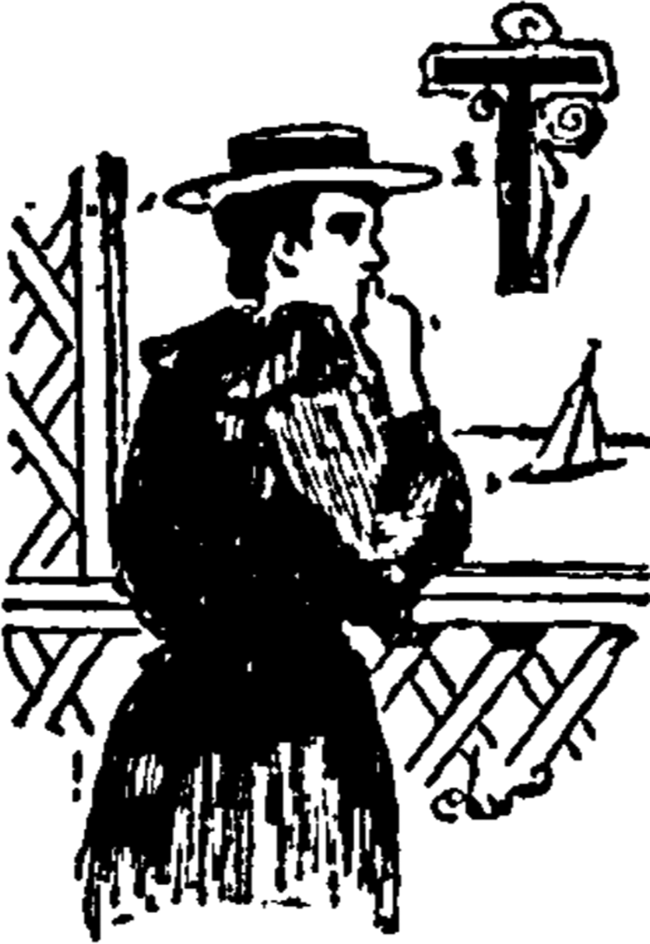
The 1894 New York Herald clipping offers a small but tantalizing glimpse of what I find more persuasive about the Summer School as a site for imagining the marriage of laywomen's cultural work and ideas of Catholic whiteness at the turn of the century. To illustrate the CSSA woman to its readership, the Herald published a small sketch of a slim, well-dressed woman in a fashionable shirtwaist and ribbon-trimmed straw hat gazing upon two symbols of religion and recreation: the cross and the sailboat. (See Figure 3.) The visual language of public Catholicism suggested in the Herald is worth noticing: the CSSA woman was portrayed as pious, stylish, and modern, with ample access to leisure. The illustration would not look out of place with the emergent “Gibson Girl” aesthetic of the 1890s, indisputably the most recognizable “American Girl” archetype found in secular print at the time and popularized by illustrator Charles Dana Gibson. That the Gibson Girl—what scholar Martha H. Patterson has described as an essentially “white bourgeois ideal”—could be a Catholic girl affirms the role that the CSSA played in the cultural work of making Catholicism respectable in the U.S. context.Footnote 46
“Women Are to Take Part” illustration published in the New York Herald (1894).

One need not look only to the newspaper illustration to see Catholic womanhood on full display at the CSSA. While there is no extant comprehensive register of CSSA guests, picture postcards from the Summer School held in private collections were largely written by women guests to their women friends at home, sharing observations about the delicious meals, friendly camaraderie, and the lovely upstate scenery.Footnote 47 Recently cataloged photographs in the collections of the Clinton County Historical Association also bear witness to the preponderance of women on the grounds. Strolling arm in arm, crowding events like August's Lady Day festivities, or casually posed inside the cottages dressed in the latest summer fashions, bows starched, sitting by the hearth or on a sunporch, they are the Herald's illustration brought to life.Footnote 48 It was not the occasional female lecturer or summer devotion to the Blessed Virgin Mary that made the CSSA a women's space; it was the tone women's presence set and the affective bonds they built. As one 1895 chronicle of the Summer School described:
The receptions given by the ladies on the Saturday evenings of the session have been sources of delight and pride to the [CSSA], for they have proved that among our Catholic people there is an undeveloped social strength. . . . Catholics coming together from all sections of the country are led to know one another better.Footnote 49
In these formal reports, men often stressed getting acquainted with “prominent” Catholic writers, clergy, and educators, and the importance of expanding lay Catholic networks beyond one's parish or city. But many others, including a number of Catholic laywomen, wrote a different story of the first years of the CSSA as a place that fostered the most intimate of associations with ramifications for Catholic futures—friendship and marriage.
Catholic Family, Catholic Flirtations, and the “Social Need”
Organized leisure extended Catholic women an opportunity to build connections that reached further than their schools or local parishes. Summer School narratives describe weeks where men and women populated the grounds, discussing the latest works by Catholic authors, making new friends, and renewing old acquaintances. Mothers visiting with their families or career women on the lecture stage offered glimpses of Catholic futures to young women graduates of the convent schools. The reading circle magazines even bragged of young women choosing to attend the CSSA over taking a fashionable European tour during the summer months. As Warren Mosher described it, the Summer School could be a home for many:
The life is ideal. The whole assembly forms one large family. . . . The scholar, as well as he who is in search of scholarship, can store his mind with the choicest treasures of history, literature, philosophy, theology, science and art. The mother of a family can be provided with a perfect home for herself and her little ones. Tired men of business can get useful, restful, and strengthening vacation. The young people of both sexes are afforded an unending round of social and athletic pastimes.Footnote 50
Descriptions of the CSSA in circulars over the next decade would continue to use Mosher's “one large family” phrasing. Certainly, the CSSA was family friendly; Mosher's description posits a peaceful retreat for Catholic mothers and fathers, and endless entertainments for their sons and daughters. But his vision of “perfect” “useful” and “scholarly” community rested on shared status, and promotional materials consistently announced that status throughout the year. “All the patrons of the Summer School are cultivated and well educated,” a set of advertisements from April 1900 proclaimed. It was a place of safety where “no rough or disagreeable characters ever enter, in which class distinctions are unknown.” Endorsing a vision of homogeneity, Summer School boosters made clear that simply having the good taste to choose a vacation at the Summer School (and affording its $12 weekly fee along with the cost of travel arrangements) was proof enough of one's worthiness for “social intercourse.”Footnote 51
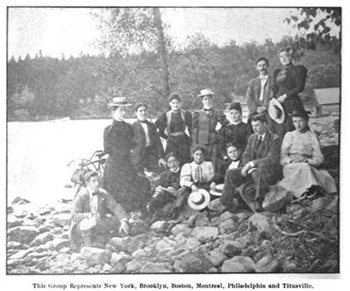
Unlike the largely single-sex reading circles, co-ed intermingling at the CSSA was not by accident. If these second- and third-generation white Catholic Americans, largely Irish in origin, created an exclusive space of belonging, one they used to distinguish themselves as members of a new, cosmopolitan, but still very Catholic, leisure class, they also had a new concern: intermarriage. A few years before the Summer School's founding, the Catholic World's editors published commentary by an anonymous Illinois teacher to promote the reading circles, which suggested that, without a vibrant American Catholic culture, rates of “mixed” marriages would soar. “In small places where almost everything is Protestant it is next to impossible to rear the young untainted by false ideas,” wrote the Illinois correspondent. “Many of our Catholic girls are teachers in the public and district schools, and surrounded as they are by Protestants, unless there is a strong Catholic training, mixed marriages cannot be prevented. This might, however, be obviated to a certain extent by Catholic literature.” Could the reading circle prevent accommodation to “Protestant” America? Could Catholic culture be strengthened not simply at church, but at play? Instead of promoting cultural assimilation, the co-mingling of young Catholic women and men from around the region (and sometimes from across the country) provided a summer alternative to being “surrounded by Protestants.”Footnote 52 Nature, it seemed, provided a bulwark against intermarriage, a refuge in which American Catholicism could flourish, and, CSSA boosters often noted, a backdrop for youthful friendships and even romance. When the Catholic Reading Circle Review published its annual recap of the summer season, the men's reports were illustrated by photographs of young visitors enjoying each other's company on the grounds. (See Figure 4.)
CSSA group photo published in the Catholic Reading Circle Review (1897).

Women writers at the Summer School were some of the sharpest observers of the social dynamics in “the grove,” as the CSSA's picturesque pines were often described. Uncovering the stories they told about the resort in their lectures and published writings reveal just as much attention to women's work as hostesses and matchmakers as to the men's labors of programming summer speakers, masses, and events. Helena Goessmann often lectured to the New York reading circles during the off season about the “cultured men and women” she met at the CSSA, and “the pleasures and profit of meeting at close range so many bright Catholic men and women from all sections of the country.”Footnote 53 A self-described “cat-loving spinster,” Goessmann's series of six short stories published in the Catholic Reading Circle Review offered a lightly comedic take on Catholic society by the shores of Lake Champlain. Was this handsome young man going to study for the priesthood or was he an eligible bachelor? Was that bright young woman staying in too much or prioritizing her social calendar? Which of the older married women would successfully “pin” two names together? “I love a good, healthy, straight-forward romance,” Goessmann joked.Footnote 54 Even “the lake breezes and my paper are flirting outrageously.”Footnote 55
If men like Mosher stressed the one Catholic family formed at the Summer School, women observers were keenly aware of the Catholic flirtations that were necessary for social reproduction. Instead of writing these women's summer fables and romance stories off as simple fictions, I find them telling evidence of women's aspirations for a Catholic world and the maintenance of class and status through making the right connections. The New York writer Mary J. Browne, who published under the pen name Marion Brunowe, was a frequent CSSA visitor with her group of convent school alumnae from the Academy of Mount St. Vincent. Her stories underscored not only the Summer School founders’ desire for Catholic association, but also young women's embrace of the CSSA when they were still a religious minority in so many other places. “As it turned out,” Browne wrote for the Catholic World:
The grove was a place to meet one's friends of all and every “persuasion”: old friends as well as new ones; learned and reverend . . . men and maidens, young, old and age uncertain; here and there a matron of gracious and dignified presence; a sprinkling of children. . . . It is this atmosphere—Catholic to the core—which constitutes perhaps one of the chief charms of the Champlain Assembly. Here indeed is met and fulfilled that long-standing social need of the Catholic laity in a non-Catholic country. Nowhere else have the members of a common faith such an opportunity to meet on a basis of intellectual equality.Footnote 56
A lay Catholic elite, as Browne described it, had a “social need” that was not easily fixed at home in the heterogeneous parish or city. But at the Summer School, a privileged Catholic association life was foundational. Browne's first essay about the site, “The Summer School Story of the Lone Lorn Delegate” (1898), demonstrated the appeal of new spaces of Catholic sociability that marked the arrival of an educated Catholic leisure class. The “lone” representative of one's local reading circle was not so lonely at the CSSA, surrounded by her intellectual, social, and cultural equals. And she had a lot of fun. “Amusement is rampant,” Browne wrote. “We rarely retire before midnight.”Footnote 57
CSSA event programs support women writers’ descriptions of the flurry of social opportunities. Opening week of the 1898 summer season, for example, featured receptions or dances on four of seven nights.Footnote 58 Back at home, such a busy social calendar might be worrisome, even dangerous. But the Summer School cultivated an insularity and a sense of protection for young women—with access to the resort restricted to others like them, “bright” young “equals,” as Goessmann and Browne's words, like CSSA advertisements, suggest. Lida Rose McCabe's eight-panel promotional brochure for the CSSA, published in 1900 as an “open letter” to Catholic women uncertain about joining the upcoming summer season, promised not only days in the company of “bright minds from all parts of the country,” but also lively nights of “gay crowds” moving from cottage to cottage for music, games, theater, and dancing. Here, barely a decade into this Catholic experiment, its possibilities for consolidating an American Catholic leisure class were submitted as a significant selling point. The Summer School, McCabe described, functioned like a “matrimonial bureau,” with a Catholic cupid playing “tricks” among all the “eligibles” on vacation. “All sorts of things festive,” she promised, “are liable to happen.”Footnote 59 Local newspapers picked up on the social atmosphere, too. “The fact that this week has been a busy one in the lecture hall, has not robbed the leisure moments of their wonted happiness and gayety,” wrote one Plattsburgh reporter in July 1901. “A musicale at the New York, a reception at the Rochester, a Shirt-Waist Dance at the Brooklyn, and a hop at the Champlain Club, have made those moments speed by.”Footnote 60
The newspaper social columns saw what women writers also imagined: a rising Catholic middle class was becoming even more visible to the outside world—of American Protestants. Dominican Sister Mary Alphonsa Corry dramatically illustrated these dynamics when she made a fictional summer romance the subject of her novel At Lake Monona: An Episode of the Summer School (1899). Writing under the pseudonym M. A. Navarette, Sister Corry—a teacher and convent academy principal—set her marriage fable at the short-lived Western Summer School in Madison, Wisconsin, which was modeled after the CSSA.Footnote 61 The novel puts a distinctly Catholic twist on the marriage plot, imagining young Protestant men as outsiders attracted to the summer school and to the smart, clever, and affluent Catholic girls on the grounds. When Alfred Vane, a Protestant, falls in love at first sight with a young woman attending the summer school in his town, drama ensues. The object of Alfred's affection, summer school girl Alicia Murray, is described as “well-to-do . . . the youngest of four . . . all bright and intelligent.”Footnote 62 Alicia, too, is quickly smitten. Alfred's old school chum, Royle—now a Catholic priest—cautions the match, declaring “I shall never, as far as in my power lies, be instrumental in promoting a mixed marriage.”Footnote 63 The novel follows their courtship: Alfred and Alicia spend the summer attending lectures together, but when he proposes marriage, she rejects his bid unless he converts to Roman Catholicism.
The plot thickens with anecdotes charting the Catholic characters’ steadfast commitment to their faith—Alfred secretly sends Alicia roses, which she decides to leave at the foot of a statue of the Virgin Mary; Alicia frets that her school friends have found religious vocations when she has not felt a calling; Father Royle says Mass in honor of St. Joseph to pray for the possibility of Alfred's conversion. Throughout, Sister Corry weaves in promotion of both the Catholic Reading Circle movement and the CSSA. Alicia declares, “I think it is the duty of every Catholic who can afford it to patronize the [summer] school. I used to think that we had no [Catholic] learned lecturers, but the Summer School has dispelled the illusion.”Footnote 64 A summer spent with like-minded co-religionists encourages Alicia to find her place in a Catholic world, and forces the Protestant characters to recognize Catholic success.
The novel's dialogue points to the lingering animosity between Protestants and Catholics at the turn of the century, while also asserting that Alicia is not a pretender or social climber but representative of a new American Catholic elite. Midway through the novel, Alfred and his mother spar over the romantic match:
“Who is this wonderful paragon that will not marry my son, Alfred Vane, the son of a millionaire?”
“She is Miss Murray, of this city, and will not marry me unless I become a Catholic.”
“And aren't there enough of your own faith and social position to chose [sic] a wife from, without taking this parvenu?”
“Even if you are my mother, I must beg you to be a little more choice in the use of appellatives, and at the same time inform you that Miss Murray is no parvenu; she can boast as blue a blood as your own. The woman I have chosen is my equal, if not my superior, in every respect. I thought you had more confidence in your son, than to think he would degrade himself and you. . . . She is no parvenu, but a woman of principle, as well as of social position.”Footnote 65
The Summer School Catholics, as Sister Corry suggests through this mother-son disagreement, were no arrivistes. Instead, they had already arrived, but lacked acknowledgment from a Protestant elite. For the novel's romantic suitor, it is the Summer School that opens Alfred's eyes to the progress of the Roman Catholic Church in America. Things proceed quickly from there. In the novel's last ten pages, Sister Corry wraps up her story with a barrage of life-changing events for the Protestant Alfred: he witnesses a miracle at sea on a voyage taking American pilgrims to Lourdes; he learns the famous “Miss C” (reading circle leader Katherine Conway!) is on his same voyage; he decides to be baptized abroad; and, newly converted to Roman Catholicism, he is able to win Alicia's hand in marriage. Upon his return, the two are wed at a church dedicated to Our Lady of Lourdes. Alfred's mother, the skeptic, warms to her son's marriage. As Sister Corry writes, Mrs. Vane “consoled herself with the thought that there were so many recent conversions among the nobility of England to the Church of Rome, that, as she said to a friend, ‘Catholicism is getting to be the style.’”Footnote 66
Corry's At Lake Monona, like most Catholic women's writings at the turn of the century, were not widely read outside the reading circles, but they are critical texts for the study of U.S. Catholic history. The romance novel, like Goessmann's and Browne's essays, speaks clearly to a dynamic by which second- and third-generation white, Catholic Americans, largely Irish in origin, sought out spaces of belonging that they then used to distinguish themselves as members of a new, cosmopolitan, but still very Catholic, leisure class. Even when other women complained about the Summer School's prominence in turn-of-the-century Catholic channels, their words further demonstrate the CSSA's visibility as a sign of a new, ascendent elite within Catholic communities. The Midwestern Catholic writer Leila Hardin Bugg accused middle-class American Catholics of prioritizing the “social need” and ignoring a different kind of intra-Catholic work—charity and missions to the less fortunate. Despite the Summer School's brief extensions to New Orleans, Madison, and San Francisco, Bugg poked fun at “Eastern Catholics” who “think complacently of all this prosperity, and sink luxuriously onto a divan to scan the syllabus for next year's Summer-School, or to jot down an engagement at the Reading Circle to discuss Browning's place in Modern Thought.”Footnote 67 The learned, leisured Catholic, Bugg complained, was not funneling her efforts into truly useful action and social uplift. Other commentators saw nothing serious about the Catholic “style” of the CSSA, including the stories of Mary J. Browne. “Oh! Will she please give us the story of somebody beside ‘the madcap set’ of girls,” sighed one Catholic editor.Footnote 68 Summer School women would have disagreed with these assessments. They shared their fictions on the reading circle circuit and with their networks of convent school alumnae who delighted in seeing their Catholic milieu in print and in the club auditorium back at home.
Fixing “the social need”—what Mary Browne called that peculiar situation of a Catholic lay elite searching for companionship in Protestant America—was important Catholic work to the women writers I have surveyed here. For some—including women such as Goessmann, Browne, and Conway, who remained unmarried and found purpose and career outside of the nuclear family or the convent—fulfilling “the social need” also meant cultivating friendships and new conversation partners, and keeping up with their busy voluntary commitments.Footnote 69 These same women joined other church leaders at the CSSA in imagining strong Catholic marriages as an important outcome of Catholic learning and leisure, making future Catholic families. And they imagined a Catholic elite not just at Lake Champlain, but stretching out from coast to coast. Reflecting on the CSSA at the Lake Champlain tercentenary celebrations in 1909, Katherine Conway concluded, “After all the main thing is to get the Catholics of the various sections of the country into intimate association—to form that strong and loyal community spirit which will mean so much for all the interests of the Church.”Footnote 70
Conclusion
At its height in the early 1910s, the Summer School welcomed nearly ten thousand guests over eight weeks to its properties, which were valued at half a million dollars.Footnote 71 The “Catholic Chautauqua” was, in the eyes of its founders, a successful venture, worthy of the approbation of American Catholic bishops and even the Vatican—endorsements the annual Summer School circulars proudly repeated. Most Catholics involved with the early CSSA could agree on the benefits of their style of Catholic association—a protection against intermarriage, a strengthening of Catholic ties beyond the local, and a promotion of Catholic arts and literature. As the 1910s wore on, however, a generational change in CSSA leadership positioned the site as the ideal place for adult education and teacher training, shifting the dynamics and potential demographics of the resort. This was a practical matter: in the late 1910s CSSA correspondence began to suggest financial uncertainty on the horizon.
While many of the old-timers continued to return to the cottages most summers, CSSA leaders also sought out new partnerships to share the burden of operating a summer resort.Footnote 72 By the 1920s, the CSSA marketed itself as a place offering public and parochial school teacher enrichment days and entered into an arrangement with New York's Fordham University to offer credit-bearing lectures and courses to undergraduate and graduate students.Footnote 73 The last gathering at Lake Champlain was held in the summer of 1941; today, no buildings or infrastructure from the original site remain. Thus, for all its early fanfare, the “Catholic Chautauqua” did not have the funding or the staying power of its storied predecessor, which continues to offer programming to nearly one hundred thousand visitors each summer on its original grounds.Footnote 74 Most notably, the language of a particularly Catholic “social need” began to drop out of CSSA materials in the Summer School's third decade. Talk of a “Vacation Paradise for Catholics,” as the Fordham announcement put it, more frequently cited the advantages of mild weather, glorious lake views, and other natural features, and not the social standing and association life of the summer population.
This shift in ethos—in which the Summer School functioned more as a school and less as “one large family”—draws further attention to the ways that, I have argued, a Catholic elite in the 1890s and early 1900s envisioned a shared, exclusive space for building American Catholic community and social standing. “One of the unwritten laws,” Mary Browne wrote of the CSSA grounds in 1900, is that “every one is supposed to recognize every one else without the formality of an introduction; that they are here is hall-mark enough.”Footnote 75 That “hall-mark” of the Catholic Summer School was fundamentally exclusionary—and echoes Warren Mosher's claim that the family of CSSA visitors would never be visited by “rough” or “uncultivated” interlopers.
CSSA boosters, I argue, were always choosing their words carefully. Throughout this article, I have taken pains to draw attention to the language these men and women used to describe themselves during the 1890s and early 1900s, and I have done so to urge a closer look at white Catholic visions of belonging in the U.S. context, expanding the places and spaces we might find those visions. The CSSA did not invite working-class and immigrant Catholics to its activities or offer scholarships; entertainments such as minstrel shows clearly defined American Catholic culture as a white culture.Footnote 76 And women played a role in the maintenance of these discourses. Prominent laywomen visitors, such as Browne, Conway, and Goessmann, used their speaking and writing platforms to argue that Catholic women were central to the Summer School movement. They gendered their usefulness as female, like scores of women club members of the age. In the space of the CSSA, that female usefulness was not to duplicate the role of clergy, and only occasionally to provide a woman's voice at the lecture hall on matters of education or current affairs. Instead, it was assumed that women's consistent presence would nurture a strong Catholic elite. Laywomen, if we are to believe the Summer School advertisements and stories, kept an eye on the Catholic social scene, nudging new relationships (both romantic and platonic), and, in essence, helping to ensure the purity and insularity of the site in ways that provoke future conversation with scholarship on women and the work of white supremacy.Footnote 77
The CSSA was undeniably a white space. It was an American space, and a Catholic space—a sacred space, even. It was a social space, where the elegant cottages took up more square footage than the chapel. It was a place apart, celebrated by its loudest boosters for the harmony created by offering organized leisure to a select group of men and women in the hopes of fostering new and sustaining associations. CSSA founders supported this line of thinking, as did the women who wrote and spoke about the advantages of Summer School life, implying that, for a white Catholic elite to flourish, they needed to mix and mingle on land that would remind them of their sacred and shared inheritance. Like all summer vacations, however, the “Paradise for Catholics” was a temporary utopia. When Helena Goessmann concluded her series of “Summer Screeds,” she mourned the end of the CSSA season, “when [we] go back to our old environments, where there is little or no Catholic Association for us.”Footnote 78 Goessmann's vignettes, and the stories of many other visitors, drew attention to the fact that many Catholic laypeople were seeking community at the turn of the century, and they found it during the summer, when a resort for readers supported an American Catholic leisure class defining itself as prosperous, stylish, and cultured. Loosened from their parish bounds for the summer season, these Catholics converged on the lakefront, lecture hall, and hotel veranda, reimagining and reinforcing their social networks for the rest of the year at home. If Catholicism was getting to be the style, white laywomen were to be some of its most powerful instigators.