INTRODUCTION
The impact of multinationals’ entry mode choices on their performance across different subnational regions of a host country is not well understood. Prior studies seldom consider the relationship between subnational heterogeneity and mode choice. Using data on foreign investments in China, a rapidly developing host country exhibiting wide disparity in regional development, we set out to examine subnational variation in the way mode choice influences subsidiary performance.
Given its importance to scholars, managers and policy-makers, a mature literature on foreign market-entry strategy has amassed, with contributions from management, international business and marketing (e.g., Anderson & Gatignon, Reference Anderson and Gatignon1986; Erramilli & Rao, Reference Erramilli and Rao1993; Harzing, Reference Harzing2002). Indeed, Shaver (Reference Shaver2013) questions the need for more entry mode studies, as potential contributions are becoming increasingly marginal, but Hennart and Slangen (Reference Hennart and Slangen2015) identify several directions future entry mode studies might take, such as investigating the mode decision-making process.
Most entry mode studies define the nation-state as the geopolitical unit subject to entry and exit (e.g., Shi, Ho, & Siu, Reference Shi, Ho and Siu2001). However, nation-states are not internally homogeneous entities with regard to location-specific factors influencing firm structure and performance (Cheng & Kwan, Reference Cheng and Kwan2000). Subnational regions within a nation-state may possess very different political, economic and cultural attributes, leading to variation in the performance of a given entry mode by subnational location (Beugelsdijk & Mudambi, Reference Beugelsdijk and Mudambi2013). In consequence, multinationals’ entry mode preferences depend on their targeted subnational location (Pan & Chi, Reference Pan and Chi1999; Meyer & Nguyen, Reference Michailova and Worm2005; Shapiro, Tang, & Ma, Reference Shapiro, Tang and Ma2007; Li & Xie, Reference Li and Xie2011; Goodman, Reference Goodman2013; Wu, Muller-Kahle, Arora, & Leseane, Reference Wu, Muller-Kahle, Arora and Leseane2013). Collectively, these studies suggest that the wholly owned subsidiary (WOS) mode is preferred by multinationals in relatively developed subnational regions while the joint venture (JV) is selected in less developed subnational regions.
However, a direct test of how mode choice impacts subsidiary performance at the subnational level has not been attempted. Acknowledging subnational heterogeneity with regard to the mode–performance relationship is theoretically important. First, it reveals how the performance of a given mode depends on location factors at the subnational level. To illustrate, in less developed subnational regions, JV mode is likely to be more profitable than WOS mode since with local partners’ help, foreign subsidiaries can overcome the uncertainty they encounter and develop better sense of what is happening (Luo & Tung, Reference Luo and Tung2007), being well positioned to develop competitive advantages and reap high performance. Furthermore, it serves as a context to reconcile inconsistent findings in prior single-country studies (e.g., Chen, Reference Chen2012; Goodman, Reference Goodman2013). Beyond the theoretical realm, practitioners need confirmation that the mode choices suggested by prior studies (e.g., Meyer & Nguyen, Reference Michailova and Worm2005; Goodman, Reference Goodman2013) can actually help their firms perform better. In the current study, we focus on the WOS and JV modes in conformity with the many studies showing that the choice between them is critical to subsidiary performance (e.g., Brouthers, Reference Brouthers2013; Hennart & Slangen, Reference Hennart and Slangen2015). The WOS mode allows maximum control over operations in a host country and with local partners (Gomes-Casseres, Reference Gomes-Casseres1990). The JV mode offers local knowledge, resources and enterprise networks which reduces risk exposure in the host country (Slangen & Van Tulder, Reference Slangen and Van Tulder2009). We argue in developed subnational regions, relatively free of uncertainty and complexity, the WOS mode is more profitable than the JV mode. Conversely, the JV mode outperforms a WOS in less developed subnational regions, as it more efficiently and effectively taps into local resources. In addition, we hypothesize that the disparity between WOS and JV performance is smaller in developed regions than less developed regions because foreign subsidiaries using a JV mode may be drawing more on their partners’ product-specific technologies than their location-specific assets.
The hypotheses are tested using data from multinational investments in China, a country appealing as a destination for foreign direct investment (FDI) and one that exhibits a high degree of subnational heterogeneity (Sun & Chai, Reference Sun and Chai1998; Wu et al., Reference Wu, Muller-Kahle, Arora and Leseane2013). We compare investments in two provinces, Shandong and Gansu located in China’s Eastern and Western regions, respectively.
The remainder of the article is organized as follows. The next section reviews mode–performance studies and the literature on subnational heterogeneity thereafter. We then formulate hypotheses, which are followed by a description of data and method. Results are then reported, then discussed, and the conclusion covers the study’s theoretical contribution, limitations and practical implications.
ENTRY MODE–PERFORMANCE LINKAGE AND SUBNATIONAL HETEROGENEITY
Entry mode selection and subsidiary performance
The performance implications of entry mode choices have been extensively studied (see Brouthers, Reference Brouthers2002, Reference Brouthers2013; Brouthers, Brouthers, & Werner, Reference Brouthers, Brouthers and Werner2003; Brouthers & Hennart, Reference Brouthers and Hennart2007; Canabal & White, Reference Canabal and White2008 for an excellent review; Tihanyi, Griffith, & Russell, Reference Tihanyi, Griffith and Russell2005; Martin, Reference Martin2013). These studies demonstrate the power of transaction cost and institutional theory to account for entry-mode choice, and establish a clear link between mode choice and subsidiary performance. Under different circumstances, some modes prove more profitable for multinationals than others. For example, Martin (Reference Martin2013) found that foreign subsidiaries adopting WOS mode perform better than those adopting JV mode. However, these studies focus on the performance effects of mode choices using the nation at the unit of entry and they have produced mixed results (e.g., Woodcock, Beamish, & Makino, Reference Woodcock, Beamish and Makino1994; Schaaper, Mizoguchi, Nakamura, & Yamashita, Reference Schaaper, Mizoguchi, Nakamura and Yamashita2011; Gomes-Casseres, Jenkins, & Zámborský, Reference Gomes-Casseres, Jenkins and Zámborský2018).
For instance, in China, Chang, Chung, and Moon (Reference Chang, Chung and Moon2013) and Wu et al. (Reference Wu, Muller-Kahle, Arora and Leseane2013) found that improvement on return on assets in WOSs greatly exceeded that of JVs. Yet, Chen (Reference Chen2012) found JVs more profitable than WOSs, speculating that this might be explained by a need for local complementary assets or less experienced entrants. Foreign multinationals are seen to prefer a JV over a WOS where restrictions favour the state-held industries such as automobiles and telecommunications (Teng, Reference Teng2004). Although insightful, these studies do not specify the subnational locations in which foreign subsidiaries operate. Hence, it is possible that there were significant differences in the geographic distribution of WOSs and JVs within the studied host nation. Accordingly, we argue that subnational heterogeneity can act as a context in which mixed findings of mode choice on subsidiary performance can be reconciled.
We will draw on relevant literature on subnational difference to develop our arguments for two reasons. First, the large body of literature can provide us with compelling evidence of why subnational heterogeneity matters and so we can explain how it affects mode–performance relationship. Second, although prior entry mode studies (Brouthers, Reference Brouthers2013; Martin, Reference Martin2013) employ multiple theories (e.g., Transaction Cost Economies, Resource-based View, institutional theory) to test whether subsidiaries to evaluate the performance implications of mode choice, we did not use this approach. To do so requires primary data collection from managers of multinational firms, who are increasingly hesitant to participate for various reasons. Getting access to and (reliable) responses from corporate elites is notoriously difficult and costly (He & Huang, Reference He and Huang2011). An alternative is to use secondary data sources (He & Huang, Reference He and Huang2011). Therefore, we base our study on a reliable secondary data source. This confines us to testing with variables included in the database.
Subnational heterogeneity
For the sake of convenience, a ‘subnational region’ can be understood as a unit of public administration, such as a province, state, district or county, or as an aggregation of several such contiguous units. However, a distinctive subnational region needs not coincide exactly with the boundaries of these politically defined spaces. Thus, subnational heterogeneity manifests in clear variation in political, economic and social attributes between different provinces/states or geographic areas (e.g., Eastern and Western regions in China). Promisingly, the past two decades has witnessed a spike in international business studies recognizing subnational heterogeneity. These identify significant subnational differences such as government policy (Nguyen, Le, & Bryant, Reference Nguyen, Le and Bryant2013), intellectual property rights (IPRs) protection, market development (Yi, Chen, Wang, & Kafouros, Reference Yi, Chen, Wang and Kafouros2015) and culture (Tung, Reference Tung2008), to name a few. They influence important decisions, such as export strategy (Nguyen, Le, & Bryant, Reference Nguyen, Le and Bryant2013), executive pay (He & Fang, Reference He and Fang2016) and foreign market insidership (Monaghan, Gunnigle, & Lavelle, Reference McEvily and Zaheer2014). However, how subnational heterogeneity plays a role in effectuating the impact of mode choices on subsidiary performance remains unknown. Note that Ma, Tong, and Fitza (Reference Ma, Tong and Fitza2013) proposed that subnational heterogeneity varies across different nation-states, with some countries being relatively homogenous while others not. In the context of our study (i.e., China), subnational heterogeneity has been considered to be fairly high (Chan, Makino, & Isobe, Reference Chan, Makino and Isobe2010; Ma, Tong, & Fitza, Reference Ma, Tong and Fitza2013).
Heterogeneity in subnational political/legal dimension
Political or legal dimensions include transparency, favourability (Chan, Makino, & Isobe, Reference Chan, Makino and Isobe2010; Nguyen, Le, & Bryant, Reference Nguyen, Le and Bryant2013) and stability of government policy, openness of legal environment (Sun, Peng, Lee, & Tan, Reference Sun, Peng, Lee and Tan2015) and intellectual property rights protection (Yi et al., Reference Yi, Chen, Wang and Kafouros2015). With respect to transparency and favourability of government policies in China, developed provinces are more committed to improving policy transparency and favourability towards foreign entrants (Ma, Tong, & Fitza, Reference Ma, Tong and Fitza2013), decreasing their perceived uncertainty and facilitating the knowledge flow to support their location operations (Meyer & Nguyen, Reference Michailova and Worm2005; Nguyen, Le, & Bryant, Reference Nguyen, Le and Bryant2013). In contrast, due to their limited knowledge of how to deal with foreign entrants, governments in less developed provinces lack such experience to commit to foreign entrants, hindering knowledge flows (Meyer & Nguyen, Reference Michailova and Worm2005).
Stability of government policies refers to the pace at which policies change, contributing to the uncertainty that foreign subsidiaries perceive (Peng, Reference Peng2003). In China, developed subnational regions more often exhibit stable government policies towards foreign investment, allowing foreign subsidiaries to better predict government actions and adjust strategic plans accordingly (Delios & Henisz, Reference Delios and Henisz2003). On the contrary, the higher policy instability in less developed regions complicates foreign subsidiaries’ strategic decision making and presumably decreases their organizational effectiveness (Delios & Henisz, Reference Delios and Henisz2003). IPR protection may also vary subnationally. Yi et al. (Reference Yi, Chen, Wang and Kafouros2015) finds stronger IPR protection in developed regions in China, encouraging foreign subsidiaries to bring in superior technology. Less afraid of illegal knowledge appropriation by local competitors, multinational enterprises (MNEs) can better commercialize their products or services (Li & Xie, Reference Li and Xie2011). By contrast, low IPR protection in less developed subnational regions results in a higher probability of illegal appropriation of investor technology, which raises the cost of IPR protection (Yi et al., Reference Yi, Chen, Wang and Kafouros2015). Taken together, political/legal attributes, consisting of the properties of government policy and IPR protection, have impact on subsidiaries’ local operations by increasing or decreasing their perceived uncertainty, knowledge and information gained and additional costs.
Heterogeneity in subnational economic dimension
Subnational regions in China also differ in economic attributes, which include types of factors of production (Ma, Tong, & Fitza, Reference Ma, Tong and Fitza2013), market size and openness (Sun et al., Reference Sun, Peng, Lee and Tan2015; Yi et al., Reference Yi, Chen, Wang and Kafouros2015) and available agglomeration economies (Porter, Reference Porter1998). The factors of production include types of intermediaries and common economic infrastructure (Ma, Tong, & Fitza, Reference Ma, Tong and Fitza2013; Yi et al., Reference Yi, Chen, Wang and Kafouros2015). Intermediaries refer to universities, regional trade associations and research institutes (McEvily & Zaheer, Reference Meeker and Escobar1999), whereas common infrastructure includes suppliers and labour force (McEvily & Zaheer, Reference Meeker and Escobar1999). Subnational regions with developed production factors act to compile and disseminate information to foreign entrants, concerning acquisition of new knowledge and updates of existing knowledge (McEvily & Zaheer, Reference Meeker and Escobar1999; Chan, Makino, & Isobe, Reference Chan, Makino and Isobe2010; Han, Jo, & Kang, Reference Han, Jo and Kang2016), as well as choices of existing transaction partners (Nachum, Reference Nachum2000). This repository of knowledge allows foreign subsidiaries to reduce their local search costs (He, Reference He2002) and develop their competitive capabilities (McEvily & Zaheer, Reference Meeker and Escobar1999). In contrast, regions with less developed economic institutions fall short of providing abundant and valuable information to foreign entrants (McEvily & Zaheer, Reference Meeker and Escobar1999), increasing their search costs and hindering their development of competitive capabilities (He, Reference He2002). However, such regions are often fuelled with natural resources which can facilitate certain types of productions, such as wind and tide (Sun & Chai, Reference Sun and Chai1998; Li & Xie, Reference Li and Xie2011).
Second, market size and openness also vary across regions in China. Market size refers to the number of buyers and consumers in the local market (Buckley & Casson, Reference Buckley and Casson1998) while openness points out the extent to which foreign subsidiaries have freedom to access capital resources and mitigate the information asymmetry between subsidiaries and markets (Allen, Reference Allen1993). Regions with large market size allow foreign subsidiaries cultivate more potential consumer groups and presumably earn more benefits (Buckley & Casson, Reference Buckley and Casson1998) and such regions with high openness can help foreign subsidiaries access more information of their value from peers and other investors (Sun et al., Reference Sun, Peng, Lee and Tan2015). Subnational regions with small market size and low openness create more barriers for subsidiaries to access necessary information (La Porta, Lopez-de-Silanes, Shleifer, & Vishny, Reference La Porta, Lopez-de-Silanes, Shleifer and Vishny2000).
Finally, agglomeration economies stem from the geographical clustering of a group of firms (Porter, Reference Porter1998). In the cluster, firms can enjoy knowledge spillovers from others and a pool of specialized labour and input providers (Krugman, Reference Krugman1991). Recent studies have found that agglomeration can help foreign subsidiaries tap into local resources and access knowledge, gain legitimacy and perform better (Ma, Tong, & Fitza, Reference Ma, Tong and Fitza2013; Zhou, Kautonen, Wang, & Wang, Reference Zhou, Kautonen, Wang and Wang2017). In addition, levels of agglomeration also vary (Fan & Scott, Reference Fan and Scott2003; Zámborský, Reference Zámborský2012). In China, developed subnational regions tend to have high level of agglomeration while less developed regions do not (Fan & Scott, Reference Fan and Scott2003). Therefore, foreign subsidiaries in developed regions can access more local resources and perform better while foreign subsidiaries in less developed regions encounter more barriers to the acquisition of knowledge.
Taken together, in developed Chinese subnational regions where economic attributes are well established, foreign subsidiaries can access more knowledge, information, resources and consumer groups, thereby reducing transaction costs, increasing their production efficiency and effectiveness, gaining local legitimacy and enhancing their productivity (Zhou et al., Reference Zhou, Kautonen, Wang and Wang2017). In less developed Chinese regions where economic attributes are relatively underdeveloped, foreign subsidiaries have limited access to the benefits as they could have acquired in developed regions (Zhou et al., Reference Zhou, Kautonen, Wang and Wang2017). However, they can obtain certain scarce resources from the less developed regions.
Heterogeneity in subnational social and cultural dimension
Earlier studies on social and cultural heterogeneity in different subnational regions, which are relevant to foreign entrants, emphasize local social and/or cultural values which determine acceptable behaviours (Meyer & Nguyen, Reference Michailova and Worm2005; Tung, Reference Tung2008; Chan, Makino, & Isobe, Reference Chan, Makino and Isobe2010). Values include rituals, religions, gender roles, parental authority, family importance (Inglehart & Baker, Reference Inglehart and Baker2000), openness to change and personal mindsets such as self-enhancement and conservatism (Venaik & Midgley, Reference Venaik and Midgley2015). These values influence interpersonal trust (Fang, Worm, & Tung, Reference Fang, Worm and Tung2008) and people’s attitudes towards work (Tung, Reference Tung2008); all of which impact on local people’s engagement in business activities (Chan, Makino, & Isobe, Reference Chan, Makino and Isobe2010), subsidiary’s capability building and in turn their performance (Chan, Makino, & Isobe, Reference Chan, Makino and Isobe2010). For example, in FDI intensive regions in China (He, Reference He2002), foreign subsidiaries encounter less cultural barriers to their operations because people there are more receptive to such ‘newness’ (Park, Li, & David, Reference Park, Li and David2006). Yet, in some inland provinces, foreign subsidiaries are more likely to suffer obstacles due to peoples’ closed attitude towards them (Park, Li, & David, Reference Park, Li and David2006). Taken together, foreign subsidiaries encounter more cultural barriers, which can be manifested in people’s attitudes towards their business, in less developed regions than do they in developed regions in China. The differences in such social cultural values across regions have impact on their business performance (Park, Li, & David, Reference Park, Li and David2006).
To summarize, subnational heterogeneity in China includes political, economic and cultural differences that may impact on subsidiary operations, productivity and performance. In developed subnational regions, foreign subsidiaries perceive less uncertainty from government, gain more knowledge, resources and information, as well as encounter less cultural barriers. Given the heterogeneity between different subnational regions, we argue that foreign subsidiaries’ managers can better utilize the advantages of WOS mode in developed regions and the advantages of JV mode in less developed regions.
MODE–PERFORMANCE RELATIONSHIP IN SUBNATIONAL REGIONS
We argue that at least in China, the advantages of WOS mode may be better actualized in developed subnational regions, which possess relatively transparent and clear political environment, better infrastructure, big market size, a larger customer base and an open culture (Shapiro, Tang, & Ma, Reference Shapiro, Tang and Ma2007). All of these attributes may decrease the uncertainty and complexity encountered by foreign subsidiaries (Chen, Reference Chen2006). As such, foreign subsidiaries can feel more secure and certain, have access to more resources, and enjoy being in a relatively open and predictable environment (Chan, Makino, & Isobe, Reference Chan, Makino and Isobe2010; Ma, Tong, & Fitza, Reference Ma, Tong and Fitza2013). For instance, foreign subsidiaries with WOS mode are likely to cultivate a big consumer base given the large market size in these regions without dividing their outcomes with local partners. Also, the political, economic and cultural environments of developed regions are more transparent and predictable (Sun & Chai, Reference Sun and Chai1998; Shapiro, Tang, & Ma, Reference Shapiro, Tang and Ma2007). This may largely reduce foreign subsidiaries’ reliance on local partners, as that predictability and transparency give them more local knowledge and security.
In contrast, the advantages of JVs are less obvious since foreign subsidiaries can tap into local resources easily and spend much less effort in figuring out the high policy uncertainty in the local context (Fan & Scott, Reference Fan and Scott2003; Yi et al., Reference Yi, Chen, Wang and Kafouros2015). Also, the whole cultural environment toward foreign subsidiaries is open (Lenartowicz & Roth, Reference Lenartowicz and Roth2001). Finally, foreign subsidiaries being in a partnership with local firms need to divide their profits. Thus,
Hypothesis 1: Foreign WOSs outperform JVs in developed subnational regions.
We argue that at least in China, the advantages of JVs (such as access to local knowledge, resources and enterprise networks) may be better developed for foreign subsidiaries in less developed subnational regions. As discussed, less developed subnational regions increase subsidiaries’ high perceived uncertainty (Chan, Makino, & Isobe, Reference Chan, Makino and Isobe2010), limit their access to local knowledge and resources, have small market size and potential (Fan & Scott, Reference Fan and Scott2003), and a relatively inward-looking culture (Lenartowicz & Roth, Reference Lenartowicz and Roth2001; Park, Li, & David, Reference Park, Li and David2006). Foreign subsidiaries working in these regions therefore encounter low productivity and thus generate more operational costs than do foreign subsidiaries in developed subnational regions in China (Cheng & Kwan, Reference Cheng and Kwan2000; Chan, Makino, & Isobe, Reference Chan, Makino and Isobe2010). Yet, subsidiaries partnering with local firms can tap into local resources, gain legitimacy and overcome the uncertainty (Zhou et al., Reference Zhou, Kautonen, Wang and Wang2017). Also, local partners can assist foreign subsidiaries in acquiring local resources and familiarize them with the local conditions, such as suppliers’ distribution channels, functioning of government policies and consumers’ preferences. Thus foreign subsidiaries with JV mode can perform well.
Conversely, foreign subsidiaries that have adopted WOS mode may not be able to decrease the perceived uncertainty from government, access to local resources and overcome cultural barriers (Beamish & Banks, Reference Beamish and Banks1987). For instance, foreign subsidiaries need to work alone and deal with the high complexities and uncertainties from government, without being efficiently and effectively aware of how to cope well with such risks in China (Chen, Reference Chen2006). Moreover, it may be more difficult for WOS mode to establish legitimacy and recognition in less developed subnational regions (especially from local government) than in developed regions, due to relatively restrictive policy and local protectionism imposed on foreign firms (Mohamad & Hoshino, Reference Monaghan, Gunnigle and Lavelle2013). Such legitimacy and recognition are crucial in less developed subnational regions in terms of obtaining superior performance than in developed ones (Mohamad & Hoshino, Reference Monaghan, Gunnigle and Lavelle2013). In addition, with strict policy and no help from local partners, foreign subsidiaries can get limited resources from local context and they may still be perceived by local consumers as out-group members (Ben-Ner, McCall, Stephane, & Wang, Reference Ben-Ner, McCall, Stephane and Wang2009). Finally, the level of market size and openness is low and the advantages of WOS mode cannot be effectively actualized, if not maximized (Beamish & Banks, Reference Beamish and Banks1987). As a result, subsidiaries with WOS mode may not be as productive, cost-saving, efficient, effective and profitable as foreign subsidiaries with JV mode. Taken together, we hypothesize:
Hypothesis 2: Foreign JV subsidiaries outperform WOSs in less developed subnational regions.
We also expect that at least in China, the significance of mode choices to subsidiary performance varies across subnational regions. That is, we expect the performance difference in mode choices is smaller in developed subnational regions than in less developed regions. As noted, developed subnational regions excel with regard to stability, transparency and favourability of government FDI policies, market size, infrastructure and level of resources possessed and cultural openness (Chan, Makino, & Isobe, Reference Chan, Makino and Isobe2010; Ma, Tong, & Fitza, Reference Ma, Tong and Fitza2013). Based on such well-established business features, foreign subsidiaries with WOS mode can to a large extent actualize, if not maximize their benefits. This is because they can focus on the task of their capability building (Saxenian, Reference Saxenian1996) without over-concerning the stability and uncertainty in the environment, utilizing the advantages of WOS mode.
In contrast, even though foreign subsidiaries with JV mode cannot fully actualize the advantages of this mode in this context (Yi et al., Reference Yi, Chen, Wang and Kafouros2015), they can still reach a certain level of performance provided that the environment provides well-designed operational conditions. In addition, as evidenced in Luo and Tung (Reference Luo and Tung2007), in more stable and predictable environment, opportunistic behaviours are less likely happen. Foreign subsidiaries therefore face less local partners’ opportunistic behaviour, incur fewer operational costs, and are more likely to increase their productivity in such context. Therefore, the performance difference of mode choices is not very big in developed subnational regions.
In less developed subnational regions, however, we expect that entry mode matters more to subsidiary performance. As discussed, subsidiaries in this context with will have to overcome high uncertainty and gain legitimacy before they move a step further to achieve high performance (Cheng & Kwan, Reference Cheng and Kwan2000; Chan, Makino, & Isobe, Reference Chan, Makino and Isobe2010). This makes the overcoming of uncertainty and gaining of legitimacy especially important for foreign subsidiaries. JV mode can provide such benefits, helping foreign subsidiaries gain both with local partners’ help (Slangen & Van Tulder, Reference Slangen and Van Tulder2009), and as a result of that, achieve superior performance. On the contrary, foreign subsidiaries with WOS mode work alone and deal with the high complexities and uncertainties, without being efficiently and effectively aware of how to cope well with such risks (Chen, Reference Chen2006). This increases the liability of foreignness that they suffer and incur their additional operational costs (Zaheer, Reference Zaheer1995). As such, their performance is more likely to be much lower than performance of subsidiaries with JV mode.
In summary, the impact of entry mode on subsidiary performance in developed subnational regions is lower because foreign subsidiaries face less uncertainty and instability and have more opportunities to capture local value. In less developed regions, mode choice should play a much larger role in performance because local partners’ assistance in dealing with high uncertainty is of great importance. Therefore we predict that:
Hypothesis 3: The impact of entry mode selection on subsidiary performance is smaller in developed subnational regions than in less developed regions.
METHODOLOGY
Research setting
China is used as the setting to test the hypotheses as its disparity between the Eastern and Western provinces is significant and this context is therefore an appropriate setting for testing the hypotheses (Galvin, Reference Galvin2014). These divisions have been adopted by some researchers (e.g., Shapiro, Tang, & Ma, Reference Shapiro, Tang and Ma2007; Goodman, Reference Goodman2013) with regard to entry mode studies. Foreign subsidiaries may encounter less perceived uncertainty in the Eastern region because the Eastern region possesses more open FDI policies, highly developed economies and a more open culture than does the Western region, and thus may save foreign entrants additional costs (Park, Li, & David, Reference Park, Li and David2006). In contrast, foreign subsidiaries in Western region may encounter high uncertainty and charge more additional costs (Park, Li, & David, Reference Park, Li and David2006).
Shandong Province and Gansu Province, from the Eastern and Western region of China, respectively, were used as the setting to test the hypotheses. Shandong Province shows all the characteristics of provinces in Eastern region while Gansu Province has all the Western regions characteristics. For political stability and FDI policies, since it is hard to obtain provincial statistical data within China, prior studies create ordinal variables to indicate whether provincial government has high level of corruption level (Ma & Delios, Reference Ma and Delios2010) or has implemented FDI-friendly policy (Ma & Delios, Reference Ma and Delios2010; Ma, Tong, & Fitza, Reference Ma, Tong and Fitza2013). For instance, Ma and Delios (Reference Ma and Delios2010) use locations to serve as a proxy for the friendliness of FDI policy. They coded friendless as 1 if multinationals invest in a special economic zone, 2 if in coastal cities, 3 if in a coastal open economic zone, 4 if in a provincial capital city and 5 otherwise. In this sense, Shandong Province can be categorized as 3 while Gansu province as 5 (Ma & Delios, Reference Ma and Delios2010). In addition, the total value of import and export in Shandong Province in 2015 is 240,607 million US dollars while the total value in Gansu is 7,952 million US dollars (National Bureau of Statistics of China, 2016). We therefore believe government in Shandong Province has implemented more friendly FDI policies and have higher political stability than government in Gansu Province.
Further, both provinces also differ in their economic development, market size and cultural openness. Prior academic studies found that in China, developed subnational regions (Eastern region in China) are also economically developed, have higher market size and open culture than less developed subnational regions (Western region in China) (Ma, Tong, & Fitza, Reference Ma, Tong and Fitza2013; Yi et al., Reference Yi, Chen, Wang and Kafouros2015). Statistically evidence shows that in 2015, the total value of GDP produced by Shandong Province 63,002.33 (100 million Renminbi [RMB]) while Gansu Province has contributed 6,790.32 (100 million RMB) (National Bureau of Statistics of China, 2016). At the same year, Shandong Province has a population of about 9.8 million but Gansu Province has about 2.6 million people (National Bureau of Statistics of China, 2016). In addition, Chan, Makino, and Isobe (Reference Chan, Makino and Isobe2010) argued that regional cultures affect interpersonal trust, work values, attitudes toward work and social capital. Overall, this evidence has led us to conclude that Shandong Province has most or all the characteristics of developed subnational regions while Gansu Province is a reasonably good representation of less developed regions in China.
Data
This study presents findings from the secondary analysis of data provided by two provincial government departments, Shandong Provincial Industry and Commerce Administration (SPICA) and Gansu Provincial Industry and Commerce Administration (GPICA). Foreign enterprises must submit their annual financial reports to the two departments, which at the end of each year will submit the annual reports to the Chinese National Industry and Commerce Administration (CNICA), a central government office. That is, the data publicized by CNICA consists of the statistics reported by provincial administrative departments. Thus we have reasons to believe that the data from the two subnational departments is legitimate. However, as the data publicized by the central government is a total statistics of foreign firms (e.g., how many foreign JVs have been established in China this year) and the relevant details of each firm is not available, we were not able to obtain these details from the CNICA. Despite that, although the data publicized by CNICA does not permit readers to collect firm-level information because of protection of business confidentiality, readers can obtain a broad overview of foreign investment situation in China and its provinces.
We explained our research intentions to our government sources and requested that they collect as many observations as possible and provide relevant information relevant to the sampled firms as comprehensive as they could, because we do not know what the database contains. Sources were asked to use random sampling strategy with number generators to prevent selection bias. We stressed that sampling should comply with government policy and regulations, but these are not transparent and might result in unidentified nondisclosures. This analysis used the full extent of the data our sources could disclose. Sampling bias is not obviously a distortion in the data, but we are unable to devise corrective strategies without reference to the original databases from which data was drawn.
For confidentiality reasons, firm-level characteristics only could be accessed and firm names are not specified. According to Cooper, Schindler, and Sun (Reference Cooper, Schindler and Sun2006), and Meeker and Escobar (Reference Meyer and Nguyen2014), access to business confidential information requires scholars to be ethical in terms of not disclosing such information to others. In addition, it might be necessary to camouflage the firms’ real names which are under investigation to protect their private information, such as profits (Cooper, Schindler, & Sun, Reference Cooper, Schindler and Sun2006). Note that we specified that independent and control variables data should lag that relating to firm performance by a year so that estimation of causality to some extent can be expected.
We not follow the example of prior entry mode studies that depend on primary data collection from managers of multinational firms (cf. Brouthers, Reference Brouthers2013; Martin, Reference Martin2013). Managers are increasingly hesitant to participate in such studies. Getting access to, and reliable responses from, corporate elites is notoriously difficult and costly, and validity and reliability depends on obtaining responses from all the members of upper echelon groups (He & Huang, Reference He and Huang2011). We adopt a more pragmatic approach, and base our study on a reliable secondary data. However, this confines us to testing with variables included in the database.
Measures
Dependent variable
This study examined the performance effect of the entry mode choices in different subnational regions. In keeping with the tradition in international business research where a quarter of studies use profits/profitability (Hult et al., Reference Hult, Ketchen, Griffith, Chabowski, Hamman, Dykes, Pollitte and Cavusgil2008), we adopted net profits (unit RMB) as the measure of firm performance for both provinces. One concern of this measure is that many internationalized firms concentrate on long-term goals (increasing market share) rather than short-term objectives such as obtaining high sales and profits (e.g., Anderson & Gatignon, Reference Anderson and Gatignon1986), However, research literature on foreign firms in China suggests that survive in the long-run is difficult for foreign firms, because of the great uncertainty and complexity they face (e.g., Johnson & Tellis, Reference Johnson and Tellis2008); many reap short-term profits by utilizing advantages of newness and then exit from the Chinese market (e.g., Johnson & Tellis, Reference Johnson and Tellis2008). In this sense, we believe that profit measure is appropriate in that it helps foreign multinationals reap benefits.
Independent variable
The decision under scrutiny is the choice between the WOS and JV modes of foreign market entry. We employ a binary variable as the appropriate measure with ‘1’ assigned to a WOS mode and ‘0’ to a JV. In so doing we follow the recommendation of Pan and Chi (Reference Pan and Chi1999).
In testing the hypotheses, we included several control variables measured at firm, industry and country level that may impact on subsidiary performance. Subsidiary age can affect performance since long-lived subsidiaries are more familiar with local conditions, more flexible in dealing with external environment is measure and therefore more likely to perform better (Delios & Beamish, Reference Delios and Beamish2001). We measured age as the number of operational years since the subsidiary was established in China. We also controlled for subsidiary size, which is measured by the logarithm of number of employees. The bigger the subsidiary size, the more resources that subsidiary has and the higher performance is expected (Delios & Beamish, Reference Delios and Beamish2001).
In addition, subsidiaries working in different industries can also obtain different levels of performance, as certain industries may be more stable or more favoured by local government. Industry is measured based on SIC2 code and entered as a dummy. Moreover, we controlled for parent country of origin. We code subsidiaries from Hong Kong, Macau or Taiwan as ‘1’, and otherwise ‘0’ as subsidiaries from regions which are part of China have more knowledge of local conditions, which facilitate their operations and subsequent performance (Chen, Reference Chen2012).
Statistical estimations
A Heckman two-stage model is the commonly employed to model for entry mode performance implications. It allows for correction to self-selection (Shaver, Reference Shaver1998), whereby managers choose a mode on the strength of unobservable characteristics that maximize performance. The resulting endogeneity assumes the form of omitted variables rather than measure errors or simultaneous causality (Bascle, Reference Bascle2008). An uncorrected estimator such as ordinary least square will generate inconsistent results under these conditions, in biasing estimates of mode choice on performance (Martin, Reference Martin2013).
We first use probit to model the binary choice of entry mode, WOS mode and JV mode in our case. We used 1-year lagged firm age and size, important predictors of entry mode choice (Delios & Beamish, Reference Delios and Beamish2001), as the antecedents of the binary choice between WOS and JV mode. The regression analysis yields the inverse Mills ratio as the self-selection parameter (labelled as λ), which is then included in the second stage. As there is no reason to assume that the self-selection parameter λ is the same for both mode choices, we performed this analysis for each, generating a set of coefficients per mode in order to include a self-correction parameter in the second stage. Finally, we evaluate the performance implications of each mode by multiplying each set of coefficients by the vector of firm attributes, to compare the performance of each mode.
 $$\eqalignno{ & {\rm Performance}\,{\rm WOS}{\,\equals\,}{\rm \beta }_{0} {\bf X}{\plus}{\rm \beta }_{\lambda } {\times}{\rm \lambda }{\plus}{\rm u}, \cr & {\rm Performance}\,{\rm JV}{\,\equals\,\,}{\rm \beta }_{0} {\bf X}{\plus}{\rm \beta }_{{\rm \lambda }} {\times}{\rm \lambda }{\plus}{\rm u}, $$
where X is the vector of independent variables and λ is from the probit estimate of whether or not entry is by WOS mode. U is the error term. This Heckman two-stage model was repeated for both provinces. After generating and controlling for the self-selection parameter, we used ordinary least square regression to regress performance on other variables, as the dependent variable is continuous by nature.
In testing Hypothesis 3 which examines the significance of entry mode choices to performance in different subnational regions, we compare the coefficients of mode choices in the two regions.
RESULTS
Descriptive analysis
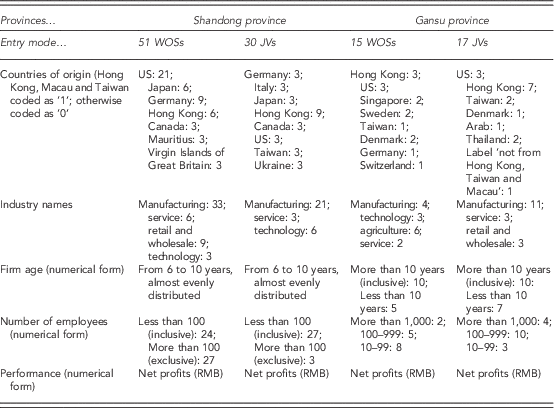
Table 1 presents information for mode choices in each province. In Shandong Province, US firms dominate the sample and show a preference for the WOS mode. This conforms to the theoretical prediction that in a developed market, foreign firms with strong capabilities are more likely to select the WOS mode to maximize their performance (Goodman, Reference Goodman2013). In Gansu Province, subsidiaries with JV mode are mainly from adjacent territories (i.e., Hong Kong and Taiwan), which demonstrates that geographically proximate multinationals are more familiar with the local environment and accordingly adapt their mode choices (Goodman, Reference Goodman2013). In Shandong, WOSs tend to be bigger than JVs, while the opposite is true in Gansu. In Shandong where market size is high and institutions are stable, larger subsidiaries with higher capabilities can better optimize profits. Yet, in Gansu where local institutions are less stable, it might be that big-sized subsidiaries vis-a-vis small-sized ones are more likely to partner with local firms to protect internal resources from being leaked to others.
Data summary for foreign subsidiaries in Shandong and Gansu

Note. JV=joint venture; RMB=Renminbi; WOS=wholly owned subsidiary.
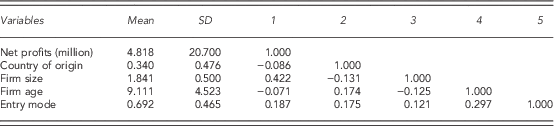
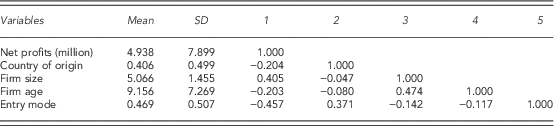
Tables 2 and 3 present the descriptive statistics and correlation matrix for the key variables in each province. It shows that the correlation between any two variables and pair-wise correlations are not excessive. We also checked multicollinearity and normality and found no violation. The homoscedasticity assumption is, however, violated so we employed robust standard error to solve this problem.
Descriptive statistics and correlations for Shandong

Descriptive statistics and correlations for Gansu

Regression analysis and hypotheses testing
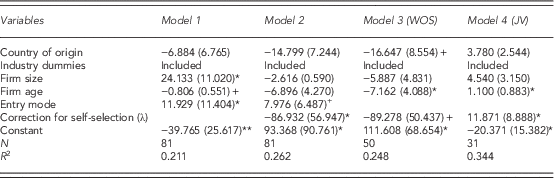
Table 4 reports the results of ordinary least square regression with Heckman two-stage model for Shandong Province. Model 1 is the baseline model with all variables but does not include self-selection parameter. Model 2 adds the self-selection parameter λ, which is statistically significant (p<.05). This suggests that multinational managers purposefully select those mode choices that can help their subsidiaries perform better. However, the marginal significant effect (p<.1) of mode choices on performance weakens but does persist marginally after controlling for the self-selection. This indicates that self-selection does have an impact on both mode selection and performance, but the effect of entry mode choices on performance is to some extent independent of the self-selection issue. Model 3 and 4 present the performance model results for firms that choose to enter by WOS mode. The significant coefficient estimates (Model 3 p<.1 and Model 4 p<.05) indicate that the predicted performance for firms that enter by WOS is greater than the predicted performance for all firms with equivalent observable characteristics if they had selected to enter by WOS mode. In other words, unobservable characteristics that affect entry mode choice also affect performance.
Results for Shandong

Notes. JV=joint venture; WOS=wholly owned subsidiary.
+p<0.1; *p<.05; **p<.01; ***p<.001, two-tailed test, robust standard erros in parentheses; industry dummies included.
To test Hypothesis 1, the model estimates in Model 3 and 4 of Table 3 can be used to assess the superiority of one entry mode versus the other. Following Shaver (Reference Shaver1998), we multiplied the nonfirm coefficient estimates in Model 3 by the vector of firm attributes for the subsample of WOS mode. It allows us to calculate whether or not an entry is predicted to performance. The predicted performance for WOS mode is 62,538 (i.e., average predicted value of performance) and is reported on the top left cell of Table 5. In addition, we assessed the predicted performance of foreign entries by JV had they entered by WOS. We did this by multiplying the coefficient estimates in Model 3 by the vector of firm attributes for the subsample of JV. We found that the predicted performance is 7,418.35 (top right cell of Table 5).
Results for Gansu

Notes. JV=joint venture; WOS=wholly owned subsidiary.
+p<0.1; *p<.05; **p<.01; ***p<.001, two-tailed test, robust standard erros in parentheses; industry dummies included.
We employed the JV estimates (Model 4) in the same manner to assess the predicted performance of JV mode and the predicted performance of WOS entries had they entered by JV mode. We multiplied the estimates of JV performance by the vector of firm attributes for JV mode, and it reveals a predicted performance of 224.07 (bottom right cell of Table 5). The predicted performance of WOS entries had they entered by JV is 1,189.00 (bottom left cell of Table 5).
These estimates allow us to compare the predicted performance between WOS mode and WOS mode had they entered by JV mode. The left column of Table 6 indicates that entries by WOS mode are significantly more likely to perform better than if they had chosen to enter by JV mode (62,538 vs. 1,189, p=.024). The interpretation is that foreign investments that chose to enter by WOS mode performs better than if they had chosen to enter by JV mode. Similarly, the right-hand column of the table indicates that the firms that entered by JV mode perform worse than if they had entered by WOS mode (7,418.35 vs. 224.08, p=.047). Therefore, Hypothesis 1 is supported.
Predicted values from probit models for Shandong

Note. JV=joint venture; WOS=wholly owned subsidiary.
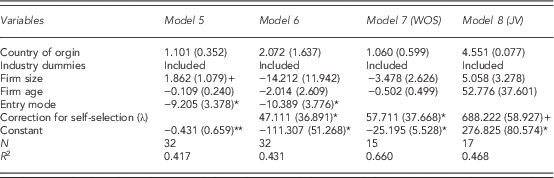
Table 6 reports the results of ordinary least square regression with Heckman two-stage model for Gansu Province. Model 5 is the baseline model without the inclusion of self-selection parameter. Model 6 adds the self-selection parameter λ but the results still hold (p<.05). This also suggests that self-selection does have an impact on both mode selection and performance, but the effect of entry mode choices on performance is to some extent independent of the self-selection issue. To test Hypothesis 2, we employed the same procedure. The significant estimates (p<.05) in Model 7 and 8 indicate that the predicted performance for firms that choose to enter by JV mode is greater than the predicted performance for all firms with equivalent observable characteristics if they had selected to enter by JV mode. The left column of Table 7 indicates that entries by WOS mode perform significantly worse than if they had chosen to enter by JV mode (106.44 vs. 5,449.85, p=.035). The interpretation is that foreign investments that chose to enter by WOS mode performs worse than if they had chosen to enter by JV mode. Similarly, the right-hand column of the table indicates that the firms that entered by JV mode perform better than if they had entered by WOS mode (836,479 vs. 16,334.08, p=.018). Thus Hypothesis 2 is supported.
Predicted values from probit models for Gansu

Note. JV=joint venture; WOS=wholly owned subsidiary.
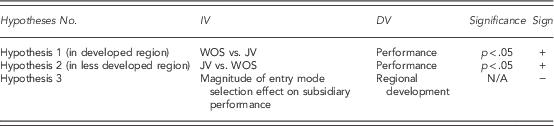
To test Hypothesis 3, we compare the coefficients of entry mode choices after controlling for the self-selection parameter. Model 2 and 6 provide such evidence. The coefficient of mode selection in Gansu is larger than that in Shandong, and both are statistically significant (p<.05). This is consistent with Hypothesis 3, namely the significance of mode choice is smaller in developed subnational regions than in less developed ones. Table 8 summarizes the results for all the hypotheses.
Summary of results

Note. DV=dependent variable; IV=independent variable; JV=joint venture; WOS=wholly owned subsidiary.
DISCUSSION
This study examines the effect and significance of entry mode choices to subsidiary performance in different subnational regions in a host country. It tests the propositions that subsidiaries with WOS mode outperform subsidiaries with JV mode in developed regions; foreign subsidiaries with JV mode outperform subsidiaries with WOS mode in less developed regions. Mode choice is more significant to multinationals in less developed regions than in developed regions. Our results support these propositions, indicating that the influence and the direction of the association between entry mode choices and financial performance differ across subnational regions. These findings have some important implications for entry mode research, subnational heterogeneity literature and investment decisions.
With respect to the contribution, first, we go beyond prior studies (e.g., Meyer & Nguyen, Reference Michailova and Worm2005; Goodman, Reference Goodman2013) which test the antecedents of mode by examining the performance implications of mode choices at subnational level. To our knowledge, our study serves as the first study investigating mode–performance relationship at the subnational level. The key implication and theoretical contribution that our study makes is the direction and the influence of the association between entry mode choices and financial performance across subnational regions. By direction we mean whether WOSs perform better than JVs in developed regions while JVs have higher performance in less developed regions. By influence we mean whether the impact of entry mode selection on subsidiary performance is smaller in developed subnational regions than in less developed regions. This means entry mode matters more to subsidiary performance in less developed regions than in developed regions. Overall, subnational heterogeneity alters the effect of mode selection on subsidiary performance.
Moreover, we move beyond few studies examining entry mode at subnational level by suggesting that the theoretically suggested mode choices (i.e., WOS mode in developed regions while JV mode in less developed regions) by prior studies (e.g., Meyer & Nguyen, Reference Michailova and Worm2005; Goodman, Reference Goodman2013) can in fact be beneficial to subsidiary performance. This study thus directly respond to Goodman’s (Reference Goodman2013) and Wu et al.’s (Reference Wu, Muller-Kahle, Arora and Leseane2013) call for more entry mode studies at subnational level.
Our finding that WOSs outperform JVs in the developed subnational regions in China is consistent with Chen (Reference Chen2012). However, Chen (Reference Chen2012) does not focus on subnational regions. Hence, our study goes beyond prior studies by reconciling inconsistent findings of mode–performance relationship.
Furthermore, we reconcile mixed findings regarding the effect of entry mode selection on subsidiary performance, using China as the reference host. Some scholars have found that JVs outperform WOSs in China (e.g., Chen, Reference Chen2012) while others suggest the opposite (e.g., Wu et al., Reference Wu, Muller-Kahle, Arora and Leseane2013). Factors such as international experience, the presence of local complementary assets (Chen, Reference Chen2012) and subsidiary industry (Teng, Reference Teng2004) have been cited as influential in reconciling the mode–performance relationship. A recent study by Chang, Chung, and Moon (Reference Chang, Chung and Moon2013) tests the influence of industry. Our study proposes that subnational heterogeneity, in terms of regional development, can also play a part (Chen Reference Chen2012; Martin, Reference Martin2013; Wu et al., Reference Wu, Muller-Kahle, Arora and Leseane2013).
This study also contributes to literature on subsidiary performance by enriching our understanding of the antecedents to subsidiary performance. Prior studies have largely overlooked the contextual effect of the relationship between subnational effects and subsidiary performance. Indeed, some scholars (Chan, Makino, & Isobe, Reference Chan, Makino and Isobe2010; Beugelsdijk & Mudambi, Reference Beugelsdijk and Mudambi2013; Ma, Tong, & Fitza, Reference Ma, Tong and Fitza2013) stress the need to explore conditions impacting on the effect of strategic decisions on subsidiary performance. Our findings directly address that call by indicating that subnational location influences the outcome of multinational strategy (i.e., entry mode selection) in terms of subsidiary performance. In doing so our findings make a unique contribution to the literature on subsidiary performance by suggesting a new interaction effect, namely subnational location and entry mode selection, as the antecedents to subsidiary performance. This suggests that subsidiary performance involves complicated strategic decisions and variations in host country context that need to be carefully investigated.
Finally, we add to the general picture of studies on mode–performance by suggesting that previous findings that there is a most profitable mode choice are too simplistic. Rather, mode–performance linkage can vary across a single nation-state or across different subnational regions. Therefore our study concludes that it is geographical variations within a single host country determine different mode–performance relationships.
Limitations, future directions and practical implications
This study has some limitations that suggest future research directions. First, this study relies on relatively few observations and variables collected. We acknowledge this limitation and suggest that the representativeness and generalization of the findings have to be interpreted with caution. Future studies may fruitfully examine such effect by collecting more observations and variables interacting with managers through localized types of connections, such as use of Guanxi in China and that of Blat in Russia, which gives scholars additional possibility to collect ideal information (Michailova & Worm, Reference Mohamad and Hoshino2003).
The second limitation is the selected choices of entry mode. That is, the study draws on only the most popular two choices, WOSs and JVs (Brouthers & Hennart, Reference Brouthers and Hennart2007). Managers of multinationals have other alternatives, and more mode choices should be included in the future to reflect this reality.
Third, in countries where regions are broadly similar, regions might differ from one another in only a subset of developmental dimensions. In these cases, it would be important to use higher resolution measures of subnational variation in development. However, since our sample is China, where subnational heterogeneity is high and Eastern regions are much more developed than Western regions in across all dimensions (Ma, Tong, & Fitza, Reference Ma, Tong and Fitza2013), we found it safe to use a more holistic term. Our findings may be indicative of trends between other east and west regions in China. Future studies using other national settings can examine how multinational managers weigh different subdimensions with respect to their mode selection.
Fourth, to observe long-term effects of mode choices on performance, future studies might attempt a longitudinal study using panel data. Finally, future studies may provide novel insights in seeking to replicate our findings focussing on firms from emerging markets. No study has directly examined emerging MNEs’ mode choices at subnational level in a host country and the performance implications mode choices have in that region. Our findings yield several policy implications. To maintain local attractiveness for FDI, regions should attend to local infrastructural development, and institutional governance, reduce foreign investment taxes where feasible, encourage labour mobility, and be attentive to investor’s need for specialized local knowledge. This could encourage foreign multinationals with advanced technologies and know-how to enter via a higher value WOS (Ang, Benischke, & Doh, Reference Ang, Benischke and Doh2015).
For managers the key practical implication is the suggestion that subnational location-specific advantages and disadvantages need to be assessed in overseas investment decisions. It is also worth noting that we reproduce the finding of Brouthers (Reference Brouthers2013) and Brouthers, Brouthers, and Werner (Reference Brouthers, Brouthers and Werner2003) that theoretically derived mode choices do seem to help subsidiaries perform better. It is likely that China’s development will lead to a rising prominence of Western and Northern provinces. China’s Eastern regions’ share of inwards FDI fell from about 90% in 1992–2002 to about 70% in 2012 (Granneman & van Dijk, Reference Granneman and van Dijk2015). Moreover, McKinsey predicts about 40% of China’s middle class will come from these provinces by 2022 (Barton, Chen, & Jin, Reference Barton, Chen and Jin2013). Multinationals’ entry mode and other strategies in China should be responsive to differences between these regions and Eastern provinces.
CONCLUSION
Prior studies on entry mode, over the last three decades have largely ignored whether the impact of entry mode on subsidiary performance may vary at subnational level. With samples from two developmentally-differentiated regions in China, our study fills this gap by demonstrating that different mode choices vary in profitability across subnational regions, and their magnitude of impact also differs across regions. A further contribution is that it is insufficient to investigate entry mode at national level as done by prior studies; subnational regions, instead, also matter to multinationals’ mode selection and subsidiary performance in a host country. Overall, our study contributes to entry mode research and provides valuable suggestions to managers in practice.
Acknowledgement
The authors would like to thank all attendants from the University of Auckland and European Academy of Management Conference, 2016 for helpful comments on earlier versions of this manuscript. The authors are also grateful to the Journal Editor Tui McKeown and two anonymous reviewers for their insightful comments. A special thank goes to our internal government source who helped collect the data. The article has not been previously published and that it is not currently under consideration elsewhere. All authors have read and approved the paper.