I. HUME AND HOBBES
Russell Hardin is a man with a mission. In his book on Hume, he seeks to convince us that Hume was an acute and profound social and political theorist or proto-social scientist, in the face of what he takes to be widespread scepticism about Hume's credentials on this score, as represented by Barry Stroud's assertion that, if Hume's ‘contributions are to be judged as part of the empirical science of man’, they ‘will appear ludicrously inadequate and there will be no reason to take him seriously’.Footnote 1 My primary objective here is to assess Hardin's claim for the originality and fecundity of Hume's ideas, especially in relation to what Hardin calls ‘the problem of social order’. According to Hardin, Hume's solution to this problem, which rests on ‘convention and slow evolution. . . fails to convince many people, in many cases perhaps because they have not understood the analysis of convention’.Footnote 2 I shall suggest, however, that Hume has to bear part of the responsibility for the difficulties readers have found in understanding him because he employed two sharply different accounts of convention without distinguishing between them. Of these two, Hardin attributes one to Hume and claims that is the correct one for the explanation of social order. I shall defend the view that the other is the one that was predominantly held by Hume and is also the right answer.
With regard to originality, Hardin concedes that ‘Hume has many often striking affinities to Hobbes’,Footnote 3 and cites Hobbes as Hume's only precursor in the analysis of social order.Footnote 4 But I believe that Hume's originality is greatly overstated by Hardin, at the expense of Hobbes. The problem of social order is how to create and maintain a peaceful and productive society, with stable possession of property and high levels of obedience to government. There are, Hardin says, three possible solutions. The first two are: ‘(1) draconian force, as represented by Hobbes, [and] (2) shared values, as represented by many moral sense theorists in Hume's time, many religious philosophers, Talcott Parsons, and contemporary communitarians’.Footnote 5 Hardin does not name names, but Michael Walzer and David Miller would seem to fit the bill. So would Rawls: the ‘well-ordered society’ of A Theory of Justice is one ‘in which everyone accepts and knows others accept the same principles of justice’,Footnote 6 and the later overlapping consensus still requires agreement on the principles, driven by a shared sense of the value of the political.Footnote 7 The third solution is ‘coordination on order as mutually beneficial even for people whose values may be widely varied’, which was ‘Hume's unique invention’.Footnote 8 I shall devote the next section to this interpretation of Hume. Before that, I want to make a few remarks about Hobbes's solution to ‘the problem of order’ and the relation between Hobbes and Hume.
I believe that it is a travesty to identify Hobbes with a position in which social order depends solely on ‘draconian force’. Hume undeniably said that ‘as FORCE is always on the side of the governed, the governors have nothing to support them but opinion. It is on opinion only that government is founded.’Footnote 9 But Hobbes was equally aware of the fragility of political power and for that reason devoted half of Leviathan – the third and fourth of its four parts – to refuting religious ideas inimical to the authority of an absolute sovereign. ‘If [the sovereign] give away the government of Doctrines, men will be frighted into rebellion with the feare of Spirits.’Footnote 10 The sovereign also needs control over political doctrines, as is shown by the way in which the widespread belief that power could be divided between king, lords and commons contributed to the Civil War. ‘Except the vulgar be better taught than they have hitherto been’, belief in the division of powers, with its destructive effects, will resurface whenever the lessons of the last breakdown of order (such as the Civil War) have been forgotten.’Footnote 11
Again, Hume certainly says that the stability of government rests heavily on the shared belief among the subjects that it has a ‘right to power’.Footnote 12 But Hobbes matches this by saying that the power of the sovereign rests (where it is stable) on a shared belief among its subjects that they have a moral obligation to obey it. Hardin takes issue with this interpretation, saying that ‘many and maybe even most scholars. . . suppose [Hobbes] argues that we are inherently morally obligated to obey our sovereign because we promised or agreed to when we entered the social compact’.Footnote 13 But Hardin's attempted refutation of these scholars is unconvincing because it rests on a misinterpretation of what Hobbes says about the obligation to obey a sovereign by acquisition. Hardin's error is evident from his describing a sovereign by acquisition as a matter of ‘imposition’ as against ‘compact’, where ‘compact’ is taken to be the origin of a sovereign by institution.Footnote 14 But there is a moral obligation to obey a sovereign by acquisition too. It also derives from a ‘compact’, but this time vertically between subject and sovereign rather than horizontally among the subjects-to-be as in the case of a sovereign by institution.
A Common-wealth by acquisition, is that, where the Sovereign Power is acquired by Force; And it is acquired by force, when men singly, or many together by plurality of voyces, for fear of death, or bonds, do authorise all the actions of that Man, or Assembly, that hath their lives and liberty in his Power.Footnote 15
The only difference, then, is that a sovereign by institution is set up by a covenant entered into by the future subjects out of fear of one another, whereas an existing sovereign gains new subjects by their entering into a covenant with it out fear of what it can do to them.
It is not therefore the Victory that giveth the right of Dominion over the Vanquished, but his own Covenant. Nor is he obliged because he is Conquered; that is to say beaten, and taken, or put to flight; but because he commeth in, and Submitteth to the Victor.Footnote 16
This makes it clear that in both cases there is an obligation to obey the sovereign that arises from covenant. The only difference lies in the identity of the parties to the covenant.
Contrary to what Hardin claims, Hobbes is not ‘ambivalent or confused’ about the meaning of ‘obligation’ in Leviathan. The confusion is Hardin's and arises from his utter unwillingness to take on board the definition of obligation that Hobbes provides and then sticks to faithfully, according to which an obligation arises from the voluntary act (which counts as voluntary even if entered into out of fear) of renouncing or transferring a right.Footnote 17 ‘The mutual transferring of Right, is that which men call CONTRACT.’ And a species of contract is a covenant, which occurs where one party ‘deliver[s] the Thing contracted for on his part, and leave[s] the other to perform his part at some determinate time; and in the mean time to be trusted’.Footnote 18 Hence, Hardin is simply wrong to say that for Hobbes
any obligation that you or I have to [a sovereign by institution] follows from its capacity to enforce its will once it is in place, not from the way it has come into being. Indeed, Hobbes does not think we are morally bound, and obligation is the wrong word unless its meaning is that we are merely coercively obliged to be obedient, so that it is in our interest.Footnote 19
On the contrary, Hobbes says that we are obliged (morally obliged if you like the terminology) to obey the sovereign in virtue of our covenant, either with our fellow subjects or the sovereign, depending on the way in which obligation to obey arises. Thus, it is completely mistaken to hold, as Hardin does, that there is nothing to Hobbes's answer to the question ‘Why should I obey the sovereign?’ than an appeal to ‘draconian force’.Footnote 20
Where Hobbes and Hume do differ, and Hume scores, is in their views of the possibility of peaceful and harmonious social interaction that is not imposed by the government. Especially in the Enquiry, Hume goes on at some length about the various rules that arise without any control or direction by government to make social interactions enjoyable and harmonious. ‘The laws of good manners [are] a kind of lesser morality, calculated for the ease of company and conversation. . . . Everything, which promotes ease, without an indecent familiarity, is useful and laudable’.Footnote 21 Politeness is clearly a virtue that rests on convention, since the notion of a polite action abstracted from its context in the ‘laws of good manners’ is unintelligible. There are also rules ‘in societies for play’, which are conventional (‘in a great measure . . . capricious and arbitrary’), while ‘waggoners, coachmen, and postilions have principles, by which they give the way; and these are chiefly founded on mutual ease and convenience’.Footnote 22 Hume does not mention the rule of the road (drive on the left or drive on the right), which Hardin takes as the paradigm of a coordinating convention. (Before the advent of the turnpike, were roads so narrow that the only issue between vehicles was which one pulls to the side when two of them meet?) But Hume does mention a pedestrian analogue: ‘the right-hand entitles a man to the wall, and prevents jostling, which peaceable people find very disagreeable and inconvenient’.Footnote 23
Hume need not be taken to mean that such rules could be maintained in a Hobbesian state of nature. The law still has to be in the background to inhibit the escalation of quarrels about marked cards into shoot-outs, as happened in the Wild West (or at any rate in the Hollywood take on it). But with basic security in place, a whole mass of rules, many of them customary, can be operative without any state involvement. ‘Common interest and utility beget infallibly a standard of right and wrong among the parties concerned’, as Hume sums it up.Footnote 24 All of these complex institutions of civil society are missing from Hobbes's analysis.
Hardin draws a contrast between Hume and Hobbes along somewhat different lines.
It is sometimes noted that major philosophers, such as Kant, have a moral theory that does not lead to a political theory or, like Hobbes, they have a political theory that does not build on a moral theory. Hume is distinctively different because his moral and political theories are cut from a single cloth. The differences between the two are essentially a matter of scale or numbers involved.Footnote 25
To cash this out, on both the micro and macro scale, it is equally the case that for Hume virtues are those character traits that conduce to utility, either of their possessor or of others. Now it is true that Hobbes does not have a political theory that builds on a moral theory, but Hardin does not claim that for Hume either. Rather, Hume has the same theory for the small scale (e.g. promise-keeping) and the large scale (e.g. respecting others’ property). Hobbes chooses not to address small-scale interactions explicitly: he has only two categories of ‘laws of nature’, those that are ‘a means to the preservation of men in multitudes’ and ‘other things tending to the destruction of particular men: as Drunkenness and all other parts of Intemperance’, which he says are ‘not pertinent enough to this place’.Footnote 26 But Hobbes, just as much as Hume, has a unified theory for interactions, in the sense that he brings to bear a single criterion for all rules, which is their prospective contribution to peace and prosperity.
In fact, if we look at Hobbes's ‘laws of nature’, we can discern a nascent theory for small-scale interactions there, which could easily have been developed. Thus, for example, the fourth law of nature is: ‘That a man which receiveth Benefit from another of meer Grace, Endeavour that he which giveth it, have no reasonable cause to repent of his good will’.Footnote 27 General observance of this in groups of any size (including dyads) would surely encourage ‘benevolence or trust: [and] consequently. . . mutual help’, as Hobbes says it will, sovereign or no sovereign. Again, Hobbes's fifth law is ‘That every man strive to accommodate himself to the rest’, and this is the essence of polite behaviour.Footnote 28 The next three, which require willingness to pardon, caution in seeking revenge and care in not showing contempt for others, are in just the same way entirely appropriate to small-scale relations. My conclusion is therefore that Hume and Hobbes both had scale-independent criteria, of a roughly similar kind.
II. COORDINATION, COOPERATION AND CONVENTION
The third of Hardin's theories of social order is ‘coordination on order as mutually beneficial’.Footnote 29 Hardin says that the relevant concept of convention was clarified only when David Lewis published his book Convention,Footnote 30 and that ‘it is clear that the meaning [Hume] has in mind is that of Lewis's analysis’.Footnote 31 But he does not spell out what that meaning is. A simplified version of Lewis's final definition (which is all we need) runs as follows:
One of my defining conditions for the conventionality of a regularity R regarding choice of action by agents in a situation S has been: ‘In any instance of S among members of P [some group], everyone prefers to conform to R on condition that the others do, since S is a co-ordination problem and uniform conformity to R is a coordination equilibrium in S.’Footnote 32
Elsewhere he writes ‘A coordination equilibrium [is] a combination [of different people's actions] in which no one would have been better off had any one agent alone acted otherwise, either himself or someone else.’Footnote 33 By taking over Lewis's conception of convention, Hardin is thus committing himself to the claim that virtues such as justice, fidelity and allegiance, whose value depends on convention, represent coordination equilibria. For this reason, he takes as the paradigm of a convention the rule of the road. This is also one of Lewis's eleven sample coordination conventions.Footnote 34 Hardin describes this as ‘the rare case. . . of an ideal type that is actually instantiated in the world’, and he warns us that Hume's ‘explanations of social practices and social order’ will have to ‘allow for a lot of slack and for some degree of failure to follow the convention that governs the behavior of most of us’.Footnote 35 I propose instead that the problem of social order (notably the stability of property and government) is not solved by a coordination convention at all.
Does Hume agree with Hardin that social order (primarily stable property and government) rests on a coordination convention? Yes and no. In favour of the position that he does agree is the way in which Hume immediately goes on from introducing justice (respect for others’ possessions) as a convention to what are indubitably coordination problems, presenting them as illustrations of the same idea:
Thus, two men pull the oars of a boat by common convention for common interest, without any promise or contract: thus gold and silver are made the measures of exchange; thus speech and words and language are fixed by human convention and agreement.Footnote 36
These three examples are such paradigmatic cases of coordination conventions that they are also included in Lewis's list of sample coordination conventions.Footnote 37 What makes these into coordination cases is that every single transaction is mutually advantageous. The two men may never expect to meet again, but if it takes two men to row the boat (because the boat is configured so that two people have to sit side by side and take an oar each) and they have a common destination, it is a simple matter to agree that they will join forces. Similarly, a would-be seller will fail if he accepts only currency that nobody has and a would-be buyer will fail if he offers only currency that nobody uses. Assuming a trade is mutually advantageous, buyer and seller have a common interest in fixing on the same currency. And if you want to communicate with somebody, you had better speak (or sign) in some language that the other person understands. But again the mutual advantage is fully contained in a single transaction: you may have no wish to strengthen the language the other person speaks and may even wish that it would die out. Now contrast all this with what Hume says about justice, immediately before introducing these three examples:
if it be allowed . . . that the particular consequences of every particular act of justice may be hurtful to the public as well as to individuals; it follows that every man, in embracing that virtue, must have an eye to the whole plan or system, and must expect the concurrence of his fellows in the same conduct and behaviour. Did all his views terminate in the consequences of each act of his own, his benevolence and humanity, as well as his self-love, might often prescribe to him measures of conduct very different from those which are agreeable to the strict rules of right and justice.Footnote 38
Hume could hardly make it plainer, in the absence of the actual vocabulary of game theory, that he is here making justice a cooperative convention in an indefinitely iterated prisoner's dilemma.
Let me explain. A prisoner's dilemma is a game with the payoff structure laid out in figure 1. Played once, there is only one equilibrium, D/D (both players defect): if the Column player chooses C, the Row player (whose payoffs are on the left in each cell) gets 3 rather than 2 by playing D; and if the Column player chooses D, the Row player gets 1 rather than O by playing D. Of course, C/C is better for both than D/D, but neither has a self-interested reason for choosing C. (Contrary to a surprisingly common idea, this is not a question of trust: even if Column has already chosen C, Row is still ahead playing D.) In a one-shot game, then, defection is a dominant strategy. But this fails to carry over to indefinitely iterated plays, because what each player does can be made contingent on what the other player(s) did previously. We can now understand a cooperative convention to exist when a convention to play the cooperative move in an indefinitely iterated prisoner's dilemma is established among the members of a group.
Prisoner's Dilemma
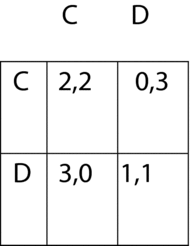
The most compelling way of showing the difference between a coordination convention and a cooperative convention is as follows. Where a coordination problem exists, it is advantageous to any one agent to play C where the other parties all play C, regardless of any expectations about what the other player(s) will do in future. But where a cooperative problem exists, it is advantageous to any one agent to play C only if that agent has a well-founded expectation that what he or she does this time will change what the other player(s) will do in future. In an indefinitely iterated prisoner's dilemma (which is to say a cooperative problem), it is always better to play D if you do not believe that what you do will change the future behaviour of the other player(s). Thus, in a two-person case, if the other player will play C regardless, D/C beats C/C, and if the other player will play D regardless, D/D beats C/D. Once we take away ‘the shadow of the future’, the iterated game collapses into a series of one-shot plays. In a cooperative problem, the cooperative behaviour of others is always a potential opportunity to be exploited by defecting. By contrast, if all others play the cooperative move in a coordination problem, cooperating myself is unconditionally advantageous to me. There is simply no room for the idea of taking advantage of others’ cooperation.
The obvious difficulty for Hume is this: somehow he has to convince us that, when faced with a cooperation problem, acting in accordance with the ‘strict rules of right and justice’ really does without any exceptions best serve the interests of the actor. In the case of a two-person prisoner's dilemma, this is not too problematic. It is well known that if both parties play a tit-for-tat strategy, for example, they will normally find themselves in a cooperative equilibrium. That is to say, if the first party plays C and thereafter each follows a C with another C and a D with another D, each will serve his own interests as well as can be hoped for by playing C every time. Following a C with a D (the dominant strategy in a one-shot play) will always reap an immediate gain, but risks bogging down the interactions of the parties in a long (perhaps indefinite) series of Ds from one party followed by Ds from the other.
Hume in fact provides an example to illustrate the virtues of tit-for-tat. This is the case of two farmers whose corn ripens at different times. If they cooperate on both harvests, they will both get their crops reaped. But this will not happen if they take no thought for the morrow because they will not cooperate. The farmer whose crops ripen later will not risk losing his labour, which is what will happen if the other fails to reciprocate when the time comes. As a result, the cooperation will not get off the ground and they will both lose (part of) their crops. But things go well if ‘I learn to do a service to another without bearing him any real kindness; because I forsee, that he will return my service, in expectation of another of the same kind.’ So, he is in turn ‘induc'd to perform his part, as foreseeing the consequences of his refusal’.Footnote 39
Scale matters critically in cooperative contexts. For example, two neighbours with a field in common will be able to drain it simply by each indicating to the other a willingness to cooperate. The idea will, obviously, be that neither will carry on digging unless the other digs as well. ‘But ‘tis very difficult, and indeed impossible that a thousand persons shou'd agree in any such action.’Footnote 40 One reason Hume gives is the difficulty of planning and executing the work. But this could be met if the thousand people chose someone to plan the drainage scheme, and the problem of executing it could be solved by collecting money from each rather than requiring all thousand to take part in the work. But that brings us to the other impediment: the free-rider problem. Hume says that ‘each seeks to free himself of the trouble and expense and wou'd lay the burden on others’.Footnote 41 The only solution here is a state, with its power to fund public projects by taxation and arrange for them to be executed: ‘political society easily remedies both these inconveniences. . . . Thus bridges are built; harbours open'd; ramparts rais'd; canals form'd; fleets equipped; and armies disciplined; every where by the care of government.’Footnote 42
Although Hardin treats public goods cases such as these as collective action problems – n-person prisoner's dilemmas – he distinguishes them, as we have seen, from the stability of property and government, which he categorizes as coordination problems. But Hume recognizes, I believe, that these are just as much prisoner's dilemmas – cooperation problems – as is the provision of public goods. Justice is introduced by Hume with a two-person case of cooperation in respecting the possessions of one another. Cooperation here depends on something like mutual tit-for-tat strategies and these plausibly produce the cooperative outcome over time.
I observe, that it will be for my interest to leave another in the possession of his good, provided he will act in the same manner with regard to me. He is sensible of a like interest in the regulation of his conduct. When this common sense of interest is mutually express'd, and is known to both, it produces a suitable resolution and behaviour.Footnote 43
In contemporary terminology, the players have common knowledge that each will pursue a tit-for-tat strategy. Hume thinks that this line of reasoning can be extended to groups larger than a dyad, and makes the very strong claim that ‘even every individual person must find himself a gainer on balancing the account, since, without justice, society must immediately dissolve’ and collapse into a Hobbesian state of nature.Footnote 44 If a single act of injustice would precipitate all that, there would be an overwhelming reason for refraining from committing any such acts. But Hume concedes that ‘it may be ask'd, how any disorder can ever arise in society’ if this account is correct.Footnote 45 He needs to answer that question because he invokes the breakdown of the justice convention without enforcement to provide an explanation of our need for government, with its corresponding virtue of ‘allegiance’.
To the imposition then, and observance of these rules [of justice, men] are at first mov'd only by a regard to interest; and this motive, on the first formulation of society, is sufficiently strong and forcible. But when society has become numerous, and increas'd to a tribe or nation, this interest is more remote; nor do men readily perceive, that disorder and confusion follow upon every breach of those rules, as in a more narrow and contracted society.Footnote 46
Hume presents this as a cognitive issue, a kind of perceptual error: a failure to assess accurately the effects of an individual act of theft on the general stability of property. But as soon as a society becomes large, it really does become true that a single act of theft – or even a number of them – will not bring the whole system crashing down. But even if we were to accept Hume's version, and say that a lot of people are liable to calculate incorrectly, we would still get the result that the justice convention collapses whenever we have a large group. How large is ‘large’? If a thousand men could not drain a meadow in the absence of a state, it seems to me highly doubtful that we would need to get to anything like the size of a ‘tribe or nation’ before the justice convention failed to bring about stability of possessions. The solution, as with public goods, is the state. Thus, the origin of civil government and allegiance lies in the advantage to all in having ‘civil magistrates, kings and their ministers, our governors and rulers’ who are satisfied with the status quo, so they are ‘not only induc'd to observe [the] rules [of justice] in their own conduct, but also to constrain others to a like regularity, and inforce the dictates of equity thro’ the whole society’.Footnote 47
Hume actually brings together justice and allegiance at one point, treating them as parallel cases. Government, by deciding disputes and enforcing its decisions, provides ‘security’ for possessions, which Hume describes as ‘protect[ing] men in those conventions [as those of justice], they make for their mutual interest’. Hume then adds the public goods case under the description ‘oblig[ing] them to make such conventions, and forc[ing] them to seek their own advantage, by a concurrence in some common end or purpose’.Footnote 48 It will be observed that Hume continues here to employ the language of convention, but once we have a rule that is enforced we have lost whatever traction the concept of convention can give us in the explanation of social order. In particular, I can see no reason why every compulsory contribution to the cost of a public good should be described as obliging taxpayers to make conventions when the whole point is that the kind of convention that enables two men to drain a meadow without enforcement has broken down. Why not simply talk about property laws and taxes?
Partly for ideological reasons (he implausibly tries to recruit Hume as a ‘forerunner of . . . Friedrich Hayek and the Austrians in social theory’),Footnote 49 Hardin is quite exercised about what he calls ‘the public-goods theory of the state’. This he takes as having two elements. One is the ‘claim that certain characteristics of public goods require that they be provided by a central agency acting on behalf of a larger group of beneficiaries’.Footnote 50 He contrasts this with the view ‘that collective provision merely has advantages over individual provision’. Hardin says of the second that ‘this is surely true in some cases’, which implies that the first claim is false.Footnote 51 But while Hardin may believe this personally, it is completely wrong as an interpretation of Hume, since he said that it was ‘impossible’ rather than merely ‘difficult’ for a thousand men to drain a meadow in the absence of government.Footnote 52 Thus, it is simply false to suggest that what Hume has to say about the capacity of states to provide public goods ‘is consistent with both the first and second claims’.Footnote 53 Hume's view is plainly that there are some benefits for which states are indispensible, and I do not see how this could reasonably be denied.
The other element in the ‘public goods theory of the state’ is explanatory: states exist because they are the solution to the problem of providing public goods for a large group.Footnote 54 Hume is clear that the initial impetus is the need to secure property rights in a large group.Footnote 55 But he is equally clear, as we have seen, that states then take on the additional job of providing public goods. Hardin complains that this idea
is circular if it is supposed that the state is a public good [the solution to a cooperation problem]. In frustration at failing to provide ourselves some public goods, we merely provide ourselves with one that then provides the one we failed to provide.Footnote 56
Hardin says that the fallacy involved is the one pointed out by Mancur OlsonFootnote 57 in The Logic of Collective Action. ‘According to this logic, I rationally contribute to the provision of a collective good only if I get more value from the bit of the collective good that my contribution buys than the contribution costs me.’Footnote 58 Thus, the two men draining the meadow each get half the value of the improved meadow, which may well make it worthwhile to contribute a half share of the effort to do the job. But if my contribution will produce only one-thousandth of the value to me of having the meadow drained, it is highly plausible, to say the least, that contributing will not look like a good deal from a self-interested viewpoint. ‘Hence, although all of us might receive a large net benefit if we all contribute, none of us may have any interest in contributing individually.’Footnote 59
What Olson explodes, then, is the fallacy that in an n-person prisoner's dilemma it is sufficient to give everyone a self-interested reason for cooperating that C/C is a higher payoff than D/D. This shows that collective action (prisoner's dilemma) problems involving large numbers of agents cannot (in the absence of special conditions that we need not enter into here) be resolved by counting on voluntary contributions to the public good in question. But the conclusion that Olson goes on to draw from this problem is that what is needed to get this sort of public good supplied is what he called ‘selective incentives’, which could be understood to include selective deterrents. These are rewards or penalties that are individualized to give each potential contributor a self-interested reason for coming through with a fair share of the cost of supplying the public good. And the paradigmatic case of an entity that can produce selective incentives and deterrents is the state. Thus, there is no vicious circle created by bringing in the state as the solution to the public goods problem, because the state is a special kind of public good: a body that provides enforcement of its own edicts. Hardin objects that ‘if the government is an ongoing resolution of a continuing society-wide prisoner's dilemma or collective action interaction, it cannot be stable, because it can be brought down by free-riding at any time’.Footnote 60 But free-riders are deterred by the power that the state provides to enable fare dodgers to be prosecuted. Public transport does not normally rely on voluntary contributions to its cost.
Hardin adds that ‘coordination is the dominant feature of stable social organization because its continuing resolution faces no. . . problems [of free-riding] and is therefore stable’.Footnote 61 This begs the question by assuming that states actually do create something that can properly be described as ‘stable social organization’. But waiving that question for a moment, we might try to unpack this argument as follows: (1) cooperative problems cannot have stable solutions; (2) social organization (e.g. the system of property and the governmental regime) is stable; therefore (3) the existence of social order proves that it cannot be the solution of a cooperative problem; and (4) by a process of elimination we arrive at the conclusion that social order must be the solution to a coordination problem. Otherwise it could not occur – at any rate in large groups.
How persuasive is the claim that social order must solve a coordination problem to account for its stability? An immediate problem that crops up even in interpreting this claim is that Hardin mixes together two different notions of stability. A solution, whether it involves a convention or not, may be stable in the sense that it secures a high level of compliance among the members of some group (call this c.s. or compliance stability). Alternatively, a solution may be stable in the sense that ‘changing [it] through spontaneous actions is commonly hard to do, because the individuals first have to coordinate with each other on switching the convention’Footnote 62 (call this i.s. or inertial stability). These two kinds of stability can form four combinations, which I number as follows:
(1) High c.s. and high i.s.
(2) High c.s. and low i.s.
(3) Low c.s. and high i.s.
(4) Low c.s. and low i.s.
The last combination is of no interest for present purposes, but the others all have examples in Hume – and in reality – in at least one kind of convention and one size of group.
(1) Lewis's coordination conventions with large numbers provide compelling incentives for compliance and are hard to change except by a political authority (as with the Swedish change in the rule of the road at 5 a.m. on 3 September 1967), or by a market leader (as with the standard time zones introduced by the American railroads).Footnote 63 If Hume is right that a group of people larger than two but smaller than a thousand could arrive at the convention of regarding one another's possessions as off-limits, they would have a compliance-stable cooperative convention. But in any but an extremely small group it seems plausible that whatever pattern of possessions had already been arrived at would also be inertia-stable. This is because permitting disputes about rival claims to possess some good or piece of land would open up a can of worms that would threaten the whole scheme.
(2) High compliance stability and low inertial stability can be found in many small-number coordination situations. Inertial stability in large-number situations is high. Thus, ‘What makes a soda fountain, coffee house or bar “in” is the existence of a convention in some social circle that it is the place to go when one wants to socialize.’Footnote 64 This coordination convention might be hard to change spontaneously, though we do know that there are cases in which what is “in” can become “out” quite fast, as with fashion in clothes. But if two people have agreed to have lunch at a certain time and place, they can change their minds quite easily and switch to a different one.Footnote 65 This combination of high c.s. and low i.s. could also hold for small-scale cooperative problems. Thus, the two neighbours would have to agree on a plan for draining the field, but they could easily agree to change it as the work progressed. This cooperation would be compliance-stable if each gave the other to understand that he would work as long as the other did and not otherwise (a form of simultaneous tit-for-tat), but its focus could be changed by agreement.
(3) Genuine coordination problems have a built-in incentive for everyone to comply with the solution regardless of the size of the group. If you refuse to trade with one or more people except in a currency they do not accept, you will miss out on the opportunity of mutually beneficial exchange; if you set your watch to some idiosyncratic time, you will miss trains and appointments; and so on. Thus, in coordination problems, there is no difficulty in securing compliance with an ongoing convention, regardless or the size of the group. It is only in cooperative problems (prisoner's dilemmas) that non-compliance becomes an issue. As the size of the society grows, the property convention becomes more subject to non-compliance, either through hope of gain (free-riding on others’ compliance) or fear of loss (the anticipation that if I alone comply amid general ‘licentiousness’ I shall become ‘the cully of my own integrity’).Footnote 66 Compliance stability is thus liable to be low in a large group. But inertial stability – as long as the convention can still be said to hold at all – will be high, since it would be extremely hard to change the form of the convention (such as the distribution of property rights) to another one by ‘spontaneous individual actions’. We witness the complete collapse of compliance stability wherever government ceases to have effective control over its territory. Somalia fits this description fairly well, and the Congo has done so to a horrendous degree in the recent past and is still subject to outbreaks of violence which the government is powerless to control. At the same time, this kind of anarchy is inertially stable in the sense that there is no way in which concerted acts by individual citizens can end it by bringing into being a government whose writ runs throughout the country.
I suggest that Hardin uses the term ‘stability’ in different senses when he says ‘Large numbers stabilize social conventions in coordination contexts’ but undercut standard kinds of cooperation in collective action contexts.Footnote 67 The sense in which the first claim is true is that of inertial stability, which we have seen increases as a function of group size in both coordination and cooperative problems. It would not be true of compliance stability because all coordination conventions are compliance-stable, regardless of size. To say (the second point) that large numbers undercut cooperation in collective-action contexts (or n-person prisoner's dilemmas generally) is not to compare like with like. For, as I have said, inertial stability increases in cooperation conventions just as much as it does in coordinating conventions. The instability here is compliance instability. Hardin is thus guilty of an equivocation, employing different senses of ‘stability’ in his two claims.
This equivocation underlies the fallacious argument mentioned earlier. This runs as follows. Stability in large-number cases can be provided only if they are coordination problems. And since states are stable, this means that they must be the solution to a coordination problem. But the way in which large numbers make states stable is that they make spontaneous individual action to change the form of government to another one very difficult.Footnote 68 This proposition would hold for inertial stability equally well if the state were the solution of a prisoner's dilemma problem. We cannot therefore deduce from anything said so far that a state must be the solution of a coordination problem. Then we have the assertion that large numbers destabilize prisoner's dilemma problems. This is true of compliance stability. But why should we accept that this refutes the idea that states are the solution to a cooperation problem? Perhaps we should say that states do suffer from varying degrees of non-compliance, ranging from some non-compliance to total non-compliance where a situation has degenerated into anarchy, and that this actually supports the conclusion that social order is a cooperative rather than a coordination problem.
If a state is the solution (to the extent that it is) to a cooperation problem, it will always be beset by the potential advantage to individuals or small groups of breaking the law. Hardin treats anybody who points to this difficulty as asking an invalid question: ‘by far the most common query or challenge is to pose a particular case in which a person is a loser from the application of the law, the rules of property or some other convention for mutual advantage’. This is, he says, ‘based on a fundamental misconception’ because
having the overall system. . . of law makes us better off than we would have been without the system of law. . . . To be a credible objection it must be formulated as a whole-cloth rejection [this should read ‘assertion’] of the idea that the chaos of an unordered society would be preferred by at least one person over a well-ordered society.Footnote 69
This is to commit precisely the fallacy picked out in Olson's ‘logic of collective action’: the idea that if all-C in a large group is better for everybody than all-D, that gives each person a self-interested incentive to play C.
No doubt it is true that ‘even a devoted thief must prefer a society that is well enough organized to produce enough to steal’.Footnote 70 But the choice between refraining from stealing and living in a society with no property worth stealing is not one that faces any individual thief in a large society, because a single act of theft (or even a whole career of theft) will not suffice to switch a society from comprehensive order to comprehensive disorder, as Hume admitted when he conceded that a ‘sensible knave’ may think that ‘an act of iniquity or infidelity will make a considerable addition to his fortune, without causing any considerable breach in the social union and confederacy’.Footnote 71 And in his essay ‘Of the Origin of Government’, Hume again says: ‘Some extraordinary circumstances may happen, in which a man finds his interests to be more promoted by fraud and rapine, than hurt by the breach which his injustice makes in the social union.’Footnote 72
The fundamental objection to Hardin's whole approach is that to make a state the solution of a coordination problem is far too good an explanation of social order. Coordination conventions have built-in self-enforcing mechanisms that give everybody a strong incentive to comply without any need for any additional enforcement. By contrast, a state has to rely heavily on its ability to call down heavy sanctions on those who break its laws or fail to pay its taxes. Even then, states achieve nothing remotely like the high levels of compliance effortlessly created by coordination conventions. A recent survey found that people in Britain admit to breaking the law several times a week on average. These are mostly traffic offences, but the clear-up rate on crimes such as car theft and burglary is extremely low, while tax evasion is estimated to cost many billions of pounds a year. At the other end of the scale from relatively law-abiding Britain there are places where social order has broken down completely, but in addition there are many other countries that suffer from a very high level of offences against property and person.
South Africa, for example, has thirty times the murder rate of Britain and has been estimated to have more violent deaths per head than any country not involved in warfare. It is a society sliding towards a Hobbesian war of all against all. In addition to the high level of ordinary crime, there have also been pogroms directed against refugees from other African states, which have killed some and made many destitute and homeless. Troops have been deployed in the townships for the first time since the end of apartheid, and the minister responsible for the police has accepted the responsibility if they shoot first and ask questions afterwards. Again, there are studies suggesting that ‘Latin America's income could be 25% higher if its crime rate, which began soaring in the 1980s, was similar to the rest of the world.’ The head of the Organization of American States has described ‘drug trafficking, kidnapping and other crimes’ as ‘an epidemic, a plague on our continent that that kills more people than Aids or any other known epidemic. It destroys more homes than any economic crisis.’Footnote 73 Across the world, William Dalrymple, in The Age of Kali, described the breakdown of social order in all its forms in the northern Indian state of Bihar:
crime is completely out of control: 64,085 violent offences. . . took place between January and June 1997. . . . According to [local editor] Sengupta, what was happening in Bihar was nothing less than the death of the state. . . . In the Patna hospital there were no bedsheets, no drugs and no bandages. The only X-ray machine in the city had been out of order for a year: the hospital could not afford to buy the spare parts. . . . Outside the capital, electricity had virtually ceased to be supplied. . . . Without power, industry had been brought to a grinding halt. No roads were being built. There was no functioning system of public transport.Footnote 74
Coming up to date, in Orissa state there is one district within which there has been ‘a two-month orgy of sectarian violence which has left at least 59 people dead, 50,000 homeless and thousands of houses and churches burnt to the ground’.Footnote 75
There is one final reflection I want to offer. While it is true that regimes are seldom overthrown by non-organized individual action, they certainly cannot be replaced by these means. They are quite frequently changed in other ways. It is quite common in Africa and Latin America for a fairly small group of military personnel to overthrow a constitutional regime or for a constitutional president to turn into a dictator by an autogolpe. This fact does not in itself point us more towards states being solutions to one kind of problem rather than the other. But if we reflect on its significance, we shall surely see how implausible it makes the idea that states are solutions to coordination problems. Nobody sheds blood over the time zone, the rule of the road, or the system of weights and measures, even if they arouse some degree of disagreement. Political power is only at the extreme margins concerned with coordination problems such as these. Control of the government enables those who hold it to enrich themselves corruptly (or in accordance with corrupt laws they have created), to channel costs and benefits to some regions and ethnic groups and away from others, and so on. Especially where other means of enrichment are scant, this power is worth fighting for. I apologize for the obviousness of these reminders, but they seem to be needed.
III. DID HUME HAVE A NORMATIVE THEORY?
The bulk of Hardin's book is devoted to the thesis that I began by stating: that Hume's social and political theory has not received sufficient credit. But Hardin goes beyond seeking to substantiate his claim that Hume's social theory is both sophisticated and in all essentials correct. He also argues that Hume's objectives in the Treatise and the Enquiry are solely explanatory: he has a ‘consistent and systematic . . . anti-normative stance’.Footnote 76 Yet at the same time, Hardin has chapters entitled ‘Value Theory’ and ‘Utilitarianism’. According to Hardin, Hume's value theory is, in the current jargon, welfarist: the only measure of value is subjective individual utility. And Hume's moral theory is utilitarian: the goodness of a state of affairs is some function of the utilities of the people in it. Hume is not an aggregative utilitarian on the lines of Bentham or Sidgwick: he has no use for the notion of a sum of interpersonally comparable cardinal utilities. According to Hardin, Hume is an ordinalist utilitarian or Paretian: situation A is better than situation B if each person has more subjective utility in A than in B (or at least some have more and none have less). I shall take this up in a moment, but the immediate issue is that these claims look awfully like asserting a first-order moral commitment made by Hume in his own right. Can the circle somehow be squared?
I do not see how this could quite be done. But if Hume were to be taken as saying that everybody is as a matter of fact a utilitarian, he could simply tag along and associate himself with everybody else, which would be pretty innocuous. Now it is true that Hume does sometimes make such a claim. In the Enquiry (where ‘utility’ plays the central role) he says at any rate ‘that the circumstance of utility, in all subjects, is a source of praise and approbation. . . . That it is the sole source of that high regard paid to justice [etc., and] inseparable from all the other social virtues.’Footnote 77 In A Dialogue he goes even further, and claims that ‘there never was any quality recommended by any one, as a virtue or moral excellence, but on account of its being useful, or agreeable to a man himself or to others’.Footnote 78 But saying that Hume is simply describing the way things are will not stand up against Hume's constant sallies at views of morality that quite obviously fly in the face of this utility-based normative criterion.
Although Hardin makes passing mention of the ‘monkish virtues’Footnote 79 he does not stop to notice that Hume's contempt for them is inconsistent with any idea of utility as the universal foundation of morality. Hume has to recognize that some people do in fact hold non-utilitarian doctrines before he can disparage them. In his strongest statement, he says that:
as every quality which is useful or agreeable to ourselves or others is, in common life, allowed to be a part of personal merit; so no other will ever be received, where men judge of things by their natural, unprejudiced reason, without the delusive glosses of superstition and false religion. Celibacy, fasting, penance, mortification . . . and the whole train of monkish virtues; for what reason are they everywhere rejected by men of sense, but because they . . . neither advance a man's fortune in the world, nor render him a more valuable member of society . . .? We justly, therefore, transfer them to the opposite column, and place them in the catalogue of vices.Footnote 80
Who are ‘we’ here? Surely Hume is associating himself with the ‘men of sense’ and says that those who extol the ‘monkish virtues’ are just plain wrong. In A Dialogue, Hume explicitly concedes that his utilitarian theory simply does not work for those who, like Pascal, ‘depart from the principles of common reason’ and are subject to ‘the illusions of religious superstition or philosophical enthusiasm’.Footnote 81 It is all very well for Hume to say that ‘an experiment . . . which succeeds in the air, will not always succeed in a vacuum’.Footnote 82 But if Hume's objective had been to explain all moral judgements, rather than to endorse some and condemn others as mistaken, he would surely have had to accept that he needed to come up with an explanation that covered all the varieties of moral judgement that are actually found in the world, whether they fit the utilitarian model or not.
Hardin concedes that ‘Hume occasionally slips into what he calls ‘panegyric’ and advocates particular moral beliefs and actions. On one occasion he virtually apologizes for the slip even while slyly defending it: ‘But I forget, that it is not my present business to recommend generosity and benevolence, or to paint, in their true colours, all the genuine charms of the social virtues.’Footnote 83 Hardin might more tellingly still have cited Hume's remarks right at the close of the Treatise, where he says that his ‘system may help us to form a just notion of the happiness, as well as the dignity of virtue.’ He goes on there to say that he ‘forbear[s] insisting on this subject. Such reflexions require a work a-part, very different from the genius of the present. The anatomist ought never to emulate the painter.’Footnote 84 But praises of the virtues are not the right place to look for Hume's breaches of his official role as a scientist dissecting the phenomenon of morality – an ‘anatomist’. My proposal is that we instead direct our attention to the many places, especially in the Enquiry, where he drops the mask and denounces what he regards as pseudo-virtues that conduce to the benefit of neither their possessor nor anyone else.
Let me now return to the question of what sort of utilitarian Hume is. Hardin has to be right in saying that when Hume talks about ‘public interest’ he never means a sum of interpersonally comparable cardinal utilities along Benthamite lines. But Hardin is saddling Hume with his own ideas when he claims that Hume's utilitarianism (ordinalist or Paretian) supports pursuing the interests of others only where there is mutual advantage, so that the actor benefits along with others. This leaves out fully half of Hume's utilitarianism: that part which covers ‘the social virtues of humanity and benevolence’ as against ‘the social virtues of justice and fidelity’.Footnote 85 Hume actually addresses the conception of morality attributed to him by Hardin when he writes that ‘those philosophers were excusable, who fancied that all our concern for the public might be resolved into a concern for our own happiness and preservation’, the excuse lying in ‘that close union of interest, which is so observable between the public and each individual’.Footnote 86 Against this, Hume says that:
we have found instances, in which private interest was separate from public; in which it was even contrary: And yet we observed the moral sentiment to continue, notwithstanding this disjunction of interests. . . . If usefulness, therefore, be a source of moral sentiment, and if this usefulness be not always considered with a reference to self; it follows, that everything, which contributes to the happiness of society, recommends itself directly to our approbation and good-will.Footnote 87
Of course, ‘the public’ and ‘society’ are only the outer limits of our altruistic appraisal. In contrasting humanity and benevolence with justice and the other convention-based virtues, Hume's examples are a parent or a friend. ‘And as the good, resulting from their benign influence, is in itself complete and entire, it also excites the moral sentiment of approbation.’Footnote 88 Hardin's difficulty in coming to terms with these virtues (‘natural’ as against ‘artificial’ in the Treatise) may have something to do with his analysis of strategic types, in which he puts ‘benevolence’ in the category of ‘Pure Conflict’.Footnote 89 This is curious, because conflict should involve an opposition of wills. It is true of course that, if I give you money that you need or help you to move house, I am disposing of money or time that I might have used on myself. But if I want to help and choose to do so, and you want my help, there is a coincidence of wills rather than a conflict. There remains a question about how far Hume thinks that people are moved to be benevolent by the thought that benevolence is a virtue (as he says they are moved at least to some degree by the thought that injustice is a vice) and how far by a direct impulse to help, as a parent or a friend, for example. But I do not see that anything much turns on this, since either way benevolence is for Hume a virtue as lustrous as justice.
IV. CONCLUSION
Coming full circle, where does all this leave Hardin's objective of calling attention to Hume's merits as a non-normative social and political theorist? This claim is, I suggest, vindicated. Without the benefit of any formal apparatus, Hume showed a remarkably sure grasp of strategic analysis. Hardin's specific argument that Hume's great contribution was to show that social order depends on coordination conventions fares less well. It is true that Hume shows a pronounced wobble in that direction immediately after introducing the idea of justice as resting on a convention by adducing as illustrations three paradigmatic examples of a coordination convention. But Hume's overall line is that justice and the other convention-based virtues rest on a cooperative convention which solves (to the extent that it does) a prisoner's dilemma problem and that states are required when a society exceeds some small size because only states can solve the large number prisoner's dilemma problems that constitute the ‘problem of social order’. However, this does not detract from Hume's merits – quite the contrary, since it is the right answer. Admittedly it makes Hume less original than Hardin would have him be, since Hobbes also held that the problem of order is a prisoner's dilemma. But I think it is fair to say that, while Hobbes is the superior writer, Hume is the more precise and subtle thinker.